Slashdot Mirror
Domain: lifeboat.com
Stories and comments across the archive that link to lifeboat.com.
Comments · 24
-
The general issue is decentralization & resile
As I discussed here (~25years ago): http://www.pdfernhout.net/prin...
"As outlined in my statement of purpose, my lifetime goal is to design and construct self-replicating habitats. These habitats can be best envisioned as huge walled gardens inhabited by thousands of people. Each garden would have a library which would contain the information needed to construct a new garden from tools and materials found within the garden's walls. The garden walls and construction methods would be of several different types, allowing such gardens to be built on land, underground, in space, or under the ocean. Such gardens would have the capacity to seal themselves to become environmentally and economically self-sufficient in the event of economic collapse or global warfare and the attendant environmental destruction. "And: http://www.pdfernhout.net/reco...
And here: http://pcast.ideascale.com/a/d...
But many others have discussed similar things, so just another voice in the choir in that sense. If Musk really reflects on these issues (other than being another Mars fanboy) he will see that there are many possible avenues to decentralization and resiliency, of which Mars is just one. As we gain knowledge and experience in creating such systems, then we can disperse farther and farther to deal with bigger and bigger possible disasters (including the ones you point out about gamma ray burst or wandering neutron stars).
More ideas in that direction: http://www.kurtz-fernhout.com/...
And by others:
http://www.luf.org/
http://tmp2.wikia.com/wiki/Mai...
http://lifeboat.com/ex/main
http://openluna.org/Also something I've been involved with, but has since became more broadly "Open Manufacturing" and the maker movement: http://openvirgle.net/
So, generation ships etc. are interesting ideas, and they all fit into a large general picture of possibilities.
Still, for all that, making the Earth work well for most everyone (zero emissions cradle-to-cradle manufacturing, better healthcare and nutrition, a global basic income, better education for all, indoor agriculture, new power sources like dirt cheap solar and hot and cold fusion, and so on) is a good first step towards knowing how to live in space, especially given we are already on what Bucky Fuller called "Spaceship Earth". So, I see no big incompatibility between trying to make the Earth work for everyone and preparing for a future where there are quadrillions of people living in self-replicating space habitats throughout the solar system and ultimately the galaxy and beyond -- perhaps even into other dimensions and realities and simulations? Of course, there are philosophical issues still about all this about meanings in life and so on.
-
The Wikipedia Bio In Full
I've never heard of this person John Bohannon.
John Bohannon is a biologist, science journalist, and dancer based at Harvard University. He writes for Science Magazine, Discover Magazine, and Wired Magazine, and frequently reports on the intersections of science and war. After embedding in southern Afghanistan in 2010, he was the first journalist to convince the US military to voluntarily release civilian casualty data. He received a Reuters environmental journalism award in 2006 for his reporting on collaborative research in Gaza. He was also involved in some controversy over an article he wrote critiquing the Lancet survey of Iraq War Casualties.
At Science Magazine, Bohannon also adopts the ''Gonzo Scientist'' persona, where he ''takes a look at the intersections among science, culture, and art -- and, in true gonzo style, doesn't shrink from making himself a part of the story. The stories include original art and accompanying multimedia features.'' As the Gonzo Scientist, Bohannon's research on whether humans can tell the difference between pate and dog food led to Stephen Colbert eating cat food on the Colbert Report.
Bohannon is probably best known for creating the Dance Your PhD competition, in which scientists from all around the world interpret their doctoral dissertations in dance form. Slate Magazine ran a profile on Bohannon and the competition in 2011. He performed with the Black Label Movement dance troupe at TEDx Brussels in November 2011, where he satirized Jonathan Swift's A Modest Proposal by modestly proposing that Powerpoint software be replaced by live dancers. Bohannon then went on to perform with Black Label Movement at TED 2012 in Long Beach.
Advisory Board - John Bohannon
While visiting the Harvard University Program in Ethics and Health, he is working on two areas of research: 1) torture --- in particular the complicity of scientific and medical workers in torture, and 2) ethical problems involved with obtaining global health data, stemming from his journalistic coverage of the controversial attempts to estimate the health and mortality of the Iraqi population since the US-led invasion.
After completing a Ph.D. in molecular biology at the University of Oxford in 2002, John focused on bioethics as a Fulbright fellow (2003 --- 2004) in Berlin.
-
Re:"Massive" DDoS attack
If you've caused them any pain it's miniscule, they've regrouped, patched a few systems, installed a couple of load balancers, whatever it is they do.
You need sufficiant bandwidth to receive all the traffic (legit and DDoS) and then sufficient hardware to return legitimate responses for the legimate traffic while dealing with the DDoS traffic. Depending on the details of the DDoS traffic it may be possible to filter it or it may have to be dealt with as if it was legitimate traffic. For a large scale DDoS attack you are unlikely to have these resources in-house so you will have to find a company (likely a content delivery network) to do it for you. Unless you are lucky enough to have someone who has the resources take pity on you then you will have to pay for these services.
And you can't just ignore a DDoS attack and wait for it to go away because your hosting provider is unlikely to let you.
The question is who will break first, the entity who has to pay for DDoS mitigation services or the entities performing the DDoS attacks. It's certainly not a forgone conclustion that the attacker(s) will break first.
-
Re:scientifically
In theory, yes. The type of design (a "waverider") places the hypersonic shockwave directly beneath the vehicle. Basically, you're surfing the shockwave. This reduces the stresses involved, improves stability and should allow considerably more control than could be achieved with the space shuttle (you have sufficient lift from a waverider to glide). Waveriders do have disadvantages - most designs only work at specific speeds, the wings have a habit of frying and they rely on cooling by radiation (only effective at high altitude).
Old wisdom on waveriders:
http://research.lifeboat.com/surf.htm
http://www.aerospaceweb.org/design/waverider/waverider.shtmlPublished theory:
http://www.waset.org/journals/waset/v79/v79-79.pdf
http://www.dept.aoe.vt.edu/~mason/Mason_f/ConfigAeroHypersonics.pdfMulti-speed waveriders:
http://www.springerlink.com/content/x75nh2154nuh5464/Amateur waverider research:
http://www.gbnet.net/orgs/staar/waveriders.htmlNB: The STAAR group beat NASA and the US DoD to the first working waverider airfoil, as noted on their site. Perhaps NASA's problem with their current design is that they're not threatening the engineers with bagpipe music.
-
Not impressed by either
I'm not really impressed by either. Wolfram made some very good software but then wrote that wretched book which was primarily a mix of either wrong ideas or unoriginal ideas. There was a strong failure to credit the work others had done with cellular automaton. I couldn't tell if that was due to his ignorance or his general self-promotional tendencies.
As to the Lifeboat Foundation I lost minimal trust in them after they got in bed with Pam Geller http://lifeboat.com/ex/boards (yes, that's Pamela "Obama is a Muslim with a Fake Birth Certificate" Geller http://en.wikipedia.org/wiki/Pamela_Geller#Birther_views). If that weren't enough they've been involved in fear mongering about the LHC http://lifeboat.com/ex/particle.accelerator.shield. There are however other groups that are dealing with exisential risk threats in a serious and useful fashion. The Future of Humanity Institute http://www.fhi.ox.ac.uk/ which is affiliated with the University of Oxford, and headed by the very bright Nick Bostrom thinks about existential risk issues in general. Meanwhile, there are organizations focusing on specific concerns. For example, the B612 Foundation http://www.b612foundation.org/b612/ is focused on dealing with detecting and dealing with large asteroids. They have the advantage of also having a very clever name. Internet cookie to anyone who can figure out why they are called that without searching.
-
Not impressed by either
I'm not really impressed by either. Wolfram made some very good software but then wrote that wretched book which was primarily a mix of either wrong ideas or unoriginal ideas. There was a strong failure to credit the work others had done with cellular automaton. I couldn't tell if that was due to his ignorance or his general self-promotional tendencies.
As to the Lifeboat Foundation I lost minimal trust in them after they got in bed with Pam Geller http://lifeboat.com/ex/boards (yes, that's Pamela "Obama is a Muslim with a Fake Birth Certificate" Geller http://en.wikipedia.org/wiki/Pamela_Geller#Birther_views). If that weren't enough they've been involved in fear mongering about the LHC http://lifeboat.com/ex/particle.accelerator.shield. There are however other groups that are dealing with exisential risk threats in a serious and useful fashion. The Future of Humanity Institute http://www.fhi.ox.ac.uk/ which is affiliated with the University of Oxford, and headed by the very bright Nick Bostrom thinks about existential risk issues in general. Meanwhile, there are organizations focusing on specific concerns. For example, the B612 Foundation http://www.b612foundation.org/b612/ is focused on dealing with detecting and dealing with large asteroids. They have the advantage of also having a very clever name. Internet cookie to anyone who can figure out why they are called that without searching.
-
Re:real survival
See also my own comments here on putting together knowledge about self-replicating infrastructre:
http://www.kurtz-fernhout.com/oscomak/
http://www.pdfernhout.net/princeton-graduate-school-plans.htmlOthers:
http://www.islandone.org/MMSG/aasm/
http://lifeboat.com/ex/mainYou might like this guy's writing starting from a charcoal furnance to make a machine shop from scrap:
http://en.wikipedia.org/wiki/David_J._Gingery -
More preparedness through SR space habitats
See: http://lifeboat.com/ex/main
Or some ideas I was working towards over two decades ago:
http://www.pdfernhout.net/princeton-graduate-school-plans.html
"Self-replicating habitats could be built in space, underwater, underground, in the desert, or elsewhere. A habitat would consist of many square miles of enclosed land used for living, farming, and recreation. Examples of such enclosures are a cluster of kilometer high geodesic domes in the desert, a collection of hundred meter diameter spheres underwater, and a ten kilometer diameter dough nut-shaped O'Neill habitat rotating in space. The land area inside the habitat would have tall trees, and grassy fields. It would be designed explicitly to seem extremely open and natural to the thousands of people living inside. Each habitat would have its own power plant, running from solar, nuclear, or ocean-thermal energy. Each habitat would have attached manufacturing facilities for processing raw materials into finished goods. The raw materials would come from the area immediately surrounding the habitat, like the sea floor, the desert sands, or asteroids in space. Each manufacturing facility would have all the equipment needed to replicate itself and the attached habitat.
Why do I want to build these habitats? Most people would agree there is at least a one percent chance the human race will wipe itself out within the next century through a nuclear or biological war. The issue isn't even necessarily about our politicians making mistakes. The fallibility of the Soviet missile command computer technicians is what worries me most. Like anyone else familiar with computers, I know how easy it is to make a mistake with one. Beyond accidental warfare, expanding populations and industrial pollution threaten our lives just as much. I feel that even if there is only a one percent chance of ecological disaster over the next century, I want to do my best to ensure human survival in that case.
Most people do not think about these issues, or if they do, rapidly dismiss the problems as too large and impossible to do anything significant about. I feel I have an alternative to apathy or despair. Some habitats in space or underwater would probably survive a nuclear war. Unlike bomb shelters, they would provide an intact technological and cultural base from which to regrow our civilization. If there is not a war, they would still serve the useful function of providing more living space for expanding populations. Being a closed environmental system, they would also make people focus on recycling industrial pollution back into raw materials, leading to safer industries and a cleaner environment. " -
Mother Nature can still really kick ass...
This calamity shows Mother Nature can still really kick ass...
And that's why we should cooperate more globally and not worry so much about fighting each other with all the advanced technology we have been creating. While this tragedy is horrible, just horrible, something like an asteroid strike on the Earth, a supervolcano eruption like in Yellostone, or a massive plague could kill billions. So, this should be a warning to our global society that we should cooperate more to prepare together for what Mother Nature can still dish out at random times.
See also:
http://lifeboat.com/ex/mainAnd by me:
http://www.pdfernhout.net/recognizing-irony-is-a-key-to-transcending-militarism.htmlLike with Hurricane Katrina where the USA lost a city, this event will be a test of the Japanese character. The good news is, you can see in Japan aspects of what a healthy society looks like (unlike the USA during Katrina or before). Japan prepared a lot for this (good building codes, to begin with). Their leadership has responded immediately. People are helping each other. News is being posted right away through their advanced social networks. (Many individuals wanted to help with Katrina, and were turned back, and parts of the New Orleans area descended into violence and fear...) You can be sure, as a society, Japan will come through this even stronger and healthier and better prepared for the next event. I wish I could say stuff like that about the USA these days? I don't know, even as I have a lot of faith in US individuals in a crisis. But in the USA, government is painted as the enemy. We don't know what good government would feel like anymore, sadly -- government that is accountable, or plans well, or prioritizes human needs over short-term profits to a few.
With that said, more money put into solar energy research in Japan is probably a good idea... And if you are going to have nuclear power plants, designs like Hyperion power might make more sense (ignoring how you still need reprocessing facilities that might be at earthquake risk). That plant design was 40 years old. This book explains why old nuclear power plant designs are riskier:
http://www.phyast.pitt.edu/~blc/book/chapter10.html
"The nuclear power plants in service today were conceptually designed and developed during the 1960s. At that time, it was deemed necessary to achieve maximum efficiency and minimum cost in order to compete successfully with coal- or oil-burning plants. The latter were priced at 15% of their present cost and used fuel that was very cheap by current standards. In order to maximize efficiencies in the nuclear plants, temperatures, pressures, and power densities were pushed up to their highest practical limits. Safety features were exemplary for that era, and even for current safety practices in other industries. But they were not up to present-day demands for super-super safety in the nuclear industry.
As the public became more concerned with nuclear safety, the Nuclear Regulatory Commission required that new safety equipment and procedures be added on, in the process discussed in Chapter 9 as "regulatory ratcheting." The amount of labor and materials for these add-ons exceeded that for the plant as originally conceived. With this added complexity, the plants became difficult and expensive to construct, operate, and maintain. Moreover, the level of safety was still limited by the original conceptual design.
By the early 1980s it became apparent that a new conceptual design of nuclear reactors was called for. The cost of electricity from coal- and oil-burning plants had escalated to the point where their competition did not require maximum efficiency from nuclear plants. Furthermore, the added efficiency achieved by pushing temp -
Re:Next Physical Tetris?
-
Linkdump
(AC, so I'm not as much a karma whore)
http://diybio.org/ - open source hardware, biology, XMLizing lab protocols, the goods.
http://openwetware.org/
http://biopunk.org/
http://syntheticbiology.org/
http://partsregistry.org/
http://igem.org/ (international genetically engineered machines competition)
http://ponoko.com/
http://shapeways.com/
http://thingiverse.com/
http://instructables.com/
lifeboat foundation (AKA "fearmongers click here")cat * >
-
Re:Grandstanding..
They should be spending their valuable time actually checking the facts and figures and coming up with some real conclusions not some abstract theory on the reliability of scientific calculations..
I think I can guess why they're not off doing their own analysis of LHC safety: they probably don't have the skills necessary to do so. Contrary to the summary's assertion that they are "physicists", only one appears to be an actual physicist; it's not clear how much she might know about particle physics or black holes. The others are a philosophy PhD student with a little bit of a science/math background, and a futurist with a PhD in computational neuroscience.
They might have some kind of point (I don't know enough about risk assessment to tell, really), but I just thought it was quite misleading to cast this as three Oxford physicists with an actual criticism of the LHC safety analysis.
-
Re:Joost
I think this is what you're looking for.
There have also been US military studies done on the topic and there is a contest brewing as well.
Exciting times. -
Re:This is Voyage to the Bottom of the Sea
A wild imagination is a good thing. See this piece of aluminum from a few years back: http://lifeboat.com/images/transparent.aluminum.jpg
-
New materials
They are just so cool ! http://lifeboat.com/ex/10.futuristic.materials
-
Re:What about the weirdest computer of all?
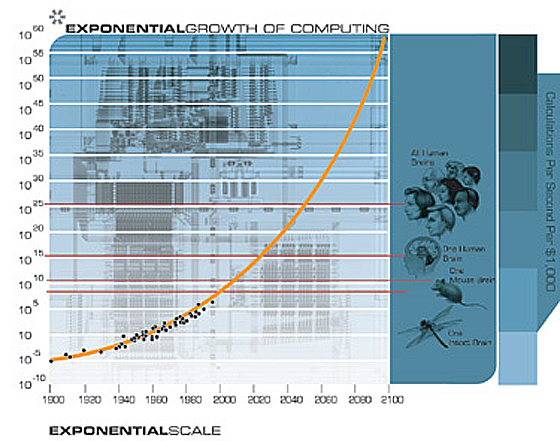
You talk about "computing power" as if it plateauing would prevent the singularity, and Kurzweil et al. make diagrams like these that pretty much link Moore's law and the Singularity together.
As for brute force not leading to scalable intelligence, just take a quick look at tree search. That's exponential; it's just that, as an example, the game tree for chess is narrow enough that computers can beat grandmasters. And it's not just chess. Many other puzzles, when generalized, are NP-complete, and many games PSPACE-complete (at least). To make headway into the harder areas here is going to require real effort and ingenuity, not just traveling up the computing power graph.
Therefore it doesn't matter where computing power will plateau, if it will. As long as the algorithms are exponential for most real cases, the horizon will always catch up with you. -
Indicitive of the times.
Pure research is a luxury(although necessary in the long run). In financially tough times, research facilites focus on marketable technologies. Instead of persuing a thinking machine, MIT is persuing projects for the military. Details here Why? Money, plain and simple.
Ask anyone who worked for Bell labs in the late 70's and 80's. These types of environments fostered incredible research that didn't really turn into real products for 20 years. Today the bean counters yell and managment focuses on marketable products. It's just a sign of the times.
-ted -
An Entire Interview
I found the following interview on SpaceNStuff.com and decided to mirror it here ('cause Slashdot can take a Slashdotting). August 31, 2002 posted on 08-31-2002 at 09:35PM by Nancy
Summary: Interview Part 1
"The Lifeboat Foundation "
A matter of life and death.....
Full Story: Space N Stuff has recently learned of the existence of the above Foundation, as a result of a Guest who visited Space N Stuff and contacted me.
An email request was made and Mr. Eric Klien, Founder and President of Lifeboat Foundation , generously agreed to an interview. As a matter of fact, once Mr. Klien responded to the questions in this interview, I discovered this is like eating potato chips, you can't be satisfied with just "one". At a later date, Space N Stuff will again contact Mr. Klien for a follow-up to this initial query.
Please understand that this is a very complex subject and due to space constraints, not all of the details can be presented, however, we are providing LINKS at the bottom of this Interview so that you can check their site for yourselves.
In a nutshell, the purpose of Lifeboat Foundation is to research technology in a serious effort to build vehicles, or "Arks" that will house permanent residents, away from Earth. In essence, self-sustaining colonies would be established, one at a time, in an effort to save Humanity. Lifeboat Foundation 's basic concept of leaving Earth
This premise is a result of facts that cannot be denied. Human Beings are finding more and more ways to destroy the Earth, and......... each other.
Their goals are straight forward:
By 2004, they hope to educate the public as to 'coming dangers', promote efforts to preserve life, encourage advancement in Space Technology and fund SETI research.
By 2010, the efforts to develop self-sustaining technologies will be in full swing.
By 2018, complete the development above, launch a for-profit Corporation that would have as its primary goal , to put the first self-sustaining Space Colony in orbit, 248 miles above the Earth, and have subsequent colonies, further from Earth.
By 2020, to promote free enterprise in the conquest of Space.
Space N Stuff : Mr. Klien , your site provides a great deal of background information regarding your goals. However, I do have a series of questions to pose:
Space N Stuff : If I understand correctly, based on your current projections, people will not be off this planet until approximately 2020. In view of the seemingly endless strikes of Terrorism globally, will your "Arks" be too late?
Mr. Klien : It will be a close call.
In a technology timeline produced by British Telecommunications (a multibillion dollar conglomerate based in the United Kingdom) which we have a copy of at http://research.lifeboat.com/btexact.pdf, it was predicted that in as little as three more years terrorists will unleash dangerous bioweapons on the public. It stands to reason that creating self-sustaining space stations during the time between this prediction and total extinction will be a non trivial task.
Space N Stuff : It is my interpretation that each 'Ark' will be self-sufficient to accommodate 1,000 permanent residents and 500 visitors. In addition, those who are chosen will be the winner(s) of a lottery or benefit from "Lifeboat scholarships". While security is one of the top priorities for The United States, will that be a priority onboard an Ark? Will Lifeboat screen those who enter/win said lottery or scholarships? In other words, will criminals either present or future be included? If not? Would that be discrimination?
Mr. Klien : Needless to say, each passenger will undergo an intense screening process before being allowed to board. Someone like Martha Stewart, who may have done a little insider trading, would still be considered a potential candidate. But a convicted murderer would have little chance of being accepted as a candidate.
Space N Stuff : Human Nature, being just that, "human"
Mr. Klien : Each colony will be free to create its own laws and standards of conduct. Security officials will have the benefit of a confined station and its finite number of passengers when monitoring suspicious or malicious behavior. And, of course, the use of practical safeguards such as psychological testing will have to be in place for those onboard who have access to dangerous technologies.
Space N Stuff : On this planet, we have various means to cope with and handle death. Since these colonies have no capability of returning to Earth, how would deceased individuals be cared for?
Mr. Klien : Long term, we intend for the colonies to repopulate other planets-- including the Earth. As for those permanently living on spacestations, burial traditions would be unlikely. The departed could, in the fashion of a sailor's burial at sea, be ceremoniously launched into the sun. Simple cremation and cryonic suspension are additional possibilities. In all cases, memorials could also be created to both honor those who have passed and provide comfort to those who have lost loved ones.
Space N Stuff : Although the world has made significant progress with various Space Programs, we still find 'glitches' that delay progress, at great expense. How will Lifeboat be different in this regard? Since the colonies are forever 'out there' how will replacement parts be stored? It would seem to be quite difficult to predict in advance, how many of each, would be needed to keep the Arks functioning at tip top performance.
Mr. Klien : The development of self-sustaining technologies is essential to this project. We certainly don't want to replicate the Skylab and Mir experiences where they had to toss their junked space stations into the ocean.
To create effective self-sustaining technologies will require, at the very least, the primitive beginnings of nanotechnology. This technology, which enables the manipulation of matter, atom by atom, could be used to stop a ship's entropy. Also, whatever plagues, fallout or weaponry was used by terrorists to wipe out life on Earth could be removed by this technology, thereby making the planet habitable again.
For the record, while it will take hundreds of billions of dollars, if not more, to create nanotechnology, we will let others handle the cost. (Over a billion dollars was spent on nanotechnology development just this year.) We will just slightly adjust such technologies so they are useful to self-sustain a space station. And that is what we will spend ten years doing.
Space N Stuff : For the first time since Man has walked on Earth, scientists and engineers are capable of mind boggling research and results. Yet, our Universe is constantly changing. Solar storms are perhaps altering many of our 'normal' weather patterns. Discoveries are being made faster than the press can report. Wouldn't it be difficult to plan now, with so many unknowns?
Mr. Klien : It is always difficult to make plans based on educated guesses, but no plan to preserve mankind seems premature when you consider the consequences. Stephen Hawking warns that "You can't regulate every lab in the world. The danger is that either by accident or design, we create a virus that destroys us." With this in mind, can we afford to wait? Can we afford not to make plans?
Space N Stuff : Finally Mr. Klien , mankind survives in 'groups.' Families, friendships, coworkers. Would Colonies provide employment? How would normal everyday expenses be handled? Would entire families qualify to climb onboard at the same time? Those who find living in space, is NOT their 'cup of tea' will face great stress, since it appears they will not be able to return, assuming there is a planet here still in existence. Can you elaborate?
Mr. Klien : The more arks we are able to build, the more room will be available to house entire families. And considering that only a few thousand people will be in such close proximity onboard the station, meaningful bonds will be forged, new families will spring up and, with time, a sense of community will grow strong.
As to employment, consumerism will not die alongside our planet. There will still be financial reward for services rendered. A new frontier offers new opportunity. Everyone will be encouraged to stimulate creativity and to provide the goods, services and entertainment needed for the station to flourish.
Comments: Mr. Klien ? Feel free to add whatever you wish.
Mr. Klien : The idea that advanced technologies are not an appropriate match for our primitive culture is an obvious one, but it wasn't until recently that I figured out why few people are worrying about it. The answer is that non-scientists are oblivious to potential dangers, while on the other hand, those who worship at the altar of science live by the precept that future advancements will cure all the world's problems.
We are currently working on phase 4, the technical credibility, of our ARK I design and, in two weeks, I will be flying off to England to meet with a multibillionaire. Within a year or two, we expect our project to really gain some momentum!
Space N Stuff wishes to extend its sincere gratitude to Mr. Klien for his timely response and the use of his valuable time. In the near future, we will pursue additional information in the form of a follow-up interview.
In the meantime Mr. Klien , have a safe journey to England and back.
Nancy, Director of Operations, Editor
www.spacenstuff.com
RESOURCES:
Below you will find various LINKS within Lifeboat Foundation 's web site. It is very easy to navigate. We hope you will visit and see the details for yourself. Thank you.
http://lifeboat.com/ex/ : Home Page
http://lifeboat.com/ex/ArkI : Details on Ark I
http://lifeboat.com/ex/timeline : Current and Future Goals.
http://lifeboat.com/ex/faq : Frequently Asked Questions
http://research.lifeboat.com/btexact.pdf : Research -
An Entire Interview
I found the following interview on SpaceNStuff.com and decided to mirror it here ('cause Slashdot can take a Slashdotting). August 31, 2002 posted on 08-31-2002 at 09:35PM by Nancy
Summary: Interview Part 1
"The Lifeboat Foundation "
A matter of life and death.....
Full Story: Space N Stuff has recently learned of the existence of the above Foundation, as a result of a Guest who visited Space N Stuff and contacted me.
An email request was made and Mr. Eric Klien, Founder and President of Lifeboat Foundation , generously agreed to an interview. As a matter of fact, once Mr. Klien responded to the questions in this interview, I discovered this is like eating potato chips, you can't be satisfied with just "one". At a later date, Space N Stuff will again contact Mr. Klien for a follow-up to this initial query.
Please understand that this is a very complex subject and due to space constraints, not all of the details can be presented, however, we are providing LINKS at the bottom of this Interview so that you can check their site for yourselves.
In a nutshell, the purpose of Lifeboat Foundation is to research technology in a serious effort to build vehicles, or "Arks" that will house permanent residents, away from Earth. In essence, self-sustaining colonies would be established, one at a time, in an effort to save Humanity. Lifeboat Foundation 's basic concept of leaving Earth
This premise is a result of facts that cannot be denied. Human Beings are finding more and more ways to destroy the Earth, and......... each other.
Their goals are straight forward:
By 2004, they hope to educate the public as to 'coming dangers', promote efforts to preserve life, encourage advancement in Space Technology and fund SETI research.
By 2010, the efforts to develop self-sustaining technologies will be in full swing.
By 2018, complete the development above, launch a for-profit Corporation that would have as its primary goal , to put the first self-sustaining Space Colony in orbit, 248 miles above the Earth, and have subsequent colonies, further from Earth.
By 2020, to promote free enterprise in the conquest of Space.
Space N Stuff : Mr. Klien , your site provides a great deal of background information regarding your goals. However, I do have a series of questions to pose:
Space N Stuff : If I understand correctly, based on your current projections, people will not be off this planet until approximately 2020. In view of the seemingly endless strikes of Terrorism globally, will your "Arks" be too late?
Mr. Klien : It will be a close call.
In a technology timeline produced by British Telecommunications (a multibillion dollar conglomerate based in the United Kingdom) which we have a copy of at http://research.lifeboat.com/btexact.pdf, it was predicted that in as little as three more years terrorists will unleash dangerous bioweapons on the public. It stands to reason that creating self-sustaining space stations during the time between this prediction and total extinction will be a non trivial task.
Space N Stuff : It is my interpretation that each 'Ark' will be self-sufficient to accommodate 1,000 permanent residents and 500 visitors. In addition, those who are chosen will be the winner(s) of a lottery or benefit from "Lifeboat scholarships". While security is one of the top priorities for The United States, will that be a priority onboard an Ark? Will Lifeboat screen those who enter/win said lottery or scholarships? In other words, will criminals either present or future be included? If not? Would that be discrimination?
Mr. Klien : Needless to say, each passenger will undergo an intense screening process before being allowed to board. Someone like Martha Stewart, who may have done a little insider trading, would still be considered a potential candidate. But a convicted murderer would have little chance of being accepted as a candidate.
Space N Stuff : Human Nature, being just that, "human"
Mr. Klien : Each colony will be free to create its own laws and standards of conduct. Security officials will have the benefit of a confined station and its finite number of passengers when monitoring suspicious or malicious behavior. And, of course, the use of practical safeguards such as psychological testing will have to be in place for those onboard who have access to dangerous technologies.
Space N Stuff : On this planet, we have various means to cope with and handle death. Since these colonies have no capability of returning to Earth, how would deceased individuals be cared for?
Mr. Klien : Long term, we intend for the colonies to repopulate other planets-- including the Earth. As for those permanently living on spacestations, burial traditions would be unlikely. The departed could, in the fashion of a sailor's burial at sea, be ceremoniously launched into the sun. Simple cremation and cryonic suspension are additional possibilities. In all cases, memorials could also be created to both honor those who have passed and provide comfort to those who have lost loved ones.
Space N Stuff : Although the world has made significant progress with various Space Programs, we still find 'glitches' that delay progress, at great expense. How will Lifeboat be different in this regard? Since the colonies are forever 'out there' how will replacement parts be stored? It would seem to be quite difficult to predict in advance, how many of each, would be needed to keep the Arks functioning at tip top performance.
Mr. Klien : The development of self-sustaining technologies is essential to this project. We certainly don't want to replicate the Skylab and Mir experiences where they had to toss their junked space stations into the ocean.
To create effective self-sustaining technologies will require, at the very least, the primitive beginnings of nanotechnology. This technology, which enables the manipulation of matter, atom by atom, could be used to stop a ship's entropy. Also, whatever plagues, fallout or weaponry was used by terrorists to wipe out life on Earth could be removed by this technology, thereby making the planet habitable again.
For the record, while it will take hundreds of billions of dollars, if not more, to create nanotechnology, we will let others handle the cost. (Over a billion dollars was spent on nanotechnology development just this year.) We will just slightly adjust such technologies so they are useful to self-sustain a space station. And that is what we will spend ten years doing.
Space N Stuff : For the first time since Man has walked on Earth, scientists and engineers are capable of mind boggling research and results. Yet, our Universe is constantly changing. Solar storms are perhaps altering many of our 'normal' weather patterns. Discoveries are being made faster than the press can report. Wouldn't it be difficult to plan now, with so many unknowns?
Mr. Klien : It is always difficult to make plans based on educated guesses, but no plan to preserve mankind seems premature when you consider the consequences. Stephen Hawking warns that "You can't regulate every lab in the world. The danger is that either by accident or design, we create a virus that destroys us." With this in mind, can we afford to wait? Can we afford not to make plans?
Space N Stuff : Finally Mr. Klien , mankind survives in 'groups.' Families, friendships, coworkers. Would Colonies provide employment? How would normal everyday expenses be handled? Would entire families qualify to climb onboard at the same time? Those who find living in space, is NOT their 'cup of tea' will face great stress, since it appears they will not be able to return, assuming there is a planet here still in existence. Can you elaborate?
Mr. Klien : The more arks we are able to build, the more room will be available to house entire families. And considering that only a few thousand people will be in such close proximity onboard the station, meaningful bonds will be forged, new families will spring up and, with time, a sense of community will grow strong.
As to employment, consumerism will not die alongside our planet. There will still be financial reward for services rendered. A new frontier offers new opportunity. Everyone will be encouraged to stimulate creativity and to provide the goods, services and entertainment needed for the station to flourish.
Comments: Mr. Klien ? Feel free to add whatever you wish.
Mr. Klien : The idea that advanced technologies are not an appropriate match for our primitive culture is an obvious one, but it wasn't until recently that I figured out why few people are worrying about it. The answer is that non-scientists are oblivious to potential dangers, while on the other hand, those who worship at the altar of science live by the precept that future advancements will cure all the world's problems.
We are currently working on phase 4, the technical credibility, of our ARK I design and, in two weeks, I will be flying off to England to meet with a multibillionaire. Within a year or two, we expect our project to really gain some momentum!
Space N Stuff wishes to extend its sincere gratitude to Mr. Klien for his timely response and the use of his valuable time. In the near future, we will pursue additional information in the form of a follow-up interview.
In the meantime Mr. Klien , have a safe journey to England and back.
Nancy, Director of Operations, Editor
www.spacenstuff.com
RESOURCES:
Below you will find various LINKS within Lifeboat Foundation 's web site. It is very easy to navigate. We hope you will visit and see the details for yourself. Thank you.
http://lifeboat.com/ex/ : Home Page
http://lifeboat.com/ex/ArkI : Details on Ark I
http://lifeboat.com/ex/timeline : Current and Future Goals.
http://lifeboat.com/ex/faq : Frequently Asked Questions
http://research.lifeboat.com/btexact.pdf : Research -
An Entire Interview
I found the following interview on SpaceNStuff.com and decided to mirror it here ('cause Slashdot can take a Slashdotting). August 31, 2002 posted on 08-31-2002 at 09:35PM by Nancy
Summary: Interview Part 1
"The Lifeboat Foundation "
A matter of life and death.....
Full Story: Space N Stuff has recently learned of the existence of the above Foundation, as a result of a Guest who visited Space N Stuff and contacted me.
An email request was made and Mr. Eric Klien, Founder and President of Lifeboat Foundation , generously agreed to an interview. As a matter of fact, once Mr. Klien responded to the questions in this interview, I discovered this is like eating potato chips, you can't be satisfied with just "one". At a later date, Space N Stuff will again contact Mr. Klien for a follow-up to this initial query.
Please understand that this is a very complex subject and due to space constraints, not all of the details can be presented, however, we are providing LINKS at the bottom of this Interview so that you can check their site for yourselves.
In a nutshell, the purpose of Lifeboat Foundation is to research technology in a serious effort to build vehicles, or "Arks" that will house permanent residents, away from Earth. In essence, self-sustaining colonies would be established, one at a time, in an effort to save Humanity. Lifeboat Foundation 's basic concept of leaving Earth
This premise is a result of facts that cannot be denied. Human Beings are finding more and more ways to destroy the Earth, and......... each other.
Their goals are straight forward:
By 2004, they hope to educate the public as to 'coming dangers', promote efforts to preserve life, encourage advancement in Space Technology and fund SETI research.
By 2010, the efforts to develop self-sustaining technologies will be in full swing.
By 2018, complete the development above, launch a for-profit Corporation that would have as its primary goal , to put the first self-sustaining Space Colony in orbit, 248 miles above the Earth, and have subsequent colonies, further from Earth.
By 2020, to promote free enterprise in the conquest of Space.
Space N Stuff : Mr. Klien , your site provides a great deal of background information regarding your goals. However, I do have a series of questions to pose:
Space N Stuff : If I understand correctly, based on your current projections, people will not be off this planet until approximately 2020. In view of the seemingly endless strikes of Terrorism globally, will your "Arks" be too late?
Mr. Klien : It will be a close call.
In a technology timeline produced by British Telecommunications (a multibillion dollar conglomerate based in the United Kingdom) which we have a copy of at http://research.lifeboat.com/btexact.pdf, it was predicted that in as little as three more years terrorists will unleash dangerous bioweapons on the public. It stands to reason that creating self-sustaining space stations during the time between this prediction and total extinction will be a non trivial task.
Space N Stuff : It is my interpretation that each 'Ark' will be self-sufficient to accommodate 1,000 permanent residents and 500 visitors. In addition, those who are chosen will be the winner(s) of a lottery or benefit from "Lifeboat scholarships". While security is one of the top priorities for The United States, will that be a priority onboard an Ark? Will Lifeboat screen those who enter/win said lottery or scholarships? In other words, will criminals either present or future be included? If not? Would that be discrimination?
Mr. Klien : Needless to say, each passenger will undergo an intense screening process before being allowed to board. Someone like Martha Stewart, who may have done a little insider trading, would still be considered a potential candidate. But a convicted murderer would have little chance of being accepted as a candidate.
Space N Stuff : Human Nature, being just that, "human"
Mr. Klien : Each colony will be free to create its own laws and standards of conduct. Security officials will have the benefit of a confined station and its finite number of passengers when monitoring suspicious or malicious behavior. And, of course, the use of practical safeguards such as psychological testing will have to be in place for those onboard who have access to dangerous technologies.
Space N Stuff : On this planet, we have various means to cope with and handle death. Since these colonies have no capability of returning to Earth, how would deceased individuals be cared for?
Mr. Klien : Long term, we intend for the colonies to repopulate other planets-- including the Earth. As for those permanently living on spacestations, burial traditions would be unlikely. The departed could, in the fashion of a sailor's burial at sea, be ceremoniously launched into the sun. Simple cremation and cryonic suspension are additional possibilities. In all cases, memorials could also be created to both honor those who have passed and provide comfort to those who have lost loved ones.
Space N Stuff : Although the world has made significant progress with various Space Programs, we still find 'glitches' that delay progress, at great expense. How will Lifeboat be different in this regard? Since the colonies are forever 'out there' how will replacement parts be stored? It would seem to be quite difficult to predict in advance, how many of each, would be needed to keep the Arks functioning at tip top performance.
Mr. Klien : The development of self-sustaining technologies is essential to this project. We certainly don't want to replicate the Skylab and Mir experiences where they had to toss their junked space stations into the ocean.
To create effective self-sustaining technologies will require, at the very least, the primitive beginnings of nanotechnology. This technology, which enables the manipulation of matter, atom by atom, could be used to stop a ship's entropy. Also, whatever plagues, fallout or weaponry was used by terrorists to wipe out life on Earth could be removed by this technology, thereby making the planet habitable again.
For the record, while it will take hundreds of billions of dollars, if not more, to create nanotechnology, we will let others handle the cost. (Over a billion dollars was spent on nanotechnology development just this year.) We will just slightly adjust such technologies so they are useful to self-sustain a space station. And that is what we will spend ten years doing.
Space N Stuff : For the first time since Man has walked on Earth, scientists and engineers are capable of mind boggling research and results. Yet, our Universe is constantly changing. Solar storms are perhaps altering many of our 'normal' weather patterns. Discoveries are being made faster than the press can report. Wouldn't it be difficult to plan now, with so many unknowns?
Mr. Klien : It is always difficult to make plans based on educated guesses, but no plan to preserve mankind seems premature when you consider the consequences. Stephen Hawking warns that "You can't regulate every lab in the world. The danger is that either by accident or design, we create a virus that destroys us." With this in mind, can we afford to wait? Can we afford not to make plans?
Space N Stuff : Finally Mr. Klien , mankind survives in 'groups.' Families, friendships, coworkers. Would Colonies provide employment? How would normal everyday expenses be handled? Would entire families qualify to climb onboard at the same time? Those who find living in space, is NOT their 'cup of tea' will face great stress, since it appears they will not be able to return, assuming there is a planet here still in existence. Can you elaborate?
Mr. Klien : The more arks we are able to build, the more room will be available to house entire families. And considering that only a few thousand people will be in such close proximity onboard the station, meaningful bonds will be forged, new families will spring up and, with time, a sense of community will grow strong.
As to employment, consumerism will not die alongside our planet. There will still be financial reward for services rendered. A new frontier offers new opportunity. Everyone will be encouraged to stimulate creativity and to provide the goods, services and entertainment needed for the station to flourish.
Comments: Mr. Klien ? Feel free to add whatever you wish.
Mr. Klien : The idea that advanced technologies are not an appropriate match for our primitive culture is an obvious one, but it wasn't until recently that I figured out why few people are worrying about it. The answer is that non-scientists are oblivious to potential dangers, while on the other hand, those who worship at the altar of science live by the precept that future advancements will cure all the world's problems.
We are currently working on phase 4, the technical credibility, of our ARK I design and, in two weeks, I will be flying off to England to meet with a multibillionaire. Within a year or two, we expect our project to really gain some momentum!
Space N Stuff wishes to extend its sincere gratitude to Mr. Klien for his timely response and the use of his valuable time. In the near future, we will pursue additional information in the form of a follow-up interview.
In the meantime Mr. Klien , have a safe journey to England and back.
Nancy, Director of Operations, Editor
www.spacenstuff.com
RESOURCES:
Below you will find various LINKS within Lifeboat Foundation 's web site. It is very easy to navigate. We hope you will visit and see the details for yourself. Thank you.
http://lifeboat.com/ex/ : Home Page
http://lifeboat.com/ex/ArkI : Details on Ark I
http://lifeboat.com/ex/timeline : Current and Future Goals.
http://lifeboat.com/ex/faq : Frequently Asked Questions
http://research.lifeboat.com/btexact.pdf : Research -
An Entire Interview
I found the following interview on SpaceNStuff.com and decided to mirror it here ('cause Slashdot can take a Slashdotting). August 31, 2002 posted on 08-31-2002 at 09:35PM by Nancy
Summary: Interview Part 1
"The Lifeboat Foundation "
A matter of life and death.....
Full Story: Space N Stuff has recently learned of the existence of the above Foundation, as a result of a Guest who visited Space N Stuff and contacted me.
An email request was made and Mr. Eric Klien, Founder and President of Lifeboat Foundation , generously agreed to an interview. As a matter of fact, once Mr. Klien responded to the questions in this interview, I discovered this is like eating potato chips, you can't be satisfied with just "one". At a later date, Space N Stuff will again contact Mr. Klien for a follow-up to this initial query.
Please understand that this is a very complex subject and due to space constraints, not all of the details can be presented, however, we are providing LINKS at the bottom of this Interview so that you can check their site for yourselves.
In a nutshell, the purpose of Lifeboat Foundation is to research technology in a serious effort to build vehicles, or "Arks" that will house permanent residents, away from Earth. In essence, self-sustaining colonies would be established, one at a time, in an effort to save Humanity. Lifeboat Foundation 's basic concept of leaving Earth
This premise is a result of facts that cannot be denied. Human Beings are finding more and more ways to destroy the Earth, and......... each other.
Their goals are straight forward:
By 2004, they hope to educate the public as to 'coming dangers', promote efforts to preserve life, encourage advancement in Space Technology and fund SETI research.
By 2010, the efforts to develop self-sustaining technologies will be in full swing.
By 2018, complete the development above, launch a for-profit Corporation that would have as its primary goal , to put the first self-sustaining Space Colony in orbit, 248 miles above the Earth, and have subsequent colonies, further from Earth.
By 2020, to promote free enterprise in the conquest of Space.
Space N Stuff : Mr. Klien , your site provides a great deal of background information regarding your goals. However, I do have a series of questions to pose:
Space N Stuff : If I understand correctly, based on your current projections, people will not be off this planet until approximately 2020. In view of the seemingly endless strikes of Terrorism globally, will your "Arks" be too late?
Mr. Klien : It will be a close call.
In a technology timeline produced by British Telecommunications (a multibillion dollar conglomerate based in the United Kingdom) which we have a copy of at http://research.lifeboat.com/btexact.pdf, it was predicted that in as little as three more years terrorists will unleash dangerous bioweapons on the public. It stands to reason that creating self-sustaining space stations during the time between this prediction and total extinction will be a non trivial task.
Space N Stuff : It is my interpretation that each 'Ark' will be self-sufficient to accommodate 1,000 permanent residents and 500 visitors. In addition, those who are chosen will be the winner(s) of a lottery or benefit from "Lifeboat scholarships". While security is one of the top priorities for The United States, will that be a priority onboard an Ark? Will Lifeboat screen those who enter/win said lottery or scholarships? In other words, will criminals either present or future be included? If not? Would that be discrimination?
Mr. Klien : Needless to say, each passenger will undergo an intense screening process before being allowed to board. Someone like Martha Stewart, who may have done a little insider trading, would still be considered a potential candidate. But a convicted murderer would have little chance of being accepted as a candidate.
Space N Stuff : Human Nature, being just that, "human"
Mr. Klien : Each colony will be free to create its own laws and standards of conduct. Security officials will have the benefit of a confined station and its finite number of passengers when monitoring suspicious or malicious behavior. And, of course, the use of practical safeguards such as psychological testing will have to be in place for those onboard who have access to dangerous technologies.
Space N Stuff : On this planet, we have various means to cope with and handle death. Since these colonies have no capability of returning to Earth, how would deceased individuals be cared for?
Mr. Klien : Long term, we intend for the colonies to repopulate other planets-- including the Earth. As for those permanently living on spacestations, burial traditions would be unlikely. The departed could, in the fashion of a sailor's burial at sea, be ceremoniously launched into the sun. Simple cremation and cryonic suspension are additional possibilities. In all cases, memorials could also be created to both honor those who have passed and provide comfort to those who have lost loved ones.
Space N Stuff : Although the world has made significant progress with various Space Programs, we still find 'glitches' that delay progress, at great expense. How will Lifeboat be different in this regard? Since the colonies are forever 'out there' how will replacement parts be stored? It would seem to be quite difficult to predict in advance, how many of each, would be needed to keep the Arks functioning at tip top performance.
Mr. Klien : The development of self-sustaining technologies is essential to this project. We certainly don't want to replicate the Skylab and Mir experiences where they had to toss their junked space stations into the ocean.
To create effective self-sustaining technologies will require, at the very least, the primitive beginnings of nanotechnology. This technology, which enables the manipulation of matter, atom by atom, could be used to stop a ship's entropy. Also, whatever plagues, fallout or weaponry was used by terrorists to wipe out life on Earth could be removed by this technology, thereby making the planet habitable again.
For the record, while it will take hundreds of billions of dollars, if not more, to create nanotechnology, we will let others handle the cost. (Over a billion dollars was spent on nanotechnology development just this year.) We will just slightly adjust such technologies so they are useful to self-sustain a space station. And that is what we will spend ten years doing.
Space N Stuff : For the first time since Man has walked on Earth, scientists and engineers are capable of mind boggling research and results. Yet, our Universe is constantly changing. Solar storms are perhaps altering many of our 'normal' weather patterns. Discoveries are being made faster than the press can report. Wouldn't it be difficult to plan now, with so many unknowns?
Mr. Klien : It is always difficult to make plans based on educated guesses, but no plan to preserve mankind seems premature when you consider the consequences. Stephen Hawking warns that "You can't regulate every lab in the world. The danger is that either by accident or design, we create a virus that destroys us." With this in mind, can we afford to wait? Can we afford not to make plans?
Space N Stuff : Finally Mr. Klien , mankind survives in 'groups.' Families, friendships, coworkers. Would Colonies provide employment? How would normal everyday expenses be handled? Would entire families qualify to climb onboard at the same time? Those who find living in space, is NOT their 'cup of tea' will face great stress, since it appears they will not be able to return, assuming there is a planet here still in existence. Can you elaborate?
Mr. Klien : The more arks we are able to build, the more room will be available to house entire families. And considering that only a few thousand people will be in such close proximity onboard the station, meaningful bonds will be forged, new families will spring up and, with time, a sense of community will grow strong.
As to employment, consumerism will not die alongside our planet. There will still be financial reward for services rendered. A new frontier offers new opportunity. Everyone will be encouraged to stimulate creativity and to provide the goods, services and entertainment needed for the station to flourish.
Comments: Mr. Klien ? Feel free to add whatever you wish.
Mr. Klien : The idea that advanced technologies are not an appropriate match for our primitive culture is an obvious one, but it wasn't until recently that I figured out why few people are worrying about it. The answer is that non-scientists are oblivious to potential dangers, while on the other hand, those who worship at the altar of science live by the precept that future advancements will cure all the world's problems.
We are currently working on phase 4, the technical credibility, of our ARK I design and, in two weeks, I will be flying off to England to meet with a multibillionaire. Within a year or two, we expect our project to really gain some momentum!
Space N Stuff wishes to extend its sincere gratitude to Mr. Klien for his timely response and the use of his valuable time. In the near future, we will pursue additional information in the form of a follow-up interview.
In the meantime Mr. Klien , have a safe journey to England and back.
Nancy, Director of Operations, Editor
www.spacenstuff.com
RESOURCES:
Below you will find various LINKS within Lifeboat Foundation 's web site. It is very easy to navigate. We hope you will visit and see the details for yourself. Thank you.
http://lifeboat.com/ex/ : Home Page
http://lifeboat.com/ex/ArkI : Details on Ark I
http://lifeboat.com/ex/timeline : Current and Future Goals.
http://lifeboat.com/ex/faq : Frequently Asked Questions
http://research.lifeboat.com/btexact.pdf : Research -
An Entire Interview
I found the following interview on SpaceNStuff.com and decided to mirror it here ('cause Slashdot can take a Slashdotting). August 31, 2002 posted on 08-31-2002 at 09:35PM by Nancy
Summary: Interview Part 1
"The Lifeboat Foundation "
A matter of life and death.....
Full Story: Space N Stuff has recently learned of the existence of the above Foundation, as a result of a Guest who visited Space N Stuff and contacted me.
An email request was made and Mr. Eric Klien, Founder and President of Lifeboat Foundation , generously agreed to an interview. As a matter of fact, once Mr. Klien responded to the questions in this interview, I discovered this is like eating potato chips, you can't be satisfied with just "one". At a later date, Space N Stuff will again contact Mr. Klien for a follow-up to this initial query.
Please understand that this is a very complex subject and due to space constraints, not all of the details can be presented, however, we are providing LINKS at the bottom of this Interview so that you can check their site for yourselves.
In a nutshell, the purpose of Lifeboat Foundation is to research technology in a serious effort to build vehicles, or "Arks" that will house permanent residents, away from Earth. In essence, self-sustaining colonies would be established, one at a time, in an effort to save Humanity. Lifeboat Foundation 's basic concept of leaving Earth
This premise is a result of facts that cannot be denied. Human Beings are finding more and more ways to destroy the Earth, and......... each other.
Their goals are straight forward:
By 2004, they hope to educate the public as to 'coming dangers', promote efforts to preserve life, encourage advancement in Space Technology and fund SETI research.
By 2010, the efforts to develop self-sustaining technologies will be in full swing.
By 2018, complete the development above, launch a for-profit Corporation that would have as its primary goal , to put the first self-sustaining Space Colony in orbit, 248 miles above the Earth, and have subsequent colonies, further from Earth.
By 2020, to promote free enterprise in the conquest of Space.
Space N Stuff : Mr. Klien , your site provides a great deal of background information regarding your goals. However, I do have a series of questions to pose:
Space N Stuff : If I understand correctly, based on your current projections, people will not be off this planet until approximately 2020. In view of the seemingly endless strikes of Terrorism globally, will your "Arks" be too late?
Mr. Klien : It will be a close call.
In a technology timeline produced by British Telecommunications (a multibillion dollar conglomerate based in the United Kingdom) which we have a copy of at http://research.lifeboat.com/btexact.pdf, it was predicted that in as little as three more years terrorists will unleash dangerous bioweapons on the public. It stands to reason that creating self-sustaining space stations during the time between this prediction and total extinction will be a non trivial task.
Space N Stuff : It is my interpretation that each 'Ark' will be self-sufficient to accommodate 1,000 permanent residents and 500 visitors. In addition, those who are chosen will be the winner(s) of a lottery or benefit from "Lifeboat scholarships". While security is one of the top priorities for The United States, will that be a priority onboard an Ark? Will Lifeboat screen those who enter/win said lottery or scholarships? In other words, will criminals either present or future be included? If not? Would that be discrimination?
Mr. Klien : Needless to say, each passenger will undergo an intense screening process before being allowed to board. Someone like Martha Stewart, who may have done a little insider trading, would still be considered a potential candidate. But a convicted murderer would have little chance of being accepted as a candidate.
Space N Stuff : Human Nature, being just that, "human"
Mr. Klien : Each colony will be free to create its own laws and standards of conduct. Security officials will have the benefit of a confined station and its finite number of passengers when monitoring suspicious or malicious behavior. And, of course, the use of practical safeguards such as psychological testing will have to be in place for those onboard who have access to dangerous technologies.
Space N Stuff : On this planet, we have various means to cope with and handle death. Since these colonies have no capability of returning to Earth, how would deceased individuals be cared for?
Mr. Klien : Long term, we intend for the colonies to repopulate other planets-- including the Earth. As for those permanently living on spacestations, burial traditions would be unlikely. The departed could, in the fashion of a sailor's burial at sea, be ceremoniously launched into the sun. Simple cremation and cryonic suspension are additional possibilities. In all cases, memorials could also be created to both honor those who have passed and provide comfort to those who have lost loved ones.
Space N Stuff : Although the world has made significant progress with various Space Programs, we still find 'glitches' that delay progress, at great expense. How will Lifeboat be different in this regard? Since the colonies are forever 'out there' how will replacement parts be stored? It would seem to be quite difficult to predict in advance, how many of each, would be needed to keep the Arks functioning at tip top performance.
Mr. Klien : The development of self-sustaining technologies is essential to this project. We certainly don't want to replicate the Skylab and Mir experiences where they had to toss their junked space stations into the ocean.
To create effective self-sustaining technologies will require, at the very least, the primitive beginnings of nanotechnology. This technology, which enables the manipulation of matter, atom by atom, could be used to stop a ship's entropy. Also, whatever plagues, fallout or weaponry was used by terrorists to wipe out life on Earth could be removed by this technology, thereby making the planet habitable again.
For the record, while it will take hundreds of billions of dollars, if not more, to create nanotechnology, we will let others handle the cost. (Over a billion dollars was spent on nanotechnology development just this year.) We will just slightly adjust such technologies so they are useful to self-sustain a space station. And that is what we will spend ten years doing.
Space N Stuff : For the first time since Man has walked on Earth, scientists and engineers are capable of mind boggling research and results. Yet, our Universe is constantly changing. Solar storms are perhaps altering many of our 'normal' weather patterns. Discoveries are being made faster than the press can report. Wouldn't it be difficult to plan now, with so many unknowns?
Mr. Klien : It is always difficult to make plans based on educated guesses, but no plan to preserve mankind seems premature when you consider the consequences. Stephen Hawking warns that "You can't regulate every lab in the world. The danger is that either by accident or design, we create a virus that destroys us." With this in mind, can we afford to wait? Can we afford not to make plans?
Space N Stuff : Finally Mr. Klien , mankind survives in 'groups.' Families, friendships, coworkers. Would Colonies provide employment? How would normal everyday expenses be handled? Would entire families qualify to climb onboard at the same time? Those who find living in space, is NOT their 'cup of tea' will face great stress, since it appears they will not be able to return, assuming there is a planet here still in existence. Can you elaborate?
Mr. Klien : The more arks we are able to build, the more room will be available to house entire families. And considering that only a few thousand people will be in such close proximity onboard the station, meaningful bonds will be forged, new families will spring up and, with time, a sense of community will grow strong.
As to employment, consumerism will not die alongside our planet. There will still be financial reward for services rendered. A new frontier offers new opportunity. Everyone will be encouraged to stimulate creativity and to provide the goods, services and entertainment needed for the station to flourish.
Comments: Mr. Klien ? Feel free to add whatever you wish.
Mr. Klien : The idea that advanced technologies are not an appropriate match for our primitive culture is an obvious one, but it wasn't until recently that I figured out why few people are worrying about it. The answer is that non-scientists are oblivious to potential dangers, while on the other hand, those who worship at the altar of science live by the precept that future advancements will cure all the world's problems.
We are currently working on phase 4, the technical credibility, of our ARK I design and, in two weeks, I will be flying off to England to meet with a multibillionaire. Within a year or two, we expect our project to really gain some momentum!
Space N Stuff wishes to extend its sincere gratitude to Mr. Klien for his timely response and the use of his valuable time. In the near future, we will pursue additional information in the form of a follow-up interview.
In the meantime Mr. Klien , have a safe journey to England and back.
Nancy, Director of Operations, Editor
www.spacenstuff.com
RESOURCES:
Below you will find various LINKS within Lifeboat Foundation 's web site. It is very easy to navigate. We hope you will visit and see the details for yourself. Thank you.
http://lifeboat.com/ex/ : Home Page
http://lifeboat.com/ex/ArkI : Details on Ark I
http://lifeboat.com/ex/timeline : Current and Future Goals.
http://lifeboat.com/ex/faq : Frequently Asked Questions
http://research.lifeboat.com/btexact.pdf : Research -
An Entire Interview
I found the following interview on SpaceNStuff.com and decided to mirror it here ('cause Slashdot can take a Slashdotting). August 31, 2002 posted on 08-31-2002 at 09:35PM by Nancy
Summary: Interview Part 1
"The Lifeboat Foundation "
A matter of life and death.....
Full Story: Space N Stuff has recently learned of the existence of the above Foundation, as a result of a Guest who visited Space N Stuff and contacted me.
An email request was made and Mr. Eric Klien, Founder and President of Lifeboat Foundation , generously agreed to an interview. As a matter of fact, once Mr. Klien responded to the questions in this interview, I discovered this is like eating potato chips, you can't be satisfied with just "one". At a later date, Space N Stuff will again contact Mr. Klien for a follow-up to this initial query.
Please understand that this is a very complex subject and due to space constraints, not all of the details can be presented, however, we are providing LINKS at the bottom of this Interview so that you can check their site for yourselves.
In a nutshell, the purpose of Lifeboat Foundation is to research technology in a serious effort to build vehicles, or "Arks" that will house permanent residents, away from Earth. In essence, self-sustaining colonies would be established, one at a time, in an effort to save Humanity. Lifeboat Foundation 's basic concept of leaving Earth
This premise is a result of facts that cannot be denied. Human Beings are finding more and more ways to destroy the Earth, and......... each other.
Their goals are straight forward:
By 2004, they hope to educate the public as to 'coming dangers', promote efforts to preserve life, encourage advancement in Space Technology and fund SETI research.
By 2010, the efforts to develop self-sustaining technologies will be in full swing.
By 2018, complete the development above, launch a for-profit Corporation that would have as its primary goal , to put the first self-sustaining Space Colony in orbit, 248 miles above the Earth, and have subsequent colonies, further from Earth.
By 2020, to promote free enterprise in the conquest of Space.
Space N Stuff : Mr. Klien , your site provides a great deal of background information regarding your goals. However, I do have a series of questions to pose:
Space N Stuff : If I understand correctly, based on your current projections, people will not be off this planet until approximately 2020. In view of the seemingly endless strikes of Terrorism globally, will your "Arks" be too late?
Mr. Klien : It will be a close call.
In a technology timeline produced by British Telecommunications (a multibillion dollar conglomerate based in the United Kingdom) which we have a copy of at http://research.lifeboat.com/btexact.pdf, it was predicted that in as little as three more years terrorists will unleash dangerous bioweapons on the public. It stands to reason that creating self-sustaining space stations during the time between this prediction and total extinction will be a non trivial task.
Space N Stuff : It is my interpretation that each 'Ark' will be self-sufficient to accommodate 1,000 permanent residents and 500 visitors. In addition, those who are chosen will be the winner(s) of a lottery or benefit from "Lifeboat scholarships". While security is one of the top priorities for The United States, will that be a priority onboard an Ark? Will Lifeboat screen those who enter/win said lottery or scholarships? In other words, will criminals either present or future be included? If not? Would that be discrimination?
Mr. Klien : Needless to say, each passenger will undergo an intense screening process before being allowed to board. Someone like Martha Stewart, who may have done a little insider trading, would still be considered a potential candidate. But a convicted murderer would have little chance of being accepted as a candidate.
Space N Stuff : Human Nature, being just that, "human"
Mr. Klien : Each colony will be free to create its own laws and standards of conduct. Security officials will have the benefit of a confined station and its finite number of passengers when monitoring suspicious or malicious behavior. And, of course, the use of practical safeguards such as psychological testing will have to be in place for those onboard who have access to dangerous technologies.
Space N Stuff : On this planet, we have various means to cope with and handle death. Since these colonies have no capability of returning to Earth, how would deceased individuals be cared for?
Mr. Klien : Long term, we intend for the colonies to repopulate other planets-- including the Earth. As for those permanently living on spacestations, burial traditions would be unlikely. The departed could, in the fashion of a sailor's burial at sea, be ceremoniously launched into the sun. Simple cremation and cryonic suspension are additional possibilities. In all cases, memorials could also be created to both honor those who have passed and provide comfort to those who have lost loved ones.
Space N Stuff : Although the world has made significant progress with various Space Programs, we still find 'glitches' that delay progress, at great expense. How will Lifeboat be different in this regard? Since the colonies are forever 'out there' how will replacement parts be stored? It would seem to be quite difficult to predict in advance, how many of each, would be needed to keep the Arks functioning at tip top performance.
Mr. Klien : The development of self-sustaining technologies is essential to this project. We certainly don't want to replicate the Skylab and Mir experiences where they had to toss their junked space stations into the ocean.
To create effective self-sustaining technologies will require, at the very least, the primitive beginnings of nanotechnology. This technology, which enables the manipulation of matter, atom by atom, could be used to stop a ship's entropy. Also, whatever plagues, fallout or weaponry was used by terrorists to wipe out life on Earth could be removed by this technology, thereby making the planet habitable again.
For the record, while it will take hundreds of billions of dollars, if not more, to create nanotechnology, we will let others handle the cost. (Over a billion dollars was spent on nanotechnology development just this year.) We will just slightly adjust such technologies so they are useful to self-sustain a space station. And that is what we will spend ten years doing.
Space N Stuff : For the first time since Man has walked on Earth, scientists and engineers are capable of mind boggling research and results. Yet, our Universe is constantly changing. Solar storms are perhaps altering many of our 'normal' weather patterns. Discoveries are being made faster than the press can report. Wouldn't it be difficult to plan now, with so many unknowns?
Mr. Klien : It is always difficult to make plans based on educated guesses, but no plan to preserve mankind seems premature when you consider the consequences. Stephen Hawking warns that "You can't regulate every lab in the world. The danger is that either by accident or design, we create a virus that destroys us." With this in mind, can we afford to wait? Can we afford not to make plans?
Space N Stuff : Finally Mr. Klien , mankind survives in 'groups.' Families, friendships, coworkers. Would Colonies provide employment? How would normal everyday expenses be handled? Would entire families qualify to climb onboard at the same time? Those who find living in space, is NOT their 'cup of tea' will face great stress, since it appears they will not be able to return, assuming there is a planet here still in existence. Can you elaborate?
Mr. Klien : The more arks we are able to build, the more room will be available to house entire families. And considering that only a few thousand people will be in such close proximity onboard the station, meaningful bonds will be forged, new families will spring up and, with time, a sense of community will grow strong.
As to employment, consumerism will not die alongside our planet. There will still be financial reward for services rendered. A new frontier offers new opportunity. Everyone will be encouraged to stimulate creativity and to provide the goods, services and entertainment needed for the station to flourish.
Comments: Mr. Klien ? Feel free to add whatever you wish.
Mr. Klien : The idea that advanced technologies are not an appropriate match for our primitive culture is an obvious one, but it wasn't until recently that I figured out why few people are worrying about it. The answer is that non-scientists are oblivious to potential dangers, while on the other hand, those who worship at the altar of science live by the precept that future advancements will cure all the world's problems.
We are currently working on phase 4, the technical credibility, of our ARK I design and, in two weeks, I will be flying off to England to meet with a multibillionaire. Within a year or two, we expect our project to really gain some momentum!
Space N Stuff wishes to extend its sincere gratitude to Mr. Klien for his timely response and the use of his valuable time. In the near future, we will pursue additional information in the form of a follow-up interview.
In the meantime Mr. Klien , have a safe journey to England and back.
Nancy, Director of Operations, Editor
www.spacenstuff.com
RESOURCES:
Below you will find various LINKS within Lifeboat Foundation 's web site. It is very easy to navigate. We hope you will visit and see the details for yourself. Thank you.
http://lifeboat.com/ex/ : Home Page
http://lifeboat.com/ex/ArkI : Details on Ark I
http://lifeboat.com/ex/timeline : Current and Future Goals.
http://lifeboat.com/ex/faq : Frequently Asked Questions
http://research.lifeboat.com/btexact.pdf : Research -
Gray goo
Not all foresee nanotech as something good. Just take a look at this page where some half nutty, half sensible people want to build lifeboats/arks in space so that they can escape from the 'gray goo.'