Slashdot Mirror
Domain: masterresource.org
Stories and comments across the archive that link to masterresource.org.
Comments · 18
-
He chose Big Oil over the world's future
George H.W. Bush was instrumental in undermining the 1992 Earth Summit in Rio de Janeiro
After having got a letter from his buddy Ken Lay at Enron before the event, he made sure sure that the UN Framework Convention on Climate Change's mandatory emission cuts were replaced with voluntary measures. He also got it changed that developing nations would be exempt. For many nations, including the US -- the world's biggest polluter -- this meant no change at all. Also, that China -- then (and for some inexplicable reason, still ) classified as a "developing nation" could increase its emissions.Greenpeace called him a "environmental degenerate" and a "highway robber".
It has been said by many researchers that have looked back, that if it hadn't been for Bush in '92, the world's climate would have been in a much better state than now. -
Paul R. Ehrlich
Is this the same Paul Ehrlich who predicted humans would be reduced to cannibalism by the 1990's ?
http://reason.com/blog/2015/06...
https://www.masterresource.org...These guys are pseudo-religious nutters with their repeated doomsday predictions. Life has never been as good as it is today, but their myopic perspective and toxic personalities prevents them from seeing how good life is today compared to any other time in the past.
Smart Slashdotters can also see how good things are compared to the past, and how bright the future can be if we work towards making greater scientific and technological progress. Leave the quasi-religious eschatons to their 'sky is falling' narratives.
-
Re:i'th Post
Climate Change IS political. You have to be a complete moron to not understand that.
Just look at all the idiotic statements made by the Press and Politicians about it. Most of the horrendous disasters that have been predicted have been predicted by the Press and Politicians. In fact, whenever these predicted disasters and their conspicuous absence is brought up, the stock reply on the part of the Climate Change communities is that, "Climate Scientists didn't say that".
Further, when the scientists driving climate research are caught red handed discussing how to have degrees revoked because of their noncpmpliant views on AGW, that is the basest of politics.
-
Re:I do believe it because it based on sound scien
He said he agrees with that consensus......what exactly is your point?
That you don't know what the hell you're talking about because you didn't bother to read the link that I supplied. Instead you answered with an unrelated link.
A scientist who admits his mistakes is respectable. Lindzen corrected them and resubmitted the paper in 2011.
And it was rejected. The first rejection was due to reviewers. The Proceedings of the National Academy of Sciences felt that one reviewer wasn't qualified enough to review the work and the second reviewer had worked with Lindzen previously. The PNAS suggested four other reviewers. Lindzen protested he hasn't worked the second reviewer in 8 years. Lindzen rejected all but one of suggested reviewers. After some back and forth, Lindzen got two reviewers that he wanted and two others were picked by PNAS. All four rejected his work on a number of factors agreeing that the quality was not suitable and the conclusions were not justified. They all agreed the topic was of interest, but they disagreed as to whether the paper was clearly written or that the procedures were described in detail.
-
Re:BUYING SLASHDOT ACCOUNTS
Except it's not 97%, read the actual paper instead of the summary. And the others are producing evidence, and aren't on the payroll of major financial interests.
Other than that, it's just like what you said.The "science" behind this ridiculous "97% of all non-corrupt, progressive scientists agree" paper is even worse than the "science" arguing for AGW in the first place:
Note this excerpt from Anthony Wattts' blog on Cook's more-than-a-little-suspect claims:
Now, Cook has upped the ante, allowing the average person to help participate in the lie and make it their own, as Brandon Schollenberger observes, Cook has launched a new “Consensus project” to make even more certain the public gets his message:
The guidelines for rating [the] abstracts show only the highest rating value blames the majority of global warming on humans. No other rating says how much humans contribute to global warming. The only time an abstract is rated as saying how much humans contribute to global warming is if it mentions:
that human activity is a dominant influence or has caused most of recent climate change (>50%).
If we use the system’s search feature for abstracts that meet this requirement, we get 65 results. That is 65, out of the 12,000+ examined abstracts. Not only is that value incredibly small, it is smaller than another value listed in the paper:
Reject AGW 0.7% (78)
Remembering AGW stands for anthropogenic global warming, or global warming caused by humans, take a minute to let that sink in. This study done by John Cook and others, praised by the President of the United States, found more scientific publications whose abstracts reject global warming than say humans are primarily to blame for it.
It’s gobsmacking. But, I see this as a good thing, because like the lies of presidential politics, eventually this will all come tumbling down.
(Emphasis added by
-
Re:BUYING SLASHDOT ACCOUNTS
Except it's not 97%, read the actual paper instead of the summary. And the others are producing evidence, and aren't on the payroll of major financial interests.
Other than that, it's just like what you said. -
Re:No significant change for a century.
recent data doesn't show any increase in rate of sea level rise:
http://sealevel.colorado.edu/Not sure what you're looking at there; that graph clearly shows the current rate is about twice what it was a hundred years ago. Fortunately we don't have to rely on our eyes, Church and White most recently calculated an acceleration of 0.009 mm/yr^2 over that period -- that's actually a downgrade from 0.013 mm/yr^2 in their 2006 paper. Ever done data analysis before? Trying to figure out the second derivative of noisy data is not an easy thing.
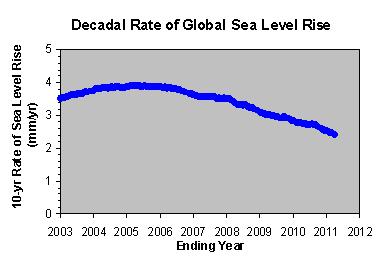
looking at the decadal rate of increase it has actually been falling off for last 5 years:
http://www.masterresource.org/wp-content/uploads/2011/09/sea_level_rise_fig1.jpgThat's a nice unattributed JPEG hosted at "Master Resource", a "free-market energy blog" with categories on Austrian economics, Ayn Rand, and objectivism. Fortunately I don't need to leave my criticisms at questioning the source of the material. If you look at your first link, you can see that the rate really did decline towards the beginning of 2011 where this 2nd chart stops before suddenly surging up again to match the preceding trends: so the trend over 2011 and 2012 is actually much higher than it was the preceding few years.
This is cherry-picked data -- it is very easy in any system containing noise to pick endpoints to make it appear that the overall trends have stopped. A great depiction of this is the escalator graph: How "Skeptics" View Global Warming. You need to look at the big picture -- every climate graph shorter than a decade is lying, because a decade is not long enough to show long-term climate trends. It is very easy to pick subdecadal trends that either exaggerate or mask longterm trends, so you need to look at the big picture.
A rather big factor that needs to be taken into account is that since the 1950's there has been a massive amount of ground water abstraction for agriculture that is estimated to contribute something like 0.4-0.8mm/year to sea level rise (15-25% of total).http://news.nationalgeographic.co.uk/news/2012/05/120531-groundwater-depletion-may-accelerate-sea-level-rise/
This is counter-acted by the amount of water that humans are storing in reservoirs, which account for 0.55mm/year: Impact of Artificial Reservoir Water Impoundment on Global Sea Level.
-
Re:No significant change for a century.
recent data doesn't show any increase in rate of sea level rise:
http://sealevel.colorado.edu/The article doesn't say that the rate of sea level rise is accelerating, it says that it is higher than was predicted.
looking at the decadal rate of increase it has actually been falling off for last 5 years:
http://www.masterresource.org/wp-content/uploads/2011/09/sea_level_rise_fig1.jpg
doesn't appear to be any significant alteration in rate of rise over last 100 years,Are we looking at the same graph? That shows a distinct accelerating upward curve over 140 years, and the graph has too much noise to take any notice of 5-year timescales.
rate of rise in 30's-60's was about the same as current:http://www.oceanclimatechange.org.au/content/images/uploads/2012_sea_level_fig1.jpg
20 years should be a big enough time frame to see something, but it's still hard to make out what that graph is saying. The first 12 years look like acceleration, then there seems to be a fall-off in the rise for 6 years, but the dip in 2011 might just be an anomaly.
-
No significant change for a century.
recent data doesn't show any increase in rate of sea level rise:
http://sealevel.colorado.edu/
looking at the decadal rate of increase it has actually been falling off for last 5 years:
http://www.masterresource.org/wp-content/uploads/2011/09/sea_level_rise_fig1.jpg
doesn't appear to be any significant alteration in rate of rise over last 100 years, rate of rise in 30's-60's was about the same as current:
http://www.oceanclimatechange.org.au/content/images/uploads/2012_sea_level_fig1.jpgA rather big factor that needs to be taken into account is that since the 1950's there has been a massive amount of ground water abstraction for agriculture that is estimated to contribute something like 0.4-0.8mm/year to sea level rise (15-25% of total).
http://news.nationalgeographic.co.uk/news/2012/05/120531-groundwater-depletion-may-accelerate-sea-level-rise/ -
Re:Necessary and sufficient
The USA has been investing hugely in wind energy [wikipedia.org]. Does "stopping" mean "exponential increase" in your world?
No, what that means to me is that good money is being thrown at bad technology. If it could compete in the market (without killing bunches of endangered raptors), it would do it without government subsidies (measured per kW generated, not just absolute value). There is a reason *the free market* abandoned wind power over a century ago.
Instead, we have huge oil/coal subsidies which end up making coal energy marginally cheaper then comparable wind turbines at present technology.
Um, no. Stop looking at the total amounts, and look at the subsidy per kW generated.
http://www.masterresource.org/2011/05/big-wind-sen-alexander/
Also, remember, we can ship coal everywhere - you can't ship wind everywhere
The Europeans and Asians will end up owning this market if the Republicans keep subsidizing big coal/oil.
False association. China and low-wage european countries will own any manufacturing market because of labor costs compared to the US, not because of any subsidies.
-
Re:No doubt
One paper overturns all of climate science, really?
If you'd spend less time on denier blogs, you'd be aware of the vast breadth of research papers on each topic. And how Lindzen and Choi don't exactly have the best record out there. That paper was first rejected from the Journal of Geophysical Research. Then it was rejected by the Proceedings of the National Academies of Sciences, and only later accepted by a rather no-name journal (Asia-Pacific Journal of Atmospheric Sciences). Here's PNAS's rejection of it.
-
Re:College bull
Hey lazyej
Let's correct some of your misperceptions:
1) Occam's razor dictates that we should not favor a hypothesis which requires more assumptions (http://jeffreyellis.org/blog/?p=44). Your hypothesis that a trace gas measured in ppm is the primary driver of temperature requires all kinds of assumptions regarding amplification of effect by water vapor, and ad hoc explanations to deal with the historical record which shows CO2 lagging temperatures, not leading them.
2) Seasonal temperature differences *require* more than just an axial tilt - your original statement, while attempting to relate to Occam's razor, was simply "seasons are defined by the axial tilt of the earth" - a tautology, not a cause/effect relationship. Your poor rhetoric and misunderstanding of *definition* versus *cause and effect* clouds your argument here.
3) The heat from the earth's core is not evenly distributed in either time or space - it's specific distribution certainly can effect weather patterns, on all number of scales.
4) Lazyej misunderstands that the slope you get is highly dependent on what endpoints you pick: http://www.masterresource.org/2009/10/a-cherry-pickers-guide-to-temperature-trends/
Another conundrum for the CO2 is responsible for all theory:
http://wattsupwiththat.com/2009/02/21/co2-does-not-drive-glacial-cycles/
"Consider the earth 14,000 years ago. CO2 levels were around 200 ppm and temperatures, at 6C below present values, were rising fast. Now consider 30,000 years ago. CO2 levels were also around 200 ppm and temperatures were also about 6C below current levels, yet at that time the earth was cooling. Exactly the same CO2 and temperature levels as 14,000 years ago, but the opposite direction of temperature change. CO2 was not the driver."
CO2 at 200ppm behaves the same way as CO2 at 200ppm. It does not care whether or not the jump from 180-200ppm came from a volcano, outgassing from oceans, or through forest fires. Asserting that it does is a special pleading that requires ad hoc additions and assumptions to explain past climactic variation.
-
Re:Climate Change Deniers
You claim that Occam's razor dictates that the easiest answer is always right, and of course the easiest answer is "We don't know". Thank God scientists don't share your understanding of Occam's razor or we would know nothing at all.
You're misunderstanding the application of Occam's razor, and more particularly, how we could possibly apply it to chaotic systems. In order to understand the PDO and ENSO, we don't simply measure things, and then attribute all of our observations of ignorance to those two phenomena. We ruthlessly filter, challenge and try to falsify our assertions. Your interpretation of Occam's razor is "if I have a hypothesis, and nobody else does, it automatically must be true because it's simpler than the alternative that we don't know". This is a faulty interpretation.
For instance, let's apply our understandings to the seasons. I believe that the seasons are caused because the earth's axis is tilted with respect to it's orbit. Summer happens in the hemisphere tilted towards the Sun.
So by that token, would you explain the Year Without a Summer in 1816 as a change in the tilt of the earth's axis?
By your hypothesis, you would've predicted that 1816 would have had a normal summer. As it turned out, an unknown factor entered the equation, and modified the results. Attributing the unknown factor instead to your original hypothesis would have required a special pleading for a anomalous change in the tilt of the earth's axis.
Here's another interesting note:
Here, the evidence shows that without significant ocean currents, heat distribution throughout the world would be more even, leading to less notable seasons, despite the earth's axial tilt.
With respect to whether or not the temperature has been rising, you are alone in thinking that it has not. Every temperature reconstruction shows the same trend.
Wrong again. Look carefully at the global temperature trend graph here:
http://www.masterresource.org/2009/10/a-cherry-pickers-guide-to-temperature-trends/
1) The reason we over sample is so that errors in trends will cancel each other out. Watts has found that this strategy is working.
Agreed, however I still hold that the increased uncertainty discovered by Watts is important to understand the trend.
2) You are the only one who ever suggested that there should be a statistically significant trend over any timescale no matter how small. This idea is ludicrous.
I believe you're misunderstanding me - I merely suggest that there *could* be a statistically significant trend over any timescale. As for small timescales with statistically significant trends, I'll simply offer the temperature difference over your house from 9am to 12 midnight.
Spencer is referring to climate sensitivity, not to the known forcing of CO2. That is, given that the world will warm by about 1C for a doubling of CO2, how much more should we expect from feedbacks? Spencer does not dispute the known forcing of CO2.
I don't think anyone disputes the "known forcing of CO2" as measured in a laboratory - the question is, is this significant when in the real world, and we have the possibility of both more *and less* due to competing feedbacks. More pointedly, the question being posed to the layperson is, "will this be a bad thing?"
I would argue the following - the expectation of more warming due to positive feedbacks with additional CO2 is grossly overstated, and l
-
Re:Climate Change Deniers
Regarding the 20 year temperature trend, and the various global datasets:
http://www.masterresource.org/2009/10/a-cherry-pickers-guide-to-temperature-trends/
-
Re:And that's bad how?
If this is all an attempt to cut global pollution, fine that is a good thing.
Which it's obviously not, because what it does is re-classify CO2 as a pollutant, which it is not. Has anybody studied how reducing CO2 concentrations back to 1940's levels will affect crop yields, which have increased significantly since then? Yes, there have been plenty of advances in technology and know-how that have improved farming in the last 70 years, but surely the concentrations of such a critical component of photosynthesis as CO2 must have some effect on yields as well. So will our attempts to "solve" the Global Warming "crisis" have other unintended consequences like
And what about all the real pollution, that we have much better control over? Are we ignoring doing something about the obvious issues with our critical waterways because of some prediction from computer simulators? And how many of the assumptions that went into those climate models are accurate, and how many are way off from reality? Shouldn't we ask for some accurate predictions out of those models before we assume that all the theory behind them are correct?
-
Re:Extraordinary claims...
I've heard a lot of criticism of the IPCC, but all of it is political. Are there any scientific rebuttals of their findings?
Not sure if you would call it a "rebuttal", but it seems that certain observed factors of climate sensitivity shed some very serious doubt on the assumptions used in the vast majority of climate models that predict certain outcomes.
Based on this new data, most of the predictions of effects that would occur in about 100 years, according to the IPCC reports, would actually take more like about 700 years based on current trends in of CO2 emissions.
There are others, but this one seems the most damaging.
-
Re:How long has this been going on?
Maybe this makes for an interesting read: http://masterresource.org/?p=3847
I have been wondering for years how climate scientists can "know" so well that their forecasts "are right", when their scientific "models" are so simplistic compared to reality, that they most probably are wrong anyways. It kind of reminds me of a biologist who has just recently discovered neurons in the brain, and is now telling me that his model based on that can predict my thoughts. Or an LTCM manager telling me that he has a "bulletproof" way of making a profit.
After all, 99% of scientists who agree with GWT are *nothing* compared to the single person with the falsification of GWT.
-
Re:Cap & Trade = Energy Rationing
Taking money away from Target doesn't make everything that much more expensive. I can shop there or not. I can shop elsewhere, I can choose to not buy it, Target can choose to reduce costs or profit, etc. Oh, and inflation can happen even if money printing were suspended to keep money levels at the current levels. If a true scarcity of money were to exist it would increase bartering, but it wouldn't eliminate inflation. To add that in indicates to me that you don't know anything about economics, but that you hate the government and read sites that agree with your opinion and parrot their stances.
Taking money away from a store like Target does make everything that much more expensive, if not right away. The store may need to raise prices to stay profitable, or if that isn't possible, discontinue production or switch to something more profitable. In any event, it discourages production and raises prices (law of supply). This is Econ 101 stuff.
Inflation can still happen without price inflation, if there is monetary inflation. (All three are different, I use this definition to illustrate a point). The tendency of prices is to go down as people become more specialized and efficient, so if prices to televisions or food stays the same because government is inflating the money supply, you are still being ripped off none the less, because society is producing more goods but not consuming more. And price inflation does have to stop somewhere, as evidenced by the fact a price, an exchange ratio, cannot go above the current amount of money in existence (almost humorously, because of the fractional reserve system, trying to do so would cause both monetary and price deflation). Any price inflation without monetary inflation represents a true increase in the cost of goods, e.g. more people trying to purchase the same amount of oil/metal/food (though, more money would be allocated for these uses and away from other goods, so it couldn't last for too long). I agree, barter also changes the landscape, though money is so superior to barter that there is little reason to do so, unless laws like price fixing actually prevent you from attaining money.
You claim money isn't scarce? It is an economic good, by definition it is scarce. (Alright, technically fiat money is not truly scarce in the sense it can be created with no factors of production required, but for day to day concerns, I know for sure I can't get an infinite amount of dollars)
Projected by whom? And to "the climate" or our contribution to it? And how is it taxing me when I won't be paying a penny into the government fund?
I cited the slightly broader definition of a tax: government revenue. Even if government isn't taxing a specific entity, for example with inflation, it is still a tax on society. Anything government consumes is something that the rest of society cannot, making things more expensive.
"Cap and trade" is a tax, not on individuals, correct, but that doesn't mean it does not affect individuals. It has far reaching consequences for everyone, especially the lower class since this is about energy.
I heard 1/50 deg (C iirc) decrease on the news this morning, but the highest I can actually find is 1/900 deg C. And that presumes the climate works the way we think it does (the harsh reality is we haven't been able to model even a decade into the future). Can you do better? I almost want to be wrong about this.