Slashdot Mirror
Domain: mpoweruk.com
Stories and comments across the archive that link to mpoweruk.com.
Comments · 22
-
Re:Nat Gas
Brushing the coal to make "clean coal" sounds like a homeopathic idea.
Otto Frisch, the nuclear scientist wrote a parody scientific paper back in 1955 set in the distant future when nuclear fuels had become scarce, entitled "On the Feasibility of Coal-Driven Power Stations". It suggested that coal be machined into similar-sized spheres for optimum packing within the furnace among other things. Its energy density was derisory of course compared to safe clean uranium. The gaseous emissions would be dealt with by captive balloons of some sort since it was unthinkable to allow the toxic wastes from the coal-burning furnace to enter the atmosphere we breathed.
-
Re:Inconvenient truth about solar
at noon, near the equator - some correction for your preferred latitude may be necessary.
-
Otto Frisch had the answerOtto Frisch (one of the inventors of the nuclear bomb) wrote a spoof article: "On the Feasibility of Coal-Driven Power Stations" in 1955
The main health hazard is attached to the gaseous waste products. They contain not only carbon monoxide and sulphur dioxide (both highly toxic) but also a number of carcinogenic compounds such as phenanthrene and others. To discharge these into the air is impossible. It would cause the tolerance level to be exceeded for several miles around the reactor.
It is therefore necessary to collect the gaseous waste in suitable containers, pending chemical detoxification. Alternatively, the waste might be mixed with hydrogen and filled into large balloons which are subsequently released.
-
Coal is a poor option
The U.S. has the largest coal reserves on the planet it's our cheapest and most abundant energy source.
"Most abundant energy source"? Nope. Solar energy is far more abundant and will still be here even if we (foolishly) burn every ounce of coal from the ground. The earth receives more energy in one hour from the sun than all of humanity uses in an entire year. "Cheapest"? Wrong again. Currently natural gas is cheaper in many cases at today's prices. So is on-shore wind, geothermal, and hydro. Nuclear is about equal to coal. Solar PV is competitive even without subsidies and falling fast. If you take into account the full cost of coal (including pollution) then it isn't even close to the cheapest option for power generation. Coal only seems cheap because we don't require coal plants to mitigate the full cost of the pollution (including CO2) that they produce. Yes the US has a lot of coal but the best thing we could possibly do with that is to leave most of it in the ground.
If anything we should be building more coal plants instead of trying to drop our economic growth to zero and surrender comparative advantage.
Why would we do such an idiotic thing? Natural gas plants currently make a lot more economic sense and while not clean are certainly cleaner than coal plants. Perhaps you don't care to actually be able to breathe the air? If you want to see the effects of your suggestion in real life I encourage you to go travel to China and see the results of abundant coal power. Never mind the fact that burning all that sequestered carbon is without question going to wreak havoc with the global climate. What, you thought that putting billions of tons of carbon that is currently buried into the atmosphere would come without consequence? That's a foolish and dangerous thing to believe.
-
Re:What about at night?
What about at night?
Fortunately the wind blows at night. Here is a wind resources map for the United States. Lots and lots of consistently windy areas. Wind is cheaper than solar currently and in nine out the ten nations that top the renewable energy charts, there is more wind capacity than solar, and this is likely to remain the case.
With the use of high voltage DC transmission lines (a technology that has been in use since 1930) electricity can be shipped coast to coast with minor losses. 800 KV lines can transport electricity from one coast to the other with about the same losses as existing grids, about 6%. Constructing a national long distance electrical "highway" makes most of the "problems" perceived with renewable energy disappear. Just like now, there is not going to be just one source of power in the future, so solar does not have to do it all.
Even is solar "only" supplies the daytime peak load, this is half of the total electricity demand. In North America it is convenient that 40% of the entire U.S. population lives on the Eastern Seaboard, so that when it has its evening demand peak, the sunny west is three hours earlier and would still be producing a lot of solar electricity. Then there are proven power storage technologies like pumped water storage. Just considering existing pumped storage capacity, and capacity expansion that has applied for permits, we are looking at 76.7 GW of PS capacity in the U.S. which is 7.5% of U.S. peak electricity demand.
-
Re:flywheel
Adding a pump to an existing dam to convert it to pumped-storage operation, is rather inexpensive.
You have no idea how dams work. Water that leaves a dam flows down river and is not available to be pumped up again. Even if you added another dam to catch the water it would decrease the efficiency of the original dam as the drop would be decreased.
The power loss is overwhelmingly because of evaporation from the dam reservoir.
Again you need to look into facts before commenting. The no electric motor or generator is 100% efficient. For example, water turbines have an efficiency as high as 95%. Since that is for a turbine optimized for generation and pumped storage uses the same turbine to pump and it does to generate the efficiency would be less. Assuming losses from the pump are the same at least 10% of the electricity is lost due to converting the electricity into potential energy and back again.
-
Re:But
The quickest numbers I could find say that at the scales of large power-plants, the generator is very efficient, but the turbine not so much, around 50%. This would put the system as a whole at around 40% efficency sunlight -> electricity. That's competitive with the best solar voltaic systems tested in the lab, and 50-100% better than practical systems on the market. Assuming their system really does scale up to power plant sizes, of course.
-
Re:summary is of course very misleading.
A 1st grade teacher doesn't need the same qualifications but they do need qualifications in teaching science.
Science magazine has had lots of articles about the new ways to teach 1st graders about science.
For example, teachers gave out stones and seeds. They asked the kids what the difference was between the stones and seeds. Then they planted them and waited for the seeds to sprout while the stones did nothing.
The point was that 1st graders don't distinguish clearly between animate and inanimate objects. This is a surprisingly important concept. This lesson taught them the difference between animate and inanimate objects.
Science teaching looks easy but it's actually quite difficult to do well.
A lot of this these comments sound like the joke about the efficiency engineer who went to a performance of a symphony orchestra. http://www.mpoweruk.com/harmon...
-
Re:You've got your 3 and 6 mixed up
Here's some other images then:
http://www.mpoweruk.com/electr...
California 1999, peak load at 6PM.http://www.hawaiianelectric.co...
Hawaii, peak load at 7PM. Also shows insolation, which shows the sun has set by 7PM.There's all kinds of data on the internet showing load profiles, it's just that most of it is in Excel spreadsheets. I'm not in the mood to download them to see what I already know. If you have data that shows otherwise then please share rather than make unsubstantiated claims.
Solar power is a boondoggle. It produces no real power since it requires backups for when the sun does not shine. If we have to build the backups for solar power then why not just run the backups all the time? Given that natural gas is cheaper than solar that is precisely what the utilities are doing.
Even if solar power were free it is still worthless since we do not have the means to store that electricity for a price cheaper than producing it from natural gas, wind, coal, and nuclear. Running power lines to where the sun is shining won't help either since I2R losses would be huge, as would be the cost to build and maintain those lines.
I'm not "green bashing", I just did the math. Solar power is worthless for grid power. If you are off the grid then the math changes but that is not what is being discussed here. The only reason anyone buys solar panels when grid power is available is because the government paid them to. That means the government took my money to give to some wealthy person with a big house so they can buy solar panels, then they take more of my money through more solar power subsidies because they have the solar panels on their roof.
If you think "big oil" is some evil lobby then what about "big solar"? The solar power business model is based on continued government subsidies. Without the government propping them up none of them would be in business. "Big oil" and "big coal" would still be around without government money because they actually produce something useful.
Does "big oil" make a lot of money? Yep, that's because you and I gave it to them. We got energy in return but we still gave them that money without a gun to our head. Does "big solar" make a lot of money? Yep, but they do it with the threat of government force.
-
Re:There's a question about that at Skeptics
That's interesting and may well be true, however can we please step back from the copse of trees to see the whole forest? That DNA is a fractal antenna is an interesting bit of trivia, but requires context for proper interpretation of what that means when applied to the scope of our everyday lives. Electromagnetic radiation is not a human invention, it has always existed, both in ionizing as well as non-ionizing wavelengths. For the average person, even in our electronic age, natural sources account for the greater portion of our day-to-day electromagnetic radiation exposure.
While it only deals with ionizing wavelengths I still want to call upon XKCD's radiation dose chart because it provides some much needed perspective. I would further like to include a nice little tutorial on EM. Before we even begin to pick on WiFi, there are plenty of other things in modern society we should ban first including, the Sun, cordless phones, cell phones, TVs, microwave ovens, electric space heaters, electric motors, baby monitors, analog radio stations, high-voltage power lines, etc.. I find it simply amazing how the same people whom are so concerned about radiation from cell phones, will think nothing of placing a baby monitor right next to their child's crib.
-
Re:Sounds like a great plan.
I did some quick research. Fracking is typically done 2-3 km underground. The ground temperature at that depth is about 75 C. The pressure at that depth is about 200-300 bar (atmospheres).
How dare you! Actually putting together some data. What's this world coming to?
Anyhow, I appreciate it. But my biggest concern is that underlying the Marecellus shale is the Utica shale. Although it spreads out further than the Marcellus, it is in most of the same area. Having valuable natural gas reserves, this will be next on the hit list.
And after the Marcellus reserves play out, would sequestering CO2 in the rocks interfere with Utica drilling? Assuming similar drilling methods, the boreholes would be spending a fair amount of time in the Marcellus shale before getting to the Utica shale. Would all the wells in an area heve to be played out before pumping CO2 into them? Important in some areas, as even the Tuscarora sandstone fields in the same area are not yet played out.
So, a nice computer simulation asaide, I don't think there is anywhere enough data plugged into this, just looks like a comparison between gas out/gas in.
-
Re:Sounds like a great plan.
we instead have a massive catastrophic climate change when one of those chambers springs a leak.
A lot of people forget that material properties change with pressure and depth. The first time the Alvin submersible found black smokers (active volcanic vents) on the mid-oceanic ridge, they moved in for a closer look. They found out afterwards that they'd recorded temperatures close to 400 C. The melting point of Alvin's portholes was far less than 400 C, and they would've died if they'd stayed there too long. People see liquid water, and just assume the temperature is below 100 C and therefore the glass portholes are safe. But at the depth they were at, the pressure is much higher and thus the boiling point of water was around 400 C.
I did some quick research. Fracking is typically done 2-3 km underground. The ground temperature at that depth is about 75 C. The pressure at that depth is about 200-300 bar (atmospheres).
Looking at the phase diagram for CO2, that's in the supercritical fluid phase. So the CO2 wouldn't need to be pressurized at that depth like it has to be at sea level. The ground pressure alone would be enough to prevent it from reverting to a gas, and thus it would be impossible for the chamber to catastrophically spring a leak. The only way that could happen is if another drilling operation tapped the chamber and suffered a blowout. Normally that doesn't happen - they keep the bore filled with heavy mud to maintain the pressure at depth. But occasionally (e.g. Deepwater Horizon) there is a blowout, the pressurized mud is lost, and the liquid/gas underneath is then squeezed out by the surrounding rock through the "straw" (bore). I don't see this as being any more risky than regular oil drilling. If anything it's safer since CO2 is pretty inert and won't catch fire. The biggest risk would be the CO2 gas pooling in a depression and suffocating anyone/anything inside. -
Re:Letting the battery cycle?
You can treat them however you like cycle-wise and you'll get about the same total lifespan out of them
This isn't entirely true. See the graph here (the page is mostly about lead-acids, but as the author states the graph in question is valid for li-ion, just with a different scale). Look at a couple of data points towards either edge of the graph, for example, 20% and 80% depth-of-discharge. At 20%, the battery the author is describing gets 3,300 cycles whereas at 80% it gets 675. Assuming the battery has a 1Ah capacity (for simplicity of calculation) this means that with 20% DOD you get a total battery life of 660Ah but at 80% you only get 540Ah. That's nearly a 20% difference in lifespan.
-
Re:Japanese covering their butts?
This is a nice quick review of Lithium nastiness....
-
Re:Good grief. Religious zealots really annoy me.
"Since the Earth's cross sectional area is 127,400,000 square km, the total Sun's power intercepted by the Earth is 1.74E+17 Watts but as the earth rotates, no energy is received during the night and the Sun's energy is distributed across the Earth's entire surface area so that the average insolation is only one quarter of the solar constant or about 342 Watts per square meter. Taking into account the seasonal and climatic conditions the actual power reaching the ground generally averages less than 200 Watts per square meter. Thus the average power intercepted at any time by the earth's surface is around 127.4 X 106 X 106 X 200 = 25.4 X 10¹⁵ Watts or 25,400 TeraWatts.
Integrating this power over the whole year the total solar energy received by the earth will be:
25,400 TW X 24 X 365 = 222,504,000 TeraWatthours (TWh)"
So what is the mass equivalent of 222,504,000 TeraWatthours if one gram of matter is equivalent to 10E+13 J of energy? -
Re:So, they know of no fires
Nope, my logic is fine. I stated my assumptions - comparing worst case scenarios. You're applying a "best case scenario" (no gas tank rupture) to a worst-case lithium cell failure - thermal runaway with cell integrity failure. Lithium cells in a thermal runaway situation normally vent byproducts for a controlled burnoff of the products rather than explosion. Like you said, there's no free oxygen to burn the gas tank, same applies to the lithium cells. ASSUMING THEY'RE NOT RUPTURED.
Unfortunately you are making the common mistake of assuming that Lithium Ions cells have elemental lithium in them - not true. You can't apply the high-school chemistry notion that elemental Lithium is very reactive.
Lithium ion batteries don't spontaneously burn when exposed to air or water. They almost always burn because of thermal runaway, and it's usually the electrolyte that burns. Thermal runaway usually occurs because of dead shorts. Modern LiON cell design takes this into account and makes it VERY physically difficult for dead shorts to occur. There is copious fusing mechanisms located throughout the battery, and the battery housings are all composite materials. You pretty much would have to drive a steel stake through the heart of the cell to have any kind multi-cell dead short.
In the context of the volt crash test fires, all of them happened WEEKS after the crash test was performed.
What can happen in a gas fire is that if you sufficiently heat the tank such that it ruptures, you run the possibility of spraying gas everywhere that is then your typical fun fuel-air bomb. Since we're talking about wrecks here (which was the topic of the original article), this is relevant. This is a rare chance given a well- designed vehicle that has a tank in a secure location. So, usually, worst case you have a small leak. Fuel pumps cut off after wrecks for this reason, so you're not dumping fuel through a potentially broken line.
Honestly we won't really know the stats until we get a few million vehicles on the road. Given that there are 300,000 car fires a year, I don't think it will be hard for electric cars to beat that.
More info on how Lithium batteries fail:
http://www.mpoweruk.com/lithium_failures.htm -
Re:Power Miracle
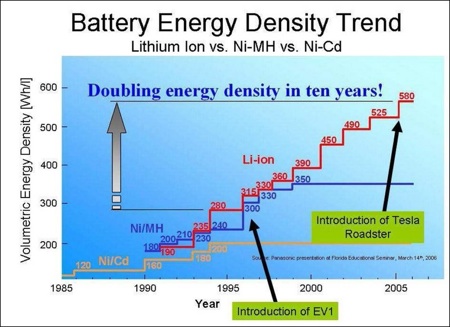
Except guess what, battery density actually has improved steadily over time, and dramatically overall. It's not automatic, it's the result of many improvements just like this one.
-
Re:Batteries
Dan doesn't seem to know much about batteries. Check out batter power discharge curves and such...
http://www.mpoweruk.com/performance.htm Remaining power is estimated based on the charge of the battery. If you notice on those graphs, when you get out to the end of the stored charge, it drops off very quickly, which is why the gauge goes from half to empty quickly.
Those curves are for a new, single cell.
If the battery charge meter precipitously drops on a not-so-new multi-cell battery (most laptop batteries are multi-cell), it is more likely indicative of a failed cell within the battery.
-
Batteries
Dan doesn't seem to know much about batteries. Check out batter power discharge curves and such...
http://www.mpoweruk.com/performance.htm Remaining power is estimated based on the charge of the battery. If you notice on those graphs, when you get out to the end of the stored charge, it drops off very quickly, which is why the gauge goes from half to empty quickly. -
Re:Critical questions of how
1) How much will they cost
2) How long does it take to charge
3) How many charges can you get in its lifetime.And one more:
4) What is the self-discharge rate?
Most sites I checked say it is a function of cell chemistry and temperature, but this is also a significant change in geometry, so I'd still want to see 'shelf-life' measured.
-
Re:I doubt it will be viable in notebooks
What are the numbers for the "half as long"?
If you look at the battery curve for a Lithium Ion battery as in http://www.mpoweruk.com/performance.htm, you can see that the voltage is very stable for most of the life of a Lithium ion battery.
Remember what capacitor discharge looks like?
It is an exponentially decaying curve, as shown in various physics and engineering texts: V(t)=V*e^(t/RC). How do you manage the voltage? The half-life time constant is the resistive load times the capacitance. But the voltage isn't constant at all. At some point you will be above [sometimes WAY above] the desired voltage, and at some point you will be below.
It also takes energy to stabilize the voltage - so that is a continual loss.
Some uses - like motors - can handle varying voltage, but what about electronics? How does a digital camera like 2V vs. 2.4V? What about 6V? or 1.4V?
The convenience of a quick charge is nice, don't get me wrong. But the tradeoff is the voltage level, and needing to recharge more often, and more energy lost when regulating the voltage. -
Re:A cheaper way> 4. Place phone in pan.
5. Crack an egg on the phone.#5 might be closer to a solution than you guess.
I, like others, RTFA, and along with everyone else who'd like their 30 seconds of "WTF" back, here's a way that might actually work.
1) Remove batteries from phones.
2) You've got between 1 and 2 amp-hours of 12 volts to work with.
3) You need to get the yolk to around 63C for soft-boiling, and from 20C room temperature, that'll take you around 15-20kJ of energy. Yeah, I've skipped a bit.
4)Crack one egg onto one phone - you'll cook something as you short the entire battery out through a pile of egg. If you used the battery as a swizzle stick, constantly stirring the egg mess, and constantly scraping the battery terminals free of solidified gunk, you'll generate a decent amount of heat in the gunk. (You'll also probably electrolyze some of the stuff in the egg, so I wouldn't recommend trying this at home - FSM-only-knows what kind of stuff will show up at the battery terminals beyond hydrogen and oxygen.)
At worst, you'll end up with a partially-toxic, soupy, warmed-over mess with a few chunks of scrambled egg in it.
6) If you've got enough surplus energy (like, say, 100kJ to work with), break up the battery packs, use them to power a small hot plate or peltier unit, (preferably with 12V, but if you've got even more surplus energy in the battery packs to waste on conversions, you could use a converter to turn 12VDC into 120VAC), and power your heater with that.
Crack the egg onto the hot plate, and you'll end up with a light fluffy omelette.
Either way, you're way ahead of the author of the original link.