Slashdot Mirror
Domain: mrob.com
Stories and comments across the archive that link to mrob.com.
Comments · 10
-
Re:Lunar clocks?
Sleeping after lunch works well for a lot of people. I'm Spanish -- we know about our 'siesta'.
There's evidence that we naturally used to sleep in two phases, and some people have suggested a similar pattern to yours.
-
Re:It was a very stupid idea
TB wrote:
>Linux is far from "write once, works 3 years from now" and neither is OS XAn application properly written for the original 128K Mac was able to run all the way through the Mac OS X era on PowerPC machines: http://mrob.com/pub/source/missile.html
25 years. 1984 (initial Mac OS) -- 2009 (when Snow Leopard was released and Rosetta ceased to be available).
I'm still running Macromedia FreeHand/MX (and sometimes v10) on my iMac running Snow Leopard (unfortunately, it doesn't work outside of emulation on 10.7 or later) and it came out in --- that's 2003 or 2000 or so up to now.
By contrast, I can't get FreeHand v8 to run on my Windows machine 'cause the splash screen won't go away after the program launches.
Just a few datapoints.
-
Re:Why doesn't Linux use sub-pixel rendering on te
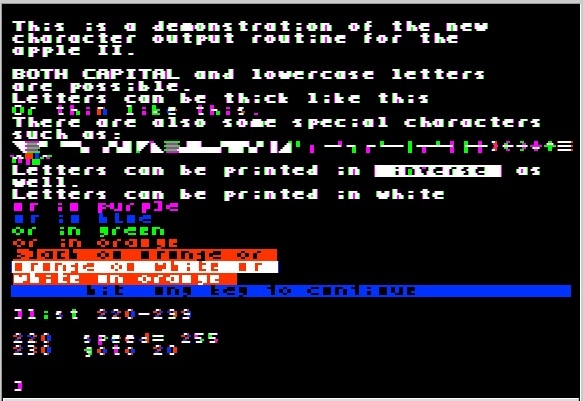
I generally dislike "subpixel" rendering, I didnt buy a high res monitor to look at fuzzy text like my Apple II displays
-
Re:Yeah, this is GREAT...
That said, properly written software for Mac OS 1.0 could run perfectly through every version of Mac OS, up to and including under Classic emulation on PowerPC running up to Mac OS X 10.5 --- here's the source code for a Missile Command clone which demonstrates that:
http://mrob.com/pub/source/missile.html
Anyone know if there's a Pascal compiler for Mac OS X which would let it work yet?
-
Mac source code classic app
That would be an old version of Missile Command I believe:
http://www.mrob.com/pub/source/missile.html
William -
Here, try this...
...then maybe you can retire that Apple
-
For Those Who Don't Know What We're Talking About
I dug up a copy of the original source here.
-
Reduced accessibilityI use gnut under Linux and have written a simple script which connects to http://www.gnutellahosts.com/, downloads the top hosts and then fires up gnut with them.
Over the space of the last six months the percentage of network content has dropped from 95% to now only 48.19%.
I think this percentage will drop even more in the next 6 months.
--
-
the Internet current opinion
take a look at this graphics to see what langage rules/sucks. What sucks hard is Maple, and people prefer Cobol to Java
--
BeDevId 15453 - Download BeOS R5 Lite free! -
historically, rich artists are a very new thing
So, what made us think we needed rich recording artists? I look at the radio-dominated years, when quality music had to be paid for, and think of how much I missed. Your great-grandparents got their music for free, and most of them knew the musicians personally. Read here for a description of how much we lost when industrialized music dsitribution came into being. To summarize:
- Music was distributed from one person to the next (by word of mouth), completely uncontrolled and decentralized.
- Everyone heard LIVE performances several times a month for free.
- Rich performing artists were virtually nonexistent.
Sounds like the MP3-future, right? But that was THEN.
We all know what the recording industry brought us -- popular classical supplanted folk, and then many other even more technically elaborate musical styles ensued (ragtime, jazz, etc. right up to today's techno and conscious hip hop). Most people today believe that more and better music was available to Americans in the 1970's than in the 1870's. But they lost their folk art too, and live performance became a very rare treat. Music became something you had to pay for, or endure the voiceover chatter and advertisements of the radio.
So what? Well, think about it -- if things keep going the way they are, we'll return to an economy in which massively rich artists are very rare or nonexistent. Music will once again be passed along from one person to the next. It's really closer to our roots as a human race, if you think about it. The best creative musicians will be those who, like Mozart and Beethoven, live and die for their art and nothing else. And of course, we'll retain the technological convenience of not having to perform music ourselves. Beyond that -- imagine a personal DJ that takes your requests and automatically figures out what you'd most like to hear next.
Sounds pretty good to me.