Slashdot Mirror
Domain: nasa.gov
Stories and comments across the archive that link to nasa.gov.
Comments · 16,365
-
Re:It's classic crackpotteryI'm afraid that you are not paying attention to recent developments
http://science.nasa.gov/headlines/y2007/11dec_themis.htm?list136664:"THEMIS encountered its first magnetic rope on May 20, 2007," says Sibeck. "It was very large, about as wide as Earth, and located approximately 40,000 miles above Earth's surface in a region called the magnetopause." The magnetopause is where the solar wind and Earth's magnetic field meet and push against one another like sumo wrestlers locked in combat. There, the rope formed and unraveled in just a few minutes, providing a brief but significant conduit for solar wind energy. Other ropes quickly followed: "They seem to occur all the time," says Sibeck.
Now, either you know what the implications of this are -- or you do not. Please forgive me if you do, but I will explain it.
What happens in the laboratory with *electrical* plasmas is that the plasma will tend to form filaments of charged particles. It is a natural state of the plasma. Furthermore, multiple filaments will tend to possess long-range attraction and short-range repulsion. In other words, they will twist around one another without fully combining. This roped structure will essentially constitute a flow of charged particles as those charged particles move across the rope in response to charge differences, and this flow of charged particles will in turn create helical magnetic fields around each filament.
The observation of a roped magnetic structure connecting the Sun and Earth is extremely important because we know from our laboratory experiences with plasmas that ropelike structures occur when the plasma is electrical. If your argument now is that the similarity is coincidental, then the burden is upon yourself to explain how it is that gravity can create a roped structure within the solar wind.
I'm very curious what the response will be from the astrophysical community, but from what I've observed so far, it appears that the professional astrophysicists are going to attempt to ignore the unmistakable shape of this thing -- and the implications that it has for all of science.
So, do electrical currents exist in space? Let's look at what NASA has to say on the topic. You can check the link yourself if you don't believe it
From http://www.nasa.gov/mission_pages/themis/auroras/northern_lights.html:THEMIS also has observed a number of small explosions in Earth's magnetic bow shock. "The bow shock is like the bow wave in front of a boat," explained Sibeck. "It is where the solar wind first feels the effects of Earth's magnetic field. Sometimes a burst of electrical current within the solar wind will hit the bow shock and--Bang! We get an explosion."
Emphasis is clearly mine.
I urge you to continue your ridicule of me with more caution, for you may come to regret saying these things in the future. You can certainly be excused for not believing that we are seeing paradigm change, but it may turn out that we in fact just live in interesting times, and that I'm actually one of the good guys just trying to raise awareness of the issue. -
Re:Can anyone find any other pictures but the.....
The NASA main website and the JPL site both have a ton of full-res images http://photojournal.jpl.nasa.gov/index.html http://www.nasa.gov/multimedia/imagegallery/index.html
-
Re:Can anyone find any other pictures but the.....
The NASA main website and the JPL site both have a ton of full-res images http://photojournal.jpl.nasa.gov/index.html http://www.nasa.gov/multimedia/imagegallery/index.html
-
Re:Lovely
...and while the astronomers fiddle with gear you and I can only dream of having access to, take your camera and a tripod outside, and with no more than a portrait lens, you can take shots like these.
Disclaimer: I have a masters in Astronomy but I've never worked in the field. I did the degree "for fun", because I never got the opportunity to study in highschool, and because I wanted to know how we know what we know about the universe. I'm very much an amateur in every respect.
Defintely worth fiddling with camera gear, but at some point if you're taking your own shots you're going to want to use a telescope. Starting with binoculars is definitely the best way. Moving to a dobsonian for viewing (but terrible for photography) is a good next step. (Don't buy anything with a small aperture unless all you're interested in is moon and planets). Next good step would be a Newtonian on EQ mount or SCT. It gets very expensive very quickly. I pretty much gave up on astrophotography. (I live in a large city and when I do get away far enough, I'm usually exhausted from the drive, and there are other priorities (family). Also a 10" scope takes up a hell of a lot of room even in a station wagon).
An alternative to the above is to get hold of sky survey data that's already available and captured by the pro images. There's a lot out there that gets released usually after a year (to give the professional scientists time to work with it). Hubble data, Chandra X-Ray data, SOHO images. It's not all pretty composite colour pictures - you often have to learn to manipulate the images with image software or with more complex data there's specialized software that's not always for the faint of heart (often free, often Linux based). "Amateurs" have done amazing things with some of the images and data. In astronomy there is an "image" (FITS) file format that is actually more than just a simple JPEG etc. You have a background in photography so while it's not strictly RAW data in the sense that it's not coming straight off a sensor, you can think of this format as containing more information the way RAW contains more than JPEG (stuff like calibration information). More information here.
http://en.wikipedia.org/wiki/FITS
http://heasarc.gsfc.nasa.gov/docs/heasarc/fits.html
Please understand I'm not trying to discourage you from backyard astronomy. I just thought you might be interested in this too. These days the guys that take the images/capture data and the guys that analyse them are not always the same. ie. you often have technicians that specialise in running the machines.
Here are some links for you:
FITS data from lots of missions/instruments
http://heasarc.gsfc.nasa.gov/docs/archive.html
Digitized Sky Survey
http://archive.eso.org/dss/dss
http://archive.stsci.edu/cgi-bin/dss_form
Hubble
http://hubblesite.org/
SOHO
http://sohowww.nascom.nasa.gov/
Chandra
http://chandra.harvard.edu/
http://chandra.harvard.edu/resources/
If you want more detail and are prepared to try to work out science speak, you can get access to draft papers on:
http://arxiv.org/
Look under astrophysics
I don't have time to go into any more. Hope you're interested. -
Re:Lovely
...and while the astronomers fiddle with gear you and I can only dream of having access to, take your camera and a tripod outside, and with no more than a portrait lens, you can take shots like these.
Disclaimer: I have a masters in Astronomy but I've never worked in the field. I did the degree "for fun", because I never got the opportunity to study in highschool, and because I wanted to know how we know what we know about the universe. I'm very much an amateur in every respect.
Defintely worth fiddling with camera gear, but at some point if you're taking your own shots you're going to want to use a telescope. Starting with binoculars is definitely the best way. Moving to a dobsonian for viewing (but terrible for photography) is a good next step. (Don't buy anything with a small aperture unless all you're interested in is moon and planets). Next good step would be a Newtonian on EQ mount or SCT. It gets very expensive very quickly. I pretty much gave up on astrophotography. (I live in a large city and when I do get away far enough, I'm usually exhausted from the drive, and there are other priorities (family). Also a 10" scope takes up a hell of a lot of room even in a station wagon).
An alternative to the above is to get hold of sky survey data that's already available and captured by the pro images. There's a lot out there that gets released usually after a year (to give the professional scientists time to work with it). Hubble data, Chandra X-Ray data, SOHO images. It's not all pretty composite colour pictures - you often have to learn to manipulate the images with image software or with more complex data there's specialized software that's not always for the faint of heart (often free, often Linux based). "Amateurs" have done amazing things with some of the images and data. In astronomy there is an "image" (FITS) file format that is actually more than just a simple JPEG etc. You have a background in photography so while it's not strictly RAW data in the sense that it's not coming straight off a sensor, you can think of this format as containing more information the way RAW contains more than JPEG (stuff like calibration information). More information here.
http://en.wikipedia.org/wiki/FITS
http://heasarc.gsfc.nasa.gov/docs/heasarc/fits.html
Please understand I'm not trying to discourage you from backyard astronomy. I just thought you might be interested in this too. These days the guys that take the images/capture data and the guys that analyse them are not always the same. ie. you often have technicians that specialise in running the machines.
Here are some links for you:
FITS data from lots of missions/instruments
http://heasarc.gsfc.nasa.gov/docs/archive.html
Digitized Sky Survey
http://archive.eso.org/dss/dss
http://archive.stsci.edu/cgi-bin/dss_form
Hubble
http://hubblesite.org/
SOHO
http://sohowww.nascom.nasa.gov/
Chandra
http://chandra.harvard.edu/
http://chandra.harvard.edu/resources/
If you want more detail and are prepared to try to work out science speak, you can get access to draft papers on:
http://arxiv.org/
Look under astrophysics
I don't have time to go into any more. Hope you're interested. -
Re:Lovely
...and while the astronomers fiddle with gear you and I can only dream of having access to, take your camera and a tripod outside, and with no more than a portrait lens, you can take shots like these.
Disclaimer: I have a masters in Astronomy but I've never worked in the field. I did the degree "for fun", because I never got the opportunity to study in highschool, and because I wanted to know how we know what we know about the universe. I'm very much an amateur in every respect.
Defintely worth fiddling with camera gear, but at some point if you're taking your own shots you're going to want to use a telescope. Starting with binoculars is definitely the best way. Moving to a dobsonian for viewing (but terrible for photography) is a good next step. (Don't buy anything with a small aperture unless all you're interested in is moon and planets). Next good step would be a Newtonian on EQ mount or SCT. It gets very expensive very quickly. I pretty much gave up on astrophotography. (I live in a large city and when I do get away far enough, I'm usually exhausted from the drive, and there are other priorities (family). Also a 10" scope takes up a hell of a lot of room even in a station wagon).
An alternative to the above is to get hold of sky survey data that's already available and captured by the pro images. There's a lot out there that gets released usually after a year (to give the professional scientists time to work with it). Hubble data, Chandra X-Ray data, SOHO images. It's not all pretty composite colour pictures - you often have to learn to manipulate the images with image software or with more complex data there's specialized software that's not always for the faint of heart (often free, often Linux based). "Amateurs" have done amazing things with some of the images and data. In astronomy there is an "image" (FITS) file format that is actually more than just a simple JPEG etc. You have a background in photography so while it's not strictly RAW data in the sense that it's not coming straight off a sensor, you can think of this format as containing more information the way RAW contains more than JPEG (stuff like calibration information). More information here.
http://en.wikipedia.org/wiki/FITS
http://heasarc.gsfc.nasa.gov/docs/heasarc/fits.html
Please understand I'm not trying to discourage you from backyard astronomy. I just thought you might be interested in this too. These days the guys that take the images/capture data and the guys that analyse them are not always the same. ie. you often have technicians that specialise in running the machines.
Here are some links for you:
FITS data from lots of missions/instruments
http://heasarc.gsfc.nasa.gov/docs/archive.html
Digitized Sky Survey
http://archive.eso.org/dss/dss
http://archive.stsci.edu/cgi-bin/dss_form
Hubble
http://hubblesite.org/
SOHO
http://sohowww.nascom.nasa.gov/
Chandra
http://chandra.harvard.edu/
http://chandra.harvard.edu/resources/
If you want more detail and are prepared to try to work out science speak, you can get access to draft papers on:
http://arxiv.org/
Look under astrophysics
I don't have time to go into any more. Hope you're interested. -
Re:Yeah, that's about what I thoughtBy the way, for your reading pleasure, and in the midst of our debate over electrical plasmas, comes additional confirmation for EU Theory
http://science.nasa.gov/headlines/y2007/11dec_themis.htm?list136664:"THEMIS encountered its first magnetic rope on May 20, 2007," says Sibeck. "It was very large, about as wide as Earth, and located approximately 40,000 miles above Earth's surface in a region called the magnetopause." The magnetopause is where the solar wind and Earth's magnetic field meet and push against one another like sumo wrestlers locked in combat. There, the rope formed and unraveled in just a few minutes, providing a brief but significant conduit for solar wind energy. Other ropes quickly followed: "They seem to occur all the time," says Sibeck.
The existence of frequent "magnetic ropes" that connect the Earth to the Sun is a potentially paradigm-shifting observation. At this point, I'd have to express dismay if you do not understand the implications of what is happening right before our eyes, because it's surreal even to myself. The conventional paradigm is collapsing. Magnetic ropes connecting Earth with the Sun would constitute a direct and local observation of Birkeland Currents in space. In other words, quasi-neutrality is *TOAST*.
And the explosions within the bowshock? Have you ever heard of exploding double layers? -
Re:These Clouds are FilamentaryBy the way, check this out from today
http://science.nasa.gov/headlines/y2007/11dec_themis.htm?list136664:"THEMIS encountered its first magnetic rope on May 20, 2007," says Sibeck. "It was very large, about as wide as Earth, and located approximately 40,000 miles above Earth's surface in a region called the magnetopause." The magnetopause is where the solar wind and Earth's magnetic field meet and push against one another like sumo wrestlers locked in combat. There, the rope formed and unraveled in just a few minutes, providing a brief but significant conduit for solar wind energy. Other ropes quickly followed: "They seem to occur all the time," says Sibeck.
Ask *ANY* laboratory plasma physicist what a "magnetic rope" is and he'll surely, without any doubt whatsoever, respond that it's a Birkeland Current. It's the natural formation of electrical plasmas within the laboratory.
You can surely be excused for not realizing what is happening right now because the amount of evidence for Birkeland Currents in space has remained somewhat elusive for many years now. But the inordinate amount of instrumentation we have up in space right now is finally filling in the blanks. If you educate yourself on what is normal within a plasma laboratory and theories about how that relates to space, you will begin to realize that these structures are in fact Birkeland Currents. I highly recommend that you read "The Electric Sky" by Don Scott so that you can observe this surreal process of paradigm shift as it occurs. We will not experience something as profound as this in science for the rest of our lives. -
Re:missing matter != dark matter?
I'll probably get this wrong but
You don't really know, but you can infer.
If you know(1) there's some mass somewhere from say a gravitational lens but it doesn't emit radiation the way normal matter (proton, electron, neutron, typical neutrino's) would then it's presumably non-baryonic, ie dark matter(2). http://www.nasa.gov/home/hqnews/2006/aug/HQ_06297_CHANDRA_Dark_Matter.html
On the other hand if you can detect the radiation (in line with expected levels) and it's mass then you know it's baryonic.
The normal baryonic matter in the article's case isn't detectable now due to instrument sensitivity,
not due to some abnormality in the material itself. Once the new instruments are built the
hope is the matter can be detected. The material itself isn't abnormal, just it's location and density is
abnormal.
1) For random definitions of know
2) This is more or less the meaning of dark matter. -
Not Dark Matter
Since I'm sure the question will be asked, no this missing mass is not dark matter, as both the summary and the article are clear to emphasize. I wanted to repeat that. The primary evidence for dark matter is the galactic rotation curves. The article is talking about gaseous normal matter that we believe exists, but hasn't spotted yet. This missing gaseous matter is nowhere near sufficient in mass to explain the gravitational effect of dark matter and is being looked for on a scale larger than galaxies. The missing mass is an estimate 2% of the mass of the universe, whereas dark matter is an estimate 25%.
Also, I though it interesting that the is a very interesting rendition of the nearby universe. It's not related to the article, but it does show the filamentary structure the article talks about. -
Re: Let's not forget also the TCP/IP unfixed flaws
1- keepalive : IBM's SNA has an efficient keepalive mechanism. TCP has one but I never saw it working properly.
Uh, no? Please do correct me if I'm wrong, but keepalives are not at all part of the TCP/IP "church". In fact, keepalives are outside the TCP state machine, and I've seen some really interesting behaviors caused by poor implementations of this poor idea.
Poor idea? Well, yes: One of the points of TCP is to be able to survive temporary or intermittent "disappearance" of the underlying network. Keepalives expose these failures, breaking the TCP model.
For more on keepalive badness, please refer to section 4.2.3.6 of RFC 1122 (HTML); to RFC 2525 (HTML), which documents a number of known problems with the implementation of TCP keepalives; and to http://tcp-impl.grc.nasa.gov/tcp-impl/list/archive/0367.html for more on why TCP keepalives are a bad idea (and not even implemented the same way on all systems!).
Some of the bad behavior I've seen? This one is cool....
Server and client, both on HP-UX 6.5 (yeah, I know...). Both ends have sockets set to use keepalives (remember the old ISODE code? Used keepalives over TCP to mimic an X.25 analog that wasn't necessary in a TCP network! deep sigh). Every morning, recycle the server via cron. But server won't come back up, claims socket is in use.
Problem? Server shuts down, tells kernel to close socket. Kernel on server tells client that it is closing, both drop into wait state. Socket will close when client sends its close message. BUT! During the wait state, one end (doesn't matter which) sends the other an ACK. WTF? A keepalive.
Due to a bug in how the HP-UX 6.5 networking libraries handled the TCP state machine violation (an ACK at this point is illegal), the close sequence is forgotten, and the two machines exchange ACKs until one is rebooted. Servver's port is never released by kernel, therefore server cannot come back up. Until client machine or server machine (doesn't matter which) is rebooted.
Sigh. Two days with a network analyzer and a lot of WTF, this can't be moments. IIRC, they fixed this in 7.0, broke it briefly later, but fixed it for good in 8.0 and above.
And don't even get me started on the fact that TCP keepalives are still the default in OpenSSH, despite known security concerns with having a keepalive outside the security envelope, and therefore injectable by an attacker.
-
A link for you
Took 5 seconds with google, mostly because I type slow and am on dialup
Nasa open source -
Re:COTS is the problem.
Actually Landsat 6 wasn't built or launched by the government (not sure about how much they had to do with the design. Of course, it failed to reach orbit after being delayed for several years.
-
Re:WTF
Well, except for the NASA photo. Almost everything NASA produces is in the public domain. NASA can only own copyright if it is create by somebody else (like a contractor) and then transfered to them.
The only thing frowned upon the public using the is NASA logo (aka "meatball"), because it is for official business only and could be mistaken as an endorsement from NASA for whatever it's on. -
Real Images of Pan and Atlas
http://saturn.jpl.nasa.gov/multimedia/images/image-details.cfm?imageID=2865
-
According to the article
According to the article, the scientists involved are saying the moon was formed in two phases and that the second phase had the moon pull in ring material and add it on top of the first phase. While it's general scientific consensus that the rings of saturn were probably caused by a moon breaking up, the use of 'probably' is important. We're still looking for that kernel of truth that will prove decisively one theory over another. This isn't a case of the whole evolution vs creationism debacle - there's more than one view on the creation of the rings of Saturn. It should tell you something that NASA doesn't mention the method of ring creation on their 'rings of saturn' page: http://solarsystem.nasa.gov/planets/profile.cfm?Object=Saturn&Display=Rings
-
More photos
The linked article has 3D renderings of models. Actual photos of the moons are here. The real photos look distinctly weird.
Clearly, we'll have to revise our "That's no moon!" filters. -
Re:All scientific photos are doctored
NASA developed the retinex filter for post-processing lunar images. In the GIMP you can find this filter under Filters/Colors/Retinex. In combination with GIMP's barrel distortion filter and its corrective perspective tool I found it very useful for correcting imperfectly lit photos of black and white magazine pages, and a lot faster than using a flatbed scanner.
What would be good Hubble data sets to begin with? -
Crater pics from NASA...
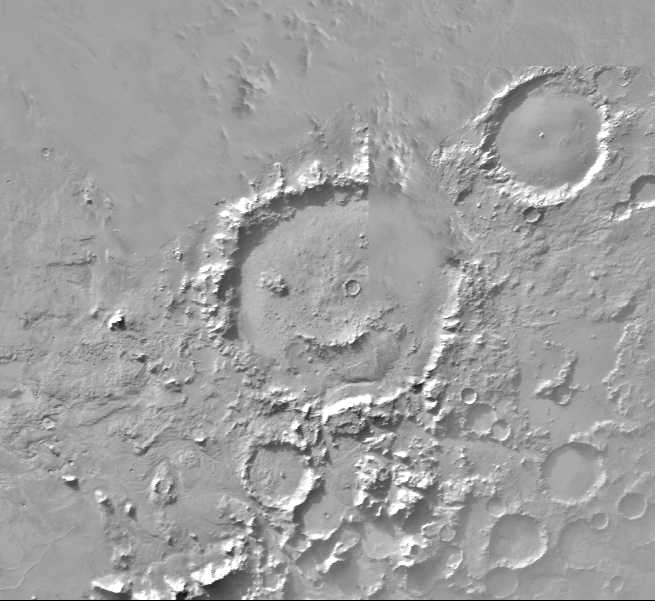
Speaking of photographs of craters, this is a neat one.
Development of the Mars global surveyor: $148 million
Launching it into space: $52.6 million
Getting it into orbit: $46.4 million
Seeing what the martins really think of us: Priceless. -
Crater pics from NASA...
Speaking of photographs of craters, this is a neat one.
Development of the Mars global surveyor: $148 million
Launching it into space: $52.6 million
Getting it into orbit: $46.4 million
Seeing what the martins really think of us: Priceless. -
Crater pics from NASA...
Speaking of photographs of craters, this is a neat one.
Development of the Mars global surveyor: $148 million
Launching it into space: $52.6 million
Getting it into orbit: $46.4 million
Seeing what the martins really think of us: Priceless. -
Crater pics from NASA...
Speaking of photographs of craters, this is a neat one.
Development of the Mars global surveyor: $148 million
Launching it into space: $52.6 million
Getting it into orbit: $46.4 million
Seeing what the martins really think of us: Priceless. -
Re:Ground me in reality.
They're not going to start launching during thunderstorms. But having a system that protects the vehicle for the days leading up to the launch is certainly worthwhile. Actually the Shuttle launch facilities already have lightning protection, this story is just the new system they will be using for Ares launches. The system is already in place at LC-40 and LC-41 where is very obvious.
-
Re:Could the headline have been more misleading?
The thing is, if you compare the budgets of NASA (http://www.nasa.gov/home/hqnews/2006/feb/HQ_06056_Budget_Statement.html) and NIH (http://www.nih.gov/about/director/budgetrequest/fy2007directorsbudgetrequest.htm) (the agency responsible for funding most federal health research), it turns out that NIH gets about $12 billion a year more than NASA. Granted, not all of that is spent on AIDS or cancer research, but there is the additional factor that substantial private monies are also spent on health research, while little private money is spent on the sorts of things NASA does. With the government also spending a trillion+ dollars a year to treat certain ill people (and to try to slightly lessen some social ills), it seems that they are already following your recommendation that money should be spent on AIDS or cancer research instead of NASA. Of course, there is the question of why AIDS or cancer research in particular should be a priority--what about antibiotics? Almost everyone needs those at some point in their lives, after all. Or better anti-malarial drugs--about twice as many people per year are killed by malaria than by cancer. Finally, some (such as the late Gerard K. O'Neill) have suggested that space travel and exploration could be used to help solve certain problems on Earth, particularly poverty. Space travel is no cure-all, of course, and there are also many smart people who doubt that space industry or the like would do much good or be very practical, but it is difficult to know for sure without going.
-
Re:Could the headline have been more misleading?I can think of plenty of things that are more motivating and visionary to spend taxpayer money on. Things like AIDS research and cancer research, just to name two off the top of my head.
It's interesting that you mention research in medicine. In fact a lot of NASA's research goes into medicine, most notably osteoporosis. There is a much better understanding of the disease because of studying the effects of bone density loss on long term spaceflights. The ill-fated Columbia mission was mostly dedicated to medical research, cancer included. Just because you don't understand what they are doing with our money and is easily dismissed, doesn't make it useless.
More info on NASA's contributions and spin-offs:
A searchable database, and bit technical, http://www.sti.nasa.gov/tto/
A practical list of contributions, http://www.thespaceplace.com/nasa/spinoffs.html
I believe that the people lacking vision are those that want to spend billions of dollars rocketing a team of 8 people to a giant red rock in the sky when we haven't figured out how to fix problems at home first. And spending $475 BILLION on an illegitimate war is visionary? With what NASA is able to accomplish on $16 Billion per year is the ultimate in visionary and resourcefulness. Not only does it create jobs but gives us a better understanding of so many things that have previously been mentioned. And that's my $.02. -
Re:Why?What does Congress have against funding for exploration of Mars? At the present time Mars exploration is an inefficient method of purchasing voters. The money will instead flow to those interests that leverage the largest constituency of the dominant party. What those interests are can be found here, here, here and here, but mostly here. All public proselytizing aside the recent change in US political party dominance has not and will not cause substantial disruption in the flow of funds here, because nothing raises the cost of voters for incumbent rulers as rapidly as martial humiliation.
The good news is that inevitably a rivalry will develop between the US mob and some other nation's mob and NASA will once again be an efficient vote purchasing mechanism. With any luck the US will have a solid launch platform ready for that eventuality despite current shifts in political priorities. We'll have the wisdom of an engineer (in not coupling the fate of launch platform development to Mars exploration,) to thank for this when it comes to pass.
The fact that launch platform development is not coupled directly to Mars Exploration makes this anti-Mars Exploration language from Congress largely symbolic anyhow; NASA will go right on developing the necessary rockets. That fact is the single best argument I can think of against this naive and now very dead notion. -
Re:Why?What does Congress have against funding for exploration of Mars? At the present time Mars exploration is an inefficient method of purchasing voters. The money will instead flow to those interests that leverage the largest constituency of the dominant party. What those interests are can be found here, here, here and here, but mostly here. All public proselytizing aside the recent change in US political party dominance has not and will not cause substantial disruption in the flow of funds here, because nothing raises the cost of voters for incumbent rulers as rapidly as martial humiliation.
The good news is that inevitably a rivalry will develop between the US mob and some other nation's mob and NASA will once again be an efficient vote purchasing mechanism. With any luck the US will have a solid launch platform ready for that eventuality despite current shifts in political priorities. We'll have the wisdom of an engineer (in not coupling the fate of launch platform development to Mars exploration,) to thank for this when it comes to pass.
The fact that launch platform development is not coupled directly to Mars Exploration makes this anti-Mars Exploration language from Congress largely symbolic anyhow; NASA will go right on developing the necessary rockets. That fact is the single best argument I can think of against this naive and now very dead notion. -
NASA geeks need a how-to guide at last?
Here is how you can beat the ban of humans on Mars:
Just go lobby the Congress into believing that the arid, Afghanistan-looking planet is a socialist state that painted itself all red, supplies illegal immigrants and exports products that could cause severe health problems. You don't even need to suggest it is in development of nuclear weaponry, once Mars gets the attention, any journalist looking for quick fame will release a "breaking news" that our spy satellites have found bomb testing sites. Not to mention the famous "they'll follow us home" scenario study with countless versions of simulations that can be slipped into the appendix section.
Then in no time you will see some 250,000 men up on the planet automatically without NASA having to spend/ask for a dime. -
Re:Other than the Apollo missions...
In 2013 there is suppose to be a new telescope that should be capable of replacing Hubble. http://www.jwst.nasa.gov/
-
Re:Calling Mr Tang>However I'd strongly question your assertion that zero-g can be adequately simulated on earth.
'Zero-gee': no, never. 'Free-fall': yes, quite well. The sentence before the one you quoted reads:
"So how do you propose to simulate, say, just one hour of continuous zero gravity?" Witness:
http://science.nasa.gov/ssl/msad/dtf/tube.htm
(cool image: http://science.nasa.gov/ssl/msad/dtf/images/stand1.gif) "For an evacuated Tube, minimal free-fall times of 4.6 seconds produce a quiescent, micro-gravity environment."
<sarcasm> OK, 4.6 seconds is very close to an hour </sarcasm> http://en.wikipedia.org/wiki/Fallturm_Bremen
(additional: http://www.spaceflight.esa.int/users/index.cfm?act=default.page&level=11&page=fac-dt) "in which for 4.74 seconds (with release of the drop capsule), or for over 9 seconds (with the use of a catapult, installed in 2004) weightlessness can be produced."
Yes, that's much closer to an hour
Indeed, I'm surprised that you didn't come up with parabolic flights, which can give you up to about 25 seconds of continuous weightlessness.
OK, so where's that one-hour continuous weightlessness down here on earth? -
Re:Calling Mr Tang>However I'd strongly question your assertion that zero-g can be adequately simulated on earth.
'Zero-gee': no, never. 'Free-fall': yes, quite well. The sentence before the one you quoted reads:
"So how do you propose to simulate, say, just one hour of continuous zero gravity?" Witness:
http://science.nasa.gov/ssl/msad/dtf/tube.htm
(cool image: http://science.nasa.gov/ssl/msad/dtf/images/stand1.gif) "For an evacuated Tube, minimal free-fall times of 4.6 seconds produce a quiescent, micro-gravity environment."
<sarcasm> OK, 4.6 seconds is very close to an hour </sarcasm> http://en.wikipedia.org/wiki/Fallturm_Bremen
(additional: http://www.spaceflight.esa.int/users/index.cfm?act=default.page&level=11&page=fac-dt) "in which for 4.74 seconds (with release of the drop capsule), or for over 9 seconds (with the use of a catapult, installed in 2004) weightlessness can be produced."
Yes, that's much closer to an hour
Indeed, I'm surprised that you didn't come up with parabolic flights, which can give you up to about 25 seconds of continuous weightlessness.
OK, so where's that one-hour continuous weightlessness down here on earth? -
Re:Calling Mr Tang
>However I'd strongly question your assertion that zero-g can be adequately simulated on earth.
'Zero-gee': no, never. 'Free-fall': yes, quite well.
Witness:
http://science.nasa.gov/ssl/msad/dtf/tube.htm
(cool image: http://science.nasa.gov/ssl/msad/dtf/images/stand1.gif)
http://en.wikipedia.org/wiki/Fallturm_Bremen
(additional: http://www.spaceflight.esa.int/users/index.cfm?act=default.page&level=11&page=fac-dt)
http://en.wikipedia.org/wiki/Drop_tube -
Re:Calling Mr Tang
>However I'd strongly question your assertion that zero-g can be adequately simulated on earth.
'Zero-gee': no, never. 'Free-fall': yes, quite well.
Witness:
http://science.nasa.gov/ssl/msad/dtf/tube.htm
(cool image: http://science.nasa.gov/ssl/msad/dtf/images/stand1.gif)
http://en.wikipedia.org/wiki/Fallturm_Bremen
(additional: http://www.spaceflight.esa.int/users/index.cfm?act=default.page&level=11&page=fac-dt)
http://en.wikipedia.org/wiki/Drop_tube -
Comes with the territory
I am all for the space program, but there have been some major issues lately
Being "for the space program" requires some acceptance of the massive risks inherent in manned space travel. If mechanical systems are design-simplified it may reduce points of failure.
KERMIt, a "Kit for External Repair of Module Impacts", is one of those simple systems being developed at Marshall Research to seal punctures in the ISS. It will enable crewmembers to seal punctures from outside damaged modules that have lost atmospheric pressure. Delivery of the kit is scheduled for next year. KERMIt is also useful for sealing leaking atmospheric seals as TFF article describes (more info here). -
Re:BVLLSH1T!
The whole manned space program from mercury to apollo cost $25 billion.
1.) NASA's budgets from 1958 (inception) to 1973 (end of the Apollo program) add up to $56.7 billion. I'm not sure how much was on Mercury and Gemini, but over $19 billion was on Apollo alone.
2.) There's a little thing called inflation that you failed to take into account. Using the consumer price index, the Apollo expense were $135 billion. In 1966, NASA spent 1.8 times as much in adjusted dollars as their budget for 2007 (note: numbers in this paragraph are derived from wikipedia and don't quite match NASA's published numbers).
3.) I have no idea where you got the figure of $100 million for a Saturn V. NASA spent $6.4 billion on the Saturn V, and launched 13 vehicles, 10 of them manned. That's $492 million per launch, and from the link above you will see that it does not include the CSM, lander, or mission costs.
4.) Just a perspective of modern launch costs shows your numbers are almost certainly skewed. A Titan IV, which had a payload slightly less than the space shuttle but is unmanned cost over $250 million.
5.) The largest of the proposed Saturn derivatives would have peaked out at 260,000 kg LEO capability, but that doesn't matter since those were abandoned in the 60's or 70's.
6.) Another poster addressed the myth that the shuttle has to be rebuilt from the ground up, but I'll repeat it since the myth seems to come up incessantly. The shuttle is thoroughly cleaned and inspected, any repairs or maintenance needed is performed, damaged tiles replaced, and the engines tested. The solid rocket boosters are refurbished and reloaded, and a new external tank is fitted. This is most definitely not a rebuild.
7.) The arguments versus the shuttle are somewhat irrelevant since the ISS components were mostly designed around the shuttle cargo bay and with the shuttle's capability as a work platform in mind. Additionally, the limiting factor on many of the payloads has been not mass, but crew hours available to install them and launcher volume. And don't forget, the launch capacity of the Saturn V is before crew accomodations. For the shuttle, it's after.
8.) The discussion here was a Mars mission, and NASA is developing a more advanced launcher that would eventually contribute to that purpose. The Ares V will have a 130 mT LEO capability, compared to 118 mT for the Saturn V. NASA hasn't made a lot of cost projections, but looking at the infrastructure required and the types of components being used, I'm guessing the Ares V will be around $500-750 million per launch, not counting development costs. I'd figure $150-250 million for manned Ares I missions.
-
Re:NASAI would like to remind everyone here that NASA is NOT a civilian space agency, it a branch of the Department of Defense and if you read the charter you shouldn't be surprised at all about this.
You write as though you are awfully certain of this, but the fact is it is not, nor ever has been the case. It is a civilian organization, which does not report to the Secretary of Defense, but is accountable to the President and Congress. The military operates its own space program, separate from, but in close cooperation with NASA.
-
Oh no... obviously not important...
Oh definitely not affecting our every day lives.
I know you don't exactly drink Tang every day, but exactly what percentage of the United State's population do you think is affected by weather satellites? -
If you don't like it, leave your govt. job.
How can Americans really be concerned about this?
-Try getting a job for the US Postal Service or even try to enlist into the US Military; -There are significant background checks, waivers, and forms required.
Waiving certain 4th (and probably 5th) Amendment privacy rights are part of said employment for the government. If you do not like it, leave the job.
Much of what JPL does is subject to espionage and/or industrial espionage not to mention they certainly need access to classified information and technologies (for example: the positions/orbits & maneuverabilities of US Spy satellites and other 'stuff' in orbit), consider JPL's missions and its history: http://www.jpl.nasa.gov/news/fact_sheets/jpl.pdf
If you can't pass the background checks, get a job elsewhere. It should be a privilege to work for the JPL and the cutting edge research and technological achievements it creates. Besides, this is a US Government entity, not a civilian corporation.
Your rights to privacy CANNOT be more important than National Security. Even IF said employees can't see why.
I'd wager that the Janitors and Maids in the White House MUST PASS a thorough security clearance to perform their 'non-classified' work as well. And someone at a higher pay grade likely has very good reasons for the security requirements as they are, and rocket scientists need background checks too. -
Re:BVLLSH1T!
NASA pegs each shuttle flights' launch cost at 450 million
The shuttle has a payload capacity of 20 tons. So, even if we peg today's Saturn 5 at 500 million per copy, it has a 120 LEO capacity - 6 times the payload for about the same price. Sounds like a better deal to me.
-
Re:BVLLSH1T!
" Second, the marginal cost of a Shuttle flight (I.E. adding a flight to the manifest) is under $100/million a flight. "
More bullshit. NASA's own web site says it costs $450 million per launch. That doesn't include any apportionment of fixed costs, etc.
The shuttle was a mistake. Without it, we'd already be on Mars.
-
Nice animated images.
In NASA the imaginary clouds don't move.
-
New document from NASA IG
Well, from 2 weeks ago:
NASA Inspector General: NASA's Most Serious Management and Performance Challenges [PDF]
-
Re:And then what?
Actually...
"The Voyager spacecraft will be the third and fourth human spacecraft to fly beyond all the planets in our solar system. Pioneers 10 and 11 preceded Voyager in outstripping the gravitational attraction of the Sun but on February 17, 1998, Voyager 1 passed Pioneer 10 to become the most distant human-made object in space."
http://voyager.jpl.nasa.gov/mission/fastfacts.html
Wikipedia sucks. -
Re:Remind me again
I got to wondering myself and did a bit of searching. Turns out that the speed of sound in space is not due to particle collisions as much as it due to magnetic interactions of the ionized atoms. It's the magnetic fields bouncing off one another. If you're curious to learn more, the place I started was http://www-istp.gsfc.nasa.gov/Education/wtermin.html. From that clue I came across http://en.wikipedia.org/wiki/Alfv%C3%A9n_wave, but I'm not about to do the math to confirm the speed of sound in space.
-
Re:There's nothing there...
Voyager 1 is the furthest human object.
Here is a nice link and a graphic of what is still being explored: http://voyager.jpl.nasa.gov/mission/interstellar.html -
next step: interstellar probe
I am looking forward to the interstellar probe mission, which is specifically designed to explore the interstellar medium.
Unfortunately it will probably not happen in my lifetime, unless we stop putting in charge of the budget people who think that a talk between a teacher in LEO and school-children on earth is more "inspiring" than fundamental research. -
Re:Please don't link to video.
If you can't say it with written words, it wasn't worth saying.
Look, don't take this the wrong way, but are you retarded? You really think this, this, and this would have been better expressed in words? I realize you're specifically criticizing audio and video, not photographs, but come on: You're saying that all media except the written word is useless.
Seriously, +5 insightful? Who modded you up, Jack Thompson? -
Re:NASA's a Joke!
As a civilian agency they better not be following congressional orders. You can find the text of the act that created NASA here http://www.nasa.gov/offices/ogc/about/space_act1.html#POLICY. They're purposed as a civilian agency with congessional oversight. They get money from congress- not orders.
-
Not much news
From the articles other people have posted and this one, there doesn't seem to be much to report other than they did some prep work. The shavings are still a problem, the moon is pretty, and they did some cooling systems work.
-
Re:Miniaturization
Yes, the Skynet project includes a huge amount of ground infrastructure - terminals in jeeps, terminals on ships, terminals in shipping containers, terminals anywhere that an MoD Procurement Executive employee could imagine a member of the armed forces needing a terminal. So that was an unfair comparison to use; sorry.
I suspect there isn't very much deep-black material on Skynet, it was constructed via a complicated scheme of industrial contracts as a showpiece of private-finance-initiative procurement, and I can't see the kind of people who have weird packages to fly wanting the exposure risk of having extra clauses in the contract detailing the packages. I've worked a small amount on projects near Skynet, but on the documentation and assurance side rather than anywhere near either money or bent metal - yes, in a past life I was a civil servant.
The DVB satellites are off-the-rack ones (in as much as satellites ever are) which are supported by infrastructure that's already there, so I'm a bit more confident about that $400 million figure.
Actually, http://www.solarstorms.org/Sinsurance.html has some interesting numbers - Intelsat 'have declined to purchase insurance for satellites costing less than $150M', suggesting that some of their satellites cost more than that.
Envisat-1 (according to http://www.hq.nasa.gov/webaccess/CommSpaceTrans/SpaceCommTransSec34/CommSpacTransSec34.html) has 70% of its (http://ec.europa.eu/research/press/2002/pr0103en.html) about 2.3 billion Euro cost for satellite and launch services, though that is a large satellite bristling with novel detectors.