Slashdot Mirror
Domain: nasa.gov
Stories and comments across the archive that link to nasa.gov.
Comments · 16,365
-
Re:never should have been left to rotThe original plan called for 20 Apollo missions.
If I remember correctly, two complete Saturn V's were available when the program was cancelled. One of them was turned into Skylab and another into this showpiece. Apollo 20 was never assembled.
-
Wrong
new cameras were supposed to be installed, and the scientists that made science justifications have been planning for years to use then.
See here.
Why do you trust the President?
-
Lunar Orbiter & photographyI'm not sure about all the missions of that era, but Lunar Orbiter did indeed expose film, scan it, and send it back. Full images were hand-mosaicked photographic film. For info see:
- Lunar Orbiter camera info from the Lunar Orbiter mission history
- Online Photographic Atlas of the Moon contains scans of the hand-mosaicked frames originally published in the original NASA Lunar Orbiter Photographic Atlas of the Moon by Bowker and Hughes
- Another site with scanned Lunar Orbier frames
- Lunar Orbiter Digitization Project is a project to scan the films and digitally mosaic the frames to get rid of striping and other blemishes and create a global lunar mosaic
-
Lunar Orbiter & photographyI'm not sure about all the missions of that era, but Lunar Orbiter did indeed expose film, scan it, and send it back. Full images were hand-mosaicked photographic film. For info see:
- Lunar Orbiter camera info from the Lunar Orbiter mission history
- Online Photographic Atlas of the Moon contains scans of the hand-mosaicked frames originally published in the original NASA Lunar Orbiter Photographic Atlas of the Moon by Bowker and Hughes
- Another site with scanned Lunar Orbier frames
- Lunar Orbiter Digitization Project is a project to scan the films and digitally mosaic the frames to get rid of striping and other blemishes and create a global lunar mosaic
-
Re:Crash your name into a comet
It's not a troll. NASA routinely does this with CDs or chips on probes. Somewhere near Mars' south pole there's a splattered CD with my name on it. Stardust carried chips, two of which will return with the sample. Here's the signup page for Deep Impact until the end of January.
-
Re:Crash your name into a comet
It's not a troll. NASA routinely does this with CDs or chips on probes. Somewhere near Mars' south pole there's a splattered CD with my name on it. Stardust carried chips, two of which will return with the sample. Here's the signup page for Deep Impact until the end of January.
-
I had forgotten about the DVD
It looks like 2 years of waiting is finally over. This is now on mars. I had completely forgotten about it until this stupid story. Thanks
-
Mapping mercury
As a note about fully mapping mercury, it seems to be one of the forgotten planets nobody talks about much, but has had some attention in the past.
Still, there are some interesting Mariner shots of the planet online. Not quite half has been mapped yet, but there's some interesting features that make it unique.
nude macgirls webcam -
Re:Hubble Links!
The Goddard Space Flight Center has a Hubble Project site.
-
Re:Hubble Links!
The Goddard Space Flight Center has a Hubble Project site.
-
Rover parts
Actually, $400M will buy a lot of LEGO.
-
Nope, not even difficult.The escape velocity of Mars is 5.03 km/sec (thanks to Acidic Diarrhea for the link). The velocity required just to get into Earth orbit is ~8.0 km/sec, and Earth's atmosphere is quite a bit more difficult to deal with.
5 km/sec is about 11,200 MPH. That's not even enough to make a good ICBM on Earth, but it'll get you completely off Mars. It is pretty obvious that we have had the rocket technology to get back from Mars for a long time, and getting back is much easier than getting there in the first place.
One of the things people keep claiming is that it's necessary to leave a return vehicle in Mars orbit. This is exactly how NASA got the $400 billion figure for a Mars mission; it is a huge mistake. Landing everything instead of leaving it in orbit has terrific advantages:
- You can aerobrake your entire mission instead of having to insert into orbit with rockets. This eliminates the mass budget for the fuel.
- You can manufacture your fuel supply for the return voyage from Martian atmosphere, instead of having to carry it with you. This buys you something like a 12:1 advantage.
- You avoid having to rendezvous with an orbiting return vehicle to get home; if you cannot rendezvous, you're dead.
- You avoid leaving your return ticket in orbit where you can't maintain or protect it, with its precious fuel in tanks which can be punctured by meteoroids, etc.
-
Re:Two answers
You're wrong. According to this NASA page, they either invented or developed materials for many of those things and more.
-
Re:information please! not just hot air!
Energy required to lift 1 kg out of the gravitational well is (if I am not mistaken) G*M/R, where G is grav. constant, M is mass of planet, and R is planet's radius (in SI units). Plugging in values from the Mars fact sheet for M and R, I get
6.24 * 10^7 J for Earth;
and 1.26 * 10^7 J for Mars (or about 20% of the energy required to leave Earth).
Now, actually, the energy required to leave Mars will be much less than that because you won't be lifting 1) half of the fuel (burnt on the way there); 2) most of the spacecraft (parked in Mars orbit); or 3) most of the experiments and equipment (leave 'em on Mars so the next expedition needs less stuff to carry). -
Re:information please! not just hot air!The mass of the Mars is about 11% of the mass of the Earth; the moon being about 1.2%.
The escape velocity of Mars is about 4/9 of that of the Earth; 11.2 km/s Earth vs 5.0 km/s Mars (vs 2.38 km/s Moon).
The 'one sixth' figure refers to surface gravity, g. For the Earth, g=9.8 m^2/s. For the Moon, g=1.6 m^2/s. For Mars, g=3.7 m^2/s, not quite two-fifths.
Source: Meters may in fact be feet, but the numbers look right
As for atmosphere, the Martian surface you have around 8.5 mb, depending on the weather, which is less than 1% of your typical Earth surface atmosphere.
All in all, I'd say these guys have it backwards. I think we have a better shot at a one-way mission from Mars to the Earth. Lot's of good stuff to see on the Earth. Although if your main interest is the search for intelligent life, we haven't ruled it out yet for Mars.
-
Life demands it!
Life demands it!
Life must spread itself in order to survive, if all known life is limited to Earth, which is one small planet, it can be all killed in one little (little for the universe anyway) accident. Accidents both natural and man made, like an asteroid impact, new unstoppable disease, nuclear or biological war. Even a drastic climate change could kill 80% of all living things on the planet.
I believe life naturally advances to an intelligent level for its own survival. The world has been trying for a long time many times an asteroid set it back. We as humans really have only just come onto the seen, and only the past 10,000 years have we been really moving forward. The next few hundred years may pass as calmly as the last 10,000, but we have been lucky so far. If we are to survive we must leave Earth and this solar system.
Arthur Clarke said "If the human race is to survive, then for all but a very brief moment in its history the word ship will mean space ship."
The Pale Blue Dot
Asteroid Risk
Magnetic Changes
Climate Changes
My 2 cents... -
Re:information please! not just hot air!Mars Fact Sheet:
Surface gravity ratio [Mars/Earth] 0.379
Escape velocity ratio [Mars/Earth] 0.450So no, it's not getting quite close. Let's say we need 1 unit of power to lift off from Earth, we would need less than half a unit to lift off from Mars. Plus, there may be resources on Mars that could be used as fuel, given the proper technology to harness/convert/whatever those resources.
-
Please learn how to use links.Please learn how to use links.
<a href="http://marsrovers.jpl.nasa.gov/gallery/all/
yields: Raw Image Gallerys pirit_p011.html">Raw Image Gallery</a> -
black spot
anyhow, what's that black spot that appears on many of the photos ? Example
-
Re:What is the REAL color of the sky on Mars?
Of course it is colourised - the image was taken with a filter that doesn't properly read the red wavelength part of the spectrum. They have been using an infrared filter to map out the landscape because it produces much better details, and at this stage of the mission, details are far more important than natural colours. If you want real colour, you need the L4, the L5, and the L6 filters, for R,G,B respectively. Try these:
red
green
blue
Use an image program that lets you alter the RGB colour channels, and just stick them in.
If you want a comparison, use one of the sets of images from the Color Wheel, for example, these:
red
green
blue
The colours are close to those taken on Earth, you can try fiddling them a bit to get them closer if you want, but the timing and light conditions on Mars may be different for the landscape and the Color Wheel. If you do the same with the standardly used images, the L2, L5 and L6 filters, the Color Wheel is clearly wrong. -
Re:What is the REAL color of the sky on Mars?
Of course it is colourised - the image was taken with a filter that doesn't properly read the red wavelength part of the spectrum. They have been using an infrared filter to map out the landscape because it produces much better details, and at this stage of the mission, details are far more important than natural colours. If you want real colour, you need the L4, the L5, and the L6 filters, for R,G,B respectively. Try these:
red
green
blue
Use an image program that lets you alter the RGB colour channels, and just stick them in.
If you want a comparison, use one of the sets of images from the Color Wheel, for example, these:
red
green
blue
The colours are close to those taken on Earth, you can try fiddling them a bit to get them closer if you want, but the timing and light conditions on Mars may be different for the landscape and the Color Wheel. If you do the same with the standardly used images, the L2, L5 and L6 filters, the Color Wheel is clearly wrong. -
Re:What is the REAL color of the sky on Mars?
Of course it is colourised - the image was taken with a filter that doesn't properly read the red wavelength part of the spectrum. They have been using an infrared filter to map out the landscape because it produces much better details, and at this stage of the mission, details are far more important than natural colours. If you want real colour, you need the L4, the L5, and the L6 filters, for R,G,B respectively. Try these:
red
green
blue
Use an image program that lets you alter the RGB colour channels, and just stick them in.
If you want a comparison, use one of the sets of images from the Color Wheel, for example, these:
red
green
blue
The colours are close to those taken on Earth, you can try fiddling them a bit to get them closer if you want, but the timing and light conditions on Mars may be different for the landscape and the Color Wheel. If you do the same with the standardly used images, the L2, L5 and L6 filters, the Color Wheel is clearly wrong. -
Re:What is the REAL color of the sky on Mars?
Of course it is colourised - the image was taken with a filter that doesn't properly read the red wavelength part of the spectrum. They have been using an infrared filter to map out the landscape because it produces much better details, and at this stage of the mission, details are far more important than natural colours. If you want real colour, you need the L4, the L5, and the L6 filters, for R,G,B respectively. Try these:
red
green
blue
Use an image program that lets you alter the RGB colour channels, and just stick them in.
If you want a comparison, use one of the sets of images from the Color Wheel, for example, these:
red
green
blue
The colours are close to those taken on Earth, you can try fiddling them a bit to get them closer if you want, but the timing and light conditions on Mars may be different for the landscape and the Color Wheel. If you do the same with the standardly used images, the L2, L5 and L6 filters, the Color Wheel is clearly wrong. -
Re:What is the REAL color of the sky on Mars?
Of course it is colourised - the image was taken with a filter that doesn't properly read the red wavelength part of the spectrum. They have been using an infrared filter to map out the landscape because it produces much better details, and at this stage of the mission, details are far more important than natural colours. If you want real colour, you need the L4, the L5, and the L6 filters, for R,G,B respectively. Try these:
red
green
blue
Use an image program that lets you alter the RGB colour channels, and just stick them in.
If you want a comparison, use one of the sets of images from the Color Wheel, for example, these:
red
green
blue
The colours are close to those taken on Earth, you can try fiddling them a bit to get them closer if you want, but the timing and light conditions on Mars may be different for the landscape and the Color Wheel. If you do the same with the standardly used images, the L2, L5 and L6 filters, the Color Wheel is clearly wrong. -
Re:What is the REAL color of the sky on Mars?
Of course it is colourised - the image was taken with a filter that doesn't properly read the red wavelength part of the spectrum. They have been using an infrared filter to map out the landscape because it produces much better details, and at this stage of the mission, details are far more important than natural colours. If you want real colour, you need the L4, the L5, and the L6 filters, for R,G,B respectively. Try these:
red
green
blue
Use an image program that lets you alter the RGB colour channels, and just stick them in.
If you want a comparison, use one of the sets of images from the Color Wheel, for example, these:
red
green
blue
The colours are close to those taken on Earth, you can try fiddling them a bit to get them closer if you want, but the timing and light conditions on Mars may be different for the landscape and the Color Wheel. If you do the same with the standardly used images, the L2, L5 and L6 filters, the Color Wheel is clearly wrong. -
Re:is there a microphone on the Spirit Rover?
But they wouldn't sound anything like real sound, the pitch would be way off (kind of like hearing a sound underwater, but backwards)
Then I hope the Martians don't start playing their subliminal messages to our little rover:
"... woN tcurtseD fleS
But seriously, here is NASA's page listing the Rover Instruments. No microphone. And for lots more info, check the link below.
-
For news, status, updates, scientific info, images, video, and more, check out:
(AXCH) 2004 Mars Exploration Rovers - News, Status, Technical Info, History. -
Butterscotch maybe?
I remember seeing this on one of the fisrt postings about spirit.
-
Re:Blue skies?
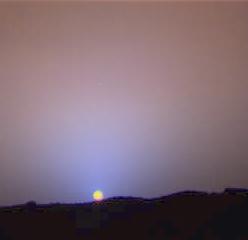
I think the short answer is -- if there was no dust in the martian atmosphere coloring it to its characteristic color (i.e. a rust color from the rust in its sky), it would be, no, not bright blue like earth's, but almost black because it's so thin. But if you'd see any color from a sky cleared from dust, it would probably be blue. Anyway, its sky isn't usually blue because it's so thick of iron oxide. Sunsets on Mars can also show a blue halo around the sun.
Mars Pathfinder captured some interesting true color (or at least near-true color) images of the martian sky while it paid Mars a visit: Mars Pathfinder Images. This is one interesting true color image of the martian sky. -
Re:Blue skies?
I think the short answer is -- if there was no dust in the martian atmosphere coloring it to its characteristic color (i.e. a rust color from the rust in its sky), it would be, no, not bright blue like earth's, but almost black because it's so thin. But if you'd see any color from a sky cleared from dust, it would probably be blue. Anyway, its sky isn't usually blue because it's so thick of iron oxide. Sunsets on Mars can also show a blue halo around the sun.
Mars Pathfinder captured some interesting true color (or at least near-true color) images of the martian sky while it paid Mars a visit: Mars Pathfinder Images. This is one interesting true color image of the martian sky. -
Re:Blue skies?
I think the short answer is -- if there was no dust in the martian atmosphere coloring it to its characteristic color (i.e. a rust color from the rust in its sky), it would be, no, not bright blue like earth's, but almost black because it's so thin. But if you'd see any color from a sky cleared from dust, it would probably be blue. Anyway, its sky isn't usually blue because it's so thick of iron oxide. Sunsets on Mars can also show a blue halo around the sun.
Mars Pathfinder captured some interesting true color (or at least near-true color) images of the martian sky while it paid Mars a visit: Mars Pathfinder Images. This is one interesting true color image of the martian sky. -
Re:$400,000,000?
It includes all the people (engineers, scientists, etc). That's to build the rover, to launch it, to operate it on the cruise to Mars, to operate it on Mars (see those rooms full of people on TV? Multiply by how much each is making), to run the radio dishes and communications hardware, to analyze the data, etc. I don't know whether the launcher itself would be included, but that's only $50 million or less (closer numbers are probably buried somewhere at JSC or other sites with launcher prices).
Having said all that, $800 million for two rovers is a bit more pricey than Mars Pathfinder, Mars Odyssey, the Stardust comet mission, etc, which were more in the $200-300 million range or so (for a single spacecraft, though). Some say that NASA cut corners a bit too far (as seen by the failures of Mars Polar Lander and Mars Climate Observer); others say they merely failed to reinvent themselves in terms of finding more efficient ways to do things.
-
Why big pixels are good.
Large pixels are more sensitive to light, meaning they are better able to cope with a wider range of values. Notice the details both in the shadows and in the sunlight: here. Try doing that with a consumer-level camera (on planet Earth, of course) and you will find that the shadows will be pure black or the sunlit regions pure white.
-
Re:Blue skies?
Most of the images we see from Mars surface are of the horizon. I don't believe there ever has been an image of the full Mars sky from the surface. Perhaps the sky would be more of a blue colour looking directly up? There would be a lot less dust to give it the usual pinky/red colour.
I know at sunrise/sunset the air around the sun can appear blue. -
Re:My question
If I were standing on the surface of Mars, what does it look like? Is the surface red to a human eye the way it looks in the most common pictures?
It'll look pretty similar to the pictures, yes. The camera's been calibrated to give a fairly good idea of what things look like in visible light, and generations of Earth-based astronomers will attest to the fact that Mars does indeed look red.
View from Earth orbit. -
What is the REAL color of the sky on Mars?Ever since the first Viking lander beamed back an image of a blue sky on Mars which was "adjusted" to show a pink sky in subsequent photos, I've wondered what the real sky color is. I am not a conspiracy theorist by any stretch, but the large, full color image of the Spirit Landing site at http://marsrovers.jpl.nasa.gov/gallery/press/spir
i t/20040112a/mspan_2X_final-A10R1.jpg has pretty obviously been photoshopped to remove the sky and replace it with a solid peach color. Look at the horizon line in this photo and notice the jagged pixels along the hilltops. This doesn't appear in any of the monochrome images that are composited to produce the color images. So what other explanation is there other than the sky was edited out and replaced with peach?What color was it before the picture was edited and if it wasn't "peach", why does NASA think we need to see a pink Martian sky? What happened to the blue sky that Viking showed us? Just wondering if anyone else has noticed this.
-
Re:It's All About The Optics
You can also do cunning tricks with moving the camera fractions of a pixel to generate 'super-resolution' images - I'm almost afraid to think what the images from Spirit could be like with this technique.
They've talked about using it to take pictures of the hills a few kilometres away - even if the rover doesn't reach them, they should still get some very impressive images of them. -
correct color?
they are great but are they correct? i know it sounds like a crackpot conspiracy type observation but i think this question is sound. I mean, everyone knows it's a dead red dust laden planet. so why do we keep seeing blue skies in various ap photos of nasa press conferences?
press conference
here is the link to the same photo from the press conference. it's a little bit more red, don't ya think?
official for public consumption
here is a page of comparisons of various jpl/nasa official public photos with links to originals off of nasa.gov...
comparisons all around
and as far as canadian press is concerned, it seems they are gonna go with the blue "arizona-like" version...
canada knows
i don't believe in little green men but i know when my images are too red and have the need for the curves tool in photoshop. -
Artifical Stuff On Mars
But why have only a handful of pictures been released out of the 3,900 that have been taken? And why the scarcity of color images? Maybe it's because of pictures of artificial objects like these.
-
if (!ie){......}
"Sorry, your browser is not compatible with this feature!"
@%**! MSnbc
Click on the "Interactive feature" if you don't know what I mean,
then curse microsoft,
then go straight to http://marsrovers.jpl.nasa.gov to see the images without paying the microsoft tax. I vowed a long time ago to stop clicking on msnbc links.... sucker that I am to keep coming back for more... -
Re:How will we fund it? Spend it elsewhere!
You make several good points. I just wanted to point out that satellites can also be used for fire detection.
-
What's with the stitch in the images?
http://marsrovers.jpl.nasa.gov/spotlight/spirit/a
5 _20040110.html
Noticed a vertical stitch in the images. I thought the images were single shots. Are they partial panorama shots instead? -
Re:Revisit Sojourner!
A watch that can tell time in Sol: $1500
One trip to MARS: $400M
towing an old decrepid machine back home to tell us the obvious answers (dust and radiation): $800M
The look on Chris Voorhees face after seeing the rover's video feed swapped with "Mighty Morphin Power Rangers: The Movie" just seconds before something important was about to happen: $Priceless$ -
Re:Budget -- Mars plan is wildly UnderfundedBush Sr's Mars plan would have cost $500 billion. Bush Jr claims Mars could be done by "spending an additional $1 billion over five years." As these folks report, this is so small, it is almost embarrassing: a single space shuttle mission costs roughly $500 million. In contrast to Bush's Mars proposal, "the original Apollo program cost $150 billion to $175 billion in 2003 dollars."
News Flash: most of our space science comes from unmanned machines such as the Space Telescope, the Mars Spirit Rover, the Stardust comet explorer, and others. Did I mention the Mars Global Explorer, the Wilkinson Microwave Anisotropy Probe satellite, GALEX, the Cassini mission to Saturn, Genesis solar wind sampler, the New Horizons Pluto-Kuiper Belt mission (planned for 2006), etc, etc. Voyagers 1 and 2 have been operating since 1977 (are they older than you?) and are approaching the heliopause. Now that's what I call space exploration. The truth is, in space, robots rule!
Folks, I'm sorry to inform you; but unless there's serious funding, this is at best a publicity stunt, and at worst a president micro-managing NASA in a way that will get rid of the few remaining actual science programs.
-
Re:Budget -- Mars plan is wildly UnderfundedBush Sr's Mars plan would have cost $500 billion. Bush Jr claims Mars could be done by "spending an additional $1 billion over five years." As these folks report, this is so small, it is almost embarrassing: a single space shuttle mission costs roughly $500 million. In contrast to Bush's Mars proposal, "the original Apollo program cost $150 billion to $175 billion in 2003 dollars."
News Flash: most of our space science comes from unmanned machines such as the Space Telescope, the Mars Spirit Rover, the Stardust comet explorer, and others. Did I mention the Mars Global Explorer, the Wilkinson Microwave Anisotropy Probe satellite, GALEX, the Cassini mission to Saturn, Genesis solar wind sampler, the New Horizons Pluto-Kuiper Belt mission (planned for 2006), etc, etc. Voyagers 1 and 2 have been operating since 1977 (are they older than you?) and are approaching the heliopause. Now that's what I call space exploration. The truth is, in space, robots rule!
Folks, I'm sorry to inform you; but unless there's serious funding, this is at best a publicity stunt, and at worst a president micro-managing NASA in a way that will get rid of the few remaining actual science programs.
-
Re:Budget -- Mars plan is wildly UnderfundedBush Sr's Mars plan would have cost $500 billion. Bush Jr claims Mars could be done by "spending an additional $1 billion over five years." As these folks report, this is so small, it is almost embarrassing: a single space shuttle mission costs roughly $500 million. In contrast to Bush's Mars proposal, "the original Apollo program cost $150 billion to $175 billion in 2003 dollars."
News Flash: most of our space science comes from unmanned machines such as the Space Telescope, the Mars Spirit Rover, the Stardust comet explorer, and others. Did I mention the Mars Global Explorer, the Wilkinson Microwave Anisotropy Probe satellite, GALEX, the Cassini mission to Saturn, Genesis solar wind sampler, the New Horizons Pluto-Kuiper Belt mission (planned for 2006), etc, etc. Voyagers 1 and 2 have been operating since 1977 (are they older than you?) and are approaching the heliopause. Now that's what I call space exploration. The truth is, in space, robots rule!
Folks, I'm sorry to inform you; but unless there's serious funding, this is at best a publicity stunt, and at worst a president micro-managing NASA in a way that will get rid of the few remaining actual science programs.
-
Is the "mud" going to be a problem for the rover?
Take a longer look at the rear view picture of the rover. Kinda suprising how the soil is clumping in the tracks and on the left rear wheel of the rover.
Even JPL seems suprised on how "mud" like the soil in this landing spot seems to be.
I wonder if that's going to cause any problems for the rover? -
My Favorite Pic
Is this one of a little Martian girl.
-
Official pics
The best site for Spirit pictures (and Opportunity when it lands too, I'm sure) is JPL's MER site, it's the official site, so first with the pictures (and if you click one of the dated releases and change the date in the URL manually you can sometimes get a sneak peek at the days release half an hour earlier than the rest of the world - about 4:30pm GMT or thereabouts
-
Mars Watch
I found this to be one of the more interesting links from the NASA site. It is about a watchmaker in California who modified mechanical watches to keep Mars time.
-
now we'll know...