Slashdot Mirror
Domain: nasa.gov
Stories and comments across the archive that link to nasa.gov.
Comments · 16,365
-
Re:Best page for up to the minute news?
What is THE best site for up to the minute reports?
I'd have to say Gusev Crater, but if you can't make it there, you could try this jpl (has all images & press releases) or this other jpl site (has more articles). Don't miss the 3D model they've built of the site -
Re:Best page for up to the minute news?
What is THE best site for up to the minute reports?
I'd have to say Gusev Crater, but if you can't make it there, you could try this jpl (has all images & press releases) or this other jpl site (has more articles). Don't miss the 3D model they've built of the site -
Re:Best page for up to the minute news?
What is THE best site for up to the minute reports?
I'd have to say Gusev Crater, but if you can't make it there, you could try this jpl (has all images & press releases) or this other jpl site (has more articles). Don't miss the 3D model they've built of the site -
Re:intrigueBecause the surface air temperature is never above freezing (usually between -40 to -60 degrees.)
-
Built by Americans, Fixed by Foreigners
US mission commander Michael Foale and flight engineer Alexander Kaleri repaired the crack soon after it was discovered in the US module early on Monday, the officials told news agencies.
Michael Foale: considers Cambridge, England to be his hometown & came to the U.S. in '83
Alexander Yurievich Kaleri: Special Honors: Hero of the Russian Federation
[Insert Soviet Russia Jokes Below] -
Built by Americans, Fixed by Foreigners
US mission commander Michael Foale and flight engineer Alexander Kaleri repaired the crack soon after it was discovered in the US module early on Monday, the officials told news agencies.
Michael Foale: considers Cambridge, England to be his hometown & came to the U.S. in '83
Alexander Yurievich Kaleri: Special Honors: Hero of the Russian Federation
[Insert Soviet Russia Jokes Below] -
Re:Interesting
Unless I'm way off, this is what's called a Ball-Grid Array,
You're way off, I think. Ball Grid Array refers to a IC form factor that has a grid of contacts on the bottom of the chip carrier. Each of these contacts is pre-filled with a small ball of solder. BGA devices aren't meant to be socketed. -
Re:150 watts of?
Is that dissipated heat?
Unless it emits light, moves rocks uphill, accellerates your car, or charges one whopper of a battery, yes, that's dissipated heat.
It's called conservation of energy. Here is a NASA page explaining it. It's not rocket science, but it is important to understand for building rockets, bicycling, etc. Along with Conservation of Mass and Conservation of Momentum it forms the trilateral commission that keeps us all from building those "free energy" devices I keep hearing about.
-
Re:150 watts of?
Is that dissipated heat?
Unless it emits light, moves rocks uphill, accellerates your car, or charges one whopper of a battery, yes, that's dissipated heat.
It's called conservation of energy. Here is a NASA page explaining it. It's not rocket science, but it is important to understand for building rockets, bicycling, etc. Along with Conservation of Mass and Conservation of Momentum it forms the trilateral commission that keeps us all from building those "free energy" devices I keep hearing about.
-
Re:150 watts of?
Is that dissipated heat?
Unless it emits light, moves rocks uphill, accellerates your car, or charges one whopper of a battery, yes, that's dissipated heat.
It's called conservation of energy. Here is a NASA page explaining it. It's not rocket science, but it is important to understand for building rockets, bicycling, etc. Along with Conservation of Mass and Conservation of Momentum it forms the trilateral commission that keeps us all from building those "free energy" devices I keep hearing about.
-
DC is a pretty high-tech placeAnd who decided D.C. was a likely meeting place for programmers?
All of the Python core team (including Guido until recently) live in DC. Granted, it's better if the conference was held in Vegas, on a cruise ship or in Monaco parhaps, but you're forgetting that the organizers of it are volunteers and do not get paid. The days when you could get a sponsor to shell out a few hundred grand to fly everyone to Vegas are gone.
DC is home to places like NASA, NIST, NIH... Quite a few well known open source folk live out this way.
I don't get out much these days, but before the
-
Re:I'm probably too late, but the answer is BLACK
Again, the people at NASA have already worked this out, so why don't we just trust them? It seems like you are right, except that there are dust particles in the atmosphere that will make a big difference and turn the sky yellow. Rayleigh scattering will not be an issue.
-
Who says there's not an anti-graviton, anti-photon
No, the graviton can very well have an anti-graviton and a photon an anti-photon. The argument against it would be that both things don't have a charge...well neutrinos don't have charges either, but they have anti-particles. If particle A has a charge of 0, then Anti-A has a charge of 0 as well. However, the graviton is special...it produces 'gravity waves'. Photons and gravitons are more dissimilar though, gravitons cause gravity waves. If an anti-graviton were to exist, and we could convert photons to gravitons/anti-gravitons (though with some energy loss) you could cancel out the effects of gravity..hence warp travel. Gravitons in the back, anti-gravitons in the front, and then you have faster than light travel. That would be a great big leap in technology, don'cha think? NASA thinks it might exist (along with negative energy)
-
Actually not yet, but...
Here's a cool kid's site that has some animations
It's for the LISA (Laser Interferometer Space Antenna). Space.com did a story on it a little while back, and it was in a Scientific American, but I'm not sure which, I have too many lying around. Unfortunantly, it doesn't launch until 2009. -
It's the filter, according to NASA Tv
I watched a press meeting at NASA Tv. Actually, the rover has 8 filters on each camera, with only a few in common (also, one of them is a sun filter, so the rover can figure out it's orientation and direct it's antenna to earth). The blue pigment on the sundial is specially selected because it also has a strong infrared signature. So if you watch the blue spot with the infrared filter, the "blue" spot turns out red. Another mistery solved.
-
HTML versions
I can't be the only PDF hater out there, can I?
The description of each as well as the numbering scheme is available from the Athena instruments website at Cornell University
For a better description of the filters themselves, and of the way they plan to (and have *BEGUN* to) calibrate the images, check out several different publications.
(yes, the "publications" link was HTML in the parent, but I've kept it in anyway). -
Re:Don't believe should be a blue sky
Blue sky or not, I think you're missing the point.
The colour calibration target has a full range of colours on it, red, green and blue.
The exact same target in this image does not.
What's going on?
Well, I think I know.. the full-colour image I linked first is a composite of three scans, using the red, green and blue filters.
The second image was taken with just one filter because it's HUGE in space terms; limited bandwidth, limited power to transmit, and real science takes priority over making the PR photos look pretty. Scanning it with three-colour filters would have taken three times as long.
The planet IS mostly red, so that's what people expect to see. If you want a more honest representation strip out the colour and you'll have the black-and-white image that it actually is.
-
Re:Don't believe should be a blue sky
Blue sky or not, I think you're missing the point.
The colour calibration target has a full range of colours on it, red, green and blue.
The exact same target in this image does not.
What's going on?
Well, I think I know.. the full-colour image I linked first is a composite of three scans, using the red, green and blue filters.
The second image was taken with just one filter because it's HUGE in space terms; limited bandwidth, limited power to transmit, and real science takes priority over making the PR photos look pretty. Scanning it with three-colour filters would have taken three times as long.
The planet IS mostly red, so that's what people expect to see. If you want a more honest representation strip out the colour and you'll have the black-and-white image that it actually is.
-
Better one color
Than an entire palate of 'em:
http://marsrovers.jpl.nasa.gov/gallery/press/spiri t/20040109a/minites-box-A7R1.jpg -
Re:To put the conspiracy theories to rest:
Actually this link, posted in another comment by aenea talks about this very issue.
From the linked article:
On Mars, pictures taken from the surface by the two Viking lander spacecraft showed a sky which was a yellow color. Measurements also showed that the Martian atmosphere always had some fine dust suspended in it. The dust particles vary in size from smaller than visible wavelengths (0.4 - 0.7 micrometers) to as large as several tens of micrometers. (A micrometer is one-millionth of a meter, or about 0.00004 inches). Sky color measurements from Viking Lander 1 have been used with computer simulations of light scattering to estimate that the dust particles contained about 1% by volume of an iron oxide mineral known as magnetite (a black, opaque material). This mineral absorbs sunlight more effectively at blue wavelengths than at red wavelengths. Scattering (including absorption) of sunlight by the dust particles in the Martian atmosphere therefore accounts for the sky color. The scattering is more complicated than the simple Rayleigh case because the dust particles both reflect and absorb the sunlight, and because the presence of 'large' particles leads to more uniform scattering among the different wavelengths. If the dust did not absorb any sunlight, the Martian sky would appear whitish, since all wavelengths would be scattered to similar degree, much like sunlight scattered by clouds. The atmospheric dust which provides the pink-yellow tint to the Martian sky is also responsible, due to its ubiquitous presence on the martian surface, for producing the characteristic red color of Mars seen by the naked eye. In general, Rayleigh scattering is a very small effect in the Martian atmosphere However, at certain times and in certain places, clouds of extremely small dust particles give a blue cast to images taken from overhead. These are the so-called "blue hazes" observed in some cratered regions and parts of the Valles Marineris. -
Re:They're faked, obviously.
Look, they don't even mention the aliens! What is our NASA trying to do.
-
Read this and be silent
NASA's explination for the changes and need for image processing. I am still not sure the get it exactly right, but that's OK, neither is any one else.
-
Holger Isenberg is a kook.
Holger Isenberg, the guy behind mars-news.de, is one of many kooks out there who are too ugly and interpersonally incompetent to ever hope to get laid in this life time. He must therefore resort to enclosing himself into his imaginary universe of in-bred conspiracy theories. enjoy.
NASA has always made raw data available to the public, which is what you can leverage thru the Maestro the software. The red tint observed in composite pictures made available to the public are, in fact, a fairly accurate representation of the truth. Pictures MUST be composited to be available in a JPEG format Joe Six Pack can look at in his browser, hence some level of alteration is necessary. There is no lie. There is no conspiracy. Even your average Joe Six Pack can grok the fact that some basic alterations are necessary to represent flat images. Otherwise Joe Six Pack can always download Maestro.
-
Re:Definition of a secrethttp://marsrovers.jpl.nasa.gov/gallery/images.htm
l I guess it doesn't say it out right that the press photos are enhanced, but its implied since there is a difference made between Press photos and Raw photos.
It does talk about the enhancements in the Maestro program, so that would be the thing to check out if your interested.
-
Re:Check the links, editors
True, but the JPL images webpage has a couple pictures of the color calibrator while _on_ mars, clearly showing the blue and green.
So the images are clearly color-doctored. Whether this is part of some grand martian conspiracy I leave as an exercise to the reader... -
Re:Check the links, editors
True, but the JPL images webpage has a couple pictures of the color calibrator while _on_ mars, clearly showing the blue and green.
So the images are clearly color-doctored. Whether this is part of some grand martian conspiracy I leave as an exercise to the reader... -
Stop making stuff upOne can make up lots of arguments about this, but without any facts you won't get far. I did a quick google search and came up with this.
It basically says that small particles (such as most molecules in our atmosphere) reflect blue light more than red light because the wavelength is smaller at the blue end of the spectrum, comperable with the sizes of the molecules.
But Mars has a fair amount of dust in the atmosphere, and the particles are generally large enough so that the color reflected by them depends more on the composition of the dust than its size. The material is "magnetite", which absorbs blue light more than red. They say that without the dust, the martian sky would appear blue as it does on Earth. The link also provides true-color images.
Comments below indicate that the recent press release images were actually taken with infrared filters, so those images are false color no matter how we see them. Some of them are doctored to approximate true color and others are doctored to be too reddish. But the colors on the sundial are of no help since they are really being viewed in the infrared.
-
Re:Don't believe should be a blue sky
Mars looks red, Jupiter looks red, Saturn looks a bit more orange, etc.
The Martian sky is butterscotch.We've never had a probe on the surface of Jupiter or Saturn look up and see the sky. Since gas giants are giant balls of slush with crunchy centers, the idea of "sky" isn't quite clear.
-
If ya don't like their colors, then do it yourself
Seems like they're working pretty quick over at JPL to get the colorized version of the images out to the general public, since this week, they've been releasing them less between 6 and 18 hours after receiving them. But if you're not happy with their coloration, then I invite those among the slashdot community who know such things to do it themselves.
The pan cam is black and white, and uses filters to pick out certain colors in the images it takes. If you want, you can read more about what filters are on which half of the pancam (l and r). There are 8 on a side, each with its own particular wavelength and bandpasses. The description of each as well as the numbering scheme is available from the Athena instruments website at Cornell University
The raw images are being freely distributed from the JPL MER website. You'll notice camera (l or r) and filter (1-8) used is described from the naming of the pancam files (eg. 2P126471535EDN0000P2303L6M1.JPG)
Just from this last days images, they have quite a few images in differant filters, of the color wheel itself, for calibration. For a better description of the filters themselves, and of the way they plan to (and have *BEGUN* to) calibrate the images, check out several differant publications. (thanks to JPL-Gene and doug_ellison of #maestro irc.freenode.net for the links).
I, for one, am thankful that they're releasing the raw data/images at all, considering the scale of the global-slashdotting currently going on. The speedy data turnaround, and amazing openness with which they are conducting this mission is really impressive compared to anything else of this scale. Thanks to everyone at JPL, Cornell, and NASA as a whole for all the incredible work from this meager enthusiast. -
If ya don't like their colors, then do it yourself
Seems like they're working pretty quick over at JPL to get the colorized version of the images out to the general public, since this week, they've been releasing them less between 6 and 18 hours after receiving them. But if you're not happy with their coloration, then I invite those among the slashdot community who know such things to do it themselves.
The pan cam is black and white, and uses filters to pick out certain colors in the images it takes. If you want, you can read more about what filters are on which half of the pancam (l and r). There are 8 on a side, each with its own particular wavelength and bandpasses. The description of each as well as the numbering scheme is available from the Athena instruments website at Cornell University
The raw images are being freely distributed from the JPL MER website. You'll notice camera (l or r) and filter (1-8) used is described from the naming of the pancam files (eg. 2P126471535EDN0000P2303L6M1.JPG)
Just from this last days images, they have quite a few images in differant filters, of the color wheel itself, for calibration. For a better description of the filters themselves, and of the way they plan to (and have *BEGUN* to) calibrate the images, check out several differant publications. (thanks to JPL-Gene and doug_ellison of #maestro irc.freenode.net for the links).
I, for one, am thankful that they're releasing the raw data/images at all, considering the scale of the global-slashdotting currently going on. The speedy data turnaround, and amazing openness with which they are conducting this mission is really impressive compared to anything else of this scale. Thanks to everyone at JPL, Cornell, and NASA as a whole for all the incredible work from this meager enthusiast. -
Spirit has 16 filters on its cameras
I saw on NASA TV yesterday they were talking about how there are 8 different lenses on each camera of the stereo array. They even mentioned how the dots on the color calibration wheel would change significantly with each filter
Here is a link to Spirit's rover specs -
Individual channels available
If you here, for example, you can see a good quantity of the images they're releasing. They're in groups of three, for the most part -- and funny, but light has three primary colors -- and they seem to be in RGB order (as guessed by experimentation with the white tones in the last set, with the airbag visible). Thus you too can see what Mars looks like before being color (calibrated|corrected|conspiricized) by integrating the three images in (your favorite imaging software). Then, if only we could find the color data for the calibration sundial, it would be possible to recurve the colors to match the known values. I haven't found this stuff yet, but I'm stil looking. And I don't know if the GIMP can do this part (since I haven't used it enough) but I'm postive that Photoshop or Corel Photo-Paint can handle it. So get the data and prove for yourself whether or not it's real!
-
The Communist Martian sky
I thought it was red because the Soviets got there first.
Helpful timeline
Oct 1957 - Sputnik 1 - first LEO
Sep 1959 - Luna 2 - first Lunar impact
Feb 1962 - Mercury 6 - first manned LEO
Jan 1966 - Luna 9 - first Lunar landing
Jul 1969 - Apollo 11 - first manned Lunar landing
Aug 1970 - Venera 7 - first Venus landing
May 1973 - Mars 3 - first Mars landing
Yeah, it's my first -
Re:Don't believe should be a blue sky
Mars does have a blue atmosphere but there is normally enough dust to give it it's pinkish colour.
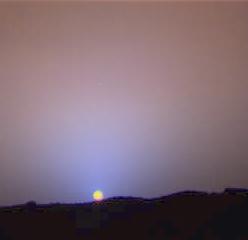
During sunrise/sunset however the air around the sun becomes blue. The light is traveling through much more atmosphere so gets a deeper blue colour, and also the dust particles are reflecting the light away from the viewer (your seeing the dark side of the particles) so the blue has a better chance of getting through.
Here's a good example from the pathfinder lander. -
The Martian Sky is butterscotch, not blue
This story should be pulled, it is wrong in too many places, and is just a bunch of conspiracy mumbo-jumbo. The pictures are slightly modded for color, but that's because it's a collage
As evidenced, here, the Martian sky is more yellow/butterscotch (they used the Viking landers American flag to balance the colors properly,pictures are on the website). The Martian sky doesn't really get "overcasted" as there is no moisture in the air to create clouds! There is dust, yes, but the atmosphere is so thin, the sunlight can still go through it. Ares2003 has a few loose screws-My guess is that the digital image of the craft itself was taken later in the martian day, and modifying the color of the photo was the only way to make it look like it "fit in". Mars should not have "earth-like" colors. Any glance through a moderately-powerful telescope will show that the "red planet" is, in fact, red in color (iron oxide dust). Those more yellow pictures of Mars floating around are actually not real photographs, but generated images from the Mars Orbiter Laser Altimeter data.
To see lots of pictures and some scientific conjecture and analysis, you can go here -
To all "it's not the right color" conspiracies :)
-
To heck with the recolored images...
...what I want to know is:
Why does the Spirit rover have an Atari game console joystick installed on it? -
Re:Don't believe should be a blue sky
You are wrong. The sky's color comes mainly from the scattering of light, which has to do with the wavelength of light. That's why the sky is blue on virtually every planet.
Check this panoramic photo (warning, 4.1 MB). Here's a small example of what it should look like to human eyes, without the stupid NASA red tint. See the rainbow around the sun ? It's because of ice in the upper atmosphere. -
Re:Check the links, editors
My keyboard is obviously a part of the conspiracy. Butterscotch martian sky
-
Re:Scrapping shuttles
Dan Goldin is who you're thinking of.
-
Re:Here's a summary.
It was my understanding that quite a few NASA's space shuttle missions were classified, and the unclassified ones also have classified components to them. Probably just launching some spying satellites (optical, radar, signals intelligence (i.e. echelon)), but then again, who knows what else..
The DoD was involved with quite a few shuttle launches... Many of these are shown on the following shuttle launch histories site. According to this site, there was a DoD payload as early as STS-4 (flight #4), on June 27, 1982. As noted in the first link, the DoD sent their final payload via shuttle at STS-53 (launch #52), on December 2, 1992. So these payloads spanned roughly a 10 year period. Note that this applies only to STS launches -- I am quite sure that nowadays the DoD continues to send classified payloads via other launch vehicles at KSC, such as the Delta series of rockets. -
Re:Here's a summary.
It was my understanding that quite a few NASA's space shuttle missions were classified, and the unclassified ones also have classified components to them. Probably just launching some spying satellites (optical, radar, signals intelligence (i.e. echelon)), but then again, who knows what else..
The DoD was involved with quite a few shuttle launches... Many of these are shown on the following shuttle launch histories site. According to this site, there was a DoD payload as early as STS-4 (flight #4), on June 27, 1982. As noted in the first link, the DoD sent their final payload via shuttle at STS-53 (launch #52), on December 2, 1992. So these payloads spanned roughly a 10 year period. Note that this applies only to STS launches -- I am quite sure that nowadays the DoD continues to send classified payloads via other launch vehicles at KSC, such as the Delta series of rockets. -
Re:Mars is out of reach using current technology
Yes, I know that making ionengines powerfull enought to give a manned spacecraft an acceleration of 0.1G is something we can't do today, or even this week.
Yes, we can. Gentlemen, we have the technology. We can build the craft. All that we require is the desire to do so. JIMO will be the first test of a Fission powered ION drive, which is a more advanced (and powerful) version of the NERVA and GRNA engines. With an accelerated development program, we could build the engines within two years and begin flying shortly thereafter.
Tell everyone you know. Shout it from the rooftops. We can go to Mars!
-
Poorly designed microbenchmark
The benchmarks are poorly designed microbenchmarks. Why do people pay attention to such things? See Cliff Click's talk on "How NOT To Write A Microbenchmark".
We've done some of our own cross-language benchmarking. The NASA Advanced Supercomputing Parallel Benchmarks are problem statements for serious computation science problems, and solutions can be written in any programming language. We implemented the sparse Conjugate Gradient benchmark, and compared Java against fastest Fortran/MPI implementation on a cluster of 32 linux workstations. Java performed at essentially the same speed as Fortran/MPI (actually a little faster on 16 nodes). Although Fortran was slightly faster at the sparse matrix-vector product, Java communications using Java nio was faster than using the LAM implementation of MPI (the MPICH implementation was much worse than the LAM implementation). -
Where lego has been
This is, ok a bit off topic but the current mars lander has lego on board, with a photo of it here as part of an experiment
-
Re:"We can find it if we know where it is!"
Says here the MRO will have 20-30cm resolution...
-
Re:Scrapping shuttles
FYI, Sean O'Keefe
-
There is no JFK,Jeez, I never even heard about that plan. How lame.
Every politician wants to be JFK, but none of them wants to do the most essential thing. Which is to get killed before your fuckups become common knowledge.
-
Re:Can we say...
What this really means is that NASA might see a 1% budget increase instead of a budget cut next year, and after that (after Bush is re-elected or someone else is elected), it'll go back down.
You should do a little fact-checking before you post. Bush has increased NASA's budget each year of his presidency. This year's budget already had over a 3% increase, proposed in Feb 2003.
For comparison, over the 8 years of Clinton's presidency, there was a net decrease (over $300 million) in NASA's budget, and over George HW Bush's presidency, a net increase (over $3 billion).
Here are a couple articles with information. They're secondary sources, but can be verified easily enough. Unfortunately, NASA doesn't have a table with consecutive years' budgets on one single page. However, their current year budget information is here, and previous years' budgets are here. -
Re:Can we say...
What this really means is that NASA might see a 1% budget increase instead of a budget cut next year, and after that (after Bush is re-elected or someone else is elected), it'll go back down.
You should do a little fact-checking before you post. Bush has increased NASA's budget each year of his presidency. This year's budget already had over a 3% increase, proposed in Feb 2003.
For comparison, over the 8 years of Clinton's presidency, there was a net decrease (over $300 million) in NASA's budget, and over George HW Bush's presidency, a net increase (over $3 billion).
Here are a couple articles with information. They're secondary sources, but can be verified easily enough. Unfortunately, NASA doesn't have a table with consecutive years' budgets on one single page. However, their current year budget information is here, and previous years' budgets are here.