Slashdot Mirror
Domain: nasa.gov
Stories and comments across the archive that link to nasa.gov.
Comments · 16,365
-
To go where?I would think that the difference is primarily the result of thousands of people being excited by the prospect of air travel
The comparison of the current technology level of space travel to the beginnings of air travel does have points, but so far we're missing a very important one:Where are we going to go?
There are no orbiting space stations (no, the currently 2 person ISS doesn't count), no lunar base, no asteroid mining, no space colonies
When avation was beginning, there was an entire world it could open up to new travel opportunities. What is space travel going to give us?
-
Re:Is the X Prize really a good idea?
Nothing other than building the ISS, hmm the first permenant habitat off this little rock, seems like a really BIG nothing to me.
It's hardly the first. But your lack of enlightenment is hardly surprising, you are after all, an ignorant yank. -
Re:Bad Joke Alert
-
Re:for those of us without telescopes or probes...
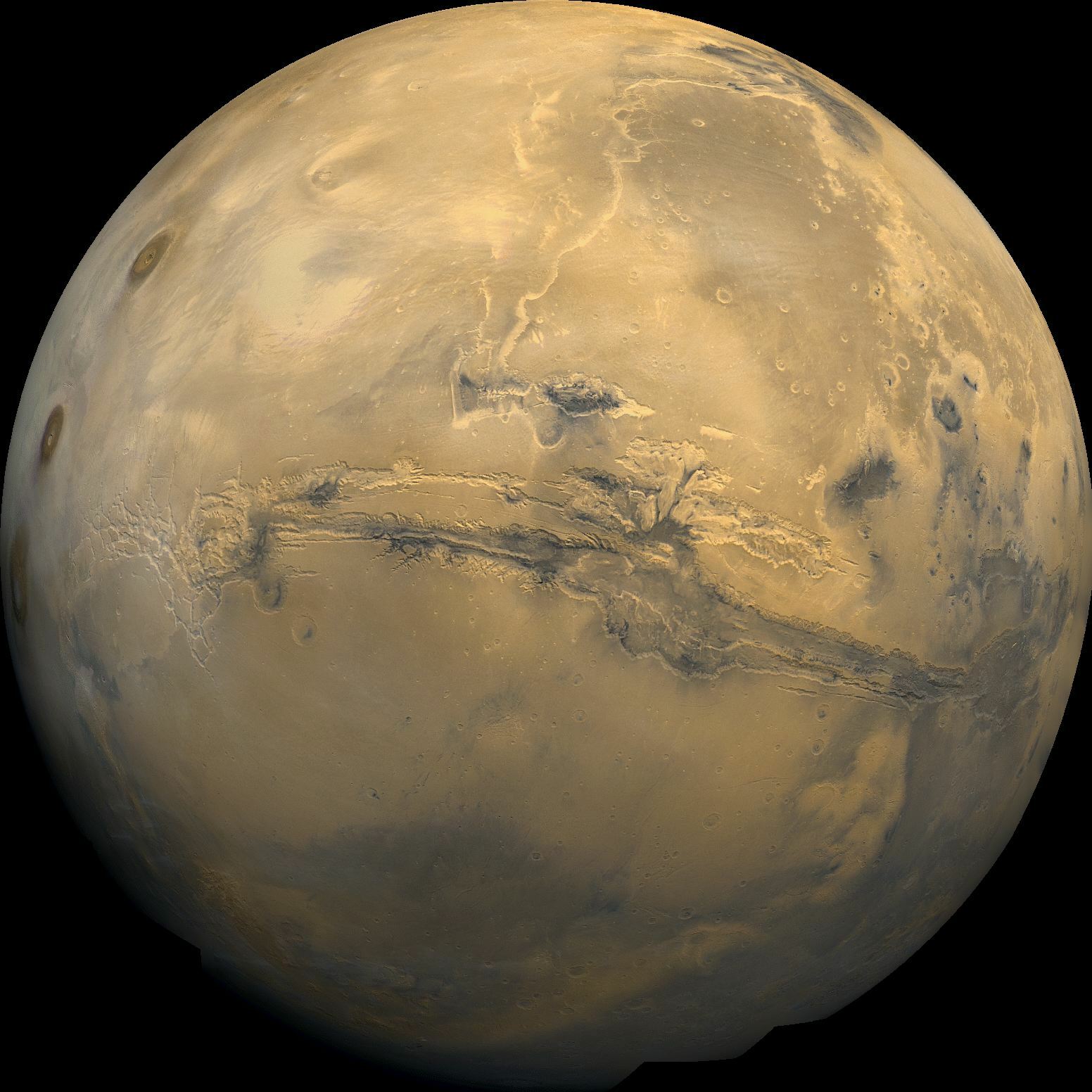
Speaking of APotD here's a good composite image of Mars
I usually only like the high-res pics that have been through a million filters to look sexy...
APotD often has lots of grainy bland pics that are scientifically useful but not exactly great desktop material -
for those of us without telescopes or probes...
there's always the astronomy pic of the day
And for those of us with OSX, there's a macosxhints article that helps you rotate your desktop pic with the APotD -
Maps of Mars, including dust storm
For global views of Mars check here, however at this time of year (August) Mars is enveloped in planet wide dust storms, so the view is going to be obfuscated by all that red grit...if you want to check out before and during storm pics then click here.
many more pics available from the Mars Global Surveyor: Mars Orbiter Camera (MOC)here.
-
Maps of Mars, including dust storm
For global views of Mars check here, however at this time of year (August) Mars is enveloped in planet wide dust storms, so the view is going to be obfuscated by all that red grit...if you want to check out before and during storm pics then click here.
many more pics available from the Mars Global Surveyor: Mars Orbiter Camera (MOC)here.
-
Maps of Mars, including dust storm
For global views of Mars check here, however at this time of year (August) Mars is enveloped in planet wide dust storms, so the view is going to be obfuscated by all that red grit...if you want to check out before and during storm pics then click here.
many more pics available from the Mars Global Surveyor: Mars Orbiter Camera (MOC)here.
-
Apollo 11
Haven't read the article (typically of slashdot), but I do remember that the Apollo 11 computer nearly caused the first lunar landing to fail because it kept rebooting in-flight. Due to a configuration error that occurred shortly before flight, the computer repeatedly ran out of memory, but the software was designed so that the computer could reboot without catastrophe.
You can read more here. -
Re:Hah
This is an ideal application for LinuxBIOS [linuxbios.org]. The article says an average of 14 minutes per flight were spent rebooting computers. Even 36 seconds per reboot is too much, and would be totally unacceptable if it were say, a navigation computer on a 737 with a hundred civilians on-board.
Nasa has an interesting project called FlightLinux [nasa.gov] specifically geared for this sort of application. Unfortunately, they have yet to release code (export restrictions), but they supposedly use LinuxBIOS for their system.
Of course, having software that never crashes (no pun intended) would be best, but it never hurts to have a system that can boot up in just a couple seconds anyway! -
LinuxBIOS in flight computers
This is an ideal application for LinuxBIOS. The article says an average of 14 minutes per flight were spent rebooting computers. Even 36 seconds per reboot is too much, and would be totally unacceptable if it were say, a navigation computer on a 737 with a hundred civilians on-board.
Nasa has an interesting project called FlightLinux specifically geared for this sort of application. Unfortunately, they have yet to release code (export restrictions), but they supposedly use LinuxBIOS for their system.
Of course, having software that never crashes (no pun intended) would be best, but it never hurts to have a system that can boot up in just a couple seconds anyway. -
Re:Cloudy days.
Nope.
From http://imagine.gsfc.nasa.gov/docs/ask_astro/answer s/980221a.html:
"
I have heard two conflicting reasons explaining why winter is cooler.
(1) Because of the slight pivot of Earth's on its axis, the sun is farther away during winter because part of the planet is pointing away from the sun, hence, less energy reaches that surface.
(2) The sun is actually CLOSER to the surface during winter but light hits the planet at an obtuse angle which "skims" the surface. Direct rays are not hitting the surface which brings about cooler temperatures.
Which explanation is correct?
The Answer
The second. Winter is colder because the earth's axis is tilted. Winter occurs for the hemisphere which is tilted away from the sun (the northern hemisphere in January, the southern in July). This has two main effects on the winter hemisphere. First, the sun is above the horizon for fewer hours each day, so that hemisphere receives less heat from the sun. Also, sunlight strikes the ground at a shallower angle so that less energy per unit area is intercepted by the winter hemisphere. It is true that the earth is closest to the sun in January. However, the distance from the earth to the sun varies by only about 2% over a year. This causes a change of only 4% in the amount of solar radiation hitting the earth so this effect is not significant compared to the other two.
"
Emphasis mine.
-
Re:Huh?I will get bashed for this but MS actually does some interesting things which could improve reliability and stability of their OSes.
Check out the SLAM toolkit. It is far from complete and others are doing related work, but still MS is clearly researching some very interesting ideas here.
Basically (and a bit oversimplified) what they try to do is create software that can reasonably well check if a given device driver could ever deadlock. If you can tell that before even compiling the driver, I'd say thats pretty innovative (;
-
Re:Weird Science
This verges awfully close to being junk science. If you don't have some expectations to compare results to, or some theory of what the results are likely to be, it's awful hard to come up with valid results.
I agree with your point, especially when the article goes on to say:
But first they need to find reliable ways to arrange the droplets into various 3-dimensional patterns. This is where low gravity comes in handy. Weightlessness greatly simplifies making 3-D structures from fluid droplets...
To a technical reader, it looks suspiciously like a hammer (weightless environment) looking for a nail (ooh, multilayer refracting LCDs!).
One thing to remember, though, is that "Science @ NASA" is not targeted at technically savvy folks like we
The Science Directorate at NASA's Marshall Space Flight Center sponsors the Science@NASA web sites. The mission of Science@NASA is to help the public understand how exciting NASA research is and to help NASA scientists fulfill their outreach responsibilities.
The article we're dissecting here wasn't designed to explain LCDs in accurate technical detail, nor was it supposed to present the pros and cons of the technology. It's clearly written to "help the public understand how exciting NASA research is" -- and nothing else.
IIRC, the Science @ NASA info used to be a little more in depth. Then, a funding squeeze nearly killed the website altogether. Apparently, the only way they were able to get funding for this basic communications vehicle was to direct it at the least common denomonator. I used to get their email updates, but I dropped them quite a while back -- I think because the articles lost their tech-geek appeal. -
Re:If it really worked
-
Re:OR....
I have the same question.
According to this article, "Since ozone is created and destroyed by solar UV radiation, there is some correlation of ozone concentration with 11-year sunspot cycles." (article also give a number of other natural causes of ozone layer change). The SF Chronicle said, "Between 1997 and 2000, the average growth rate of the ozone hole has slowed by approximately 7 percent per decade" That was the exact period of a spike in sunspot activity.
So how can we prove that it was the meager efforts of us humans that made the change, and not just a natural cycle? -
Yucatan half-circle
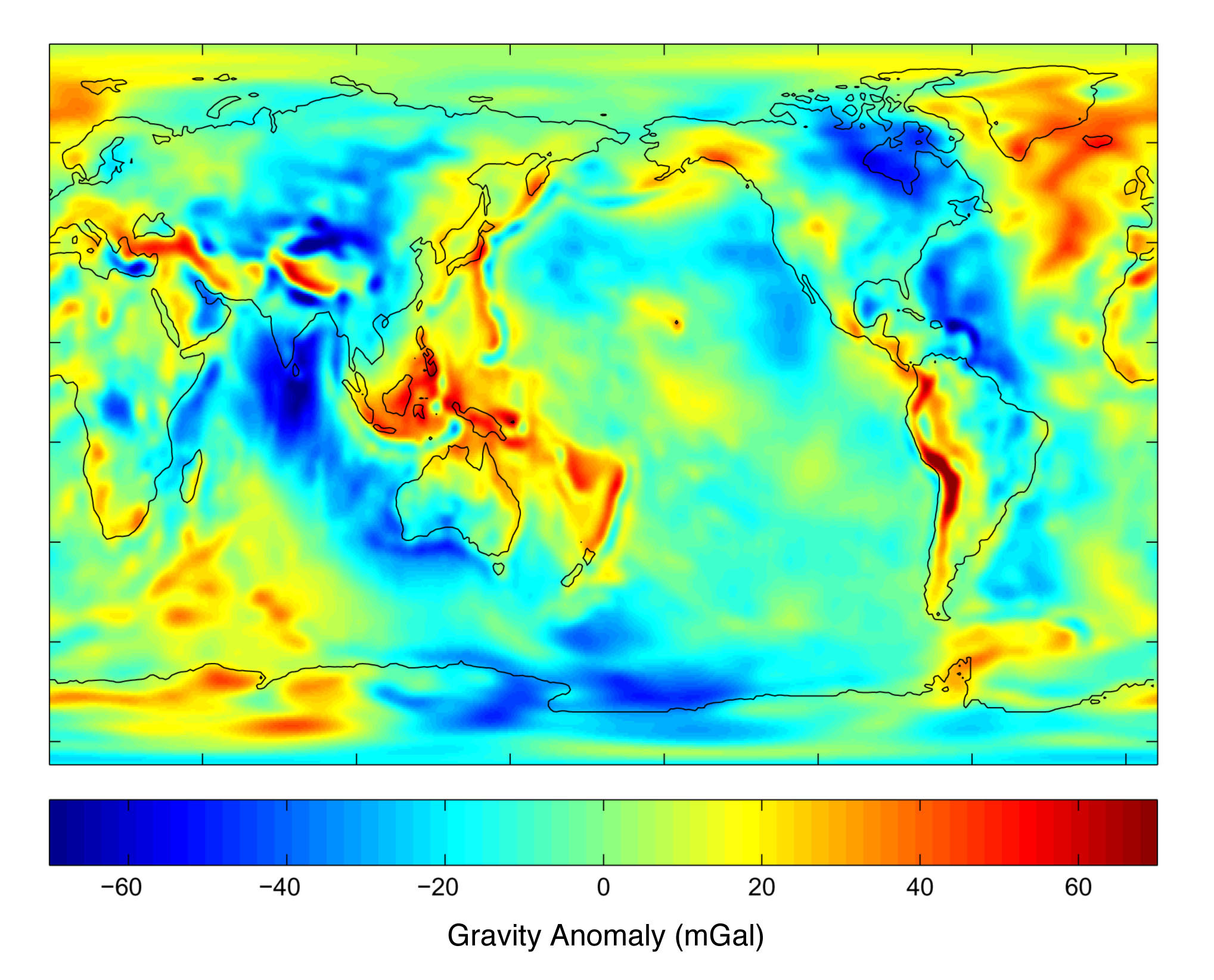
Note in the image just North of the Yucatan peninsula (South-East of Florida), the strong half-circle anomaly. I've read before that this particular anomaly is probably the signature of the asteroid that hit the Earth 60 millions years ago and caused the extinction of the dinosaurs.
-
Re:Complicated by Columbia?
If one wanted to build a Hubble 2 which was very similar to the original, there are easier ways - when Hubble was being built, two copies of many parts were made. In particular, NASA has a second Hubble primary mirror in storage, which, moreover, does not suffer from the same optical error as the one which was sent up. Using this would be far cheaper and easier than stripping and reconditioning the existing Hubble components.
-
Re:*sigh*
I was wrong about the extent of the power loss. From The NSSDC Master Catalog entry for Voyager
The total output of RTGs slowly decreases with time as the radioactive material is expended. Therefore, although the initial output of the RTGs on Voyager was approximately 470 W of 30 V DC power at launch, it had fallen off to approximately 335 W by the beginning of 1997 (about 19.5 years post-launch). As power continues to decrease, power loads on the spacecraft must also decrease. Current estimates (1998) are that increasingly limited instrument operations can be carried out at least until 2020.
So the actual power loss would be 30% over 20 years, rather my stated 50% over 10 years.
Whilst the isotopes used have a long half-life, as you state, the other components of the RTG are subject to continuous exposure to heat and radiation. So the ability to convert the available heat into power degrades over time (rather than the available heat degrading, particularly)
-
Re:Complicated by Columbia?
JWST will be great for its intended mission [...] it will be at a lagrange point, and therefore completely unserviceable.
The lagrange point in question is Lagrange Point 2 (L2) of the Earth-Sun system. A notable characteristic of L2 is that it is always on the night side of Earth orbit (ie. the Earth is always in between L2 and the Sun). Clearly, this is advantageous for a telescope like the James Webb.
As a side note, L1 is opposite to L2 and is therefore, always on the day side. As might be expected, L1 is currently occupied by The Solar and Helioscopic Observatory, or SOHO
Further, the reason why satellites at either of these points are (currently) unservicable is simply a consequence of distance; approx. 100th of 1 AU, or, 4 times the distance of Earth to Moon. -
Re:Bring Webb up and Hubble down in same mission?
Sadly not, for a start the JWST will orbit the L2. Secondly, it's currently planned to be launched on an Ariane 5.
-
Re: too late
This has already been done! (at the request of Carl Sagan in the early 90's)
-
Maps
Here's a photo of Mars, the elliptical bright feature at lower-center in the image is the Hellas Basin, the largest unequivocal impact basin (formed by an asteroid or comet) on the planet. Hellas is approximately 2200 km (1,370 mi) across. Really amazing detail, photo was taken by the Mars Global Surveyor, check out many more of its pics here.
-
Maps
Here's a photo of Mars, the elliptical bright feature at lower-center in the image is the Hellas Basin, the largest unequivocal impact basin (formed by an asteroid or comet) on the planet. Hellas is approximately 2200 km (1,370 mi) across. Really amazing detail, photo was taken by the Mars Global Surveyor, check out many more of its pics here.
-
Entertainment value.
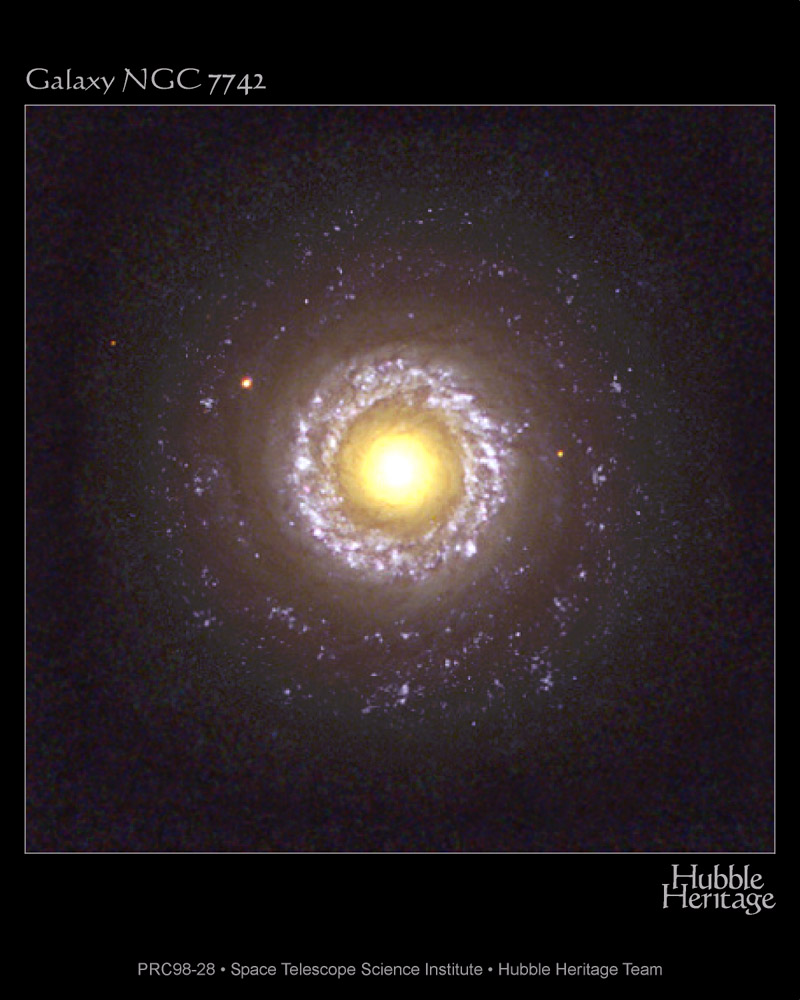
I don't know exactly how much of my tax money goes toward funding Hubble, but even apart from the science I get a pretty good entertainment value from the the pictures it has produced, such as the wonderful picture of NGC 7742 on the APOD page for today. -
Re:the Pan Am Ad and planetary observation
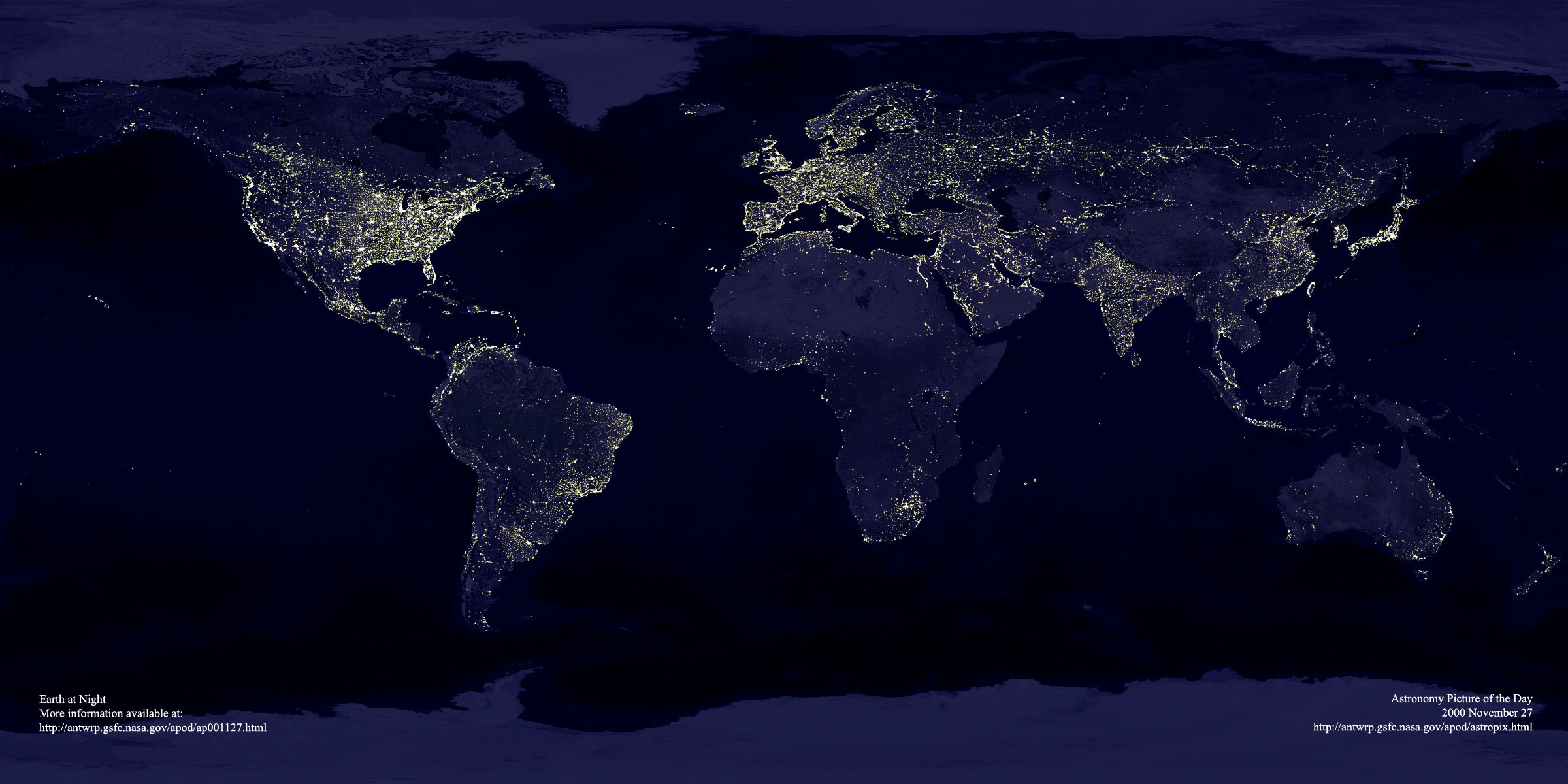
Here ya go.
-
Places that really, really suck
Looking at the detailed map, it's fair to say that, in the Western Hemisphere, Alaska sucks. Also, Montana seems to suck, and southern Mexico sucks, too. Colombia and Chile, though, really suck.
On the other hand, the Bermuda Triangle totally blows.
Interesting how the map relegates Europe to the fringes... I'm suuuuuuuure it's just because the Prime Meridian happened to cut France in half. -
I've visited and it's great!
I visited this place a few years ago when it was a bit harder to get into and it was fantastic! Back then you had to call ahead and get an escort through the guarded gate onto the base. The museum was a few ancient warehouses in the shadow of this monstrous dirigile hanger which is also an amazing sight.
I forget his name, but the person who ran the museum was very cool and took an hour just guiding me and a friend through the museum chatting about all the computers they had. Back then everything was in a huge dark warehouse on big dusty shelves. It felt like walking into the government warehouse at the end of the Raiders of the Lost Arc. Every time you turned a corner you were facing a lost treasure.
Crazy old LISP OS machines in wooden cabinets. One of the original Internet routers the size of a refrigerator with a hand drawn network map of the Internet from 1979 still taped to the side. An amazing old Cray that looked like an art deco couch from the movie 2001. Computers that look like telephone switches from 1901. The kitchen computer! Oh my GOD they actually built this thing! See it and believe it.
-
The whole internet, on a single piece of 8.5x11The computer history museum used to be housed in an old warehouse on Moffett Field (which also has a huge hangar that was used for airships). I visited there a while ago, and they have a great collection of stuff.
One of the more interesting things was the internet (or arpanet) router. A six-foot high cabinet. And stuck on the side, was a hand-drawn map of the entire internet. On one piece of 8.5x11. With about 15 nodes. I hope it didn't fall off when they moved it to the new museum.
-
The nation's first engineering school
United States Military Academy at West Point
How can you miss a place that has been producing engineers for two centuries? Plus you get great scenery, lots of history, interesting architecture, and if you time it right, you might be able to catch a show at Ike Hall.
Some other places to consider would be the Johnson Space Center, the Boston Museum of Science, the Las Vegas strip, and, to see what our lives will be like in the future (minus a few decades...), Epcot Center. Those are just a few places I can think of that I've been to that would be of interest (other than what has already been mentioned several times).
-
Observatories
I think you must visit the observatories and NASA at Houston and the Kennedy space center in Florida. My favorites (open to the public):
George Observatory, Houston, 36 inches
Rainwater Observatory, Mississippi, 32 inches
Goldendale Observatory in Washington, 24 inches
Custer observatory, NY, 13 inches
-
Observatories
I think you must visit the observatories and NASA at Houston and the Kennedy space center in Florida. My favorites (open to the public):
George Observatory, Houston, 36 inches
Rainwater Observatory, Mississippi, 32 inches
Goldendale Observatory in Washington, 24 inches
Custer observatory, NY, 13 inches
-
Corvettes, Aquariums, Mountains, Caves -many links
If you are in DC then you won't be too far from Baltimore where you can go to the Inner Harbor area and see the National Aquarium, very cool and very worth the trip. And if you happen to be an Aquarium nut, one of the Largest is in Chattanooga, TN right at the Base of Lookout Mountain where on a clear day you can see 7 states (and probably Dollywood too.)
If you make it to chattanooga, you might want to come north a bit to Bowling Green, KY where you can visit the National Corvette Museum and tour the facility where every Corvette is built and possibly get a glance at the new Cadillac XLR based off the Corvette.
Now if you've made it to the Corvette Museum you are only 15 miles from the worlds Largest Cave System Mammoth Cave National Park
South of here is is the US Space and Rocket Center in Huntsville, Alabama and of course others have mentioned The Kennedy Space Center at Cape Canaveral.
Of course I'm sure there's plenty interesting things I have forgotten about. Those are some pretty good things to do while you are in the eastern half of the US. -
Re:Cape Canaveral, Florida!
Yes, shuttles land in Cape Canaveral. They very rarely land at Edwards Air Force Base in CA because of the price of flying the shuttle back to Florida.
-
Re:My Top Choices
When visiting Redstone Arsenal, be sure to check out NASA's Marshall Space Flight Center and the Redstone Scientific Information Center - if possible.
-
LA Geek Spots!
Well, If you want Geeksih how about this:
Palamar Telescope.
Then again there is Cal Tech in Pasadena.
Next you can stop at JPL.
There is also Mt. Wilson above Los Angeles.
Of course you could also goto Griffith Observatory but it's closed for a renovation.
All these are in the San Diego/Los Angeles area.
Heck, if you are into art/old books/old stuff there is the Getty.
And of course the Huntington with their copy of the Guttenburg bible.
We also have Edwards Airforce Base which is where the shuttle use to land, but they put on a heck of an air show.
And when traveling to the LA area you need to fly into the Burbank airport. They built the SR-71, the F117 and several other toys right there...
When you are done with Los Angeles area head on up to the San Fransisco area and check out the Valley. I'm sure a couple more people here can fill you in on those spots.
MAn I think I'm going to love looking at this thread! -
Re:mac problems
Unrefuted testimony is presumed fact. I ao declare, the person you are responding to is in-fact denying that Windows and Lunix and BDS are using *RECYCLED* electrons to store data!
This was proven by the ol' Old Testament biblical concept of unrefuted testimony presumed fact:
Planet Earth was proven to be flat. You can't prove otherwise until astronaughts go into space and take a picture while on the pancake-shaped moon. That is why the lunar landing missions to the moon are all fake! Fake! The moon is flat, same with planet Earth! You can't trust pictures taken from space probes looking at planet Earth, because we know freely-available technology is availble to manipulate and doctor-up space evidence! Doo-doo-Im-not-listening-doo-doo. -
Re:Yeah, but how much are you willing to pay?
Apollo wasn't as expensive as you might think. According to this NASA page, total funding for the Apollo program was less than 20 billion dollars (which would equal about 100 billion of today's dollars).
In contrast to that, last year's US GDP was about USD 10 trillion. It's just a matter of will - the state's administration doesn't really have an interest in space exploration. -
NASA killing any Shuttle competitorCaptain Loser, you have to remember that NASA is a bureaucratic organization. The purpose of a bureaucratic organization is to extract money from the taxpayers to hire more bureaucrats.
It's the reason why NASA deceived Congress and underestimated the cost and reliability of the Shuttle. Not a concious conspiracy, just your regular bureaucratic tendency.
Nowadays, the Shuttle is keeping tens of thousands of plushy jobs at NASA. Many of them aren't paper pushers, there are really good engineers working on this program. However, the real top dogs are the bureaucrats. And they know that the Shuttle should be replaced by something that does not require an army to operate, but they'd be out of a job.
Each time the crazy engineers rock the boat and create a potential cheaper competitor for the Shuttle, it magically gets killed. Look at the X-33. Look at the DC-X: This demonstrator was taking off and landing on its jet, vertically. It was perfectly working when it was given to NASA, and somehow, NASA killed it on its first NASA flight. And somehow, the budget to build a new DC-X was consumed by, why, the Shuttle of course. So this perfectly good project was dropped.
See how it works? Tons of examples can be found in the history of the various X-projects that got mysteriously mismanaged and killed since the Shuttle program started.
NASA outlived its utility and became the worst enemy of cheap space access.
You want space access? You want to get to Mars before the Chinese? Keep the JPL and the researchers, get rid of the rest of NASA.
-- SysKoll
-
yeah
A pretty picture may be cheap, but it does not always prove correct. Oh well, the next one will be better.
-
Re:If SOHO data is so critical...why are space weather forecasters [...] relying on a satellite [...] two years past its [...] lifespan?
SOHO was launched at the end of 1995 and arrived in its orbit in mid-1996. The mission was originally scheduled to end in 1998. So we are now 5 years past its originally planned mission.
But to answer your question -- there is currently no other spacecraft that could do SOHO's job. However, there are plans for a "Solar Dynamics Observatory (SDO)", part of the "Living with a Star" program. After it launches (maybe in 2006), then SOHO will no longer be a single point of failure. Hopefully, SOHO will last that long.
#standard disclaimer: I work for SOHO, but don't speak for NASA or my employer
-
Re:If SOHO data is so critical...why are space weather forecasters [...] relying on a satellite [...] two years past its [...] lifespan?
SOHO was launched at the end of 1995 and arrived in its orbit in mid-1996. The mission was originally scheduled to end in 1998. So we are now 5 years past its originally planned mission.
But to answer your question -- there is currently no other spacecraft that could do SOHO's job. However, there are plans for a "Solar Dynamics Observatory (SDO)", part of the "Living with a Star" program. After it launches (maybe in 2006), then SOHO will no longer be a single point of failure. Hopefully, SOHO will last that long.
#standard disclaimer: I work for SOHO, but don't speak for NASA or my employer
-
Re:The Millennial Project
FYI: NASA is working on a pair of microgravity research racks called the Fluids and Combustion Facility (website) for the Space Station; the Combustion rack will be doing ultra-low-g combustion experiments. That rack is currently scheduled to fly in early '05, but will probably be delayed quite a bit by the Columbia tragedy and consequent shuttle grounding.
-
Deja vu?It looks like SOHO was already "nearly back in business in 1998...
Regardless of administrative crap, here are some nice shots of our by far biggest source of life energy!
-
Can't believe they didn't link it...
-
Re:Hands up...Ever seen this before?
FBI WARNING: Federal law provides severe civil and criminal penalties for the unauthorized reproduction, distribution or exhibition of copyrighted motion pictures, video tapes or video discs. Criminal copyright infringement is investigated by the FBI and may constitute a felony with a maximum penalty of up to five years in prison and/or a $250,000 fine.
The real crime is that they have to write and vote on a new law when there are already existing laws that either cover the same thing, or ones that should have been written more vaguely.
Next, the US will do something like make a constitutional amendment to make alcoholic beverages illegal, and another one to repeal that amendment.
Although I think the "War on Drugs" is bs, the law is pretty clear. If its on the list, you can't do it (or its illegal to do so). While I'm on it you might want to look at the "War on Drugs budget" (which does not include incarceration) vs. NASA's budget. -
Bah, it's been done!This was done way back in 1958! And they went ALL the way to the moon!
The winner was Tom Swift Jr. and it's even documented on the NASA web site!
Kids these days -- nobody reads
-
here's some link budget calculators
used to calculate the gains and losses on a link...
ya know.. sometimes you just need to know... BOOKMARK THEM!
http://www.satsig.net/linkbugt.htm
http://classwww.gsfc.nasa.gov/class/pages/FLBCalc. htm
http://nmsp.gsfc.nasa.gov/tdrss/calc.html -
here's some link budget calculators
used to calculate the gains and losses on a link...
ya know.. sometimes you just need to know... BOOKMARK THEM!
http://www.satsig.net/linkbugt.htm
http://classwww.gsfc.nasa.gov/class/pages/FLBCalc. htm
http://nmsp.gsfc.nasa.gov/tdrss/calc.html -
Re:Piss on the FAA!> IIRC, it's easier to get into orbit from close to the equator. Does that apply to suborbital flight too?
No. For suborbital, you just need altitude. These flights basically just go up and come down.
To attain orbit, you also need to achieve enough velocity to stay up.
If you're in geosynchronous orbit, then you orbit the earth once a day. If you're closer to the ground, you need to orbit the earth more than once a day. The space station travels at 18000 mph.
Here's an interesting snippet from Ed Lu's blog (he's currently abord ISS):
Begin quote:
Think of standing on the ground and throwing a baseball. The harder you throw it, the further it goes before gravity pulls it to the ground. Obvious. Now imagine you are incredibly strong and can throw the baseball all the way across the country, or even half way around the Earth before it lands. Now reach back and throw it even harder - perhaps it goes three fourths of the way around the Earth. What if you throw it even faster? Then maybe it will fly almost completely around the Earth and land right at your feet. Now throw it just a bit harder. What will happen? If there was no atmosphere and therefore no air resistance to slow the ball down, the ball would fly all the way around the world, right past your feet, and keep going. Since it doesn't slow down, it keeps right on going and continues around the Earth again and again. The ball would be in orbit.