Slashdot Mirror
Domain: nasa.gov
Stories and comments across the archive that link to nasa.gov.
Comments · 16,365
-
Re:Data available from NASA
Perhaps you meant te Planetary Image Atlas. It has raw and processed images from many planetary missions. They have some neat utils to search and find the data you want too.
-
Re:Volcano's sustain life
The more we find out about IO the more I'm sure that some primitive life exists there.
I'd say Europa is more likely, as it is the only other body in the solar system known to have liquid oceans.
Or actually, it's possible Callisto does, too.
-
Re:Volcano's sustain life
The more we find out about IO the more I'm sure that some primitive life exists there.
I'd say Europa is more likely, as it is the only other body in the solar system known to have liquid oceans.
Or actually, it's possible Callisto does, too.
-
Somewhat bogus articleThat article has been around for a while. It paints an excessively rosy picture of the Space Shuttle flight control software.
Here's NASA's own history on bugs in that software:
- So, despite the well-planned and well-manned verification effort, software bugs exist. Part of the reason is the complexity of the real-time system, and part is because, as one IBM manager said, "we didn't do it up front enough," the "it" being thinking through the program logic and verification schemes. Aware that effort expended at the early part of a project on quality would be much cheaper and simpler than trying to put quality in toward the end, IBM and NASA tried to do much more at the beginning of the Shuttle software development than in any previous effort, but it still was not enough to ensure perfection.
The Shuttle's user interface is awful. The thing has hex keyboards!. Some astronaut comments include
- "What we have in the Shuttle is a disaster. We are not making computers do what we want" -- John Young, Chief Astronaut, 1980s
- "We end up working for the computer, rather than the computer working for us." -- Frank Hughes, NASA flight trainer
- "crew interfaces...more confusing and complex than I thought they would be" -- John Aaron, NASA interface designer
- "(the) 13,000 keystrokes used in a week-long lunar mission are matched by a Shuttle crew in a 58-hour flight" -- NASA history
This project should not be held up as a great example of software engineering. Even NASA doesn't think it is.
-
Re:Flight Software
-
Wrap yer brain around this, then =)Well, I think it is 4" per year like someone else said.. that number works out correctly, so let's do the math on that:
It takes the Moon 15,840 Earth years to travel 1 mile at 4" per year. Over 4 billion years it's travelled about 250,000 miles away from Earth. Mars and its satellites are ~78 million miles away on a good day (data from this site). See the scale here? It'll take the Moon another 4 billion years to travel another 250,000 miles. It's not going anywhere any time soon. =)
Even if it travelled a full mile per year, after 50 *million* years, it would still be closer than Mars...
-
Re:A Brief History...
Another episode of Apple's attempts at modern operating systems involves A/UX which was released sometime before 1993. This ill-fated OS included an environment that ran Mac applications. It wasn't well supported and Apple dumped it while claiming they were planning on supporting the PowerOpen ABI for PowerPC-based Unices. This effort also eventually died.
One wonders what would have happened if Apple continued to support A/UX instead of buying NeXT.
p.s. Is there a good history of A/UX available on the web? -
Re:First planned ventrure??
Was Gallileo's extra-solar journey an accident? How about Voyager?
Are you thinking of Pioneer? Gallileo is still well within the Sol system, getting ready for a Ganymede fly-by.While the Pioneer and Voyager spacecraft trajectories were planned to leave the system, it was never planned that they'd be at all operational at the time.
Both missions have far exceeded their design parameters. Pioneer 10's mission ended in 1997, but it's still useful; its transmissions are being used to study chaos theory. (Pioneer 11 went dead years ago, when its RTG ran down.) And the Voyagers have been re-assigned to look for the heliopause boundary and study the interstellar environment.
-
Re:First planned ventrure??
Was Gallileo's extra-solar journey an accident? How about Voyager?
Are you thinking of Pioneer? Gallileo is still well within the Sol system, getting ready for a Ganymede fly-by.While the Pioneer and Voyager spacecraft trajectories were planned to leave the system, it was never planned that they'd be at all operational at the time.
Both missions have far exceeded their design parameters. Pioneer 10's mission ended in 1997, but it's still useful; its transmissions are being used to study chaos theory. (Pioneer 11 went dead years ago, when its RTG ran down.) And the Voyagers have been re-assigned to look for the heliopause boundary and study the interstellar environment.
-
Re:First planned ventrure??
Was Gallileo's extra-solar journey an accident? How about Voyager?
Are you thinking of Pioneer? Gallileo is still well within the Sol system, getting ready for a Ganymede fly-by.While the Pioneer and Voyager spacecraft trajectories were planned to leave the system, it was never planned that they'd be at all operational at the time.
Both missions have far exceeded their design parameters. Pioneer 10's mission ended in 1997, but it's still useful; its transmissions are being used to study chaos theory. (Pioneer 11 went dead years ago, when its RTG ran down.) And the Voyagers have been re-assigned to look for the heliopause boundary and study the interstellar environment.
-
Re:trashFrom the site:
A part of you and your life can be deposited on the moon at the end of TrailBlazer's mission.
That is sad. A business card?? This is how you should go about "securing your place in history and on the moon"?? Oh yeah, here's my card - it symbolizes everything about me and my life... Call me, we'll do lunch - NOT!
I'm much happier having my name on a chip on the Stardust Mission, and it didn't cost me a dime!
-
Re:Why?
The environment is not radioactive.
Yes it is. One of the design issues of the space suites is to protect against radiation from the sun. IMO that is part of the environment.
Water was not found on the moon
Ummmm.... NASA tends to disagree
Other links....
another NASA article
More water than original estimates
Info on Prospector
For instance, goods falling into earth's atmosphere would need to be assured of a safe reentry.
I never said that! Please read what I wrote...
These goods would fall into orbit around the earth and be used for whatever... A space station or brought back to earth for sale.
That is brought back to earth for sale. Most likely by a space craft similar to the space shuttle!
A steel produced in a vacuum is stronger. Read it here
Anyway if you try to refute statements please back them up with facts like this. I was just making a comment not submitting a report.
Maybe I am just responding to a troll.
-
Re:Why?
The environment is not radioactive.
Yes it is. One of the design issues of the space suites is to protect against radiation from the sun. IMO that is part of the environment.
Water was not found on the moon
Ummmm.... NASA tends to disagree
Other links....
another NASA article
More water than original estimates
Info on Prospector
For instance, goods falling into earth's atmosphere would need to be assured of a safe reentry.
I never said that! Please read what I wrote...
These goods would fall into orbit around the earth and be used for whatever... A space station or brought back to earth for sale.
That is brought back to earth for sale. Most likely by a space craft similar to the space shuttle!
A steel produced in a vacuum is stronger. Read it here
Anyway if you try to refute statements please back them up with facts like this. I was just making a comment not submitting a report.
Maybe I am just responding to a troll.
-
Re:Why?
The environment is not radioactive.
Yes it is. One of the design issues of the space suites is to protect against radiation from the sun. IMO that is part of the environment.
Water was not found on the moon
Ummmm.... NASA tends to disagree
Other links....
another NASA article
More water than original estimates
Info on Prospector
For instance, goods falling into earth's atmosphere would need to be assured of a safe reentry.
I never said that! Please read what I wrote...
These goods would fall into orbit around the earth and be used for whatever... A space station or brought back to earth for sale.
That is brought back to earth for sale. Most likely by a space craft similar to the space shuttle!
A steel produced in a vacuum is stronger. Read it here
Anyway if you try to refute statements please back them up with facts like this. I was just making a comment not submitting a report.
Maybe I am just responding to a troll.
-
Re:Why?
The environment is not radioactive.
Yes it is. One of the design issues of the space suites is to protect against radiation from the sun. IMO that is part of the environment.
Water was not found on the moon
Ummmm.... NASA tends to disagree
Other links....
another NASA article
More water than original estimates
Info on Prospector
For instance, goods falling into earth's atmosphere would need to be assured of a safe reentry.
I never said that! Please read what I wrote...
These goods would fall into orbit around the earth and be used for whatever... A space station or brought back to earth for sale.
That is brought back to earth for sale. Most likely by a space craft similar to the space shuttle!
A steel produced in a vacuum is stronger. Read it here
Anyway if you try to refute statements please back them up with facts like this. I was just making a comment not submitting a report.
Maybe I am just responding to a troll.
-
We've already lived through this.
Linux and Unix software is pretty immune to attacks like the one exploited by ILOVEYOU. In my mind, there are two reasons for this:
1. We've already lived through such attacks. We haven't already forgotten The Internet Worm, have we? It happened back in 1988, so I'm guessing there are readers who don't remember it. Do yourself a favor and at least check out This Executive Summary of what the worm was.
2. Open source lets us learn from our past. In the Unix world, no software with blatant holes has those holes for long. Code is scrutinized for previous exploits. Nobody wants to get burned twice. On the other hand, in the closed-source world, it's likely that the developer won't know every previous software exploit ever, and he's likely to make the same mistake that someone else did. We will never see ANOTHER program that works like the internet worm; we now know to look for those type of exploits.
We might not be immune, but it's nearly impossible that we woule make the same mistake twice. That's the beauty of open source.
-
You mean like the "Real World Interface" of
Unicenter TNG ?
Jack me in...
Actually, I DO beleive that a lot of cheesy SciFi (like "Tom Corbet! Space Cadet!", Buck Rogers, etc) of the 50's were very instrumental in growing the public momentum towards the US space program in the 60's, altho it was a combination of many things incl. the cold war/sputnik/space race, Werner Von Braun (also SciFi influenced), commitment by President and congress, etc, etc... -
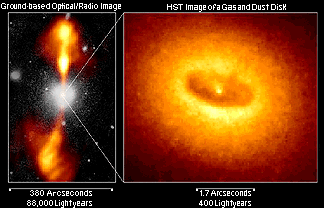
They're really looking for Active Galactic Nuclei
-
They're really looking for Active Galactic Nuclei
-
Re:Why it's ground based
Good reply, you obviously know what you're talking about. However the main reason you use a ground based telescope is that you require a detector the size of a football pitch to see enough gamma rays of this energy to say anything useful. Thus it's impractical to launch one into space. Instead you use the atmosphere as your detector. Space based telescopes exist already which see lower energy gamma radiation from blazars, such as CGRO . I should also mention the experiment which discovered very high energy gamma rays from blazars, using the Cerenkov technique: The Whipple experiment (a blatant plug for my own PhD experiment!).
-
Re:Open Source movement == Communism.
I hate to tell you this guys, but for those of you who think Open Source != Communism, you are sadly mistaken. You can continue to delude yourself but it doesn't make it any less true. People who want to "open source" hardware, ALL proprietary software, and now radio and probably TV and music? Why not just come out and say it? All property should be community property and everyone takes whatever they need from others.
Okay, everyone all together now: "All property should be community property and everyone takes whatever they need from others."
There, feel better?
No, you're right, there's no such thing as the "excluded middle" in logic, so you must be right that anyone who doesn't argue for the most extreme forms of intellectual property (what I like to call "intellectual privilege", for a variety of reasons, e.g. the gov't takes it away after a fairly limited amount of time and places into the public domain -- kinda like how it treated Elian Gonzalez, heh
You want MS Office 2000? No prob, just download it. MS wants a copy of your latest program? No problem, they download it. Clinton wants the latest copy of Playboy? No problem, he breaks into a magazine shop and takes it. Want free Internet access? No problem, just crack passwords and dial up.
Let me get this straight. You're saying these things aren't happening now?? "According to Janet Reno and Clinton lawyer Bob Bennett, the magazine shop had been given more than enough time to liberate the latest issue of Playboy, so the use of force to obtain 10 copies of that issue for `important White House activities relating to a dire shortage of interns' was way past due, justifying the raid of the store by 50 BATFP agents." -- ABC News, 2000-07-09.
Communism doesn't do anything for people but use them as slaves for the sake of fattening the government and the people in power..
Gee, almost like how America's supposedly "compassionate" combination retirement-home, health-care-facility, and mental-ward otherwise referred to as "The Federal Government", post-FDR anyway? (Okay, you don't quite have to be among the elite ruling class in the USA to enjoy a top-flight lifestyle while you're forced to pay for the stupid, avoidable mistakes made by people you've never met by a government that has never really cared...but it sure helps to be friendly with that elite, if you don't want your stock valuations sued out from under you.)
i.e. look at the Soviet Union and Fidel Castro in Cuba. NOTHING good has ever come out of communism. NOTHING.
Oh, come on. What about hockey? Ballet? "Hot Cuban Chicks", as the wags put it? You think Russians and Cubans would naturally have come up with these things without the direct intervention of Marx, Lenin, Stalin, Castro, and the helpful influence of Mao, Pol Pot, etc.? Keep in mind most of the very best hockey players and ballet dancers would have been couch potatoes like me ("I coulda been a contendah!", says I) if it weren't for the prospect of becoming a mere statistic in the latest Communist-sponsored "mass re-education"....
Remember that open source kiddies.
Remember that open source kiddies what? Did you run out of money before you could buy a verb or something?
This whole stupid movement will collapse like the ponzi scheme it is when people realize that they may want to get PAID to do the WORK that they HAVE done in case they some day want to retire without living in a complete [****]hole on a meager social security or welfare income.
Ah, but by the time we retire, our leaders will have Taken Over, the Great RMS will rule the world, and he will give each of us of the crumbs of his great wealth and power! Can't wait to run NASA, the National Weather Service, and The Weather Channel, myself...or did you think I wrote GNU Fortran because I actually write in that hackforsaken language?? Hahahahahaha!!
-
Similar things almost got to Mars
Ever heard of the Mars balloon?
It was a big helium balloon which was supposed to move around Mars during daytime (with the help of winds) and during the nighttime it would go lower and stop.
The snake-relation here is the device attached to the balloon. It was a snake look-a-like, formed of interconnected metal cones containing electronics and measurement gadgets inside. When they tested the balloon, they set it free in France and it ended up in the USA, to be picked up by a farmer when the balloon ended stuck on a tree.
The snake was designed to be such that it wouldn't get stuck between rocks. In fact, the snake performed exceptionally well, slithering between rocks.
What happened to the Mars balloon and the snake?
Well, it didn't make it (the balloons were removed from the project), due to many reasons, one of them being the breakdown of Soviet Union and one being the failures of Mars probes. For instance, the Mars Observer carried the "Mars Balloon Relay" (MBR) and as we know, the MO disappeared 3 days before arriving on Mars. So no relays were deployed.
More information about the balloon, and here about "aerobots".
I couldn't find a link about the snake attached to the balloon, sorry. -
Similar things almost got to Mars
Ever heard of the Mars balloon?
It was a big helium balloon which was supposed to move around Mars during daytime (with the help of winds) and during the nighttime it would go lower and stop.
The snake-relation here is the device attached to the balloon. It was a snake look-a-like, formed of interconnected metal cones containing electronics and measurement gadgets inside. When they tested the balloon, they set it free in France and it ended up in the USA, to be picked up by a farmer when the balloon ended stuck on a tree.
The snake was designed to be such that it wouldn't get stuck between rocks. In fact, the snake performed exceptionally well, slithering between rocks.
What happened to the Mars balloon and the snake?
Well, it didn't make it (the balloons were removed from the project), due to many reasons, one of them being the breakdown of Soviet Union and one being the failures of Mars probes. For instance, the Mars Observer carried the "Mars Balloon Relay" (MBR) and as we know, the MO disappeared 3 days before arriving on Mars. So no relays were deployed.
More information about the balloon, and here about "aerobots".
I couldn't find a link about the snake attached to the balloon, sorry. -
Similar things almost got to Mars
Ever heard of the Mars balloon?
It was a big helium balloon which was supposed to move around Mars during daytime (with the help of winds) and during the nighttime it would go lower and stop.
The snake-relation here is the device attached to the balloon. It was a snake look-a-like, formed of interconnected metal cones containing electronics and measurement gadgets inside. When they tested the balloon, they set it free in France and it ended up in the USA, to be picked up by a farmer when the balloon ended stuck on a tree.
The snake was designed to be such that it wouldn't get stuck between rocks. In fact, the snake performed exceptionally well, slithering between rocks.
What happened to the Mars balloon and the snake?
Well, it didn't make it (the balloons were removed from the project), due to many reasons, one of them being the breakdown of Soviet Union and one being the failures of Mars probes. For instance, the Mars Observer carried the "Mars Balloon Relay" (MBR) and as we know, the MO disappeared 3 days before arriving on Mars. So no relays were deployed.
More information about the balloon, and here about "aerobots".
I couldn't find a link about the snake attached to the balloon, sorry. -
Re:based on PARC work
As I recall, there were still many problems with his transforming robots (nifty as the idea was). The biggest problem seemed to be power issues...
I don't see power as a problem in space: since the snake weighs nothing, it only has to act against its measly momentum (until the astronauts hold a snake race
But I do see control as a problem. True robotics, especially in space, has a miserable track record. Even apparently simple things are actually very difficult, as Deep Space 1 pointing its camera in the wrong direction demonstrate. The snake will need to perform complex folding and grasping motions using a dozen joints. Designing that control system will be formidable. (The space shuttles' vaunted "robotic" arm is no more robotic than a bulldozer. It is a waldo (remote-controlled hand) driven by a human operator at a joystick.)
If the snake is anything like the prototypes they showed, it will have lots of bearings. Vacuum welding will be a minor challenge, and thermal expansion could be a major concern. Many missions, such as Galileo, have been impaired or lost from solar arrays and antennas that were supposed to fold out, but instead jammed.
And then they want detachable segments! That probably means electrical connectors (unless they put a radio transciever in each segment, which makes it a networking nightmare). On every design project I've ever been on, connectors have been the single largest pain in the ass (picking a microcontroller or transistor is easy compared to picking a connector). And not only is it a connector, it has to attach/detach (in vacuum) under the supervision of a robotic (read dumb) brain.
I don't mean to put the snake projects down -- they just have so many compounded difficulties.
There is one way the snake beats everything else hands down: redundancy, both of operations and repair. Most spacecraft can't keep several full sets of spare parts in a bucket! When you're 100 million miles from home, that might overshadow the other shortcomings.
-
Another small misconception...
Another point I'd like to make (started by a small error in the inital
What's new here is that they have detected highly-ionized oxygen without a substantial neutral couterpart. There must be a substantial amount of ionized hydrogen that is associated as a result.
Unlike star-forming regions (like the Orion nebula) where ionized hydrogen is more easily detected, the ionized hydrogen associated with this state of oxygen (it's missing 5 electrons!) is extremely difficult to detect directly. The high temperatures and low densities in these regions keep the protons and electrons from easily rejoining and producing the tell-tale cascade of light from an ionized gas that illuminates star-forming regions. Any neutral hydrogen which does manage to form is quickly rammed by high speed particles and re-ionized, escaping our detection by other techniques.
As a sidenote, these kinds of highly-ionized regions are found close by in our own galaxy. In the most obvious cases the gas has been heated to great temperatures by supernovae explosions. The sun is actually sitting in one, affectionately known as the Local Bubble.
These new regions found in intergalactic space may be fossil remants of early, vigorous star-formation in distant galaxies that has been ejected into intergalactic space. Or, they maybe something entirely new!
mh -
Why?A number of people have posted comments to the effect of "who cares?", "this isn't important".
This is really interesting stuff to me because of a couple of things that radar measurements can do that optical either can't or has difficulty doing.
1) Radar can penetrate clouds. Witness Magellan.
2) Since radar can do this, ground based radar doesn't suffer nearly as much atmospheric distortion as a normal telescope does.
3) Radar is an active system, so a radar observer does not have to worry about reflected sunlight providing illumination.
4) Radar observations can easily provide lots of info like rotation rate, etc. See here for examples.
5) Radar can also, given sufficient info, provde 3D maps. For an optical 3D map, you either need a laser altimeter or a stereo imager
Also check out this quote from a NASA press release about radar imaging of asteroid 1999 JM8:
""Our finest resolution is 15 meters (49 feet) per pixel, which is finer than that obtained for any other asteroid, even for spacecraft" said Dr. Jean-Luc Margot, one of the team members from Arecibo Observatory. "To get that kind of resolution with an optical telescope, you'd need a mirror several hundred meters across. Radar certainly is the least expensive way of imaging Earth-approaching objects.""
Certainly seems to me that radar is a very useful tool for observing near-Earth and even belt asteroids which could lead to later exploration and exploitation.
-
Why?A number of people have posted comments to the effect of "who cares?", "this isn't important".
This is really interesting stuff to me because of a couple of things that radar measurements can do that optical either can't or has difficulty doing.
1) Radar can penetrate clouds. Witness Magellan.
2) Since radar can do this, ground based radar doesn't suffer nearly as much atmospheric distortion as a normal telescope does.
3) Radar is an active system, so a radar observer does not have to worry about reflected sunlight providing illumination.
4) Radar observations can easily provide lots of info like rotation rate, etc. See here for examples.
5) Radar can also, given sufficient info, provde 3D maps. For an optical 3D map, you either need a laser altimeter or a stereo imager
Also check out this quote from a NASA press release about radar imaging of asteroid 1999 JM8:
""Our finest resolution is 15 meters (49 feet) per pixel, which is finer than that obtained for any other asteroid, even for spacecraft" said Dr. Jean-Luc Margot, one of the team members from Arecibo Observatory. "To get that kind of resolution with an optical telescope, you'd need a mirror several hundred meters across. Radar certainly is the least expensive way of imaging Earth-approaching objects.""
Certainly seems to me that radar is a very useful tool for observing near-Earth and even belt asteroids which could lead to later exploration and exploitation.
-
Why?A number of people have posted comments to the effect of "who cares?", "this isn't important".
This is really interesting stuff to me because of a couple of things that radar measurements can do that optical either can't or has difficulty doing.
1) Radar can penetrate clouds. Witness Magellan.
2) Since radar can do this, ground based radar doesn't suffer nearly as much atmospheric distortion as a normal telescope does.
3) Radar is an active system, so a radar observer does not have to worry about reflected sunlight providing illumination.
4) Radar observations can easily provide lots of info like rotation rate, etc. See here for examples.
5) Radar can also, given sufficient info, provde 3D maps. For an optical 3D map, you either need a laser altimeter or a stereo imager
Also check out this quote from a NASA press release about radar imaging of asteroid 1999 JM8:
""Our finest resolution is 15 meters (49 feet) per pixel, which is finer than that obtained for any other asteroid, even for spacecraft" said Dr. Jean-Luc Margot, one of the team members from Arecibo Observatory. "To get that kind of resolution with an optical telescope, you'd need a mirror several hundred meters across. Radar certainly is the least expensive way of imaging Earth-approaching objects.""
Certainly seems to me that radar is a very useful tool for observing near-Earth and even belt asteroids which could lead to later exploration and exploitation.
-
Why?A number of people have posted comments to the effect of "who cares?", "this isn't important".
This is really interesting stuff to me because of a couple of things that radar measurements can do that optical either can't or has difficulty doing.
1) Radar can penetrate clouds. Witness Magellan.
2) Since radar can do this, ground based radar doesn't suffer nearly as much atmospheric distortion as a normal telescope does.
3) Radar is an active system, so a radar observer does not have to worry about reflected sunlight providing illumination.
4) Radar observations can easily provide lots of info like rotation rate, etc. See here for examples.
5) Radar can also, given sufficient info, provde 3D maps. For an optical 3D map, you either need a laser altimeter or a stereo imager
Also check out this quote from a NASA press release about radar imaging of asteroid 1999 JM8:
""Our finest resolution is 15 meters (49 feet) per pixel, which is finer than that obtained for any other asteroid, even for spacecraft" said Dr. Jean-Luc Margot, one of the team members from Arecibo Observatory. "To get that kind of resolution with an optical telescope, you'd need a mirror several hundred meters across. Radar certainly is the least expensive way of imaging Earth-approaching objects.""
Certainly seems to me that radar is a very useful tool for observing near-Earth and even belt asteroids which could lead to later exploration and exploitation.
-
Why?A number of people have posted comments to the effect of "who cares?", "this isn't important".
This is really interesting stuff to me because of a couple of things that radar measurements can do that optical either can't or has difficulty doing.
1) Radar can penetrate clouds. Witness Magellan.
2) Since radar can do this, ground based radar doesn't suffer nearly as much atmospheric distortion as a normal telescope does.
3) Radar is an active system, so a radar observer does not have to worry about reflected sunlight providing illumination.
4) Radar observations can easily provide lots of info like rotation rate, etc. See here for examples.
5) Radar can also, given sufficient info, provde 3D maps. For an optical 3D map, you either need a laser altimeter or a stereo imager
Also check out this quote from a NASA press release about radar imaging of asteroid 1999 JM8:
""Our finest resolution is 15 meters (49 feet) per pixel, which is finer than that obtained for any other asteroid, even for spacecraft" said Dr. Jean-Luc Margot, one of the team members from Arecibo Observatory. "To get that kind of resolution with an optical telescope, you'd need a mirror several hundred meters across. Radar certainly is the least expensive way of imaging Earth-approaching objects.""
Certainly seems to me that radar is a very useful tool for observing near-Earth and even belt asteroids which could lead to later exploration and exploitation.
-
Re:More information on radar asteroid astronomy.
Here's a real link for your clicking pleasure. Sorry about that! (I swear I selected "HTML Formatted"...)
-
More information on radar asteroid astronomy.
-
Re:Now we need to hollow it out...
Wait... hmm. It seems that water and air won't be so much of a problem after all. The radar detected an asteroid that is supposed to be "water-rich". [http://echo.jpl.nasa.gov/~ostro/KY26/index.html] I don't know how close they are, but it would seem that if there is water, air is only a step away, so this asteroid would be a better candidate for hollowing out.
-
More information?
The official release is here:
http://www.jpl.nasa.gov/releas es/2000/kleopatra.html
Another picture and an animation of the asteroid are here:
http://www.jpl.nasa.gov/pictures/kleopa tra/
Brief, yes. Useful, perhaps.
-
More information?
The official release is here:
http://www.jpl.nasa.gov/releas es/2000/kleopatra.html
Another picture and an animation of the asteroid are here:
http://www.jpl.nasa.gov/pictures/kleopa tra/
Brief, yes. Useful, perhaps.
-
Another pic, movie:
-
Nasa needs funding for designers
-Hey! That page loaded up almost instantly.. No flashy graphics or nothing.. Where is all that tax money going?
-
Re: Not a huge surpriseTCP/IP was developed in a time when ping times were on the order of 10000 ms from coast to coast with non-robust network paths, so it's not a huge surprise it works to a satellite.
Actually, these Plotted Results from the project's site shows us that ping times are between 0.1 and 0.2 seconds, a few of them higher. I've seen worse ping times on today's earth-Internet
-
Re:Weeks? Try hours.Voyager weekly status raport
According to that Voyager is about 75 AU from Sun.
-
Re:This will make Vint HappyDid you know it, the ISOC has even formed an "Interplanetary International Special Interest Group" (IPNSIG).
Yes, and here's the URL (for those too lazy to look it up in Google!): http://ipn.jpl.nasa.gov/
-
Re:Security -- this is foolish!Tell me about it. Much of our unmanned space program is inextricably linked with internet access. When I worked for the SOHO project at NASA/GSFC, several of the internal computers were cracked. Among them was mine -- a science workstation that could've (at the time) been used as a staging area for a more concerted attack on the command computers themselves (thanks to trusted-host protocols). The attackers used a well-known but unpatched hole in IRIX 6.2 (by default, the line printer account had no password). They were content to fire up an IRC server and brag about how kew1 they were -- we were lucky it was a random heist.
Some of the other instruments' actual command computers were compromised in similar ways at other times. If the attackers had known what they were doing, (I think they, too, were script kiddies) they could've sent commands to the spacecraft, a million miles away.
The problem for that project, as for so many, is lack of clear forethought about security and time pressure once the system was installed. We had a heterogeneous network set up by people from something like 10 different countries, and many workstations (mine included) that were administered by the scientists who used them.
The big shock for me, both in my experience at NASA and at other high-technology, high-risk ventures, is that people remain people even if they work for NASA. Folks who are interested in flying spacecraft have little time to install the latest OS patches or to design secure protocols -- they're too busy shooting from the hip, making huge volumes of hastily written code work right, or cranking out the next research paper.
IMHO, we need *less* connectivity, not more, to our spacecraft and their ground systems!
-
OMNIThe project doing this is OMNI (Operating Missions as Nodes on the Internet). Check out their web page, it sounds like a cool project.
This is definitely the way to go IMO. It will allow easier access to satellites or whatever in space and when this kind of thing becomes more common, the general public will be able to perhaps interact with satellites over the internet from their own computer.
-
OMNIThe project doing this is OMNI (Operating Missions as Nodes on the Internet). Check out their web page, it sounds like a cool project.
This is definitely the way to go IMO. It will allow easier access to satellites or whatever in space and when this kind of thing becomes more common, the general public will be able to perhaps interact with satellites over the internet from their own computer.
-
Re:I'm sick of...Yeah, what about that blatant plug for Goddard Space Flight Center and the Center of Excellence in Space Data and Information Sciences!? Sheesh, guy puts in a few hundred thousand hours writing and maintaining network drivers for Linux and he has the gall to actually put a plug in for his boss? The nerve!
Man, at least I don't have to boot my linux box for much except hardware changes and new kernels. Imagine if NT used drivers from Donald Becker then I'd have to see his spam on a daily basis!
-
Re:I'm sick of...Yeah, what about that blatant plug for Goddard Space Flight Center and the Center of Excellence in Space Data and Information Sciences!? Sheesh, guy puts in a few hundred thousand hours writing and maintaining network drivers for Linux and he has the gall to actually put a plug in for his boss? The nerve!
Man, at least I don't have to boot my linux box for much except hardware changes and new kernels. Imagine if NT used drivers from Donald Becker then I'd have to see his spam on a daily basis!
-
Re:Selective denial of GPS on a regional basis - H
They actually orbit quite a bit higher than LEO (in the area between LEO and geosynchronous). NASA has a great visualization tool at http://liftoff.msfc.n asa.gov/RealTime/Jtrack/3d/JTrack3d.html. I mainly use this for amateur radio satellites, but GPS satellites are in the catalog, and you can see where they are relative to most others.
At a given location, there are realistically 4-6 GPS satellites providing a solid signal. If you move one or two hundred miles away, 1 or 2 of those satellites will be different. If you limited your intentional errors to those initial satellites, you now have like a 20% accuracy increase. Move a few hundred miles away from that and you're further out of the error zone. A smart receiver could possibly figure out which satellites were giving the better signals and ignore the ones that were giving errors. You're right that error can't really be introduced with pinpoint accuracy, but the area where signal quality is 100% affected by intentional area can be made relatively small. Of course at least 1/4 - 1/2 of the world will be affected in some way, no matter how selective you try and get your satellites.
I imagine this ability (to switch off or introduce tremendous error) has been in the satellites since the beginning. The process of switching it on and off in real-time, as satellites pass over black-out areas, may be almost entirely automated. Just feed a set of coordinates to all of the GPS satellites, and have them figure out for themselves when to activate selective availability. *shrug*.. -
APOD pictures of Eros
A search of the Astronomy Picture Of the Day site has a binch more images and a few
Hmm I think we need an APOD slashbox... -
Re:Taking pictures of a rock...
There already exist many pictures of asteroids
um, where?
I could be wrong but unless there's been a sudden increase of spacecraft visiting asteroids, I think there are only about 3 asteroids that we have any close up pictures of.
Because there's so much space between them, we know almost nothing detailed about the asteroid belt except what other missions have scooped up in flyby's and with the exception of Galileo zooming past Ida and Gaspra, and (very recently) Cassini flying past 2685 Masursky. Neither of them were intended or to look specifically at the asteroid belt.
I'm not qualified to say what scientific benefit it could offer or if anyone should spend any money on it, but generally knowing more about what's in the asteroid belt could help a lot towards working out how the Solar System began. Theres only so much information you can get from a few fuzzy photographs.
A Europa probe would expand our knowledge of our solar system and perhaps uncover clues to the development of life
Plans for a couple of missions to Europa are underway.
-
JPL description of NEAR mission
There's a JPL writeup/description of the NEAR mission here.