Slashdot Mirror
Domain: nasa.gov
Stories and comments across the archive that link to nasa.gov.
Comments · 16,365
-
Re:Background radiation
What the Big Bang theory doesn't explain is the overall uniformity of the cosmic background radiation nor it's minute fluctuations. To explain this, the inflation theory was developed.
-- -
Re:Background radiation
What the Big Bang theory doesn't explain is the overall uniformity of the cosmic background radiation nor it's minute fluctuations. To explain this, the inflation theory was developed.
-- -
Mars Pathfinder super-res image examples.
Link: http://ic-www.arc.nasa.gov/ic/projects/bayes-grou
p /group/super-res/2d/mpf/
Mars Pathfinder Super-resolved images -
Re:Space
- If I ever have 1% of the money Bill Gates has, I'm going to fund a manned mission to Mars, including a colony.
If you ever got any real money, I would suggest that the first thing that you buy is a clue.
I believe you'll find that the Apollo missions to the Moon cost quite a bit more than Bill Gates' fortune (that's 100% of the money Bill Gates has), if you convert 1960-1970 dollars to today's dollars. Although, I couldn't find hard figures to support this speculation, I did find where the NASA budget was around $30 Billion between 1964 and 1969 alone. But, it's difficult to tell if this was mostly Apollo spending. I also can't tell for sure if this has been adjusted for inflation. If it wasn't adjusted for inflation, then it would be over $100 Billion, which is what Bill Gates' fortune is often reported to be, in today's dollars.
In any case, I imagine that a colony on Mars would cost quite a bit more than the $1 Billion that you seem to think it would require.
-
Re:The REAL energizer bunny
It is simply amazing. Voyager 1 and 2 are simply one of the shining examples of Human Engineering that we have.
On one end, you have a machine that is for all intents and purposes free flying trying to track an object that is probably less than an arcsecond away from something that is now just another point of light(Earth and the Sun)...and all on 1970's hardware!
On the other end, the technology has improved 100 fold but the signals are week and so low bandwidth (160 bps, thats right, BITS!
Think about what has been accomplished with the Voyager Project. Think about trying to do it again with today's technology! These days, if a project like Voyager was proposed, it would get lost in the budget hacking frenzy in Washington DC. Where has the sense of accomplishment and discovery gone?
Checkout The Voyager Project Home Page while you are at it. -
Re:AHHH NEW DESKTOP IMAGE :)
OK, not too shabby...however, I don't think I will replace my desktop background just yet.
-
Check out all the photos...
All the photos they have online...HERE
-
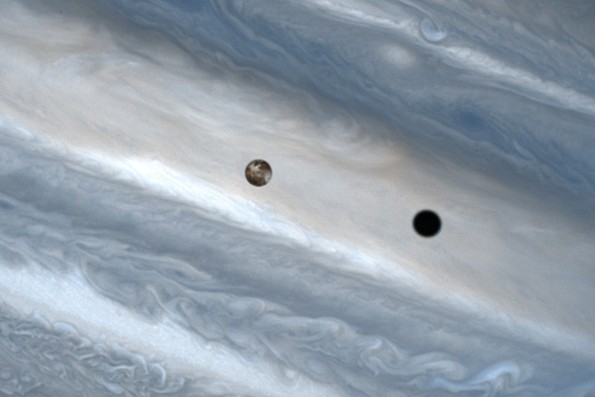
more pictures of IO
Some other pictures of IO are at http://galileo.jpl.nasa.gov/ima ges/io/ioimages.html.
-
Re:gop.org
-
How bad is global warming?Because of the "sky is falling" reactions I've seen in this forum, I've gathered a few interesting links. Have a look. (/. appears to have mangled the text in my message, but the links all work, although they look funny).
http://science.msfc.n asa.gov/newhome/essd/essd_strat_temp.htm - globally averaged atmospheric temperatures - troposphere and stratosphere.
http://sc ience.msfc.nasa.gov/newhome/headlines/notebook/es
s d13aug98_1.htm - Unexpected results from satelite measurements.http://www.cgcp.rsc.ca/en glish/html_documents/whatis.html - climate change in general, including long term and "global warming". General background.
http://www.ncdc.noaa.gov/onlineprod/p rod.html - the blank areas on the map on the left are where there are no measurements. Most of the ocean... Globally averaged atmospheric temperatures in the map on the right. General upward trend, but a LOT of fluctuation.
-
How bad is global warming?Because of the "sky is falling" reactions I've seen in this forum, I've gathered a few interesting links. Have a look. (/. appears to have mangled the text in my message, but the links all work, although they look funny).
http://science.msfc.n asa.gov/newhome/essd/essd_strat_temp.htm - globally averaged atmospheric temperatures - troposphere and stratosphere.
http://sc ience.msfc.nasa.gov/newhome/headlines/notebook/es
s d13aug98_1.htm - Unexpected results from satelite measurements.http://www.cgcp.rsc.ca/en glish/html_documents/whatis.html - climate change in general, including long term and "global warming". General background.
http://www.ncdc.noaa.gov/onlineprod/p rod.html - the blank areas on the map on the left are where there are no measurements. Most of the ocean... Globally averaged atmospheric temperatures in the map on the right. General upward trend, but a LOT of fluctuation.
-
How bad is global warming?Because of the "sky is falling" reactions I've seen in this forum, I've gathered a few interesting links. Have a look. (/. appears to have mangled the text in my message, but the links all work, although they look funny).
http://science.msfc.n asa.gov/newhome/essd/essd_strat_temp.htm - globally averaged atmospheric temperatures - troposphere and stratosphere.
http://sc ience.msfc.nasa.gov/newhome/headlines/notebook/es
s d13aug98_1.htm - Unexpected results from satelite measurements.http://www.cgcp.rsc.ca/en glish/html_documents/whatis.html - climate change in general, including long term and "global warming". General background.
http://www.ncdc.noaa.gov/onlineprod/p rod.html - the blank areas on the map on the left are where there are no measurements. Most of the ocean... Globally averaged atmospheric temperatures in the map on the right. General upward trend, but a LOT of fluctuation.
-
Re:Global warming?What's real science? Real science to me means peer-reviewed journal articles, not rantings on a newsgroup. As an active researcher in climate modelling (we produce land surface albedo and BRDF datasets, currently from AVHRR in future from TERRA) I disagree.
In my (informed) opinion the overwelming consesus amongst climatologists and biogeographers is that climate change is real - and this is backed up by both modelled and experimental data - see Myneni et al, Nature 386 (1997) for some convincing evidence from our group.
Of course, you are perfectly welcome to download a GCM such as CCM3 and go through it line by line to see whether it is "real science" or not.
If you want to discuss what is "real science" or not email me or if you're in the Boston area, come round - my work address is on my web page.
Nick
-
What's next?
Actually 73Gig is nothing. I could fill up a 73Gig drive in no time. I think the way to go is with Ferroelectric Molecular Optical Storage Nanotechnology. Colossal Storage has invented new ways of non - contact reading and writing with non destructive reading of information to a ferroelectric molecule, which not only results in a far larger capacity (4 gigabits/sq.in. maxing at 40 gigabits compared with 40 gigabits/sq.in up to 500 gigabits/sq.in), but also the speed is fantastic; The FE Drive will have much higher disk spindle speeds over 10,000 rpm and higher bandwidth data transfer rate parameters over 500 mbps. What all this means, is that someday we will get away from our present magnetic HD's and break way beyond the 1Terrabyte! And we are not talking 10years down the road! The technology is here today, and wil be available to mass consumers by 2002. Click here for more stuff about ferroelectricity
-
Launch locations
no its due to Florida's closeness to equator...
take off from higher latitude and you have to factor in many more variables into your launch windowIf it were merely a matter of being close to the equator, they could have put the launch site near Miami or Brownsville, Texas, both of which are further south than Canaveral. But they didn't.
From a Kennedy Space Center page about the Space Shuttle:
Kennedy Space Center launches have an allowable path no less than 35 degrees northeast and no greater than 120 degrees southeast. These are azimuth degree readings based on due east from KSC as 90 degrees.
These two azimuths - 35 and 120 degrees - represent the launch limits from the KSC. Any azimuth angles further north or south would launch a spacecraft over a habitable land mass, adversely affect safety provisions for abort or vehicle separation conditions, or present the undesirable possibility that the SRB or external tank could land on foreign land or sea space.If the launch site was in Miami, the available launch angles would be greatly reduced, as any launches angled to the south would risk dropping a SRB onto the Bahamas. Likewise, basing the launches in Brownsville would risk dropping shuttle bits along the entire US Gulf Coast, Florida, the Yucatan, and Cuba.
-
Re:Electricity is not really environmentally kosheIt's true that the external tank contains liquid hydrogen and oxygen. But the initial thrust, the part that the maglev would be replacing or supplementing, is largely provided by the solid rocket boosters, or SRBs.
From NASA's website:
The two SRBs provide 71.4 percent of the thrust at lift- off and during first-stage ascent.
Now, if that mixture combusts to steam, I'll eat it.(snip)
The propellant mixture in each SRB motor consists of an ammonium perchlorate (oxidizer, 69.6 percent by weight), aluminum (fuel, 16 percent), iron oxide (a catalyst, 0.4 percent), a polymer (a binder that holds the mixture together, 12.04 percent), and an epoxy curing agent (1.96 percent).
-
Inductrack et alThe official nasa press release for this mag-lev system can be found here This system does use the Inductrack system mentiones earlier, which has several advantages over other forms of mas driver, which this essentially is. The inductrack system is bacically coils of ordinary wire surrounding some sort of ferrous core. The article above mentions that each section of track weighs over 500lbs wich is due laregly to the huge chunk of iron in the center of the coil of wire. This reduces cost and complexety many times. You dont need any cooling apparatus, you dont need any expensive magnets, and its very scalable. To make the track longer just ad a section of track. This is a very promising technology, it could really pave the way for cheap access to space. Heres hoping that nasa will continue to develop it.
There is one problem though, that is, there might be a speed limit associated with it. As the craft accelerates, a larger magnetic field needs to be generated to continue the acceleration, this means more current through the coils of wire. Eventually the wire will overheat and short out or simply melt. Previously a speed limit of 600 mph was mentioned, this seems plausible, but id need more data. Also, if the speed can max out at around say mach 10 (about 6000 mph) then scramjets can be used in place of rockets. Scramjets are much more eifficient than rockets since they burn oxygen in the air, resulting in a further reduction in weight of fuel and a commensurate increase in payload capacity.
-
Track length math600 mph is 1000 km/hr, or about 280 m/s.
The length of a track needed to accelerate from 0 to v is equal to v^2/2a, where a is the acceleration. One G of acceleration is about 10 m/s^2. Thus, the length of the track needed is about 3.9 kilometers divided by the number of Gs.
According to NASA, the Shuttle accelerates no faster than 3 Gs, so we'd need a 1.3 km track, or about 4300 feet. For comparison, the Shuttle requires 2500 feet. (That figure's at the very end of the document I linked to.)
So, the track you'd need is long, but not outrageously long.
-
Track length math600 mph is 1000 km/hr, or about 280 m/s.
The length of a track needed to accelerate from 0 to v is equal to v^2/2a, where a is the acceleration. One G of acceleration is about 10 m/s^2. Thus, the length of the track needed is about 3.9 kilometers divided by the number of Gs.
According to NASA, the Shuttle accelerates no faster than 3 Gs, so we'd need a 1.3 km track, or about 4300 feet. For comparison, the Shuttle requires 2500 feet. (That figure's at the very end of the document I linked to.)
So, the track you'd need is long, but not outrageously long.
-
The right answer(s)
Wouldn't it make sense that, these black holes out there would eventually all converge together, gaining mass and 'size', presumably even increasing escape velocity?
The right answer is that space is almost empty, so the black hole cannot grow quickly. (but see below for more)
A black hole has the same gravitational pull as a star of the same mass would. So, if our Sun miraculously became a black hole, it could not suck in the Earth. Black holes are special because you can get really close to them. Since gravity decreases as the distance squared, small distance equals strong gravity.
Radiation is not a significant factor. Only very small black holes radiate significantly enough to matter. A solar-mass black hole would take 10^67 years to evaporate... alienmole had it right above.
In a high-density environment, black holes do grow. Namely, in the center of galaxies we see black holes that can be like a million or 10 million times the mass of the Sun. Ones which are actively feeding (on gas clouds, stars, etc) may explain quasars (the brightest sustained light sources in the universe).
The Milky Way almost certainly has a pretty decent sized black hole in the center, so our galaxy may once have hosted a quasar.
M87 has a somewhat active one now. See http://antwrp.gsfc.nasa.gov/a pod/index/blackhole.html for more observational evidence of black holes. -
The right answer(s)
Wouldn't it make sense that, these black holes out there would eventually all converge together, gaining mass and 'size', presumably even increasing escape velocity?
The right answer is that space is almost empty, so the black hole cannot grow quickly. (but see below for more)
A black hole has the same gravitational pull as a star of the same mass would. So, if our Sun miraculously became a black hole, it could not suck in the Earth. Black holes are special because you can get really close to them. Since gravity decreases as the distance squared, small distance equals strong gravity.
Radiation is not a significant factor. Only very small black holes radiate significantly enough to matter. A solar-mass black hole would take 10^67 years to evaporate... alienmole had it right above.
In a high-density environment, black holes do grow. Namely, in the center of galaxies we see black holes that can be like a million or 10 million times the mass of the Sun. Ones which are actively feeding (on gas clouds, stars, etc) may explain quasars (the brightest sustained light sources in the universe).
The Milky Way almost certainly has a pretty decent sized black hole in the center, so our galaxy may once have hosted a quasar.
M87 has a somewhat active one now. See http://antwrp.gsfc.nasa.gov/a pod/index/blackhole.html for more observational evidence of black holes. -
small but non-zero probabilities(Don't take this as doom-saying about the work at Brookhaven or any specific project, it's meant as a general discussion.)
As we begin to control greater energies, we seem to be entering a time when some scientific experiments will entail small, but non-zero, risk to people in the area, maybe even to humanity at large.
How small of a probability of disaster does it take before we can justify a certain amount of risk, and how do we estimate the probability of disaster without a large number of trials?
For instance: IIRC, pre-Challenger the official estimates on the Space Shuttle having a fatal accident were supposed to be something like one in a million. (My copy of What Do You Care What Other People Think? is at home, feel free to correct me on the real number.) How do you get that estimate? Best way would be to launch a million times and see what happens, but that's hardly practical. Instead it was based on engineering knowledge of well-understood physical principals, materials, and techniques. But it was completely wrong, extrapolation on top of extrapolation without even a propagation of errors. How much worse are our chances of predicting the risks of new techniques, new materials, even new physics?
Of course, the fine and noble folks onboard the shuttle knew that there was a risk, and volunteered to take it. What about "innocent" bystanders? The probability of a fatal accident during the Cassini launch or flyby may have been one in a million (or, it may have been much greater - NASA's "Cassini Mission False and True" says "the navigation accuracy of NASA spacecraft is better than 20 km." Or is that 20 miles?), but it was never non-zero. No launch has a non-zero risk - there's some small chance of a chain of malfunctions that crashes the thing into someone's house. How small do we have to get the risk to justify the experiment?
I'm not going to lose any sleep over the Brookhaven work - given what we know about cosmic rays, I'd say the risk is greater that I'll be hit by a metorite than that there will be any problems there. But the questions of risk to the public will remain.
-
If you're going to hit a wall, try a new road
If the silicon technology doesn't want to get any faster, just use a different technology. The HTMT project is seriously looking at doing this within a decade, though it will mean significant changes in system architecture.
-
What it really means (and URLs to back it up)
I've been writing SF stories set at Oort-cloud planets and brown dwarfs for a couple of years now. (You can find one, "Halo", in the Tor Books anthology Northern Suns; I am just completing a novel set among these objects). This planet, if it exists, is probably not unique. The astronomer J. Davy Kirkpatrick said in a press release last year that brown dwarfs appear to be so abundant that we'll probably find one closer than the nearest star.
So what? Well, let me put it this way: while the stars remain as far away as ever, the distance between planetary systems has been halved by the recent calculations of the abundance of brown dwarfs and the possible existence of this planet.
Consider Jupiter. It's got a couple of Mars-sized moons orbiting it; one of them might even have a subsurface ocean (Europa). This theoretical new planet could easily have similar moons. Might as well call 'em planets at that size.
The resources of the Jupiter system are huge, and the same could be true of this distant world. It's not likely to be a frozen ball; Jupiter radiates more heat than it receives from the sun, and it heats its own moons with tidal force. Even half a light-year into the Oort cloud, we might find a Europan-style oceanic world orbiting Nemesis (or whatever you want to call this 10th planet).
While the radiation environment around Nemesis is likely to be nasty, if its magnetic field is anything like Jupiter's it will be trivially easy to draw power from it; easier, in fact, than it is to generate power from solar cells. A simple wire orbiting a jovian planet produces electricity in colossal amounts through interaction with the magnetic field. A nascent colony at Nemesis would have as much power as it needed for light and heat.
If this planet does exist it should be our target for settlement after Mars and Jupiter. It will be the place where we'll learn if and how we'll travel to and survive at other stars.
-
parallels between revolutions
I'm working on a paper (which I eventually hope to be able to turn in for some class) dealing with parallels between the Information and Industrial revolutions. One of the major parts is about safety; at this time a century ago, the working conditions of most factories were terribly unsafe; think the Triangle Shirtcoat factory fire (lots of extremely flammable lint lying around; many young women died because of inadequate fire escapes so they jumped from the top stories of the burning building). It took some major (and much publicized) disasters for people to begin calling for safer working conditions en masse. I have the suspicion that it will take a similar mass failure in the electronic realm for a similar push for more bug-free software -- I don't claim to know what the failure will be, I'm just willing to bet that it will be a significant catastrophe. We've already had several minor accidents, like the Mars Orbiter or THERAC-25, but it's going to take something severe that affects many people, like a massive communications infrastructure failure. Though I don't think we have a lot to hope for right now, I have the feeling that eventually, peer-review of a program's source code (under any license, just as long as it's checked) will become basically mandatory, either by the laws of free-market economics or by (yuck) government mandate. The Free Software/Open Source communities already have the structures in place, putting us ahead in the game.
-
Re:Warped space maybe?I seem to remember reading an article a while back discussing the possibility that gravity warps time/space
Er, yes, that's known as General Relativity, and is pretty well understood. The test satellite you mention is Gravity Probe B, scheduled for launch next year.
This sort of thing has certainly been taken into account. Compared to predicting the force due to thermal radiation from the satellites, it's easy. And thermal radiation will always result in a sunward force, because you put the radiators on the dark side of the spacecraft (unless you want it to get really hot while it's still in the inner solar system.)
-
They made- and apologised for- this mistake before
This BBC article yesterday about the discovery of yet another Kuiper Belt object by Pioneer, mentions at the bottom:
Earlier this year, scientists were puzzled by what was described as a mysterious force acting on the probe. It led to speculation that there was something wrong in our understanding of the force of gravity.
Eventually the effect was tracked down to the probe itself, which was unexpectedly pushing itself in one particular direction.
I expect this new theory will also be dispelled by minor impacts, leaking remainders of fuel, and the fact that space isn't a true vaccuum. I'd be delighted to be proved wrong, of course.
--
-
Re:Edison was a sick bastard
I am not sure that it is exactly the same principle, but instead of towers, it has been tried with tethers suspended from the space shuttle. Apparently it works, and the technique might be used to partially power the international space station
The technical document on that page is rather big, and I haven't completely read it yet, so I might be way off, but:
The space shuttle tether was 20 km long. Perhaps the technical difficulty with Tesla's plan was that the towers would have had to be impractically tall, making energy generated by them impractically expensive? I love the idea though... reminds me a bit of building pyramids or putting people on the moon. -
Re:Edison was a sick bastard
I am not sure that it is exactly the same principle, but instead of towers, it has been tried with tethers suspended from the space shuttle. Apparently it works, and the technique might be used to partially power the international space station
The technical document on that page is rather big, and I haven't completely read it yet, so I might be way off, but:
The space shuttle tether was 20 km long. Perhaps the technical difficulty with Tesla's plan was that the towers would have had to be impractically tall, making energy generated by them impractically expensive? I love the idea though... reminds me a bit of building pyramids or putting people on the moon. -
Re:The article doesn't inspire confidence...X-rays cannot be focused for imaging purposes
Well, they may not have been in this work, but X-rays certainly can be focused. See, for example, the Chandra image of Cas A.
It doesn't get much more focused than that!
-
Atoms in Molecules (AIM)I was excited recently to learn that there exists a (more) rigorous derivation of the empirical chemical wisdom that molecules can be described fairly good by considering them built from smaller components (functional groups and atoms of course).
That such a treatment is possible, is not obvious, nature could have been that way, that one had to treat the whole system (like solving the wave equation for all particles at once) in order to make any useful statement at all.
Read this article on Atoms in Molecules by Richard Bader to find out more.
Bader claims that the study of the Laplacian (2nd spatial derivative) of the electron distribution leads to a natural spatial decomposition of a molecule.
Have a look at these great pictures for some simulations based on that AIM theory.
I am still surprised, that during my physics studies, I heard nothing about that treatment. You get exposed to Feynman of course, but Schwinger's formulation of quantumn electro dynamics I knew only as possible but not practical alternative. Very interesting to see Schwingers approach at the heart of this AIM theory.
-
Voyager, the greatest spacecraft ever.
I hope everyone realizes I'm talking about Voyager 1 and 2, launched by NASA in 1977, and not the USS Voyager, launched by Paramount sometime around 1996...
Voyager is undoubtedly humankind's greatest acheivement in unmanned space exploration. Two quickly prepared spacecraft to take advantage of a rare solar alignment tha only occured once every 175 years, the "Solar Tour" trajectory. Both Voyager 1 traveled to Jupiter and then to Saturn. Since these mission were never planned to last longer than these two planets, the mission planners decided to leave the Uranus/Neptune option to Voyager 2, and do a closeup flyby of Saturn's moon Titan to check up on that atmosphere of hydrocarbons and hope for a "break in the clouds" (thier words). Hopefully we'll learn more with the Huygens probe with Casinni in 2006. Unlike Galileo's Jupiter probe, Huygens may actually land on the surface and record data for up to 30 minutes! That may be really cool... Let's hope it lands on "land".
Voyager 2 went on to be the only probe to explore Uranus and Neptune. Quadruple planetary gravity assist! By the time Voyager 2 reached Neptune, it's arthritic camera (I'm not kidding, it's motors were pretty shot by that point), managed to keep the cameras on Neptune for the 30 seconds requried to gather enough light for a single photo...
And now Voyager is headed for the interstellar void. JPL *Still* has a 30 year plan. The nuclear RTGs on board will be powering Voyager equipment until 2017! The Voyager team still puts out Weekly Status Reports
I remember reading the sci.space.* newsgroups about 10 years ago. People were discussing mass-producing a thousand Voyager class spacecraft and sending about 5 of them to every object in the solar system. Sure, the failure rate would be atrocious, but think of the science! That sounds a bit like NASA's new "Discovery" program.
As for MCO, we're just learning how to produce spacecraft with all the bang for 1/10th the price. Give them a chance, they'll work out the bugs in the system. -
Daniel Golden has been incredible for NASA
Daniel Golden has done an incredible job for NASA in the past several years. He's taken a ho hum, shuttle after shuttle launching NASA without much focus, dealt with massive bugestary cuts, and trimmed NASA down (relatively) to a mean, lean space exploration machine. I know it's not quite what we expected when we were growing up, but who has done better? Not Private Business. The Russians stopped sending out interplanetary probes since their failed launch of a Mars probe in (I think) '96.
Can you remember this may active spacecraft ten years ago? (There are ten right now, alright, so I'm counting Voyager 1&2, the greatest missions ever, which are still alive and kicking 7 billion mies away). Half of these active missions are the new "better, faster, cheaper" created under Goldin's regime. Two missions to Mars every two years? The man has this incredible ability to convince the American public that science and space exploration are a good use of American tax dollars...
Goldin's ultimate goal it seems is to build a mega-telescope, most likely a huge interferometer, that could image the surfaces of planets in other solar systems, generating an Apollo 17 like image of an extra-solar Earth like planet to inspire the next generation. Deep Space 3 should be a good first test of space formation flying and interferometry.
Of course, NASA sounds like they're getting more cuts. One of those few instances where I guess you Americans would want Newt Gingrich, who was a big NASA fan himself, back where he was... OK, perhaps the only instance.
At any rate, I hope Goldin gets to keep hold of the helm for a while, or that private industry manages to gain some of the public's interest in space. I don't want to see a return to the late 80's... -
Daniel Golden has been incredible for NASA
Daniel Golden has done an incredible job for NASA in the past several years. He's taken a ho hum, shuttle after shuttle launching NASA without much focus, dealt with massive bugestary cuts, and trimmed NASA down (relatively) to a mean, lean space exploration machine. I know it's not quite what we expected when we were growing up, but who has done better? Not Private Business. The Russians stopped sending out interplanetary probes since their failed launch of a Mars probe in (I think) '96.
Can you remember this may active spacecraft ten years ago? (There are ten right now, alright, so I'm counting Voyager 1&2, the greatest missions ever, which are still alive and kicking 7 billion mies away). Half of these active missions are the new "better, faster, cheaper" created under Goldin's regime. Two missions to Mars every two years? The man has this incredible ability to convince the American public that science and space exploration are a good use of American tax dollars...
Goldin's ultimate goal it seems is to build a mega-telescope, most likely a huge interferometer, that could image the surfaces of planets in other solar systems, generating an Apollo 17 like image of an extra-solar Earth like planet to inspire the next generation. Deep Space 3 should be a good first test of space formation flying and interferometry.
Of course, NASA sounds like they're getting more cuts. One of those few instances where I guess you Americans would want Newt Gingrich, who was a big NASA fan himself, back where he was... OK, perhaps the only instance.
At any rate, I hope Goldin gets to keep hold of the helm for a while, or that private industry manages to gain some of the public's interest in space. I don't want to see a return to the late 80's... -
Daniel Golden has been incredible for NASA
Daniel Golden has done an incredible job for NASA in the past several years. He's taken a ho hum, shuttle after shuttle launching NASA without much focus, dealt with massive bugestary cuts, and trimmed NASA down (relatively) to a mean, lean space exploration machine. I know it's not quite what we expected when we were growing up, but who has done better? Not Private Business. The Russians stopped sending out interplanetary probes since their failed launch of a Mars probe in (I think) '96.
Can you remember this may active spacecraft ten years ago? (There are ten right now, alright, so I'm counting Voyager 1&2, the greatest missions ever, which are still alive and kicking 7 billion mies away). Half of these active missions are the new "better, faster, cheaper" created under Goldin's regime. Two missions to Mars every two years? The man has this incredible ability to convince the American public that science and space exploration are a good use of American tax dollars...
Goldin's ultimate goal it seems is to build a mega-telescope, most likely a huge interferometer, that could image the surfaces of planets in other solar systems, generating an Apollo 17 like image of an extra-solar Earth like planet to inspire the next generation. Deep Space 3 should be a good first test of space formation flying and interferometry.
Of course, NASA sounds like they're getting more cuts. One of those few instances where I guess you Americans would want Newt Gingrich, who was a big NASA fan himself, back where he was... OK, perhaps the only instance.
At any rate, I hope Goldin gets to keep hold of the helm for a while, or that private industry manages to gain some of the public's interest in space. I don't want to see a return to the late 80's... -
Daniel Golden has been incredible for NASA
Daniel Golden has done an incredible job for NASA in the past several years. He's taken a ho hum, shuttle after shuttle launching NASA without much focus, dealt with massive bugestary cuts, and trimmed NASA down (relatively) to a mean, lean space exploration machine. I know it's not quite what we expected when we were growing up, but who has done better? Not Private Business. The Russians stopped sending out interplanetary probes since their failed launch of a Mars probe in (I think) '96.
Can you remember this may active spacecraft ten years ago? (There are ten right now, alright, so I'm counting Voyager 1&2, the greatest missions ever, which are still alive and kicking 7 billion mies away). Half of these active missions are the new "better, faster, cheaper" created under Goldin's regime. Two missions to Mars every two years? The man has this incredible ability to convince the American public that science and space exploration are a good use of American tax dollars...
Goldin's ultimate goal it seems is to build a mega-telescope, most likely a huge interferometer, that could image the surfaces of planets in other solar systems, generating an Apollo 17 like image of an extra-solar Earth like planet to inspire the next generation. Deep Space 3 should be a good first test of space formation flying and interferometry.
Of course, NASA sounds like they're getting more cuts. One of those few instances where I guess you Americans would want Newt Gingrich, who was a big NASA fan himself, back where he was... OK, perhaps the only instance.
At any rate, I hope Goldin gets to keep hold of the helm for a while, or that private industry manages to gain some of the public's interest in space. I don't want to see a return to the late 80's... -
intelligent decisions?
"I guess we are about 15-20 years (maybe sooner) away from having a few problems with machines making unauthorized (by any human) decisions that could go against humans in general. At the rate things are changing, I would feel that in 30-40 years time things will be out of our hands."
kinda scary if, in fact, "war is quickly becoming a game only machines can play". Then again, if "artificial" intelligence is a belittling name for it, and we find ourselves blocking its progress, then maybe it'll subjugate us and serve its real host with a favor in kind. Here we haggle over our "intellect" as "property", while we actually manage our "property" (as in coastal real estate) with so little intelligence*. Or maybe trading more ideas we'll dump less industrial filth, and we'll get smart enough to leapfrog over the *pending antarctic melt down. Who the hell knows?
It is very difficulty to classify the intelligence of Deep Blue. Its main advantage appeared to be that it could process information at a much faster rate than Kasparov. Also, unlike Kasparov, it did not whine and grumble when it lost.
My beef with the in-awed worship of "machine intelligence" (as in the age of"spiritual machines") is that the two bits gurus rarely refer to "emotional intelligence", (which may represent a healthy portion of the 90% of our "brain" we don't use. Other human cultural traditions, such as the Tibetan Buddhist, have copious libraries full of recorded learning about states of feeling, compassion, awareness and consciousness which the analytic Western tradition seems to ignore if not repress. Will "intelligence" outsmart us in a few short years with simple yes or no answers? Maybe or maybe not:)
On that note, apparently Deep Dark Blue is still kinda dumb when playing more binary and ancient human bored games like Korean shogi or Chinese go. "Deep Blue beat Kasparov by plotting 14 moves ahead, but a good shogi program would require a computer to read at least 20 moves ahead - professional shogi players can think 30 - 40 moves ahead.. Another lure for programmers is the ancient Chinese game of go, which is even harder for computers than shogi.." - latimes 990819A
Sure, just a couple more exponential steps up mount moore's law, but until we let eugenetic engineers hardwire quantum wetware into our loved ones, how will digital decisionmakers get *meaningful* information from human feelings, intuitions, subtle verbal and subtler non-verbal communications, etc.?
-
New Revision of Device Driver Book Needed
I own the "Linux Device Drivers" by Alessandro Rubini. It is a good book for learning the (somewhat) confusing driver interface under Linux. However, I think a new revision of this book is needed to address things like:
- Operating within an SMP environment.
- Programming to the new APIs, such as:
- ISDN4Linux
- Video4Linux
- I2O
- Dare I say, USB
- Insert your favorite new API here.
Tuning your device drivers; specific hints for character drivers, block drivers, and net drivers.
A special section devoted to writing and maintaining a kernel version independant, mostly binary, device driver (for more closed companies). This could yield a wider base of companies that support Linux, as they don't want to, "give away the family jewels."
What we need is the definitive guide. A portable, referrable, assemblance of all Linux device driver knowledge to promote the growth and acceptance of Linux as an O/S in the buisness and even the hobbiest communities. Such a book would also raise the bar for performance within the average driver-- something which would help Linux win those benchmark tests. To support this argument, approach your favorite monolithic hardware manufacturer and ask him what tools they are using to support Linux into the future. If they answer with:
- "I don't know."
- "We have an older book to refer to."
- or, "A collection of websites."
If I could write, and could write good enough driver code, I would do it myself.
-AP
-
Re:UPDATED OFFICAL PAGECorrected URL:
http://mars.jpl.nasa.gov/msp98/orbiter/
(trust me, it's different)
-
UPDATED OFFICAL PAGE
This page looks like it will get updated within seconds of reestablishing communication.
http://mars.jpl.nasa.gov/msp98/orbiter/
My
Quux26
http://www.intap.net/
My
Quux26 -
Re: It's Pluto you fool ;-)
In 1979 the Solar System became a bit mixed up. That's when Pluto, which travels in a highly elliptical orbit, temporarily moved closer to the sun than Neptune. Every 248 years the two planets swap places and for about 20 years Pluto becomes the eighth planet and Neptune the ninth. This topsy-turvy situation was rectified last Thursday, Feb. 11, when Pluto crossed Neptune's orbit and became the ninth planet once again.
http://es91-se rver1.msfc.nasa.gov/newhome/headlines/ast17feb99_1 .htm
BTW - is that a Glasgow "eejit" or a Ren & Stimpy "eejit"? -
Link to real time telemetryI hope they manage to re-establish contact... Moments like these are the worst, racking your brains thinking of ways how to solve the problem, wondering what went wrong.
Anyway, for those interested, if they do manage to make contact again here is a link to the real time telemetry of the orbiter.
-
Click me, read meSee this NASA link for more information about vector processing, and how it relates to Crays. Here are a few paragraphs from it:
Cray Supercomputers perform arithmetic and boolean operations in segmented functional units that divide the operation into a set of substeps or segments, with each segment being performed in one CPU cycle. In a nonvector (scalar) operation, only one segment is performed at any given time because only one set of values is available to the functional unit. The time needed to complete a scalar operation is equal to the number of segments in the functional unit times the CPU clock period of the computer.
The CRAY C90's functional units in the CPUs are dual units. That is, they are capable of producing two results per CPU cycle during vector operations.
Vector processing produces high computational speeds by applying pipeline techniques to arithmetic operations. In vector operations, the ability to access sets of data items allows the system to place new values into the functional unit as soon as the previous values have cleared the first segment. This allows every segment in the functional unit to operate simultaneously. The system thus produces two results every clock period (4.2 nanoseconds) once the first set of values in the vectors has moved through all segments in the functional units. The use of vector functional units also reduces the number of instructions that the system must interpret because multiple sets of values are processed by a single instruction.
A vector can be defined as a set of floating-point data items that the computer accesses as a unit, with the same operations being performed for each value.Cheers,
ZicoKnows@hotmail.com -
Re:I don't get it.
No, near UV light has been imaged since the early days of film photography. But I believe this is a significant advance in the direct electronic detection of UV light. As someone else said, UV light is usually detected electronically by fluorescence: take one UV photon, and use an absorptive chemical film to convert that into two visible light photons. (That's what Tide laundry soap does to make "whites whiter!" etc.)
The energies discussed are definitely "near-UV". That is, wavelengths of 200-400 nanometers (the human eye can see from about 400 (blue) to 700 (red) nm. Far UV (about 100 nm) and Extreme UV (less than 100 nm) are not included in this technology. X-rays (1 nm and shorter) are definitely out (but actually, CCDs are used on the new Chandra X-Ray satellite in funky ways). Down to about 100 nm (or maybe lower?) you can use conventional lenses, but they must be made out of magnesium-fluoride (MgF) instead of glass. It's not really until X-rays that you have to use bizarre techniques to focus light (like nested grazing-incidence foil mirrors).
This is new technology to do a better job of old science (at least from the astronomical point of view). -
Orbit
Most satellites used for remote sensing (ie, looking at the earth) are either in geosynchronous orbits or polar orbits. The ones in polar orbits have a regular repeat cycle. For example, the NOAA AVHRR satellites have a daily repeat while the Landsat TM sensors have about a 14 day cycle (more often at the poles). The general rule of thumb is the higher the resolution, the longer the overpass cycle.
This satellites has a polar orbit. They are really intended to be an alternative to aerial photography for planners, foresters, and farmers. They provide regularly updated imagery but not continuous coverage.
The specific of the ikonos satellite, including orbit info, can be found here on the Space Imagine Inc. Home page .
This applet shows the orbit and ground track for ~100 different satellites. It's really useful for visualizing the orbits. -
Re:Space news
Chandra's first pictures appeared on the net about a week ago at NASA's news site
Actually, the first Chandra images (of supernova remnant Cassiopeia A and a distant quasar) were released to the public during a press conference August 26. Read the NASA press release from that day as well as a related article.
-
Re:Cool!
Go to
Astronomy picture of the day for a huge archive of cool images...
Pete. -
Space newsChandra's first pictures appeared on the net about a week ago at NASA's news site.
NASA also has a mailinglist which announces the daily headlines, which is very cool, as there's something waiting for me nearly every morning
-
Space newsChandra's first pictures appeared on the net about a week ago at NASA's news site.
NASA also has a mailinglist which announces the daily headlines, which is very cool, as there's something waiting for me nearly every morning
-
Smug? Moi?
I've had these pictures on my desktop for over a week. Ha.
Actually, you can too, if you head on over to NASA and sign up for their email notification thingy; it'll let you know when there's a new story posted. It's seriously handy, and the stories are always meaty.
Actually, I'm a vegetarian so I suppose I should say they're always full of protein and iron.