Slashdot Mirror
Domain: nasa.gov
Stories and comments across the archive that link to nasa.gov.
Stories · 2,550
-
Today's Solar Flare
An anonymous reader writes "X1-class solar flare today (13:30 Universal Time). Still the SOHO spacecraft offers some of the all-time greatest snapshots anywhere on the web. The flare's residual activity would be shown white and at around 9 o'clock position here. There are 3 major categories, each 10 times stronger than the next: X-class flares are big; they are major events that can trigger planet-wide radio blackouts and long-lasting radiation storms. M-class flares are medium-sized; they generally cause brief radio blackouts that affect Earth's polar regions. C-class flares are small with few noticeable consequences here on Earth. If it were headed towards Earth, arrival is usually 48-72 hrs later (this is not coming this way). Future Mars astronauts should take a lead umbrella because one radiation day on Mars is like living at 70,000 feet on Earth." Nature is pretty. -
Slashback: Brainwaves, MPnothin', Telescopy
Slashback tonight with a few words on forcing Open software, NASA mind-reading tricks, a reminder of one nice way not to pay for an MP3 decoder, and more. Read on for the details. Update: 08/28 00:36 GMT by T : Oops -- No DoubleClick news tonight, as the original headline implied. Regrets.They felt your unvoiced contempt. perl-guy writes "According to a recent NASA press release, reports such as those in this Slashdot story stating that NASA is planning to develop mind-reading equipment for airports in efforts against terrorism are exaggerated and ignore the facts and science behind current research. 'NASA does not have the capability to read minds, nor are we suggesting that would be done,' said Robert Pearce, Director, NASA's Strategy and Analysis Division in the Office of Aerospace Technology in Washington. 'Our scientists were asked to think outside the box with regards to ideas that could aid the nation in the war on terrorism and that's what they are doing. We have not approved any research in this area and because of the sensitivity of such research, we will seek independent review before we do.'"
Let's put that Schneier fellow on the "body-search" list. Quixotic1 writes "Four articles are highlighted over at The Atlantic Online arguing that to protect ourselves against terrorism we must rely on people, not simply on technology. The outline touches on the recent article about Bruce Schneier, the national ID card proposal, and the Clipper Chip."
Star systems, slip through fingers, etc. Since Thomson Multimedia / the Frauenhofer Institute has decided to press the $0.75-per-decoder charge for MP3 decoders mentioned earlier today, there are probably a lot of people suddenly more interested in other formats. I favor the Xiph Foundation's Ogg Vorbis; Xiph CEO Emmett Plant has written his thank-you note to Thomson Multimedia.
Depends what you consider "great." morhoj writes "ZDNet is running a great commentary that talks about the recent debate involving the Digital Software Security Act (the California law the would force governments to use open source software). ''Open source is supposed to be about freedom. Unfortunately, certain advocates have lost sight of that goal.'' I couldn't have summed it up better myself. Forcing anyone to use Open Source software is no better than ludicrous Microsoft licensing agreements." I think Carroll is dead-wrong when he focuses on cost-benefit analyses (and ignores the question of whose money is being spent by whom, for what), but YMMV.
I bet they'd have to edit Super Troopers, too. David_Bloom writes: "Following up on an earlier article, according to a page (link is a direct link to a frame - context sold separately) on the IMAX website, the first movie to use 35mm to 70mm IMAX DMR technology will be the hit 1995 flick Apollo 13. It is interesting to note that, according to a FilmRatings.com lookup, the film has been edited for content for its IMAX release (which is bad news for people hoping to see The Matrix or similar movies on IMAX)."
No, I said I'm meet you by the other telescope! Reader Dan Yocum points out that the skyward-gazing Yalies who captured asteroid 2002 NY40 digitally did so with a different telescope than the one reported. He writes: "They weren't even using WIYN. They were using the 0.9M that's next to it (about 50yd away)." Thanks for the correction!
-
Space News Roundup
ke4roh writes "NASA reports that they're readying Atlantis for a launch "no earlier than October 2". STS-112, space station assembly flight 9A (the 15th) will add to the truss on the station. To get the station from the vehicle assembly building to the launch pad, they transport it in launch position - on one of the 37-year-old crawlers that travels at just 1 mile per hour. Each 6 million pound vehicle transports a big rectangle - the Mobile Launch Platform - to the launch pad. The crawler is 40 by 37 meters, has two steering wheels and two mufflers the size of a car. The crawlers have received minimal service to date, and an inspector noticed a cracked bearing shortly before a crawler took Atlantis out for the launch. A few folks are enjoying the opportunity to work on the crawlers before they make their journey. Will N-Sync's 23-year-old singer Lance Bass be space tourist number three - and the youngest person to ever fly in space? Corporate sponsors get to decide. Telescopes show Contour, short for "Comet Nucleus Tour", in three pieces. Unfortunately, it's only supposed to be one. The craft was to visit three comets to investigate their contents. They're murmuring about a replacement which would cost about $15M less (than the $154M price tag) thanks to much of the engineering being done already. The AP has more." -
Space News Roundup
ke4roh writes "NASA reports that they're readying Atlantis for a launch "no earlier than October 2". STS-112, space station assembly flight 9A (the 15th) will add to the truss on the station. To get the station from the vehicle assembly building to the launch pad, they transport it in launch position - on one of the 37-year-old crawlers that travels at just 1 mile per hour. Each 6 million pound vehicle transports a big rectangle - the Mobile Launch Platform - to the launch pad. The crawler is 40 by 37 meters, has two steering wheels and two mufflers the size of a car. The crawlers have received minimal service to date, and an inspector noticed a cracked bearing shortly before a crawler took Atlantis out for the launch. A few folks are enjoying the opportunity to work on the crawlers before they make their journey. Will N-Sync's 23-year-old singer Lance Bass be space tourist number three - and the youngest person to ever fly in space? Corporate sponsors get to decide. Telescopes show Contour, short for "Comet Nucleus Tour", in three pieces. Unfortunately, it's only supposed to be one. The craft was to visit three comets to investigate their contents. They're murmuring about a replacement which would cost about $15M less (than the $154M price tag) thanks to much of the engineering being done already. The AP has more." -
Star Charts From A Strange Book From The Past
serutan writes: "Today there is a really unusual Astronomy Picture of the Day that talks about a centuries-old book, written in an unknown language that is undeciphered to this date. The 265-page book, with its curly script and weird illustrations, reminds me a lot of a bizarre modern book called the Codex Seraphinus, but for real. Any crypto experts care to take a whack at this?" Update: The image was transitioned and the entry can be found Here - cd -
Star Charts From A Strange Book From The Past
serutan writes: "Today there is a really unusual Astronomy Picture of the Day that talks about a centuries-old book, written in an unknown language that is undeciphered to this date. The 265-page book, with its curly script and weird illustrations, reminds me a lot of a bizarre modern book called the Codex Seraphinus, but for real. Any crypto experts care to take a whack at this?" Update: The image was transitioned and the entry can be found Here - cd -
Voyagers Legacy in Pictures
tanveer1979 writes "Space.com has an interesting photo feature from the voyager craft. For the uninformed voyager is the most distant man made object. For the first time we are recieving photos of distant parts of the solar system. Currently voyager is about 12 light hours away. Wonder how far is that? Well Sun is 8 light minutes away from Earth. In case you are wondering what is this all about, check out the current location of voyager. The voyager spacecraft are about to cross heliopause, which is the limit of the rule of the sun, after which inter steller winds take over, and for the first time scientists can get the feel of what lies outside the solar system." -
Voyagers Legacy in Pictures
tanveer1979 writes "Space.com has an interesting photo feature from the voyager craft. For the uninformed voyager is the most distant man made object. For the first time we are recieving photos of distant parts of the solar system. Currently voyager is about 12 light hours away. Wonder how far is that? Well Sun is 8 light minutes away from Earth. In case you are wondering what is this all about, check out the current location of voyager. The voyager spacecraft are about to cross heliopause, which is the limit of the rule of the sun, after which inter steller winds take over, and for the first time scientists can get the feel of what lies outside the solar system." -
Marsoweb
EyesWideOpen writes "Scientists preparing for Nasa's next Mars mission have created a website to help them choose potential landing sites on Mars. Marsoweb enables scientists to view more than 44,000 high-resolution images of the red planet; the images combine all the available data about the surface of Mars." -
Farthest Human-Made Object: First Quarter Century
An anonymous reader writes "The NASA Astrobiology Magazine reports today the 25th anniversary of the Voyager I launch, now the farthest human-made object at 93 Sun-Earth distances (93 AU), or 12 light-hours away. Expected battery life to 2020. The fascinating part is that gold record of civilization, which is a strange audio mix of sentimental kisses [wav file, let ET phone home that way] and perhaps the most dated picture of DNA. Some progress there. Voy 1 will likely confuse even modern earthlings-- much less ET. Case in point: In 2002, can we understand that 70's show, when the Polish greeting memorialized as "Welcome, creatures from beyond the outer world"? Unlike those ET creatures we meet daily from the inner world?" -
Farthest Human-Made Object: First Quarter Century
An anonymous reader writes "The NASA Astrobiology Magazine reports today the 25th anniversary of the Voyager I launch, now the farthest human-made object at 93 Sun-Earth distances (93 AU), or 12 light-hours away. Expected battery life to 2020. The fascinating part is that gold record of civilization, which is a strange audio mix of sentimental kisses [wav file, let ET phone home that way] and perhaps the most dated picture of DNA. Some progress there. Voy 1 will likely confuse even modern earthlings-- much less ET. Case in point: In 2002, can we understand that 70's show, when the Polish greeting memorialized as "Welcome, creatures from beyond the outer world"? Unlike those ET creatures we meet daily from the inner world?" -
Farthest Human-Made Object: First Quarter Century
An anonymous reader writes "The NASA Astrobiology Magazine reports today the 25th anniversary of the Voyager I launch, now the farthest human-made object at 93 Sun-Earth distances (93 AU), or 12 light-hours away. Expected battery life to 2020. The fascinating part is that gold record of civilization, which is a strange audio mix of sentimental kisses [wav file, let ET phone home that way] and perhaps the most dated picture of DNA. Some progress there. Voy 1 will likely confuse even modern earthlings-- much less ET. Case in point: In 2002, can we understand that 70's show, when the Polish greeting memorialized as "Welcome, creatures from beyond the outer world"? Unlike those ET creatures we meet daily from the inner world?" -
Farthest Human-Made Object: First Quarter Century
An anonymous reader writes "The NASA Astrobiology Magazine reports today the 25th anniversary of the Voyager I launch, now the farthest human-made object at 93 Sun-Earth distances (93 AU), or 12 light-hours away. Expected battery life to 2020. The fascinating part is that gold record of civilization, which is a strange audio mix of sentimental kisses [wav file, let ET phone home that way] and perhaps the most dated picture of DNA. Some progress there. Voy 1 will likely confuse even modern earthlings-- much less ET. Case in point: In 2002, can we understand that 70's show, when the Polish greeting memorialized as "Welcome, creatures from beyond the outer world"? Unlike those ET creatures we meet daily from the inner world?" -
Farthest Human-Made Object: First Quarter Century
An anonymous reader writes "The NASA Astrobiology Magazine reports today the 25th anniversary of the Voyager I launch, now the farthest human-made object at 93 Sun-Earth distances (93 AU), or 12 light-hours away. Expected battery life to 2020. The fascinating part is that gold record of civilization, which is a strange audio mix of sentimental kisses [wav file, let ET phone home that way] and perhaps the most dated picture of DNA. Some progress there. Voy 1 will likely confuse even modern earthlings-- much less ET. Case in point: In 2002, can we understand that 70's show, when the Polish greeting memorialized as "Welcome, creatures from beyond the outer world"? Unlike those ET creatures we meet daily from the inner world?" -
Farthest Human-Made Object: First Quarter Century
An anonymous reader writes "The NASA Astrobiology Magazine reports today the 25th anniversary of the Voyager I launch, now the farthest human-made object at 93 Sun-Earth distances (93 AU), or 12 light-hours away. Expected battery life to 2020. The fascinating part is that gold record of civilization, which is a strange audio mix of sentimental kisses [wav file, let ET phone home that way] and perhaps the most dated picture of DNA. Some progress there. Voy 1 will likely confuse even modern earthlings-- much less ET. Case in point: In 2002, can we understand that 70's show, when the Polish greeting memorialized as "Welcome, creatures from beyond the outer world"? Unlike those ET creatures we meet daily from the inner world?" -
NASA Contour Probe May Not Be Broken After All
RedPhoenix writes "A few friends & I got together this morning to visit the Tidbinbilla Deep Space Communication station open day, just outside of Canberra Australia. One of the NASA team mentioned that there have been indications early this morning (AESTime) of a contact with the 'Contour' probe, that has been reported to have broken in two. Perhaps some cause for optimism? The most interesting part of the day though, was probably the little old wooden crate out the back of one of the warehouses, stamped with 'NASA Voyager 1 Mission' ... Now that would look nice as a geek coffee-table." -
Man Conquers Space
dirtyhank writes "Half a century ago space exploration was the ultimate adventure and a team headed by Wernher von Braun dreamed about it for Colliers Magazine. Their vision of the future to come was too optimistic though and we haven't made to Mars yet. Now the dreamers are some people in Australia trying to produce Man Conquers Space, a documentary based on the premise that all that had been proposed in the early 1950's in Colliers actually came to pass - and sooner than they expected." -
New Problem Could Ground Space Shuttle Fleet
Ender writes "As if the NASA folks at KSC did not have enough problems to deal with a the moment, (see previous /. article on the engine cracks and the following CNN article on the repairs) a NEW problem has sufaced in the Apollo Era transporter which vehiculates the Shuttles to the launch pads (crawler). They found many cracked bearings in the cylinders that lift the shuttle and its launch platform on the transporter. After this discovery they took a look at the other crawler and it too had quite numerous cracked bearings. No word from NASA yet but these findings may further delay the next Space Shuttle launch which is currently scheduled for NET (no earlier than) Sept 28th and by the same token slow down the assembly of the ISS. Complete articles at SpaceFlightNow and United Press International." -
NASA Sweeps Up
corleth writes "The BBC reports that a NASA spacecraft has begun its second phase of collecting interstellar dust grains to be returned to Earth in 2006 for analysis. In 2004, Stardust will rendezvous with comet Wild 2 to collect gas and dust. This will make it the first mission since the Apollo programme to collect and return materials from an extra-terrestrial body. The JPL press release can be found here." The Aerogel that they're using is nifty stuff. -
NASA Sweeps Up
corleth writes "The BBC reports that a NASA spacecraft has begun its second phase of collecting interstellar dust grains to be returned to Earth in 2006 for analysis. In 2004, Stardust will rendezvous with comet Wild 2 to collect gas and dust. This will make it the first mission since the Apollo programme to collect and return materials from an extra-terrestrial body. The JPL press release can be found here." The Aerogel that they're using is nifty stuff. -
NASA Sweeps Up
corleth writes "The BBC reports that a NASA spacecraft has begun its second phase of collecting interstellar dust grains to be returned to Earth in 2006 for analysis. In 2004, Stardust will rendezvous with comet Wild 2 to collect gas and dust. This will make it the first mission since the Apollo programme to collect and return materials from an extra-terrestrial body. The JPL press release can be found here." The Aerogel that they're using is nifty stuff. -
August of Wind: Rare Mars Dust Devil Footage Released
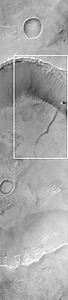
astrobio writes "Very rare picture released today from Mars Orbital Camera: the image actually captured a dust devil in the act of creating a streak as it climbed an embankment out of a crater. See panorama, larger image here, and in context. Apparently the University of Arizona has a study called Project Matador which is supposed to tornado-chase on Earth, so that Mars-instruments can be hardened against dust devils. Dorothy, it isn't Kansas." -
August of Wind: Rare Mars Dust Devil Footage Released
astrobio writes "Very rare picture released today from Mars Orbital Camera: the image actually captured a dust devil in the act of creating a streak as it climbed an embankment out of a crater. See panorama, larger image here, and in context. Apparently the University of Arizona has a study called Project Matador which is supposed to tornado-chase on Earth, so that Mars-instruments can be hardened against dust devils. Dorothy, it isn't Kansas." -
Possible Evidence of Martian Bacteria
half-seas-over writes "NASA issued a very interesting press release today. It highlights a recent study that compared tiny magnetite crystals in the Allan Hill meteorite to similar magnetite crystals that are created here on Earth by bacteria (who use the magnetite as a compass). The study (abstract available here (PDF) from this site) uses fairly strict criteria to determine that 25% of the magnetite content of the meteorite was created by ancient (>3.9Gyr ago) martian bacteria... either that or there is some strange natural process that makes very pure, isolated magnetite crystals that we haven't imagined or seen on Earth which is present on Mars. We'll have to wait and see what happens next, 'extraordinary claims require extraordinary evidence' -Carl Sagan." -
Possible Evidence of Martian Bacteria
half-seas-over writes "NASA issued a very interesting press release today. It highlights a recent study that compared tiny magnetite crystals in the Allan Hill meteorite to similar magnetite crystals that are created here on Earth by bacteria (who use the magnetite as a compass). The study (abstract available here (PDF) from this site) uses fairly strict criteria to determine that 25% of the magnetite content of the meteorite was created by ancient (>3.9Gyr ago) martian bacteria... either that or there is some strange natural process that makes very pure, isolated magnetite crystals that we haven't imagined or seen on Earth which is present on Mars. We'll have to wait and see what happens next, 'extraordinary claims require extraordinary evidence' -Carl Sagan." -
Possible Evidence of Martian Bacteria
half-seas-over writes "NASA issued a very interesting press release today. It highlights a recent study that compared tiny magnetite crystals in the Allan Hill meteorite to similar magnetite crystals that are created here on Earth by bacteria (who use the magnetite as a compass). The study (abstract available here (PDF) from this site) uses fairly strict criteria to determine that 25% of the magnetite content of the meteorite was created by ancient (>3.9Gyr ago) martian bacteria... either that or there is some strange natural process that makes very pure, isolated magnetite crystals that we haven't imagined or seen on Earth which is present on Mars. We'll have to wait and see what happens next, 'extraordinary claims require extraordinary evidence' -Carl Sagan." -
Possible Evidence of Martian Bacteria
half-seas-over writes "NASA issued a very interesting press release today. It highlights a recent study that compared tiny magnetite crystals in the Allan Hill meteorite to similar magnetite crystals that are created here on Earth by bacteria (who use the magnetite as a compass). The study (abstract available here (PDF) from this site) uses fairly strict criteria to determine that 25% of the magnetite content of the meteorite was created by ancient (>3.9Gyr ago) martian bacteria... either that or there is some strange natural process that makes very pure, isolated magnetite crystals that we haven't imagined or seen on Earth which is present on Mars. We'll have to wait and see what happens next, 'extraordinary claims require extraordinary evidence' -Carl Sagan." -
Possible Evidence of Martian Bacteria
half-seas-over writes "NASA issued a very interesting press release today. It highlights a recent study that compared tiny magnetite crystals in the Allan Hill meteorite to similar magnetite crystals that are created here on Earth by bacteria (who use the magnetite as a compass). The study (abstract available here (PDF) from this site) uses fairly strict criteria to determine that 25% of the magnetite content of the meteorite was created by ancient (>3.9Gyr ago) martian bacteria... either that or there is some strange natural process that makes very pure, isolated magnetite crystals that we haven't imagined or seen on Earth which is present on Mars. We'll have to wait and see what happens next, 'extraordinary claims require extraordinary evidence' -Carl Sagan." -
Asteroid Fly-By on August 18
ke4roh writes "An asteroid will fly near the planet and be visible with binoculars from the northern hemisphere August 18, so says this article. Astronomers say it will cross the sky at 8 degrees per hour and fade out of view as it approaches the sun and hence goes through its various phases - full, gibbous, half... down to nothing. Such a show only comes about twice a century, so take a look before it disappears!" Another reader sends in a few useful links: "Here's the complete article from the folks at NASA Space Science with extra links including details on the astreroid's trajectory." -
Asteroid Fly-By on August 18
ke4roh writes "An asteroid will fly near the planet and be visible with binoculars from the northern hemisphere August 18, so says this article. Astronomers say it will cross the sky at 8 degrees per hour and fade out of view as it approaches the sun and hence goes through its various phases - full, gibbous, half... down to nothing. Such a show only comes about twice a century, so take a look before it disappears!" Another reader sends in a few useful links: "Here's the complete article from the folks at NASA Space Science with extra links including details on the astreroid's trajectory." -
Asteroid Fly-By on August 18
ke4roh writes "An asteroid will fly near the planet and be visible with binoculars from the northern hemisphere August 18, so says this article. Astronomers say it will cross the sky at 8 degrees per hour and fade out of view as it approaches the sun and hence goes through its various phases - full, gibbous, half... down to nothing. Such a show only comes about twice a century, so take a look before it disappears!" Another reader sends in a few useful links: "Here's the complete article from the folks at NASA Space Science with extra links including details on the astreroid's trajectory." -
NASA Pinpoints Lightning The Old-Fashioned Way
ke4roh writes: "As a child, I would watch a lightning flash and count the seconds until I heard the first clap of thunder. Get three kids counting in different places, and you could figure out where that cloud-to-ground strike was by coordinating their counts. That's the premise behind NASA's latest lightning detector, according to a press release. It uses a radio to detect the strike and four microphones spaced about 20 feet (7 m) apart. The neat part is its accuracy - about 15 feet (5 m) within a 1 mile (1.6 km) radius. The information should help them determine if lightning may have damaged sensitive launchpad equipment." -
Slashback: Assembly, Avoidance, Civility
With the usual round of updates, corrections, reactions and related stories, Slashback tonight has word of yet another giant Euronerd conclave, as well as some news on the odds of being smashed into a pulp in the year 2019, and a gentle response from Richard M. Stallman on appropriate behavior in absurd circumstances.Good place for a lemonade stand. The march of the gigantic temporary European computer city-state goes on: Late writes that "Assembly 2002 starts in Finland on Thursday at 12.00 EET-DST (GMT +3). With over 2800 computer places and an expected total of over 4500 visitors, Assembly is one of the largest combined demo- and lanparties in the world. Those of you who can't make it, can watch our streamed TV broadcast. We'll be broadcasting all the competitions, at least part of the seminars that include such speakers as Rob Hubbard (C64 music legend) and a whole bunch of other programs."
You are condemned to live even longer. h4mmer5tein writes: "The BBC has an update on the asteroid story from a few days ago saying that it won't, after all, hit the earth in 2019. More information is being collated but it seems that 2060 is unlikely to see an impact either."
Iron IronGorilla adds: "Much like a Microsoft crash^H^H^H^H^Hrelease date being pushed back, NASA is reporting here that we are not, in fact, all going to die on February 1st, 2019 ..."
The dangers of meeting someone who means what he says. A few weeks ago, reader Al3x wrote his account ("Results of the Commerce Dept's DRM Workshop") of the recent gathering in DC of (officially invited) representatives of the entertainment industry and the less-officially invited members of the public. Alex criticized the approach of several members of the Free software community on hand for the discussion, including Richard Stallman.
Stallman writes in response:
"Al3x went to the July 17 Washington Digital Restrictions Management panel feeling admiration for me, but left disappointed with my views and actions. I think his disappointment was partly due to a couple of misconceptions, so I hope this explanation will partly restore his good opinion of my work and methods.
I cannot deny Al3x's charge that I, and the rest of us, defied the rules of the meeting by refusing to be completely silent. If it is wrong to disobey an unfair system, I stand convicted, but I am not ashamed. However, in the scale of civil disobedience, ours was very mild. Women demanding the vote sometimes chained themselves to doorways, which might have been inconvenient for some passersby. Blacks demanding an end to segregation sometimes broke rules, and even laws, by sitting in a Whites-only diner or at the front of a bus. It is up to each of you to decide your ethical approach to judging acts of disobedience to an unfair system.
Al3x criticized NY Fair Use for 'preferring to show up and disrupt the debate' rather than ask for a seat on the panel. Our occasional laughter and less frequent verbal comments did not disrupt the panel, and all the panelists were able to express their views; but because our means were so limited, we could not communicate very much. We would have much preferred to participate officially, on an equal footing with Jack Valenti, but they had refused our request, just as they refused the EFF. Our measured protest appears to have obtained for us the chance for a seat on a subsequent panel.
After the meeting, Al3x asked me for my views on intellectual property. As it happens, I think it is a grave mistake to formulate one's views in terms of 'intellectual property,' and I explained why.
I explained that the term 'intellectual property' lumps together disparate areas of law, including copyright, patent, trademark, and others, and that they are so different that it is a mistake to try to group them together. The public policy issues of these various areas of law result from the details of how they restrict the public, and those details are different; if you try to form your opinions about 'intellectual property,' you will miss all of these issues, and you will be led to propose sweeping generalizations which cannot help being foolish. I explained the problems of the term 'intellectual property' to Al3x hoping this would help him and others he communicates with avoid that pitfall in thinking.
I suspect a miscommunication took place there, because when I said that his proposed copyright system for music might be a good one, he perceived that as a contradiction. Perhaps when I said 'the term "intellectual property" is bad,' he heard me as saying 'everything people call "intellectual property" is bad.' That, however, is exactly the sort of sweeping overgeneralization that the term 'intellectual property' leads people to form; it is to discourage such simplistic views that I ask people to avoid the term. I have views on copyright, views on patent, and views on trademark, but I do not have *any* position on 'intellectual property.' As Al3x learned, I'm not 100% opposed to copyright, though I believe it should be much less restrictive to the public than it is now.
See http://www.gnu.org/philosophy/words-to-avoid.htm for more explanation of the problems of the term 'intellectual property.' If you're interested in my views on copyright, see www.gnu.org/philosophy/copyright-and-globalization.html.
-
Heads-Up Wearable Display
selfsealingstembolt writes "Looks like the guys at NASA are trying to combine some existing technologies into a wearable computer. At the moment it is designed as headset combined with a small box to wear at your belt or so. The interesting part is, that they are looking for new technologies at outside sources (companies, educational institutions, ...). The design is still subject to change, but the general idea is great." -
Humanoid Robot for Spacewalks
Nils writes "Here is the web page of a research project at NASA JSC's Dexterous Robots Lab (DRL) to develop a humanoid robot for use in space. It is state-of-the-art with incredible hands, arms, torso, and stereoscopic vision for remote control. Very cool." We had a story on the Robonaut two years ago, but it looks like they've come a long way since then. -
Back to the Moon?
An anonymous reader writes "This BBC story discusses the prospects of probes returning to the moon. The article first mentions the ESA's SMART-1 probe, which will overfly the Apollo landing sites during 2003, and then talks with US scientists about why NASA should send probes back." -
NASA 'Hyper-X' Series Scramjets
swight1701 writes "Sciencedaily.com is reporting that NASA has revealed its plans for developing Hypersonic aircraft within 2 decades. These plans include planes that could routinely go Mach 5+ and capable of taking off from an airport and visiting the IIS, or for you earthbound folk, from one airport to any other within 2 hours. And you thought your luggage gets lost NOW.:)" NASA's release includes some graphics showing what the test vehicles look like. -
Road Trip On The Interplanetary Superhighway
eegad writes: "CNN has an article about a new idea from NASA springing from chaos theory called the interplanetary superhighway. It will purportedly allow easier space travel by steering through regions where the net gravitational force exerted by nearby bodies is smallest. The actual NASA news release is here. Sounds like an interesting concept but it is unclear how the scientists will account for every source of gravity, including the elusive dark matter." -
Road Trip On The Interplanetary Superhighway
eegad writes: "CNN has an article about a new idea from NASA springing from chaos theory called the interplanetary superhighway. It will purportedly allow easier space travel by steering through regions where the net gravitational force exerted by nearby bodies is smallest. The actual NASA news release is here. Sounds like an interesting concept but it is unclear how the scientists will account for every source of gravity, including the elusive dark matter." -
Live Via Satellite
markhb writes "40 years ago today, the first trans-Atlantic TV transmission made it out of the Maine woods and into history, via the original Telstar. The IEEE and Lucent plan to commemorate the event at three events today in Pleumeur-Bodou, France, Goonhilly Downs, England, and Andover, Maine." -
SOHO Captures Solar Eruption
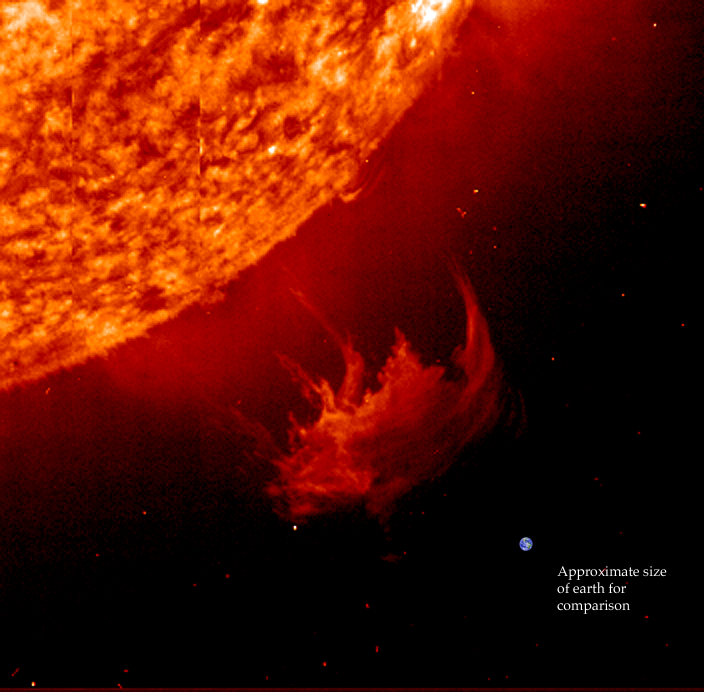
Liora writes: "A Solar and Heliospheric Observatory (SOHO) satellite captures this awesome reminder of our own minuteness. There is an article mentioning it briefly from Lycos, but this is my favorite picture on the NASA site." -
Moon (Dactyl) Discoved Orbiting Asteroid Ida
Dot.Sig writes "Here is a picture and short description of an asteroid with its own moon." Taken by galileo during it's trip to jupiter. Sort of like those pics you take out the car window.... Here is the requisite NASA Press Release. Who names these thing, anyway? Not the first asteroid to be found to have a moon, but interesting regardless. -
Moon (Dactyl) Discoved Orbiting Asteroid Ida
Dot.Sig writes "Here is a picture and short description of an asteroid with its own moon." Taken by galileo during it's trip to jupiter. Sort of like those pics you take out the car window.... Here is the requisite NASA Press Release. Who names these thing, anyway? Not the first asteroid to be found to have a moon, but interesting regardless. -
Moon (Dactyl) Discoved Orbiting Asteroid Ida
Dot.Sig writes "Here is a picture and short description of an asteroid with its own moon." Taken by galileo during it's trip to jupiter. Sort of like those pics you take out the car window.... Here is the requisite NASA Press Release. Who names these thing, anyway? Not the first asteroid to be found to have a moon, but interesting regardless. -
NASA Confirms Rainy Cities
Devil's BSD writes: "It's true, urban areas are rainier than rural areas. Using the Tropical Rainfall Measuring Mission satelite to measure rainfall around cities, NASA found that areas downwind from cities had up to 116% more precipitation than those upwind from it. The cause? The major heat difference, up to about 10 degrees Fahrenheit (5.6 Celsius degrees), caused by the asphalt and concrete in cities. This story is posted on the Goddard Space Flight Center page." -
NASA Confirms Rainy Cities
Devil's BSD writes: "It's true, urban areas are rainier than rural areas. Using the Tropical Rainfall Measuring Mission satelite to measure rainfall around cities, NASA found that areas downwind from cities had up to 116% more precipitation than those upwind from it. The cause? The major heat difference, up to about 10 degrees Fahrenheit (5.6 Celsius degrees), caused by the asphalt and concrete in cities. This story is posted on the Goddard Space Flight Center page." -
Cells' Responses to Gravity
scubacuda writes "Science@NASA has an article on how cells respond to gravity in unexpected ways. Cell skeletons ("cytoskeletons") consist of protein molecules arranged into chains very much like Kenneth Snelson's Needletower , a tensegrity (tension gravity) sculpture built in 1969. This tension is what makes red blood cells flat and human endothelial cell filaments' geodesic-domes triangular-shaped." -
Cells' Responses to Gravity
scubacuda writes "Science@NASA has an article on how cells respond to gravity in unexpected ways. Cell skeletons ("cytoskeletons") consist of protein molecules arranged into chains very much like Kenneth Snelson's Needletower , a tensegrity (tension gravity) sculpture built in 1969. This tension is what makes red blood cells flat and human endothelial cell filaments' geodesic-domes triangular-shaped." -
NASA Experiment Examines Fluid Flow
scubacuda writes "A new NASA experiment might shed light on thixotropic objects (e.g. ketchup not coming out of the bottle easily) and the mysteries of sheer thinning. At present, fluid interactions on the molecular level is difficult to predict: there is no tight theory that accurately predicts how a new polymer "goop" might flow through a pipe without testing via experiments." -
Software Product Liability?
ben writes "Reuters just ran a story about the increasing number of calls for liability on the part of software developers, with a not-too-suprising focus on Microsoft and its uber-fallible IIS webserver. Given that many other engineering disciplines have some sort of accreditation and licensing body to enforce codes of professional ethics, I'm curious what impact the demand for such a creature in the software industry could have on Open Source developers, especially the part-time hobbyist ones. That is, establishment of some sort of Software Developer's license means the developer is potentially liable for whatever havoc his bugs may wreak, and traditionally the only environment with legal resources adequate to deal with such liability has been the megalithic corporate one."