Slashdot Mirror
Domain: nasa.gov
Stories and comments across the archive that link to nasa.gov.
Comments · 16,365
-
Re: Hello, economics
Just requires the Space Elevator, which NASA and others are working on.
-
Re:No chance of striking Earth
NASA's page about this asteroid lists impact energy of 2.5MT - about same level as thermonuclear bombs (and 20 times less than Tsar Bomb).
-
Cite the NASA story, not some parasite's blogThe Stupid Fucking Article linked doesn't even say how close the fucking asteroid will come.
Why source a story sourced from NASA to some wanker's blog in Network World"?Presuambly this asshole just submitted it himself to get more pageviews.
The actual NASA story is Record Setting Asteroid Flyby And it actually tells you that "On Feb. 15th an asteroid about half the size of a football field will fly past Earth only 17,200 miles above our planet's surface." (Sadly even NASA use the inane "football field" measure, but goes on to say "It measures some 50 meters wide".)
-
Re:Football field unit.
The journalists are to be commended for coming up with a analogy that appropriately captures the uncertainty
Nasa says
Diameter - This is an estimate based on the absolute magnitude, usually assuming a uniform spherical body with visual albedo pV = 0.154 (in accordance with the Palermo Scale) but sometimes using actual measured values if these are available. Since the albedo is rarely measured, the diameter estimate should be considered only approximate, but in most cases will be accurate to within a factor of two.
-
Some background reading
I did a load of background reading on this yesterday so here's some interesting related material. One interesting source is the NASA guidelines for li-ion use in space
http://ntrs.nasa.gov/archive/nasa/casi.ntrs.nasa.gov/20090023862_2009023573.pdfNow NASA I think have a pretty good track record of thinking technologies through carefully... (By the by, did you know that GS Yuasa also have a contract to supply their li-ion batteries to NASA for use in the ISS?)
Also, did you know that prior to the 787 the Cessna CJ4 was the first civili aircraft to utilise li-ion batteries (supplied by a123). In 2011 there was a fire onboard one whilst it was connected to a ground power unit. As a result the FAA ordered all 42 in operation to be changed to conventional ni-cd or lead acid.
http://www.gpo.gov/fdsys/pkg/FR-2011-11-01/html/2011-27596.htmThis is interesting as it's similar i.e. on the ground. This of course *could* be coincidental.
Next up are lots of interesting pictures from the NTSB investigation. Much as I HATE to link to the Daily Mail (normally a pretty retarded publication) I couldn't find any other pic sources. Bizarre
http://www.dailymail.co.uk/news/article-2268152/Boeing-787-Dreamliners-burnt-battery-spewed-molten-electrolytes-reveal-investigators.html?ito=feeds-newsxmlAnd some great source material from the NTSB themselves
http://www.ntsb.gov/investigations/2013/boeing_787/boeing_787.htmlAnd the NTSB update on the investigation (including some samples of their cell CT scans)
http://www.ntsb.gov/investigations/2013/boeing_787/JAL_B-787_1-24-13.pdfNTSB Primer on li-ion battery tech
http://www.ntsb.gov/investigations/2013/boeing_787/Primer_LIB_Technology.pdfOne of the theories being talked about are the fact that the li-ion batteries that Boieng (via Thales) decided on are based on a lithium cobalt oxide cathode which is old tech and regarded as not exactly the safest variant of li-ion technology out there
http://www.designnews.com/document.asp?doc_id=257987
and via a translation
http://translate.google.com/translate?sl=no&tl=en&js=n&prev=_t&hl=en&ie=UTF-8&eotf=1&u=http%3A%2F%2Fwww.tu.no%2Findustri%2F2013%2F01%2F17%2Fher-er-dreamliner-problemetThis EEtimes article has some interesting comments
http://cdn.eetimes.com/electronics-news/4405441/787-Dreamliner-investigation-probes-battery-charging-electronicAnd some info from GS Yuasa
http://www.s399157097.onlinehome.us/SpecSheets/LVP10-65.pdfAll interesting stuff. Personally I think they shouldn't have been allowed to 'trial' li-ion on such a big aircraft especially after the cessna incident. Trying so many new tricks at once isn't wise - as engineers always say, just change one thing at a time...
-
Re:Hello, economics
This is like saying "gene mapping and recombinant dna is how we'll solve all our health problems!" You've named a current technique with promise, and hand-waved over all of the critical steps in between "current understanding" and "effectively doing the things I've claimed are possible." And those steps are LEGION.
All of those technologies MAY be useful in microgravity; NONE of them have been tested or proven. The addition of machinery materials and gear for every one of those techniques will require:
1) Massive launches of materials & machinery into space; You don't build a blast furnace by banging a couple asteroid rocks together a few hundred times;
2) Massive expenditures of energy and engineering know-how to develop and test the processes in microgravity to ensure that they're safe, and that the materials created are substantially similar in characteristic to the materials we produce here on earth.As one example: has anybody studied how raw metals and alloys solidify from a molten state in zero gravity, and what effect that has on the metal produced? Is it stronger in some ways? weaker in others? Does it have different properties? Many materials do - for instance, glass: http://science.nasa.gov/science-news/science-at-nasa/2003/14apr_zeroglass/ - turns out it's "purer" at least in small batches, because they can eliminate the container the glass is melted in, which eliminates impurities from that container. Of course, these tests are done on 1/4 inch diameter droplets of molten glass... how do you scale that up to industrial capacities?
Same applies for metals - how do we scale up production to an industrial capacity allowing us to effectively build large projects in microgravity? We can't smelt metal an ounce at a time. Where do the materials and energy come from? Ever see the machinery that goes into mining here on earth? Any of those tested in microgravity yet? No? Shit, there's a whole new field of industry you'll have to reinvent.
The point is not that we "can't do it," - it's fundamentally an engineering problem, and if cost is no object, there's certainly an engineering solution to it. The point remains though that, no matter how "free" those materials in that asteroid are, they are going to require VAST expenditures of materials, engineering, and energy here on earth to develop the technology to make use of them. Which means that there's effectively no point in the near future when any endeavor to harvest them will break even, or even be remotely possible in any near-term time frame.
-
Re:Koch Brothers?
Put down the talking points:
http://science.nasa.gov/science-news/science-at-nasa/2003/07aug_southpole/
There have been observations of Mars accurate enough to determine the day on Mars since Cassini, or 1666. You can google them, they show the ice caps existed, but not in high detail.
Honeré Flaugergues, 1813, starts tracking the melting cycle of the ice caps, and also can see the dust storms. That is a lot more detail than "blurry indistinct features on the tiny visible orb".
The canals were not a case of them not being there, it was a case of misinterpreting the lines that are clearly there, caused by natural features. There is even some debate over the meaning of the original Italian report, which used a word that does not mean man made, just a "channel". His drawings look more like channels in a delta, the "straight" line stuff came later. Actual daguerreotypes made in the mid-1800 show the white caps, so they are there.
100x magnification gets you an image of Mars roughly the apparent size of the moon with the naked eye. Such telescopes have been around for 3 or 400 years.
-
Re:Look at the data
* is the World is warmer than it has been for the last two thousand years? Why is the answer to this question relevant? There are many variables that affect climate (forcing factors). It's entirely possible that we've experienced cooling over the first 1700 of the last 2000 years; that has nothing to do with what degree (ha!) of change we should expect from our cranking CO2 up past any level we've seen in the last 15 million years. http://newsroom.ucla.edu/portal/ucla/last-time-carbon-dioxide-levels-111074.aspx * is the warning of the last three hundreds years (which is undeniable) human induced? You quote Watts. He (unsurprisingly) gets the science wrong: http://grist.org/climate-energy/co2-doesnt-lead-it-lags/ * why are scientists who use the Scientific Method and go against the narrative being vilified? and 1. Who is being vilified? Names, please, of climate scientists who have been vilified for arguing against AGW. I know of very few -- Lindzen and Singer, perhaps, the latter being entirely deserving of vilification to the point of outright dismissal from the conversation, given his enthusiastic and utterly disingenuous defense of the asbestos and tobacco industries and the former appearing to simply be a contrarian in general. http://www.realclimate.org/index.php/archives/2012/03/misrepresentation-from-lindzen/ Meanwhile, climate scientists who report that we're headed in a dangerous direction are receiving death threats. No, really: http://www.popsci.com/science/article/2012-06/battle-over-climate-change 2. Controversial research results are a dream. Anybody who could come up with a data-driven defensible argument disproving AGW would have their career made for them. * global climate models "Much of the global warming information is based on 'extrapolations' (projections) of short-term trends." Hm. Seems like lots of folks are running tests of current GCMs against paleo data, which undermines if not invalidates your point. http://www.research.noaa.gov/climate/t_modeling.html#figure4 http://www.giss.nasa.gov/projects/gcm/ http://www.ipcc.ch/pdf/assessment-report/ar4/wg1/ar4-wg1-chapter6.pdf I know that climate change, as a global problem, is painful for libertarians to consider. However, as Feynman said, nature cannot be fooled. In a battle between physics and philosophy, I bet on physics. Apologies if the formatting is broken in this post; apparently Safari on a Mac doesn't want to insert line breaks.
-
Re:Keeping Up With N. Korea
You obviously aren't familiar with ITAR and AECA and the onerous restrictions they place on exporting 'arms' (which includes anything larger than a large model rocket motor, and any space launch vehicles). Merely letting a 'non-US person', see a device, prototype, technical drawings, or other documentation, is punishable by large fines and possible jail time, even within the US.
That said, NASA has a lot of content available publicly on NTRS.
-
Re:I Almost Hate To Say This
The part of the earth that has warmed the most or the north pole. i am not sure how you could account for that by an urban heat island effect.
http://www.giss.nasa.gov/research/news/20130115/ -
Re:Surprise
1) Not an era of the globe cooling. An era where the general population was panicked about global cooling. I stated that poorly. They were trying to use their models to prove the opposite conclusion, and looked at somewhat different factors. There are several FAR better studies than Hansen's. Plotting "temperature anomalies" is simply not enough. Also read the entirety of Hanson's study not a pundit-analysis of it from 1995-present. The people presenting his data have cherry picked some of his strongest statements. But yes the conclusions are certainly supported by his study. I can't argue with that. 2) Yes CO2 is a greenhouse gas. Yes it heats things up, but we're at least trying to cut down. My point wasn't that it's not happening, as I said, it is. My point was there are a lot of factors that cannot or have not been taken into account. If we found OTHER causes that can be addressed in a more direct, cheaper, or easier method we can mitigate the climate change. For example deforestation causing issues with the carbon, nitrogen, and water cycles. If we find out this is a factor we can pass EPA regulations (I'm a social liberal/fiscal conservative so...a moderate? I'm liberal on anything green (the environment, pot laws) but the PC stuff is getting on my nerves...this was ineveitably gonna come up) to plant certain species of trees that perform best in the specific role we need. We can create provisions for protected areas (areas with certain soil/water profiles) and the like. My plankton argument is actually in favor of global warming. Due to chlorophyll phytoplankton the reflect near-infared visible light very well (like plants.) You might recognize this as the wavelength area the sun radiates most of it's energy on. A lot of plants have markings to reflect UV light. I don't know it's relevance here, but it might be important. What I KNOW is important is that plankton process more CO2 than classical plant matter. This makes sense due to the surface area of the ocean, and the small size of plankton enabling massive surface area. Ocean pollution kills them which weakens the Earth's ability to process CO2. I've spent too much time on this post already, I don't feel like grabbing sources. I don't think I've heard that disputed before though? 3) I don't think you understand how the sun works. Every 11 years it flips it's poles in what's known as the "solar maximum." This is a period in which extremely large CMEs and solar flares are most likely. We have had several X class solar flares hit us in 2012. True there seems to be less sunspot activity right now, but they seem to be FAR more energetic. Then there is a consistent increase in X-class solar flares which is consistent with the solar maximum. " The most recent solar minimum occurred in 2008, and the sun began to ramp up in January 2010, with an M-class flare (a flare that is 10 times less powerful than the largest flares, labeled X-class). The sun has continued to get more active, with the next solar maximum predicted for 2013." From http://www.nasa.gov/mission_pages/sunearth/news/solarmin-max.html. The people saying "this is the weakest solar cycle" have been misled by a single piece of data. It IS the weakest cycle since 1903 if you look at solar flare/sunspot/cme activity. Unfortunately solar flares aren't even remotely (well maybe remotely) important in this debate. In fact the more sunspots there are the lower the average temperature is. What IS important is that the suns irradiance increases
-
Offtopic but cool video of the Sun
Last week the Astronomy Picture of the Day web site had this impressive video of the eruption of a solar prominence. If you haven't seen it you should check it out.
-
Re:Hugely cool, 3d-printing in space a bonus
Geez, Cynical Sam. Save some room for me at the compound; I'll bring bullets and beans.
Not that there isn't plenty of depressing stuff going on:
Political gridlock? Can't get enough of that.
US Debt ceiling? Nope, sky is the limit, keep printing money.
Oil? The hell with global warming, we have this swell fracking thing that will let us out-produce Saudi Arabia. Carbon footprints be damned. Come on, what could go wrong?
Oh, Global Warming is just too hard of a problem... we can't do anything about it (assuming it was real...).
(But hey, if you are worried about the environment, let me tell you about Clean Coal...)
Income disparity? Hmm... could be larger; what could go wrong?
Meanwhile I'll just savor some hope for a bright future (at least parts of it).
It pleases me to see people working on cool long term possibilities like asteroid mining.
Maybe this asteroid / space thing will work out, maybe not.
Maybe the Civilization Starter Kit will work out, maybe not.
Looks like Khan Academy" is doing some cool stuff (cool because I see massive education as growing the economic pie).
I see things like these and I think "cool future".
It pleases me that our species can conceive cool things.
I do kind of hope the space thing gets traction soon. If our civilization tanks (world-war III or whatever), then post-collapse it gets hard to see where the next civilization (if any) would find enough raw materials to get going. Oil kicked in during 1850 when somebody saw it oozing out of the ground. If our great-great grandparents had to start by drilling miles underwater in the gulf for oil, or maybe invent fracking to pull it off, damn... its hard to see how our current civilization ever could have evolved.
Because of that it is abundantly unclear to me our species will get a "do-over" if anything serious should go wrong.
Anyway, yeah. I'll check up on the asteroid miners in a few years. Given this successful proof of concept about landing an SUV on Mars and driving it around, yeah... chasing down a smaller rock just might work. -
Re:Has anyone done an assessment...
we don't take 1% of 1% of 1% out of the power of the wind
Actually, we do.
Wind is, directly and indirectly, powered by the sun heating our atmosphere. The total power received by the earth from the sun is 1.7×10^17 watts. 29% of this is immediately reflected back to space by the surface and clouds, so this leaves 1.2x10^17 watts to actually interact with our atmosphere somehow. Let's take that as an upper limit for wind power.
In 2008 the average global electricity power generated was 2.3x10^12 watts. 2.5% of that is generated from wind power, call it 5x10^10 watts. Considering losses in generation, I'll assume we are actually taking twice that from the wind so about 10^11 watts.
Which is about 1 millionth of that upper limit for available wind power, or "1% of 1% of 1%" as you would put it.
Now factor in that wind power generation is growing exponentially, doubling every 3 years, and then it starts to become more plausible that there will be local climate effects within a few decades.
-
Re:In the US...
NASA images are generally public domain; that's why there's a huge pile of them on Wikipedia, among other places. There are a few exceptions for stuff created by third-party contractors, though; depending on the terms of the contract, the copyrights might be owned by the contractor. The NASA logo itself is also not in the public domain, so you can't sell knockoff NASA tshirts.
-
Re:How does it affect models?
There are still people actively working on studying how soot, dust, and debris affect CC but from the sounds of it, the models would be rough if particulate data was included at all.
"The distance particulates travel depends on their size, how long they can stay in the atmosphere – gravity comes into play here. For example, soot is a relatively small particulate; it can travel quite far. A fire in Canada can cause soot to travel to Greenland's ice sheet. Scientists suspect that changes to the amount and frequency of forest fires might be affecting how much soot is traveling to glaciers. [...] Similarly, with climate change, dryness is becoming more prevalent and as a result, there's more dust. One study documented increased dust transported to glaciers in the Swiss Alps, which in turn was increasing glacier melt rates." http://www.nasa.gov/topics/earth/features/glacier-debris.html
-
Re:Are we sure this time?
Here's a more trustworthy link, at least for me: http://www.nasa.gov/mission_pages/msl/news/msl20130115.html
-
Re:Warp vs Hyperspace
Oops, OCR fail. The link is: http://www.hq.nasa.gov/office/pao/History/ap15fj/ if you're interested.
-
Re:Oh snap!
Not true. They may get the jobs, but we also get the pollution. The planet is a living thing, and things that happen in China don't stay in China.
-
Yet another firecracker
Ok, I kid. I know their work is important, and working today. But what about fusion propulsion? http://www.nasa.gov/offices/oct/stp/niac/2012_phaseII_fellows_slough.html Note: it is different from the known problem of electricity from fusion.
Also, any news on a gamma radiation reflector, a possible prerequisite to a propulsion with gamma rays from "cheaper" antimatter?
-
Re:WRONG
This announcement seems to be pretty clear that the $18 million (give or take with some change) is for the module and not merely a study. Yeah, this is causing my head to scratch too. I would think this amount is just throat clearing for a typical NASA project that would provide a stack of power point presentations suggesting a module in the future, but I don't see anywhere in the announcement that this is for a study but rather for actual flying hardware.
Owing to the fact that I don't know of any launcher that could put anything like an ISS module into space (not even a reusable Falcon 9) for that price, it does seem rather odd. I hope the details of what that money will be used for is discussed at the press conference. If you have another source suggesting this is just a paper study with no flying hardware, I would be interested in seeing that source.
-
Comb the planet for honeycomb
was done several years ago and we were looking for honeycomb shaped patterns on the surface. It was at:
http://clickworkers.arc.nasa.gov/about-honeycomb
but that sites dead now...
-
Long Galaxy is Long.
Link to more Nasa's images.
TFA says the elongated shape is likely do to interaction with a neighboring galaxy, which may have also spawned a nearby dwarf galaxy; Both visible primarily thanks to the ultraviolet instrumentation.The tidal dwarf candidate is brighter in the ultraviolet than other
regions of the galaxy, a sign it bears a rich supply of hot young
stars less than 200 million years old.Hmm, Sounds about like Hollywood...
-
Re:2036: NASA says no collision
"PASADENA, Calif. -- NASA scientists at the agency's Jet Propulsion Laboratory in Pasadena, Calif., effectively have ruled out the possibility the asteroid Apophis will impact Earth during a close flyby in 2036. The scientists used updated information obtained by NASA-supported telescopes in 2011 and 2012, as well as new data from the time leading up to Apophis' distant Earth flyby yesterday (Jan. 9).
Discovered in 2004, the asteroid, which is the size of three-and-a-half football fields, gathered the immediate attention of space scientists and the media when initial calculations of its orbit indicated a 2.7 percent possibility of an Earth impact during a close flyby in 2029. Data discovered during a search of old astronomical images provided the additional information required to rule out the 2029 impact scenario, but a remote possibility of one in 2036 remained - until yesterday.
"With the new data provided by the Magdalena Ridge [New Mexico Institute of Mining and Technology] and the Pan-STARRS [Univ. of Hawaii] optical observatories, along with very recent data provided by the Goldstone Solar System Radar, we have effectively ruled out the possibility of an Earth impact by Apophis in 2036," said Don Yeomans, manager of NASA's Near-Earth Object Program Office at JPL. "The impact odds as they stand now are less than one in a million, which makes us comfortable saying we can effectively rule out an Earth impact in 2036. Our interest in asteroid Apophis will essentially be for its scientific interest for the foreseeable future."
The April 13, 2029, flyby of asteroid Apophis will be one for the record books. On that date, Apophis will become the closest flyby of an asteroid of its size when it comes no closer than 19, 400 miles (31,300 kilometers) above Earth's surface.
"But much sooner, a closer approach by a lesser-known asteroid is going to occur in the middle of next month when a 40-meter-sized asteroid, 2012 DA14, flies safely past Earth's surface at about 17,200 miles," said Yeomans. "With new telescopes coming online, the upgrade of existing telescopes and the continued refinement of our orbital determination process, there's never a dull moment working on near-Earth objects."
http://www.nasa.gov/mission_pages/asteroids/news/asteroid20130110.html
-
Re:Satellite imagery of wildfires is so 1990.
Just for the record, the land burnt or burning in the current outbreak is 368,940 hectares (~911,670 acres) in the State of New South Wales (with a few just over State borders) where most of the fires are concentrated. The largest single fire is approx 177,000 hectares (437,000 acres). (Source: http://www.rfs.nsw.gov.au/feeds/majorIncidents.xml at 2013-01-09T21:10Z)
There does not appear to be "a whole lot in central Australia to burn" but what is present, not forests but grassland, is tinder dry and burns routinely and for extended periods. The last few years have seen abnormally high rainfall in large parts of the interior (result of cyclones) which has made the fuel load higher than usual. Take a look at the NASA Black Marble imagery: almost all light not on the coastal fringe is the result of a fire in this compound imagery (22 days in 2012). http://www.nasa.gov/mission_pages/NPP/news/aus-fires.html
-
Satellite imagery of wildfires is so 1990.
Seeing wildfires from space is not unusual. All wildfires are visible from space, and we have several monitoring programs going on right now that use satellite imagery to track wildfire appearance and growth.
The most dramatic imagery I remember doing was the Rodeo-Chediski wildfires in 2002, which burned half a million acres (compared to the 50,000 acres burning in Australia so far, although they might get larger.) There are also a few good pics from the Alaskan wildfires in 2004, which burned 6.6 million acres. That was such a large-scale disaster that it was almost too big for the satellites to view; smoke obscured almost the entire state.
The bad news for Australia is that the climate is getting hotter. The good news is that there ain't a whole lot in central Australia to burn.
-
Re:Odd pattern in the rock?
I'm feeling a bit dim... I only see a cleaned image and a close up of the cleaned area.
Would you mind linking to the pre-cleaning image?Its this image: http://blogs.discovery.com/.a/6a00d8341bf67c53ef017c356d7348970b-pi
When you dig up the relevant page on JPL you learn that this close up image is clearly taken AFTER cleaning, not before. Its the post cleaned area, and the circular marks are left overs that the brush did not remove.
-
Summary is misleading.
The summary makes absolutely no mention at all of the next-gen rocket, SLS (capable of well over 100mT to orbit), which is being finished up. The boosters for it have been test-fired already (as have the main engines, which are left-over Shuttle main engines, and the upper stage for now is a big version of the Delta IV upper stage), and it is on-track for CDR. SLS will use LC-39A and the VAB. NASA and Florida are just looking for others who would also like to use the facilities, since they won't be in constant use. Boeing is already using one of the Shuttle processing buildings for their CST-100, which is part of NASA's "commercial crew" program and is already very far along, having tested its parachutes, heatshield, abort thrusters, airbags, etc.
Now, I'm quite skeptical with the idea of going back to 100+mT rockets for exploration instead of multiple commercial 15-30mT rockets (which have other, current customers and so are cheaper and will be around as long as the US is a country and which may shortly be capable of reusable flight), and especially I'm skeptical of the zipcode-engineered SLS, but it IS the current plan and it has lots of Congressional support and I'll cheer it along and enjoy its launches. People deserve to know that it's actually being built and that the VAB and LC-39A are going to be used by it, not all this BS about "oh, 'Bama canceled NASA, so they're having a fire sale." NASA's budget is still about the same (which is only about half of a percent of the federal budget, by the way), and the International Space Station is doing just fine with NASA astronauts in it, being resupplied with cargo by American spacecraft (SpaceX's Dragon right now has made two successful supply runs up and safely back down, soon to be joined by Orbital Science's Cygnus), and soon Dragon will be also shuttling the astronauts up and down to Station. http://www.nasaspaceflight.com/2013/01/yir-part4-iss-new-year-successful-2012/
Oh, another thing is that NASA is currently experimenting with a deep space habitat based on ISS modules and a Space Exploration Vehicle for going to asteroids or the moons of Mars. NASA retired Shuttle, and a dang good thing, too! Now we can really go explore beyond the confines of the Earth's gravitational influence.
Also, NASA's Orion capsule is VERY far along, has done several tests already and will do its first orbital test in the late 2014 time frame. This means by the time President Palin (or whathaveyou) is inaugurated, NASA will have essentially 3 man-rated capsules (Dragon, Orion, and Boeing's CST-100) already flight tested and a big-ass rocket built and prepping for launch (in 2017). NASA is NOT fracking canceled.
http://www.nasaspaceflight.com/2013/01/sls-cdr-engineers-work-baffling-issue/.
.About the SEV: http://www.nasa.gov/exploration/technology/space_exploration_vehicle/index.html
About the Deep Space Hab using ISS heritage or possibly even just existing ISS spares: http://www.nasaspaceflight.com/2012/03/dsh-module-concepts-outlined-beo-exploration/ -
It's more complicated than tat
The moon is still slightly protected by earths magnetic field. The field doesn't just suddenly end; inverse square law, and all that.
Actually, the moon is usually not protected by the earth's magnetic field. The earth's magnetic field is greatly affected by solar wind so that the part of the field projecting towards the sun is squished and the part away from the sun forms a long "tail"
If you look at this website, you can see that the moon only spends about 6 days/month inside the earth's magnetic tail.
Not only that, extremely dilute atmospheric particles have been discovered on the far side of the moon - the moon is technically inside Earth's atmosphere.
I think this is just false. Although some missions have detected traces of an atmosphere on parts of the moon (e.g., Apollo detected Argon, O2, CO2, CH4, etc, and LRO detected H3), these are thought to be from outgassing or sputtering from material inside the moon itself. The reason that some of them are similar to earth atmopheric components are that the earth-moon system may have actually been formed from prehistoric collision
-
Re:Pilots...
With virtually no incidents tied to RF interference from handheld devices.
That you know of.
I went to this page, entered 'Passenger Electronic Device' events detected by 'Aircraft Other Automation, Flight Crew' and found 54 incidents (ACNs).
-
Re:Black-and-white?
From the Cassini FAQ this time:
What are the camera filters?
To increase their scientific value, cameras on Cassini have two filter wheels in order to take images at specific wavelengths of light. Some filters only allow light of a certain color to reach the sensor. Combining three such images can produce a color image. Other filters pass light at a specific wavelength absorbed by an element such as hydrogen or methane. This allows scientists to measure where these elements are and at what abundances. Other filters, called polarizers, allow light oriented in a certain direction to reach the sensor. These filters are capable to see through a hazy atmosphere.
Why are there images of different sizes?
The Cassini cameras are 1-megapixel cameras. A normal image is 1024 x 1024 pixels. Using a technique called "summation" the cameras have the ability to combine pixels together to get smaller but less noisy images. This results in smaller images that take a lot less time to readout out and take up less data volume. Summation is very useful if a scientist needs to conserve both. In the 2 x 2 mode, the camera takes a 2 x 2 pixel square and averages those values into a single pixel. Images in this mode will be 512 x 512 pixels. In the 4 x 4 mode, the camera takes a 4 x 4 pixel square and makes that a single pixel. Images in this mode are 256 x 256 in size.The explanation: "To increase their scientific value" and "to get smaller but less noisy images" for "smaller images that take a lot less time to readout out and take up less data volume". Or in my words, regular cameras don't do good science and are inefficient.
-
Re:Black-and-white?
Not a dumb question at all, it's actually a very good question. The short answer is that an image taken by a standard digital camera would probably be pretty disappointing.
The first thing to realise is that your eyes aren't really like cameras at all. There's a complex series of interactions in your eyes and brain that take place before you perceive an image. When you take a colour image with a digital camera most people reasonably expect it to match what they see. So, your digital camera manipulates the raw data it gets from its sensors to munge it into a form that looks like what you see. Like the Cassini cameras, a digital camera detects the level of light hitting its sensor and uses different coloured (red, green and blue) filters to turn this back into a colour image. It also often applies various algorithms to the image data to adjust the relative intensities of the light.
The result is an image that's more of less what you see. But there's lots of ways this can fail. Sunsets, for example, are difficult to capture in a way that meets our expectations. If you have an image with a bright area (the sky, say) and a darker area (an area in shadow) it's impossible to get the entire image properly exposed.
When you send a probe a long way from the sun and take photos with a very sensitive camera you get a set of data which you can assemble in lots of different ways, all of which are true representations of the light "seen" by the probe. If NASA attached a typical colour digital camera to the probe they'd just be attaching a much more basic version of the imaging sensors they already have.
So why don't they just process all the RAW images into colour ones? Well, most are pretty dull, and it's not worth the effort. So instead, they make all the raw images available (see them here), which look like a series of black and white images (you can sometimes assemble these into colour images in Photoshop/GIMP). Out of the thousands of images they take only some of them are considered interesting enough to spend some time processing into full colour images.
-
Re:Pilots...
Well, the reason airplanes are not crashing from the sky is that airplanes are not automated. There's a human being who can detect whether or not the messages are reasonable.
For example, I read a recent incident here where a smoke alarm went off in the cargo bay of an airplane. But just for a moment. It would come on and go off intermittently. The pilot reported it to the ground crew who checked out the system and found no problem. The maintenance people believed that somebody probably left a cellphone on in their checked bag.
The plane did not fall from the sky. It arrived at it's destination in one piece. But you now have a pilot who, next time he sees a smoke alarm go off in the cargo bay, might be inclined to ignore it since it's probably a cellphone. And when it isn't, well, I suppose it will be the pilot's fault for not paying attention.
-
Re:Pilots...
Here's a list of all of them.
http://asrs.arc.nasa.gov/docs/rpsts/ped.pdf
Not a single one is proven to be RF interference from a handheld device.
-
Re:Pilots...
Yes there has. NASA has a database of voluntarily reported incidents.
-
Re:Pilots...
No accidents, but there have been issues.
NASA keeps a database which people will voluntarily contribute to discussing various issues that occur on flights. Do a quick search for PEDs (Passenger Electronic Device) and you'll see a few incidents. And these are just ones that are Voluntarily reported.
That said, I also note that many of the incidents come from older planes.
-
Re:Pilots...
Guess what?
Here's a report from NASA essentially telling the FAA that they're a bunch of morons for thinking these things cause interference.
-
Re:Go to the source...
I've never understood this tendency to post some commercial source when there is a free one with better and more pictures.
Someone always pimps for Space.com when NASA give you a much better view. -
Re:Black-and-white?
From NASA's FAQ page:
Why are so few of the Cassini pictures in color?
Creating color images is a complex task requiring much more labor and computer time than black and white images. This is because all Cassini images are recorded in black and white. The camera records the amount of light (not the color of the light) coming through a filter in front of the sensor. It is the filters that come in color.
To create color images scientists take three black and white images of the same target with the red, green, and blue (RGB) filters. In other words, one image records the amount of red light (using a red filter), another records the amount of green and one the amount of blue light (using green and blue filters respectively). Color renditions of the scene are then constructed on the ground by combining images taken with the different filters.
Unfortunately, these three images are not taken simultaneously. Consequently, intricate fitting and geometric transformations are needed to construct the color image because the spacecraft, planet, rings and moons have all moved a little during the time it takes to record the images using the different filters.What controls when a picture is taken?
The scientists determine this when they do the observation designs. The path of Cassini is known, as are the paths of the Saturn's moons, so it's a matter of looking at the varying geometry with time and selecting the camera pointing directions and shuttering times that will gather the most scientifically interesting images. These commands are then built into sequences that are sent to the spacecraft from days to weeks in advance of the observations.
-
Re:Black-and-white?
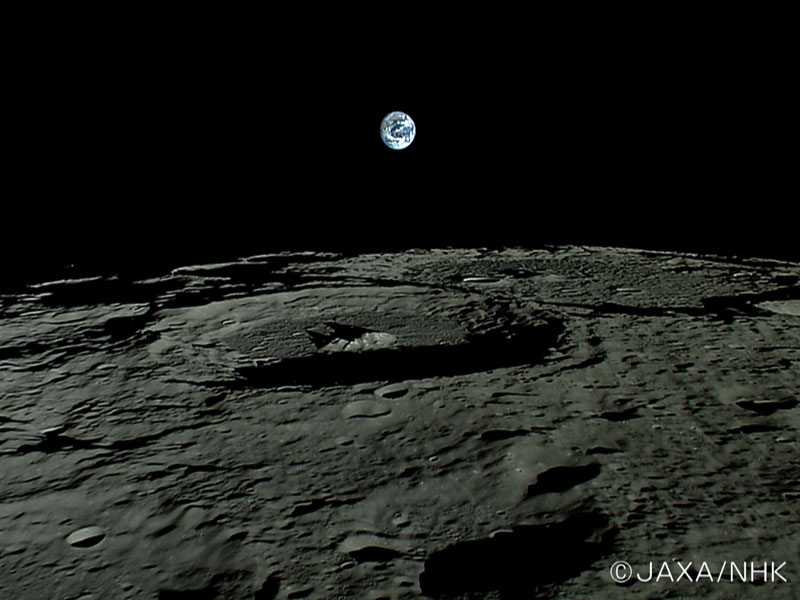
Maybe the same reason moon shots are B&W.
http://apod.nasa.gov/apod/image/0711/earthrise_kayuga.jpg Maybe it is in color.
-
Re:Poor definitions
Isn't the reason Mars doesn't have much of an atmosphere because it doesn't have a magnetic field to deflect solar wind?
http://science.nasa.gov/science-news/science-at-nasa/2001/ast31jan_1/
-
It's all about the spectra
The CrIS hyper spectral sounder is enabling much more precise forecasting. Proving once again that it's not the number of pixels, but the quality of them.
http://npp.gsfc.nasa.gov/cris.html
Sheldon
-
Re:Ion thrusters
It's going to be a while on "Warp Drive". They're working on a detection device for the required field now. It's called the "White-Juday Warp Field Interferometer". I don't think anyone has a clue as to how to alter space, but at least they will be able to detect any changes. Let the testing commence!
-
Let me google that for you
Oh look, I found an interesting discussion about that very post from John Christy of UAH, posted on notorious denier Roger Pielke Jr's blog. The great thing about blogs as compared to scientific journals is that you get to choose your "pal review"! Who will notice if you mis–represent the original data, and use a flawed dataset?
One comment really nails it, and I can't link to it individually, so I'll just include it here:
The first thing I noticed when looking at Christy’s graph was that Hansen’s scenario B had been replotted to make it appear that it tracks scenario A very closely. It doesn’t, it never has. The graph on Real Climate uses the original data http://www.realclimate.org/images/Hansen
The next thing that was obvious was that the RSS and UAH temperature graph shows very little warming. I thought this issue was supposed to have been rectified after Spencer and Christy corrected the errors relating to orbital drift (meaning the temps were taken at progressively later times each day).
After making the corrections (version 5.2) the data now correlates with other global temperature records such as those of NASA and the CRU (remember when the skeptics always relied on the RSS / UAH temperature records, until it came to light that it was wrong).
Detail - http://www.sciencemag.org/cgi/content/fu
Summary - http://www.ssmi.com/msu/msu_data_descrip
UAH Data - http://vortex.nsstc.uah.edu/data/msu/t2l
RSS Data - http://vortex.nsstc.uah.edu/data/msu/t2l
Comparison Data - http://www.cru.uea.ac.uk/cru/data/temper
Hansen’s Data - http://pubs.giss.nasa.gov/docs/1988/1988
It appears that Christy has chosen to use the old data in his comparison. In effect, what he’s done is to exaggerate the warming predicted in Hansen’s Scenario B (the one Hansen always said was most likely) and then downplay the true amount of warming that has occurred.
When the real data are used it becomes apparent how accurate Hansen’s scenario B projections have actually been – not exact but pretty close. Considering Jim’s 1988 projections were based on single inputs then this is quite impressive. -
Sounds like the Human Computers of WWII
Human Computers describes the (mostly) women who did the mathematical calculations the engineers handed them to do for the war effort, freeing up valuable engineering time.
The article doesn't say how much parallelism there was in these "human computer pools" but I suspect there was a lot of it.
I guess it goes to show that even today, some problems are, for the moment at least, done cheaper, faster, and/or better (pick any two) with a person than an electronic computer.
See also: Logopolis, a Dr. Who serial from 1981 which features people (not humans) doing mathematical calculations rather than having computers do them.
-
Re:meh
How do you think coral survived 7000ppm CO2?
The first corals were soft bodied, which probably helped.
"8th December 2010 13:24 GMT - A group of top NASA and NOAA scientists say that current climate models predicting global warming are far too gloomy, and have failed to properly account for an important cooling factor which will come into play as CO2 levels rise.
If instead of relying on The Register you went to the NASA source for that, you'd find this quote:
Bounoua stressed that while the model's results showed a negative feedback, it is not a strong enough response to alter the global warming trend that is expected
See also: There are winners and losers among corals under the accumulating impacts of climate change
The issue there is that different corals play massively different roles in a reef and in the growth and survival of reef-associated organisms. You can't just replace coral A with coral B and expect everything to be fine. As the authors themselves put it: "many of these novel coral reef communities are likely to lack contemporary analogs, with unknown but potentially far-reaching consequences for the ecology and evolution of reef organisms". In other words, the coral reefs could change massively but we can't predict what the reef ecology will be like afterwards. Bearing in mind that reefs are some of the most biodiverse habitats and that they're critical for ocean life in general that's something to worry about. For all we know the new reef systems could be dominated by a coral which doesn't support the fish and shellfish which we can make use of.
-
Re:You are right, but still oh so wrong...
What a ridiculous statement. Here's the data. No year since 2001 has been colder than the warmest year from 2000 on back except for 1998. 2005 and 2010 are basically tied for the warmest temperature in the record, The slope of temperature rise in the 2000's is less than it was in the 1980's and 90's but it's still positive.
-
Re:Data not conforming to predictions
We've had about 15 years of near stasis, and recent results show that the heat isn't 'hiding' in the ocean - it simply doesn't exist, though CO2 continues to rise.
Please stop making up "facts" and pretending they're real. It's trivially easy to find actual data on the subject. Fact: every single year from 2001 on has been hotter than every single year on record prior to that, with the sole exception of 1998. No, the climate did not magically stop getting warmer in 1997.
-
Cubesat companies are hogwash
Having been on a team that has built and launched two cubesats, I consider myself somewhat of an expert in the area. I'll answer this question to the best of my knowledge, I've been to the cubesat conference for several years now (it's mostly academics but most of the launch companies are there.) The first couple of years as a student I would get all excited whenever companies like this would start up. I noticed quickly that the same company never came around to the conference more than a few years, why? Because they couldn't get the funding, a launch requires some where in the range of 10$ million. There are plenty of companies that start up and claim that they will launch a rocket with a 50-100 (or so cubesats) and that will cover there costs, the problem is they have to find that many people to fill the spots. No one has done that yet. Cubesats were designed as a containerized system to mitigate the testing and integration launch costs. Everything that goes to space has to be thoroughly tested, when you have to do this on a case by case basis, it takes a lot of time (=money). So if you already know your payload will fit in a 10cm x 10cm x 10cm (1U) and has a ~1kg weight then that saves a lot of testing. Another benefit of the container is NASA can slap them all over their rockets and launch 10's of them (currently) at a time. Since every rocket has tons of payload margin (you want to ensure your payload reaches space you size its mass several percent smaller than what the rocket can handle to ensure delivery) and some payloads are in the tons, throwing on a few cubsats won't really do a thing to your mass budget. Now NASA has a program for this: http://www.nasa.gov/mission_pages/smallsats/elana/index.html this has been successful. As far as launching your own, I wouldn't count on it in the near future. Launching a satellite is not trivial, you have to make sure its not going to break apart, or damage other payloads on the way out of its container. Look up ISBN: 047075012X . You have to make sure its not going to outgass because volatile compounds evaporate and can cause problems. You have to use materials that can withstand the rigors of space, atomic oxygen and radiation can be rough on most materials. Plus some materials like PVC will evaporate in a vacuum. Another problem is ensuring you have enough battery and solar power to support your payload. You have to make sure you payload will not shake apart on the way up (rockets are very very bumpy rides). The satellite should have an attributed and control system to make sure it can orient itself in the right direction (for your solar cells and radio). And last but not least is the radio and comm system. A ground station is needed and the appropriate radio frequencies used (if you want anything fast you have to get a license from the gov, this is very difficult). The satellite itself needs to have a good antenna (if you have any nulls in your antenna pattern then you won't be able to communicate with it when the null is pointed at you. Oh, and if you put a camera on it the NOAA has to know about it and approve of your data (really stupid, but that's the way the government is). Anyway I could go on for a long time... Building a satellite requires people from many different disciplines to pull it off. Unless you are going for insanely simple you would have to have a group of people to accomplish the task. If there is available access and launch costs come down I could see a few hobbyists groups pulling it off in 10 or so years if they can clear all of the governmental hoops. I won't believe any commercial venture claiming that they will launch cubesats (or tubesats http://interorbital.com/TubeSat_1.htm) until they actually do.
-
Re:It goes the other way, too
Here you go. If these values are still accurate, then 12 light years is a little more than an order of magnitude beyond our reach.