Slashdot Mirror
Domain: nasa.gov
Stories and comments across the archive that link to nasa.gov.
Comments · 16,365
-
Re:Burning air?
They've had a proof-of-concept of sorts for this for a long time. Here's a Science@NASA article from 1999 explaining it:
http://science.nasa.gov/science-news/science-at-nasa/1999/prop16apr99_1/The craft is saucer-shaped, but it accelerates straight upward while it's still low in the atmosphere. From TFA:
"That seems wrong but for another trick. The microwaves are reflected forward to create a superhot bubble of air above the craft and form an air spike that acts as the nose cone as the Lightcraft accelerates to 25 times the speed of sound. This cleans up the aerodynamics of a vehicle that does not look like it should fly in that direction. Even better, when the load is properly balanced the craft sails through the air without leaving a shock wave and virtually no supersonic wake."
It's essentially creating a near-vacuum above the craft, which pulls it upward with an incredible amount of force (while moving air out of the way to eliminate the incredible amount of drag you would expect in that situation). While it is true that the force will weaken as the craft ascends, by then it will already moving fast enough to break away from the Earth's gravity well. TFA mentions getting to the moon in 5.5 hours without needing any fuel on-board (just energy beamed to the craft from space), which is no small feat. The G-forces involved might kill any passengers, but it would still be great to be able to put heavy equipment in space (or on the moon) quickly and cheaply. If you want something like a moon base, this is critical.
-
A Centennial Challenge
NASA has had a Centennial Challenge open in power beaming for some years now. From :
This challenge is a practical demonstration of wireless power transmission. Practical systems employing power beaming would have a wide range of applications from lunar rovers and space propulsion systems to airships above the Earth. Another future application of power beaming would be the space elevator concept.
In 2009 the competitors drove their laser-powered devices up a cable one kilometer high, suspended from a helicopter, and LaserMotive LLC was awarded $900,000.
It turns out that it is really tough and actually somewhat dangerous to have a helicopter dangle a 1 km string perfectly vertical. This also "doesn't scale" (i.e., there is no way a helicopter is going to dangle a 5 km string for a longer test), and future competitions will be done horizontally, on the ground. (This also fits in with the idea of power beaming to rovers, say one exploring the always dark Shackleton Crater at the Lunar South pole, which is frankly a more realistic near-term prospect than a terrestrial space elevator.)
I believe there is still $ 2 million (USD) to be awarded, so slashdotters should get to it and go out there and take the Governments money.
-
A Centennial Challenge
NASA has had a Centennial Challenge open in power beaming for some years now. From :
This challenge is a practical demonstration of wireless power transmission. Practical systems employing power beaming would have a wide range of applications from lunar rovers and space propulsion systems to airships above the Earth. Another future application of power beaming would be the space elevator concept.
In 2009 the competitors drove their laser-powered devices up a cable one kilometer high, suspended from a helicopter, and LaserMotive LLC was awarded $900,000.
It turns out that it is really tough and actually somewhat dangerous to have a helicopter dangle a 1 km string perfectly vertical. This also "doesn't scale" (i.e., there is no way a helicopter is going to dangle a 5 km string for a longer test), and future competitions will be done horizontally, on the ground. (This also fits in with the idea of power beaming to rovers, say one exploring the always dark Shackleton Crater at the Lunar South pole, which is frankly a more realistic near-term prospect than a terrestrial space elevator.)
I believe there is still $ 2 million (USD) to be awarded, so slashdotters should get to it and go out there and take the Governments money.
-
Re:It's not the only thing
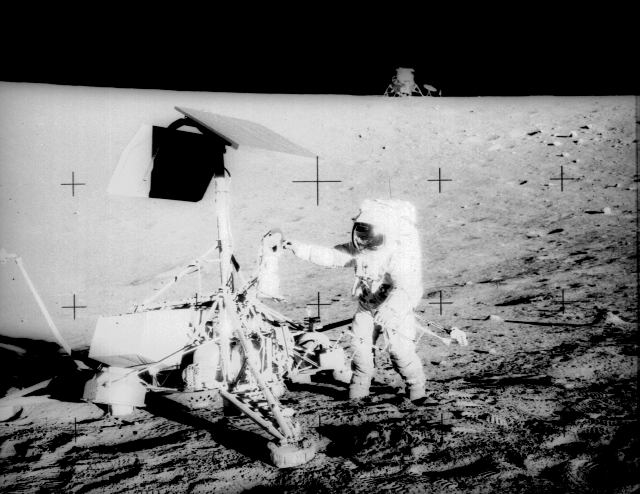
I know something about it because I was following it at the time, and because I am still involved in such stuff.
Here are some links to get you started
http://www.nasa.gov/mission_pages/apollo/missions/index.html
http://www.myspacemuseum.com/sitemap.htm
http://www.honeysucklecreek.net/msfn_missions/ALSEP/hl_alsep.html -
Greenland going green?
If Greenland were to get warm enough to, say, farm wheat, surely we'd be seeing the end of civilization as we know it, right?
Right? -
Re:Global warming has become hopelessly politicize
global temperatures haven't risen since 1998
I'm not going to talk at you about how to do data analysis and averaging. Picking 1998 as a starting point is a canary for someone who is measuring "increase" as "difference since start of plot" and then cherry-picking a high value as their start point.
Even if you use that highly-deceptive "analysis" technique, though, it's not true:
NASA GISS Global Surface Air Temperature Anomaly
1998: 0.70 C
2010: 0.83 C
2010 is the most recent year for which there is data.NASA GISS Land-Ocean Temperature Index
1998: 0.56 C
2010: 0.63 CIf you look at the tabular data, anyone reasonably familiar with analysis should spot immediately that 1998 is an outlier and that there is an overall positive trend that continues up to 2010.
-
Re:Funny how
Check out NASA's Earth at Night picture for a comprehensive view. One striking area is to look at the difference between North Korea and South Korea.
-
Re:Perhaps the founding project of space archaeolo
This was the founding of space archaeology.
-
It's not the only thing
There are also the Apollo 8, 10, 11 and 12 S-IVBs (3rd stage). (Starting with Apollo 13, the S-IVBs were impacted on the Moon to produce "Moonquakes" for the ALSEP seismometers). For all of those except for Apollo 8, there were also 4 large SLAs (panels) around the LM, which were ejected when the LM was retrieved just after TLI. (The Apollo-8 panels stayed on the S-IVB, as it had no LM.) In a real trivia, the Apollo 13-17 SLAs also should be out there, as the S-IVB was directed to hit the Moon after the LM was retrieved, and thus after they were ejected.
There was a claim that the S-IVB for Apollo 12 might have been found. I don't know if that was ever confirmed, though.
-
Re:Finally!
MODIS Rapid Response has 2.5 hour lag images from both Terra and Aqua.
Don't forget to check out their interactive mapping service while there.
And a link for all their services. -
Re:Finally!
MODIS Rapid Response has 2.5 hour lag images from both Terra and Aqua.
Don't forget to check out their interactive mapping service while there.
And a link for all their services. -
Re:Finally!
MODIS Rapid Response has 2.5 hour lag images from both Terra and Aqua.
Don't forget to check out their interactive mapping service while there.
And a link for all their services. -
Re:The ISS isn't in polar orbit is it?
I think AC if right about tracking down the west coast of the Americas. It looks like the first big city you see is probably Vancouver, BC, Canada, then the Puget Sound region, on to Portland. I live in Oregon and the placement of the cities south of Portland look just right to me. If you look at a globe the 53 degree inclination is about right to track down the coast. Here is a page that shows the ISS track.
-
Re:Finally!
http://saturn.jpl.nasa.gov/photos/raw/
http://www.nasa.gov/mission_pages/messenger/multimedia/index.htmlThose are just two missions that come to mind.
For your proposal, I think you underestimate the complexity and equipment needed to launch a probe and have it captured into a geostationary orbit (you want to "match speed") of a moon of another planet. Also note that geostationary orbits are very high altitude orbits over the equator. For decent pictures you need to do what the ISS is doing and use a lower orbit (polar or other inclination), but in that case you wont "match speed" anymore and will have to deal with the body moving underneath you (from your reference frame).
At the costs involved you'll probably want to put more than just a nikon and a big lens on your probe.
-
Re:Finally!
http://saturn.jpl.nasa.gov/photos/raw/
http://www.nasa.gov/mission_pages/messenger/multimedia/index.htmlThose are just two missions that come to mind.
For your proposal, I think you underestimate the complexity and equipment needed to launch a probe and have it captured into a geostationary orbit (you want to "match speed") of a moon of another planet. Also note that geostationary orbits are very high altitude orbits over the equator. For decent pictures you need to do what the ISS is doing and use a lower orbit (polar or other inclination), but in that case you wont "match speed" anymore and will have to deal with the body moving underneath you (from your reference frame).
At the costs involved you'll probably want to put more than just a nikon and a big lens on your probe.
-
Re:Direction
This page shows the orbit of the ISS. I believe what we're seeing is:
0:00 - Seattle / Vancouver as a dot on the horizon at left.
0:05 - Left to right: Seattle, Portland, San Francisco.
0:12 - ISS passes over land slightly north of San Francisco, moving toward Las Vegas; Los Angeles and San Diego on the right.
0:16 - ISS passes almost directly over Las Vegas (bottom center).
0:18 - ISS passes almost directly over Phoenix. Gulf of California on the right; Dallas and Houston on the horizon at far left.
0:28 - Mexico City. Gulf of Mexico on the left, Pacific Ocean on the right.
0:34 - Central American coast flyby, complete with tropical storms.
0:43 - South American coast flyby: Colombia, then Ecuador, then Peru.
0:51 - Lima, Peru.
0:55 - Border between Peru and Chile. The station's orbit begins to curve inland (eastward).
0:58 - Valparaiso and Santiago on the horizon at right (behind the solar panels after 0:59).
0:59 - Buenos Aires, Argentina is just appearing on the horizon (top center) as the video ends.So I don't think Antarctica is ever visible - the station's orbit starts to turn eastward before that happens.
-
Re:Green city?
Looks Veracruz has predominantly mercury vapor lighting, as opposed to the yellow-orange sodium vapor lighting seen in most of the other cities. Tokyo at night from space glows greenish blue for this reason, anyway. There's an discussion of this (and of other effects seen in pictures of cities at night taken from orbit) here: Cities At Night
-
Re:constant streaming
There's the ISS live stream which isn't on 24/7 and isn't always an Earth view then, but it's the best I've found. Plays with VLC on linux, too. On Windows you can make the live video your desktop. That's, uhhh, distracting.
-
Strange...
...According to the BBC this morning Kepler-16 is only 20 LY away... of course, the BBC have it completely wrong; from the NASA initial press release:
"The distance from Kepler-16 to Earth has not been measured, but is probably about 200 light years, judging from the apparent brightness of star A and theoretical models of stellar structure that give a crude estimate of its intrinsic luminosity."
-
Re:More Good Money After Bad!
Reading NASA's website, it sounds like the microshutters have already been developed and shipped
http://www.nasa.gov/topics/technology/features/microshutters.html
and
http://spiedigitallibrary.org/proceedings/resource/2/psisdg/7594/1/75940N_1?isAuthorized=no"The assemblies have passed a series of critical reviews, which include programmable 2-D addressing, life tests, optical contrast tests, and environmental tests, required by the design specifications of JWST."
-
We have discovered them
And not just one of them. Kepler has previously found 5 Earth-sized planets, in the habitable zones around their stars. And quite a few that are either Earth sized, or in the habitable zone, but not both. Including things like super-Earth sized ones in the habitable zone.
The findings increase the number of planet candidates identified by Kepler to-date to 1,235. Of these, 68 are approximately Earth-size; 288 are super-Earth-size; 662 are Neptune-size; 165 are the size of Jupiter and 19 are larger than Jupiter. Of the 54 new planet candidates found in the habitable zone, five are near Earth-sized. The remaining 49 habitable zone candidates range from super-Earth size -- up to twice the size of Earth -- to larger than Jupiter. The findings are based on the results of observations conducted May 12 to Sept. 17, 2009 of more than 156,000 stars in Kepler’s field of view, which covers approximately 1/400 of the sky.
-
Re:Why land on a boat?
The cancellation of the Constellation program forced a retooling of the Orion MPCV. I believe the final decision is for water landings. Here is a link to a water landing certification test performed last July.
-
Re:Food Prices
Thus, why I strongly suggest to NASA that they contract for 500 or so of the mars rovers and send them to the moon and mars en-masse. They are proven to be durable little buggers, and all the engineering work is done. They will be positively cheap compared to new designs and could really capture the public's interest.
Except that boosters don't scale quite as well. It would still be 'expensive'. But it was seriously considered as an option instead of pushing forward with the Mars Science Laboratory. If that one screws up, then there will be a lot of 'told you so' from the Fast and Furious proponents.
-
Re:Falsifiability & Difficulty of the Problem
I was expecting a scientific source, not some journalist writing about the source, but ok. Your cbs article states that according to the NASA 2010 was the warmest year on record. Have a look here: http://data.giss.nasa.gov/gistemp/graphs/
-
Re:Probably costs a lot
actually - it's sounds pretty tasty. it's not like they take boxes of MREs.
http://www.nasa.gov/audience/forstudents/postsecondary/features/F_Food_for_Space_Flight.htmlnot all of it is dehydrated... they have (irridiated) steaks
scroll down for the base menu
http://spaceflight.nasa.gov/shuttle/reference/factsheets/food.htmla week on the shuttle is manageable.. it's like camping.
a months long stint on the ISS is a different story... for a mission of that duration, food becomes a significant factor in crew morale. same reason submarine food is also said to be very good. -
Re:Probably costs a lot
actually - it's sounds pretty tasty. it's not like they take boxes of MREs.
http://www.nasa.gov/audience/forstudents/postsecondary/features/F_Food_for_Space_Flight.htmlnot all of it is dehydrated... they have (irridiated) steaks
scroll down for the base menu
http://spaceflight.nasa.gov/shuttle/reference/factsheets/food.htmla week on the shuttle is manageable.. it's like camping.
a months long stint on the ISS is a different story... for a mission of that duration, food becomes a significant factor in crew morale. same reason submarine food is also said to be very good. -
Re:I've Tried This Logic with Resulting Low Impact
...and I love this one: http://earthobservatory.nasa.gov/blogs/climateqa/if-earth-has-warmed-and-cooled-throughout-history-what-makes-scientists-think-that-humans-are-causing-global-warming-now/
Read to the end. There's the sweet spot. The ice shows up to 800,000 years into the past, and we are having the largest explosion of CO2 in the past 800,000 years. How do we know? Because the ice (to its base) is 800,000 years old (roughly).
What about the time before that 800,000 years? The ice wasn't there. Does that mean the world was warm before that time, then entered the cooling phase where ice could form again?
Did Humans cause that?
There's just a lot of data. All of the data can be used to point TO it or AGAINST it. It depends on who wants to use it and how, and what patterns and/or bias they want to attach to it.
Unless <chongvoice>we were there, man</chongvoice>, then we don't really have anything to say is absolute fact. It's just conjecture.
It's conjecture, just like everything else in the Universe we see and hypothesize on. It's fascinating and awesome to open the mind up and see some of what could be a view on the past AND reality, but it can't be hard fact unless you were there and got the data yourself.
IMHO, only.
No trolling, no meanness. Just thought...
-
Re:Binary planet?
I did the calculation, after finding the details of the planet on the Kepler website. They don't have a mass value for 19b, just an upper limit at 14 earth masses. I just plugged in a value of 10 earth masses for my calculation, and I get 10^30 J, or about 200 zettatons of TNT equivalent, or enough energy to accelerate 3.6 billion pounds of bacon to the speed of the LHC beam.
-
Re:Mirror question
"Does anyone know what protects the mirrors?"
It's not in earth orbit. It's roughtly a million miles from the earth, so space junk isn't really a factor.
http://www.jwst.nasa.gov/orbit.html
If you get something of any size hitting you out there, it's likely going so fast a shield wouldn't make much difference anyway. But, there isn't a big debris attracting mass like the earth out there either.
-
Re:Why so long to the moon?
Thanks. I eventually found this in the press kit on the NASA site.
-
Visualising radio waves
Speaking about radio waves, I always have a hard time visualizing how they fly through the air, what shields them, what reflects them, what is transparent for them, etc. So does anybody know images that demonstrate how the world would look like when seen with radio waves instead of regular light, how a room would look like just illuminated by your WLan router? For IR one can find a few nice pictures such as these, but for radio waves I haven't been able to find anything, aside of course from astronomy pictures, but I am looking more for everyday life.
PS: I know there are issues with resolution that would make a regular "photo" impossible, but putting in some equations into a raytracer might be doable.
-
Re:There are no accidents
Apparently, yes
-
Re:Being far enough...
That's a fission rocket. There are at least two detailed designs for fusion spacecraft, Discovery II and Project Daedalus / Icarus.
Neither, however, would look anything like a star, unusual or otherwise, even if the exhaust happened to be pointing in your direction.
-
Re:Being far enough...
That presumes, of course, that there would be such a craft that would propel itself with some kind of fusion-based drive. Tell me, how does one propel a vehicle with fusion?
Check this out. I was being humorous, but propelling vehicles with fusion is completely plausible. In fact, the design discussed in that very link expels hydrogen.
-
Re:So what does this mean?
I really hope for the best, but that should read "In the unlikely event that Curiosity lands successfully
-
Re:China, don't get ahead of yourself.
My main point was that a 10m rock from space poses no threat to life on earth.
If you're stuck on terminology, yeah, it can be a bit fuzzy. But here are the wikipedia sections on asteroids and meteoroids:
http://en.wikipedia.org/wiki/Asteroid#Terminology
"Traditionally, small bodies orbiting the Sun were classified as asteroids, comets or meteoroids, with anything smaller than ten metres across being called a meteoroid.[15]"http://en.wikipedia.org/wiki/Meteoroid#Meteoroid
"As of 2011[update] the International Astronomical Union officially defines a meteoroid as 'a solid object moving in interplanetary space, of a size considerably smaller than an asteroid and considerably larger than an atom'.[1][2] Beech and Steel, writing in Quarterly Journal of the Royal Astronomical Society, proposed a new definition where a meteoroid is between 100 m and 10 m across.[3] The NEO definition includes larger objects, up to 50 m in diameter, in this category."But then you get articles like this one, which covers a fairly recent Earth collision with a 10m "asteroid":
http://neo.jpl.nasa.gov/news/news165.htmlBack to my main point, that article (from NASA/JPL) says:
"As a rule, the most common types of stony asteroids would not be expected to cause ground damage unless their diameters were about 25 meters in diameter or larger."
Hence, any fear-mongering about the destructive potential of a hypothetical mission to intelligently nudge a 10m asteroid 2 moon orbits from earth, is just plain stupid.
But as others have already pointed out, it's not the only stupid thing about this thread, article, or concept.
-
Better view from Mars Express
The Mars Express spacecraft got a better (IMHO) shot a few years back: http://mars.jpl.nasa.gov/express/newsroom/pressreleases/20030717a_image01.html
-
Re:Oh if only
The space shuttle program was canceled back in 2004 by president Bush. See his vision for space exploration. It had a number of goals, including cancelling the space shuttle, and developing a new Crew Exploration Vehicle by 2008. The cancellation of the shuttle occurred on schedule and was already a fait accompli when Obama took office. The other goals of the 'vision' Bush had have not been accomplished (the ISS is finished construction, but that was in the cards without his 'vision'), so his plan basically amounted to cancelling the shuttle without anything domestic to replace it with.
-
Thousands of oil seeps, millions of barrels/year
There are literally thousands of oil seeps across the bottom of the Gulf. Those seeps release (as a conservative estimate) "Two Exxon-Valdez of oil every year". That would be as much as 1.5 million barrels, then.
Using a technique they developed in the early 1990s to help explore for oil in the deep ocean, Earth Satellite Corporation scientists found that there are over 600 different areas where oil oozes from rocks underlying the Gulf of Mexico. The oil bubbles up from a cracks in ocean bottom sediments and spreads out with the wind to an to an area covering about 4 square miles. "On water, oil has this wonderful property of spreading out really thin," said Mitchell. "A gallon of oil can spread over a square mile very quickly."
It's quote possible that there is an oil seep within a small distance of the BP well, that happens to be seeping the same oil. Not saying there is, but it hasn't been ruled out.
-
Crop circles?
Did anyone else notice the two large circular cloud formations out over the central and western Gulf of Mexico visible in the summary link "Irene is Big"?
http://www.nasa.gov/mission_pages/hurricanes/archives/2011/h2011_Irene.htmlLook closely at the image linked--there are two almost perfect circles of forming cloud, as well as a few smaller ones near the western-most circle.
I've never seen clouds form like that. The one in the central Gulf almost seems to defy wind flow, as evidenced by the two "streaked" formations that go right over it. Perhaps the difference is simply altitude.
My wife's first random guess was oil-booms (oil on the surface altering reflection rates and water-surface temps). Anyone else?
Oh, and hey, there's a big hurricane headed toward you guys...
-
Re:Data centers
A hate to disappoint, but the moon is clearly out.
-
90 minutes: partially due to speed of light limit
From the summary:
At this rate, it can take upwards to 90 minutes to transmit a single high resolution image to Earth from Mars
At least part of this 90 minute transmission time is due to the maximum speed of light, not the date rate. According to NASA, it takes 10 to 20 minutes to get a signal from Mars to Earth:
How long does it take for a signal to be sent from Earth to Mars?
Signals to/from Mars travel at the speed of light (186,000 miles per second, or 300,000 kilometers per second). It takes between 10 and 20 minutes for a signal to travel from Earth to Mars, depending on the relative position of the planets at that time.
-
Re:Repeat after me..... JWSB != Hubble successor
That didn't happen with the previous Centennial Prize competitions, but when "big bucks" seem to be on the line that does tend to happen in Washington. Most of the previous Centennial Prizes are typically less than a million dollars, but it has been a very successful program thus far and I do believe it could be used for something this large. See also: http://www.nasa.gov/offices/oct/early_stage_innovation/centennial_challenges/index.html
The advantage here is that not only will we have more than one telescope if something like this is tried, but America will have a whole space telescope construction industry capable of both civilian and military applications. Since it is a competition, it would get done on time simply because of redundant efforts, and we can also be certain that it would not go further over budget because no additional money would ever be allocated.
Besides, just getting rid of bureaucratic overhead alone is more than enough to cut the actual cost of building this thing in half, on top of a group focused on trying to get this to work.
As you suggest, too many members of congress who love earmarks for their home district would get annoyed that they can't get the pork they feel is rightfully belongs to their constituents. As such, this competition concept would never happen. Members of congress would rather that the work for the JWST happen in their district and really don't care if it ever flies or gets used. That is precisely what is happening with the SLS rocket system.
-
You better get NASA on the horn
Repeat after me..... JWSB != Hubble successor
I hate to "steam" you even more, but NASA disagrees with your "JWSC !- Hubble successor" belief.
Webb often gets called the replacement for Hubble, but we prefer to call it a successor. After all, Webb is the scientific successor to Hubble; its science goals were motivated by results from Hubble. Hubble's science pushed us to look to longer wavelengths to "go beyond" what Hubble has already done. In particular, more distant objects are more highly redshifted, and their light is pushed from the UV and optical into the near-infrared.
-
Re:Working on the right features, I see
It's not just about dynamic range, it's also about manipulating the image without degrading it due to rounding errors.
Indeed. And this is why many scientific images are converted to the FITS format before processing. FITS files allow floating point representations of images, and support multiple image planes, such as multispectral images, as well as simple photometric and spectral measurements. Obviously, there need be no loss of precision in manipulating images with float or double datatypes. Software such as NASA fv will render FITS images as well as is possible with your hardware. However, they are not properly handled by any of the tools mentioned here (Photoshop, GIMP, Irfanview, etc.), which can only import a subset of the FITS formats, generally truncating resolution in the process.
When you're just manipulating an image to enhance it for presentation on screen or printer, there is rarely even a need to use 16 bits per channel (of which only 10-12 might be significant, even with "professional" cameras).
-
Re:Less than impressive...
The Okla. Spaceport in Burns Flat has longer, wider runways (13,503' x 300' w/1000 overruns versus only 10,000' x 200'),
That seems kind of trivial to expand if deemed necessary. How are you faring for a comparable emergency landing and test site?
better access to major transportation and major population centers
And you think population proximity makes it a great place for launching what will be essentially experimental bombs? (maybe even with nuclear fuel)
and a golf course on site
Just in case exploring new frontiers of our universe ever gets dull.
I imagine the NM site is a little more fuel efficient for being closer to the equator and a somewhat higher elevation, and pretty stellar for weather (one of the reasons it has a large community of astronomers and sites such as the VLA).
-
Re:Please take some good photos of Apollo remains.
Wasn't that what the Lunar Reconnaissance Orbiter was for? To debunk the conspiracy theories? Couldn't have been anything else.
-
Re:WHERE ARE THE PRIVATE INVESTORS?
Could you nerds stop fellating NASA and Space Idicoy for five seconds and get a FUCKING EDUCATION!?
Dear AC, as soon as you've stopped obsessing about sexual acts, I'd appreciate it if you could tell me where you got your education, so I can prevent my children from going there. See, I want them to go to a school where they learn to read and understand what they read.
It takes extraordinarily bad reading skills to read "materials (like carbon fibre composites) that were developed by NASA" as a claim that NASA invented carbon fibres.NASA developed several carbon fibre composites (and many other materials), which are used by today's private space enterprises. Like this.
-
Re:The whole space program is private anyway
While JPL may technically be NASA-owned, it's run as a pure contractor facility. JPL is a Federally Funded Research and Development Center (FFRDC). Anyone twisting a wrench, or whatever, is a private contractor.
http://ethics.jpl.nasa.gov/welcome.html
Similarly, NASA owns Michoud Assembly Facility. But the people actually doing the hands-on work are private contractors, mostly working for Lockheed.
So the OP was partially wrong, but partially right. NASA hands-on work is mostly done by contractors, although NASA does own some of the facilities where the hands-on work is done.
[Posting AC because I'm not representing my employer here.]
-
FAQ from NASA
The actual FAQ from NASA was posted two weeks ago. Nice of someone to link to it.