Slashdot Mirror
Domain: nasa.gov
Stories and comments across the archive that link to nasa.gov.
Comments · 16,365
-
Re:Sadly...
Yeah, the GRACE system is seriously cool. Two satellites in the same orbit 137 miles apart with a microwave ranging system that can detect changes in distance between the two of 1 micron (human hair is about 50 microns in diameter). Gravity differences will tug first one then the other satellite as they pass over an area allowing scientists to derive mass changes in the ice sheet. Here's a article about it.
I was wrong about the sea level rise from Antarctic ice sheet loss. It's only about 0.4 mm/year right now but that's accelerating. There is plenty of the ice loss in Western Antarctica coming from south of the peninsula at the Pine Island Glacier and Thwaites Ice Tongue and there is some loss in Eastern Antarctica too. The ice isn't melting so much as flowing into the sea faster thus thinning the ice sheet. The current ice age cycle theory is that temperature increases are started by Milankovich cycles and one of the major positive feedbacks is CO2 released from the oceans as they warm up. For more than the past million years atmospheric CO2 has cycled between 180 and 300 ppm until the past 100 years where it has shot up to 390 ppm.
I guess I believe the climate scientists when they say that CO2 is the single biggest factor in the warming that we've observed. I haven't seen anything I consider credible that refutes that. CO2 is also the factor we have the greatest control over (along with methane and some other minor GHGs like CFCs). The 90 ppm rise in atmospheric CO2 in the last 100 years is a rise that would take several thousand years in natural cycles. I don't see how the recent fast rise is not going to be disruptive to biosystems that are adapted to much slower changes in the past. You're right that humans are adaptable but it wouldn't surprise me if the population was under 5 billion by 2100. I think we'll see mass extinction over the next 100 years not just from the stress of global warming but other human disruption of natural systems such as over harvesting. It could get pretty ugly.
-
Re:Unintended consequences...
well based on what i have read - as the moon/tidal effeects work the earth is slowing down and the moon is gaining potential energy related to earths gravity well by moving farther away - assume this is a colosed energy system..
assume we pull energy out of it.. the moon will come closer to earth (or reduce it's movement away) - so the total energy supply would be the potential energy of the moon in relation to earths gravity well.
PE = m x g x h
m = 7.3477 × 10^22 kg
g = 9.8 m/s2
h = 363,104,000 m (using it's Periapsis)PE = 2.61461968 × 10^32 Joules
474 × 10^18 = AEC = whole planet annual energy consumption
PE/AEC = 551,607,527,000 years....
so the answer is
according to this #19
http://helios.gsfc.nasa.gov/qa_sun.html"In about 5 billion more years, the useable hydrogen (not all the hydrogen) will have been converted to helium, and the Sun will start burning helium, and become a red giant."
if i remember right.. if it goes red giant it will grow larger than 1 AU so it will engulf earth..
basically.. we could increase energy consumption by a factor of 100 and only then would we be toying with maybe crashing the moon into us before the sun burns us away.
-
Origin of the myth: Great Wall of China
My car is also visible from space, via Google Map's "satellite view".
Does that make my 1995 Chevy special?
The "visible from space" expression origins in an idea from the space-race era, or possibly earlier works of science fiction. The myth claims that the Great Wall of China is the only man-made structure visible to the naked eye from space.
This is a myth, debunked here:
http://www.nasa.gov/vision/space/workinginspace/great_wall.html
http://en.wikipedia.org/wiki/Great_Wall_of_China#Visibility_from_the_moonThe idea that something is big because it is visible in a high-resolution satellite photo is (as parent suggests) utterly ridiculous.
-
Re:Nasa should reclaim this
My big problem was the military requirement for a 1000nm cross range capability which drove up the cost and was never used.
Cross range makes life so much simpler as it increases both the availability of abort landing fields and landing opportunities. Hence, the cross range capability of the Shuttle was steadily increasing over time even before the DoD came on board.
Nor is true it's never been used according to NASA references [PDF link]. That listing is not up to date, I believe the record cross range is 812NM on STS-117. -
Re:Sadly...
2. Arctic and antarctic to warm faster than rest of the planet - predicted by all models. Observed.
I haven't been keeping up with the latest news in climatology, but the last I heard Antartica was getting colder, and the sea ice was expanding. This is directly contrary to the prediction that it should be warming at a faster rate than the rest of the world. But AGW is a hydra, so the loss of that head did nothing to it. I assume there's some rationalization for why the prediction is wrong (or even better, that prediction went down the memory hole; AGW has always predicted Antarctica would cool initially).
I was originally a supporter of AGW, became a "skeptic" when I saw data that didn't fit that theory, and became apathetic when I realized that AGW will not be falsified (hence why I'm not going to bother verifying the other claims). There's probably something to it, but it's not a scientific theory so far as I'm concerned, which makes me not really care about it. Runaway CO2 production can't be maintained indefinitely without having effects, so if it gets cut, great. If the economy tanks in the process my student loans will likely become easier to pay back when I start to care about them in a few years. -
Re:uhh, no
What recent temperature decline?
According to NASA, 2009 is tied for the second warmest year on record, and it was the warmest year ever recorded in the southern hemisphere.
The only time you would see a decline is if you plaid a game by changing the starting position of your graph to be the highest year ever recorded. Then you get a downward slope because you're concealing the rise in temperatures.
What ClimateGate exposed was how desperate and unreliable many of the self-professed skeptics of AGW are. I routinely see people use the flimsiest of "evidence" from the ClimateGate emails to make extraordinary claims. What it shows to me is that the "skeptics" aren't. If they were actually skeptics they wouldn't be leaping to conclusions because that's exactly what skeptics don't do, by definition even.
-
Re:Nasa should reclaim this
Jenkins, 2001 - Space Shuttle: The History of the National Space Transportation System The First 100 Missions, 3rd Edition.
Heppenheimer 1999 - The Space Shuttle Decision: NASA's Search for a Reusable Space Vehicle.
Those two cover some of it, but it'll take you a few weeks to get through it. The rest comes from decades of actually studying the issues and processes.
-
Re:What we know about Mars
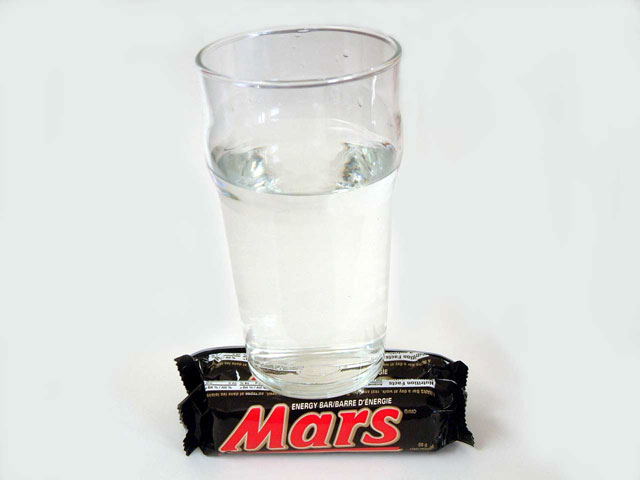
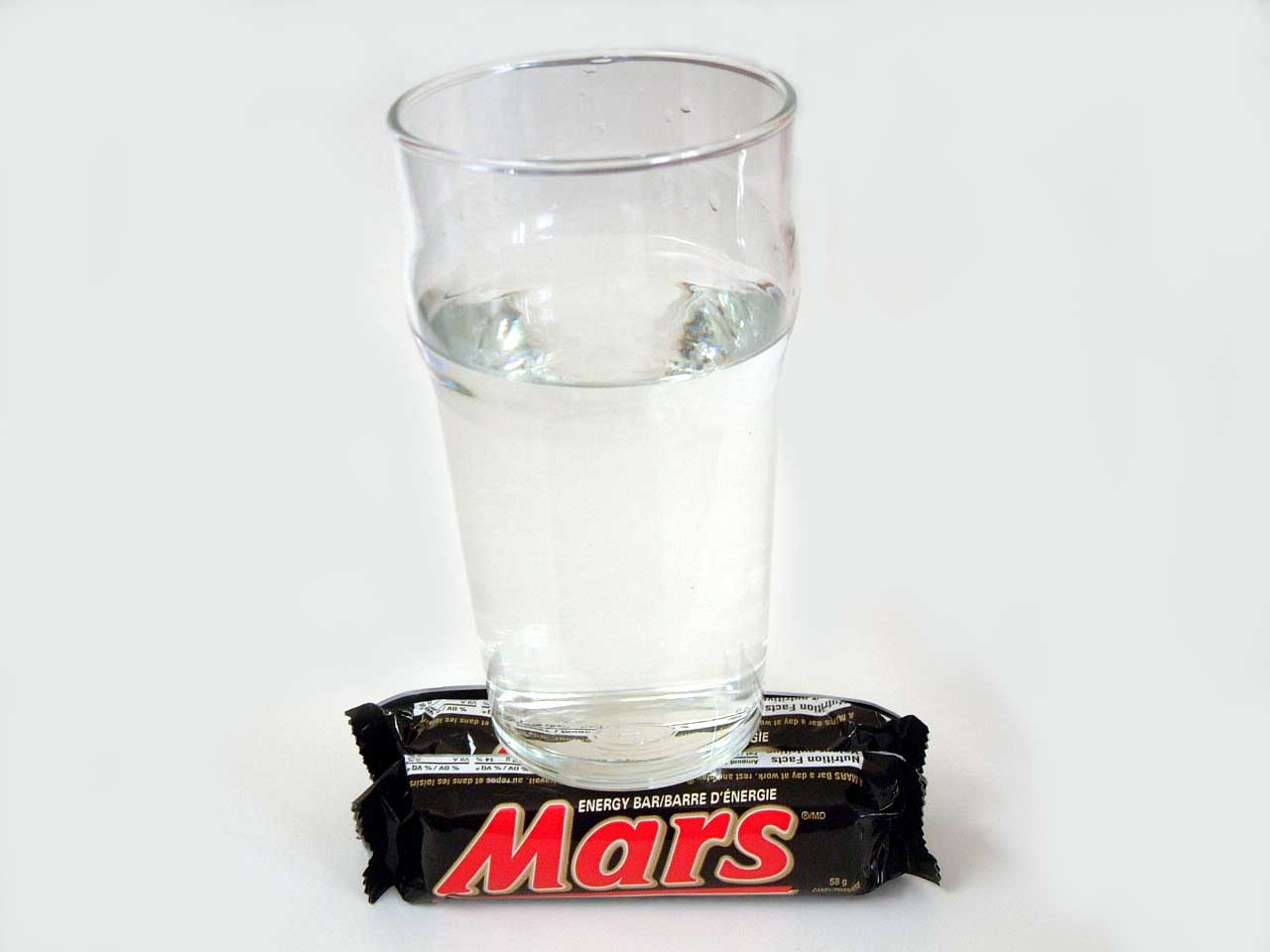
Water doesn't get included in the nutritional information.
http://apod.nasa.gov/apod/image/0504/WaterOnMars2_gcc.jpg -
Re:Photo of water on mars.
I thought you were talking about this: http://apod.nasa.gov/apod/image/0504/WaterOnMars2_gcc.jpg
-
nasa FOUND water on mars already!
http://antwrp.gsfc.nasa.gov/apod/fap/image/0504/WaterOnMars2_gcc_big.jpg this was really published by NASA a couple of years ago... on April 1st...
-
Re:TerraformingThe only way to deal with Mars is to divert the asteroid belt's mass towards it to increase its mass. Force several tens of thousands of asteroids into a decaying orbit such that the mass is deposited on the planet. There's no water there, it all evaporates away without enough gravity to hold an atmosphere and enough pressure to remain liquid!
Mass is not the issue; the lack of a magnetosphere is. Without a magnetosphere, the solar wind will strip the atmosphere, leaving you in the same state. We would need to provide some means of creating a field which shields the atmosphere from solar winds.
Did a quick google to find an article - this one was published in 2010: http://science.nasa.gov/science-news/science-at-nasa/2001/ast31jan_1/
-
Links Links
Don't you hate it when
Home Page
http://marsrover.nasa.gov/spotlight/20100430a.html
Images
http://marsrover.nasa.gov/gallery/press/opportunity/20100430a.html -
Links Links
Don't you hate it when
Home Page
http://marsrover.nasa.gov/spotlight/20100430a.html
Images
http://marsrover.nasa.gov/gallery/press/opportunity/20100430a.html -
Re:Not quite Florida
I did check out the KML, the original image and your analysis. But what are you basing the colored-in area on?
There's a small, clearly defined oil slick that is obvious, roughly 60x80 km in size. I can also see how it gradually thins out, esp. the more faint east edge going toward the south, making the area larger than the clearly defined edges would suggest. What about the rest of the massive area to the south and especially to the east, going outside the edge of the satellite pic? The slightly different color of the sea? That's not oil, that's a reflection in the water.
Here's an example from April 22nd, two days after the explosion and the day the oil was noticed in the sea, at which time there wouldn't have been an oil spill as large as the entire brown area you can see. More clearly here in this pic from the 27th, you can see the reflection to the left of the image, and the oil slick to the right, but not clearly visible since the sun isn't reflecting off the oil.
The government is lowballing numbers to prevent mass panic.
To postpone mass panic, I think you mean. The oil won't just disappear. Nope, I don't really buy conspiracy arguments, especially not with flimsy evidence.
-
Re:Not quite Florida
I did check out the KML, the original image and your analysis. But what are you basing the colored-in area on?
There's a small, clearly defined oil slick that is obvious, roughly 60x80 km in size. I can also see how it gradually thins out, esp. the more faint east edge going toward the south, making the area larger than the clearly defined edges would suggest. What about the rest of the massive area to the south and especially to the east, going outside the edge of the satellite pic? The slightly different color of the sea? That's not oil, that's a reflection in the water.
Here's an example from April 22nd, two days after the explosion and the day the oil was noticed in the sea, at which time there wouldn't have been an oil spill as large as the entire brown area you can see. More clearly here in this pic from the 27th, you can see the reflection to the left of the image, and the oil slick to the right, but not clearly visible since the sun isn't reflecting off the oil.
The government is lowballing numbers to prevent mass panic.
To postpone mass panic, I think you mean. The oil won't just disappear. Nope, I don't really buy conspiracy arguments, especially not with flimsy evidence.
-
Re:Not quite Florida
I did check out the KML, the original image and your analysis. But what are you basing the colored-in area on?
There's a small, clearly defined oil slick that is obvious, roughly 60x80 km in size. I can also see how it gradually thins out, esp. the more faint east edge going toward the south, making the area larger than the clearly defined edges would suggest. What about the rest of the massive area to the south and especially to the east, going outside the edge of the satellite pic? The slightly different color of the sea? That's not oil, that's a reflection in the water.
Here's an example from April 22nd, two days after the explosion and the day the oil was noticed in the sea, at which time there wouldn't have been an oil spill as large as the entire brown area you can see. More clearly here in this pic from the 27th, you can see the reflection to the left of the image, and the oil slick to the right, but not clearly visible since the sun isn't reflecting off the oil.
The government is lowballing numbers to prevent mass panic.
To postpone mass panic, I think you mean. The oil won't just disappear. Nope, I don't really buy conspiracy arguments, especially not with flimsy evidence.
-
Re:Politicizing science?
Actually, I got it from the actual interview where they asked the guy the questions and he filled in his responses. http://news.bbc.co.uk/2/hi/science/nature/8511670.stm
Then you got it wrong, did you read the link you provided as it said nothing of the sort.
He expressly saidC - Do you agree that from January 2002 to the present there has been statistically significant global cooling?
No. This period is even shorter than 1995-2009. The trend this time is negative (-0.12C per decade), but this trend is not statistically significant.
Only the Daily Mail re-interpreted that as no warming in the last 10 years.
From the link you provided.B - Do you agree that from 1995 to the present there has been no statistically-significant global warming
Yes, but only just. I also calculated the trend for the period 1995 to 2009. This trend (0.12C per decade) is positive, but not significant at the 95% significance level. The positive trend is quite close to the significance level. Achieving statistical significance in scientific terms is much more likely for longer periods, and much less likely for shorter periods.
Also you might want to note that in 1998 there was a massive temperature anomaly related to ENSO (IIRC) which affects the average. Graph is here courtesy of NASA, article is here. There still has been an increase since 1995, expect the 09/10 data to be pretty bad due to ENSO, several Australian cities including Perth and Darwin just sweltered through their hottest summers ever, most of the world had fairly warm winters (this is overshadowed by the cold snaps in UK, Washington caused by a shift in the polar jet stream, which is consistent with previous ENSO events).
Natural events like ENSO are going to ensure that this is not a linear progression, 10 years is not long enough to collect enough data to establish a global trend, 15 years is barely enough data. Which is what professor Jones said and why most graphs are 50 to 100 years. It was a British tabloid that said there is no significant warming in the last 10 years, not Phil Jones. -
Re:Politicizing science?
Actually, I got it from the actual interview where they asked the guy the questions and he filled in his responses. http://news.bbc.co.uk/2/hi/science/nature/8511670.stm
Then you got it wrong, did you read the link you provided as it said nothing of the sort.
He expressly saidC - Do you agree that from January 2002 to the present there has been statistically significant global cooling?
No. This period is even shorter than 1995-2009. The trend this time is negative (-0.12C per decade), but this trend is not statistically significant.
Only the Daily Mail re-interpreted that as no warming in the last 10 years.
From the link you provided.B - Do you agree that from 1995 to the present there has been no statistically-significant global warming
Yes, but only just. I also calculated the trend for the period 1995 to 2009. This trend (0.12C per decade) is positive, but not significant at the 95% significance level. The positive trend is quite close to the significance level. Achieving statistical significance in scientific terms is much more likely for longer periods, and much less likely for shorter periods.
Also you might want to note that in 1998 there was a massive temperature anomaly related to ENSO (IIRC) which affects the average. Graph is here courtesy of NASA, article is here. There still has been an increase since 1995, expect the 09/10 data to be pretty bad due to ENSO, several Australian cities including Perth and Darwin just sweltered through their hottest summers ever, most of the world had fairly warm winters (this is overshadowed by the cold snaps in UK, Washington caused by a shift in the polar jet stream, which is consistent with previous ENSO events).
Natural events like ENSO are going to ensure that this is not a linear progression, 10 years is not long enough to collect enough data to establish a global trend, 15 years is barely enough data. Which is what professor Jones said and why most graphs are 50 to 100 years. It was a British tabloid that said there is no significant warming in the last 10 years, not Phil Jones. -
Re: Politicizing science?
On the other hand, the speed of melting has been unprecedented, and it was predicted before it occurred, because increasing greenhouse gasses were predicted to increase temperatures. The melting is also continuing at an accelerating rate, for example, in the Antarctic and Greenland. You may be referring to the Arctic sea ice extent increasing, but the volume is decreasing because the ice is getting thinner. Besides, some years the Arctic sea ice extent will increase due to natural variations. The long-term trend is that the area of Arctic ice is also decreasing.
-
Re:It's NOT a Hubble successor"The man whose name NASA has chosen to bestow upon the successor to the Hubble Space Telescope is most commonly linked to the Apollo moon program, not to science."
First Sentence: http://www.jwst.nasa.gov/whois.html/
-
Re:Timely article
No need to gown up. You can see pretty much everything from the viewing area on the second floor of Building 7. Besides, none of the really interesting flight hardware is at Goddard yet. Come back in a year! As long as you are a US citizen, your friends can badge you in at the front gate.
As for ITAR... Your own pictures a big no-no. But there's a Webcam that allows the public a view into the clean room.
http://www.jwst.nasa.gov/webcam.html
-or- you can just view the video of them bringing in ISIM.
-
Re:ooooooh! It "passed" a "test" !
People look at these scopes as single instruments but a lot of those scopes (including Hubble) are part of NASA's Great Observatories project which aims to cover as much of the EM spectrum as posible. IMHO it has to be the most underrated scientific project on the planet.
-
Re:Hubble II
The Webb telescope is estimated to cost around $4.5 billion and have a life span of 5-10 years. The ISS will cost over $100 billion over 30 years and we will have spent $174 billion in almost 30 years of shuttle service when it retires.
If we built several space telescopes instead of 1 every 20-30 years, we would have less money for shuttle and ISS missions. That would mean that we would not answer such burning questions as:
- Do mice get osteoporosis in space? (link)
- Do LANs work in space? (link)
- How do people deal with the vibrations of a space launch? (link)
- The genetic changes in yeast in space. ()When you are up against such ground breaking breakthroughs as these, you can see how it is tough to scrape together the cash to study trivial things like the origin of the universe and whether there are other inhabitable planets in the galaxy.
All sarcasm aside, you are right to point that manned missions do not give you more bang for the buck from a science perspective. We would know alot more about the universe if we had half a dozen space telescopes in orbit and more rovers on various planets and moons.
-
Re:Hubble II
The Webb telescope is estimated to cost around $4.5 billion and have a life span of 5-10 years. The ISS will cost over $100 billion over 30 years and we will have spent $174 billion in almost 30 years of shuttle service when it retires.
If we built several space telescopes instead of 1 every 20-30 years, we would have less money for shuttle and ISS missions. That would mean that we would not answer such burning questions as:
- Do mice get osteoporosis in space? (link)
- Do LANs work in space? (link)
- How do people deal with the vibrations of a space launch? (link)
- The genetic changes in yeast in space. ()When you are up against such ground breaking breakthroughs as these, you can see how it is tough to scrape together the cash to study trivial things like the origin of the universe and whether there are other inhabitable planets in the galaxy.
All sarcasm aside, you are right to point that manned missions do not give you more bang for the buck from a science perspective. We would know alot more about the universe if we had half a dozen space telescopes in orbit and more rovers on various planets and moons.
-
Re:Hubble II
The Webb telescope is estimated to cost around $4.5 billion and have a life span of 5-10 years. The ISS will cost over $100 billion over 30 years and we will have spent $174 billion in almost 30 years of shuttle service when it retires.
If we built several space telescopes instead of 1 every 20-30 years, we would have less money for shuttle and ISS missions. That would mean that we would not answer such burning questions as:
- Do mice get osteoporosis in space? (link)
- Do LANs work in space? (link)
- How do people deal with the vibrations of a space launch? (link)
- The genetic changes in yeast in space. ()When you are up against such ground breaking breakthroughs as these, you can see how it is tough to scrape together the cash to study trivial things like the origin of the universe and whether there are other inhabitable planets in the galaxy.
All sarcasm aside, you are right to point that manned missions do not give you more bang for the buck from a science perspective. We would know alot more about the universe if we had half a dozen space telescopes in orbit and more rovers on various planets and moons.
-
Re:Hubble II
The Webb telescope is estimated to cost around $4.5 billion and have a life span of 5-10 years. The ISS will cost over $100 billion over 30 years and we will have spent $174 billion in almost 30 years of shuttle service when it retires.
If we built several space telescopes instead of 1 every 20-30 years, we would have less money for shuttle and ISS missions. That would mean that we would not answer such burning questions as:
- Do mice get osteoporosis in space? (link)
- Do LANs work in space? (link)
- How do people deal with the vibrations of a space launch? (link)
- The genetic changes in yeast in space. ()When you are up against such ground breaking breakthroughs as these, you can see how it is tough to scrape together the cash to study trivial things like the origin of the universe and whether there are other inhabitable planets in the galaxy.
All sarcasm aside, you are right to point that manned missions do not give you more bang for the buck from a science perspective. We would know alot more about the universe if we had half a dozen space telescopes in orbit and more rovers on various planets and moons.
-
Re:Dr. who?
...we all know about the waters of mars!!! Yes, we do.
-
Re:OT sig reply - off by an order of magnitude
on average US taxpayers pay $10/month for everything that NASA does.
Number of US tax payers is about 138 Million... NASA Budget is 18.7 $B(2010). So mathematically the average is closer to $130 per taxpayer...
$18.700.000.000 / 138.000.000 = $135 per person per year.
$135 / 12 (months in a year) = $11 per person per month. -
OT sig reply - off by an order of magnitude
on average US taxpayers pay $10/month for everything that NASA does.
Number of US tax payers is about 138 Million... NASA Budget is 18.7 $B(2010). So mathematically the average is closer to $130 per taxpayer...
But the way the system is set up you might be close, e.g. the average Joe paying $10 and a few rich guys paying a heck of a lot more (and then there is the issue that the government simply spends more money than they have, just to complicate things.) -
$16M seem cheap?
I would like to see the verification on all of these statistics from another source. I am hesitant to believe this because it costs about $450 MILLION just to launch a space shuttle once. If the article has more basis than mere rumor, this price tag cannot possibly include deployment. Maybe it's $16M on materials alone? Maybe salaries alone? Consider also that they plan on spending around $2B over the course of ten years, which is just $.3B more than the pricetag on a single Space Shuttle. I will be surprised if this actually comes to pass.
Then again, they ARE Japanese. They probably already have a nanobot-built space elevator on top of the Tokyo Arcology. -
Re:Come On!Uh, 2009 was tied for the 2nd warmest on record
. Who told you it was one of the coldest, and why would you blindly believe something so hard to believe and easily falsifiable?
-
Not to worry!
-
Re:There is no way NASA mixed the measurement systYeah, my reading is that the contractor reused an older routine (in English units) with a newer routine (in metric units) without double-checking the interface spec. It's (sort of) like the operators ordered a metric speedometer but received one marked in English. Since the unit wasn't marked, they assumed it was metric as per the specifications.
The MCO Investigation Board report is a quick read and an interesting case study.
-
Re:Who exactly is fighting back?
I'm not sure that's what science tells us. CO2 ppm in the atmosphere is a somewhat hotly debated issue - today - but in reality we have both older direct measurements than what's normally reported, as well as a problem where we graft direct measurements onto proxies (i.e, the same problem as with tree ring proxies for temperature) without discussing what that means.
There are proper papers discussing diffusion of CO2 levels in ice cores available, but as a primer this writeup should do: http://www.john-daly.com/zjiceco2.htm
(disregard the site, the information is valid and sourced)
We also need to remember that for modelling reasons we claim CO2 to be well mixed in the atmosphere, even though we know from satellite measurements that it isn't (AIRS) - of special interest, of course, is that it's lower at the poles.
If we switch from the dubious ice core proxies for historical CO2 levels, things become much more interesting. It seems we're currently in a very CO2 starved atmosphere where most plant life (and animals) evolved when CO2 levels were much higher. On the order of ten magnitudes higher even: http://gcmd.nasa.gov/records/GCMD_NOAA_NCDC_PALEO_2002-051.html
As to the issue of volcanoes, you're correct, but thinking of single eruptions. If we instead talk about "volcanic activity" the issue becomes clearer. There are always eruptions happening at someplace on earth, but the level of activity waxes and wanes. Here are some telling quotes from a book on the effects just the volcanoes on Iceland have on the (european) climate: http://europe.theoildrum.com/node/6387
(again, disregard the site - it's not the source)
There's no such thing as a "scientific consensus" (Popper spins wildly in his grave) with regards to our climate. Usually those words are uttered by the same people who claimed acid rain would kill all plant life, that we would all die from exposure to UV radiation through the ozone hole (and no, we didn't "fix" it - it has a completely natural sun influenced cycle) or any one of the other scares from the "humans are a pest and the earth would do a lot better without us"-movement.
I'd rather do science.
-
Re:Cool!
Please try to use any fish eye lens to produce this and then we can talk.
-
Re:His Master's Voice
430 apparently
-
Re:His Master's Voice
It's more like, you can't see any bee's near you so you expect it to be unlikely to find bee's far from you
Anyhow, the point was just that earth like planet's do not appear to be common (there is a possibility that it's just around us that earth like planets are really rare, though that's unlikely).
Apparently we've searched 430 planets so far. http://planetquest.jpl.nasa.gov/
-
While Dr. Hawking is undoubtedly intelligent...
That doesn't make him omniscient nor immune to logic. It is entirely too late for the human race to hide. It's not our radio emissions that will give us away to advanced aliens but the natural radiation the Earth is currently reflecting into space. With our current technology we've found (and confirmed) 452 exoplanets and managed to image several. A new generation of planet hunting telescopes is beginning to come online (they're largely funding limited and not technologically limited) and they'll find and image even more exoplanets. It won't be too long before we're able to detect and get spectra from terrestrial planets around stars.
Any species with the means and desire to fly around the galaxy is going to do a survey of exoplanets before they leave home. If they're out there they've seen us already. They know what the Earth's atmosphere is like, they have a good idea of what its made of, and they know something lives here. They may not know specifically that humans live here and are armed to the teeth but they know something lives here. Damn near every inch of the Earth is covered in living organisms, the chlorophyll in spectra will make that abundantly clear. Check out NASA's Earth Observatory page. We can gather that sort of data with dedicated instruments in orbit but it's all being broadcast to the rest of the galaxy. A sufficiently advanced and large enough interferometry telescope would be able to gather the same data about the Earth from the aliens' home system.
Hiding from advanced alien species that want to pay us a visit is impossible. Radio emissions won't make any difference at all. If anything radio emissions would likely be a deterrent for a resource gathering alien species. Why bother coming here and fighting us for our resources when they can head over to the uninhabited system next door and take what the want without a fight? Even if our radio emissions aren't a deterrent they're hyper advanced aliens that can travel interstellar distances. They know the Earth is here and if they want it there's not a lot we can do besides becoming hyper advanced ourselves providing our current technology wouldn't be adequate for our defense.
-
Re:Who exactly is fighting back?
And one more nit to pick, there is no shortage of O2 in the world. The formation of O2 is not hindered very much by deforestation, since most of the oxygen in our atmosphere comes from algae.
One more nitpick: about half of the atmosphere's O2 comes from phytoplankton which are on the decrease. Furthermore, atmospheric oxygen is also decreasing.
-
Re:Ultimately
HERE IS YOUR FUCKING RAW DATA (because you are unvilling to search it for yourself -- and call yourself a skeptic...):
ftp://ftp.ncdc.noaa.gov/pub/data/ghcn/v2 [noaa.gov]
ftp://ftp.ncdc.noaa.gov/pub/data/ushcn/v2/monthly/ [noaa.gov]
http://dss.ucar.edu/datasets/ds570.0/ [ucar.edu]
http://www.antarctica.ac.uk/met/READER [antarctica.ac.uk]
http://eca.knmi.nl/ [eca.knmi.nl]
http://www.zamg.ac.at/histalp/content/view/35/1 [zamg.ac.at]
http://daac.gsfc.nasa.gov/atdd [nasa.gov]
http://mirador.gsfc.nasa.gov/cgi-bin/mirador/presentNavigation.pl?tree=project&project=SORCE [nasa.gov]
http://amsu.cira.colostate.edu/ [colostate.edu]
http://www.pol.ac.uk/ntslf/data.html [pol.ac.uk]
http://www.geo.unizh.ch/wgms/dataexp.html [unizh.ch]
http://www.marine.csiro.au/~ttchen/argo/gmap.htm [csiro.au]
http://icoads.noaa.gov/ [noaa.gov] -
Re:Ultimately
HERE IS YOUR FUCKING RAW DATA (because you are unvilling to search it for yourself -- and call yourself a skeptic...):
ftp://ftp.ncdc.noaa.gov/pub/data/ghcn/v2 [noaa.gov]
ftp://ftp.ncdc.noaa.gov/pub/data/ushcn/v2/monthly/ [noaa.gov]
http://dss.ucar.edu/datasets/ds570.0/ [ucar.edu]
http://www.antarctica.ac.uk/met/READER [antarctica.ac.uk]
http://eca.knmi.nl/ [eca.knmi.nl]
http://www.zamg.ac.at/histalp/content/view/35/1 [zamg.ac.at]
http://daac.gsfc.nasa.gov/atdd [nasa.gov]
http://mirador.gsfc.nasa.gov/cgi-bin/mirador/presentNavigation.pl?tree=project&project=SORCE [nasa.gov]
http://amsu.cira.colostate.edu/ [colostate.edu]
http://www.pol.ac.uk/ntslf/data.html [pol.ac.uk]
http://www.geo.unizh.ch/wgms/dataexp.html [unizh.ch]
http://www.marine.csiro.au/~ttchen/argo/gmap.htm [csiro.au]
http://icoads.noaa.gov/ [noaa.gov] -
Re:Are climate researchers....
YOU IDIOT!
Here you are, PLENTY of RAW datasets:ftp://ftp.ncdc.noaa.gov/pub/data/ghcn/v2
ftp://ftp.ncdc.noaa.gov/pub/data/ushcn/v2/monthly/
http://dss.ucar.edu/datasets/ds570.0/
http://www.antarctica.ac.uk/met/READER
http://eca.knmi.nl/
http://www.zamg.ac.at/histalp/content/view/35/1
http://daac.gsfc.nasa.gov/atdd
http://mirador.gsfc.nasa.gov/cgi-bin/mirador/presentNavigation.pl?tree=project&project=SORCE
http://amsu.cira.colostate.edu/
http://www.pol.ac.uk/ntslf/data.html
http://www.geo.unizh.ch/wgms/dataexp.html
http://www.marine.csiro.au/~ttchen/argo/gmap.htm
http://icoads.noaa.gov/Let me repeat:
YOU IDIOT -
Re:Are climate researchers....
YOU IDIOT!
Here you are, PLENTY of RAW datasets:ftp://ftp.ncdc.noaa.gov/pub/data/ghcn/v2
ftp://ftp.ncdc.noaa.gov/pub/data/ushcn/v2/monthly/
http://dss.ucar.edu/datasets/ds570.0/
http://www.antarctica.ac.uk/met/READER
http://eca.knmi.nl/
http://www.zamg.ac.at/histalp/content/view/35/1
http://daac.gsfc.nasa.gov/atdd
http://mirador.gsfc.nasa.gov/cgi-bin/mirador/presentNavigation.pl?tree=project&project=SORCE
http://amsu.cira.colostate.edu/
http://www.pol.ac.uk/ntslf/data.html
http://www.geo.unizh.ch/wgms/dataexp.html
http://www.marine.csiro.au/~ttchen/argo/gmap.htm
http://icoads.noaa.gov/Let me repeat:
YOU IDIOT -
Re:Who exactly is fighting back?
Here is the raw data, now will you please stop linking tabloid hit pieces and repeating their propoganda?
Note the raw data in the link has a few minor holes, this is due to the fact some national weather services (eg: France) will only release their data on condition you keep it private. If you intend to perform a reconstruction be aware the raw data is chock full of anaomolies such as undocumented station movements and typos. OTHOH Jones and his unit have spent the last couple of decades ferreting out and documenting these anomolies so you may want to consider using the more complete and more accurate HadCRUT data set or NASA's similarly painstakingly cleaned GISTemp data set.
As you may or may not be aware historical temprature reconstructions are fairly insensitive to the holes and anomolies mentioned above, meaning that the raw data in the link is more than sufficient to reproduce any of the historical temprature reconstructions in the literature. If this is still insuffitient to shake your faith in tabloid journalisim, you could try some of the other raw data and master repositiries. -
Re:I'd go back to NYC just to see it
Agreed. The Intrepid is a great museum, and one of my favorite places in the world. But it's very specifically a museum of durable things. Military aircraft and supersonic transports that are designed for all-weather.
The Space Shuttle is the very definition of a Hangar Queen. It takes tens of thousands of man hours of re-fitting for each flight. The tiles are delicate, and it's not really designed to be exposed to the elements long term. It might be able to be, but given it's track record, do we really want to risk it when there are only three remaining in existence?
Yes, they probably *could* get it into the hangar bay of the Intrepid, but given the shuttle's size, they may actually have to dismantle the ship to do so.
The Essex Class carrier has a deck elevator with dimensions of 60 ft x 34 ft. It's maximum load weight was 40,000 Lbs. The shuttle orbiter by comparison is 122.17 ft by 78.06 ft and weighs 151,205 lb.
In other words, the orbiter weighs in (empty) at triple the capacity of the Intrepid's elevators. Even if they didn't use the elevators and used some kind of crane instead, it's still 78.06 ft on it's smaller dimension vs the deck opening's larger dimension which is 60 ft.
They'd have to dismantle either the Intrepid or the orbiter to get it inside. Even if they did, the hangar deck is hardly climate controlled to begin with...
To use the Intrepid site, they'd either have to dismantle part of the ship to get it inside, then extensively retrofit it to provide a climate controlled environment, or they'd have to build a new facility on the Pier along side Intrepid just to house the Shuttle. The Intrepid gets most of it's operating budget from admissions, memberships, and the occasional grant. I don't think it's going to go away tomorrow, but I do get the distinct impression that compared to the Smithsonian, or the Kennedy Space Center (both government funded), it's hanging on my the margins.
The 500 year rule makes sense to me. These are invaluable pieces of human history. The Apollo Command Modules are in the same class. The National Air And Space Museum in D.C. makes sense as a location for one. They already have the Columbia module from Apollo 11, which I assume we would want to maintain to the same standards. However, they also already have the orbiter prototype Enterprise, so it seems to make more sense to spread the three remaining orbiters to allow as many people as possible to have access to them as possible. Perhaps one one at Kennedy Space Center, and one in Houston, and one on the West Coast somewhere?
New York City would allow millions of people to have access. And Intrepid is the premier aerospace site in the city. But it's just not equipped or funded for something like this.
The Aerospace museum at Wright-Patterson Air Force Base may also be appropriate, but it has a distinct military aerospace bias.
Likewise Vandenberg Air Force Base in California could be a great site, as it was almost a second launch site for the Shuttle. Having an orbiter wind up there permanently could be very apropos. Unfortunately, I'm not aware of any museum or public exhibit at Vandenberg, which is a shame. Edwards Air Force Base (Secondary shuttle landing site) and White Sands Space Harbor in New Mexico could be appropriate for similar reasons. But again, they're both military bases, and not terribl
-
A Link to Several Movies
I found that this link provides access to several high quality movies that downloaded quite quickly. They are very interesting to watch.
-
super hd video at nasa
Check out the full-screen mpegs here: http://svs.gsfc.nasa.gov/Gallery/SDOFirstLight.html
-
Re:Torrent Please
I am seeding! I imagine until we get a lot of peers direct download from the websites will be better
So, if you download from the web, please seed them
http://sdo.gsfc.nasa.gov/firstlight/
http://aia.lmsal.com/public/firstlight.html -
Link to SDO?
Almost all of the links on that article refer back to crap at network world -- I'm still trying to figure out what this link is at the bottom, that claims to be "Solar Dynamics Observatory", but seems to just be a 404 to : sdo.gsfc.nasa.gov/images/site/icon.ico
(There's no 'images' directory on that server at the top level)
I'd just appreciate it if someone were going to link to our servers that they didn't link to crap.
If you want movies, see one of :
-
Cut to the chase! Hit first base!
Girls(I hope)! Guys!
These videos are awesome. For once, don't bother with the article, just feast your eyes on extraordinary false-color footage of the source* of our life:
http://www.nasa.gov/mov/445831main_Alan-1-FirstSunImageandFootageH264.mov
http://www.nasa.gov/mov/445834main_Alan-4-Larger-activeRegion-H264.mov
Others are available here:
http://www.nasa.gov/mission_pages/sdo/news/briefing-materials-20100421.html
These are some of the most beautiful works of art I've ever seen, and I studied Fine Art for over a decade. Ok, I've studied Physics for longer, but still!
What particularly struck me was the very "organic" looking cell structure (wikipedia suggests they're http://en.wikipedia.org/wiki/B%C3%A9nard_cells but I'm not a solar physicist, and I suspect it's just a _little_ bit more complicated than that, what with the vast EM energies at work and such). Call me a nerd, but my chest heaved as though I were looking into the eyes of a beautiful girl** ***.
* Yada yada
** Ok, so I've had a couple of large glasses of wine, and "life looks rosier through the bottom of a wine glass". But then, "in vino veritas". And anyway, it was white wine.
*** All girls are beautiful.