Slashdot Mirror
Domain: nd.edu
Stories and comments across the archive that link to nd.edu.
Comments · 191
-
Re:Is this the same as featured before?
No... But there is a distributed project out there working very hard to crack it - but so far elliptic curve encryption holds out...
By the way, Ars Technica has a team working hard on this project, and they I'm sure they'd like some help...
-
My mom said...
...I told you never trust a monkey!
The end. -
folks, look up the plural of "virus"I can't tell whether this is just some sort of Slashdot hangup or whether people actually think the plural of "virus" is "virii". Look it up in a dictionary. The plural of "virus" is "viruses"--no other form is acceptable in English.
"Virii" isn't not a Latin plural of any known word. The most plausible latin nominative plural would be "viri", but some people don't buy that.
-
Re:In the forth quater?
>> What the heck is a forth quater?
>
> 25% of a FORTH program?
Er, no. That would be a FORTH quarter. Also notice that forth is not capitalized.
So a " forth quater " is something like "going forward four times" or maybe "stuck FF button".
<obGeek> "FORTH quater" would be something like:
: quater (n1 -- n1) dup 2dup
</obGeek>
Burn karma, burn! -
Actually, fonts are patentable
Fonts are patentable, in design patents. Fonts are patentable as articles of manufacture - This is a kind of legal fiction to keep patent law in line with the tradition, when type was made out of wood or metal, of being protectable. Therefore, to protect software fonts, they must be claimed as embedded in something, such as a computer screen. One title suggested by the USPTO is "portion of a monitor displayed with a computer icon image." See MPEP 1504.01(a). Bezuwork's friend
-
Where's Tux?
A fairly complete history of Linux, to be sure. But they're certaintly missing a rather important piece. The birth of a symbol! Well, here's me cleaning up their mess. Go here -> Tux History
-
Re:Please note that . . . Re:$$, too
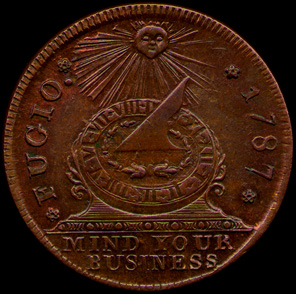
Early coins are more interesting, and to the point without being so religious. One of the very first coins, the Fugio Cent, says Mind Your Business among other things. It's one of my favorite coins.
-
Re:Please note that . . . Re:$$, too
Early coins are more interesting, and to the point without being so religious. One of the very first coins, the Fugio Cent, says Mind Your Business among other things. It's one of my favorite coins.
-
Procedural Minimum for Democracy
many scholars argue that without effective guarantees of civil liberties, elections do not constitute democracy, and that a procedural minimum for defining democracy must include not only elections, but reasonably broad guarantees of basic civil rights-e.g., freedom of speech, assembly, and association.
-Democracy 'with Adjectives', by D. Collier and S. Levitsky
The paper I link to (which is academic but pretty accessible - I'm a biologist, not a political scientist) is about military juntas in south america, not Aussies.
I raise this point because I think John Howard (the prime minister of Australia) is Australian for Hitler. A modern Democracy can survive all matter of scuminess, but if this proposal goes through, Australia will need an adjective (such as crpyto or pseudo) to qualify their form of government. -
AFS or NFS
The University of Notre Dame and University of Michigan both use an AFS/Kerberos set-up for large volumes of accounts.
Notre Dame offers accounts on their Solaris/SPARC machines to every student at the university. Michigan's CAEN is also an AFS/Kerberos system for the whole College of Engineering.
MIT's Athena project is pretty interesting (and also partially uses an AFS/Kerberos scheme), but it probably won't help you set up a quick public network of Linux machines since it focuses more on the research side of things (not to mention the fact that it's been actively worked on since 1983!).
In general, you will probably want to decide between an AFS/Kerberos set-up or an NFS set-up.
With AFS/Kerberos, you as the administrator would directly control a pool of servers ("Vice") which physically contain the data in every user's account. The client machines ("Venus") would get temporary "tickets" from the central Kerberos server (which you also control) to access their accounts which are stored on Vice.
In the NFS scenario, the physical location of accounts is totally decentralized and distributed across all the machines that users actually work on. This means less work for you as an administrator, but it also means less security since random users' data is actually stored on the disks of the computers in the user pool (in AFS, Vice machines are considered to be "locked in closets" to which only the administrators have physical access). It's good to remember a golden rule, "physical access to a computer always implies root access." Using a tomsrtbt disk for example, you can change the root password on just about any Linux machine with a floppy drive.
Since Vice (in the AFS scheme) computers are presumably kept behind locked doors, you avoid this type of problem. However, AFS is harder to maintain, and you probably have to pay Transarc for a commercial version.
For more info on AFS/Kerberos and NFS, I recommend surfing the ACM Digital Library, in which you can find the seminal papers on these various technologies (if you're an ACM member and have access). You may also be able to find case studies there (which I found to be surprisingly hard to find on the web). -
Referring to your sig...
The original phrase's verb would be "cogitare", meaning "to think", 1st person singular is "cogito". Supposed you wanted to refer to something like "codere", take "codeo, ergo sum". BTW, there's a nice page to play around with latin vocab here.
-
Re:Scale-Free Networks
This is also called a scale-free network, and the research on it, by Albert-Laszlo Barabasi (currently at Notre Dame U) is in this week's New Scientist.
There are a quite few papers on this topic (behaviour of disordered networks) by Barabasi and one of his research students, Reka Albert (now probably graduated), most of which are available from his research group's website or from arXiv.
Particular highlights:
A-L. Barabasi and R. Albert, Emergence of scaling in random networks, Science 286, 509, (1999)
A-L. Barabasi, R. Albert and H. Jeong, Scale-free characteristics of random networks: The topology of the World Wide Web, Physica A 281, 69-77 (2000).
A-L. Barabasi and R. Albert, Topology of evolving networks: local events and universality, Physcal Review Letters 85 5234 (2000).
This work is an interesting counterpoint to the 'small world' networks of Watts and Strogatz:
D.J. Watts and S.H. Strogatz, Collective dynamics of 'small-world' networks, Nature 393, 440-442, (1998).
D.J. Watts, Small Worlds, Princeton University Press, (1999).
-
Re:Scale-Free Networks
This is also called a scale-free network, and the research on it, by Albert-Laszlo Barabasi (currently at Notre Dame U) is in this week's New Scientist.
There are a quite few papers on this topic (behaviour of disordered networks) by Barabasi and one of his research students, Reka Albert (now probably graduated), most of which are available from his research group's website or from arXiv.
Particular highlights:
A-L. Barabasi and R. Albert, Emergence of scaling in random networks, Science 286, 509, (1999)
A-L. Barabasi, R. Albert and H. Jeong, Scale-free characteristics of random networks: The topology of the World Wide Web, Physica A 281, 69-77 (2000).
A-L. Barabasi and R. Albert, Topology of evolving networks: local events and universality, Physcal Review Letters 85 5234 (2000).
This work is an interesting counterpoint to the 'small world' networks of Watts and Strogatz:
D.J. Watts and S.H. Strogatz, Collective dynamics of 'small-world' networks, Nature 393, 440-442, (1998).
D.J. Watts, Small Worlds, Princeton University Press, (1999).
-
Re:I don't understand this privacy thing fully...
I'm interested in people's opinions. What is so terrible about directed marketing (NOT SPAM), but advertising targeted at a particular group of people?
The problem is abuse. As markets move quicker and faster still, marketing budgets increase in orders of magnitude, as a company that has no name recognition for a product it's been selling for six months is basically screwed.
The problem is that marketing knows only to match what the industry does - grow. We've seen many cases where a particular company staked out into uncharted territory and was richly rewarded for it...but on the other hand, we've seen tenfold or more cases where they were either scorned, slow, selfish, or stupid. Marketing in brute force is a proven tactic because even the worst product has a buyer somewhere who is stupid enough to fall for it.
My problem with it is that marketing yesterday, today, and tomorrow is *all* about mindshare. Companies consistently bombard me with ads for a product that I either have already, don't have money for, or have no interest in altogether. I've been seeing banner ads all over the place for my DSL provider. I already have an account with them, so this ad is a waste of money for them. However, if targeted advertising wasn't a pipe dream, and if they had competition in my area (they don't), then their competitors would be bombarding me with ads day-in and day-out until I switched. And then what? I'll get the same treatment back from my old provider. If Coke knows you buy Coke and agrees tos top sending you ads, then what do you think Pepsi is going to do? Suppose you change to Pepsi. Then what?
The problem is bigger than marketing. The problem is that, in the eyes of the industry, we have mutated from homo sapiens into homo emptoris. -
Reinventing the Wheel
Phil, you really should do a literature survey before you write stuff like this. Your so called leaech computing does not seem that novel, most viruses and intrusions occur like this. Non destructive voluntary cycle stealing has been well studied too, maybe you should take a look at the Condor project. For distributed search, there have been many applications, most notably seti@home but also protein folding and other such important problems. I could put the links in here, but you might be an undergrad trying to get help with your homework and then I could get in trouble (as I'm a Professor). On a side note, Barabasi et al. recently published an interesting paper on Parasitic Computing was published lately about using internet checksum computations to do interesting work. I will provide that link as it appeared in Nature (a MAJOR scientific forum but not usually thought of when looking for Computer Science references).
-
Re:Hello! Remember IBM?
TRSDOS from tandy and written by MS.
MS wrote quite a bit of Tandy's software.
As for other fantasies google claims about 92,200 found...
or maybe you mean this -
Re:Desktop metaphors were supposed to scale
Apple's Macintosh, from the very beginning, allowed folders to be nested inside folders, allowing an infinite amount of scalability
Surprisingly this is untrue! The original MacOS System 1.0 used MFS (Macintosh File Sysyem) which only allowed two levels of files on a disk. You had the disk root which could contain folders but folders could not contain more folders. Additionally the OS didn't care much about folders at all - an open file dialog would just list the entire disk's contents. Fortunately HFS replaced the original MFS in system 3.0. Here's a link for those interested in very early MacOS. -
Re:Legos obsolete
This got them money from rich geeks, but made the product even less pleasant and fun for average, non-technological kids.
Legos are hardly the place for taking pot-shots in the Class Warfare struggle in America. For every nine year old child building remote controlled cars out of legos, there are working class children too, building oil rigs, monster trucks, and freight trains, powerful symbols of blue collar existence. The extensive flexibility introduced by the newer legos do not extend new possibilities just to upper middle class science-fiction fans, but to children everywhere with a solid engineering background and about a hundred dollars.
Pure left wing nonsense! -
You have to copy software to use it.The legal basis for restrictive EULAs is that you have to make a copy of the software (in your computer's RAM) in order to use it. Copying is prohibited without explicit permission, and so, therefore, is use. Therefore the companies can ask you to sign whatever argument they want before allowing you to use the software. If the license is non-transferable then, sure, you can sell the source CD for the software -- but the poor schnook who buys it from you doesn't have a license to copy it, so he can't use it.
Yep, I know it sounds stupid (and means, for example, that online documentation has more restrictions than the exact same information printed on paper). But there are federal legal precedents for that interpretaiton. Check out, for example, MAI vs. Peak Computer, from 1993.
IANAL.
-
Re:Interesting...
I'm not an expert on checksumming or firewalls, but I am a graduate of Notre Dame and I can't imagine that the Powers That Be will be too happy about this. ND prides itself on being a pre-eminent *Catholic* university, and somehow I don't think they'll like an association with "parasitic" anything. And the emphasis on religion does extend into the sciences as well. Hell, my freshman year Honors Biology class professor had to teach creation theory alongside evolution, even though it was clear the man resented every minute of it. All it will take is a few morally outraged letters to the Observer and the project will be shut down. Just watch.
-
Albert-Laszlo BarabasiThis Barabasi guy's an ass. All he does is sensationalist pop-physics crap. Look at his website. The organization of handclapping (featured at ABCNews and FoxNews), sandcastles, and internet topology and attack work (discussed at Slashdot here). This guy just jumps between pop-science subjects and eats up press coverage of his crap.
Can we stop talking about him now? -
Albert-Laszlo BarabasiThis Barabasi guy's an ass. All he does is sensationalist pop-physics crap. Look at his website. The organization of handclapping (featured at ABCNews and FoxNews), sandcastles, and internet topology and attack work (discussed at Slashdot here). This guy just jumps between pop-science subjects and eats up press coverage of his crap.
Can we stop talking about him now? -
Albert-Laszlo BarabasiThis Barabasi guy's an ass. All he does is sensationalist pop-physics crap. Look at his website. The organization of handclapping (featured at ABCNews and FoxNews), sandcastles, and internet topology and attack work (discussed at Slashdot here). This guy just jumps between pop-science subjects and eats up press coverage of his crap.
Can we stop talking about him now? -
Albert-Laszlo BarabasiThis Barabasi guy's an ass. All he does is sensationalist pop-physics crap. Look at his website. The organization of handclapping (featured at ABCNews and FoxNews), sandcastles, and internet topology and attack work (discussed at Slashdot here). This guy just jumps between pop-science subjects and eats up press coverage of his crap.
Can we stop talking about him now? -
Re:Hmmmm.
President Bush can Read!?
I hear that the White House staffers are trying to teach him, so he'll be able to see what those funny squiggles are on his honorary doctorate -- a sad day for universities everywhere, that was... -
Message Passing Interface 6.3.2
You might want to check out MPI-6.3.2 (aka LAM) which has been around for a lot longer than Grid. MPI is a library for writing parallel programs that execute on groups of workstations.
-
been done before
The Lab for Scientific Computing at the University of Notre Dame has, for many years now, had a Dome Cam set up with an optional ascii version. So this isn't that new. http://lisa.ee.nd.edu/DomeCam/. Of course, it seems to be down right now...
-
Re:Screenshots
Apple Mac System 1. Doesn't look too different to System 7 to me...
-
Re:Corporate Beowulf?
This question recently came up on the LAM mailing list (LAM is a free implementation of MPI). and Yes, beowulf is used in a variety of non-academic settings. Many government research labs use it (I am presently working at Lawrence Berkeley on cluster-realted work)
and, from the download logs for
LAM, I can say that a _lot_ of
MPI is an industry standard which has for years been used on Crays, IBMs, HPs and other mainframe and supercomputers. MPI is a highly portable API, so porting to PC clusters can often be just a recompile (realisticly it sometimes takes a bit more tuning, but no where near as bad as say porting from X to Win32 graphics API or something like that) -
Re:Futures and pasts
Apple did not steal the GUI concept from Xerox's Palo Alto Research Centre. They borrowed some ideas but not the complete OS concept. The other key difference is that Apple actually asked Xerox first. Smalltalk really has very little in common with MacOS. Microsoft was given detailed information about the MacOS APIs to aid them in creating apps for the Macintosh. Microsoft used this information when creating windows.
There has been enough misinformation spread about the birth of the GUI and Apple and Xerox part in it all. Microsoft had no part in the creation of the GUI all the concepts were in place when it created its own.
I suggest those who are interested take a look at the following essay linked from here. They were written by people actually involved:
http://www.apple-history.com/horn1.html
You can actually still run System 1 today using the vMac emulator. If you have too much spare time then you can try it out and see just how advanced it was for its time.
-
A Look At The Universitys' "Reasoning"
It's really amusing how often I find out about Slashdot stories from places other than Slashdot itself (the classic case being Bruce Sterling's Viridian Design Manifesto story, where I either was sent the manifesto itself or a link to the Slashdot story by, among others, Bruce himself, Warren Ellis (a raving mad comic book writer and fellow member of the Viridian Movement), and about 30 random people) and it just happened again with this story.
I'm on the Resnet mailing list as a result of work I've done here at Oberlin College (as a student) on DHCP registration crap, so I've been hearing carping about Napster for a while now. This story first popped up earlier today or yesterday, and then, lo and behold, someone mentioned that Slashdot picked up on it. heh. If you're potentially interested in seeing why this is being done, and how they think they'll get it to stick, take a look at thi s, a canned search for the words "napster" or "slashdot" in the Resnet mailing list archive.
Also, after first reading this most recent furor, I wandered over from my cubicle to chat with my boss, the college's chief sysadmin, and asked her how we were acting in regards to Napster. Her reaction? "It's not that much bandwidth. Big deal. If someone gets caught doing something the RIAA doesn't like, we'll yell at them. It's not that big a deal." Kind of refreshing, I thought... -
Re:Arse Award?Actually the translation is Art Technology
No. From an intuitive standpoint, that is an incredibly awkward translation (and a good sign it's wrong). More concretely, technica is not a noun. Technica is derived from techna, technae (meaning "trick or artifice") by adding an -ic which makes it an adjective. Thus technicus, -a, -um means "pertaining to trick or artifice" (given the context, "technological"). Thus my translation stands
Kudos to nd.edu (specifically http://lysy2.archives.nd.edu/cgi-bin/words.exe?te
c hnica) for the excellent resources they have available! -
GNU C compiler
Let's face it: without common standards-compliant compilers, Open Source would be nearly helpless to advance on multiple platforms.
In 1999, gcc saw its first major upgrade for years, as egcs and gcc were merged. This went along with continued developments to make programmers more productive, such as the Standard Template Library and new Matrix Template Library (an awesome project at Notre Dame), to mean we can spend less time doing generic stuff and more time doing application-specific stuff.
GCC made great advances in 1999, and is deserving of recognition. -
Re:Linux close but no cigar
Lam can be found at http://www.mpi.nd.edu/lam/. It was originally written at the Ohio Supercomputing Center. It is currently being maintained by the Laboratory for Scientific Computing at the University of Notre Dame. By the way, we just released version 6.3 of LAM. If you're looking for a good way to see how LAM is communicating, check out XMPI, a graphical interface to LAM (as well as SGI's MPI implimentation). LAM is available as a tarball, i386 and SRC RPMS, and should be available in the Debian Potato archives. BTW - While you're visiting the LSC's pages, don't forget to see the world famous domecam.
-
Re:Linux close but no cigar
Lam can be found at http://www.mpi.nd.edu/lam/. It was originally written at the Ohio Supercomputing Center. It is currently being maintained by the Laboratory for Scientific Computing at the University of Notre Dame. By the way, we just released version 6.3 of LAM. If you're looking for a good way to see how LAM is communicating, check out XMPI, a graphical interface to LAM (as well as SGI's MPI implimentation). LAM is available as a tarball, i386 and SRC RPMS, and should be available in the Debian Potato archives. BTW - While you're visiting the LSC's pages, don't forget to see the world famous domecam.
-
Re:Faster CPUs aren't what we need
Very true, the primary bottle neck in computers these days is memory and network latency. I think that the advances IBM is showcasing here will really pay off though in decreased power requirements which are becoming increasingly important as embedded devices appear. and the combination of Processor and Memory is an extremely attactive option as it relieves requirements on the bus.
intersting work is being done in this direction under the Processor-in-Memory (PIM) project.
Another mechanism to decrease the effect of this memory latency is to use large numbers of low-level threads (often automatically generated by the compiler) to mask latency. By decreasing the context switch penalty to a single cycle (or less with interwoven threads) and then switching on every cache miss substantial benifits can be made. One example of this is Tera computing MTA architechture. For certain common simulation tasks the 4-processor TERA machine blew away a multi-node Origin and Cray computer according to This NASA report.
Also, Sun's new MAJC architechture uses threads to mask latency.
Interwoven threads (where the processor switches thread every clock cycle) has the benifits of removing branch and data dependancies from a processor pipleine, thus removing the need for processor complexity like data forwarding, speculative execution, and the like. An example of this technique can be found a the TIPSI Project. -
Re:Faster CPUs aren't what we need
Very true, the primary bottle neck in computers these days is memory and network latency. I think that the advances IBM is showcasing here will really pay off though in decreased power requirements which are becoming increasingly important as embedded devices appear. and the combination of Processor and Memory is an extremely attactive option as it relieves requirements on the bus.
intersting work is being done in this direction under the Processor-in-Memory (PIM) project.
Another mechanism to decrease the effect of this memory latency is to use large numbers of low-level threads (often automatically generated by the compiler) to mask latency. By decreasing the context switch penalty to a single cycle (or less with interwoven threads) and then switching on every cache miss substantial benifits can be made. One example of this is Tera computing MTA architechture. For certain common simulation tasks the 4-processor TERA machine blew away a multi-node Origin and Cray computer according to This NASA report.
Also, Sun's new MAJC architechture uses threads to mask latency.
Interwoven threads (where the processor switches thread every clock cycle) has the benifits of removing branch and data dependancies from a processor pipleine, thus removing the need for processor complexity like data forwarding, speculative execution, and the like. An example of this technique can be found a the TIPSI Project. -
_The_ RPN calcI'm not really sure what you are after, but if you want an RPN calculator, go for what you are used to, that is your favorite calculator... emulated.
I use x48, I didn't do much digging, but have a look here for a screenshot and an explanation.
It's considerably faster than the real thing, and even if the interface is a little akward (well, I gess it's only something you have to get used to) it's usable.Only slight problem... still no ROMs available legally unless you own the real thing.
Anyway once you have everything set up you will need some cool tools
-
interesting.
A few weeks ago, I helped set up a mirror for the LAM pages (http://www.mpi.nd.edu/lam/) and while one of the mirrors was spidering our site, downloading everything, we noticed another machine that was on our campus doing the same thing. We found this slightly odd and sent a Big Brother sorta mail (we're watching you spider our site... why?) to the people doing this... got a response about them doing some study about how the web is laid out. They thought they could predict it using some physical or mathematical model.
I also administer the NDLUG (http://www.ndlug.nd.edu/) web server, and noticed massive spidering from the same machine on campus.
Now I read this article and see this quote:
"The Web doesn't look anything like we expected it to be," said Notre Dame physicist Albert-Laszlo Barabasi, who along with two colleagues studied the Web's topology.
so, i guess i don't have much of a point, but it's kinda cool to see that something actually came of some people in the college of science abusing our poor 486 webserver...
-
interesting.
A few weeks ago, I helped set up a mirror for the LAM pages (http://www.mpi.nd.edu/lam/) and while one of the mirrors was spidering our site, downloading everything, we noticed another machine that was on our campus doing the same thing. We found this slightly odd and sent a Big Brother sorta mail (we're watching you spider our site... why?) to the people doing this... got a response about them doing some study about how the web is laid out. They thought they could predict it using some physical or mathematical model.
I also administer the NDLUG (http://www.ndlug.nd.edu/) web server, and noticed massive spidering from the same machine on campus.
Now I read this article and see this quote:
"The Web doesn't look anything like we expected it to be," said Notre Dame physicist Albert-Laszlo Barabasi, who along with two colleagues studied the Web's topology.
so, i guess i don't have much of a point, but it's kinda cool to see that something actually came of some people in the college of science abusing our poor 486 webserver...
-
interesting.
A few weeks ago, I helped set up a mirror for the LAM pages (http://www.mpi.nd.edu/lam/) and while one of the mirrors was spidering our site, downloading everything, we noticed another machine that was on our campus doing the same thing. We found this slightly odd and sent a Big Brother sorta mail (we're watching you spider our site... why?) to the people doing this... got a response about them doing some study about how the web is laid out. They thought they could predict it using some physical or mathematical model.
I also administer the NDLUG (http://www.ndlug.nd.edu/) web server, and noticed massive spidering from the same machine on campus.
Now I read this article and see this quote:
"The Web doesn't look anything like we expected it to be," said Notre Dame physicist Albert-Laszlo Barabasi, who along with two colleagues studied the Web's topology.
so, i guess i don't have much of a point, but it's kinda cool to see that something actually came of some people in the college of science abusing our poor 486 webserver...