Slashdot Mirror
Domain: nrel.gov
Stories and comments across the archive that link to nrel.gov.
Stories · 7
-
Japanese Company Develops a Solar Cell With Record-Breaking 26%+ Efficiency (arstechnica.com)
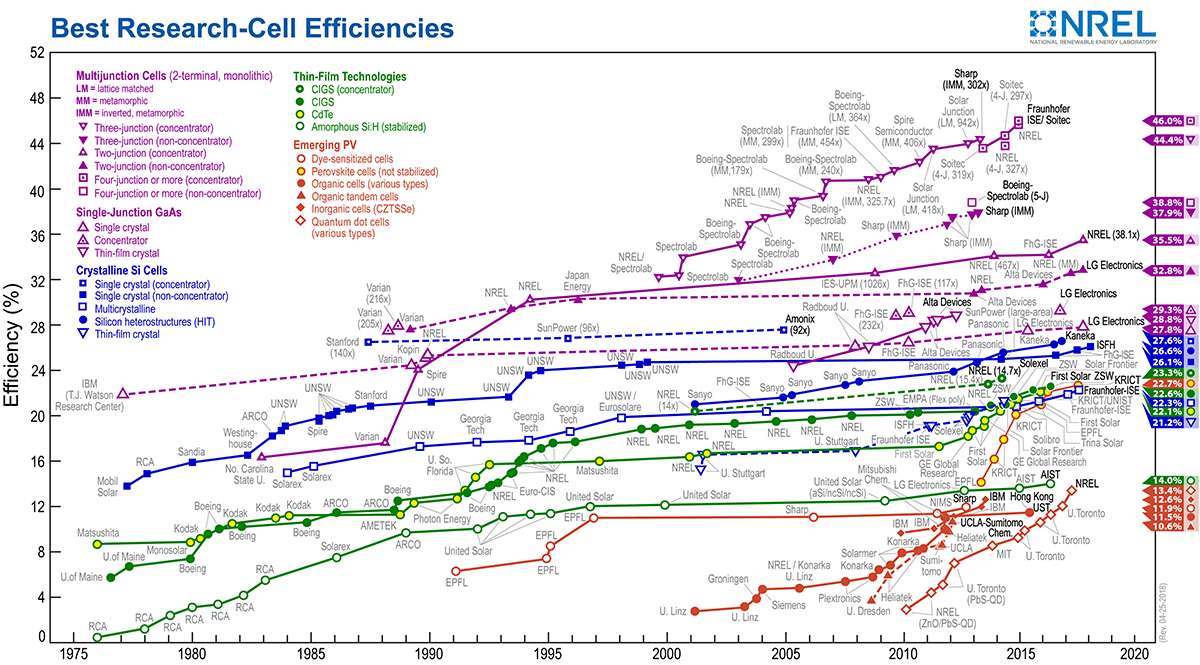
An anonymous reader quotes a report from Ars Technica: The silicon-based cells that make up a solar panel have a theoretical efficiency limit of 29 percent, but so far that number has proven elusive. Practical efficiency rates in the low-20-percent range have been considered very good for commercial solar panels. But researchers with Japanese chemical manufacturer Kaneka Corporation have built a solar cell with a photo conversion rate of 26.3 percent, breaking the previous record of 25.6 percent. Although it's just a 2.7 percent increase in efficiency, improvements in commercially viable solar cell technology are increasingly hard-won. Not only that, but the researchers noted in their paper that after they submitted their article to Nature Energy, they were able to further optimize their solar cell to achieve 26.6 percent efficiency. That result has been recognized by the National Renewable Energy Lab (NREL). In the Nature Energy paper, the researchers described building a 180.4 cm2 cell using high-quality thin-film heterojunction (HJ) -- that is, layering silicon within the cell to minimize band gaps where electron states can't exist. Controlling heterojunctions is a known technique among solar cell builders -- Panasonic uses it and will likely incorporate it into cells built for Tesla at the Solar City plant in Buffalo, and Kaneka has its own proprietary heterojunction techniques. For this record-breaking solar cell, the Kaneka researchers also placed low-resistance electrodes toward the rear of the cell, which maximized the number of photons that collected inside the cell from the front. And, as is common on many solar cells, they coated the front of the cell with a layer of amorphous silicon and an anti-reflective layer to protect the cell's components and collect photons more efficiently. -
Fox News: US Solar Energy Investment Less Than Germany Because US Has Less Sun
Andy Prough writes "Apparently those wise folks at Fox have figured out America's reluctance to invest as much money in solar energy as Germany — the Germans simply have more sun! Well, as Will Oremus from Slate points out, according to the U.S. Dept. of Energy's Solar Resource map comparison of the U.S. and Germany, nothing could be further from the truth — Germany receives as much sunlight as the least lit U.S. state — Alaska." -
Existing Solar Tech Could Power Entire US, Says NREL
derekmead writes "A new report from the National Renewable Energy Laboratory finds that solar holds more potential to generate more power (PDF) than any other clean energy source. The NREL broke things down into four groups: urban and rural utility-scale photovoltaics (giant solar plants, basically) as well as rooftop solar and concentrated mirror arrays. Between those technologies, which are all already on the market, the NREL reckons there's a proven potential for solar to hit a capacity of 200,000 gigawatts in the United States alone. For some perspective, 1 gigawatt is what a single nuclear power plant might generate, and it's more than most coal plants. A gigawatt of capacity is enough to power approximately 700,000 homes." -
Optical Furnace Bakes Better Solar Cells
An anonymous reader writes "Researchers at the National Renewable Energy Laboratory just announced that they have found a way to create more efficient photovoltaic cells using 50% less energy. The technique hinges upon a new optical furnace that uses intense light instead of a conventional furnace to heat silicon to make solar cells. The new furnace utilizes 'highly reflective and heat-resistant ceramics to ensure that the light is absorbed only by a silicon wafer, not by the walls inside the furnace.'" -
New Air Conditioner Process Cuts Energy Use 50-90%
necro81 writes "The US National Renewable Energy Laboratory has announced that it has developed a new method for air conditioning that reduces energy use by 50-90%. The DEVap system (Desiccant-Enhanced eVaporative air conditioner) cools air using evaporative cooling, which is not new, but combines the process with a liquid dessicant for pulling the water vapor out of the cooled air stream. The liquid dessicant, a very strong aqueous solution of lithium chloride or sodium chloride, is separated from the air stream by a permeable hydrophobic membrane. Heat is later used to evaporate water vapor back out — heat that can come from a variety of sources such as solar or natural gas. The dessicants are, compared to typical refrigerants like HCFCs, relatively benign on the environment." -
Organism Uses Solar Energy to Produce Hydrogen
Stan Freeman writes "CNET is reporting that Stanford University researchers have discovered a soil microorganism that splits water into hydrogen and oxygen. They are trying to adapt this naturally occurring anaerobic organism into one that can survive in a more normal environment. There is some more information on biological water splitting here on the National Renewable Energy Laboratory's (NREL) web site." -
Organism Uses Solar Energy to Produce Hydrogen
Stan Freeman writes "CNET is reporting that Stanford University researchers have discovered a soil microorganism that splits water into hydrogen and oxygen. They are trying to adapt this naturally occurring anaerobic organism into one that can survive in a more normal environment. There is some more information on biological water splitting here on the National Renewable Energy Laboratory's (NREL) web site."