Slashdot Mirror


Japanese Company Develops a Solar Cell With Record-Breaking 26%+ Efficiency (arstechnica.com)

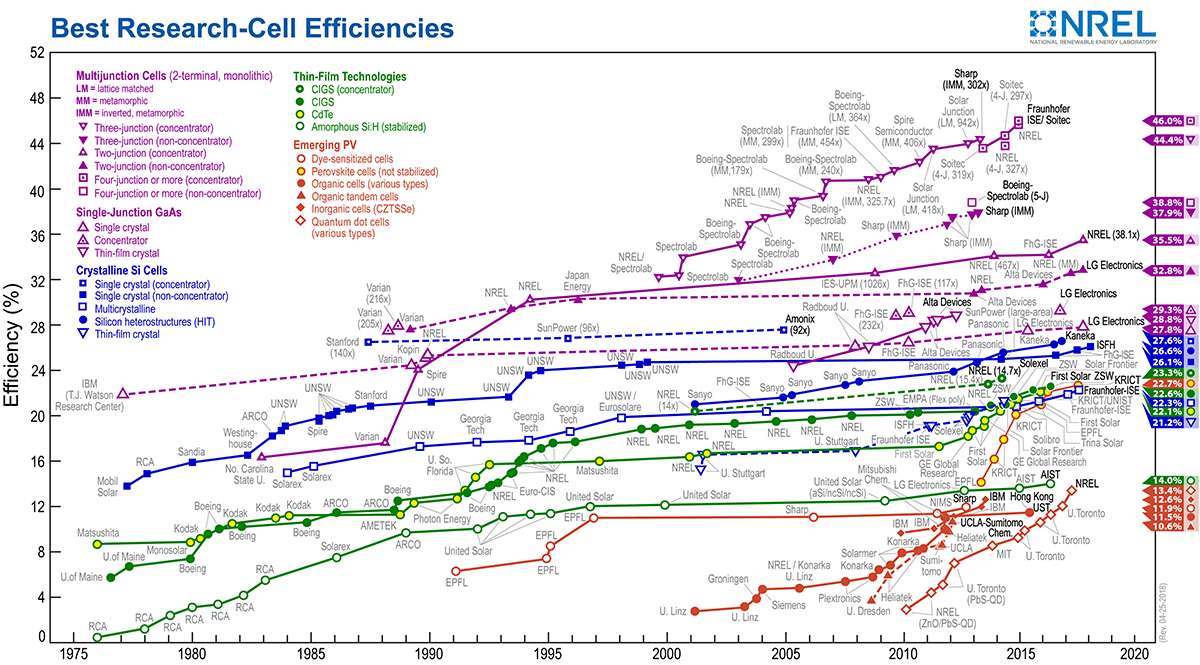
An anonymous reader quotes a report from Ars Technica: The silicon-based cells that make up a solar panel have a theoretical efficiency limit of 29 percent, but so far that number has proven elusive. Practical efficiency rates in the low-20-percent range have been considered very good for commercial solar panels. But researchers with Japanese chemical manufacturer Kaneka Corporation have built a solar cell with a photo conversion rate of 26.3 percent, breaking the previous record of 25.6 percent. Although it's just a 2.7 percent increase in efficiency, improvements in commercially viable solar cell technology are increasingly hard-won. Not only that, but the researchers noted in their paper that after they submitted their article to Nature Energy, they were able to further optimize their solar cell to achieve 26.6 percent efficiency. That result has been recognized by the National Renewable Energy Lab (NREL). In the Nature Energy paper, the researchers described building a 180.4 cm2 cell using high-quality thin-film heterojunction (HJ) -- that is, layering silicon within the cell to minimize band gaps where electron states can't exist. Controlling heterojunctions is a known technique among solar cell builders -- Panasonic uses it and will likely incorporate it into cells built for Tesla at the Solar City plant in Buffalo, and Kaneka has its own proprietary heterojunction techniques. For this record-breaking solar cell, the Kaneka researchers also placed low-resistance electrodes toward the rear of the cell, which maximized the number of photons that collected inside the cell from the front. And, as is common on many solar cells, they coated the front of the cell with a layer of amorphous silicon and an anti-reflective layer to protect the cell's components and collect photons more efficiently.
133 comments

  1. Can you by Anonymous Coward · · Score: 0

    DRM it?

  2. Re:Subtraction... by newcastlejon · · Score: 5, Informative

    "26.3 percent, breaking the previous record of 25.6 percent. Although it's just a 2.7 percent increase"
    Uh, what? Someone flunked elementary school math.

    25.6 * 1.027 = 26.29

    Lots of people flunk elementary maths... apparently.

    --
    If God forks the Universe every time you roll a die, he'd better have a damned good memory.
  3. Thin-film Heterojunction by Anonymous Coward · · Score: 0

    Thin-film heterojunction? Is that like latex fetish?

    1. Re:Thin-film Heterojunction by Anonymous Coward · · Score: 1

      First they tried thin-film homojunction, but they couldn't get it to replicate.

  4. Re:Subtraction... by Anonymous Coward · · Score: 0

    26.3/25.6 is ~1.027 i.e. a 2.7% increase. Could've been less-confusingly worded though.

  5. Cost and Toxicity by Anonymous Coward · · Score: 0, Insightful

    The only reasonable improvements are in reducing the cost of manufacturing and reducing the amazingly toxic byproducts of solar cell production.

    1. Re:Cost and Toxicity by fahrbot-bot · · Score: 1

      The only reasonable improvements are in reducing the cost of manufacturing and reducing the amazingly toxic byproducts of solar cell production.

      And, of course, making them Godzilla proof.

      --
      It must have been something you assimilated. . . .
    2. Re:Cost and Toxicity by Anonymous Coward · · Score: 0

      I'm glad you raised the point about amazingly toxic byproducts of solar cell production. After all, it's a completely new phenomenon with energy production. Nuclear, coal and oil are just three examples of energy production that have not a single toxic byproduct associated with them. Which is why you are warmly invited to go stick your head in a spent nuclear fuel pool.

  6. Re:Subtraction... by Anonymous Coward · · Score: 0

    Yeah lots do ... let maths buttfuck them ... but not him , speaking in a casual context.

  7. Re:Efficiency is useless. by rtb61 · · Score: 4, Insightful

    Cost is not everything, that is pretty dumb economic thinking. Cost efficiency is everything, the return on capital investment. With branded solar energy systems, retained capital investment is as important as energy generated. Want it the price of a home with a top quality solar energy system versus a home without one. What premium can you start to charge on a home where the supply charge for electricity is higher than the cost of actual supply of electricity, a house that is basically black out proof. Where energy running cost for a car heads to zero.

    So in mid level housing density, how close to an effective solar energy system for a two story town house, where a premium is paid, due to limited are for panels. It makes no sense with solar panels to have them anywhere else but as close as practicable to the point of demand, screw the insensate greed of the energy companies. Doing away with the electrical grid all together in suburban low density housing would be a major victory for the majority, screw the energy companies, they can pretty much choke on their own gas (tee hee).

    --
    Chaos - everything, everywhere, everywhen
  8. Re:Efficiency is useless. by Dracolytch · · Score: 3, Insightful

    Over time, though, the cost almost always comes down unless there's a reliance on highly valuable raw materials (such as gold).

    --
    This sig has been enciphered with a one-time pad. It could say almost anything.
  9. Re:Subtraction... by pem · · Score: 1, Funny
    Yeah, you're butt-hurt because you didn't do the word problem right originally, but that's no reason to keep spouting nonsense.

    Keeping the same number of significant digits in the lower and higher efficiencies, a 3 percent increase from 25.6 would round to 26.4, and a 2 percent increase from 25.6 would round to 26.1.

    This means that to describe a percentage increase that properly rounds to 26.3, you need one more digit, and once you decide to add the extra digit, you want to make it as accurate as possible. The 2.7 percent given in the article rounds to 26.3, as accurately as possible.

  10. Re:Subtraction... by Nemyst · · Score: 2, Informative

    26.29 rounds to 26, not 27.

    Nobody mentioned 27 though. 2.7 isn't 27.

    And, although the wording clearly implies an absolute relationship, the correct relative formula would be 26.3/25.6=1.03 when significant digits are accommodated (which would be a 3% relative increase).

    You're making the assumption that 26.3 and 25.6 are given with the full number of significant digits (which may not be the case), or that significant digits actually matter in a percentage figure (not an actual measurement) in popular scientific journalism. Get over yourself.

    Well, at least you're in good company.

    Someone's really salty to be shown wrong, eh?

  11. Misleading and false by stratzvyda · · Score: 1, Informative

    This is only single cell solar cells, multi-junction cells have breached 46%. https://www.ise.fraunhofer.de/... At this point increases in efficiency are mostly masturbation, relying on complex materials/techniques that aren't worth the cost. The big transformation will occur when they get thin film solar cells that are more efficient so you can have solar cells without making ridiculous amounts of toxic waste.

    1. Re:Misleading and false by Seequeue · · Score: 5, Informative

      There is a good graph on Wikipedia regarding research cell efficiency over time, and comparing all of the technologies at https://en.wikipedia.org/wiki/...

    2. Re:Misleading and false by angel'o'sphere · · Score: 4, Informative

      have solar cells without making ridiculous amounts of toxic waste.
      Production of solar cells does not produce "ridiculous amounts of toxic waste" ... no idea where this myth is coming from.

      BTW: traditional PV cells are produced in the same way as computer chips, CPUs, memory, and SSDs.

      --
      Cost free eBook I read (by iBook/Kobo/Amazon/ObookO/Gutenberg etc.): "The Green Odyssey" by Philip Jose Farmer.
    3. Re:Misleading and false by vinlud · · Score: 1

      This is laboratory stage, the hunt for better efficiency is still very useful. Other teams / companies work on industrialization of the newly found processes from a laboratory to create these things for a reasonable price. This is how science has worked for over 100 years now

      --
      Repeat after me: We are all individuals
    4. Re:Misleading and false by TheRaven64 · · Score: 1

      Exactly. It's interesting research, but it hits diminishing returns very quickly. Cheap solar panels have gone from 8% to 16% efficiency in a few years. That's a huge win, because you get double the power output for the same investment. Getting up to 32% for the same cost will be a similar win, but that's a long way away.

      --
      I am TheRaven on Soylent News
    5. Re:Misleading and false by K.+S.+Kyosuke · · Score: 1

      The vast majority of solar cells produced (which is crystalline silicon cells) use no rare earths whatsoever. Go the fuck back to school yourself.

      --
      Ezekiel 23:20
    6. Re:Misleading and false by edtice1559 · · Score: 1

      Manufacturing computer chips is an industry that looks clean (fancy, spotless manufacturing facilities), but is actually very dirty.

    7. Re:Misleading and false by Anonymous Coward · · Score: 0

      have solar cells without making ridiculous amounts of toxic waste.
      Production of solar cells does not produce "ridiculous amounts of toxic waste" ... no idea where this myth is coming from.

      BTW: traditional PV cells are produced in the same way as computer chips, CPUs, memory, and SSDs.

      The myth is coming from the propaganda wings of the oil, gas, and coal companies and their pet politicians. Not that there's a conflict of interest there or anything.

      And it's spread profusely by unwashed masses who are willing to parrot the line in the futile hope that the 1% will reward them for it. But it goes against the tenets of Conservatism to give money to poor people, so they're out of luck.

      That's why you should parrot the Liberal line instead. George Soros is at least willing to pay shills, they say.

    8. Re:Misleading and false by GameboyRMH · · Score: 1

      It's a standard, procedurally-generated right-wing parroting point that executes in any discussion about $NEW_GREEN_TECH:

      "$NEW_GREEN_TECH generates an incredible amount of toxic waste to produce, even more than $OLD_FOSSIL_TECH!"

      Veracity is not a factor in the algorithm, the statement is simply generated and echoed. It's interesting how right-wingers suddenly become concerned (if fact-deprived) environmentalists AND income-egalitarians ("The CEO of $NEW_GREEN_TECH company is going to get rich off the backs of the working class!" they scream, as if tax code & labor policy problems are the fault of environmental policy) as soon as fossil energy is threatened.

      --
      "When information is power, privacy is freedom" - Jah-Wren Ryel
    9. Re:Misleading and false by Anonymous Coward · · Score: 0

      Even then, it costs more energy to fab the silicon, build the frames, etc. than the panel will ever obtain in its 20 year service life.

    10. Re:Misleading and false by K.+S.+Kyosuke · · Score: 1

      No, actually, the energy is recouped in less than two years. Probably quite a bit less now.

      --
      Ezekiel 23:20
    11. Re:Misleading and false by Anonymous Coward · · Score: 0

      http://www.bbc.com/future/stor...

      That is where it is coming from. China has basically been strip mining huge areas and creating huge slurry lakes to hold this stuff. You do not see it much here because we outsourced the pollution.

    12. Re:Misleading and false by T.E.D. · · Score: 1

      Perhaps, but the ultimate ancestor in this thread was referring to "multi-junction cells have breached 46%", which tend to made of things like Indium Gallium Phosphide, Gallium Arsenide, Germanium, and Indium Gallium Arsenide.

      I believe the point was that that we know how to make them far more efficient than 26%, if we really want to. It just tends to require making them of relatively exotic things that probably aren't worth the trouble.

    13. Re:Misleading and false by Anonymous Coward · · Score: 1

      And, as someone else mentioned in this thread, the ecological disaster discussed in the BBC article is due to the mining of rare earth metals. None of which are used in modern solar panels.

    14. Re:Misleading and false by Anonymous Coward · · Score: 0

      Nope, it's a fact that's deliberately ignored. The left greenwashes solar cell production by ignoring the silicon production and hazmat disposal. From that perspective, it's very clean; the nice white tank full of toxins leaves the nice clean facility and magically disappears.

    15. Re:Misleading and false by GameboyRMH · · Score: 1

      Most of the waste can indeed be recycled:

      http://spectrum.ieee.org/green...

      Meanwhile, coal power plants spew radioactive waste from smokestacks, the ground is pumped full of earthquake-enabling mystery sauce for hydrofracking, and oil refineries guzzle energy to transform fossil fuels from one form to another before they're even used, all while literally causing floods of toxic waste, and nobody on the right bats an eye at those environmental disasters that happen in the process of releasing fossil CO2. They have much bigger problems to worry about - an environmentally unremarkable electronics manufacturing industry that's giving us devices that produce carbon-neutral energy.

      --
      "When information is power, privacy is freedom" - Jah-Wren Ryel
    16. Re:Misleading and false by MattskEE · · Score: 1

      This is the record efficiency obtained for a SILICON solar cell, and while the title may be slightly misleading by not clarifying the summary and articles are discussing Silicon cells. This is absolutely a record, and it is of great interest and importance since such a cell would be expected to give a lower cost per watt than multijunction cells.

    17. Re:Misleading and false by angel'o'sphere · · Score: 1

      It is actually not very dirty, as your country and mine has regulations preventing factories to spill dirt/waste into the environment.

      And: there are no real toxic products involved in making chips or PV panels anyway.

      --
      Cost free eBook I read (by iBook/Kobo/Amazon/ObookO/Gutenberg etc.): "The Green Odyssey" by Philip Jose Farmer.
    18. Re:Misleading and false by DanielRavenNest · · Score: 1

      The easiest way to get up around 32% efficiency is to stop using semiconductors and use concentrated sunlight to drive a turbine instead. Glass mirrors are fairly cheap per square meter.

      Solar concentrators don't work for residential solar, because of the need to track the Sun. But utility-scale solar panel farms beat residential by 2.5x on cost anyway. The panels cost the same in both cases, but all the other costs are much lower for a solar farm when you install them at ground level by the hundred thousand, than on a home rooftop by the dozen. Rooftop solar is nice to have, but not really cost-effective.

    19. Re:Misleading and false by edtice1559 · · Score: 1
    20. Re:Misleading and false by ooloorie · · Score: 1

      Based on a meta-analysis, current PV systems have energy payback times of about 3-4 years. But that's unlikely to be accurate. Subsidized payback periods for PV systems are about 7 years, and unsubsidized payback periods are about 15 years, and both PV and non-PV costs are dominated by energy inputs.

  12. My panels are 12% efficient... by Anonymous Coward · · Score: 0

    and I have all of my roof covered that gets direct sunlight, and they still aren't powerful enough to produce enough power even in the summer to overcome the self-discharge of my SLA batteries. Here in Seattle in the winter, I might as well not even have the panels. 26% efficient would be strong enough to keep me from having to plug a charger into the wall to charge my batteries for maybe six months a year. Hopefully this will reach consumers soon.

    1. Re: My panels are 12% efficient... by Anonymous Coward · · Score: 0

      I spent over $15k on panels and it sucks they don't even put out enough power most of the year to keep the batteries from draining themselves.

    2. Re:My panels are 12% efficient... by thinkwaitfast · · Score: 1

      Seattle gets about 3.7 hours per day average insolation. It doesn't make sense to put them there until you run out of space in AZ and California. Your roi is 2x higher in those places. Worse than that, it doesn't provide energy in the winter when it's needed most. I have a house there and my summer electric bill is next to nothing.

      http://rredc.nrel.gov/solar/ol...

    3. Re:My panels are 12% efficient... by Dutch+Gun · · Score: 2

      and I have all of my roof covered that gets direct sunlight, and they still aren't powerful enough to produce enough power even in the summer to overcome the self-discharge of my SLA batteries. Here in Seattle in the winter, I might as well not even have the panels. 26% efficient would be strong enough to keep me from having to plug a charger into the wall to charge my batteries for maybe six months a year. Hopefully this will reach consumers soon.

      The state of WA is almost entirely powered by hydro-electric. We already have reasonably cheap, green power right off the grid here. And you weren't satisfied with buying solar panels just once, but are interested in purchasing a second set because the first ones were so worthless.

      I'm apparently missing something.

      --
      Irony: Agile development has too much intertia to be abandoned now.
    4. Re: My panels are 12% efficient... by Anonymous Coward · · Score: 0

      Why not change to lifepo4 batteries which are around 94% charge effecient. It'd be similar to having more effecient solar panels. And with optimised charge parameters/cut off voltages would see then last 20-30 years.

    5. Re:My panels are 12% efficient... by ctilsie242 · · Score: 1

      I've found that the charger you are using makes a difference. If it is a PWM charger that cuts the voltage down to whatever the batteries take, you can lose 25-50% of the incoming wattage. For example (and note, these figures vary widely in real life since batteries require different voltages in different charging stages), a 24 volt panel feeding a PWM charger that is using a 12 volt battery, the PWM charger will not use 12 volts of the 24 coming in. However, a MPPT controller will reduce the voltage and double the amperage.

      The difference is quite noticeable when it comes to smaller applications.

  13. Re:Subtraction... by newcastlejon · · Score: 2

    26.29 rounds to 26, not 27. And, although the wording clearly implies an absolute relationship, the correct relative formula would be 26.3/25.6=1.03 when significant digits are accommodated (which would be a 3% relative increase).

    26.3 (the previous record), multiplied by 1.027 (or 102.7%, or increasing by 2.7%) equals 26.29, which rounds to 26.3 (the new record).
    That's not elementary maths, I grant you, but I'm sure you would have spotted it if you weren't so eager for the FP.

    --
    If God forks the Universe every time you roll a die, he'd better have a damned good memory.
  14. OK, cool... by Bartles · · Score: 2, Insightful

    ...but solar cell efficiency only really matters when space is limited.

    1. Re:OK, cool... by amiga3D · · Score: 3, Informative

      The only thing holding me back now isn't efficiency, it's the cost of batteries. That's the real cost issue.

    2. Re:OK, cool... by Socguy · · Score: 2

      Not necessarily. More efficient cells mean that you can get away with fewer, lowing your costs to install.

    3. Re:OK, cool... by msauve · · Score: 1

      Your unstated and unsupported assumption is that the installed cost per watt is the same for cells of increased efficiency..

      --
      "National Security is the chief cause of national insecurity." - Celine's First Law
    4. Re:OK, cool... by Anonymous Coward · · Score: 0

      Good 2.7% closer to a phone that charges itself.

    5. Re:OK, cool... by thinkwaitfast · · Score: 1

      can you show this mathematically?

    6. Re:OK, cool... by vinlud · · Score: 1

      For a lot of applications of solar space is an very relevant factor

      --
      Repeat after me: We are all individuals
    7. Re:OK, cool... by K.+S.+Kyosuke · · Score: 1

      Except that as you're going towards higher efficiencies, the price tag of the cells on the market rises more quickly than how their number in your fixed-power system decreases.

      --
      Ezekiel 23:20
    8. Re:OK, cool... by bluefoxlucid · · Score: 1

      Shipping the cells requires more energy because they're larger and heavier. It requires more shipping hardware and energy infrastructure maintenance. It requires more handling to install them, wire them, and keep them free of the energy-robbing layer of dust. Manufacturing costs increase for an array with the same output, so decay from oxidization, delamination, imbalanced arrays and overvoltage, or plain old damage costs more--as does the shipping and handling, again.

      If I could get a single 2 meter by 1 meter panel that output 6kW, I could have that slapped up on my roof for $500, and have a cheap $450 string inverter installed for $1,000. As it stands, I can get a 6kW array with a $1,800 power-optimizing inverter (required only for multiple-panel installations) for $5,800; I can also pay about $5,000 for the full installation labor, plus a good $400-$600 to ship the material in the first place.

    9. Re:OK, cool... by bluefoxlucid · · Score: 1

      Panels of the same form factor with higher-efficiency cells install in exactly the same way. 255W panels install the same way as 180W panels and 355W panels (all of the same size). They rack up onto the same hardware.

      Oddly enough, the cost of micro-inverters for panels above 255W increases; and modern power-optimizing inverters actually cost the same, but fail less-often and provide more-efficient power regulation. The installation for string inverters, micro-inverters, and power-optimizing inverters is roughly the same: connect each cell to the next, then run a home-run wire to each end of the array. String inverters plug a wire into each end; micro-inverters and power-optimizers plug in the same wire connector, but with a little box dangling off.

      The three options have some rough differences.

      String Inverters are cheap. You might pay $500 for a 5kW array. The array feeds each solar panel into the next, and so an underperforming module drags the entire array down and strains other panels: shade on one cell can cut your entire array's efficiency by 50%.

      Micro-inverters are more-expensive. You might pay $1,200 for a 5kW array. The array plugs each solar module into the next through a micro-inverter, which really converts the panel's 600VDC into 3-wire 240VAC. This gives you a 3-wire service feed. Micro-inverters have a relatively-high failure rate.

      Power optimizers cost about what micro-inverters cost. You might pay $1,300 for a 5kW array. They wire in the same way as micro-inverters, but pass 600VDC down to what amounts to a string inverter. The power optimizers themselves function similar to a modern lithium cell battery management system, drawing more power from higher-output panels and less from lower-output panels without letting the panels interact and stress each other. Power optimizers are simpler than micro-inverters, dissipate less heat, and thus have less loss and a lower failure rate.

      So the physical aspect of installing any solar array is the same. If you use high-efficiency cells, nothing changes. If you use high-output panels--larger panels or similarly-sized panels with high-efficiency cells--you have to use either a cheap string inverter or a power optimizer. Micro-inverters are probably the worst choice in any installation: for a single-panel or small area, you should use a string inverter; for multi-panel, use power optimizers.

    10. Re:OK, cool... by enrique556 · · Score: 1

      And while the cost per watt of the panels goes down (and from that the cost of shipping & installation), the cost of the inverter & other electrical wiring stays relatively fixed. It's way behind the panels & batteries but it is in the thousands of dollars per installation.

    11. Re:OK, cool... by PhoenixFlare · · Score: 1

      Yeah, this is pretty much the only reason I haven't set my house up with solar already.

      Hoping that by the time we have to replace our roof, it'll be relatively cheap enough to include in the cost though.

    12. Re:OK, cool... by Anonymous Coward · · Score: 0

      .. Which are getting cheaper at an astonishing rate. Many are predicting 100-125$/kwh by 2020. Back in 2008 it was 1300.

      FYI the auto industry's wet-dream-petrol-engines-are-obsolete threshold for battery prices is $150/kwh

    13. Re:OK, cool... by Barsteward · · Score: 1

      if you are going to replace your roof, then have a look at this. https://techcrunch.com/2016/10... be cheaper than a new roof plus solar, its allegedly almost the same as just a new roof (depending on what you use)

      --
      "The hands that help are better far than lips that pray." - Robert Ingersoll (1833-1899)
    14. Re:OK, cool... by Anonymous Coward · · Score: 0

      Look up saltwater batteries.; They aren't cheap but they seem to offer more than lead-acid.

    15. Re:OK, cool... by amiga3D · · Score: 1

      So far the consensus of what I've read says for the long haul industrial lead acid are the best for the money. I looked at some, they had some running about 400 pounds each. Thousands of dollars but long lasting and durable. Properly cared for easily good for a decade.

    16. Re:OK, cool... by Bartles · · Score: 1

      It is impossible for a 2 square meter to output 6kW anywhere in the world. Even if you had a perfect solar cell that converts all forms of solar radiation to electicity at 100% efficiency you are limited to 1.361kW per square meter. You just can't make more sunlight.

    17. Re:OK, cool... by bluefoxlucid · · Score: 1

      That wasn't the point. The cost differences in shipping and installation are because the panels are of various sizes and weights; if I could get an impossible device that's a cubic centimeter, 3 grams, and generates 500GW of power, I could ship it via 32 cents of postage and install it in a few minutes of labor. Do you know how much it costs just to ship the concrete to build the nuclear containment building for a reactor?

      Moving material around requires time. Mining large amounts of material requires time. You're going to expend more to install and maintain a big, 1%-efficient array than a small, 24%-efficient array.

  15. Re:Subtraction... by PopeRatzo · · Score: 2

    25.6 * 1.027 = 26.29

    Nobody said there would be math in this comments section.

    Next time, could we get some kind of warning?

    --
    You are welcome on my lawn.
  16. Re:Efficiency is useless. by Anonymous Coward · · Score: 0

    Hey genius, you just agreed with the person you're arguing with. At least in the first part of your post.

    For the second part I had to wrap my head in tin foil to truly get on the same wavelength with you. Omg! The evil energy companies! Those highly regulated monopolies that are essentially government agencies!!!!111 eeeeeep!!!

    Idiot.

  17. ..and you can bring back leaded gas too!!!! by Dutchmaan · · Score: 1

    Don't you worry folks... we got your coal jobs right here!!! that thar sciency mumbo jumbo is fer them Hollywood E-leetists... you won't catch me usin' no soLAR sells.... commie contraptions iffn' ya ask me!!!!

  18. Re: Subtraction... by Anonymous Coward · · Score: 0

    Math blows, like your mom.

    Can we get back to serious discussion now and stop being fucking retarded internet pedants? kthx.

  19. Re:Subtraction... by fahrbot-bot · · Score: 2

    "26.3 percent, breaking the previous record of 25.6 percent. Although it's just a 2.7 percent increase" Uh, what? Someone flunked elementary school math.

    25.6 * 1.027 = 26.29

    Lots of people flunk elementary maths... apparently.

    It's from Japan; their numbers are in metric - duh.

    --
    It must have been something you assimilated. . . .
  20. Suck it Trebeck by thinkwaitfast · · Score: 1

    My solar panels are 14% efficient and cost 11 cents per watt.

  21. Re: Subtraction... by Anonymous Coward · · Score: 0

    Math blows, like your mom.

    Can we get back to serious discussion now and stop being fucking retarded internet pedants? kthx.

    Do you even know where you are?

  22. Modern consumer solar by nightfire-unique · · Score: 2

    Modern consumer solar is breathtakingly amazing.

    We forget how bad things were just 15-20 years ago.

    Earlier today, I set up a folding panel with sunpower cells; it was literally vertical, in a window, facing South. Total surface area.. maybe 3sqft, weighing 1lb. It was making ~20W for 4 hours, and managed to completely recharge my 130Wh battery pack in 8. Through a window. In the winter, in Canada.

    The thing cost $120.

    It's easy to get lost in the constant claims of breakthroughs while forgetting what an amazing time we live in. 20 years ago, this panel would have blocked out the sun and cost a months' salary.

    --
    A government is a body of people notably ungoverned - AC
    1. Re: Modern consumer solar by Anonymous Coward · · Score: 0

      Care to share brand and model?

    2. Re:Modern consumer solar by ledow · · Score: 1, Interesting

      Good for you.

      The solar roof installed on my workplace (a large school) costs tens of thousands and won't pay for itself in 20 years.

      It isn't even warrantied for that long.

      It very much depends on where you are, not whether your panel is vertical or not (sure, it's BETTER to be vertical, but if you don't have enough sun in the first place, it makes virtually no difference).

      We even have one of those "this is how much energy you're generating, CO2 you've saved" screens inside the building it's on. It's currently generating.... 45W. I could run a small incandescent bulb from it. Before losses.

      Fortunately, we don't try and push that into battery storage or anything, because it's just not worth it. I was once asked if we could show the stat to parents on the website. Ironically, the servers, network switches, etc. in use to display that stat on the school webpages would use something like 10 times more power than it would be generating, just to do so.

    3. Re:Modern consumer solar by shilly · · Score: 1

      How on *earth* did your school manage to install a large panel costing tens of thousands that can generate as little as 45W??? Can you provide more details? Cos this sounds pretty dubious. What time of day? How old is the installation? What was its rated generative capacity? Where is the school?

      I mean, a typical home installation generates 3kW, and costs well under 10k.

    4. Re:Modern consumer solar by angel'o'sphere · · Score: 2

      The solar roof installed on my workplace (a large school) costs tens of thousands and won't pay for itself in 20 years.
      Then the school got ripped of, it should pay itself in about 3 years.

      It isn't even warrantied for that long.
      Then you life in the wrong country and should demand better laws. In Europe such installations have a warranty of 20 - 30 years: by law.

      --
      Cost free eBook I read (by iBook/Kobo/Amazon/ObookO/Gutenberg etc.): "The Green Odyssey" by Philip Jose Farmer.
    5. Re:Modern consumer solar by Anonymous Coward · · Score: 0

      You are just wrong, it's broken, you're not telling the whole story, or all three.

    6. Re:Modern consumer solar by MatthiasF · · Score: 4, Interesting

      They didn't. He's either lying or doesn't realize it's generating in kilowatts.

    7. Re: Modern consumer solar by Anonymous Coward · · Score: 0

      Moleville? Atlantis? Coal mine?

      Sounds like this guy might have just realized how incompetent he is and/or the people around him.

    8. Re:Modern consumer solar by Hodr · · Score: 1

      He sure as shit isn't generating 45kw for "tens of thousands"

    9. Re:Modern consumer solar by WheezyJoe · · Score: 1

      > install a large panel costing tens of thousands that can generate as little as 45W???

      He forgot to mention that it's night, and the only light is coming from the full moon and a street lamp in the parking lot.

      The real problem is: 'one of those "this is how much energy you're generating, CO2 you've saved" screens'. Some people just get hopelessly irritated by stuff like that. These panels could be great, making free power, steak dinners, good jobs, curing erectile dysfunction and shitting out Tiffany cufflinks, but if there's a cartoon display of happy trees, spotted owls, and a smiley-face sun, some folks feel a moral duty to hate it.

      --
      Take it easy, Charlie, I've got an Angle...
    10. Re:Modern consumer solar by ledow · · Score: 1

      Sigh.

      This is the FOURTH school I've worked at that has the same problem. The others I've worked at have deliberately refused solar installs after doing the sums.

      In certain places, solar is just POINTLESS.

      I'm in the UK, a major developed country the same latitude as other huge centres of population the world over. (Please don't say "Ah, yes, in the UK you won't get...." - this is exactly my point, solar is not a panacea).

      And it's currently reading... ZIP. Literally I have to interpret the decimal points, so it's less than 100W. It's 1pm, it's got cloud cover but not raining, etc. and is daylight enough that you don't need a bulb in the office. We're in the middle of 28 acres of farmland (which tells you just what kind of school we're talking about here).

      It's a school so it's electrically checked annually. They are paying for support, so it's verified to be working . It's cleaned every term. It's on a feed-in tariff and they are pushing their green credentials to parents, so they have an interest in seeing it work. I've seen it read nearly a KW, in the Summer, in direct sunlight, on scorching hot days, if you're lucky.

      It's on an unobstructed roof, faces South, no trees or other cover.

      It's 10KWp. It's about five years old (please don't say "Oh, you need to replace it to get the new.... what's the point if every five years you have to replace a system that takes 20+ to pay itself off?).

      In over five years, it's generated 24408 KWh. That's everything, total, complete.

      We are not alone. Selling solar to schools is a known con for bursars in the UK. The suppliers do exactly what they promise (and they never promise a minimum), the kit does what it can (and the kit is all third-party so you can verify others do get the maximums). It gets installed properly and schools that have it ALL complain how little it actually does, no matter what company, panel, etc. they use.

      Honestly, fourth school I've had this at, all of them the ONLY schools to actually have solar.

    11. Re:Modern consumer solar by ctilsie242 · · Score: 1

      The ironic thing is that both the preppers I know and the hippies both actually like photo-voltaic technology. One camp likes it because it is off grid and frees them from being dependent on a central electricity system. Another camp likes it because it is not throwing pollution into the air. Plus, it is pretty foolproof. You can get electrocuted or have a panel fall on your head... but for the most part, setup is idiot resistant, especially compared to almost any other power generation out there. Plus, once set up, it requires little upkeep other than battery watering (if lead-acid or NiFe.)

      Solar power has almost zero downsides. The only thing is requires is energy storage technology, and that eventually will get there, especially with China and other countries looking into this.

    12. Re: Modern consumer solar by nightfire-unique · · Score: 1

      It's just some random off-brand from eBay I bought two years ago, but I've had really good luck with most of the modern panels with sunpower cells.

      No reviews on it, but it looks identical to this one:

      39W folding sunpower panel

      Plugged into the PowerAdd version of this power bank:

      32,000mAh power bank

      ... via a cheap "MPPT" controller (non-automatic) floating the panel at 17V.

      --
      A government is a body of people notably ungoverned - AC
    13. Re:Modern consumer solar by Anonymous Coward · · Score: 0

      >...and won't pay for itself in 20 years...

      It's not that the panels are expensive & inefficient at your latitude. It's that your school is now 'Servicing A Loan' which of course is very different from purchasing a product outright.

      And servicing a loan = your school was over charged. Believe me after marketing/sales, permits, installation, loan amortization, and a variety of other add-ons the product will be overpriced. It's literally based on a twenty year payback of the client's ability... not the actual value of the panels (which are great).

    14. Re: Modern consumer solar by Anonymous Coward · · Score: 0

      Well, I applaud your regular-Joe & apparent non-shill post :)

    15. Re:Modern consumer solar by nightfire-unique · · Score: 1

      Someone fucked up.

      A correctly installed 10kW solar array at that latitude should peak at around 7kW. If you're seeing less than one, then someone fucked up the wiring, or most of the panels are defective. Fire whoever's responsible, and sue the company until they fix it.

      --
      A government is a body of people notably ungoverned - AC
    16. Re:Modern consumer solar by Barsteward · · Score: 1

      maybe installed back to front

      --
      "The hands that help are better far than lips that pray." - Robert Ingersoll (1833-1899)
    17. Re:Modern consumer solar by nightfire-unique · · Score: 1

      Don't let that experience sour you on PV solar. What you're seeing has nothing to do with the technology itself; solar works extremely well, even at high latitudes, when installed correctly. Ask any sailor, NASA engineer, or grid energy systems expert.

      If you're seeing 45W during the day on a $10k+ array, sue the installer because it's malfunctioning.

      BTW - You don't want vertical panels except at the poles (or temporarily when mounted on a heliostat).

      --
      A government is a body of people notably ungoverned - AC
    18. Re:Modern consumer solar by nightfire-unique · · Score: 1

      Hey .. $90k is still "tens of thousands" and would just about do it.. :)

      --
      A government is a body of people notably ungoverned - AC
    19. Re:Modern consumer solar by Anonymous Coward · · Score: 0

      Wait.... You have a 5 year old 10KW system (~cost 20,000#), and it has displaced ~$6000# in electricity costs ( 24408 KWh at 12p generation and 12p delivery = 5857.92# ).

      Panels are guaranteed for 25 years
      Inverters guaranteed for 20
      System pays for itself in 17 years
      Remaining 3 years on the inverters are pure 'profit'
      Remaining 8 years on the panels are pure 'profit'

      So finished numbers this is assuming that the cost of power neither goes up nor down during the next 20 years, and currency inflation does not exist (which is decidedly in the favor of not putting up solar panels).

      Going from the solar panels that's 9,600# 'profit', and you still have a solar system that may continue to produce, or it may break the day the warranty ends, you have contributed significantly to the power grid during peak periods, and you have a clearer line to future solar upgrades.
      If that same 20,000 had been invested at a consistent market appreciation rate of 2% and , it would generate 12,812 (assuming no market crashes).

      So- the solar panels are doing a great job as a safe but slightly low return infrastructure investment over time, with a nod towards environmentalism, and your complaining because?

    20. Re:Modern consumer solar by Anonymous Coward · · Score: 0

      I'm in the UK, a major developed country the same latitude as other huge centres of population the world over.

      You know, people might be more willing to take you seriously if you didn't lead with an obvious falsehood.

      The UK is actually at a much higher latitude than most of the world's population. In fact, outside of northern Europe, there are no "huge centres of population" that far north (or comparatively, that far south in the Southern Hemisphere). So much for "the world over". Except for part of Alaska, all of the United States is further south. All of the major cities in Canada are further south. All of the major cities in Asia are further south. Entire continents (Africa, Australia) are closer to the equator than the UK is. Even in South America, whose southern tip does extend to such latitude extremes, there are no major population centers that far off the equator. So sorry, the UK is an extreme case. The vast majority of the world's population lives at lower latitudes.

      Not that this really matters though. As other posters have pointed out, even at those latitudes you should be getting much better returns than you've reported seeing.

    21. Re:Modern consumer solar by Anonymous Coward · · Score: 0

      What about 4.5kw?

    22. Re:Modern consumer solar by MatthiasF · · Score: 1

      Price of solar is about $3 a kilowatt/hour. So, a 45kw system would cost roughly $135k before subsidies.

      It looks like he lives in the United Kingdom, which has subsidies at install and for production that could have cut the costs down below $100k om 2015 or 2016.

      Also, there's no telling if any of his numbers are remotely accurate either considering his position on the matter.

    23. Re:Modern consumer solar by shilly · · Score: 1

      FFS, mate. I live in the UK too. Your figures seem ridiculous -- your school has been had. Here in Norf London, there are hundreds of houses with solar fitted that's charging Teslas. Couldn't do that if the conversions were as poor as you assert for your school. And there is no way that at 1pm on a cloudy day a 10kW system in the UK should be generating zero. That is mad.

    24. Re:Modern consumer solar by stoatwblr · · Score: 1

      "Solar power has almost zero downsides."

      Apart from the massive amounts of nasty environmental waste being produced in China (where most come from) that's threatening the potable water of a few tens of millions of people downstream.

      Hydroflouric acid in particular is something you don't want in your waterways.

      In northern latitudes, you'd be better off thinking about solar heat panels and suchlike to offset your energy costs, but solar PV is generally a waste of space unless you're off-grid and away-from-grid (in many cases the cost of solar is a lot more than the cost of a grid connection), or using it for low energy-density applications (I'm pretty sure that even those solar-panel equipped streetlights will need topups in winter months if used in the UK)

    25. Re:Modern consumer solar by stoatwblr · · Score: 1

      The reason I suggest solar heat panels is because they're cheap to manufacture and maintain, making the 5-10% potential heating costs saving worthwhile aiming for.

      If you wanted to get really whizzy you could store solar heat in the ground in summer and extract in winter but that's a massive complexity boost with long payoff period. On the other hand schools tend to have large open fields where the pipework for such systems can be laid relatively easily and deeply.

  23. Re:Subtraction... by TheInternetGuy · · Score: 1

    "26.3 percent, breaking the previous record of 25.6 percent. Although it's just a 2.7 percent increase" Uh, what? Someone flunked elementary school math.

    26.29/25.6=1.026953125 ,rounded to 3 decimals 1.027 , which makes it a 2.7 percent increase. How man decimals do they need to use not to flunk math would you say?

    --
    If my comment didn't sound as good in your head as it did in mine, then I guess we all know who's to blame
  24. Re:Efficiency is useless. by thinkwaitfast · · Score: 0

    I don't know anything about politics, but this level of ignorance is quite prevalent. The really sad thing is is that it's mostly arithmetic, you don't even need to know algebra to do the analysis.

  25. Re:Subtraction... by Maxo-Texas · · Score: 1

    The language is actually ambiguous.

    It can legitimately be read as

    25.6%+2.7%=28.3% (huh?).

    or

    25.6%+ (25.6%*2.7%)=26.29% (hooray)

    or even

    25.6%*1.027=26.29% (hooray)

    --
    She was like chocolate when she drank... semi-sweet at first and then increasingly bitter.
  26. Re:Subtraction... by sexconker · · Score: 0

    Significant digits (figures)? Fuck that shit - everyone does it incorrectly, and it's fucking retarded when done "correctly". Seriously, why the FUCK would you consider a reading of "20" to be less valid than a reading of "21" when all else (measurement device, environment, methodology, etc.) is the same? Yet "2.0x10^1" is more significant than 20? It's absurd.

    Further, 26.3 / 25.6 is a calculation, not a measurement, and you can't apply significant figures to raw calculations like that without fucking everything up. Significant figures are meant to handle the inaccuracy/imprecision of measurements. Only a few classes of calculations are imprecise (essentially because they are based on measurements or approximations, like trig functions on shitty, not cool angles).

    What if I asked you to convert 1 meter to inches? 1 meter is exactly 5000/127 inches. Using 1 significant figure, to match 1 meter, we need to do 5000/100! 1 meter is not 50 fucking inches.

    For 26.3/25.6 You get exactly 1.02734375.

    Now, IF you know the significant figures of the measurements (and you don't necessarily just by seeing the number there), then you can do the following:

    Assume 26.3 means a value in the range of [26.25, 26.35) and 25.6 means a value in the range of [25.55, 25.65).
    We can take the extremes, 26.25/25.65 and 26.35/25.55 and get 1.0233918128654970760233918128655 to 1.0313111545988258317025440313112. The mean of which is 1.0273514837321614538629679220883, if you want to take a statistical stab at it. Remember our calculated value of 1.02734375? How does that compare?

    If we used "significant figures" we'd get 1.03 for a 3% increase. But wait, it gets more retarded. Because if we calculate the percentage increase instead of the ratio, we get a different result even though they're giving us the same fucking information!
    (26.3-25.6)/25.6 = 0.02734375, rounded to 3 significant figures gets us 2.73x10^-2, or 2.73% (as leading zeroes are never significant).

    It's HORSE SHIT!

  27. Re:Subtraction... by Anonymous Coward · · Score: 2, Interesting

    It can legitimately be read as

    25.6%+2.7%=28.3% (huh?).

    No, what you have just described is a 2.7 percentage point increase. The language is not ambiguous.

  28. Re: Efficiency is useless. by backslashdot · · Score: 1

    Sometimes there is an energy cost to making the material/molecular structure.

  29. Smart Grid as a solution for DER challenge by Anonymous Coward · · Score: 0

    The efficiency of renewable energy is only half the battle. The major problem with networks powering up from DER (distributed energy resources) is that you don’t really get to deliver the power in an efficient manner without a Smart Grid. So ok, it’s good for household, but for a major plant, you’ll be left with really goon solar panels that generate quite a lot of electricity, but then all the power will be dissipated.

    Since we don’t have sufficient energy storage units and no Smart distribution grids that supply in accordance with a consumer demand. On a large scale (mass energy production) having a system that can respond to changes in the power requirements boosts efficiency far more than advancement in energy generation. Although it is important as well, I just though it needs to be mentioned, because this subject is always overlooked in the discussion of renewables.

    1. Re:Smart Grid as a solution for DER challenge by LinaOstoroukh · · Score: 1

      Can you actually share this links? Or you are not allowed by the rules of the website ? that would be a pity. Your comment actually seems quite good compared to alll the terrible stuff that is above

    2. Re:Smart Grid as a solution for DER challenge by tinkerton · · Score: 1

      The key word is 'buffering' , the ability to absorb excess energy. Solar and wind energy are very variable. You can store a bit of excess energy locally in your own home, but a smart grid allows you to pass it on to others who need it. Excess energy production on a larger scale becomes problematic. If you can adjust fossil energy production quickly to match so you can compensate this way, but the possibilities for storing renewable energy are minimal. They're also rather lowtech so they won't get much attention(except when Tesla comes up with household battery storage).

      One reason why the German 'energiewende' is fairly successful is because they're the first to do large scale conversion to renewables, so they can make use of the European buffering capacity of the network. But the next one does not have that benefit.

    3. Re:Smart Grid as a solution for DER challenge by Anonymous Coward · · Score: 0

      They don't vary as badly as nuke stations that can be needed to be taken down in minutes, requiring a large spinning reserve or more economically, backup hydro drop plants to cover the many minutes necessary to get enough gas and oil generators on line and up to temperature.

      Moreover, when they "fail" by there being no sun or wind, both those occasions are quite easily and accurately predicted by weather models and this gives plenty of time for slow reacting but efficient plants to be started in plenty of time.

    4. Re:Smart Grid as a solution for DER challenge by stoatwblr · · Score: 1

      "the European buffering capacity of the network"

      AKA "The very large French nuclear reactor fleet in the country next door (which happens to be France)", which has some load-following ability.

      "Renewables" in northern europe have the potential to replace all current carbon emitting sources - if the entire european countryside is carpetted in turbines and glazed with solar panels, at a cost several tens of times higher than the carbon-emitting sources (and the fuel) they replace.

      Eliminating OTHER sources of carbon (heating, transportation, industrial processes) will require an increase in electrical generation by a factor of _AT LEAST_ 6 if not more. The only way forward is massive investment into nuclear sources and nuclear research. We _need_ LFTR technology and we need it deployed at least 10 years ago. The ironic thing is that LFTR's inherent ability to load-follow without penalty means that whilst it's an ideal backing source for "renewables" the overall lower cost of operation (an removal of the need to subsidise, as LTFRs are carbon-neutral) means that the deployed renewables fleet would become white elephants overnight.

      When you factor in the requirements for increased energy availability in developing countries, the need for nuclear sources is clear. Even in equatorial areas the investment required to ramp up production of "renewable" energy dwarfs the cost of a few nuclear plants (conventional or LFTR) and without low-cost reliable energy, we cannot continue to both pull people out of poverty AND reduce the population (well-off people have fewer kids. Making people better off is the only _proven_ way of curbing population growth. Wars, Famine and Malthus effects have _all_ resulted in population bounces which more than made up the losses within 2 generations.)

      Those nuclear plants are likely to be chinese, and the LFTR plants will almost definitely be chinese - they're the biggest player in R&D into making LFTRs viable. It'll be interesting to see how fast chinese industry hoovers up both Thorium and "nuclear waste" to feed their plants in the next 20 years.

  30. Re:Efficiency is useless. by TimothyHollins · · Score: 1

    Why is this rated -1? Cost is a damn strong motivator to general adoption, and the absolute first thing that comes to mind as a barricade to entry in the current energy market.

    Cost might not be the only thing that matters, but any energy source today must fulfill one of two criteria -

    1. Cheap. For personal use (such as solar panels on the roof of a house) the barrier to entry is price. Your standard homeowner only has $X saved up, so even a super-efficient solar panel for $250,000 will remain out of reach. A cheap-ass solar panel of low efficiency for $1,000 though? That is what makes the energy companies complain (and lobby for bans).
    2. A high power to cost ratio. The west is starting to drown in wind-parks. The energy is there, but building a wind-turbine out in nowhere is expensive, and the energy output is damn low. Coupled with the erratic performance of wind ( and solar to a lesser extent), and you will need a(n expensive) backup source to meet demand. Don't expect to get your money back quickly. And that's not even counting the protesting or zoning laws you will face before construction can begin.

    And because of those, the parent asked a very pertinent quetion - What does it cost? Because that determines what, if any, role can the panel fulfill in our current energy market.

  31. Re:Efficiency is useless. by Anonymous Coward · · Score: 0

    Cost efficiency is everything, the return on capital investment.

    What a delightfully parochial point of view.

    If you can produce a more efficient product more cheaply, but the toxic effects of producing it depopulate the neighbourhood for 350 miles around, that's kind of an "everything" too, at least unless your factory is in Bhopal.

    The bean counters are notoriously lax at counting the true cost of what a factory produces. They cannot assign a hard dollar amount to so many things, so for them, those things don't exist. And for many more, they simply assign the amount to "Someone Else's Problem".

    And that's just the touchy-feely greenie Liberal side of it. The Conservative hard-nosed practical business approach these days has little to do with the costs of R&D or production and a lot more with how the C-suite can leverage perceptions of it to buy and sell corporate assets and collect their bonuses and golden parachutes.

    The 1800s are over and it's no longer a case where to be a successful manufacturing business you can build a mill, belch smoke until the sheep fall over and rake in big bags of cash from customers a la Scrooge McDuck.

  32. Re:Subtraction... by Bearhouse · · Score: 1

    Eh? Well, the way I was taught to calculate a percentage increase was:

    (a) 26.3 - 25.6 = 0.7
    (b) 0.7/25.6 = 0.02734

    So 2.7% increase....

    (c) Check your result 25.6 * 1.02734 = 26.2999 or round up to 26.3

    At least these guys agree with me anyway...

    https://www.skillsyouneed.com/...

  33. Re:Subtraction... by Dog-Cow · · Score: 1, Insightful

    You are so stupid it's truly a shame your parents were not tortured for bringing you into this world. Even the Republicans support abortion for things as stupid as you.

  34. Re:Subtraction... by tinkerton · · Score: 1

    Oh I like how this is going!

    Maybe the word 'ambiguous' is too ambiguous for you?

  35. Re:Subtraction... by tinkerton · · Score: 1

    And don't forget , 26.29% is just 2.7% away from that theoretical limit!

  36. Re:Subtraction... by tinkerton · · Score: 1

    We need Gunpistolman on here.

  37. What's wrong with you people ?! by DrYak · · Score: 2

    What's wrong with you ?

    There's a new better photovoltaic cell, that is actually produced by an actual manufacturer (Kaneka) and could soon be matched by other actual manufacturer making real cells in the real world (Panasonic and Tesla mentioned), and not simply one of those "small research team in some university lab make a small breakthrough that could increase cell effenciency. In theory. Probably within 25 years when the discovery finally reach actual production at a real-world manufacturer".

    And all you people bicker about how the numbers are presented in the summary ?

    What's next ? Going ape-shit crazy about some shirt that a scientist is wearing, instead of paying attention that he's announcing that they managed to land a probe on...

    oh, wait!

    --
    "Sufficiently advanced satire is indistinguishable from reality." - [Tips: 1DrYakQDKCQ6y52z6QbnkxHXAocMZJE61o ]
    1. Re:What's wrong with you people ?! by Anonymous Coward · · Score: 0

      You're replying to the wrong person. It's msauve who has been complaining about the numbers. newcastlejon simply explained why they are correct.

    2. Re:What's wrong with you people ?! by slashdotwannabe · · Score: 1

      What's wrong with you ?

      I'd say "you must be new here, but I can see from your UID that you aren't.

      So instead, I ask you: Have you been under a rock a few years? You know, since the time /. actually had a meaningful signal:noise ratio?

      --
      This comment is my opinion and does not represent an official position of Donald Trump or others I do not work for
  38. Re:Efficiency is useless. by K.+S.+Kyosuke · · Score: 1

    Cost is not everything, that is pretty dumb economic thinking. Cost efficiency is everything, the return on capital investment.

    With solar panels, it turns out that these two correlate quite nicely. With the exception of potential panel area limitation, cheaper panels are also more cost efficient. Although the US is also an outlier with fixed non-hardware costs (permits, labor etc.), so your experience may be somewhat different than in other parts of the world, where the cost efficiency of ordinary panels is much more obvious.

    --
    Ezekiel 23:20
  39. Re:Subtraction... by fgouget · · Score: 1

    Eh? Well, the way I was taught to calculate a percentage increase was:

    (a) 26.3 - 25.6 = 0.7 (b) 0.7/25.6 = 0.02734

    It's not a percentage increase in the first place. When the power of the incident light was 100W the old solar cells would produce 25.6W of electrical power. In the same conditions the new cells provide 26.3W. So that's an increase in the delivered power of (26.3 - 25.6) / 25.6 = 2.7%. See none of the numbers being compared are percentages.

  40. Re:Subtraction... by cheesybagel · · Score: 1

    I just do 1 - old/new.

  41. Re: Efficiency is useless. by cheesybagel · · Score: 1

    A notable example of that is silicon wafer manufacturing.

  42. Re: Efficiency is useless. by Anonymous Coward · · Score: 0

    Or the steel for making the coal boiler casing. Or the loss of land due to spoil leeching (ask Aberfan too about the dangers).

    Then again merely to house you requires a lot of materials. So you should, since you appear so worried about use of resources to build, be living in an apartment block high-rise to minimise the resources you used to be housed. No car either. Take a bus, only one of those carries you and several other people and if you have a car, they still have to have the bus made, so you're just adding to the resources used.

    Or we can assume your concern is fake and you do not live like that nor wish to.

  43. Re: Efficiency is useless. by edtice1559 · · Score: 1

    Well, kind of. The cost for wafers keeps staying about the same but the transistor-density goes up. So if you were to measure cost/transistor, the prices are sinking like a rock.

  44. Re:Efficiency is useless. by ctilsie242 · · Score: 1

    We need both:

    Panels that are cheap for areas such as building roofs where grabbing every last watt isn't such a big deal, due to the availability of space. It is just getting the solar cells on the area that is the main thing.

    Panels where surface area is hard to obtain (satellites is one example.) where every watt is precious. A more realistic example are solar panels on class "B" motorhomes (campervans.) There isn't much in the way of square footage, so the trick is to maximize what can be gotten.

    Similar argument can be made regarding PWM versus MPPT controllers. You can buy a PWM controller for $8 which "lops off" excess voltage and passes the batteries what it needs. MPPT controllers require an inductor and coil to change volts into amps and vice versa, so are usually an order of magnitude more expensive... but for areas where space is precious, they allow more energy to hit the batteries.

  45. The sun still shines in winter. by Anonymous Coward · · Score: 0

    Moreover, if you're mostly using it for personal use, you are far better off using solar water heating and cutting bills heating water or the home.

    And if you're spending $15k, either two thirds of that is not the cost of the panels but installation, in which case that is where you were ripped off, not on the panels, shop around next time, or that's over 10kW you think you're using.

    Try using less power you fucking wasteful moron.

  46. Re:Subtraction... by Anonymous Coward · · Score: 0

    It's comments like this that literally give my life meaning. I friggin love this place. lol.

  47. Re: Subtraction... by Anonymous Coward · · Score: 0

    This isn't a maths problem, it's a units problem.

    Since % can be expressed as the original units or as a new %, it is ambiguous. Both are reasonable approaches, though obviously one is correct whereas one is not.

    Most people wouldn't automatically try to do the % of % difference in their head

  48. Re:Efficiency is useless. by stoatwblr · · Score: 1

    "you will need a(n expensive) backup source to meet demand"

    If you can use LFTR (when they're ready) it's likely to prove so cheap that solar and wind installations will be abandoned.