Slashdot Mirror
Domain: nuclearfaq.ca
Stories and comments across the archive that link to nuclearfaq.ca.
Comments · 49
-
Re:Increasing its nuclear capacity? Good.
You obviously didn't even click on the link I gave, it redirects to a Wikipedia page titled "Reprocessed uranium". It's kind of hard to miss, it's in large bold letters at the top of the page. If you read the short, three paragraph, article you will see in the last paragraph a mention of DUPIC. DUPIC is in short chopping up spent LWR fuel into little bits and recladding it in a bundle for CANDU. There is even a link to an article going into detail on how CANDU is capable of burning natural uranium, reprocessed uranium, plutonium, and thorium.
Since you are unlikely to go back to the Wikipedia page I'll post the link here in hopes that maybe you'll read this and learn something.
http://www.nuclearfaq.ca/brat_...Then again, I'll just quote a part that I think is most relevant.
CANDU technology offers another unique option for the back end of the LWR fuel cycle, which completely avoids the need for wet reprocessing and fissile-material recovery. The "DUPIC" fuel cycle, or "direct use of spent PWR fuel in CANDU", utilizes the non-separated, non-enhanced waste product of LWRs directly as CANDU fuel (Keil, 1992).
The transfer from LWR to CANDU can be literally "direct", involving only the cutting of spent LWR fuel rods to CANDU length (~50 cm), resealing (or double-sheathing), and reengineering into cylindrical bundles suitable for CANDU geometry.
Alternatively, a dry reprocessing technology has been developed which removes only the volatile fission products from the spent LWR fuel mix (Lee, 1998; Sullivan, 1998). After removal of the cladding, a thermal-mechanical process is used to reduce the spent LWR fuel pellet to a powder, which is then sintered and pressed into CANDU-sized pellets.
The DUPIC process is much simpler than conventional wet-chemistry techniques for reprocessing, and promises to be cheaper. It presents a significant anti-proliferation benefit as well, since radioactive fission products and fissile material are not separated. In addition, since the heat load of spent DUPIC fuel is similar to that of the original spent LWR fuel, disposal requirements do not increase. However, since approximately 50% more energy can be derived from LWR fuel by burning it as DUPIC fuel in a CANDU reactor, the disposal cost is expected to be lower than either spent LWR or CANDU fuel (Baumgartner, 1998).
Between the extremes of conventional reprocessing and the DUPIC fuel cycle, a spectrum of options exists. The CANDU reactorâ(TM)s high neutron economy offers many options for exploiting the CANDU/LWR synergism, allowing customization to meet local requirements and capabilities. Pursuing these various options requires international cooperation, such as the Canada-South Korea partnership that has pioneered the DUPIC process. South Korea has a fleet of both LWR and CANDU reactors, and can thus benefit from the synergism within its existing nuclear infrastructure (Lee, 1998).
That's just one way to reprocess spent fuel. Using CANDU and DUPIC we can "burn the fuel twice" and get much more from the mined and refined uranium we have. Add to this some other simple reprocessing, like chemically separating the plutonium (reactor grade, useless for weapons) and mixing it with thorium to make fuel, and we have all kinds of ways to reprocess fuel instead of dumping it in a hole in the ground. This is effectively unlimited energy, using technology we developed decades ago, so no new technology or materials needed. We can do this now, while we wait for solar and wind power to catch up.
-
AECL Nuclear Battery
I'm late to the party with this, but Atomic Energy Canada designed an Nuclear Battery (self contained low maintenance uranium reactor) that would output 2400 kW (thermal) or 600 kW (electric).
Might be a starting point for a colony system.
-
Re:AND, notT OR
The life-cycle carbon footprint of different energy production is very extensively studied, and if eco-freaks don't cre about those, nuclear-freaks tend to come up with very fantastic numbers, manaking to make nuclear almost as clean as renewables by creative and fantastic accounting.
And some retardo-freaks make stupid comments on slashdot? Right? No unpossible!
For example, there's often some unknown technical magic happening when moving from high-grade uranium to low-grade uranium that requires no extra enrichment.
NO ONE uses high-enriched uranium for anything except maybe experimental reactors. Do you understand this? 5% enrichment is NOT high-enriched uranium. Do you understand that? Do you also understand that there are nuclear reactors that run on unenriched uranium too? Like CANDU. But those are less efficient than slightly enriched since enrichment process is now very simple (and apparently classified because "no one" can think of the same method twice, given that fundamental technology has been there for decades)
Or by stroke of other kind of magic, we turn all uranium reactor to thorium or other unproved stuff reactors overnight.
Almost all reactors can be fed some thorium already. Some designs more than others.
What everyone utterly fails at is thinking that thorium does not result in the same stuff as uranium. IT DOES!! Thorium biproducts are the same as uranium. Thorium "safety" in a reactor is virtually identical to uranium. If anyone says otherwise, they are talking BULLSHIT. And when they realize that they are talking bullshit, they will be so disappointed that they are likely to jump on the "nuclear can't be safe" bandwagon.
Only the uninformed nutters would think that if something does not breed heavy plutonium isotopes, then it must be safe. But plutonium has nothing to do with safety of the reactor itself. The point that you "can't make bomb fuel using thorium reactor" is wrong too.
Uranium == Thorium for the purposes of reactor safety and waste generation.
As for example of reactor that can burn thorium *right now*, CANDU can do that.
http://www.nuclearfaq.ca/brat_...
On-power refuelling and small (half-metre-long) fuel bundles allow almost unlimited capability to shape the axial power distribution, if necessary. Variation of reactivity along a fuel channel can be largely controlled by the fuel shuffling strategy. This allows a variety of enrichments and fissile loadings to be utilized in existing CANDU designs, including slightly-enriched uranium (SEU), mixed oxides (MOX) of plutonium, uranium or thorium, and inert-matrix fuels (containing no fertile material).
Finally, Nuclear power is 100% CO2 free. Just like hydroelectric, or wind, or solar. And do not bring up bullshit about "material cost in CO2". That cost is moot if CO2-neutral energy source is used to create such materials. Like this,
http://www.scientificamerican....
Talking about "material production results in CO2 today so power generation is CO2 intensive" is bullshit to muddle the waters. It's the same bullshit like saying "solar panels are made by coal"... Or in the past, they said it was not possible to make any significant amounts of steel because it would require more wood than all available forests and you needed wood to make steel...
Stop with the bullshit hogwash and at least bring up real problems. Like
1. PV solar panels are not base load. Intermittent. More predictable than wind.
2. Hydroelectric disrupts water ecosystem. Limited supply.
3. Wind is distracting on land - noise, bird hazard etc. Works best when augmented with Hydro.
4. Nuclear power can result in local side-effects that last up-to a few generations if mis -
Re:Nuclear Power is unnecessary.
I have never claimed thorium reactors are running in production, much less that an entire country could switch over to it as its sole means of energy production.
However, the Canadian CANDU reactors are designed to run on several kinds of fuel, including thorium. I don't know if they are using it now, but it is designed. http://www.nuclearfaq.ca/brat_fuel.htm
But I guess I'm the idot
Wow, I'm backing up claims I never made with less than a min of googling!
-
Re:Oh noes
The details are always a bit tricky. To get usable weapons-grade plutonium you have to run it through the reactor for relatively brief periods of time, otherwise you get isotopes of plutonium that make it difficult to make into bomb material (high spontaneous decay rates, which makes it harder to assemble a critical mass -- you get a "fizzle"), and that are even messier to isotopically separate out than uranium isotopes. So, you swap the fuel through the reactor really quickly (I think it's in a few days or weeks, instead of many months). In that respect CANDU reactors could be suitable because they don't have to shut down while swapping fuel, although dedicated plutonium-production reactors are probably better. Anyway, you still have to run a very unusual and obviously inefficient fueling schedule on a power reactor that would be detectable with any kind of reasonable monitoring. So, build all the CANDU reactors you like, use natural uranium so that isotopic enrichment systems aren't necessary, but subject them to the international monitoring that you would have to do anyway, and make sure people aren't running a rapid fuel-swap schedule that would be a signature of trying to make weapon's grade plutonium in any type of reactor.
The reactor in India was a heavy-water reactor, but not technically a CANDU power reactor. It was a "research" reactor and was not subjected to the monitoring that was required for the power reactors. It is believed that India derived a similar design from the research reactor and used that for the main plutonium production. So, the proliferation concerns are real, but not that different from any other type of reactor if not properly monitored.
Tons of detail at this page.
-
Re:CANDU
They also have a positive void coefficient (think Chernobyl), which is why there are none in the USA.
Which is, in a word, ridiculous. I hadn't heard that given as a reason for not using CANDU reactors in the US, but, if it is, whoever made that regulation must have had his head up his ass. The void coefficient is only one of many factors affecting safety. CANDU is a far safer design than any reactor currently being operated in the US; comparing it to Chernobyl is just asinine.
The only reason they don't scare the shit out of me despite this is because, as I understand it, they change reactivity far more slowly than graphite-moderated water-cooled units such as at Chernobyl.
Here, let me set your mind at ease:
http://www.nuclearfaq.ca/cnf_sectionD.htm#t
There's also the question of net energy efficiency, given how much energy is required to enrich heavy water.
Since construction costs for a CANDU are comparable to other reactor designs, I'm gonna go out on a limb here and say the energy requirements for manufacturing the heavy water are negligible.
-
Re:As the French would say...
Here is one interesting analyze of the cost and benefits of the nuclear, gas and coal plants: http://www.nuclearfaq.ca/cnf_sectionC.htm
And some problems about Wind Power: http://www.aweo.org/problemwithwind.html
Did you see that i did not post the "cost" of the wind power??? How could i measure something that is not constant? How much costs a ticket to the latest block buster movie, if all the tickets are sold? how much costs a ticket for some 20years old black and white movie, if no one wanna to watch it? Do you know that the irregularity caused by the irregular electricity produced by these wind turbines REQUIRES additional measures to collect and correct it? Do you wanna your computer to be plugged to such a turbine with tolerance from 50v to 200v, and thus requiring an additional USP device (just to give a simpler example of the problem)???
Anyway, because the real cost of the wind power is hid from the public, and because the customer never buys directly from the wind power grid (it is the government that does it), here is one good calculation of the cost of the solar panels farm, which is close to the wind turbines: http://www.nofreewind.com/
So, again, would you build a wind turbines or nuclear plant, if it is YOU who gives the money??? -
Re:Temporary problem.
Getting 3He from heavy water is an option. The tritium is a contaminant of the heavy water, and it is regularly removed because of its radioactivity. You're right that it doesn't amount to much, but for countries that have heavy water reactors already (e.g., Canada) it becomes a side business that is worth the cost of extraction, especially since it has to be done anyway for operational reasons. There is a dedicated Tritium Removal Facility at the Darlington Nuclear Generating Station in Ontario.
-
Re:This is good.
An academic reactor or reactor plant almost always has the following basic characteristics: (1) It is simple. (2) It is small. (3) It is cheap. (4) It is light. (5) It can be built very quickly. (6) It is very flexible in purpose. (7) Very little development will be required. It will use off-the-shelf components. (8) The reactor is in the study phase. It is not being built now.
Too bad the Americans didn't invent the SLOWPOKE, which while small, has never had a recorded incident as far as I am aware of, in its 40+ year history.
Damn Canadians. Luckily the Canadian Prime Minister and his political party has made efforts to halt Canadian nuclear efforts (all of which was and is non-weapons related) in an effort to preserve the importance of the Alberta tar sands. (the PC name is "oil sands").
-
Re:This is good.
An academic reactor or reactor plant almost always has the following basic characteristics: (1) It is simple. (2) It is small. (3) It is cheap. (4) It is light. (5) It can be built very quickly. (6) It is very flexible in purpose. (7) Very little development will be required. It will use off-the-shelf components. (8) The reactor is in the study phase. It is not being built now.
Too bad the Americans didn't invent the SLOWPOKE, which while small, has never had a recorded incident as far as I am aware of, in its 40+ year history.
Damn Canadians. Luckily the Canadian Prime Minister and his political party has made efforts to halt Canadian nuclear efforts (all of which was and is non-weapons related) in an effort to preserve the importance of the Alberta tar sands. (the PC name is "oil sands").
-
Re:I mention this
Existing CANDU plants can already use Thorium.
The infrastructure already exists for those bright enough to use an awesome design like CANDU.
-
Re:Gonna Happen
Canada once proposed building small reactors in the far north to heat Arctic communities. The idea never became reality though. More recently some have called for the idea to be reconsidered.
I think it would involve building a SLOWPOKE reactor to provide district heating to northern communities. But I suppose if Canada were to start drilling for oil up there then it could provide power for that too.
-
CANDU
My old university McMaster has a CANDU reactor which recycles the spent nuclear fuel as well.
According to this "How is high-level nuclear waste managed in Canada?" reprocessing is not done in Canada.
Falcon
-
Re:alternative energy
Do you have a link for this? I thought LNG could be ramped up or reduced quickly whereas nuclear could not.
In addition, both new-build CANDU designs, Enhanced CANDU 6 (EC6) and ACR-1000, are capable of deep, planned load-following. For EC6 this means an ability to cycle down to 60% full power and back (or 50% full power by bypassing excess steam directly to the condensers). For ACR-1000 this means an ability to cycle down to 75% and back (or 50%, using condenser bypass).
It's not as fast or as far as purpose designed peak power NG plants, but they can do it. It's just that due to their high capital and low fuel costs, like coal and hydro they tend to be used as baseload. Hydro is a bit weird - you only get so many kwh worth of water a year, and depending on your load balance it can make sense to use it for higher demand times.
I'm not sure if retrofitting or a tear down and rebuild is better, older buildings already have a lot of embedded energy.
My house also has things like cloth-wrapped electrical wiring, plaster and lathe walls, an overcomplicated roof, was already expanded three times, poorly laid out, etc... It'd be far cheaper and more efficient to bring it up to code by demolishing it and building a new one - at most reusing some of the wood. For ~$50k I could get a new double wide manufactured house(not trailor) with a proper basement, more floor space, a good bathroom, better laid out, foam insulation, etc...
-
CANDU
My University does it on campus, kinda amusing the US can't. Go Canada? (home of candu reactors)
"reprocessing of used power reactor fuel is not currently practiced in Canada"
Falcon
-
Here's what happenedIn 1986, a bunch of halfwit incompetents violated the safety procedures of a reactor that had a criminally flawed design. The Canadian NRX reactor had a meltdown twenty-five years before the Chernobyl power plant was built:
On December 12, 1952 a combination of mechanical failure and human error led to a now-famous power excursion and fuel failure in the NRX reactor at AECL Chalk River Laboratories. At the time NRX was one of the most significant research reactors in the world (rated at that time for 30 MW operation), in its sixth year of operation.
During preparations for a reactor-physics experiment at low power, a defect in the NRX shut-off rod mechanism combined with a number of operator errors to cause a temporary loss of control over reactor power. Power surged ultimately to somewhere between 60 and 90 MW over a period of about a minute (the total energy surge is estimated to be approximately 4000 MW-seconds). This energy load would normally not have been a problem, but several experimental fuel rods that were at that moment receiving inadequate cooling for high power operation ruptured and melted. About 10,000 Curies of fission products were carried by about a million gallons of cooling water into the basement of the reactor building. This water was subsequently pumped to Chalk River Laboratories' waste management facility, where the long-term ground water outflow was monitored thereafter to ensure adherence to the drinking water standard. The core of the reactor was left severely damaged.
This accident is historically important, not only because it was the first of its type and magnitude, but also because of its legacy to Canadian and international practice in reactor safety and design. Nobody was killed or hurt in the incident, but a massive clean-up operation was required that involved hundreds of AECL staff, as well as Canadian and American military personnel, and employees of an external construction company working at the site. In addition the reactor core itself was rendered unusable for an extended period. Environmental effects outside the plant were negligible, as was radiation exposure to members of the public. The health record of AECL and Canadian military personnel involved in the clean-up was scientifically reviewed in the 1980s (no significant health effects were observed).
Several of today's fundamental safety principles of reactor design and operation stem from the lessons learned at this formative stage of Canada's nuclear program, making Canada an early leader in this field. Among these were:
- the need for an independent, reliable, fast-acting shutdown system, separate from routine reactor control;
- the need for shutdown capability even in a reactor that is already shutdown (i.e., the safest reactor configuration may not be one with all neutron absorbers in the core);
- the need for a reactor trip on rate of change in power, in addition to a high power threshold;
- the importance of written and thoroughly reviewed procedures for every operational and experimental activity;
- the importance of an efficient human-machine interface in the control room;
- the need to balance thorough safety coverage with simplicity that does not interfere unduly with operations.
The accident also demonstrated that, due to a combination of redundant safety features, emergency procedures, and a level of inherent "forgiveness" (or robustness) in the technology, a major fuel-melt accident in a nuclear reactor can occur without significant environmental effects and radiation exposure to the surrounding population.
The NRX core was completely rebuilt, improved, and restarted within 14 months following the accident (the first time something like this was attempted), and the reactor continued to perform for another four decades before being retired.
As with the analysis of the accident itself, the clean-up and re
-
Re:Wikipedia has more info about itIt is interesting to note that some of the design (not the neutron absorber Lithium-6) reminds me of the Canadian SLOWPOKE reactor, first built in the 1960's.
More about SLOWPOKE:
Damn those safe, smart Canadians. They might quietly run the world, or at least keep it running. -
Nukes in Canada's north
I think AECL here in Canada has toyed with the idea of using small reactors (like the SLOWPOKE) to heat/power remote communities in Canada's arctic (see for example this article from 2001), although nothing ever became of it.
I can see the advantages, remote towns wouldn't have to fly in diesel fuel year round to power their generators; instead just the occasional delivery of a few, small, uranium fuel bundles would suffice. The downside of course would be finding engineers, technicians, etc. who would be willing to live that far north (especially this time of year when there is no sunlight). -
Re:Biggest Shame: Emotion Trumps Science
Nuclear power by standard technology requires enrichment.....in the US. In Ontario we have CANDU reactors which use natural (ie. 0.7% U235) Uranium (http://en.wikipedia.org/wiki/Candu). Granted there is one reactor up here that has a few channels fueled with slightly enriched (1% U235) fuel, as part of a demonstration intended to increase safety margins (http://www.brucepower.com/pagecontent.aspx?navui
d =1221). But, for the most part, there is no enriching of fuel here. CANDUs could even be reconfigured to use spent fuel from lightwater reactors elsewhere (http://www.thestar.com/article/180615) or even weapons grade plutonium (http://www.nuclearfaq.ca/mox.htm) although transporting that stuff around is perhaps not the best idea I've ever heard. -
Uranium supplies
Here's something helpful from the Canadian Nuclear FAQ by Dr. Jeremy Whitlock:
http://www.nuclearfaq.ca/cnf_sectionG.htm#uranium_ supply -
The small-uranium-reserves fallacy
I keep seeing this point labored again and again, yet it's simply not true. The assumption of having only 80 years of uranium only applies if 1) you consider only the reserves available at current market prices, a minuscule fraction of the world's total known reserves, and 2) don't consider the use of breeder reactors, which process fuel ~100 times more efficiently than conventional light water reactors do.
Plus, there's thorium, which is three times as common as uranium and also fissile.
Sources:
http://www.nuclearfaq.ca/cnf_sectionG.htm#uranium_ supply
http://www-formal.stanford.edu/jmc/progress/cohen. html
http://www.world-nuclear.org/info/inf75.html -
But the map was made by...
I gotta say, the best part of that site is this map. If there was ever proof that many Americans know little to nothing about Canada, it's the diagram of the province of Saskatchewan labeled "Saskatchewan, Ontario". LOL
Of course, the actual labelling of the map was done by the Canadian Website http://www.nuclearfaq.ca/uranium_map.htmnuclearfa
q .ca. So unless Americans are running nuclearfaq.ca, I suspect your 'best part' doesn't quite hold up -
Re:True cost of nuclear...?
I gotta say, the best part of that site is this map. If there was ever proof that many Americans know little to nothing about Canada, it's the diagram of the province of Saskatchewan labeled "Saskatchewan, Ontario". LOL.
-
Re:True cost of nuclear...?
Why does USA need to produce any when they can import from China or old Russia, cheaper?
China or Russia? No, the primary source of high-quality uranium is much closer.
-
Re:The Double Edged Oil Field
But if they have oil and weapons grade uranium! Now that would be something.
The world's number one uranium producer. Okay, it's not weapons-grade, but it's next-door to the country with the most enriching facilities.
I'll just go buy that bunker in Brochet now...
-
Re:The amount of uranium
Is that 50 years at our current rates of use?
or 50 years at nukes replace all oil, coal and natural gas rates of use?
Does it really matter? Apparently, so far, we have mined about 0.000007% of the available uranium in the earth's crust.
Eventually, we will be able to use breeder reactors, so we can use the abundant U-238 (99.3%) instead of the much less abundant U-235. (0.7%)
I do believe the one propaganda piece I read indicated it was 50 years at the current rate of consumption if we replaced all our energy with nuclear.
Here is a short discussion of the issue: http://www.nuclearfaq.ca/cnf_sectionG.htm#uranium_ supply
Wikipedia also contains a discussion here:
http://en.wikipedia.org/wiki/Nuclear_power -
Re:Makes sense
There's a lot of talk comparing the amount of radioactive waste from coal and nuclear. So I thought I'd compare some numbers. Both of my sources are pretty pro-nuclear, and I only have 2 sources, so it's not super scientific, and it only considers one type of reactor design, and an "average" sample of coal.
http://www.nuclearfaq.ca/cnf_sectionC.htm#p
This article states that 400 000 kg of coal have to be burnt to eaqual the energy of on 20kg Candu Reactor bundle, which is obviously not 100% uranium by weight. But the whole thing glows, so let's call it 20kg.
This article
http://www.ornl.gov/info/ornlreview/rev26-34/text/ colmain.html
States that on average, coal is 1.3 ppm (parts per million) uranium and 3.2 ppm Thorium, so let's call it 4.5 ppm radioactives.
400 000kg * 0.0000045 = 1.8kg.
So Coal does not produce as much radioactive waste as Nuclear. But it also producess 1000 tonnes of CO2 gas, and 5 tonnes of acid gas. Plus 100 tons of more or less inert ash. -
Re:people pleaseDoesn't that total energy content come from one trip through a thermal reactor? You get about a 1000 kilowatt per gram, but you also produce plutonium.
octave:1> kw_per_gram=1000 kw_per_gram = 1000
octave:2> kw_per_metric_ton=kw_per_gram * 1000000
kw_per_metric_ton = 1000000000
octave:3> 3.4 * kw_per_metric_ton
ans = 3400000000
So this agrees with your calculation. But we aren't at this point "right back where we were before", because the "waste" is actually a fuel (which France's and Japan's breeder reactors make use of, and "actually produces more fuel than it consumes"). There are also thorium breeder reactors, with "thorium reserves estimated to be 5-6 times the known availability of uranium sources"
So 6 to 30 years becomes an estimate that ignores the energy content of the fuel produced, and also ignores thorium reserves. In fact, "recoverable" is based on current market prices. If you allow for the inevitable doubling of the market price,Thus, while today's low uranium cost equates to about 50 years of assured resources (3.1 Mt) using conventional reactors at the current usage rate, a doubling of the market price increases this time roughly ten-fold. In all, conventional estimated resources account for about 250 years' supply (16.2 Mt) at the current consumption rate. This does not include advanced uranium-extraction scenarios (phosphate deposits accounting for 22 Mt, seawater accounting for up to 4000 Mt) that require 10-15 times the current market price.
Bottomline: there is a lot more to nuclear power than the numbers you sketched out. -
Re:Nuclear Power
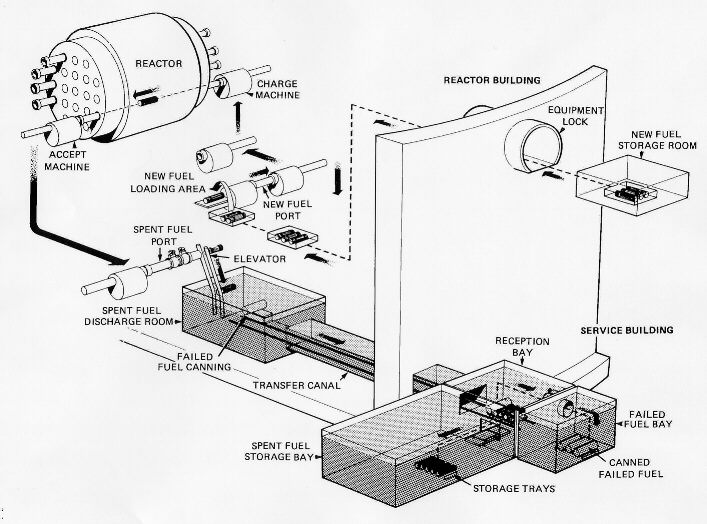
For CANDU nuclear power plants http://www.candu.org/ , we use robotics to handle all the fuel that goes in or out of the reactor http://www.nuclearfaq.ca/refuel.jpg, http://canteach.candu.org/imagelib/00000-General/
N PD_Reactor_Cutaway.pdf. Reliability and robustness are very important, which is why we eliminate most of the electronics on the fuelling machine itself. For instance, the fuelling machines are powered by two identical drives (which are therefore redundant) that control the different mechanisms through a gearbox and a series of electric clutches. The drive amplifiers are located far away out of the radiation fields.
To ensure that the fuelling machines will work correctly and reliably is simple in concept--don't use electronics if you can help it, buy radiation-resistant components if you can't, and design with failures in mind. For example, pressure transmitters at http://www.emersonprocess.com/rosemount/nuclear/. Calculate the dose that each component will receive (most electronics can take about 10 000 rads, plastics vary a lot, and most metals are decent. Zirconium is the best) to determine if it will have a good enough lifespan. Therefore, motors themselves are good to go, conductive level probes are fine, limit switches are fine, etc. It's the semiconductor components that get damaged, but apparently you can design around it, because there are radiation-resistant cameras available. Shielding works but it's like using a bigger hammer--probably not the only or the best way to solve the problem. It's also heavy, making it harder to seismically qualify things.
As an example of the sorts of design decisions made, gap sensing is done using pneumatics with remote electronics instead of proximity sensors, as might be used in a different industry.
Even with careful design, the fuelling machines still get stuck from time to time, but there are many well-thought-out recovery methods. If worse comes to worst, you have to shut down the reactor to get the fuelling machine off the channel. -
Re:I've read that one tooyou've cited on that says there was.
Well, two if you include the WikiPedia article, which appears to have gotten most of the data from this page which I didn't include in my original post since it appears biased against nuclear power in general, as opposed to this page which appears biased in favour of CANDU reactors in particular (that page is where I found the detailed report I cited because it appeared to be both more factual and more balanced than the others.).
But there are more:
The reactor building was contaminated, as well as an area of the Chalk River site, and millions of gallons of radioactive water accumulated in the reactor basement.
when a nuclear reactor at an experimental installation in Chalk River, Canada, suffered a meltdown and some radioactive material escaped into the atmosphere.
"There was some release of radioactivity"Regardless of our little game of Google, I think we can agree on that the release (either through the water only or through air and water) was minimal and all reports I have seen agree that among the servicemen and clean-up crew there has been no rise in fatality or even elevated risks for cancer after the accident.
-
StrangeThere's also this account of the accident that ends with:
This incident included a hydrogen-oxygen explosion and the melting of some uranium fuel, yet the release was contained. It's just that the days when everything goes wrong at the nuclear plant are pretty scary.
linky
More information here that would suggest that the water was pumped out into a field specifically for dealing with and monitoring the waste not simply pumped out of a basement to empty the basement. -
Try the nuke faq & friendsTry the Nuke faq instead http://nuclearweaponarchive.org/Nwfaq/Nfaq0.html that should give a clue as to how these things are build.
Now we need to enrich the stuff first. These guys http://www.urenco.com/ do it for a living and have a few nifty articles on centrifuges.
We also need a suitable boiler to make the good stuff(tm). My personal favorite is the Canadian (take that you pacifists) Candu design http://www.nuclearfaq.ca/.
This should get you in the WMD business in no time. Now don't try this at home unless you've got your own TV-show...
-
Re:Conserving Money is an Absurd Notion
But it does have a scalability and longevity issue that's human-scale, and so it shouldn't be a final design.
I don't understand your 'scalability and longevity issue'. There is enough uranium in sea water with the use of breeder reactors to potentially last us billions of years.
http://www.nuclearfaq.ca/cnf_sectionG.htm#uranium_ supply
We've proven over the decades from the hundreds of nuclear reactors have been providing power all over the world that we can handle the process safely (more people die in coal-mining cave-ins than ever died from nuclear power plants. There is no such thing as a 100% safe energy system, or car, or soft-cushy-pillow for that matter. However compared to _any_ other energy source currently available nuclear seems very clearly to be the safest.) -
Re:Conserving Money is an Absurd Notion
Nuclear fission is not an unlimited resource.
Wrong.
For all practical purposes it is an unlimited resource.
With breeder reactors and the ability to extract uranium from the sea we are looking at billions of years before we run out.
http://www-formal.stanford.edu/jmc/progress/cohen. html
http://www.nuclearfaq.ca/cnf_sectionG.htm#uranium_ supply
-
Re:The question is moot anyways
...or steal our uranium instead. From http://www.nuclearfaq.ca/cnf_sectionG.htm:
Canada is the world's leading uranium producer, accounting for a third of global production and 15% of global reserves. Australia is the next largest producer, with one quarter of global production and 27% of global reserves. -
Re:The Canadian Shield
Canada has been testing re-processing weapons grade materials from both the US and the ex Soviet Union in it's Candu reactors.
See: http://www.nuclearfaq.ca/mox.htm -
take a look at these
-
Re:Great Idea, but..
Gentilly-2 was built in 1983, which is probably inspired by the oil scare. It's in the village of Gentilly in Quebec.
Pt Lepreau (New Brunswick) went live in 1983. Probably the same deal.
No plants have been built in Canada since the mid-80s that I can find, although CANDU reactors have been built in lots of places around the world since then, but that's not really germane to the discussion.
-
Breeder reactors,,,There are a large number of technologies that could provide fuel for fission reactors for much longer. These include reprocessing, breeding uranium from thorium, using more fuel-efficient reactors, and Fast Breeder Reactors that turn uranium-238 into fissionable plutonium. The Japanese are also looking into extracting uranium from seawater.
Nuclear reactors have issues, but fuel shortages are an avoidable one.
-
Re:Nuclear plants are just fine...
NotQuiteReal wrote: Nuclear power seems pretty damn clean to me, and I live about 15 miles from a nuc plant that produces my power, far cheaper (per Kwh) than anything else with no polution that I can see.
I'm not trying to start a debate about the damage damns can cause, but NOTHING makes energy cheaper with less pollution than hydropower. Hydro-damn generates electricity is essentially pollution free, and cheaper
IANAC (I am not a canadian) but The Canadian Nuclear FAQ says "The only large-scale electricity-generating technology in Canada with cleaner air emissions than nuclear plants is hydroelectric power"
-
Been there... done that... slowpokesThis looks a lot like the plans that they had for the old SLOWPOKE reactor.
If this works out, maybe AECL will have more of a future.
-
SLOWPOKE reactor
Canada developed a reactor called the SLOWPOKE. Three versions were developed from the 60's to the 80's, ranging from 20kW to 100MW. Its needs minimal maintenace, has natural convection cooling and is engineered to shutdown automatically in case of a failure (it is designed to have the nuclear reaction stop if it overheats).
It was intended to heat facilities and towns in the Canadian Arctic. Although the program was cancelled due to lack of interest, an number still exist in Canadian Universities for research and educational purposes. -
Re:not so good news for environment
How many times do I have to link this baby? It's so BORING.
>All nuclear reactors produce highly radioactive waste that will remain highly radioactive for thousands of years. The cost of storing the waste will be far more than the benefits of the cheap electricity
WRONG. A dry storage facility costs next to NOTHING to run.
Here's some help.
>hmmm so its not clean, not safe, risky, and very dangerous.
Again, why don't you check out my link? It's just as verified. In fact, if you want some real info, run my link by some scientists. I think they'll agree, your site is scaremongering, end of the world, dogma-type info.
>CANDU reactors are much more safe for sure, since the highly radioactive waste they produce that has to be stored for thousands of years only contains traces of plutonium. Enriched unranium for bombs can still be made from a CANDU. Sprinkle that on your cornflakes.
Yes, and sulphur makes a great bomb also. Should we ban that element?
You aren't making any sense. Thousands of years?
Unshielded, the radiation dose measured at a distance of 30 cm from a used CANDU fuel bundle, one year following discharge, would be about 50 - 60 Sv/h (5000 - 6000 rem/h) [1], which is lethal after a few minutes' exposure. The radiation level drops to about 1 Sv/h after 50 years, 0.3 Sv/h after 100 years, and less than 0.001 Sv/h (100 mrem/h) after 500 years. At this time the major hazard from the used fuel is no longer one of external exposure; for example, by these estimates, spending an hour about a foot away from a 500-year-old CANDU fuel bundle would result in radiation dose about 1/4 of the average annual background exposure
If I were an ant, I'd be worried. But I'm not. I'm a human, and standing a few miles away from unshielded fresh waste is safe RIGHT NOW. In 500 years I can pick it up with my hands. Where's the thousands of years come in???
>How do you save a nuclear plant from a 9/11 type attack and still keep the costs of the electricity affordable? A hit by a plane would be the ultimate dirty bomb.
LOL. Canada has that one locked up. We simply don't get the CSIS to fund and train the terrorists in the first place. Also, we don't provide them with weapons.
Last but not least, we don't piss off the rest of the world.
Pretty simple, really.
>What about the tens of billions it costs to shut down an old nuclear plant?
Dude, that's seriously insane talk. That's Ontario's entire GDP for a few months. You're talking about the impossible, yet we sucessfully shut down Bruce without turning Ontario into a Labour camp.
>Anything run by humans has the chance of being managed poorly, your ignorance on this subject is an example of how complacency and then disasters happen.
You have to be the MOST ignorant person on slashdot on this topic. You REALLY, REALLY, REALLY need to validate those arguments. Especially the claim that shutting down a nuclear power plant would require Ontarians to work for months without even buying food, just for the government to shut down a power plant. I find that difficult to believe, because I live and work there, and my taxes are high, but they aren't _that_ high. -
Re:not so good news for environment
>Right. But you forgot to mention that these football fields are going to require a high-tech cooling system 24x7 for the forseeable future so that they don't melt into pools of plutonium-laced magma.
No I didn't. That's not necessary at all.
Why not read up on it?
In fact, immediately upon removal from the reactor core, a used CANDU fuel bundle generates about 10% of the heat that it produced in the core, but this figure drops to about 1% only a day after removal, and less than 0.1% after a year has passed. The average heat generation of a fuel bundle at this point (one year) is about 60 W -- comparable to a household lightbulb.
If "the forseeable future" is 1 year after use, again, we can handle it. After that, well, I suppose the fuel rod _could_ melt a little ice within a few inches of it... But why wouldn't you just encase it in concrete anyways? You don't want that stuff so easy to get at anyways!
>The danger comes when a suicide terrorist commando squad attacks the spent fuel storage pond.
And the same danger comes when a terrorist flies a plane into the bottom of the CN tower.
No sense in worrying about things that aren't preventable. Oh wait, they won't happen here because, in general, the world doesn't hate us. -
Re:not so good news for environment
>an internal report concluded that the province's utility company was so badly managed that it had compromised the safety of its entire nuclear power system.
LOL. You still haven't shown me any evidence it is dangerous.
If a "compromise in safety" results in 0 deaths, and 0 injuries, well, that's a price I'm willing to pay.
In fact, I bet more people have been injured/died finding "clean" alternatives than have been hurt in a CANDU power plant (excluding common office injuries, like stapling one's balls to the desk).
Here's the truth about that shutdown, also from a somewhat-biased source (I guess they cancel each other out?).
The truth is, they are increasing performance:
a phased recovery of "12/16/20" whereby in Phase 1, the utility will focus its resources on resolving the identified issues and improving the performance of the 12 existing units (Bruce B, Pickering B, and Darlington)
build and establish the managerial and technical infrastructure to sustain the expected level of performance
The truth also is, you've eaten media hype and lies up hook, line, and sinker (this time unbiased, notice the quotation marks):
The report, publicly released on August 13, 1997, despite finding that "all of the plants were being operated in a manner that meets defined regulations and accepted standards related to nuclear safety", was highly critical of Ontario Hydro's managerial and operational procedures. -
Re:Nuclear energy is clean
>If Oak Ridge has taught us anything, it's that even the best laid plans can end up destroying the ecology of an area.
Extending this logic, sitting in a parked car on your driveway for your entire lifetime will mean that you will have at least 2 or 3 car accidents.
Perhaps you should read something about the world's safest nuclear reactors; reactors so safe there are no deaths as a direct cause of it being a nuclear reactor? Even the Sierra Club doesn't seem to have any serious dirt on this reactor, apart from weapons sales blunders. Search for it yourself!
Hmmmm, zero deaths vs. many. Hard to decide. Perhaps if I were anti-people it'd be easier. You aren't anti-people, are you? -
Re:why more radioactive waste?
>But on earth there are much better ways then creating radioactive waste....
You mean like building 6,500 windmills per US state?
Do you have any idea of the damage to the environment building these things has?
Do you have any idea of just how little nuclear waste is created by today's nuclear power plants?
If you want power, something's gonna lose. The question is, do you want feel good power that truly ruins the environment, or wrongly-stigmatized power that doesn't cause much harm at all (and, better yet, provides readily accessible fuel for future reactors).
Facts:
- There are about one million used fuel bundles (0.5 m long, weighing 20 kg each) in Canada, which in volume would fit in a hockey rink three meters deep.
This corresponds to: 167,331 cu ft. of waste. This is hardly anything at all!
- Unshielded, the radiation dose measured at a distance of 30 cm from a used CANDU fuel bundle, one year following discharge, would be about 50 - 60 Sv/h (5000 - 6000 rem/h) [1], which is lethal after a few minutes' exposure. The radiation level drops to about 1 Sv/h after 50 years, 0.3 Sv/h after 100 years, and less than 0.001 Sv/h (100 mrem/h) after 500 years. At this time the major hazard from the used fuel is no longer one of external exposure; for example, by these estimates, spending an hour about a foot away from a 500-year-old CANDU fuel bundle would result in radiation dose about 1/4 of the average annual background exposure, and thousands of times less than what is known to lead to physical harm.
With some simple shielding, the waste is simple to deal with. Even without, if the waste were stored somewhere remote (Canadian Tundra) if would still be quite safe if people kept their distance (and out there, that isn't a problem).
Our own bodies expose us to 80 times more radiation than nuclear power plants do.
We can expect current uranium supplies to last up to 25,000 years.
I'd worry that one of those windmills is going to fall on me before I worry about nuclear power. -
Re:why more radioactive waste?
>But on earth there are much better ways then creating radioactive waste....
You mean like building 6,500 windmills per US state?
Do you have any idea of the damage to the environment building these things has?
Do you have any idea of just how little nuclear waste is created by today's nuclear power plants?
If you want power, something's gonna lose. The question is, do you want feel good power that truly ruins the environment, or wrongly-stigmatized power that doesn't cause much harm at all (and, better yet, provides readily accessible fuel for future reactors).
Facts:
- There are about one million used fuel bundles (0.5 m long, weighing 20 kg each) in Canada, which in volume would fit in a hockey rink three meters deep.
This corresponds to: 167,331 cu ft. of waste. This is hardly anything at all!
- Unshielded, the radiation dose measured at a distance of 30 cm from a used CANDU fuel bundle, one year following discharge, would be about 50 - 60 Sv/h (5000 - 6000 rem/h) [1], which is lethal after a few minutes' exposure. The radiation level drops to about 1 Sv/h after 50 years, 0.3 Sv/h after 100 years, and less than 0.001 Sv/h (100 mrem/h) after 500 years. At this time the major hazard from the used fuel is no longer one of external exposure; for example, by these estimates, spending an hour about a foot away from a 500-year-old CANDU fuel bundle would result in radiation dose about 1/4 of the average annual background exposure, and thousands of times less than what is known to lead to physical harm.
With some simple shielding, the waste is simple to deal with. Even without, if the waste were stored somewhere remote (Canadian Tundra) if would still be quite safe if people kept their distance (and out there, that isn't a problem).
Our own bodies expose us to 80 times more radiation than nuclear power plants do.
We can expect current uranium supplies to last up to 25,000 years.
I'd worry that one of those windmills is going to fall on me before I worry about nuclear power. -
Re:why more radioactive waste?
>But on earth there are much better ways then creating radioactive waste....
You mean like building 6,500 windmills per US state?
Do you have any idea of the damage to the environment building these things has?
Do you have any idea of just how little nuclear waste is created by today's nuclear power plants?
If you want power, something's gonna lose. The question is, do you want feel good power that truly ruins the environment, or wrongly-stigmatized power that doesn't cause much harm at all (and, better yet, provides readily accessible fuel for future reactors).
Facts:
- There are about one million used fuel bundles (0.5 m long, weighing 20 kg each) in Canada, which in volume would fit in a hockey rink three meters deep.
This corresponds to: 167,331 cu ft. of waste. This is hardly anything at all!
- Unshielded, the radiation dose measured at a distance of 30 cm from a used CANDU fuel bundle, one year following discharge, would be about 50 - 60 Sv/h (5000 - 6000 rem/h) [1], which is lethal after a few minutes' exposure. The radiation level drops to about 1 Sv/h after 50 years, 0.3 Sv/h after 100 years, and less than 0.001 Sv/h (100 mrem/h) after 500 years. At this time the major hazard from the used fuel is no longer one of external exposure; for example, by these estimates, spending an hour about a foot away from a 500-year-old CANDU fuel bundle would result in radiation dose about 1/4 of the average annual background exposure, and thousands of times less than what is known to lead to physical harm.
With some simple shielding, the waste is simple to deal with. Even without, if the waste were stored somewhere remote (Canadian Tundra) if would still be quite safe if people kept their distance (and out there, that isn't a problem).
Our own bodies expose us to 80 times more radiation than nuclear power plants do.
We can expect current uranium supplies to last up to 25,000 years.
I'd worry that one of those windmills is going to fall on me before I worry about nuclear power.