Slashdot Mirror
Domain: osdata.com
Stories and comments across the archive that link to osdata.com.
Comments · 21
-
a better operating system ..
2006 Young Innovators Under 35
Eddie Kohler
A better operating system
"Asbestos keeps personal data secure by "tagging" it with information about which programs or users can access it
"(NSA) worked with Secure Computing Corporation (SCC) to develop a strong, flexible mandatory access control architecture based on Type Enforcement, a mechanism first developed for the LOCK system."
"AppArmor security policies, called "profiles", completely define what system resources individual applications can access, and with what privileges." -
Re:Wank wank wank
so was Multics written in assembly
Yes, at least initially. The reason that UNIX exploded upon the world (unlike some other cool OS's like MULTICs and ITS), is that it was rewritten in C (it was initially written in assembly language). The fact that you only had to rewrite the assembly code instead of the entire OS made it extremely desirable (for the same reasons that Linux is desirable today). The idea of the first portable operating system escaping the editors of this article is unforgivable.
Here is a reasonable history of UNIX. The history article at wikipedia currently sucks (so I guess I had better start rolling up my sleeves). -
Re:Whomever Geeks and Nerds Find Evil...And of course, you have an explanation for the fact that before Microsoft had such enormous market share (check here: http://www.osdata.com/kind/history.htm [osdata.com] : computer history DID NOT begin with MS-DOS), security holes were virtually unknown?
Hint 1: While you were'nt looking something called the Internet happened.
Hint 2: Read up on fx Unix security history (worms, rootkits, etc.), just for a start.
-
Re:Whomever Geeks and Nerds Find Evil...
And of course, you have an explanation for the fact that before Microsoft had such enormous market share (check here: http://www.osdata.com/kind/history.htm : computer history DID NOT begin with MS-DOS), security holes were virtually unknown?
-
Re:So what does this do to thier "competing" forma
Apple are not innovate with OSx and PDF / vector screen technolgy they inherited the technology when they acquired Next that used postscript to display the screen.
http://www.osdata.com/oses/next.htm i wish people would stop quotin apple or google as innovative - they may be better at getting things to market but they are not innovative.
Desktop search & indexing - shipped in Windows 2000 long before google...
Satellite mapping - terraserver setup in the nineties!
And why we are on the anti-rant here - why doesn everyone confuse open and free
PDF is a proprietary format it is not open, though it might be able to be licesed for free
http://partners.adobe.com/public/developer/pdf/lib rary/index.html;jsessionid=0FE102393BB2EE6D4FB30BF 3E38FEBAA
make no mistake, those that have implemented PDF and haven't licensed it from PDF are in breach of IP. Just becasue adobe choose to do nothing about it doesn't mean the standard is 'open' -
Re:Are there any 32-bit-only OSes left worth menti
I know they had 32 bit build for alpha, ppc, MIPS
The port (3.51 and NT4) to Alpha was definitly 64-Bit...
-
Re:Surely you must be joking Mr Feynman
Root password on a Microvax? I call BS
I take it you've never heard of Ultrix. -
Re:Well...
no they weren't. they were written in assembler. or C.
You want to make a friendly wager on that? (HINT: Read through your sibling posts before answering. And for crying out loud, check some Google results!) -
Re:BeOS had that in 1999
Yeah, no kidding -- I remember using BeOS 4.5 and 5.0 [paid version!] and thinking that the application grouping was such an obviously good idea -- as plenty of screenshots will illustrate -- that I couldn't see why this idea wasn't being ripped off in the Windows taskbar.
But then, of course, Be was chased out of town and Windows put in substantially the same interface into XP when it came out. As forseen by prophesy -- Microsoft never saw a good idea that they weren't above flagrantly stealing for their next major release.
But then, I've whined about such things already on Slashdot, as have others I'm sure...
-
Re:OK, so MS has had this since winXP...
Yeah, no kidding -- I remember using BeOS 4.5 and 5.0 [paid version!] and thinking that the application grouping was such an obviously good idea -- as plenty of screenshots will illustrate -- that I couldn't see why this idea wasn't being ripped off in the Windows taskbar.
But then, of course, Be was chased out of town and Windows put in substantially the same interface into XP when it came out. As forseen by prophesy -- Microsoft never saw a good idea that they weren't above flagrantly stealing for their next major release.
But then, I've whined about such things already on Slashdot, as have others I'm sure...
-
Re:Why FAT32 over ISO-9660?
I know as of Win98 and NT4 that Windows does NOT grok Rockridge correctly, they instead went and implemented Joliet, which is of course patented as you mentioned. Not sure what the status is on 2k but XP supports it according to This site. Anything older than 2k doesn't matter to me anymore but I think most manufacturers will have to worry about them for a little while longer.
-
You cheated at the Security test
Um, you cheated.
MSWindows2000 was released on February 17, 2000.
RedHat 9.0 was released on March 31, 2003 (All release dates for RedHat are from this link.)
So Redhat had over 3 years to fix holes in the distribution, while crackers had 3 more years to find holes in MSWindows2000. If you want to play fair,
- use Windows2003 released April 24, 2003 and RedHat9.0 (24 days between the releases), or
- use RedHat 6.2 (released March 8, 2000) (19 days difference from MSWindows2000) or maybe RedHat 7.0 (released August 28, 2000).
If you want to compare RedHat9.0 and MSWindows2000 today, you should fully patch both of them.
I believe RedHat will still win any of the fair tests, but if you use unpatched RH6.2, it will get cracked. It will just take longer because there are tons of script kiddies just sending easy URL cracks at every web server hoping it is running MSWindows. -
Mirror, before the poor blog dies...
Caldera Employee Was Key Linux Kernel Contributor
Christoph Hellwig has been, according to this web page, "in the top-ten list of commits to both the Linux 2.4 and Linux 2.5 tree". The page also mentions another fascinating piece of news, that he worked for Caldera for at least part of the time he was making those kernel contributions:
"After a number of smaller network administration and programming contracts he worked for Caldera's German development subsidiary on various kernel and userlevel aspects of the OpenLinux distribution."
In 2002, he offered a paper on "Linux-ABI: Support for Non-native Applications" which is described like this:
"The Linux-ABI project is a modification to the Linux 2.4 kernel that allows Linux to support binaries compiled for non-Linux operating systems such as SCO OpenServer or Sun Solaris."
Back in 2002, he was described, in connection with his appearance at the Ottawa 2002 Linux Symposium, like this:
"Christoph Hellwig
"Reverse engineering an advanced filesystem
"Christoph Hellwig is employed by Caldera, working on the Linux-ABI binary emulation modules. In his spare time he cares for other parts of the kernel, often involving filesystem-related activities."
So, in short, he was contributing to the kernel and working for Caldera on Linux/UNIX integration at the same time. His work for Caldera was on the Linux kernel ("he worked for Caldera's German development subsidiary on various kernel and userlevel aspects of the OpenLinux distribution"), and he also did work on his own on the kernel. Did Caldera know about his freelance contributions, in addition to knowing about his work for them? What do you think? He used his hch at caldera.de email address when doing it. All contributions to the kernel are publicly available anyway. They certainly could have known. As for his job, his signature on his emails back in 2001 was:
"Christoph Hellwig
Kernel Engineer Unix/Linux Integration
Caldera Deutschland GmbH".
He used the email address hch at bsdonline.org sometimes too, and here you can see some of his Linux-abi contributions. Here are some of his contributions to JFS, Journaled File System. Yes, that JFS. Here he is credited as sysvfs maintainer, and he confirms it in this email, writing, "I've run native sysvfs tools under linux, but as now that I'm Linux sysvfs maintainer I'm looking into implementing free versions of it."
Here is a list of the operating systems that use or can handle the file system sysvfs:
"sysvfs: UNIX System V; SCO, Xenix, Coherent e21
"operating systems that can handle sysvfs: FreeBSD (rw), LINUX (R), SCO (NRWF)"
Here's a page listing by author (alphabetically by first name), with his emails to linux-kernel in June 2003, so he is still contributing.
Here he is listed on the Change log for patch v2.4.17. Here he tells Andrew Morton in 2002 that he will -
Re:Copying AppleUmm actually, Jar Jar, Apple made rhapsody:
In January of 1997, Apple computers promised that their operating system code named ?Rhapsody? would run on all computer models that they were shipping at that time and any computer models they introduced after that date, as well as on some unspecified number of Intel Pentium/x86-based computers.
http://www.osdata.com/oses/rhapsody.htm -
what are you talking about?The Win95 shell imitates NeXTStep in its appearance far more than it does MacOS,
Exacly what features of the Nextstep does win95 offer? "windowblinds"? Sure, if you download a serious modification. 95 shipped with the clumsy three button junk from win3.1 plus an extra button and a pannel. A root menue anywhere on the screen? Nope. The way it resizes windows? Nope. Menues that you can leave up on the screen? Nope. Can you name one feature that is not simply part of any GUI? I'm not going to go into the tremendous difference in the unerlying systems but just look at the apearances alone.
Nextstep was made from MacOS and was better. Windoze never did much more than follow along the GUI path, never evolving much from the first one they made. The evolution and lines of influence are clear when you look at screen shots from each.
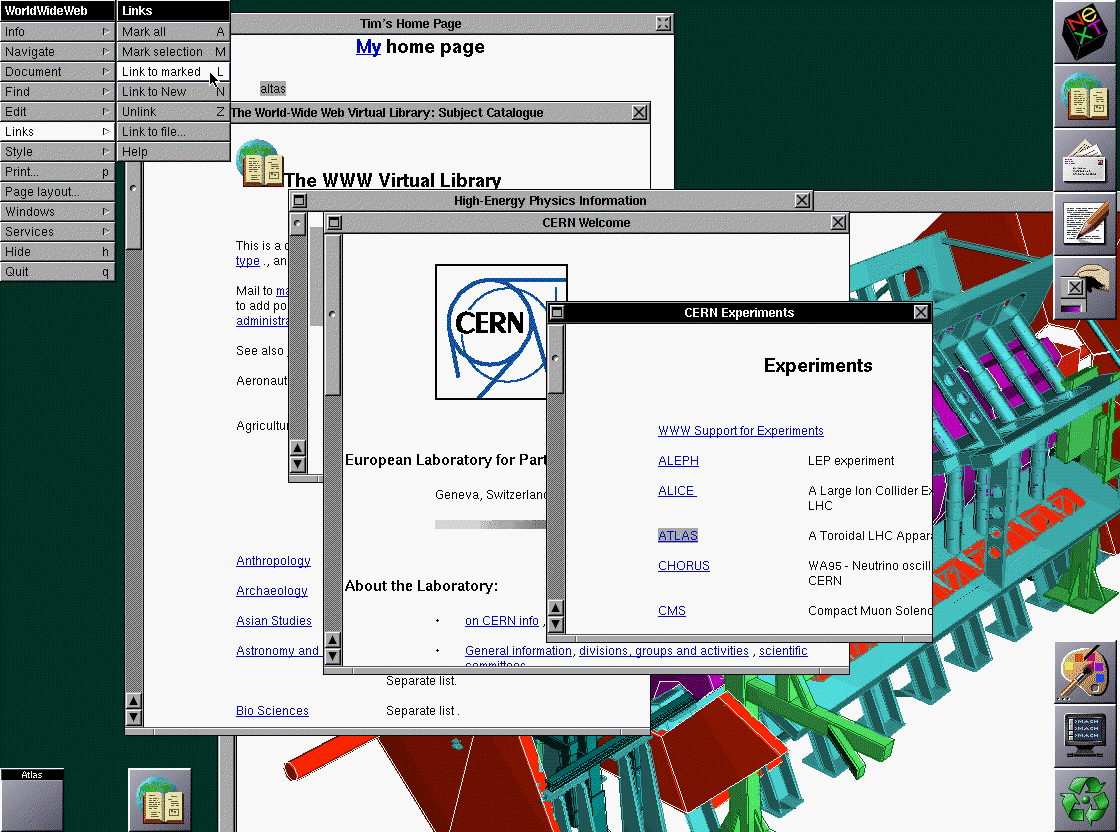
For those of you not familiar with Next, check out this 1993 screen shot of the first web browser. The client was developed in 1990. There are many free implementations of the Nextstep such as Window Maker today. It still kicks any GUI Microsoft has ever made. After using a reasonable window manager on X, few people can go back to the M$ GUI confines.
For those of you fortunate enough to have missed Windoze 3.1, here is a little screen shot from 1993 or so when Netscape became one of the first available browsers for Windoze. 95 added the X button on the top right, so I suppose you could say it coppied Nextstep in one way. Here is a typical Win95/98 desktop. Windoze XP (screen shot to compare), is more of the same and annoying as all hell.
Please don't compare reasonable software, such as Nextstep or Sun's Common Desktop Environemnt, to junk from Microsoft. People might get the idea that one was better than it is or that the other sucks in ways it never did.
-
what are you talking about?The Win95 shell imitates NeXTStep in its appearance far more than it does MacOS,
Exacly what features of the Nextstep does win95 offer? "windowblinds"? Sure, if you download a serious modification. 95 shipped with the clumsy three button junk from win3.1 plus an extra button and a pannel. A root menue anywhere on the screen? Nope. The way it resizes windows? Nope. Menues that you can leave up on the screen? Nope. Can you name one feature that is not simply part of any GUI? I'm not going to go into the tremendous difference in the unerlying systems but just look at the apearances alone.
Nextstep was made from MacOS and was better. Windoze never did much more than follow along the GUI path, never evolving much from the first one they made. The evolution and lines of influence are clear when you look at screen shots from each.
For those of you not familiar with Next, check out this 1993 screen shot of the first web browser. The client was developed in 1990. There are many free implementations of the Nextstep such as Window Maker today. It still kicks any GUI Microsoft has ever made. After using a reasonable window manager on X, few people can go back to the M$ GUI confines.
For those of you fortunate enough to have missed Windoze 3.1, here is a little screen shot from 1993 or so when Netscape became one of the first available browsers for Windoze. 95 added the X button on the top right, so I suppose you could say it coppied Nextstep in one way. Here is a typical Win95/98 desktop. Windoze XP (screen shot to compare), is more of the same and annoying as all hell.
Please don't compare reasonable software, such as Nextstep or Sun's Common Desktop Environemnt, to junk from Microsoft. People might get the idea that one was better than it is or that the other sucks in ways it never did.
-
when UNIX got 64-bits
UNIX: about a decade across their whole market.
Actually, it's a lot less than a decade for most UNIX vendors.
DEC had 64-bits first; 1992/1993 I believe, with SGI not too long afterwards. So the two guys with lowest marketshare were pretty fast out of the blocks. But where were things a few years ago? By late 1998, all the RISC vendors had at least one 64-bit piece of hardware, with half of Sun and HP's product lines moved over, IBM just starting, and SGI shipping all 64-bit hardware. But various players hadn't finished all the OS-level stuff to support that. (Source for all that here.) The transition to 64-bits wasn't done for UNIX players even 3.5 years ago, so "across their whole market" is really way too strong a statement. Wintel ran on 64-bit Alpha support long ago, but actual 64-bit APIs were still in development back in that timeframe; I haven't seen how far along they are now.
At one point in my career, I analyzed 64 bit marketing for several projects. Basically, saying "we're 64-bit, they aren't" was never a very compelling argument to begin with. Sure, in a few cases (very large databases, but not very very large databases) it made a difference, but at the end of the day, it didn't win any hardware players a lot of business.
Saying "64-bit is better" is easy, showing that 64-bit is worth paying more money is typically hard.
You're right that 64-bit Intel will likely win over 64-bit RISC long-term is right. But Intel is having huge problems executing on 64-bit Intel stuff. Itanium was a loser. We'll see how competitive McKinley is.
Right now, and I suspect for some time to come, Sun and SGI will continue to sell better hardware primarily based on "more reliable", "more scalable" kinds of features within the hardware (as usual, features requiring OS support), not leaning too heavily on the 64-bit argument.
--LP -
Re:Business sense for the real world.
I was thinking about 7.0, however, I was not fully informed on the details. As seen here OSDATA system 7 was the first system to run on the PPC processors, marking the begining of the end of 68k. OS 8 was the final nail in the cofin.
-
Hmm
-
Re:OSF MachI thought OS X was based on Mach3 (although NeXT and Rhapsody were 2.5 based and some OS X sites call it's kernal "Mach2.5 with enhancements") and NT was loosely based on DEC's VMS (Micah?). Although I could well be wrong. And yes, Tru64 is based on a 64bit Mach 2.5.
Some cool info on stuff like that here.
-
Re:See modern-day religion at work...
Ok, I'll bite...
* The Task Switcher - requires 2 clicks to switch application, compared to 1 click with a Windows-style taskbar.
Tear off the task switcher and you have a floating menu that only requires 1-click.
Also, if the previous directory window has been closed, it is now impossible to navigate backwards. Other systems (Windows included) have found solutions to this problem - why hasn't the Mac?
Apple-click the window titlebar on the folder name and select the parent directory.
* Context Menus - The lack of a second button on the standard Mac mouse is for some a boon in terms of simplicity. However, for anyone past beginner level it is a serious usability handicap.
So replace the mouse with a 2-button model.
* Keyboard navigation - or the lack of it. You're stuffed on a Mac if you can't use the mouse. The menubar is totally off limits to you, which makes the computer all but useless.
You can access the menubar using the keyboard in MacOS X.
Remember, not everyone has the faculties to use a mouse, and if this is the case for you, forget every other question about usability - a Mac just isn't usable.
Mouse Keys was specifically designed for those people who can't use a mouse.
http://www.osdata.com/holistic/disable/disable.ht
m I recently listened to a Mac-hater claiming that Macs don't run his favourite applications such as DreamWeaver and Internet Explorer. Then he started going on about the 1-button mouse. People who think only Linux and Mac users can be zealots need to take a good look at themselves.