Slashdot Mirror
Domain: pearsoncmg.com
Stories and comments across the archive that link to pearsoncmg.com.
Comments · 6
-
Re:Of course its Microsoft
No. Some things are simply complex. That doesn't automatically make them "garbage" just because you don't understand them.
Your post reeks of the same attitude that x86-haters have even to this day.
-
Re:Kildall was a great guy, but perhaps myopic
> something running on an 8-bit processor like the Intel 8080 or Zilog Z-80. There was a memory limit of 64K, and early on that 64K was expensive.
> I encourage you to read up on how these old disk systems worked, so that you can understand why someone might limit the size of file names.As someone who has *used* those 8-bit computers since the early 80's I'm quite intimate with the details of how all those old DOS's worked -- CP/M, DOS3.3, ProDOS. I'm even writing my own DOS for my 6502 Apple
> it was probably a hard-sectored, single-sided drive and the diskettes held 90K of information
A) You mean 87.5 KB when Shugart introduced the first 5.25" SA 400 drive, but OK. Later disc were soft-sectored and able to hold (35 tracks * 18 sectors) = 157.5 KB SD (Apple 2) or (40 tracks * 18 sectors * double density) 360 KB DD (IBM) respectively.
See Floppy Disk - Performance and Capacity
B) CP/M was software skewed
CP/M 1.4 was designed to work with 8" 250k discs. Thus a CP/M 1.4 disc will be laid out in the following way:
77 tracks in total;
26 128-byte sectors per track, software skewed;
2 reserved tracks;
2 1k directory blocks, giving 64 directory entries;
240 1k data blocks, numbered 2-241.> It made sense to limit file name sizes, etc, for the diskette catalogs, so that the space available for data could be maximized.
1. It is obvious you've never done the math, so I'm calling bullshit.
You mean to tell me that increasing the filename
from 8.3 (CP/M never stored the '.' extension) which takes 11*100 / 87.5K = 1200 / 89,600 = 0.012% disk space
to 16 characters = 16*100 / 90K = 1600 / 89,600 = 0.017% disk spaceis going to have any actual impact on maximizing space for data?!?!?! Riiight. Can I have some of what your smoking please!
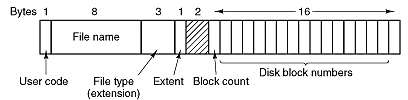
2. Furthermore, looking at the CP/M disk format, particularly the directory entry, Tanenbaum has this picture. We see 2 unused bytes!
For comparison:
Ver 1.4 wastes 2 bytes
Ver 2.2 wastes 1 bytesSo your argument is completely bogus.
3. Lastly, CP/M used a retarded allocation schema:
The CP/M 1.4 directory only has one type of entry:
SS F1 F2 F3 F4 F5 F6 F7 F8 T1 T2 T3 EX S1 S2 RC
AL AL AL AL AL AL AL AL AL AL AL AL AL AL AL ALWhich means:
AL - Allocation. Each AL is the number of a 1k block on the disc. If an AL
number is zero, that section of the file has no storage allocated to it
(ie it does not exist). For example, a 3k file might have allocation
5,6,8,0,0.... - the first 1k is in block 5, the second in block 6, the
third in block 8.Instead of wasting 16 bytes for allocation (WTF!) you store the _starting_ block number (4 bytes) and number of blocks (4 bytes), which leaves 8 more characters for filenames.
The point remains Gary completely fucked up filenames. MS, in typical fashion, just blindly copied others without actually *thinking*.
So yeah, I *do* hold him responsible for his retarded file system -- he never act
-
Re:The 30 and 40-somethings wrote the code...
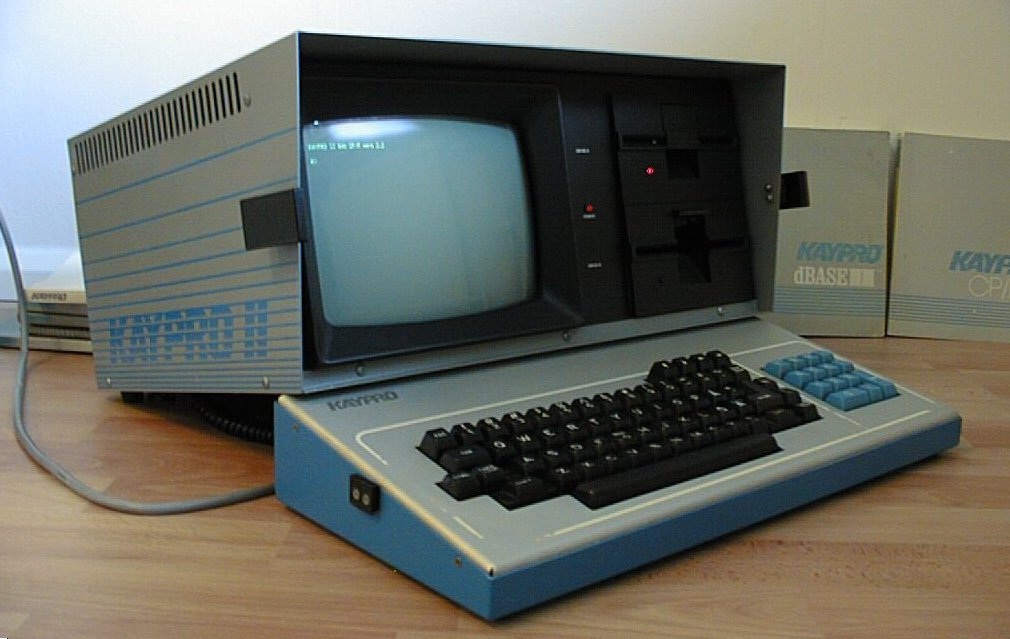
I remember my father having to get out the suitcase of a portable computer that work had assigned him, set it up on the dining room table, and dial-in to the mainframe to fix broken batch jobs on weekends occasionally.
I had one of these.
http://ptgmedia.pearsoncmg.com...
Still have it, out in the garage next to dried up paint cans and copies of Argosy magazine. And before you ask, no, "dried up paint can" is not a euphemism for my first wife's corpse.
-
Re:"illegal" open source softwareI was bothered by the guessing involved in my previous answer, so I located the real answer:
(from a presentation based upon a textbook)Intentional Interference with Contractual Relations
A tort that arises when a third party induces a contracting party to breach the contract with another party.
The following elements must be shown:
- A valid, enforceable contract between the contracting parties.
- Third-party knowledge of this contract.
- Third-party inducement to breach the contract. -
Organizational Behavior (Re:What can be done?)
Behavior in Organizations
Or, more specifically:
Chapter 5: Work Related Attitudes: Feeling about Jobs, Organizations, and People -
Organizational Behavior (Re:What can be done?)
Behavior in Organizations
Or, more specifically:
Chapter 5: Work Related Attitudes: Feeling about Jobs, Organizations, and People