Slashdot Mirror
Domain: penguincentral.com
Stories and comments across the archive that link to penguincentral.com.
Comments · 9
-
This reminds me...
of a certain couple of movies that deal with a similar-ish thing.
We also know how insane even scientists and researchers get during a several-month physical isolation from the rest of the world.
I'm hoping that Red Mars was required reading before they designed this kind of an experiment... I would assume that a similar level of precise requirements are being put into place here, as were found in that book.
Geek power unite! We've already been shown how to colonize space... just read the extensive manuals published by Issac Asimov, James Blish, and Robert A. Henlien! -
Re:200 Degree Club
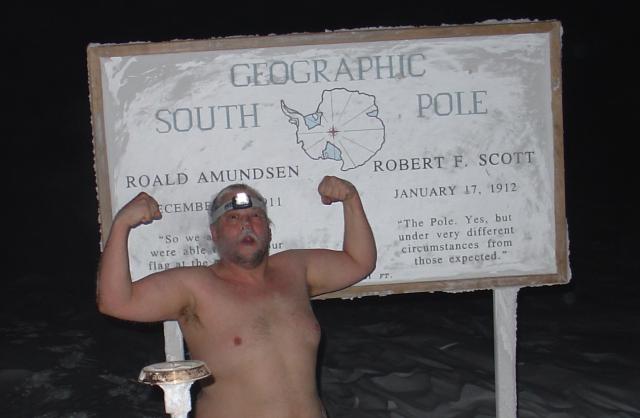
What we do at Pole is called the *300* Degree club - we crank the sauna up to +200F and run outside wearing only shoes at -100F.
http://penguincentral.com/300Club.html
(the photo is from my *second* 300 Club run this winter - no photographer out there the first time)
Before some smart-ass tries to claim that it's impossible to sit in a +200F sauna, remember that a) we are at a nominal 11,000' and b) there's about 0.5% RH, meaning that heat transfer to your body is quite poor. I wouldn't want to think about sitting in a +200F Sauna at sea level.
-ethan -
Re:200 Degree Club
What we do at Pole is called the *300* Degree club - we crank the sauna up to +200F and run outside wearing only shoes at -100F.
http://penguincentral.com/300Club.html
(the photo is from my *second* 300 Club run this winter - no photographer out there the first time)
Before some smart-ass tries to claim that it's impossible to sit in a +200F sauna, remember that a) we are at a nominal 11,000' and b) there's about 0.5% RH, meaning that heat transfer to your body is quite poor. I wouldn't want to think about sitting in a +200F Sauna at sea level.
-ethan -
Re:I'm writing this from Antarctica
I'm not sure what it is exactly, but it's a T1 until it's bridged onto the microwave link.
And, as a matter of fact, INMARSAT _is_ in a geosync orbit:
http://encyclopedia.thefreedictionary.com/Inmarsat
But last I knew, Pole didn't use INMARSAT (except as a backup, like McMurdo can). INMARSAT is _extremely_ expensive in per-minute charges. I don't recall what bird Pole uses for their main comms. I do know some folks down there now, so I'll find out.
BTW, When I was there, we didn't _have_ ATMs. We got a cash disbursement from each paycheck in the form of travelers checks (or, rarely, cash). -
Re:well...
You're probably thinking of the PET's killer poke.
-
Re:New Year's EveIt's big fun. One year, we played frisbee at midnight outside the bar. On New Year's Day itself, there's a big rock concert at McMurdo - "Icestock".
As to the champagne freezing, it's the middle of summer - at the coast, it frequently gets above 32F. They just set an all-time high at McMurdo last month - 51F!
-
Re:New Year's EveIt's big fun. One year, we played frisbee at midnight outside the bar. On New Year's Day itself, there's a big rock concert at McMurdo - "Icestock".
As to the champagne freezing, it's the middle of summer - at the coast, it frequently gets above 32F. They just set an all-time high at McMurdo last month - 51F!
-
Ozone Hole how/where/when/why (was Re:bah...)Ozone depletion research corresponds nicely with the expiration of the patent on Freon. Anyone with any knowledge of chemistry realizes that when a cosmic ray hits O2 it form 03 (ozone). In other words, depleting ozone just makes the atmosphere produce more ozone.
Having personally launched and tracked balloons (with scientists from the University of Wyoming) to sample the ozone layer over Antarctica and worked with NASA scientists on the retrieval and processing of the data from TOMS-EP (a satellite that uses reflected sunlight to indirectly measure column ozone over any lit spot on the earth), I think can respond to this.
Ozone is created and destroyed constantly all over the earth. It's how we are protected from UV radiation from the Sun. What occurs over Antarctica, the "Ozone Hole", is a case where under certain conditions, more ozone is destroyed than created, disrupting the equilbrium. You need three things in proximity to shift the balance - temperatures around -80C at about 100km altitude (30,000 ft.), a depletion agent (chlorine, bromine, etc.) and sunlight (energy). If you don't have the right temperatures, ice particles of the proper size can't form, eliminating the site where depletion happens. If you have no agent, there's nothing to catalyze the reaction. If you have no energy, there is no way to sever the O3 bonds.
All winter long, ozone forms over the South Pole as the air gets colder and colder due to radiation cooling in the absence of sunlight. The cold air can't mix with warmer air from temperate latitudes because of the circumpolar winds which corral-in the air over the polar plateau (which is two miles tall, exascerbating the heat loss). By the time the first rays of sunlight hit in late August, the ozone concentration at 100km is at its annual peak. Over the next few days, the concentration of ozone plummets dramatically. By the first week of October, the air has warmed up enough that there are no ice crystals of the appropriate size for further loss to occur. There's still chlorine and energy, but no site for depletion to take place. A few weeks later, the upper atmosphere, now heated 24/7, is energetic enough to disrupt the circumpolar current and ozone poor air from above Antarctica mixes with ordinary air from the South Pacific and South Atlantic, diluting the concentration of ozone over the entire Southern Hemisphere.
Perhaps you have missed the warnings issued to southern Chile over the past couple of years about particularly dilute patches passing overhead and the risk of skin and eye damage from as little as 15 minutes exposure if unprotected? New Zealand (occupying from approximately 43 degrees S to 48 degrees S) is at similar risk.
Yes, depleting ozone just makes the atmosphere make more ozone, but it's not a uniform process. It's a seasonal process. This detail does not often make it into the popular press because it's a) not sensational enough and b) too complicated to fit into a sound bite. What scientists currently study is not the percentage of ozone in the stratosphere (at the right altitudes to form the right kind of ice crystals, it's 0% by the start of Summer), it's not the physical size of the hole (which is determined by the shape of Antarctica and the circumpolar current), it's how fast the hole appears as compared to the winter-time minimum and the spring-time maximum extent.
As to the impact of human activity, the documented trends are that chlorine at 100km parallels (with a 18-month lag) the amount of release at ground level, and the more chlorine that's up there, the higher the rate of formation of the hole. It's not a straight uphill line; it has its minor variations up and down like a stock market graph. The overall trend, from decade to decade is up and up and up.
-
Re:Been there, done thatLet me just add to Xenon's comment that Stan *does* capture the essence of life on the Ice, so much so that while I was reading it, I realized that people who have never been there might be put off by the depths to which he goes. I was working in McMurdo when Stan was there; he went to the trouble of learning to live there, not just flit in and flit out as a casual observer.
Stan is right about Antarctica grabbing you and not letting go. I've been trying to arrange a return for several seasons, unsuccessfully for several reasons. While I missed the snowmobile incident (it happened right before I arrived), my favorite anecdotal part of the book was the description of the dance. I didn't realize he was *at* that dance. .
ObShamelessSelfPromotion: read about Stan's visit and life on the Ice at Penguin Central. -ethan