Slashdot Mirror
Domain: physicalgeography.net
Stories and comments across the archive that link to physicalgeography.net.
Comments · 13
-
Re:Sea-level threat?
It's certainly not "exponential", which would be a much faster CO2 increase than linear. Maybe you meant "logarithmic". But, looking at the most recent NOAA/ESRL charts, the CO2 rise still looks pretty close to "linear". GHG time-series plots [noaa.gov]
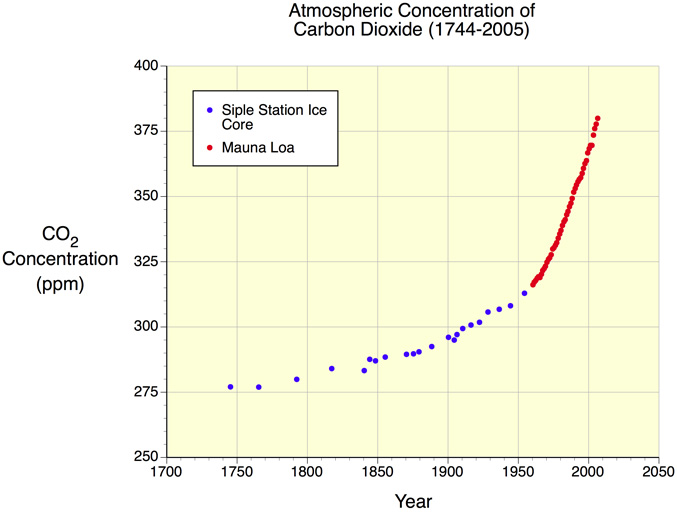
Your graph is for a short period starting in 1979 that makes it look more linear than it is. Here is a graph that starts around 1750. It looks pretty exponential to me.
So, while there very likely is an anthropogenic component to this rise, it is a very steady rise, evidently independent of recent changes in man-made production and recent temperature fluctuations (1998 Nino etc), suggests it is some kind of buffered response, which tends to smooth out natural and man-made variances (as Mother Nature likes to do).
When the rise in atmospheric CO2 from year to year is less than half of the total emissions from human activities it's kind of hard to argue that the rise is not nearly all anthropogenic. As far as buffering, the rise from year to year is about 2 ppm out of (currently) 400 ppm so relatively small changes in anthropogenic emissions get lost in the noise.
We can argue all day about different temperature measuring techniques but the fact remains that liquid in glass thermometers have been in use for over 300 years and are a well understood technology measuring directly in the medium being measured as are more modern thermometers while satellite measurements are using the proxy of microwave emissions for temperatures and require complex calculations to come up with an actual temperature. Also they don't measure the surface temperature but rather a blob of air somewhere above the surface.
If you actually look at temperatures over the last 10,000 years they reached a peak in the 6,000 to 8,000 years ago period and have been slowly declining since. This is consistent with the expectations from an analysis of Milankovitch cycles and the slight cooling trend should be continuing
No, the warming by CO2 forcing as defined by IPCC is immediate: T-change = climate-sensitivity x CO2-forcing.
What to you implies that the temperature change is instantaneous. There are different kinds of climate sensitivity and they are all time dependant. From Wikipedia:
Equilibrium and transient climate sensitivity
The equilibrium climate sensitivity (ECS) refers to the equilibrium change in global mean near-surface air temperature that would result from a sustained doubling of the atmospheric (equivalent) carbon dioxide concentration (deltaTx2). As estimated by the IPCC Fifth Assessment Report (AR5) "there is high confidence that ECS is extremely unlikely less than 1C and medium confidence that the ECS is likely between 1.5C and 4.5C and very unlikely greater than 6C."[4] This is a change from the IPCC Fourth Assessment Report (AR4), which said it was likely to be in the range 2 to 4.5 C with a best estimate of about 3 C, and is very unlikely to be less than 1.5 C. Values substantially higher than 4.5 C cannot be excluded, but agreement of models with observations is not as good for those values.[5] The IPCC Third Assessment Report (TAR) said it was "likely to be in the range of 1.5 to 4.5 C".[6] Other estimates of climate sensitivity are discussed later on.
A model estimate of equilibrium sensitivity thus requires a very long model integration; fully equilibrating ocean temperatures requires integrations of thousands of model years. A measure requiring shorter integrations is the transient climate response (TCR) which is defined
-
Re:It won't matter
I cannot tell you how much I hate this line of argument. "People who believe X must therefore believe Y. We all know Y is a crock; therefore people who believe X believe crocks; therefore X is a crock." It's completely illogical, and at least two argumentative fallacies into the bargain.
As far as CAGW goes, there is a fundamental chain of proofs that have to occur before it can be taken as reasonably proven. These start with the claim that the Earth is warming and end with the claim that therefore catastrophe will result. (Well, and more frequently these then pass on from that to claims that if we undertake to destroy the economy in a particular way, the catastrophe will be prevented or attenuated.) The very first claim, that the Earth is warming, is actually suspect because of instrumentation problems, but is likely true as we have been coming out of the Little Ice Age that ended in about 1850. That this warming, if indeed it exists, is unprecedented, is almost certainly false. The CAGW claims just get shakier from there.
Now, I have no problem with the thought that CAGW might be true, and that if so we should act. However, it is an extraordinary claim, and extraordinary claims require extraordinary evidence. So far, the CAGW proponents have not provided us with even ordinary evidence, particularly given that all of their predictions to date (that is, those whose end dates have already passed) have been dramatically wrong, that much of their evidence has been irreproducible (and thus, in a scientific sense, not evidence at all) and that their obvious bad will and career politics (as exhibited in the climategate emails) is of the kind that tends to suppress contrary evidence even if it is stronger than the "consensus" view pushed by the CAGW proponents.
In other words, CAGW may be true, but it is not obviously true, has not been shown to be reasonably likely to be true, and is as likely to be utterly false. And on this basis, the CAGW proponents wish to destroy the world's economy, immiserating hundreds of millions, if not billions, of people.
-
Re:Great idea
Think about it for a second, windmills literally suck energy out of the wind - wind that goes places and does things and is absolutely critical for most ecosystems on the planet to survive. Now, there may be absolutely nothing wrong with them at all, but it seems like we've just been rushing to use them without looking into the potential consequences. Isn't that the exact same mistake we made with oil?
- I believe this has been looked at but a brief consultation with the Oracle didn't realize any obvious results. Perhaps I didn't feed it enough electrons.
- The gist of the argument for deciding that there is no possible (or no likely, depending on how you trust these sorts of back of the email type calculations) significant disruption of the global ecosphere is thus:
Wind turbines sit perhaps 30 - 100 meters above the ground.
- The trophosphere, or bottom of the atmosphere, contains most of the weather, water and likely energy. This goes up to around 10 km. The next layer, the stratosphere goes to about 50 km.
- Even if you took a significant swath of energy out of the 100 meters or so that a wind turbine straddles, that comprises and infinitesimal amount of total energy of the system.
- For those of you inclined to argue about butterflies flapping their wings and causing hurricanes, I would point out that the wind turbines may change things but that change is buried in the statistical noise.
Or some similar handwaving argument. -
Re:nothing lie the real thing
on top of that, was the box heated in some way? because I don't see how an off-the-shelf camcorder can still work at sub-zero temperature like those above 3km (10,000 ft) of altitude - see chart, good luck with proving me wrong !!
air temperature
this experiment is utter rubbish, or at least so are the claims -
Re:Upper limit
Recently, I was having a conversation about the upper limit on solar power. I hadn't done the math then, but I just trotted out a fresh napkin to satisfy my curiosity. The earth is 12756 km in diameter. That presents a 127.8 million km^2 cross section to the sun. With the napkin-math estimate of 1kW/m^2 incident at the earth's surface, there's an upper limit of 127.8 million MW of power available from the sun. Okay, so that's an absolute ceiling for terrestrial solar collection - you can't collect more energy than is incident in the first place.
Okay, now for a more practical limit. Let's put the solar collection grid on land - that's a reduction to 30%. Let's also go with solar cells that are 20% efficient - that's not too shabby, but not bleeding-edge-expensive either. (127.8 * 0.3 * 0.2) = 7.67 million MW.
Finally, how much of the available global land mass are we willing to pave over with solar cells? If I use a residential rooftop model, a 1500 sq.ft. house on a 1/4 acre (~10000 sq.ft., sorry for the non-metric-unit shift) property would be about 15%. I think that's probably a bit high, considering that houses aren't aligned for optimal solar collection, but I'm looking for the practical upper limit of solar collection opportunity. Using 15%, the available harvestable power limit becomes 1.15 million MW.
Let's compare that to current consumption stats in the US (no pun intended.) If I read this chart correctly, December of 2006 had 335.6 million MWh of power generated across all industries. There were 744 hours in December, so that equates to 451 thousand MW average continuous power generation. So the maximum solar harvest potential is only about 3x our current consumption rate? Damn, that's sobering. -
Re:Nuke power safety
Humans currently use 321 TWH/day. Solar insolation at the equator is about 425 w/m^2. So 321,000,000,000,000 WH / 12H (sunlight per day at equator) and further / 425 W = 6.3 × 10E10 m^2 required for all human power needs, if located near the equator, and 100% efficiency.
Assuming 50% efficiency conversion gives 1.5 10E11 m^2 required, which would be a square 355 km (220 miles) on a side. This is about the distance between Washington, DC, and New York, NY.
So we need a photovoltaic array about the size of Pennsylvania (174 x 309 miles) at the Equator to produce 314 TWH/day.
Do you think that may have other environmental effects?
On the other hand, nuclear power reactors generally produce around 1 GW of electricity, so it would take 13,000 reactors to provide all human power. There currently are 441 producing 381 GW altogether (about 9 TWH if we assume they run 24 hours which most do while up).
Since the Earth's land area is 148 million km^2 / 13,000 = you can have 11,000 km^2 around each nuclear power plant, or one every 114 km or so. Or to make life easier, you can have more reactors per plant, there is no big reason why you couldn't have 10 per site and have only 1,300 installations (cooling is the only limitation, air cooling is possible but water cooling is cheaper and easier to build).
Current photovoltaic production is about 180 MW peak, keeping in mind that is probably around 1 GWH/day given average day length. That number is way up in the last few years, it was about half that in 2000. I imagine there is probably ~10 GWH/day being produced by solar now, compared to 9 TWH/day of nuclear, a factor of about around one thousand. -
Re:Attack the messenger (please)The Principle of Conservation of Energy(Also known by some as the First Law of Thermodynamics): "Energy can neither be created nor destroyed".
Taking that Law, we can now turn to the most famous equation in the world, E=MC^2. This states that Energy is equals to Matter, times the square of a Constant. Energy and Matter are interchangable: Energy can turn into Matter, Matter can turn into Energy. When combined with the Principle of Conservation of Energy, you get this statement:
"Energy AND Matter can neither be created nor destroyed."
Now that we have established that, we can turn to the Second Law of Thermodynamics, which states:
"All work processes tend towards a greater entropy (disorder/lower energy density) over time."
The universe is getting more disordered and more simplified, as dictated by the Second Law of Thermodynamics. However, the theory of Evolution has the basic principle that everything is getting more organized and more complex.
My arguments summarized:
1. The Big Bang cannot be true as it contradicts the First Law of Thermodynamics.
2. Evolution cannot be true as it contradicts the Second Law of Thermodynamics.
My opinion on the universe:
1. The universe started as a complex and orderly living entity, which, over time, began to expand. As it aged, it began to expand, and the life began to DEVOLVE until it reached our current state, humans. You can even witness this devolving process. Think. 10 or so years ago, we didn't have so many hurricanes, earthquakes, or other devastating natural disasters. People are becoming stupider by the day.
2. As for where the entire mass of atoms came from, either there is a God(which is possible), or the universe has always existed, and there in some incomprehensible way, time started a billion years back, and the universe came into existence with time. And remember this. There might be something larger than a universe...
References:
http://www.physicalgeography.net/fundamentals/6e.
h tml
http://www.grc.nasa.gov/WWW/K-12/airplane/thermo1f .html
http://www.taftan.com/thermodynamics/FIRST.HTM
http://en.wikipedia.org/wiki/Second_law_of_thermod ynamics
http://www.entropysite.com/students_approach.html
http://www.secondlaw.com/
http://www.answersingenesis.org/docs/370.asp
http://www.christiananswers.net/q-eden/edn-thermod ynamics.html
This is what I understand the laws to mean...if I'm wrong, by all means, correct me...
-
Available amount of naturally occurring D2 and oth
The main reason for developing fusion is that deuterium is virtually unlimited, unlike fossil and fission fuels.
There is about 0.5 ppm (5E-7 fraction) of hydrogen in the atmosphere, and 200 ppm of that 0.5 ppm is deuterium, so there is 100 ppt (1E-10 fraction) of deuterium in the atmosphere.
There is 1.7 ppm (1.7E-6 fraction) of methane in the atmosphere. In principle we could just extract that and burn it as fuel. It's a potent greenhouse gas in its own right, so the CO2 produced by burning it might actually contribute less greenhouse effect than does the methane being extracted, so the overall cycle could be greenhouse neutral to negative.
There is so much atmosphere (total mass 5.1E18 kg) that there is a lot of both methane and deuterium
in it: 9 trillion kg of methane, and 510 million kg of deuterium. Extracting either one, though, would be extremely difficult to do without using more energy than the resulting product would yield. And in the case of deuterium, you still have to isotopically separate the deuterium from the regular hydrogen after extracting the hydrogen.
There is also lots of deuterium in the oceans, of course.
Check my math.
Atmospheric composition
Natural occurrence of deuterium
Total mass of atmosphere -
You HAVE to be a troll.Nobody but a troll could be so wrong with such apparent sincerity.
In case you hadn't noticed, the ground layer is covered with a layer of CO2, as evidenced by the tremendous amount of plant life on the planet.
Argon is substantially heavier than oxygen and nitrogen, as well as being a much smaller (and denser) atom. Yet its concentration is roughly the same from ground level to 25 km. The only reason that water, CO2, N2O etc. are "variable" is that there are processes which add and remove them from the atmosphere on a relatively short time scale. Notice that xenon, with an atomic weight of 131, is not dense enough to fractionate by weight and be one of the variable gases.However, you aren't taking into account the difference in atomic weight
Speaking of density, there's a lot of irony in here (iron = ~7800 kg/m^3).Saying that CFC's diffuse easily, even under the thermal activity induced by the Sun, is like saying the Mississippi River can carry a brick from St. Louis to New Orleans.
Sediment particles are a lot heavier than water molecules, but that doesn't stop the Mississippi from carrying as much as six hundred million tons of them to the sea in one year. I think you'll be forced to agree that that's equivalent to one heaping shitload of bricks. And let's not mention the fact that cloud droplets and dust particles, which are many millions of times bigger and heavier than CFC molecules, remain in the air for extended periods.Nope, you've got to be a troll. Nobody could be that ignorant/stupid and still be able to use a computer.
-
Re:Other green energy sourcesYour numbers are way off. The sun gives us just over 1300 w/m2 of useful shortwave energy, but that's only in space. The atmosphere reflects 26% and absorbs 19% of that energy, leaving just 55% (more or less, the Earth's radiation cycle is complicated).
The Earth is a sphere, and the area of the half that's in daylight is twice the area of a disk of the same radius, so only half of that 55% is available per square meter shaded on average across the daylight hemisphere.
In short, you have just less than 350 watts/m2 to work with. Modern solar cells are quite efficient, however, around 30%.
With modern solar cells, if we covered every square meter of parking lot with solar cell (the most we could get away with without environmental harm, I think). You come pretty close to peak daylight electrical power usage. This is pretty cool, and hopefully we're moving that direction.
However, given that electrical power is only about 20% of total power consumption, and you need backup power for everything solar, it's not going to affect much beyond the price of power.
-
Re:Creationism BashingCould the burial stones be fakes -- absolutely. And you are correct, they do not constitute scientific evidence of man-dinosaur co-existence. But they are one of many pieces of evidence that are not factored into evolutional theory.
Why do you insist that science behave in an unscientific manner (e.g., accept claims without asking for proof, or accept a supernatural explanation for natural phenomenon)? Do you really hate science that much?
I do not hate science, but rather enjoy provable and repeatable science. However, the theory of evolution is neither provable or repeatable.
Here are some issues I have with the theory of evolution:
1. The creation of the universe
Evolution must start with the creation of the universe to be relevant. Most popular theories are based on a "Big Bang" or expanding universe premise. This theory states that there was some amount of super dense matter that imploded/exploded and began the universe. However, the First Law of Thermodynamics states that neither energy or matter can be created or destroyed (e=MC2). If e=MC2 is true, then where did the original matter come from? Did it just exist or was it created?
2. Gender
Assuming #1 doesn't matter, and evolutionary theory is true, where all living things started from single cell organisms that reproduced asexually, where did gender come from? If evolution takes the best traits of previous incarnations and passes them forward, why would something as inefficient as gender evolve?Excerpt from
The Origin of Gender and Sexual Reproduction [Part I]
By Bert Thompson, Ph.D. and Brad Harrub, Ph.D.
Biology texts are quick to illustrate amoebas evolving into intermediate organisms, which then conveniently give rise to amphibians, reptiles, mammals, and, eventually, humans. Yet, interestingly, we never learn exactly when (or how!) independent male and female species "evolved." Somewhere along this evolutionary path, both males and females were required in order to ensure the procreation that was necessary to further the existence of a particular species. But how do evolutionists explain this? When pressed to answer questions such as, "Where did males and females actually come from?," or "What is the evolutionary origin of sex?," evolutionists become as silent as the tomb in which they have laid this perennial problem. How is it that, at one point in time, "nature" was able to evolve a female member of a species that produces eggs and is internally equipped to nourish a growing embryo, while at the same time evolving a male member that produces motile sperm cells? And, further, how is it that these gametes (eggs and sperm) conveniently "evolved" so that they each contain half the normal chromosome number of somatic (body) cells?3. Fossil Records for all other species
Assuming all species evolved, shouldn't there be fossil records of the other animal's evolution?
4. Flowers
Assuming all vegetation as well as animals evolved, why do many plants require insects for pollination? Does this mean that all flowering plants evolved after insects appeared? If so, why evolve into such an inefficient type of reproduction?
These are some of many questions that I do not believe can be answered through evolutionist theory without some sort of leap of faith that 1. Matter existed for the Big Bang, 2. A male and female version of every species evolved at relatively the same time, 3. Fossils are too hard to find to prove everything, and 4. evolution doesn't always produce the most efficient species (Natural Selection). So by having faith in these things kind of turns evolution -
Re:Better IdeaThe negatives outweight the positives by several orders of magnitude, at the minimum.
The Earth has been warm before, and it was good.
From that link:
By 5000 to 3000 BC average global temperatures reached their maximum level during the Holocene and were 1 to 2 Celsius warmer than they are today. Climatologists call this period the Climatic Optimum. During the climatic optimum many of the Earth's great ancient civilizations began and flourished. In Africa, the Nile River had three times its present volume, indicating a much larger tropical region.
Those who don't know history will only repeat the bad parts of it.From 3000 to 2000 BC a cooling trend occurred. This cooling caused large drops in sea-level and the emergence of many islands (Bahamas) and coastal areas that are still above sea-level today. A short warming trend took place from 2000 to 1500 BC, followed once again by colder conditions. Colder temperatures from 1500 - 750 BC caused renewed ice growth in continental glaciers and alpine glaciers, and a sea-level drop of between 2 to 3 meters below present day levels.
The period from 750 BC - 900 AD saw warming up to 150 BC. Temperatures, however, did not get as warm as the Climatic Optimum. During the time of Roman Empire (150 BC - 300 AD) a cooling began that lasted until about 900 AD. At its height, the cooling caused the Nile River (829 AD) and the Black Sea (800-801 AD) to freeze.
The period 900 - 1200 AD has been called the Little Climatic Optimum. It represents the warmest climate since the Climatic Optimum. During this period, the Vikings established settlements on Greenland and Iceland. The snow line in the Rocky Mountains was about 370 meters above current levels. A period of cool and more extreme weather followed the Little Climatic Optimum. A great drought in the American southwest occurred between 1276 and 1299. There are records of floods, great droughts and extreme seasonal climate fluctuations up to the 1400s.
From 1550 to 1850 AD global temperatures were at their coldest since the beginning of the Holocene. Scientists call this period the Little Ice Age. During the Little Ice Age, the average annual temperature of the Northern Hemisphere was about 1.0 degree Celsius lower than today. During the period 1580 to 1600, the western United States experienced one of its longest and most severe droughts in the last 500 years. Cold weather in Iceland from 1753 and 1759 caused 25 % of the population to die from crop failure and famine. Newspapers in New England were calling 1816 the year without a summer.
-
Re:Good news, if it works
Just so you know, water expands when it freezes. Put a can of soda in the freezer to verify.
As for molten iron, I'd bet that as it cools off and solidifies it will contract.