Slashdot Mirror
Domain: plasmascience.net
Stories and comments across the archive that link to plasmascience.net.
Comments · 10
-
Re:Evidence, please
Care to explain - quantitatively - the dozens of detailed observations of weak and strong gravitational lensing of rich clusters of galaxies?
Links to articles on those observations, please. You probably would do it faster than if I go looking.
Care to explain - quantitatively - Zwicky's 1930s detailed observations on the radial velocity distribution of the Coma galaxy clusters (since repeated, for hundreds of other clusters)?
A.L. Peratt. Evolution of the Plasma Universe: II. The Formation of Systems of Galaxies. IEEE Transactions on Plasma Science PS-14, 6 (1986).
Particularly, Fig. 14 on page 771 with the attendant discussion.Care to explain - quantitatively - the angular power spectrum of the cosmic microwave background (CMB)?
For the classical Rayleigh-Jeans part of the curve, see:
W. Peter, A.L. Peratt. Synchrotron Radiation Spectrum for Galactic-Sized Plasma Filaments. IEEE Transactions on Plasma Science PS-18, 1 (1990)
Particularly, the discussion of thermalization of synchrotron radiation below plasma frequency.Care to explain - quantitatively - the observed trend in the average density of the universe, as the scale over which that density is measured increases?
Don't care, and don't see why I ought to. Plasma Universe makes no prediction on this matter. From its point of view, it could be anything, including the observed.
Care to explain - quantitatively - why the night sky is dark (except, of course, in Manhattan)?
Heh. This may be a paradox from the point of view of certain cosmological theories. But Plasma Universe expects a non-uniform distribution, based on the fundamental property of plasma to form current sheets and plasma filaments. No numbers on this, simply because Plasma Universe calls for no particular pattern, nor for a particular age of the Universe to accomplish it.
Different theories have different experimenta crucis.
Leo
-
Re:Evidence, please
Care to explain - quantitatively - the dozens of detailed observations of weak and strong gravitational lensing of rich clusters of galaxies?
Links to articles on those observations, please. You probably would do it faster than if I go looking.
Care to explain - quantitatively - Zwicky's 1930s detailed observations on the radial velocity distribution of the Coma galaxy clusters (since repeated, for hundreds of other clusters)?
A.L. Peratt. Evolution of the Plasma Universe: II. The Formation of Systems of Galaxies. IEEE Transactions on Plasma Science PS-14, 6 (1986).
Particularly, Fig. 14 on page 771 with the attendant discussion.Care to explain - quantitatively - the angular power spectrum of the cosmic microwave background (CMB)?
For the classical Rayleigh-Jeans part of the curve, see:
W. Peter, A.L. Peratt. Synchrotron Radiation Spectrum for Galactic-Sized Plasma Filaments. IEEE Transactions on Plasma Science PS-18, 1 (1990)
Particularly, the discussion of thermalization of synchrotron radiation below plasma frequency.Care to explain - quantitatively - the observed trend in the average density of the universe, as the scale over which that density is measured increases?
Don't care, and don't see why I ought to. Plasma Universe makes no prediction on this matter. From its point of view, it could be anything, including the observed.
Care to explain - quantitatively - why the night sky is dark (except, of course, in Manhattan)?
Heh. This may be a paradox from the point of view of certain cosmological theories. But Plasma Universe expects a non-uniform distribution, based on the fundamental property of plasma to form current sheets and plasma filaments. No numbers on this, simply because Plasma Universe calls for no particular pattern, nor for a particular age of the Universe to accomplish it.
Different theories have different experimenta crucis.
Leo
-
Re:Please, try to get your facts right
Translation: pln2bz has read that a few (less than ten) people who seem to have affiliation with a plasma physics lab are "arguing for the Electric Universe concepts".
I dare say there are more than ten published in a single issue of IEEE Transactions on Plasma Science alone.
Fact: to the extent that the rich variety of theories, models, hypotheses, etc that comprises mainstream science is inconsistent with "EU", then said EU has been tested, repeatedly
Name one. So far, the main strategy of dealing with Plasma Universe by the mainstream astrophysics has been to ignore it. I would much like to see evidence to the contrary, in the form of articles and tests that purportedly falsify it.
Leo
-
Re:Galactic Birkeland Currents
It's similar hubris for self-labeled "plasma physicists" (and even the occasional *actual* plasma physicist) to claim that a superficial resemblance of a few plasma effects they've seen in their work or models they've done on computers supersede the observations (of which they are largely unaware) of astronomers, cosmologists, astrophysicists, geophysicists, meteorologists, and planetary scientists, and moreover the theories developed in those fields that are consistent with the phenomena said "plasma physicists" misinterpret, misunderstand, or just don't know about.
What makes you think they are superficial? Perhaps because YOU don't know much about them? There is a solid basis behind the principle of scalability of plasma. If you know of even one observation that doesn't square with Peratt's model of galaxies, by all means, let us know. For Peratt's model, see:
A. L. Peratt. Evolution of the Plasma Universe I. Double Radio Galaxies, Quasars, and Extragalactic Jets. IEEE Transactions in Plasma Science, PS-14, 6 (1986)
A. L. Peratt. Evolution of the Plasma Universe II. The Formation of Systems of Galaxies. IEEE Transactions on Plasma Science, PS-14, 6 (1986)To this day, Peratt's model remains the only one that explains the shape and stability of galaxies, and does it without recourse to such ad-hoc devices as dark matter.
Leo
-
Re:Galactic Birkeland Currents
It's similar hubris for self-labeled "plasma physicists" (and even the occasional *actual* plasma physicist) to claim that a superficial resemblance of a few plasma effects they've seen in their work or models they've done on computers supersede the observations (of which they are largely unaware) of astronomers, cosmologists, astrophysicists, geophysicists, meteorologists, and planetary scientists, and moreover the theories developed in those fields that are consistent with the phenomena said "plasma physicists" misinterpret, misunderstand, or just don't know about.
What makes you think they are superficial? Perhaps because YOU don't know much about them? There is a solid basis behind the principle of scalability of plasma. If you know of even one observation that doesn't square with Peratt's model of galaxies, by all means, let us know. For Peratt's model, see:
A. L. Peratt. Evolution of the Plasma Universe I. Double Radio Galaxies, Quasars, and Extragalactic Jets. IEEE Transactions in Plasma Science, PS-14, 6 (1986)
A. L. Peratt. Evolution of the Plasma Universe II. The Formation of Systems of Galaxies. IEEE Transactions on Plasma Science, PS-14, 6 (1986)To this day, Peratt's model remains the only one that explains the shape and stability of galaxies, and does it without recourse to such ad-hoc devices as dark matter.
Leo
-
Re:What Is the *REAL* Story in this Image?
Impossible to tell. Due to the image's low resolution I can't tell whether it's an a regular solar corona, a star sitting in a wispy gas cloud, a star sitting in a debris field, a star sitting behind a cloud/debris field, extremely large protuberances, giant lightning bolts... Heck, it could be a giant glowing amoeba.
That image looks like it was about 30x30 pixels before scaling. With that kind of resolution being able to tell that it's a star is about as far as we get.
It is a little bit hard to tell what it is. But that doesn't mean that we cannot ask the question. Most people on Slashdot have grown quite comfortable with ridiculing plasma-based cosmologies (even though plasma makes up 99.999% of the visible universe). This is a mistake. We should consider what that alternative theory says when we see enigmas like this hot planet next to this star. If we only apply skepticism towards against-the-mainstream ideas, then skepticism stops being a philosophy and instead becomes just a support for whatever is popular. If you guys spent more time learning about what the Electric Universe said, you'd see that there is nothing at all enigmatic about this hot planet within that framework. In fact, it is exactly what we would expect to see shortly after a planet has been birthed by a star. And I'd go one step further and even make the prediction that we will one day likely image in exquisite, undeniable detail a sequence of shots demonstrating that hot planets like this are in fact expelled from highly electrical stars like this one superficially appears to be.
I've been following the Slashdot crowd closely for almost two years on this issue, and I can offer a unique perspective on this: The Slashdot audience is going to eventually be quite humbled by their refusal to consider alternative cosmologies. Consensus is not the most effective tool for identifying truth within the natural sciences, where interpretations of observations are extremely important. The first step in identifying which cosmology is correct is to drop all assumptions and learn what the various competing cosmologies argue. The fact that the Electric Universe is basically an extension of laboratory plasma physics should induce people to pay more attention around these parts. But, people continue to ridicule the theory even as it gathers additional predictive successes (Check Thornhill's site for a summary of 2007: http://www.holoscience.com/news.php?article=66b0jzyh) and even though the Plasma Universe is supported by IEEE (the largest scientific institution on the planet), the Los Alamos National Laboratory and elements of NASA. LANL has an entire website devoted to Plasma Universe (http://public.lanl.gov/alp/plasma/TheUniverse.html). IEEE Transactions on Plasma Science links to it from its main page (http://www.ieeetps.org/). More importantly, IEEE Trans. Plasma Sci.
has already devoted seven Special Issues to Plasma Universe, the latest one in August 2007. Here's the editorial:
http://plasmascience.net/tpu/downloads/Editorial-IEEETPSAug07-CosmicPlasma.pdf
The guest editors for that issue are: Dr. Peratt, a student of Alfven, a member of the Associate Directorate of LANL, a former Science Advisor to the U.S. Department of Energy, etc. etc.; and Dr. Eastman of NASA. -
Re:The More Important DiscoveryYou seem to think that as long as something (finally!) becomes accepted by the mainstream, then it ceases to be a part of Plasma Universe. Not so. Do you remember Alfven vs. Chapman debate? How many years did it last? Chapman was already dead, and Alfven already a Novel laureate by the time space probes discovered Birkeland currents in the 70s, which settled it.
Plasma Universe is not a theory. It doesn't constitute a single model based on a set of hypotheses. It's an approach, with a distinct methodology and subject emphasis. Plasma Universe may, and indeed does, contain theories on the same subject that contradict each other. It is not a monolith. Methodologically, Plasma Universe is characterized by the following.
(1) General: Consistent application of plasma physics to space phenomena. Particular: Strong emphasis on the role of the electromagnetic force, so often neglected by the mainstream astrophysicists. It is conjectured that it may play a far more important part than does the gravity. Note that Plasma Universe is not limited to a specific set of people. Rather, it's defined by the subject and the approach.
(2) General: The principle of scalability of plasma, meaning that the basic properties of plasma are the same everywhere, at any scale. Particular: Extrapolation of laboratory and near-space experiments, as well as computer simulations based on those, to space phenomena long ago and far away, justified by the principle of scalability. Note that this principle is not an arbitrary assumption but a result of many years of observations, from the microscopic scale up to the planetary scale--as many degrees of magnitude of difference as between the planetary scale and the cluster scale.
(3) General: Preference is given to the "actualistic" approach, as defined by Alfven in opposition to the "prophetic" approach. The former starts in the here-and-now and works its way outward and back in time. The latter proposes a very detailed knowledge about the origin of the universe and works its way in the opposite directions. Particular: As a result, Plasma Universe is stronger in the near-space science, as evidenced even by the now-wide acceptance of the Alfven-Birkeland theory of auroras. But it is fuzzier in the department of cosmology (not to say that the greater detail of the Big Bang theory necessarily means that it's correct). For more on this dichotomy, see the Alfven's paper where he introduces it:
http://plasmascience.net/tpu/downloads/CosmologyAlfven.pdf
(4) Normally, I wouldn't have to say it, since experiment is a necessary part of scientific method--remove experiment, and you've got no science (and I mean it). But seeing the prevalence of purely theoretical approach in the mainstream astrophysics, I want to emphasize that Plasma Universe places a heavy emphasis on experiment. No matter who's the author of a theory--even Alfven himself--even a couple of contrary experiments may be grounds for reconsidering the theory's hypotheses. Plasma Universe does not construct no epicycles. No does it care how beautiful a theory is. As someone once said, the greatest tragedy of science is the slaying of a beautiful theory by an ugly fact.
Finally, I'd like to emphasize that "mainstream astrophysics" is far from being the same as "mainstream science." Plasma physicists are generally on the side of Plasma Universe. It is supported by IEEE (the largest scientific institution on the planet), the Los Alamos National Laboratory, and elements of NASA. LANL has an entire website devoted to Plasma Universe (http://public.lanl.gov/alp/plasma/TheUniverse.html). IEEE Transactions on Plasma Science links to it from its main page (http://www.ieeetps.org/). More importantly, IEEE Trans. Plasma Sci. has already devoted seven Special Issues to Plasma Universe, the latest one in August 2007. Here's the editorial:
-
Re:pln2bz, on the philosophy of science
Perhaps most of physics is "right" (-ish, that is of course), and you only take exception to some small portion of it that's clearly wrong?
You know, if you weren't so stubborn about reading things that you don't already agree with, you could quite easily find the answer. It's interesting that you will waste your time arguing with me over these things, and yet you won't actually spend the money or time to understand what the theory states. I am confident of my understanding of what is happening because I've expanded my awareness of what they theory says beyond yours. Your carefully-crafted arguments seem to me like one long drawn-out excuse to avoid challenging your own belief system. The idea that you would be preventing me from spreading misinformation on Slashdot is silly when you've yet to fully read what is being alleged.
"Some scientists were scorned during life and posthumously proven correct, so it's at least likely if not necessary that scorned scientists are correct." That's a false generalization.
That's clever. It wasn't meant as a generalization. It was intended as a rebuttal to your allegation that
If there's observation in support of a scientific model, then that is the model that "mainstream" science will accept, ipso facto.
Your perception that I'm making sweeping generalizations is not accurate. The debate over the mathematical modeling of space plasmas is specific in its claims and philosophy and history of science can assist us in reaching a conclusion.
The majority of EU proponents steadfastly ignore the fact that the Standard Model is a more thorough framework, with fewer holes and more supporting evidence than the competing and largely mutually exclusive EU theory.
And yet, your thorough framework could come crumbling down like a house of cards at any moment
http://plasmascience.net/tpu/downloadsCosmo/Verschuur-CIV-HI-TPS-Aug2007b.pdf
Or in layman's terms
http://www.wired.com/science/space/news/2007/11/big_bang
As a sidenote, Wallace Thornhill's "The Electric Universe" was the first published book
to reference Verschuur's allegationsWhen the COBE satellite measured the cosmic microwave background radiation (CMBR) at 2.7 Kelvin, proponents of the Big Bang immediately announced that the measurement ?confirmed? their theory. Principal investigator of the COBE team, Dr. John Mather: ?The Big Bang Theory comes out a winner.? John Huchra, a professor of astronomy at Harvard University: ?The discovery of the 2.7 degree background was the clincher for the current cosmological model, the hot Big Bang.? And astrophysicist Michael Turner: ?The significance of this cannot be overstated. They have found the Holy Grail of cosmology.? Did the measurement of the CMBR actually confirm a prediction of the Big Bang hypothesis? The truth is that predictions by other theorists, who did not base their estimates on the Big Bang, were a great deal closer.
The first astronomer to collect observations from which the temperature of space could be calculated was Andrew McKellar. In 1941 he announced a temperature of 2.3K from radiative excitation of certain molecules. But World War II occupied everyone?s attention and his paper was ignored. In 1954, Finlay-Freundlich predicted 1.9K to 6K based on ?tired light? assumptions. Tigran Shmaonov estimated 3K in 1955. In 1896, Charles Edouard Guillaume predicted a temperature of 5.6K from heating by starlight. Arthur Eddington refined the calculations in 1926 and predicted a temperature of 3K. Eric Regener predicted 2.8K in 1933.
In fact, the proponents of the Big Bang had made the worst predictions. Rob -
Re:Cracks me up1) The volcanoes at Io's surface have nothing to do with plasma physics or MHD.
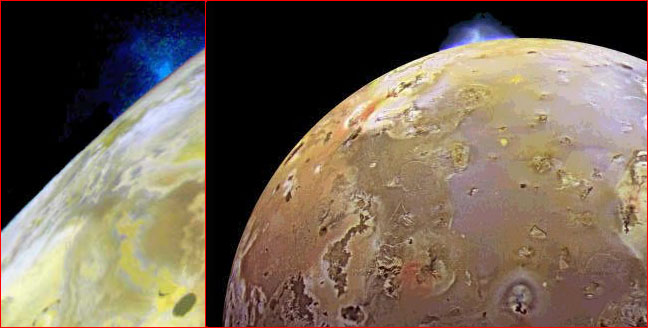
Easy to say. "Much to the astonishment of mission scientists, it was discovered that the 'volcanic' plumes emit ultraviolet light, something inconceivable under normal conditions of volcanic venting."
2) No volcanoes have "drifted around" the surface of Io.
No, just the place where stuff comes out. "Since the Voyager observations in the late 1970s, Prometheus and the exposed regions have traveled more than 80 kilometers".
3) There have been migrations of Ionian eruption plumes (the gas/dust "geysers" above the surface).
"Migration" is a nice word. "Gas/dust" is a nice way to say "ejecta", if you have trouble forming the word "plasma".
4) We can quite readily explain this with simple thermophysics. Plasma or MHD has nothing to do with it.
Squint hard. "Cornell University astrophysicist Thomas Gold
5) Some people have claimed that MHD has influenced the shape of plumes, but we can't reconcile that with the observations of WHERE the fields interact with Io.
Because you don't, personally, know where and how fields interact with Io, they can't cause anything? The earth's magnetic field still surprises.
(Somebody said, "Theory is fine, but if your pet theory can't handle the observations, go back to the theory--the observations are rarely 'wrong'." I wonder who. Me, I'd start with the observations and see where they lead. A theory might suggest itself, later.)
6) Some have claimed that electric currents can cause the elevated temperatures of some of Io's volcanoes, but they haven't done the simple math to know that even at 100% efficiency, there simply isn't enough energy available, and AGAIN, the field lines don't intersect the high temperature volcanoes.
On the contrary. From Perratt & Dessler's pre-Galileo paper,"Filamentation of Volcanic Plumes on the Jovian Satellite Io":
"Plasma in Jupiter's magnetosphere injected from Io (the Io plasma torus) flows pas[t] Io with a speed of about 57 km/s. The magnetic field from Jupiter at Io is 1900 nT. The v x B voltage induced across Io (3620 km) is, therefore, 400 kV, and approximately 10^6 A was observed to be flowing out of the satellite.
So, not only is there "enough" energy available, the energy available actually matches observation of the energy consumed. Furthermore:
"the effluent ejection velocity as calculated from an expression for the sheath velocity in a plasma gun (0.893 km/s) is close to that observed for Prometheus, 0.49 km/s."
(Have you ever heard of a volcano ejecting material continuously, year upon year, at 1100 mi/hr? On earth (neglecting atmospheric drag) that would blast 15 mi high! Mt. St. Helens managed that, for a few seconds.) Furthermore, it always comes out around the edges of the blackened region, as predicted.
Your thermophysics have a long way to go. Your "field lines" seem not to be such an impediment, perhaps be
-
Re:Cracks me upIt's interesting to see these two statements so close to one another:
Theory is fine, but if your pet theory can't handle the observations, go back to the theory--the observations are rarely "wrong".
Electrical currrents don't do a damned thing to effect morphology.
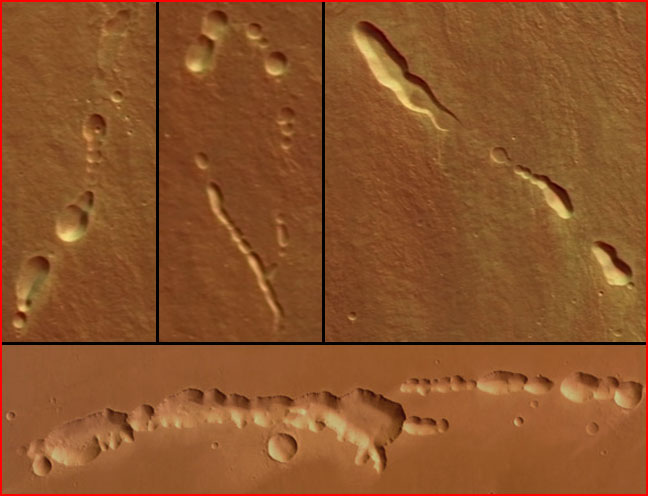
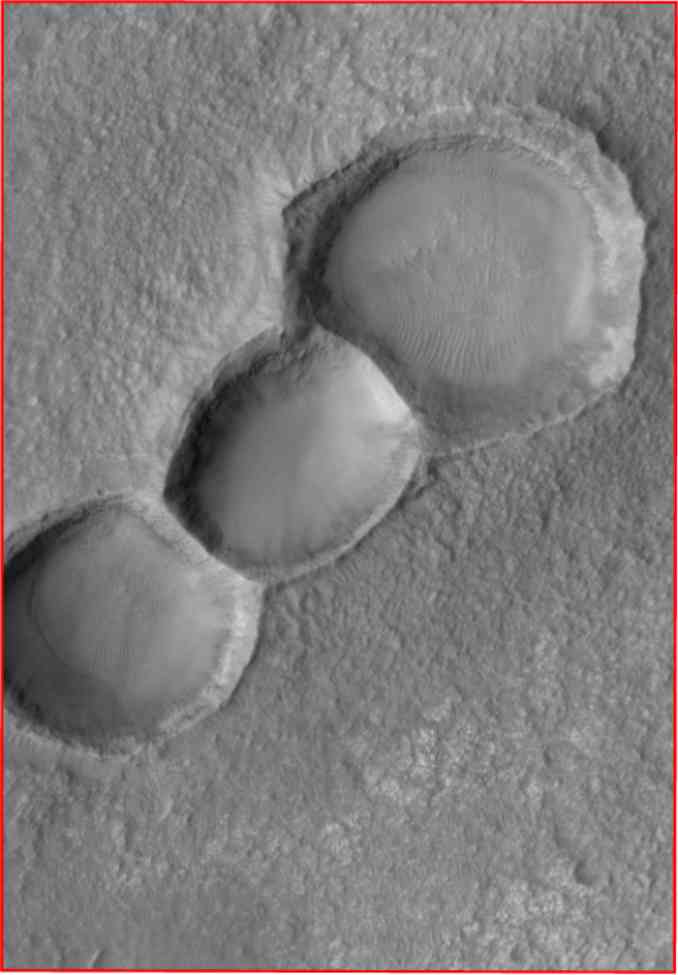
Observation is that there are whole lines of flat-bottomed, overlapping craters on Mars, consistent in human experience only with Electric Discharge Machining. Theory says that nothing much electromagnetic can ever have happened on Mars because the planet's intrinsic magnetic field is weak. Which wins?
Observation is that the explosion when comet Tempel was hit by a projectile was much, much larger than any of the principal experimenters predicted. Observation is that there was a flash (producing X-rays) long enough before any ejecta emerged for the projectile to have traveled a mile. Observation is that the ejecta contained essentially zero volatiles (also counter to every principal experimenter's predictions). Theory offers that the projectile burrowed a mile (or just a half?) through the (stony) comet before properly exploding, with no explanation for x-rays. Which wins?
Of course this doesn't prove these events were electromagnetic. All that has been proved is that the people making the announcements have disregarded better explanations for their observations, not from aversion to speculation, but because it would be personally inconvenient to learn enough to follow them up. All this would be benign if they didn't also sit on review committees reflexively rejecting papers and grant proposals that even mention the topic.