Slashdot Mirror
Domain: rfcafe.com
Stories and comments across the archive that link to rfcafe.com.
Comments · 22
-
Re: Won't damage the driver??
S band is perfectly fine for RADAR and comms; no water resonance. http://www.rfcafe.com/referenc...
-
Not so fast - what about range?
From TFA:
All of this sounds wonderful, but as usual there are some fairly sizeable catches to the promised performance improvement and as usual the press release doesn’t really touch on any of them. The biggest caveat is distance and indeed many such lab tests have measured the distance of their THz transmissions in centimetres, which is somewhat limiting.
A few teams are now starting to talk in terms of metres, but right now anything up to 10 metres can be a real stretch to achieve and even a big improvement over that still won’t cut it for Mobile communications. The idea of using THz for Satellite links is another highly contentious one because light cloud and rain could easily cause havoc.
Makes sense. The higher the frequency, the shorter the range due to attenuation (as another poster pointed out.) TFA talks about satellite links! Assuming they can get enough signal through water vapour, they'd probably need some hefty directional antennas.
This looks like a last-metre solution that could compete with Bluetooth. Anything longer than that is wishful thinking at this point.
-
Generating the power ... is impossible?!?!
So is space flight according to the NY Times - in 1920.
-
Re:Buy an rf jammer, become a drone collector
The whole 'water absorption' thing is mostly a myth. There is not a large absorption band at 2.4 GHz - that frequency was chosen specifically since it's in an ISM band where devices that generate and use RF for non-communications purposes are meant to live.
-
Re:Rare, but extant
Agreed. They are rare animals but they do exist. I had the benefit of working 15 years for a medium sized company with a culture of training and promoting the best engineers into management. Not all of them wanted or accepted promotions beyond department manager, but the VPs of Engineering, QA. Operations and Program Managment, and the General Manager all started their careers as engineers or scientists. The company paid for advanced degrees in Engineering and Management for anyone who wanted them (and kept good grades). Those who showed talent were promoted into management AND still got to hunt elephants.
But I didn't recognize how unusual that culture was until after leaving that company. My current employer is a small company micromanaged by two brilliant engineers who are horrible, horrible managers.
-
Re:Windtrap
Holy crap my experience as an ME comes in handy on
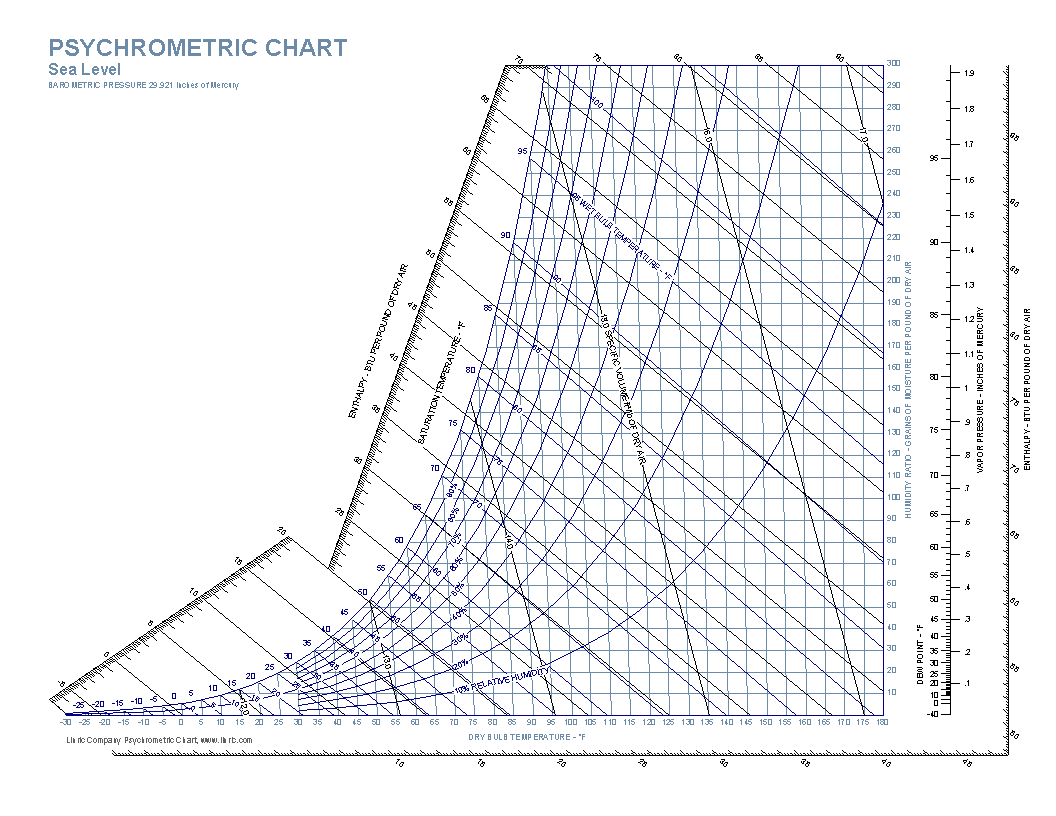
You are correct. You have to use energy to cool the air and the water in the air. But it's much easier to cool a mass of dry air than wet air. But you get less water out of dry air. You have to think of the air being cooled as wasted energy although some can be recovered by using the cool dry air to pre-cool the incoming moister air.. Also you have to cool the air to below it's dew point in order to get the water to condense. In dry air you have to cool it much further to get to the Dew Point.
Take a look at this psych chart. http://www.rfcafe.com/references/general/images/psychrom_chrt.gif
This tells you how much energy it takes to cool air from different states.
So lets take air at Death Valley. Right now it's about 70 F and 20% Humidity.
Looking on the chart you have:
Enthalpy 20 BTU/lb
Dew Point 30 F
1 lb of air you have 25 grains (.004 lb) of waterTake Orlando. Right now 80 F and 50% Humidity.
Looking on the chart you have:
Enthalpy 30 BTU/lb of air
Dew Point 60 F.
1 lb of air you have 80 grains (.011 lb) of waterSo the air in Orlando contains 3 times as much water per lb of air.
The energy required to cool it is 1.5 times as much per lb
You only have to cool 50% of the temperature difference (80-60) = 20 F vs (70-30) = 40 F.Now lets say you want to get 1000 liters = 2200 lb of water out of the air. Assume you will be able to reduce both to a humidity ratio of 10 grain/lb.
For Death Valley you will get 15 grain/lb of air so you need to cool 1,026,666 lbs of air.
Look on the chart for the before and after enthalpy and you get (20-5) Btu/lb = 15 BTU/lb
You need about 15 x 10^6 BTU to make 1000 liters.For Orlando you will get 70 grain/lb of air so you need to cool 220,000 lbs of air
Look on the chart for the before and after enthalpy and you get (30-5) Btu/lb = 25 BTU/lb
You need about 5.5 x 10^6 BTU to make 1000 liters. -
WAY over the ... limit
This thing is way over the maximum permissible exposure limit as allowed by the FCC unless exposure is limited to 150 mS per 30 minutes or so. Turning that on a crowd may be a lawsuit waiting to happen (as if you could sue the FedGov anyway).
The limits (as shown here) for uncontrolled/public access permit a 30 minute average of 1.0 mW/cm^2. This thing is running 12 W/cm^2. 0.15 secs exposure to this thing is your 30 minute averaged exposure. [The controlled access limit is the same 0.15 sec, but exposure can be repeated after only 6 minutes instead of 30].
Assuming 2MW (the low end of the spec), the antenna gain must be about 55 dB given the 12W/cm^2 at 700 yds = 2100 ft quoted in the article (using this calculator). This magnitude of gain figure is easily attainable at 95GHz and is also is justified given the apparent narrow beamwidth at 700 yds. Guess what the uncontrolled access compliance distance is? 44 MILES!!!.
-
Re:Speed=Good, but How About Distance?
Given what the tech industry has been able to make out of unlicensed use of the 2.4 GHz band (undesirable for commercial use due to water absorbing it and microwave ovens using it)
You're right about oxygen. It has a peak absorption at 63 GHz, but there isn't any thing special about water and 2.4 GHz. That's a myth that won't die. Water's peak is at 22 GHz.
-
Re:60GHz is available because its almost useless
Roger that. This fact has been known in microwave circles for decades, if not longer. For a classic absorption curve see: http://www.rfcafe.com/references/electrical/atm-absorption.htm Note where 60 GHz lies on the oxygen absorption curve. Though I have not worked in the area for a while, I presume that by now it is a lot easier to make transistors, amplifiers, receivers, etc at 60 GHz?
-
Re:WiFi is microwaves
But I would expect liquid water to have a continuous absorption spectrum, with no sharp peaks in it
RF absorption of water generally increase with higher frequencies. H2O has rotational frequencies at (ok, I googled it) 22.235 GHz and 183.31 GHz, so you have absorption peaks around those. http://www.rfcafe.com/references/electrical/atm_ab sorption.htm -
Re:this is great but...Since its for wireless communication and must use existing gear, the frequency has already been chosen for them.
But just in case, here's a graph of what is absorbed in the atmosphere by oxygen and water vapor:
http://www.rfcafe.com/references/electrical/atm_ab sorption.htm -
Re:Line of Sight?
The reason 60 GHz is a very questionable frequency to choose is do to the Oxygen (O2) absorption line present in the Earth's atmosphere. This means that an RF signal propagating through the atmosphere at a freq. of 60 GHz will be severly attenuated (up to 10,000 dB/km!). See http://www.rfcafe.com/references/electrical/atm_a
b sorption.htm for a plot of loss vs. frequency. This puts a serious damper on long-range communications! -
Re:Really? Bullshit!Quit trying to misrepresent what happened.
Anyone who cares to google will get the company's history. They only published a sample, and not just in Mensa.
Or if you're too lzay to click, you could read this quote:
During its growth from 700 employees in 2002 to over 2700 in 2004, prospects were subject to grueling thought process, logic, and spatial orientation challenges. The 21-question test, examples of which have been published in such lofty editions as MIT's Technology Review, Mensa Magazine, and Physics Today
In other words, google was already in business for over half a decade, and already had 700 employees, when they advertised in a bunch of magazines (and not just Mensa). -
Re:Really? Bullshit!Quit trying to misrepresent what happened.
Anyone who cares to google will get the company's history. They only published a sample, and not just in Mensa.
Or if you're too lzay to click, you could read this quote:
During its growth from 700 employees in 2002 to over 2700 in 2004, prospects were subject to grueling thought process, logic, and spatial orientation challenges. The 21-question test, examples of which have been published in such lofty editions as MIT's Technology Review, Mensa Magazine, and Physics Today
In other words, google was already in business for over half a decade, and already had 700 employees, when they advertised in a bunch of magazines (and not just Mensa). -
Re:Also today...
Not to mention 1s and 0s (ripped from the onion)
-
Re:Not actually based on a joke.
The choice of 2450 MHz has more to do with it being in an ISM (Industrial, Scientific, Medical) band where powerful magnetrons were plentiful and leakage regs are way more relaxed. The article you quote points this out down in the blue text labeled "Dan Writes..."Water's absorption of approx
-
Re:High frequency EMR?
Substances present different levels of opacity based on wavelength. Our atmosphere is fairly transparent to the portion of it we detect with our eyes, but is horribly opaque at many other frequencies (like 24 and 60 GHz).Many plastics that are visible light opaque serve happily as crystal-clear infrared lenses.
-
Re:No really.
It has to do with the radiation pattern from the antenna. It's not like sound or light - it doesn't go equally in all directions (like you would think it would) from a seemingly omnidirectional antenna.
Even an omni dipole has "lobes". And they're different depending on the axis you're viewing.
Reference: http://www.rfcafe.com/references/electrical/antenn a_patterns.htm -
Possible Answer: FrequencyF*ing A. my phone does that too. i usually fall asleep with the stereo playing a short playlist off my computer. It's a very rude awakening when i get an early phone call. I can also usually know when i have a call because the stereo buzzes for a second before the phone actually rings.
Some of the brighter
Yea, so: I think it's possible that your phone is on the higher frequencies while the other two aren't. I know for a fact my cell is @ 1900MHz and that i really hate it when people call before 9.
As a bonus, I discovered yesterday that the cordless phones in our house drown out my wifi cable modem. What a trip. Isn't it wonderful how they're both at 2.4GHz.
-
Re:Microsoft to Patent 1s, 0s
Give credit where credit is due, coward!
I guess you overlooked the link at the bottom of the message... -
Some Basic Info on 7X-9X GhzThe article had some factual errors (what articles don't). First the current usable bandwidth is about 1.25Gbps (BITS not BYTES) per second. Oddly (or not
The FCC is co primary with this band with the US Govmnt, and its unlikely that the govmnt will let them auction it off. An ideal situation would be a nominal license for specific link. The beams are so narrow that they are mostly non interfering (unlike 2.4Ghz, etc...), so this would make the most sense. Hard to say what will actually happen though.
The spectrum at this range has some interesting properties:
- Low atmospheric absorbtion Atmospheric absorption chart As you can see here this is right above the 60Ghz spike. This means that its better than laser, better than 60Ghz, and there is more spectrum available than the messy little swamp in the lower spectrum ranges.
- Highly directional. This means that you can get a LOT more gain for a comparable dish size.
- Dust doesn't really affect it (in fact it
goes through most walls quite nicely as well, not
counting brick
There are also a few problems- Rain is an issue. Fortunately with the high gain you can still get 2-5 miles (depending on the area) with up to 5 9's in most of the country (based on statistical analysis of rainfall). Most people don't need that high of reliability anyway, so for reasonable line of site distances the point is moot.
- They are hard to aim. Aiming a heavy 4 foot dish to hit a less than 200 foot target (.125 degree beam) 9 miles away is non trivial, but it is doable, and I've been at installations that handled up to 70Mph winds just fine.
Overall its pretty cool stuff. I wouldn't expect to see it replacing your DSL line at home any day soon, but for point to point business links, it rocks.
-
Re:electrocution? I don't think so.