Slashdot Mirror
Domain: rice.edu
Stories and comments across the archive that link to rice.edu.
Stories · 40
-
Graphene-Based Coating Could Act As a Real-time De-Icer For Aircraft (rice.edu)
hypnosec writes: Researchers have developed a graphene-based coating they have proved effective at melting ice from a helicopter blade, paving the way for a real-time de-icer. The thin coating of graphene nanoribbons in epoxy has been developed by researchers at Rice University. In their tests, researchers show the coating is capable of melting centimeter-thick ice from a static helicopter rotor blade in a -4 degree Fahrenheit environment. A small voltage was applied to the coating that delivered electrothermal heat — called Joule heating — to the surface, which melted the ice. -
Be True To Your CS School: LinkedIn Ranks US Schools For Job-Seeking Programmers
theodp writes "The Motley Fool reports that the Data Scientists at LinkedIn have been playing with their Big Data, ranking schools based on how successful recent grads have been at landing desirable software development jobs. Here's their Top 25: CMU, Caltech, Cornell, MIT, Princeton, Berkeley, Univ. of Washington, Duke, Michigan, Stanford, UCLA, Illinois, UT Austin, Brown, UCSD, Harvard, Rice, Penn, Univ. of Arizona, Harvey Mudd, UT Dallas, San Jose State, USC, Washington University, RIT. There's also a shorter list for the best schools for software developers at startups, which draws a dozen schools from the previously mentioned schools, and adds Columbia, Univ. of Virginia, and Univ. of Maryland College Park. If you're in a position to actually hire new graduates, how much do you care about applicants' alma maters? -
New Threadlike Carbon Nanotube Fiber Unveiled
Zothecula writes "At about 100 times the strength of steel and a sixth the weight, with impressive electrical conductive properties, carbon nanotubes (CNTs) have promised much since their discovery in 1991. The problem has been translating their impressive nanoscale properties into real-world applications on the macro scale. Researchers have now unveiled a new CNT fiber that conducts heat and electricity like a metal wire, is very strong like carbon fiber, and is flexible like a textile thread." -
Crushed Silicon Triples Life of Li-Ion Batteries In the Lab
derekmead writes "Batteries rule everything around us, which makes breakthroughs a big deal. A research team at Rice says they have produced a nice jump: by using a crushed silicon anode in a lithium-ion battery, they claim to have nearly tripled the energy density of current li-ion designs. Engineer Sibani Lisa Biswal and research scientist Madhuri Thakur reported in Nature's Scientific Reports (it has yet to be published online) that by taking porous silicon and crushing it, they were able to dramatically decrease the volume required for anode material. Silicon has long been looked at as an anode material because it holds up to ten times more lithium ions than graphite, which is most commonly used commercially. But it's previously been difficult to create a silicon anode with enough surface area to cycle reliably. Silicon also expands when it's lithiated, making it harder to produce a dense anode material. After previously testing a porous silicon 'sponge,' the duo decided to try crushing the sponges to make them more compact. The result is a new battery design that holds a charge of 1,000 milliamp hours per gram through 600 tested charge cycles of two hours charging, two hours discharging. According to the team, current graphite anodes can only handle 350 mAh/g." -
Researchers Spray-Paint Batteries Onto Almost Any Surface
Warmlight writes "Rice University researchers have created a type of lithium-ion battery that can be spray-painted onto most surfaces. 'Their batteries, outlined in Scientific Reports (abstract), are made up of five separate layers, each with its own recipe — together measuring just 0.5mm thick. To demonstrate the technique, the team painted batteries onto steel, glass, ceramic tile and even a beer stein.' What do you think this will do for future form-factors? Maybe a form-fitting PipBoy-style device that doesn't weigh 30lbs?" -
'Inexact' Chips Save Power By Fudging the Math
Barence writes "Computer scientists have unveiled a computer chip that turns traditional thinking about mathematical accuracy on its head by fudging calculations. The concept works by allowing processing components — such as hardware for adding and multiplying numbers — to make a few mistakes, which means they are not working as hard, and so use less power and get through tasks more quickly. The Rice University researchers say prototypes are 15 times more efficient and could be used in some applications without having a negative effect." -
Full Duplex Wireless Tech Could Double Bandwidth
CWmike writes "Rice University researchers announced on Tuesday that they have successfully demonstrated full-duplex wireless tech that would allow a doubling of network traffic without the need for more cell towers. Professor Ahutosh Sabharwal said the innovative technology requires a minimal amount of new hardware for both mobile devices and networks. However, it does require new standards, meaning it might not be available for several years as carriers move to 5G networks, he added. By allowing a cell phone or other wireless device to transmit data and receive data on the same frequency, unlike with today's tech, the new standard could double a network's capacity. Rice has created a Wireless Open-Access Research Platform (WARP) with open source software that provides a space for researches from other organizations to innovate freely and examine full-duplex innovations." -
Full Duplex Wireless Tech Could Double Bandwidth
CWmike writes "Rice University researchers announced on Tuesday that they have successfully demonstrated full-duplex wireless tech that would allow a doubling of network traffic without the need for more cell towers. Professor Ahutosh Sabharwal said the innovative technology requires a minimal amount of new hardware for both mobile devices and networks. However, it does require new standards, meaning it might not be available for several years as carriers move to 5G networks, he added. By allowing a cell phone or other wireless device to transmit data and receive data on the same frequency, unlike with today's tech, the new standard could double a network's capacity. Rice has created a Wireless Open-Access Research Platform (WARP) with open source software that provides a space for researches from other organizations to innovate freely and examine full-duplex innovations." -
Researchers Make Graphene From Girl Scout Cookies
An anonymous reader writes "Last year we learned that the miracle material graphene could be made from common table sugar, and now researchers at Rice University have taken the discovery one step further by literally baking it from a box of girl scout cookies. A group of graduate students led by chemist James Tour recently teamed up with Houston Girl Scout troop 25080 to perform the feat using a single box of Trefoil cookies — which could potentially yield $15 billion worth of graphene." -
Students Invent Revolutionary Solar Sterilizer
greenerd writes "Engineering students at Rice University have solved a huge health concern in developing countries by creating a device that uses the sun to sterilize medical instruments. This invention could help prevent the spread of infection and illness in clinics around the world without access to proper sterilization tools." -
Microchips With Multiple "Selves"
Stony Stevenson brings news from Rice University about designing integrated circuits with multiple distinct identities, which could be used in new types of hardware-based DRM, among other things. From the news release: "'With "n-variant" integrated circuits, it is possible to design portable media players that are inherently unique,' said Farinaz Koushanfar, assistant professor of electrical and computer engineering at Rice and principal investigator on the project. 'New methods of digital rights management can be built upon such devices. For example, media files can be made such that they only run on a certain variant and cannot be played by another.' Koushanfar said content providers could also use n-variant chips to sell metered access to software, music or movies because the chips can be programmed to switch from one variant to another at a particular time or after a file has been accessed a certain number of times." -
Buckyballs Can Store Concentrated Hydrogen
Pickens brings news that researchers from Rice University have discovered that it's possible to store hydrogen inside buckyballs. Hydrogen can be an excellent power source, but it is notoriously difficult to store. The buckyballs can contain up to 8% of their weight in hydrogen, and they are strong enough to hold it at a density that rivals the center of Jupiter. "Using a computer model, Yakobson's research team has tracked the strength of each atomic bond in a buckyball and simulated what happened to the bonds as more hydrogen atoms were packed inside. Yakobson said the model promises to be particularly useful because it is scalable, that is it can calculate exactly how much hydrogen a buckyball of any given size can hold, and it can also tell scientists how overstuffed buckyballs burst open and release their cargo." -
Researchers Developing Single-Pixel Camera
Assassin bug writes "According to the BBC, researchers in the US are developing a single-pixel camera to capture high-quality images without the 'expense' of traditional digital photography. The idea behind such a device is that traditional digital photography is wasteful. Most of the information taken in by the camera is thrown away in the compression process. From the article: 'The digital micromirror device, as it is known, consists of a million or more tiny mirrors each the size of a bacterium. "From that mirror array, we then focus the light through a second lens on to one single photo-detector - a single pixel." As the light passes through the device, the millions of tiny mirrors are turned on and off at random in rapid succession. Complex mathematics then interprets the signals assembling a high resolution image from the thousands of sequential single-pixel snapshots. '" -
Faster Feeds Using FeedTree Peer-To-Peer
dsandler writes "Researchers at Rice University have just released version 0.7 of FeedTree, a peer-to-peer system for distributing Web feeds faster. Instead of polling feeds independently, FeedTree users cooperate to share news updates using multicast in Pastry, a scalable p2p overlay network. FeedTree reduces the update delay for existing RSS and Atom feeds to a few minutes without putting extra stress on the webserver (anyone who's ever been temporarily banned by Slashdot's RSS feed knows this is a real concern). Feed publishers can also choose to push digitally signed updates for immediate, tamper-proof delivery to subscribers. The client software (download) runs on Linux, OS X, and Windows, and works with any desktop feed reader." -
World's Largest Nanotube Model
darthpenguin writes "A group at Rice University has completed building the world's largest Nanotube model. Rice University is a leader in this revolutionary field involving nanotubes and buckyballs, which have the potential to revolutionize certain areas of science. The completed model, a full 360 meters in length, has been accepted by the Guinness Book of World Records." -
World's Largest Nanotube Model
darthpenguin writes "A group at Rice University has completed building the world's largest Nanotube model. Rice University is a leader in this revolutionary field involving nanotubes and buckyballs, which have the potential to revolutionize certain areas of science. The completed model, a full 360 meters in length, has been accepted by the Guinness Book of World Records." -
World's Largest Nanotube Model
darthpenguin writes "A group at Rice University has completed building the world's largest Nanotube model. Rice University is a leader in this revolutionary field involving nanotubes and buckyballs, which have the potential to revolutionize certain areas of science. The completed model, a full 360 meters in length, has been accepted by the Guinness Book of World Records." -
Academic Survey for Cash
Dr. Paul Dholakia writes "Drs. Richard Bagozzi, Paul Dholakia, and Rene Algesheimer are management and psychology faculty at Rice University and the University of Zurich. We are conducting an academic survey of online gamers and MUD players. This survey is specifically about interactions among friends who play online games and/or MUD together, and for this reason must be completed by groups of three friends. The survey takes approximately twenty minutes to complete, and the survey is available here. We are paying $10 to each participant provided they and two of their friends each complete the survey individually. We will pay participants the money upon completion of the survey by the group, either through Paypal, or by mailing them a personal check." -
Perseid Meteor Shower This Week
fejikso writes "Space Daily and the BBC announce the coming of the annual Perseid meteor shower, and forecasters say it could be unusually good. The cosmic spectacle is produced by the debris left by the comet Swift-Tuttle. When the shower peaks, by August 12, sky watchers can expect to see dozens, possibly even hundreds, of meteors per hour." -
Nanotechnology: the Good, the Bad, the Hyperbole
pillageplunder writes "A very informative interview with Kristen Kulinowski who is an executive Director at the Federally funded Center for Biological and Environmental Nanotechnology at Rice University. A good well balanced read." -
May The Force (of Mayonnaise) Be With You!
Roland Piquepaille writes "A team of chemists at Rice University was working last year on two separate projects: trying to create strong fibers from carbon nanotubes, and testing emulsions of oil and water. And they discovered that a force known as 'negative first normal stress difference' was present in both solutions. The next step was to go to a grocery store and buy a more common emulsion, namely a jar of mayonnaise. And bingo! This force was also at work. They tell us more in this news release, "Bizarre Attractive Force Found in Mayonnaise." Unfortunately, they don't know what to do from their findings. Still, it's fun science. More details and references are available in this overview." -
NVRAM With Disordered Assemblies (Smaller/Cheaper)
chadjg writes " Jim Tour, of Rice University says "Our research shows that ordered precision isn't a prerequisite for computing. It is possible to make memory circuits out of disordered systems." The article on www.e4engineering.com says the team has made "NanoCells", self assembled devices made from gold nanowires and organic conductive molecules. These NanoCells are the first devices of their kind to be made into working microelectronic devices, apparently." Yep. Let an untold number of machines try to create NanoCells, and statistics says you'll find the most efficient kind. -
New Low Bandwidth Denial of Service Attacks
An anonymous reader writes "A paper from Rice University appearing at the 2003 ACM Sigcomm Conference presents a new denial of service attack where the attacker only needs to send at a low rate to shutdown TCP flows. The trick exploits the retransmission timeout mechanism in TCP. By sending small bursts of packets at just the right frequency, the attacker can cause all TCP flows sharing a bottleneck link to simultaneously stop indefinitely. And because the attacker only needs to burst periodically, the attacker will not be distinguishable from normal hosts. The presentation, and other presentations from the conference, are available online (live streaming)." -
Open Source Text-Books in California?
ebusinessmedia1 asks: "The California Open Source Textbook Project (COSTP) was created a few years ago in an attempt to help California's educational bureaucracy understand the value of open-sourced, K-12 textbook development, and we are an official collaborator with Creative Commons. COSTP could, within 6-8 years, save California up to $400M+ per year in K-12 textbook costs. (in addition to 100's-of-millions more saved in other states). We're looking for further ideas on how we might push this forward, promote it through something like the Connexions Project http://cnx.rice.edu/ at Rice University, work with enlightened for-profits on an open-source K-12 textbook model, get a test piloted, or somehow get the project bumped up a notch, funded, etc. Ideas anyone?""Our project has been lobbied/promoted to every level of government and education in California, from the Governor's office, and the legislature, on down. I hear 'this is a great idea' from many people in government, but not a single government agency or legislator (who agree the project has legs) - not even the California Teacher's Assn. - wants to promote it as an initiative in the legislature.
Nobody wants to upset the status quo, where commercial publishers - in a virtual oligopoly - create costly textbook products that have risen at three times the rate of inflation since 1992. It's not unusual for K-12 books to cost 2-3 times what books with similar content would cost in a trade (regular) bookstore." -
Denial of Service via Algorithmic Complexity
dss902 writes "We (Department of Computer Science, Rice University) present a new class of low-bandwidth denial of service attacks that exploit algorithmic deficiencies in many common applications' data structures... Using bandwidth less than a typical dialup modem, we can bring a dedicated Bro server to its knees; after six minutes of carefully chosen packets, our Bro server was dropping as much as 71% of its traffic and consuming all of its CPU. We show how modern universal hashing techniques can yield performance comparable to commonplace hash functions while being provably secure against these attacks." -
Denial of Service via Algorithmic Complexity
dss902 writes "We (Department of Computer Science, Rice University) present a new class of low-bandwidth denial of service attacks that exploit algorithmic deficiencies in many common applications' data structures... Using bandwidth less than a typical dialup modem, we can bring a dedicated Bro server to its knees; after six minutes of carefully chosen packets, our Bro server was dropping as much as 71% of its traffic and consuming all of its CPU. We show how modern universal hashing techniques can yield performance comparable to commonplace hash functions while being provably secure against these attacks." -
New Book Says The Meter Is all Wrong
Bill Klemm writes "Ken Alder's new book 'The Measure of All Things' scandalizes the metric system as 'arbitrary.' CNN has a little article about a new book that explores the 'odyssey' of Delambre and Mechain to find the perfect unit of measure." -
802.11 Networks, The Definitive Guide
cpfeifer writes with the review below of O'Reilly's 802.11 Wireless Networks: The Definitive Guide; he warns that this is not a book for everyone setting up a casual home wireless network, but says it's excellent for its intended audience. Read on for his complete review. 802.11 Wireless Networks : The Definitive Guide author Matthew S. Gast pages 443 publisher O�Reilly & Associates rating 9/10 reviewer cpfeifer ISBN 0-596-00183-5 summary A thorough survey of the features, issues and potential solutions of deploying 802.11 based wireless networks.
The ScenarioFor a lot of folks, implementing an 802.11 network involves selecting and purchasing an access point and adapter cards, and installing or compiling the proper drivers. From there, we are off and running, usually in under an hour. However for the few, the proud, the sysadmins of the world it's a whole different ballgame. Sysadmins need a deeper understanding of network technologies to be able effectively design, deploy and debug them.
What's Bad?Most of the book is right on the mark when it comes to the sysadmin audience, however chapters 8 (the PCF, for contention free service), 10 (the ISM PHYs) and 11 (802.11a overview) are only of interest to folks who are implementing 802.11 hardware, IMHO. These chapters contain very low-level material about the 802.11 transmission protocol, and will not be generally useful since equipment manufacturers do not provide access to this layer. A dead giveaway that you can skip over chapter 8 is the phrase "The PCF has not been widely implemented." If it's not widely implemented, chances are you won't have the option of using it in a deployment.
After this bellycrawl through the weeds, chapters 12 and 14 give click-by-click instructions for installing two commercially available 802.11 access point/client adapter pairs on your Windows box. The selected products are Nokia's A032 Access Point along with their C110/C111 and Lucent's Orinoco (formerly WaveLan) Access Point and client adapter. It's worth noting that these are two of the most expensive 802.11 solutions available on the market and have enhanced features that are not present in other models. These chapters are simply rehashed vendor installation documentation for these products and provide very little added value. There's nothing that I hate more than paying $30-$50 for a book which repackages documentation that is freely available on the web. Skip these chapters; the rest of the book is excellent.
What's Good?This book starts off with six strong chapters that cover the 802.11 protocol specification, why WEP is vulnerable, and some upcoming security specifications. The first six chapters are invaluable reading for any sysadmin that is planning (or already responsible) for an 802.11 deployment. This is your ammunition when users come and ask why the wireless network is slower than the wired network with fewer users (preventing contention adds more overhead in wireless) or why they really really should tunnel every wireless connection over SSH (because WEP is fundamentally flawed). The chapter that covers the current WEP implementation demystifies the "40 bit" vs. "64 bit" key-length sleight of hand that some vendors play. The standard WEP key length is 64 bits. However, 24 of those bits are used as WEP's initialization vector for the RC4 cipher. These bits aren't encrypted in an 802.11 packet, so by sniffing 802.11 traffic you can examine the IVs of the packets and see how many distinct keys are in use, and even retrieve the actual key once you have captured enough packets. AirSnort retrieves WEP keys by implementing the Fluhrer/Martin/Shamir attack (orig paper, Stubblefield paper). Chapter 16 covers using tools such as Airsnort and Ethereal to analyze the 802.11 traffic on your network. Remember to use your powers for good and not evil.
The final 3 chapters address deployment, analysis and tuning of 802.11 networks. These chapters, combined with the first six are the heart of this book and the whole motivation for buying the book. The analysis chapter has a particularly wonderful section about gathering user requirements with respect to 802.11 specific issues (security requirements, roaming ...) and a very practical section about physical installation that clearly illustrates the author's mastery of integrating 802.11 technologies into an existing infrastructure.
So What's In It For Me?If you're an sysadmin and implementing 802.11 technologies is on the horizon, this book is a solid reference of the current state of 802.11 solutions, both good and bad. It pulls no punches in presenting issues and weaknesses with the current solutions and documents forthcoming standards that are being proposed or developed to address them. If you're considering a smaller deployment at home, the security aspects of the text are still applicable, but the design/deployment sections are more rigorous than you will need. There is a bit of starch (repackaged vendor installation documentation) and unnecessary details (knowing that 802.11 frequency hopping uses Gaussian frequency shift keying is good for impressing women at parties, but doesn't really impact the design/deployment of an 802.11 network) but the other chapters redeem themselves and make this a very valuable text.
Table of Contents- Preface
- Introduction to Wireless Networks
- Overview of 802.11 Networks
- The 802.11 MAC
- 802.11 Framing in Detail
- Wired Equivalent Privacy (WEP)
- Security, Take 2: 802.1x
- Management Operations
- Contention-Free Service with the PCF
- Physical Layer Overview
- The ISM PHYs: FH, DS, and HR/DS
- 802.11a: 5-GHz OFDM PHY
- Using 802.11 on Windows
- Using 802.11 on Linux
- Using 802.11 Access Points
- 802.11 Network Deployment
- 802.11 Network Analysis
- 802.11 Performance Tuning
- The Future, at Least for 802.11
- 802.11 MIB
- 802.11 on the Macintosh
- Glossary
- Index
You can purchase 802.11 Wireless Networks : The Definitive Guide from bn.com. Slashdot welcomes readers' book reviews -- to submit yours, read the book review guidelines, then visit the submission page. -
Senate Hearing Wednesday on Webcasting Royalties
Anonymous Cowards rule writes: "RAIN is reporting that the fuss raised by save Internet radio, Save Our Streams and the recent webcaster's march on Washington has caught the attention of some in Congress. Specifically, the Senate Judiciary Committee has scheduled a hearing for Wednesday entitled, 'Copyright Royalties: Where is the Right Spot On The Dial For Webcasting.' The list of those who will testify (which is not yet complete) seems heavily weighted toward the RIAA and large content providers ... but it will still be interesting to see how this pans out. (Is Congress completely controlled by big business or just slightly?) Remember to mark your calendars for 21 May when the Librarian of Congress has to choose whether to accept, reject or ammend the current royalty rules (the NPRM which was a result of the CARP)." -
Wireless LAN Encryption Standard Broken
doug13 writes: "A Rice University student cracks 802.11x encryption protocol in a week. Here is how he did it." We mentioned the cryptographic paper that underlies this attack a few days ago. -
Plans To Peer At A Black Hole's Event Horizon
mattorb writes: "From the press release: "Scientists have designed and succesfully tested a new type of X-ray telescope that, when fully developed and placed in orbit, may capture the first images of a black hole and resolve images of nearby stars as clearly as we can see our own Sun today. The report is published in the Sept. 14 issue of Nature."Go here for more information on the project, which is known as the Micro Arcsecond X-ray Imaging Mission. Note that the proposed MAXIM mission would launch after 2010."
-
Amiga Update: When Will The Creature Awaken?
morton2002 writes: "I read an awesome interview of Amiga head honchos by IBM's developerWorks folks. (Linked to from a cool microprocessor news site, www.jc-news.com/pc.) They discuss Amiga's new technology and marketing tactics, suitably referred to as the 'new Amiga.' Instead of developing new Amiga hardware, they're using a code-morphing virtual-machine to run on existing platforms ... but most notably it will translate their 'VP' code into native instead of interpreting it, running blindingly fast! Not only that, they'll be bringing awesome hardware acceleration to OSes like Linux when they port their VP translators to various videocard processors, allowing the 'new Amiga' to run directly on graphics-intensive hardware ... just like it used to!"Reader Upsilon points to the same interview, saying "I have to admit, some of the stuff sounds very interesting, but it is hard not to be skeptical." (Anyone holding your breath, please raise your right hand so you can be counted before you keel over.)
-
Id Auctioning Off SGI That Created Q2 And Q3A
shiwala writes: "id software is auctioning the SGI Origin 2000 used to process all of the map data for Quake II and Quake III Arena." Hemos and I have been debating auctioning off the case that was the 2nd Slashdot (for a six months). I've been trying to find the alpha that was Slashdot for the first 9 months of its life (it served the first million pages: if I only knew that we would serve that many pages every day). Probably donate the $ to the FSF or Project Gutenberg or something. Anyway this id box amuses me: opening bid is $7500. -
Answers About The New NOAA Massive Linux Cluster
On May 23 we requested questions for Greg Lindahl, chief designer of the new NOAA Forecast Systems Laboratories massive Alpha Linux Cluster. Here are his answers. Fascinating stuff for people interested in big-time parallel computing.Who Else?
(Score:4, Insightful)
by AlarmistYou've built a large cluster of machines on a relatively pea-sized budget.
Are other government agencies going to duplicate your work? Have they already? If so, for what purposes?
Greg:
There are a lot of government agencies building large clusters, such as the Department of Energy's Sandia National Lab, which has the 800+ processor CPlant cluster today, with another 1,400 processors on the way. Like FSL, they use their cluster for scientific computing. The well-known Beowulf clusters started within NASA, another U.S. government agency.
However, the Forecast Systems Lab (FSL) system is a bit different from these other clusters: it's intended to be a production-quality "turn key" supercomputer, and it contains all the things supercomputer users are used to, such as a huge robotic tape storage unit (70 terabytes of tapes), and a fast disk subsystem (a bandwidth of 200 megabytes/second.) The FSL system is also much more reliable than your average cluster -- in its first three months of operation, it was up 99.9% of the time. During that time we had quite a few hardware failures (due to a power supply problems), but no work was lost, because of our fault-tolerant software.
Beowulf in General
(Score:4, Interesting)
by BgJonson79How do you think the new wave of Beowulf clusters will affect all of supercomputing, not just forecasting?
Greg:
The kinds of problems that scientists solve have different computational needs. In the mid 1970's, the most cost effective machine to use for just about any problem was a Cray supercomputer. These days, desktop PCs far are cheaper per operation than the "big iron", so that's why this interest in clusters has sprung up. The availability of production-quality commodity clusters like the FSL machine is a new development in the field.
IBM already sells IBM's idea of a commodity cluster; it uses IBM's RS/6000 business servers as building blocks. I think commodity clusters can deliver far more bang for the buck as an IBM SP supercomputer, but then again I am a cluster evangelist.
In the beginning...
(Score:5, Interesting)
by zpengoHow did you come to be the project's chief designer? I'm curious to know the background of anyone who gets to work on such an interesting project.
Greg:
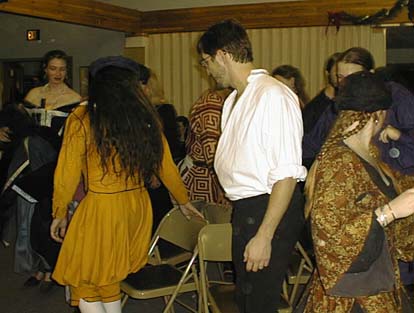
Well, let's see: I'm a dropout from an Astronomy PhD, and for fun I dress up in funny clothes (I'm the one in yellow) and play the hurdy gurdy. I've only taken one computer science class since I started college. I assure you that you're never going to meet anyone much like me in this field.
Seriously, I've worked in scientific computing for quite a while, and I've had a chance to work with a lot of people and learn from them. I was also helped quite a bit learning about distributed systems while working on IRC and later, the Legion distributed operating system. The art of designing a system like this is understanding the customer's needs, understanding what solutions are possible, and understanding what can actually be delivered, be made reliable, and hit the budget.
In addition, it's worth pointing out what this sort of project involves. Most of the interesting development parts are done by other people. Compaq designed the Alpha processor, and they and legions of Linux hackers provided Linux on the Alpha. Compaq supplied their extremely good compilers (FSL mostly uses Fortran.) Myricom supplied the interconnect and an MPI message-passing library which was optimized for their interconnect. HPTi provided the software glue that turned all this into a complete, fault-tolerant system. Without all these great building blocks, we would never have been able to produce this system.
The Future of the Control Software
(Score:5, Interesting)
by PacketMasterI built a Beowulf-style cluster this past semester in college for independent study. One of the biggest hurdles we had was picking out a message passing interface such as MPI or PVM. Configuring across multiple platforms was then even worse (we had a mixture of old Intels, SunSparcs and IBM RS/6000's). What do you see in the future for these interfaces in terms of setup and usage and will cross-platform clusters become easier to install and configure in the future?
Greg:
We provided an easy-to-use set of administrator tools so that the Forecast Systems Lab (FSL) cluster can be administered as if it were a single computer. This is a fairly difficult to do if you have a big mix of equipment, but the FSL system will never become that complex. There's already been a lot of development of programs for administering large clusters of machines; they just tend to not get used by other people. I'll admit that I'm part of that problem; I took some nice ideas from other people's tools, added some of my own, and re-invented the wheel slightly differently from everyone else.
Beowulf Alternatives?
(Score:5, Interesting)
by vvulfeBefore deciding on a Beowulf clusters, what different options did you explore (Cray? IBM?), and what motivated you to choose the Beowulf System?
Additionally, to what would you compare the system that you are planning to build, as far as computing power is concerned?
Greg:
The company I work for, HPTi, is actually a systems integrator, so we didn't decide to go out and build our own solution until we had checked out the competition and thought they didn't have the right answer. For the computational core of the system, Alpha and Myrinet were much more cost effective than the Cray SV-1, the IBM SP, and the SGI O2000. A more cost-effective machine gives the customer more bang for their buck.
I'd compare the system that we built to the IBM SP or the Cray T3E, as far as computing power is concerned. Both are mostly programmed using the same MPI programming model that FSL uses, which is the main programming model that we support on our clusters.
Biggest whack in the head?
(Score:5, Insightful)
by technosHaving built a few small ones, I got to know quite a bit about Linux clusters, and about programming for them. Therefore, this question has nothing to with clusters.
What was the biggest 'WTF was I thinking' on this project? I'd imagine there was a fair amount of lateral space allowed to the designers, and freedom to design also means freedom to screw up.
Greg:
We actually didn't make that many mistakes in the design. We had some wrong guesses about when certain technology was going to be delivered -- the CentraVision filesystem (more about that below) for Linux arrived late, and we had to work with Myrinet to shake out some bugs in their new interconnect hardware and software. Our biggest problem with our stuff was actually getting the ethernet/ATM switches from Fore Systems to talk to each other!
Imagine ...
(Score:4, Interesting)
by (void*)... a beowulf of these babies - oh wait! :-)
Seriously, what was the most challenging of maintenance tasks you had to undertake? Do you anticipate that a trade off point where the number of machines makes maintenance impossible? Do you have any pearls of wisdom for those of us just involved in the initial design of such clusters, so that maintaining it in the future is less painful?
Greg:
Hardware maintenance of the FSL machine actually isn't hard at all. If a computational node fails, we have a fault tolerance daemon which removes the failed node from the system and restarts the parallel job that was using that node. The physical maintenance of a few hundred machines actually isn't so bad; these Alphas came with three-year on-site service from Compaq. (Hi, Steve!)
More interesting than hardware maintenance is software maintenance. You can imagine how awful it would be to install and upgrade 276 machines one by one. Instead, we have an automated system that allows the system admin to simultaneously administer all the machines. We suspect that these tools could scale to thousands of nodes; after all, they're just parallel programs, like the weather applications that the machine runs.
Question about maintenance.
(Score:5, Interesting)
by Legolas-GreenleafA major problem with using a beowulf cluster over a single supercomputer is that you now have to administer many computers instead of just one. Additionally, if something is failing/misbehaving/etc., you have to determine which part of the cluster is doing it. I'm interested a] how much of a problem this is over a traditional single machine supercomputer, b] why you chose the beowulf over a single machine considering this factor, and c] how you'll keep this problem to a minimum.
Besides that, best of luck, and I can't wait to see the final product. ;^)
Greg:
You haven't described a problem, you've described a feature.
We've provided software that allows administration of the cluster as if it was one machine, not many. This software also allows FSL to test new software on a portion of the machine, instead of taking the whole thing down. The software on the machine can also be upgraded while the machine is running, instead of requiring downtime.
Since the hardware is fairly simple, it's actually quite easy to find a misbehaving piece of hardware. And in this kind of system, a hardware failure only takes out a small portion of the machine.
For example, on an SGI O2000 or similar large shared-memory computer, a single CPU or RAM chip failure takes out the entire machine. The interconnect on an O2000 is not self-healing like the interconnect we used, Myrinet. These features make a cluster more reliable than a "single machine".
Why alpha?
(Score:5, Insightful)
by crowWhy did you choose Alpha processors for the individual nodes? Why not something cheaper with more nodes, or something more expensive with fewer nodes? What other configurations did you consider, and why weren't they as good?
Greg:
We did a lot of benchmarking before settling on Alphas for this particular system -- in general we're processor agnostic, happily using whatever gives the highest performance for each customer. We could have bought more nodes if we had gone with Intel or AMD, but the total performance would have been much lower for this customer.
The Future of Scientific Programming?
(Score:5, Interesting)
by Matt GleesonThe raw performance of the hardware being used for scientific and parallel programming has improved by leaps and bounds in the past 10-20 years. However, most folks still program these supercomputers much the same way they did in the 80's: Unix, Fortran, explicit message passing, etc.
You have worked in research with Legion and in industry at HPTi. Do you think there is hope for some radical new programming technology that makes clusters easier for scientists to use?
If so, what do you think the cluster programming environment of tomorrow might look like?
Greg:
Actually, in the end of the 1980's, Unix was new in the supercomputing scene, and most sites still used vector machines. It's only in the 1990s that microprocessors and MPI message-passing have become big winners. And that's because of price-performance, not because it's easier to use than automatic vectorizing compilers. Ease of use for supercomputers reached its peak around 1989.
I do think there's hope of new approaches, however. One great example is the SMS software system developed at FSL. This software system is devoted to make it easy to write weather-forecasting style codes, and involves adding just a few extra lines of source code to parallelize a previously serial program. The result can sometimes efficiently scale to hundreds of processors, still can run on only one processor, and FSL has enough experience with non-parallel-programming users to know that they can change working programs and end up with a working program. (If you've ever heard of HPF, then this is somewhat like HPF, except it actually works.)
Today, the best programming environments are ones that hide message-passing, either in specialized library routines or using a preprocessor approach like SMS. By the way, Legion allows you to program distributed objects with minimal source code changes. I expect more of the same thing in the future.
My crystal ball isn't good enough to tell me what the next revolutionary change will be. I'm actually pretty happy with the evolutionary changes I've seen recently.
Job management
(Score:4, Interesting)
by gcoatesOne of the weaknesses for beowulfs seems to me to be a lack of decent (job) management software. How do you split the clusters resources? Do you run one large simulation on all the CPUs, or do you run 2 or 3 jobs on 1/2 or 1/3 of the available CPUs?
Is there provision for shifting jobs onto different nodes if one of them dies during a run?
Greg:
We use the PBS batch system to manage jobs; it handles splitting the cluster resources among the jobs. At FSL, there are typically 10+ jobs running at the same time; the average job uses around 16 out of the 264 compute nodes.
If a compute node dies during a run, a HPTi-written reliability daemon marks the dead node as "off-line" and restarts the job. The user never knows there was a failure.
Weather forecasting in general.
(Score:5, Interesting)
by Matt2000Ok, a two parter:
As I understood it weather models are a fairly hard thing to paralleliz (how the hell do you spell that?) because of the interdependence of pieces of the model. This would seem to me to make a Beowulf cluster a tough choice as it's inter-CPU bandwidth is pretty low right? And that's why I thought most weather prediction places chose high end super-computers because of their custom and expensive inter-CPU I/O?
Greg:
Weather models are moderately hard to parallelize; in order to process the weather in a given location, you need to know about the weather to the north, south, east, and west. For large numbers of processors, this does require more bandwidth than fast ethernet provides, and that's why we used the Myrinet interconnect, which provides gigabit bandwidth, and which scales to thousands of nodes with high bisection bandwidth, unlike gigabit ethernet.
As far as disk I/O goes, yes, most clusters are fairly weak at disk I/O compared to traditional supercomputers from Cray. We are using the CentraVision filesystem from ADIC along with fibre channel RAID controllers and disks. This is more expensive than normal SCSI or IDE disks, but provides much, much greater bandwidth for our shared filesystem.
Second part: Is weather prediction getting any better? Everything I've read about dynamic systems says that prediction past a certain level of detail or timeframe is impossible. Is that true?
Greg:
The quality of a weather prediction depends on a lot of things: the quality of the input data, which has gotten a lot better with the new satellites and other data collection systems recently deployed; the speed of the computer used to run the prediction; the quality of the physics algorithms used in the program, which have to get better and better as the resolution gets finer and finer; and the expertise of the human forecaster who interprets what comes out of the machine. All of these areas have limits, and that's why forecasts have limits.
What about a dnet type client?
(Score:5, Interesting)
by x0I am curious as to whether (no pun intended...:)) or not you have ever done any testing to see if a distributed.net type environment would be useful for your type of work?
It seems to me that there are more than a few people who are willing to donate spare cpu cycles for various projects. At a minimum. you could concentrate on the client side binaries and not worry as mouch about hardware issues.
Greg:
Most supercomputers, like the FSL system, are in use 100% of the time doing real work. The biggest provider of cycles to distributed.net are desktop machines, which aren't used most of the time. Running distributed.net type problems on the FSL cluster is a bit of a waste, since the FSL cluster has a lot more bandwidth than distributed.net needs.
---------------
In closing, I'd like to thank Slashdot for interviewing me, and I'd like to point out that I got first post on my own interview -- perhaps the only time that this will ever happen in the history of the Universe?
-
Security Analysis of My.MP3.com and Beam-It Protocol
Serg writes, "Potential ammo for the upcoming MP3.com trial? From a member of the Rice University CS Dept: "We found the protocol to provide strong protection against a user pretending to have a music CD without actually possessing it, however we found the protocol to be unnecessarily verbose and includes information that some users may prefer to keep private." You can grab the report in either PS or PDF format. " -
Evidence for a Flat Universe?
mattorb writes "The New York Times [free reg.req.] has an interesting article about a recent cosmological experiment whose results rather strongly imply a flat (omega equals 1) universe. Basically, the authors measured the scale of small variations in the cosmic microwave background, which yields strong constraints on allowed cosmologies. The abstract from the preprint (off LANL astro-ph) is here. Caveats: this is a preprint -- meaning that it hasn't been refereed yet. Also, questions are always raised about the precision of such "angular power spectrum" measurements -- who knows if this result will hold up. But it's an interesting thing to talk about." -
Feature:Open Source as an Ant Farm
Occasionally someone submits a feature that really raises my eyebrow. Jack William Bell did just that by submitting 'Open Source as an Ant Farm'. Its a really interesting piece that talks about code as art, and much more. Its quite funny, and its got a lot to think about. Click now, you won't regret it. Open Source as an Ant Farm by Jack William BellWhere Open Source is concerned, hyperbole from the digerteratti hype meisters proliferates nearly as quickly as the hyperlinks they hype. Let's face it -- Clapton has been deposed; Linus Torvalds is now God. And those pundits shouting his divinity the loudest can^Òt even tell a stack register from a walrus. I wonder if Jesus had the same problem?
This constant lionizing of Linus is getting on my nerves. I mean, he is probably a great guy and all (if you know what I mean), but a great man? Usually you wait until people are safely dead (and unable to further embarrass themselves) before heaping those kinds of laurels on their heads. If I was he I would start worrying about that strange human proclivity for taking our living idols down a notch once in a while. Or even nailing them to a tree. Not to mention burning at the stake, drawing and quartering and satirizin g on TV.
But I knew things were getting ridiculous this last week when I saw three different weblogs pointing to the same dumb article using variations on the same dumb caption: 'Open Source as an Art Form' . I mean come on, just because a bunch of nutzoid art types gives Torvalds an award for Linux doesn't mean that an operating system or a development model is art! Yeesh!
Not that I don't think of programming as art mind you. After all I am a programmer myself and I often like to compare what I do to the creation of art. A kind of raw industrial art perpetuated underneath the digital world by Morlo cks like myself while the Eloi cavort on the surface, unaware of the immense complexity (and fragility) of their world. In other words code is art, but it is exclusionist art. No more approachable to the everyday person than a Jackson Pollock work. And twice as incomprehensible!
After all if everyone could do it, it wouldn't be art, would it? It would be just another craft. And if everyone could appreciate good code the way I appreciate the Impressionists then it would be 'Classical' (read 'Dead') Art. Not something alive and thriving. Bubbling and fermenting and making funny smells the way the process of hacking out good code does.
But, you say, it is being appreciated just as you would like! After all, isn't that what the award was all about?
Well, no frankly. Not even close. In my opinion if you can't write good code you can't appreciate good code. At the most you can only appreciate the end result, the compiled program. And, while some programs are definitely 'art' in their own right, many others cannot be described as such based on their even visible-to-the-user external features. And Linux, while a work of art in my programmer eyes, is really just a kernel. A piece of code that, if everything is working right, the user will never see directly. Some of my peers would agree with this. Some will not. As always opinions are all over the map...
One poster on Slashdot tried to have it both ways when he opined "Which part of the programming is the art? Is it the code, neatly formatted, with creative comments and clever algorithms or is it the finished product? When you look at 'art' in a museum, all you see is the finished product . . . So which is the art? The code or the program? I personally think it's the program, and beautiful programs usually have very nice/efficient/clean code."
While another lamented "When the New Yorker compares Open Source to the Algonquin roundtable, the seventh seal will be complete and Microsoft will be free to release Windows 2000."
And another asks "So how is this art going to be displayed? Will art galleries have framed printouts of C code, or will they just give out Linux CDs?"
How indeed? Well, if you read the dumb article I mentioned above you will find the author's thesis is that neither the source code nor the compiled Linux kernel code is the issue, rather the art in question is the Open Source development model that built it! He bases this proposition the following facts:
- China Youth Daily used the Microsoft consternation over Open Source for propaganda purposes.
- The Open Source development model (as described by Eric Raymond) is about cooperation and participation.
- Indian Potlatches were about cooperation and participation.
- The Surrealists did some stuff that involved cooperation and participation.
- A lot of twentieth century art uses 'quotation' (like painting soup cans or sampling 1970's Rock and Roll for Rap music) and 'quotation' is kind of like Open Source, isn't it?
- John Myatt's art forgery scam was kind of like 'quotation' too! And it was kind of like art as well
- When some people share a pseudonym to do wacky performance art, and then someone else uses the same nom de plume to crack a web site or to write an on-line 'tag-team' novel you have cooperation and participation and quotation and propaganda all rolled into one, with an Internet connection as a sweetener!
My first thought on reading the article was "Huh?" Then I reread and listed the salient points above and reiterated "Huh?"
Clearly Harvey Blume isn't a programmer. If he was I wouldn't trust him to code a 'for' loop based on his demonstrated grasp of simple logic. Nonetheless if he had simply stated that Open Source programming with the Bazaar model is 'Art' because he says it was art I would have much less to quibble with. After all art, like beauty, is in the eye of the beholder. Only he didn't. Instead he chose to defend his allegation using arguments that indicate he doesn't understand anything about the subject. In other words, I cannot say Mr. Blume is wrong, but I can state with near certainty that he is the wrong person to make the claim. He might be right, but for the wrong reasons.
So, assuming you can call a development model an art form -- how do you hang it on the wall? I would argue that it is already there. The main point about Open Source is that it is (wait for it) . . . OPEN! Duh^Å Unlike 'Closed' development the source code is available for all to see. And often the discussions between developers are available as well, archived on one list server or another. In the Internet sense you can't get up against the wall any more that that!
But what does the average art lover see hanging there? Open Source as an Art Form? I think not. More like Open Source as an Ant Farm! At most they will get a glimpse of we scurrying workers as we toil underground. But they will never, ever understand. As I said before, I am OK with that.
Non programmer types can present art awards for Linux or even Sendmail if they like, but it doesn't signify to me. In my opinion these awards mean nothing until they are given by someone who understands why the jargon file definition of 'Recursion' is funny. Until then I would rather they just threw money. Wouldn't you?
-
Raster and Mandrake Interview
-
DOJ wants Court to re-think Pro-Crypto Ruling
ptevis writes "There's a story over on Wired News about the DOJ asking the Ninth Circuit Court of Appeals to reconsider their decision in May's landamrk crypto case. It's got some interesting info about where the case may go from here and what the government may try to do. " This stems from the lawsuit from the University of Illinois professor who wanted to post one of his programs online. The DOJ/White House is claiming that this will make broadband listening too difficult, and that "this type of regulation is an executive branch policy decision involving 'extraordinarily sensitive' info that's too secret to disclose publicly." However, it seems unlikely that the court will change its' mind. -
Tuesday Quickies
Don Antonio sent us a link to a site where you can *cough* club a seal. I love this world. Lee Maguire writes "According to a recent usenet post from their Director od Communications, Mainframe are to announce a deal with The Cartoon Network to show all episodes of the CGI cartoon ReBoot (quite popular with computer/sci-fi geeks like me..) - this includes the eagerly awaited third season. " Mark Ashton wrote in to tell us about a Student-run conference in Champaign, Illinois. Speakers include Bjarne Stroustrup and Theo de Raat. Mike Miller wrote in to mention that The Linux Mall now has a floatable 'Linux Headline News Stories' window which updates every 5 minutes. Is it worth adding something like that here or not? Lastly, everybody and their mother wrote in to tell me that Linux 2.1.118 is now available in the usual places.