Slashdot Mirror
Domain: scdigest.com
Stories and comments across the archive that link to scdigest.com.
Comments · 7
-
Re:Sail and nuclear ?
One of these kite experiments is described here:
-
The same Walmart that was to RFID tag everything?
In 2003, Walmart announced plans to RFID tag everything in the store and track it to the shelf it was on 24/7. So, I'll believe it when I see it.
-
Internet of Routed Things
Agree with all the commentators that say that Uber and Lyft are not ride sharing, or in a wider context 'sharing', they are extractive. Worth reading a little McKenzie Wark on this subject too: http://www.shaviro.com/Blog/?p... see the commentary on 'vectorialists'.
About ten years ago, I started in on this: https://sourceforge.net/projec... now rotting quietly away on sourceforge. One (of many) things that stopped me at the time was that Google Maps was the only source of geo-stuff, now there's Open Street Map. My idea was something that would be useful to what has now become the platform cooperative movement: https://platform.coop/, that would be genuine sharing, both the platform and the rides.
However my madness did not end there. In my mind, I looked forward to routing everything that moved around, a) dealing with half filled vans, lorries and cars, the whole lot b) creating public data that would be performative in that it would advocate for new routes where there was market failure, for example. I note that Amazon has started a project for transport consolidation: http://www.scdigest.com/firstt... so this idea is probably valid but the ownership isn't cooperative.
Ok, I'll end there. This isn't to self congratulate, it's just publication of an idea that I've nearly abandoned and someone younger might want to take up. If you do, give me a shout. -
Globalization
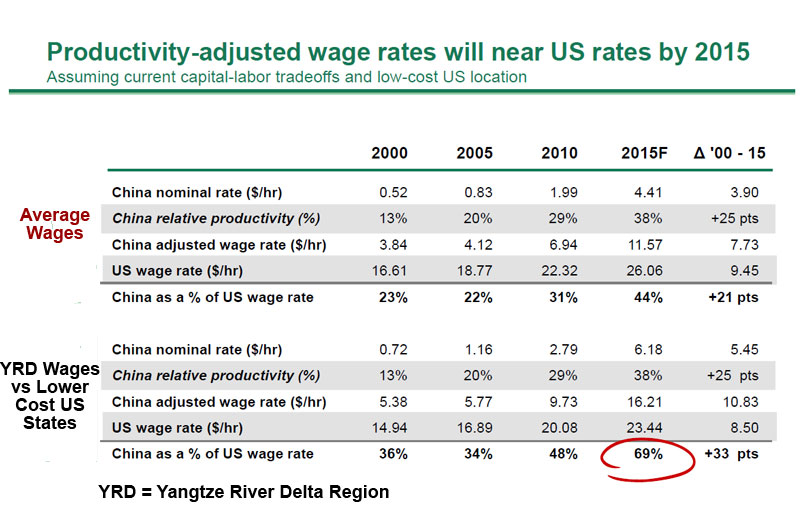
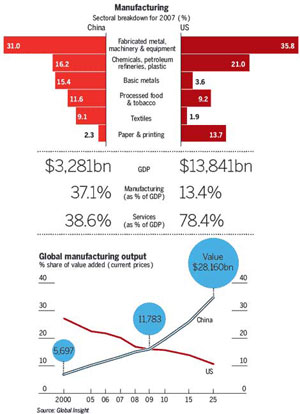
Like everything else, labor price is about supply and demand. For a long time using foreign labor was extremely impractical on so many levels, no doubt Henry Ford had to primarily hire US workers to work on US plants to sell cars to the US population. When it became practical to use Chinese and Indian labor, this lead to a massive influx of unnaturally cheap labor. Look at this table and graph. In 2000 you could hire 30 Chinese workers for the price of one American, productivity was only 13% but you still got 4:1 on your money. Today it's 6 Chinese workers to one American, productivity is up to 38% and 2.3:1 on your money. If you take high-cost China vs low-cost US, you're down to 1.45:1.
No doubt labor costs are going to continue to rise in China. India too is on the rise, though not quite as much. Within the next 5-10 years it'll probably be roughly as expensive to manufacture in China as it is in the US and the massive negative wage pressure will be gone. Same thing with software and India, whether you like it or not it's a global market now and our wages aren't going to rise again until the other workers of the world push global wages higher. If you've seen at the GDP distribution of the world there used to be a big lump at the top in the western world, then actually a drop and then the world's poor. Check out the difference between 1970 and 2006. We just can't keep up the level of inequality we used to.
-
Re:Wow, that's what passes for best these days
the difference in labour costs is a factor of 20 or so
This is too simple a measure, because US workers are far more productive than Chinese workers (because they have access to more capital).
World Bank numbers for 2008 say US GDP PPP per employed person is $65,480. China GDP PPP per employed person is $10,378. So a US employee is likely to be six times more productive than a Chinese employee, so you need to hire six Chinese workers to replace one American worker.
However because of the factor of ten difference in US vs. Chinese salaries, it still is around half as expensive for much manufacturing to be done in China.
I should add that Chinese wage rates are rising quickly (your factor of 20 was correct back in 2005), faster than Chinese productivity rises.
A study claims that in 2015, the productivity-adjusted wage difference between the US and China will only be 69%. So likely by 2020 there may not be much of a difference between manufacturing in the US or China.
-
Re:The thing about IBM
the US still produces 17% of the worlds global value-added factory output. For a country that has less than 5% of the world's population, that's not bad
But that share dropped by approx. 50% in only 10 years, and there's no end in sight.
What if foreign investors reduce their holdings of US dollars by 50% over the next 10 years? What if we have to cut oil consumption by 50% over the next 10 years? We have a diverse economy and not everything will drop by 50%, but those things could. I think our ability to afford imported stuff - and that includes everything at WalMart, not to mention gasoline - is about to go down, permanently.
-
Re:The thing about IBMSupply Chain News: For First Time in More than 100 Years, US Set to Lose Place as World's Largest Manufacturer.
Most knowledgeable observers knew the day was coming soon, but now the researchers at Global Insight say that the US will lose its position as the world's largest manufacturer to China in 2009 - some four years earlier than the firm had predicted previously.
In research done for the Financial Times, Global Insight now says that the US will retain the position it has held for more than 100 years in 2008, but that the combination of China's continued growth and the slowing US economy will create a shift in rankings the following year.
For 2008, Global Insight says the US will produce 16.9% of global value-added factory output, with China at 15%. In 2009, however, China's global share should rise to 17%, with the US having a 16% share.
The numbers do not reflect absolute levels of manufacturing output, but rather relative ones. So, the US has been losing global manufacturing market share even as its own factory volumes rise, but not nearly as quickly as China's growth.
To show how fast the situation is changing, in 2007 the US had a 20% share of global manufacturing to just 13.2% for China. China will have closed that 7% gap in just two years.
Just last year, Global Insight economists had predicted that the US would retain the top position until 2013, but a large downward revision in likely output this year and next is expected to cause the US to slip more quickly than had been expected. A faster than expected economic recovery - or a slow down in the Chinese economy - could enable the US to keep the crown for another year or two.
But fundamentals, including population size differences, the continuing shift of the US to a more services-based economy, and continued migration generally of manufacturing to lower cost countries, means the change was inevitable at some point. Manufacturing represented 37.1% of Chinese Gross Domestic Product in 2007, for example, versus just 13.4% for the US.