Slashdot Mirror
Domain: securecomputing.com
Stories and comments across the archive that link to securecomputing.com.
Stories · 14
-
From Bess to Worse
Frequent Slashdot contributor Bennett Haselton writes " From about 1996 to 2003, there were regular reports listing examples of sites stupidly blocked by blocking software. The genre has tapered off recently, probably as a result of the Supreme Court ruling in 2003 that the Children's Internet Protection Act (CIPA) was constitutional, requiring blocking software in schools and libraries that receive federal funds, despite all the evidence of over-blocking presented at the trial. The last high-profile story about a site blocked by blocking software was about the blocking of BoingBoing almost a year ago. But the lack of recent reports on blocking software errors doesn't mean that the software has gotten better." The rest of his essay follows.One product that generated several reports over the years was "Bess, the Internet Retriever" from N2H2, which has since been bought out by Secure Computing, which also makes a blocking program called SmartFilter (the one that blocked BoingBoing) and now sells "SmartFilter, Bess Edition" which uses the same database as Bess. Different organizations and individuals published a series of investigative reports about Bess from 1997 until 2002, listing sites about gay rights, eating disorders, and other subjects that were blocked as "pornography". In Ben Edelman's supplemental report, submitted as testimony in the CIPA trial, he listed examples of erroneously blocked sites that he had reported to N2H2 in his first expert report, and which were still being blocked five months later.
Since Bess represents a set of data points showing how the accuracy of a blocking program can change, or not change, over the years, recently I began testing it again. I didn't know whether to expect it to be better or worse. On the one hand, advances in technology and greater revenue to censorware companies could have caused the software to improve. On the other hand, the number of Web pages, and the rate at which dynamic sites like blogs change content every day, has exploded. The result? I'm still tabulating data, but it looks as if the accuracy rate is roughly the same as it was in 2000, when about 30% of blocked sites were obvious errors. Then and now, I found most of the errors by starting with a large list of URLs culled from search engines and other sources, and simply running them through the software to see what was blocked.
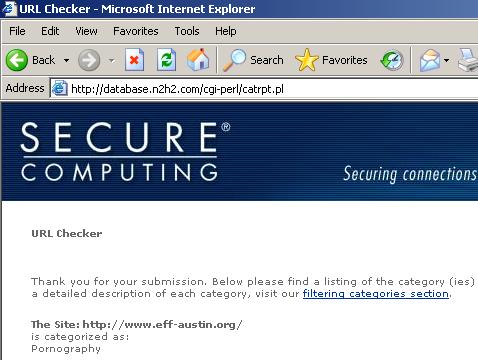
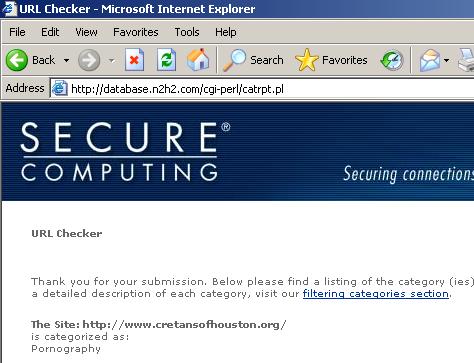
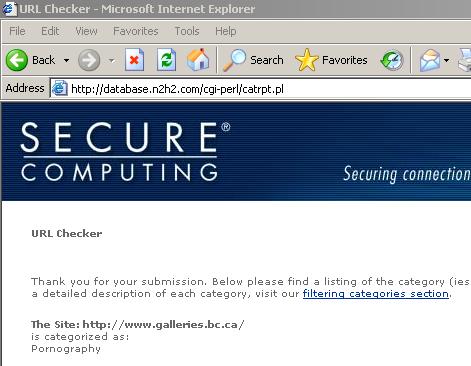
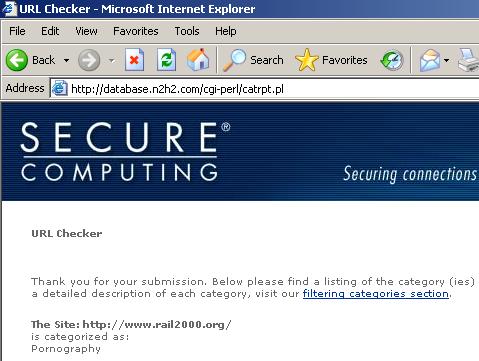
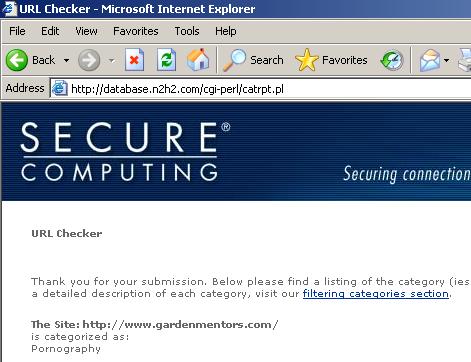
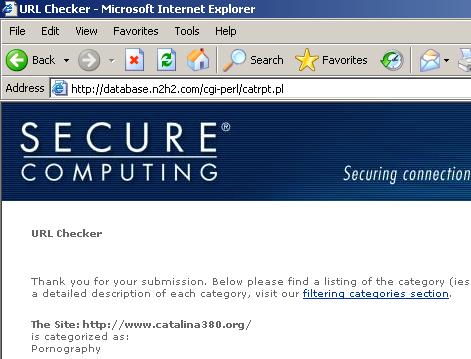
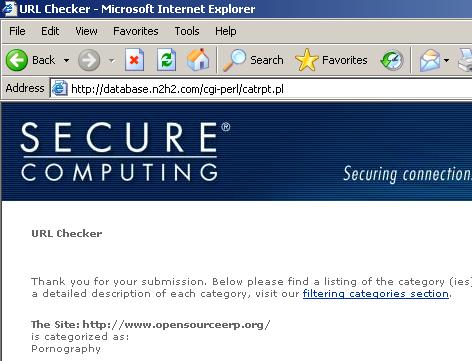
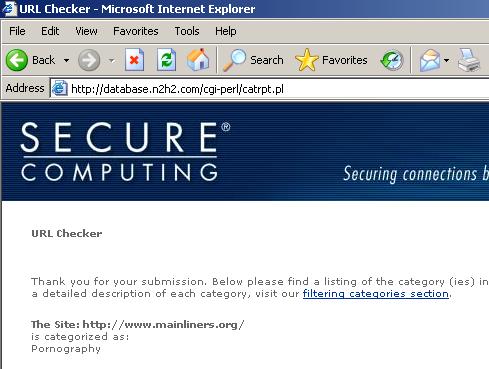
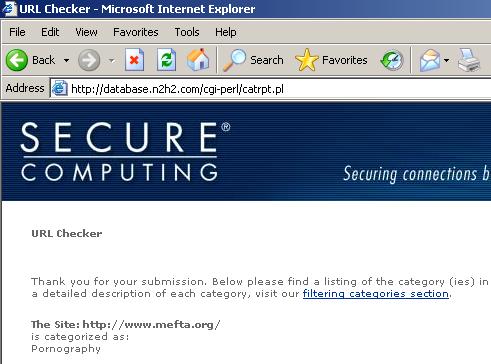
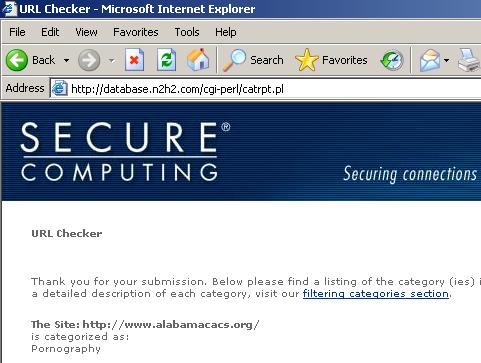
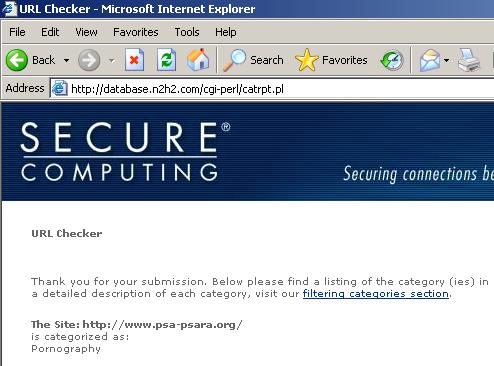
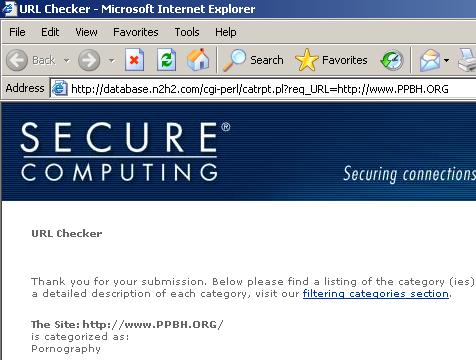
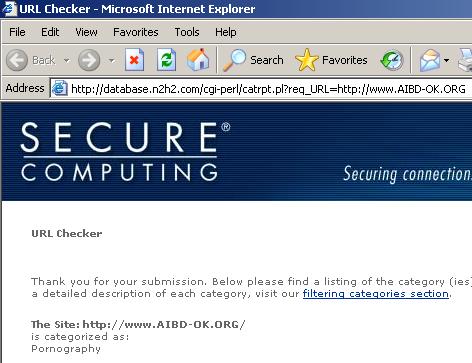
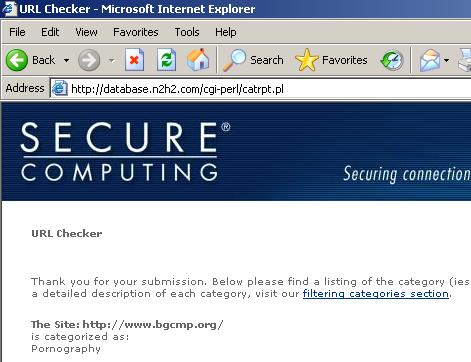
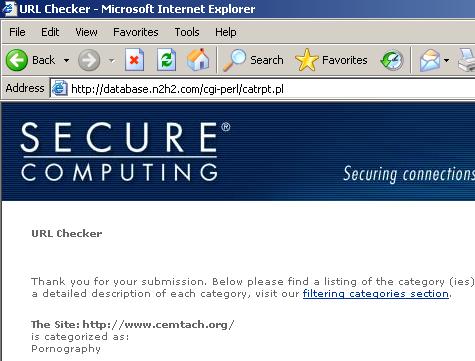
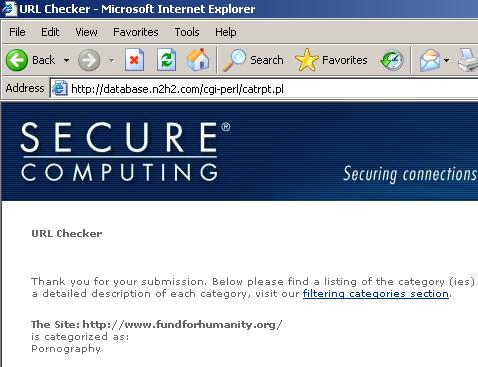
Here is a partial list of some of the questionable categorizations made by Bess; as of this writing, all of the following sites are listed as "Pornography" when you look them up on Secure Computing's Bess lookup form. (This is not just a fluke of the lookup tool; I tested against a copy of the software that all of these sites really were blocked.) The "screen cap" link next to each site links to a snapshot of the results taken from the lookup form (you can check on http://database.n2h2.com/ to see if the page is still returning the same results, although the more obvious errors will probably be fixed after this article is published):
- The Electronic Frontier Foundation, Austin chapter (screen cap)
- Cretans of Houston (screen cap). That's Cretans, as in "people from the island of Crete". Not to be confused with the Cretins of Houston, located here.
- The Rhode Island Coalition Against Domestic Violence (screen cap)
- The website of the public art galleries of British Columbia, Canada (screen cap)
- Rail2000, now the Bay Rail Alliance, a consumer group lobbying for a San Francisco regional rail system (screen cap)
- Rainbow Service Organization, a gay rights advocacy group (screen cap)
- GardenMentors.com, a custom gardening services company in Seattle (screen cap)
- A web site for Catalina 380 series boats (screen cap)
- Open Source ERP, a site promoting open source software for enterprise resource planning and customer relationship management (screen cap)
- The Bryn Mawr Mainliners, a barbershop harmony group (screen cap)
- Timber Trails, an outdoor recreation site (screen cap)
- The MEFTA Institute: "Middle East Free Trade Areas for Business Peace" -- world peace through cheap oil! (screen cap)
- Topple Rummy, a (somewhat out-of-date) site calling for the ouster of Donald Rumsfeld (screen cap)
- The Alabama Network of Children's Advocacy Centers (screen cap)
- PSARA, a non-profit organization for training cruise travel agents (screen cap)
- Park Place Behavioral Health Care, a non-profit mental health care agency (screen cap)
- The Oklahoma chapter of the American Institute of Building Design (screen cap)
- The Boys & Girls Clubs of Metropolitan Phoenix (screen cap)
- CEMTACH -- Computational ElectroMagnetics Theory-Algorithm-Code-Hardware. "Our goal is to develop systems simulations capabilities based on time-domain computational electromagnetics methods." Thanks for clearing that up. (screen cap)
- Fund for Humanity, a San Francisco non-profit supporting environmental organizations and organizations that assist the poor. (screen cap)
A long-standing point of contention while earlier reports about Bess were coming out, was whether every site on their blacklist had been reviewed by a human before being blocked. In 1998 the CEO testified before Congress that "All sites that are blocked are reviewed by N2H2 staff before being added to the block lists." However in their 2002 annual report the company finally admitted that not all sites were reviewed before being blocked: "Through automated categorization or human review, Web sites are identified as fitting into one or more of our categories". At one point an N2H2 employee also told me that when one site is blocked, they will often block all sites hosted on that machine or at that IP -- which of course means that those sites are also not reviewed before being blocked. In any case, it's possible to access some of these sites by IP address, such as the BC Art Galleries site via this link, or the or the Rhode Island Coalition Against Domestic Violence via this link -- so if they're not sharing their IP with other sites, that wouldn't explain how they got blocked either. Smartfilter spokesperson Tomo Foote-Lennox said that one other blocked URL that I found, http://www.arbiol.org/, was the result of an experiment N2H2 once did with fully automated website ratings.
Foote-Lennox added, "In general, we find that schools are VERY sensitive to under-blocking. The would rather block a whole lot of useful reference sites to avoid exposing one porn site." Probably true, although keep in mind we're talking about liability issues, not actual moral outrage. (If they were really morally outraged, they'd be trying to keep kids away from uncensored Internet access everywhere, not just in school! That is in fact the approach that schools take with things like drugs, which do inspire moral outrage because they really are harmful.) Perhaps what is needed is a law explicitly shielding schools from all liability for what students do or see on the Internet at school, if the faculty had no knowledge of it.
(Obligatory interstitial advertisement for common sense: I still don't see what the big deal is about porn anyway. Ask yourself: Why is it harmful to see a picture of a naked person, or even a picture of people having sex? And try to find an answer to that question that doesn't involve, "Lots of other people think so." That includes all variations like "Our society has determined...", "We as a people have decided...", which are just re-phrasings of "Lots of other people think so." I submit that if you disallow those variations of grownup-peer-pressure as an excuse, most people can't really come up with any reason at all.)
OK, flame-retardant suit off, lab coat back on. Previous reports have listed absurd examples of sites blocked by Bess, and looking at any one of those examples or the ones listed here, I'd say that in terms of public policy discussions -- specifically, whether a blocking software company should be trusted to decide what students can look at -- any one of these blocked sites would be more significant than, say, the blocking of BoingBoing which got so much attention. BoingBoing got blocked because of a non-sexual picture of a bare breast on the cover of one of the books they reviewed -- and in fact they were blocked only in the "nudity" category, which includes only "non-pornographic images of the bare human body". So the block on BoingBoing really only revealed that Secure Computing was a bit heavy-handed. (The real problem is that SmartFilter has the category for non-pornographic nudity blocked by default, even though the CIPA filtering law certainly doesn't require schools to block non-pornographic artistic images!) On the other hand, the fact that EFF Austin and the Rhode Island Coalition Against Domestic Violence are currently blocked as "Pornography", suggests that in many instances the blocking companies have nobody at the controls at all. To focus on stupid-but-not-completely-insane blocks like BoingBoing is letting them off easy.
So why did the laundry lists of blocked sites released over the years never become as widely known as BoingBoing, or the guffaw-inducing examples like "Beaver College", which had to change their name in part because of students reportedly being blocked from accessing their website? I think it's because the news favors a good "punch line" -- a fact that anybody can understand that makes us feel smarter than the computers making these dumb mistakes. "Oh, I get it, it was blocked because it was called Beaver College!" But the "punch line" anecdotes are precisely the ones that let the blocking companies off lightly, because it gives them a plausible-sounding excuse for making an error. On the other hand, when the Rhode Island Coalition Against Domestic Violence gets blocked as "Pornography", that could probably force the blocking company to answer some tough questions if it got more press, but there's no good punch line there, so the story just fizzles.
So, while I'm looking through the rest of the data, let me try and come up with some punch lines for reporters to make these blocked sites newsworthy. OK: Why was GardenMentor.com blocked? To keep kids away from all the dirty bitches and hoes! Get it? Ha ha! Why was the Catalina 380 yachting site blocked from kids? Because teens are too vulnerable to pier pressure! Hey, where are you going?
-
VDARE Fights Blocking By Censorware
Bennett Haselton writes "The anti-immigration site VDARE is publicizing the fact that it has been blocked as a 'hate site' by several Internet blocking programs, although some of them backed off and un-blocked it after receiving a letter from VDARE's lawyer. Since blocking software is bound to remain in use in most public schools for the foreseeable future, this raises the question: Is it possible for a blocking company to define a 'hate site' in a consistent way, without including conservative groups that might file a First Amendment lawsuit if their sites were blocked from public school computers? See what VDARE says about the content on their own site, and how blocking software companies have handled this issue in the past and what they might do this time." This is the first in a series of article by Bennett Haselton, writing for us from the Peacefire group. Read on for the rest of his piece. The anti-immigration site VDARE.com is publicizing the fact that their site is blocked as a "hate site" by several different blocking programs. They don't name the programs, although they say that four companies used to block VDARE and "backed off after receiving a lawyer's letter".
It seems to be working, since according to the online lookup forms provided by WebSense, N2H2, SurfControl and SmartFilter, only SmartFilter lists the site under "hate speech"; the rest either don't categorize it or list it in innocuous categories. (N2H2 lists it as "Web Page Hosting/Free Pages", which makes no sense -- but not only that, N2H2 is now owned by the same company that makes SmartFilter, which means the company has VDARE listed one way in one product, and a different way in another.)
VDARE says they decided that showing legal muscle was a good way to get unblocked, after reading about an experiment Peacefire did in which we found that censorware companies would block sites with anti-gay content when they thought the sites were run by individuals, but would not block the *exact same content* when it was hosted by "mainstream" groups like Focus on the Family. Concludes VDARE: "The obvious reason for the double standard is that the foundations have lawyers on staff, and volunteer lawyers, and the Censorware companies are afraid of them." True -- although we did nominate AFA.net as a "hate site" at about the same time, and it did get blocked by Cyber Patrol, so it is possible if the content is extreme enough.
I'm against blocking VDARE, even from people under 18, but only because I'm against such blocking in general. Polls show that most people under 18 are more liberally-minded about race than their parents, suggesting that if you want to end racism, give minors more rights and freedom of information, not less. There was a big flap when it came out that in some Islamic schools in New York, parents had their children taught with textbooks which said that "the Jews killed their own prophets" and "you will find them ever deceitful", but without more civil rights for people under 18 to seek information for themselves, there's not much that anybody can do about it.
But as for whether VDARE really should be listed as a "hate site", the site owner himself says that VDARE is not "white nationalist", but adds, "We also publish on VDARE.COM a few writers, for example Jared Taylor, whom I would regard as 'white nationalist'". Well even if VDARE itself claims not to be 'white nationalist', if they host white nationalist writings, it's still accurate to classify the site as a place where such content is located. VDARE itself is also listed by the Southern Poverty Law Center as a hate group. VDARE's founder insists they are merely anti-immigration, not white nationalist, although he admits he once thought about adding a chapter to his anti-immigration book Alien Nation about the "last white family" (not the "last non-illegal-immigrant family") to leave Los Angeles.
Like BoingBoing.Net did before them, VDARE is retaliating against the block by encouraging people to learn how to get around blocking software. I wonder if they looked closely at our site first, since we fight censorship from the point of view of advocating greater civil rights for minors, which would probably not be a popular view with VDARE's ultra-conservative base. And if that's not enough, I'm planning to contact WebSense, SurfControl, and any other company that doesn't currently list VDARE as a "hate site", and ask them why not. So, VDARE sends us traffic, and this is how we repay them. -
Slashback: OSX Security, DoD Filtering, Anonymous Posting
Slashdot tonight brings some corrections, clarifications, and updates to previous Slashdot stories, including some favorable results from the University of Wisconsin's Mac OS X Challenge, skeptics investigate cold fusion claims, more on DoD web filtering, AT&T cuts 10,000 jobs after BellSouth merger, more child-proofing efforts for MySpace, Why Windows Vista Will Suck: a rebuttal, Harvard Professor punished for reporting bugs, Assemblyman Biondi backpedals on NJ anonymous posting bill, and a followup on Chinese TLDs -- Read on for details.University of Wisconsin's Mac OS X Challenge. HABITcky writes "The University of Wisconsin Security Challenge has ended after 38 hours, intermittent DoS attacks, 4000 ssh login attempts, a bandwidth spike of 30 Mbps, and 6 million logged ipfw events. During this time there were 'no successful access attempts, nor any claims of a successful attempt.' You may remember this challenge was proposed in response to the 'woefully misleading' ZDnet article, Mac OS X hacked under 30 minutes, which was previously discussed here on Slashdot."
Skeptics investigate cold fusion.smooth wombat writes "As a follow-up to a previous Slashdot posting, Purdue University is investigating the claims of Rusi Taleyarkhan who claimed in 2004 to have created nuclear fusion at room temperature. The investigation came about from complaints from colleagues who suspect something is amiss. Taleyarkhan, who used to work at Oak Ridge National Laboratory, has, since working at Perdue, removed the equipment the co-workers were using to try and replicate the results, claimed results for experimental runs were positive for fusion despite the co-workers never seeing the raw data and opposed the publication of results which contradicted his findings."
More on DoD web filtering. timetrap writes "I work in a mobile combat communications unit, while I'm not in the sandbox right now, I can attest to the DoD policy on blocking web access. First of all when you are down range don't expect to even get DSL speeds from a satellite, we usually roll with about 256kbs for the data side of our trunk. So blocking sites is very important, otherwise 4 or 5 people could start streaming audio and pretty much knock down any legitimate use of the network. We filter websites with smartfilter and yes the military system admins in the IPO office will unblock any web site that isn't blocked by local policy (no pr0n, no streaming audio, no civilian web mail: both the hot and the g varieties, and no chat programs; although irc is used by the DoD) This is no Orwellian conspiracy, but quick and easy system administration; apply smartfilter: check! If you want to check the current smartfilter blocked sites goto: securecomputing and submit some sites to check." Slashdot's own Jamie took a look at Smartfilter back in '99 as a part of the Censorware project and it still remains a mysterious black box to this day. While some would advocate full disclosure using censorware still appears to be merely passing the buck.
AT&T cuts 10,000 jobs after BellSouth merger. mytrip writes to tell us that immediately following their $67 billion acquisition of BellSouth, AT&T plans on cutting about 10,000 jobs.
More child-proofing efforts for MySpace. conq writes "BusinessWeek has an interview with Connecticut Attorney General Richard Blumenthalin in which he describes measures MySpace and other similar sites should take to protect children. From the article: 'We're going to be suggesting some very specific measures that MySpace can take based on our conversations with MySpace as well as with other law enforcement authorities at the state and local levels. We've received hundreds of complaints from parents who are concerned about these issues, and we want to be sure that the measures we propose are technologically feasible and financially viable.'"
Why Windows Vista will Suck: a rebuttal. shrapnull writes "Hot on the heels of Extreme Tech's 'Why Windows Vista Won't Suck', Steven J. Vaughan-Nichols has an alternate position posted on DesktopLinux, and sent to subscribers of Novell's 'Suse Linux Cool Solutions' newsletter."
Harvard researcher punished for reporting bugs. Guillermito writes "A story previously discussed came to a sad conclusion two weeks ago. The bottom line is this means that it is forbidden to use reverse engineering tools to find bugs in a software. You also have to prove that you own a valid license for each version of the tested software. To publish a proof of concept that contains a few dozens of copyrighted bytes is also forbidden. It's a nice precedent for any company selling a defective product."
Assemblyman Biondi backpedals on NJ anonymous posting bill. Quadraginta writes "Earlier, denizens of Slashdot reacted to a story about a bill to be introduced to the New Jersey legislature that would require hosts of forums, bulletin boards and the like to keep track of the real identity of anonymous posters. Seems like there was a strong reaction all over. Assemblyman Biondi now appears to be backpedalling furiously. From a letter quoted after the link: 'I am getting inundated with responses which I will review and use to better educate myself on the implications of this bill. If, after reviewing all of the correspondence and the opinion of OLS, it turns out that the bill is, in fact, unworkable, I will certainly reconsider and withdraw it.'"
A followup on Chinese TLDs. nqz writes "In this story on ComputerWorld, ICANN and the China Internet Network Information Center (CNNIC) both dispute a previous story discussing China's new top-level domains containing Chinese characters."
-
Slashback: OSX Security, DoD Filtering, Anonymous Posting
Slashdot tonight brings some corrections, clarifications, and updates to previous Slashdot stories, including some favorable results from the University of Wisconsin's Mac OS X Challenge, skeptics investigate cold fusion claims, more on DoD web filtering, AT&T cuts 10,000 jobs after BellSouth merger, more child-proofing efforts for MySpace, Why Windows Vista Will Suck: a rebuttal, Harvard Professor punished for reporting bugs, Assemblyman Biondi backpedals on NJ anonymous posting bill, and a followup on Chinese TLDs -- Read on for details.University of Wisconsin's Mac OS X Challenge. HABITcky writes "The University of Wisconsin Security Challenge has ended after 38 hours, intermittent DoS attacks, 4000 ssh login attempts, a bandwidth spike of 30 Mbps, and 6 million logged ipfw events. During this time there were 'no successful access attempts, nor any claims of a successful attempt.' You may remember this challenge was proposed in response to the 'woefully misleading' ZDnet article, Mac OS X hacked under 30 minutes, which was previously discussed here on Slashdot."
Skeptics investigate cold fusion.smooth wombat writes "As a follow-up to a previous Slashdot posting, Purdue University is investigating the claims of Rusi Taleyarkhan who claimed in 2004 to have created nuclear fusion at room temperature. The investigation came about from complaints from colleagues who suspect something is amiss. Taleyarkhan, who used to work at Oak Ridge National Laboratory, has, since working at Perdue, removed the equipment the co-workers were using to try and replicate the results, claimed results for experimental runs were positive for fusion despite the co-workers never seeing the raw data and opposed the publication of results which contradicted his findings."
More on DoD web filtering. timetrap writes "I work in a mobile combat communications unit, while I'm not in the sandbox right now, I can attest to the DoD policy on blocking web access. First of all when you are down range don't expect to even get DSL speeds from a satellite, we usually roll with about 256kbs for the data side of our trunk. So blocking sites is very important, otherwise 4 or 5 people could start streaming audio and pretty much knock down any legitimate use of the network. We filter websites with smartfilter and yes the military system admins in the IPO office will unblock any web site that isn't blocked by local policy (no pr0n, no streaming audio, no civilian web mail: both the hot and the g varieties, and no chat programs; although irc is used by the DoD) This is no Orwellian conspiracy, but quick and easy system administration; apply smartfilter: check! If you want to check the current smartfilter blocked sites goto: securecomputing and submit some sites to check." Slashdot's own Jamie took a look at Smartfilter back in '99 as a part of the Censorware project and it still remains a mysterious black box to this day. While some would advocate full disclosure using censorware still appears to be merely passing the buck.
AT&T cuts 10,000 jobs after BellSouth merger. mytrip writes to tell us that immediately following their $67 billion acquisition of BellSouth, AT&T plans on cutting about 10,000 jobs.
More child-proofing efforts for MySpace. conq writes "BusinessWeek has an interview with Connecticut Attorney General Richard Blumenthalin in which he describes measures MySpace and other similar sites should take to protect children. From the article: 'We're going to be suggesting some very specific measures that MySpace can take based on our conversations with MySpace as well as with other law enforcement authorities at the state and local levels. We've received hundreds of complaints from parents who are concerned about these issues, and we want to be sure that the measures we propose are technologically feasible and financially viable.'"
Why Windows Vista will Suck: a rebuttal. shrapnull writes "Hot on the heels of Extreme Tech's 'Why Windows Vista Won't Suck', Steven J. Vaughan-Nichols has an alternate position posted on DesktopLinux, and sent to subscribers of Novell's 'Suse Linux Cool Solutions' newsletter."
Harvard researcher punished for reporting bugs. Guillermito writes "A story previously discussed came to a sad conclusion two weeks ago. The bottom line is this means that it is forbidden to use reverse engineering tools to find bugs in a software. You also have to prove that you own a valid license for each version of the tested software. To publish a proof of concept that contains a few dozens of copyrighted bytes is also forbidden. It's a nice precedent for any company selling a defective product."
Assemblyman Biondi backpedals on NJ anonymous posting bill. Quadraginta writes "Earlier, denizens of Slashdot reacted to a story about a bill to be introduced to the New Jersey legislature that would require hosts of forums, bulletin boards and the like to keep track of the real identity of anonymous posters. Seems like there was a strong reaction all over. Assemblyman Biondi now appears to be backpedalling furiously. From a letter quoted after the link: 'I am getting inundated with responses which I will review and use to better educate myself on the implications of this bill. If, after reviewing all of the correspondence and the opinion of OLS, it turns out that the bill is, in fact, unworkable, I will certainly reconsider and withdraw it.'"
A followup on Chinese TLDs. nqz writes "In this story on ComputerWorld, ICANN and the China Internet Network Information Center (CNNIC) both dispute a previous story discussing China's new top-level domains containing Chinese characters."
-
SCC Statement on SELinux Patent Issues
Hawke writes "Secure Computing has announced a Statement of Assurance that they will not use the patents in question to limit the availability of SELinux. They continue to say: 'However, Secure Computing does not extend the Assurance to software that merely interoperates with SELinux, or is merely included with a distribution of SELinux.'" The original story was here. -
SCC Statement on SELinux Patent Issues
Hawke writes "Secure Computing has announced a Statement of Assurance that they will not use the patents in question to limit the availability of SELinux. They continue to say: 'However, Secure Computing does not extend the Assurance to software that merely interoperates with SELinux, or is merely included with a distribution of SELinux.'" The original story was here. -
U.S. Company Helps Saudi Arabia Censor The Net
John writes: "Saudi Arabia blocks its citizens' internet access to some sites on pornography, religious information (including some on the state religion: Islam) humor, music, movies, and homosexuality, and programs that translate web pages into Arabic, according to this Boston Globe article. (Secure Computing Corp.) provides the Saudis with Smartfilter to block network of proxy servers. The article does not describe the criteria used to block various cites. I wonder if Slashdot is one of them?" Update: 07/17 15:02 GMT by T : A brief mention ran yesterday at the Censorware Project as well, linking to the referenced report itself. -
Slashback: Stapler, Interface, Gaming
Slashback tonight (read on below) has updates on next-generation aircraft, KDE user-interface improvements and suggestions, a special warning for those obsessed with Milton's stapler from Office Space, SmartFilter's attitude toward SourceForge, and more.You've got to admit it's getting better all the time. Gentu writes: "In parallel to the KDE 3.1-alpha release today, OSNews published an interesting article discussing a number of User Interface issues found on KDE 3. The article suggests a number of changes, some small, some pretty drastic. Towards the end of the two-part article, the author discusses the 'integration' problem found in today's X11 desktop environments, and how fixing this issue would bring Unix closer to average Joe's desktop."
Yes, you're allowed to have more than one friend. A NuKeFaN writes: "Following the article titled Are you a Friend of GNOME I wanted to point you out that the most used GPL'd software for the Web, PHP-Nuke, also has a similar page/system for their friends. It's a Club (MandrakeClub like) where you can be a member for a little monthly fee and you can get some extra benefits. You can access the Club area to know more about it. This can be, maybe, another example of how to get some money to fund a free software project, the matter is if we, as users, will support those project's developers this way? I think we can."
Wait, the scam was to take just a few pennies from everyone! MrBlue VT writes "In reference to the previous Slashdot article about the red Swingline Staplers, I click on the add to cart button on the Swingline website, and it pops open an ordering window with a 4 staplers added to the shopping cart. Ok, I think it's a little strange, but change the quantity back to 1, and hit continue to checkout. Next thing I know, I'm looking at an order form with all the text boxes filled out with somebody else's personal information. He's from Bellvue, WA apparently (I'm in Virginia). It also has his credit card number and expiration date!
This has to be the worst security I've ever seen in an online shopping site. The company who apparently provides the online shopping service for Swingline appears to be an outfit called SureSource.
I just wanted to let anyone who happened to order from them know about this. Your credit card info could very well be compromised."
Please fasten your belts. hondo77 submitted this follow-up to this article about next-generation aircraft, writing "Boeing says that their blended-wing aircraft will be ready for test flights in 2006. The article also has a picture of a 3% scale model. See, it doesn't look like the B-2 at all."
But thanks anyhow. flonker writes "Smartfilter no longer lists sourceforge.net! Link for those who want to see for themselves."
Great at stealing them, too. MrDingusMcGee writes "After the recent posting about a study suggesting that video games decrease brain activity, I thought it would be interesting to read the results of another study which has shown that video game players score better on a range of attention tasks (mirror here)done by Shawn Green at the University of Rochester Brain and Cognitive Sciences Department, and that this could possibly rate video game players as better drivers. Worth seeing the other side of the argument and having some validation for those hours of gaming."
-
All Sourceforge.net Being Blocked by SmartFilter
An unnamed reader writes: "I just noticed that all sites. '*.sourceforge.net' are being blocked by all corporations using SmartFilter including mine. SmartFilter lists all of them as 'MP3' sites. Below is the error I get. How come they do not block Microsoft? I can download an MP3 player from there, too (Media Player does play MP3s)." Here's the error: "Access is restricted to the site (http://www.sourceforge.net/) you requested. Per the firm's Information Security & Privacy Policy, all Internet browsing is monitored and logged. Please contact the Information Security Center at ext 7114 for more information. SmartFilter Control List category MP3 Sites is restricted. " The aptly named SmartFilterWhere tool shows which sites are painted over by SmartFilter's broad brush; in this case, software development site (and Slashdot sister site) SourceForge is blocked by the latest SmartFilter versions -- 3.0, 3.0.1 and 3.1 -- but not version 2. You might also be interested in The Censorware Project's analysis of the efficacy of SmartFilter as applied to Utah schools and libraries, or Peacefire's explanation of how and how well SmartFilter works. -
LWN on the Patent Encumbrence of SELinux
Anonymous Coward writes "LWN has a story about patents in SELinux. The article says: "Much of the actual work in the implementation of SELinux was done by Secure Computing Corporation (SCC). SCC, in its implementation of SELinux, used a technology that it calls type enforcement. As it turns out, SCC has a patent on this technology." Sigh. -
Saudi Arabia's 'Great Firewall'
securitas writes: "We've all heard about The Great Firewall of China (see this Wired feature) but many don't know about Saudi Arabia's version of the same. The New York Times reports on the challenges and problems of filtering the Internet for an entire nation. San Jose's Secure Computing has the contract but may lose it when it comes up for renewal next year." -
SmartFilter: Way Too Extreme
Another report on SmartFilter by Seth Finkelstein (here was last month's). He's written some software to decrypt the software's blacklist of forbidden sites, and has analyzed what he found. The list of blocked newsgroups is fascinating: sci.archaeology as occult, and comp.org.eff.talk as criminal, for example. He's found "extreme or obscene" sites like hotrails.com ("extreme sports" rollerblading on "naked metal"), gcsextreme.com (custom-built computers for the "extreme gamer," unfortunately at a domain name with both "sex" and "extreme" in it) and extreme-offroad.com (same deal). Their music-critic skills need work too, as they block InsaneClownPosse.com, Tupac.com, Marilyn Manson, and even Chumbawamba's Web site. Every one of these and many more are blocked as "Extreme," which puts them in the same category as photos of mutilated dead bodies, bizarre hard-core pornography and child pornography.His discussion of the legal risks of decrypting these blacklists is fascinating too, and (as he likes to say) "a topic in itself." He would like to open up the source to his SmartFilter-decryption tool but feels the legal risk is too high. How sad is that?
Here's Secure Computing's definition of the "extreme" category, and the examples they give ("Pixman's Vault of Porn Pix", "Bizarre & Maximum Perversion").
You can confirm Seth's findings using Secure Computing's own SmartFilterWhere. It asks for your name and phone number; you have my permission to make some up. As of December 7, at 9:45 PM EST, that CGI operates with a Control List updated on December 5 and confirms all of Seth's results that I tried. By the time you read this, they may have quickly fixed all the errors he published, loaded in an up-to-the-minute Control List, and proudly announced that their software is now perfect.
Until the next report.
-
SmartFilter: Way Too Extreme
Another report on SmartFilter by Seth Finkelstein (here was last month's). He's written some software to decrypt the software's blacklist of forbidden sites, and has analyzed what he found. The list of blocked newsgroups is fascinating: sci.archaeology as occult, and comp.org.eff.talk as criminal, for example. He's found "extreme or obscene" sites like hotrails.com ("extreme sports" rollerblading on "naked metal"), gcsextreme.com (custom-built computers for the "extreme gamer," unfortunately at a domain name with both "sex" and "extreme" in it) and extreme-offroad.com (same deal). Their music-critic skills need work too, as they block InsaneClownPosse.com, Tupac.com, Marilyn Manson, and even Chumbawamba's Web site. Every one of these and many more are blocked as "Extreme," which puts them in the same category as photos of mutilated dead bodies, bizarre hard-core pornography and child pornography.His discussion of the legal risks of decrypting these blacklists is fascinating too, and (as he likes to say) "a topic in itself." He would like to open up the source to his SmartFilter-decryption tool but feels the legal risk is too high. How sad is that?
Here's Secure Computing's definition of the "extreme" category, and the examples they give ("Pixman's Vault of Porn Pix", "Bizarre & Maximum Perversion").
You can confirm Seth's findings using Secure Computing's own SmartFilterWhere. It asks for your name and phone number; you have my permission to make some up. As of December 7, at 9:45 PM EST, that CGI operates with a Control List updated on December 5 and confirms all of Seth's results that I tried. By the time you read this, they may have quickly fixed all the errors he published, loaded in an up-to-the-minute Control List, and proudly announced that their software is now perfect.
Until the next report.
-
Censorware and Memetic Warfare
I'm halfway through Susan Blackmore's book "The Meme Machine," and it's rekindled my interest in meme dispersal. In a memetic sense, the battle over filters in the Holland library is just one of implanting the right ideas in enough people's minds by the day of the vote. Here's a look at one of the more annoying memes the opposition is using: a lie about the results of my very own organization. Click for more.Everyone's familiar with the term "meme" by now, so I don't have to explain that it's the unit of idea transmission. The struggle over Internet filters, or any other conflict where ideas, facts, opinions, and outlooks collide, is memetic in nature: it's memetic warfare.
All's fair in war, supposedly, but I'm someone who has been infected by the meme that we should all fight fair, even - especially - in the war of ideas.
Will the "fight fair" meme become popular in the long run? I hope so. But the way I see it, that will only happen if it is more successful at reproducing than its alternative: "fight dirty." In the long run, it doesn't matter what's right, or what's good, or what benefits us humans the most. The memes just spread because they're good at spreading.
In early 1999, my friend (now Slashdot writer) Michael Sims started a long process to obtain some Web logs from the state of Utah. Internet access for schools and libraries across the state was provided by a single network, and all their Web traffic went through proxies that had the same blocking software running. Their Web logs were a gold mine of data, showing both blocked and unblocked accesses. When users were blocked from something, the logs showed what category it was blocked in.
Our group, the Censorware Project, had been looking for a real-world test case of this software. Michael did a tremendous amount of work to file the papers, get permission to get the logs, have them delivered, gather them, and analyze them. He then wrote a brilliant report (the rest of us helped too).
What this let us do was see how blocking software's errors show up in the real world. We had known for years that the software has many mistakes in its blacklists, in every product we'd studied. But we had no data on how that affected users.
When all the data was crunched, two numbers surprised us. First, the amount of material blocked was quite small: about 0.6%. People were interested in things besides pornography on the internet. Who would have thought.
Second, just looking at the wrong blocks that we were able to find, the proportion was quite high: about one block in every 20 was Constitutionally protected material. That's a minimum - the minimum we were able to confirm. All in all, we identified over 5,000 occasions when people were blocked from reading protected material (totalling 300 unique Web sites).
Most measures of blocking software effectiveness focus on how much pornography it blocks. We weren't able to test that because we couldn't look through the 99.4% of unblocked material - over 53million URLs. Just too much data. But we did learn that, in Utah, 5% of the time, when the software said "you can't look at that," it was just plain wrong.
Ninety-five percent accuracy might sound like a nice high figure to base a good meme around. Who could argue with a number like 95%? But consider what this means for the 300 Web sites in question: each of them was blocked from being read by a great many public institutions in the state of Utah.
And the First Amendment protects publishers, not readers: it's freedom of the press, not freedom to read the press. When you're blocked from reading your favorite author, you might be annoyed, but if the censor were taken to court, the injured party would be the author.
This is exactly what we fought against the Communications Decency Act for. Except, in many ways, censorware is worse. If your site is one of the 5% that's wrongly blocked, you won't know it. Our government will stop people from reading what you have to say even if your site is completely innocent (like the Candy Land website), and nobody will bother to notify you. You won't ever know.
At least with the CDA, you'd have gotten a letter from the prosecutor telling you your site was censored - and nobody, but nobody, would ever have been censored for publishing the Bible.
(Yes, the Bible was one of the banned books we found in Utah, along with the Declaration of Independence, the U.S. Constitution, etc. That kind of thing makes good memes.)
Michael put a lot of work into our report, and I even contributed a little, so I'm a little protective of that 5% meme. Which is why it was so jarring to open up a press kit distributed by the Family Research Council, last week, and find our work, cited in black and white, as support for the figure: "one in a million."
That's right, the exact same report which found one bad block in every twenty is now being cited as proving that Web sites are misblocked "one time in a million."
Now that's a good meme. "One in a million" sticks with you. It isn't backed up by any of the facts, but despite that handicap - or perhaps partly because of it - it has thrived.
It was first invented by a fellow named David Burt, who read our report not very carefully, and then decided he was going to do a little numerology of his own.
The first thing he did was ignore all the bad blocks we'd found that he thought were perfectly appropriate. For example, we'd found that the homepage of the band "The Offspring" was wrongly blocked - you may remember their songs from the fall of 1998. "I'm just a sucker with no self-esteem," and so on. (You're humming it now. Catchymeme.)
David Burt decided that The Offspring deserved to be blocked, and to illustrate why, quoted nine words from their Web site:
"These songs have ideas PLUS drugs, sex and ass-kicking"
He also decided it was OK to block BaywatchTV.com, BirthControl.com, the Starr Report, the Yahoo category "Society and Culture: Romance," and Glamour magazine. It was OK to block a page on the NASA Web site about a crackdown on hackers, because it "discusses hacking techniques." Both takedown.com and 2600.com should be blocked, he says, for the same reason. A fellow whose homepage includes a link to a PGP FAQ - no code or binaries - should be blocked for containing "cryptographic software."
Did I mention this man is a librarian?
After trimming out all the fat from our list, he got it down from over 300 sites to just 64. Of course, this was the list of unique sites. If he'd had all our numbers, he would have known that his changes affected our 5% figure by about 0.1% - this because the large majority of blocked sites are blocked few times.
There's some other nonsense he tried, like saying that we were deceitful to ignore blocked banner ads because they were surely all pornographic. In fact, four of the five top blocked ad sites were perfectly ordinary, and counting ads would have made our numbers more impressive, not less.
But his main meme was the number. Armed with his new figure "64", he performed a division by the largest number in our report, which was 54,000,000. Kind of like dividing apples by hydrogen. Of the 54,000,000 URLs, only 29% were page views; only 0.56% of those were blocked; and the previously-mentioned 5% of those were blocked incorrectly. From there he switched from blocks to unique blocks, cutting the actual figure of 5,000 down to his list of 64.
Then, dividing 64 by the original 54,000,000, he got 1 in 1.18... well, for the meme's sake he got one in a million.
Publishing this in April of 1999, David Burt ignored our corrections. Despite our offering all the raw data on CD-ROM, for the cost of the media, he just accused us of lying.
You can't say anything to that, without getting into a yes-you-are no-we're-not. We'd put out two press releases about this already. We told him to order the CD-ROMs and check for himself. Then we moved on.
But his meme began to spread. In June, the company that made the blocking software pulled the same trick, reported the results to Sen. John McCain - and then issued a press release about it. Our group was now cited as supporting their software by proving its accuracy. Since the numbers were so big anyway, they just used the 300 figure and called it an "accuracy rate of 99.9994%."
A group I've never heard of, the American Decency Association, now points to our study and says: "Filters Work!" They source is another group I've never heard of, the Michigan Decency Action Council. Word gets around.
So when I opened up the report "Internet Filtering and Blocking Technology," published by the Family Research Council and distributed at their Holland presentations, I was not surprised when I found the same meme on pages 9 and 14. (I was surprised to see them divide 64 into 54,000,000 and get 6 parts per million. But as long as they've blown the numbers so badly, a little botched division doesn't make any difference.)
I talked to two of the FRC techies about this and tried to explain what was wrong with the numbers. I got some mild interest. Will the FRC correct and reprint this report? Of course not. Admitting that DavidBurt fudges numbers might be a bad tactical move. The concluding two sections of the report have 31 footnotes, 28 of which reference no one but Mr.Burt.
I choose to be an optimist about the marketplace of ideas. I believe that truthful memes will proliferate in the long run, because enough people's brains select for truth.
But in the meantime, it's frustrating when my team takes below-the-belt punches from the guys who don't care about what's true.
I don't expect everyone reading this to share my memeplex on this issue. I know from reading the comments that many Slashdot readers think censorware in libraries is a good thing, and that's fine. In fact, I'll bet many of you are grinding your teeth that I keep using the word "meme" so damn much. That's fine too.
All I ask is that, when your memes start arguing with my memes, you make them fight fair. It's only right.