Slashdot Mirror
Domain: seia.org
Stories and comments across the archive that link to seia.org.
Comments · 19
-
Re:Not sure if this is good or not
This is going to put a lot more people who were installing the panels out of work than the number of people who ever going to be employed making them.
To drill down on that:
The US solar industry employs between 260,000 and 374,000 workers, with about 38,000 in manufacturing and the bulk of the remainder in installation. “Solar installer” is poised to become the fastest-growing job in the United States over the next 10 years.
The Solar Energy Industries Association, which represents solar installers, estimates this decision will cause roughly 23,000 American jobs to be lost this year.
-
Re:those fucking plastic bottles
Yeah, but I'm a physicist and am not affiliated in any way with Duke Power. I'm just stating facts -- indeed, here is a piece of DP information:
https://www.duke-energy.com/ou...
700 large scale solar facilities around the state. What they are doing in other states I do not know, but in NC they are literally building new ones all the time. Note this:
http://www.seia.org/research-r...
NC is indeed number two in the national rankings in installed capacity as of last year, behind California and (perhaps surprisingly) ahead of near-desert states like Arizona, and most of this is Duke Power.
I reiterate: The Koch brothers have a specific agenda that is (as far as one can tell) the active suppression of democracy and the establishment, no, that's not fair as it's already there, the rapid growth in the power of an oligarchy. The energy companies in general, however, don't give a rat's ass what is the source of the energy they collect or release and redistribute, as long as they make a good profit from it. Solar is profitable, and about to become the most profitable, by far. So it doesn't matter what one does to "free up coal" or reverse carbon restrictions. Nobody is going back to (substantial new capacity in) coal in the US, although it may be decades before the grid can function without it.
-
Re:You don't say
Recycling of PV cells is regulated by the EPA. The EPA only gets involved if there are nasty things involved... And heavy metals, cadmium, lead, and others (which are controlled by RoHS but of course PVs are exempt from RoHS regulations) are present.
-
Re: In addition...
> I don't believe the claim that "solar photo-voltaic electricity is now less expensive than grid electricity" as bare fact.
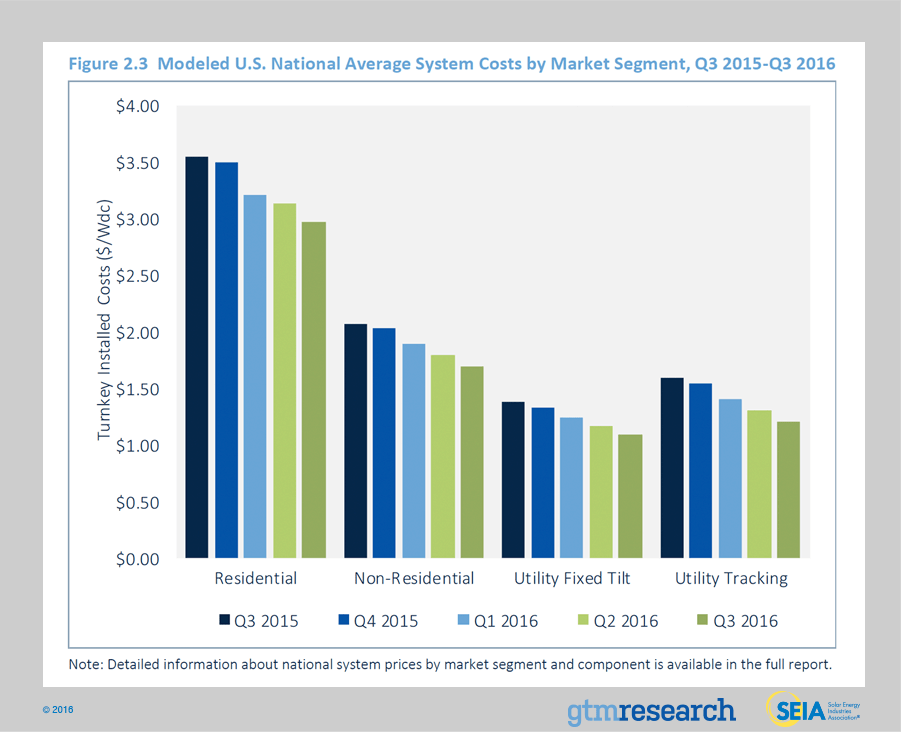
That only applies to utility-scale tracking arrays, not to residential: http://www.seia.org/research-r...
Rooftop residential fell to $2.98/Wdc in the 3rd quarter of 2016, while utility tracking came in at $1.21. Tracking systems tilt the panels to follow the Sun, and therefore produce more power than fixed ones on rooftops. So overall, the utility systems are about three times cheaper. Why are they so much less? It is much more efficient for a work crew on level ground than on a sloped roof, and they don't have to pack up their gear and drive to a new location every two dozen panels. You only need one big connection to the utility grid for a solar farm, rather than one for every house, so less wiring/transformers/etc.
At $1.21/W, and assuming the solar farm returns 8% annually and produces for 2000 hours/year, the net cost is $0.0484/kWh, which is competitive with wind and natural gas.
-
Re: Solar rated highest in 2016, but...
> IIRC installed pricing is now arround $2.50 a watt,
Depends where it is installed: http://www.seia.org/sites/defa...
Residential averages $3/W, while Utility tracking is down to $1.21/W. Tracking systems tilt the panels to follow the Sun, thus get more watts for more hours than fixed-tilt panels. The extra 10% it costs for tracking hardware is more than made up by the extra output, so they are now the best option in terms of cost per kWh produced.
-
Re:Solar rated highest in 2016, but...
> So in 2017 solar might hit 1% and probably max out.
Given the 75 GW utility solar pipeline (built, contracted, and announced), that's not likely:
http://www.seia.org/research-r...
Assuming a 20% capacity factor (average vs rated capacity), the 15 GW of average output is more than 3% of total US electric use.
-
Re:Thats really cheap
First US usage of power is about 4 times higher per household than Germany, possibly due to Germans mostly not having or using AC in the warmer months. This makes summer the power usage low in Germany. In the US the summer months are the usage high.
http://shrinkthatfootprint.com...
https://www.eia.gov/electricit...The government (ie taxpayers) subsidize the tune of 20 billion Euros per year and rising (hiding the actual cost)
http://www.bloomberg.com/view/...
http://www.greentechmedia.com/...
http://www.seia.org/research-r...German prices per kwh are higher (~.34 per kwh) vs US (~.15) mostly due to tax/tariff on energy, and regulatory procedures related to the infrastructure payments of solar and other renewables. The prices are rising so fast the government has had to begin a more restrictive path on new solar.
https://www.eia.gov/electricit...
https://www.cleanenergywire.or...Based solely on price per kwh and predictable capacity, solar is awful. More specifically awful for germany, because of geography and weather trends.
http://www.forbes.com/sites/qu...This unpredictability is causing massive new production plants using coal. This is a reult of shutting down nuclear and building solar which only generates an average of >10% of potential capacity. Altogether the solar plan's end result is not bringing them closer to meeting their climate pollution goals.
https://carboncounter.wordpres..."when the wind suddenly stops blowing, and in particular during the cold season, supply becomes scarce. That's when heavy oil and coal power plants have to be fired up to close the gap, which is why Germany's energy producers in 2012 actually released more climate-damaging carbon dioxide into the atmosphere than in 2011. If there is still an electricity shortfall, energy-hungry plants like the ArcelorMittal steel mill in Hamburg are sometimes asked to shut down production to protect the grid. Of course, ordinary electricity customers are then expected to pay for the compensation these businesses are entitled to for lost profits."
-
Erm... no
[North Carolina has] installed a massive amount in the state (to the point where they are running into problems with lack of storage during peak sunlight).
North Carolina has on the order of 1,100 MW of PV installed (source. Duke Energy Progress (NC + SC) has a peak summer load of 13,232 MW for planning purposes. Duke Energy Carolina (NC + SC) has a peak summer load of 18,691 MW. The combined load -- because Duke Energy and Duke Progress (in North and South Carolina) are now a single jointly operated system -- is 31,923 MW. See 2013 DEP IRP Table 3-A and 2013 DEC IRP Table 3-A (pdfs). Duke has roughly 36,000 MW of generating capacity (Tables 8-D, row 5), of which ~15% is combustion turbines (Charts 8-E). CTs are fast ramp, and Duke has roughly 5,400 MW of CTs -- far more than enough to easily integrate 1,100 MW of PV distributed across its system. Duke Energy operating in North Carolina should have absolutely no trouble integrating the 1,100 MW of solar PV operating in the territory, on time scales of sub-second, 15 second, 5 minute, 15 minute, hourly, and daily operations. As Duke continues to retire coal units and build CTs and combined cycle (CC) gas plants, its ability to integrate PV will only increase.
-
Re:Don't judge us by this place
More to the point, we are ranked second in the country as far as installing solar power is concerned anyway, behind only California:
http://www.seia.org/research-r...
There are solar farms all over, with more being built pretty steadily. Much of the state is well-suited for solar. The local electrical grid is supplied by Shearon-Harris, a nuclear plant about 15 miles away from where I type this. This is a nearly ideal mix -- solar reduces demand on the nuke when the sun shines, but there is plenty of capacity for days and times it doesn't.
Interestingly, it has achieved second place ranking even though electricity is cheaper than the national average at just over 0.09/kw-hr, where CA is upper-middle at just over $0.15/kw-hr. They have six more cents per kw-hr to use to amortize the cost of solar panels and regulators. I've looked at doing our house in NC, and for better or worse after I already replaced all of our furnaces and air conditioning units with super-high-efficiency units, installed low-E super-insulating glass windows, refinished the attic so that it acts as a thermal buffer in the summer with two layers of insulation (ceiling at R-40 and floor at R-20), and put in all CF and now gradually LED lighting -- there is just nothing left to use to amortize solar -- my monthly electrical bill is around $140/month for over 3000 hsf including summer air conditioning to a level of complete comfort, and I can barely break even on a 5 KW roof installation over 15 or so years.
However, I would prefer that you do judge NC by these rubes. Please! Stay away! You don't want to live in NC! These are not the droids you are looking for! California is definitely the state you want to move to. Or Florida -- think of all that sun! Or you can go work on civilizing Texas -- if enough people of sense move in, maybe they'll start to believe in things like evolution. And you really don't want to live in the fully integrated communities of Durham, and have to worry about deer eating your Hastas inside the city limits and have to worry about your kids drowning in the area lakes or getting lost in the local museums or galleries. And who really wants to see shows in venues like DPAC or the Carolina Theater, or experience world-class college basketball or even (gasp) football or soccer firsthand? See? I hear that Northern Virginia is very nice, and the suburbs of Detroit can probably hold a few more souls.
Look deeply into my eyes. North Carolina is a b-a-a-a-a-a-d place to live. You do not want to come here, even for a visit. You just want to buy our craft brews and cigarettes and feel superior right where you are... You may now wake up, and will not remember anything about this, but if anyone mentions the opportunities and advantages of living in North Carolina -- one of which is its relatively low population density and the charm of its small and heavily forested cities -- you will experience a feeling of panic that will only go away if you think about the joy of moving to rural Texas or Chicago.
rgb
-
Re:Buggy whips?
Fossil fuels are already heavily subsidized through tax-breaks and government investment. Most new oil projects are 50-80% subsidized (when counting tax-breaks as subsidy). That's without counting the cost of "stabilizing" the oil rich regions in the middle east with "peace operations".
I've often heard of these oil company tax breaks, but never actually had anyone point out what they are. Can you perhaps show me what are the oil-company-specific tax breaks you're complaining about? I can point you to solar-specific tax breaks, but not sure about the oil ones...
-
Re:What a nonsense post...
You missed the entire point of the article.
Solar prices have dropped significantly. In the last 3 years, solar panels and batteries have dropped over 3 fold in cost. Utility solar is being installed at $2 per watt at the most recent data we have - prices are *lower* now.
Unsubsidized solar+batteries beats subsidized nuclear handily in most energy markets.
Palo Verde is on 4000 acres (1,600ha) and produces 3.72GW. This is very typical of US nuclear plants. 16 million square meters at 50% coverage and 15% efficiency is about 1.2GW.
So 3x the land usage for solar over nuclear, assuming you don't use strip mall parking lots or rooftops."Useless" (not useful for mining/farming etc) land in the USA only costs $60 per acre per year to lease. A pittance. Even $50,000 an acre land cost only increases the cost of a utility solar installation like 8%.
Colorado, a state that has *no* feed in tariff, no carbon dioxide tax, and renewable mandates already more than met - solar and wind are beating out anything else. All this project gets is the 10% federal rebate.
Look at this capital cost comparison (pg 6)
http://www.eia.gov/forecasts/capitalcost/pdf/updated_capcost.pdfRun the numbers on that capcost list at 4% interest along with O&M etc. with PV at $2/watt. You install the solar at 2.5x (which gives you a coverage of about 0.5) and then back with about 2.5 kilowatt-hours of LiFePO4 batteries per (less than $200 per kilowatt-hour in volume, 20,000 cycles at 1C leave it with 65% capacity). Extra nighttime demand shortfall is already covered by existing non-fossil fuel baseload wind power (existing nuclear, hydro, and pumped storage, and also wind). About 45 days a year you buy power to cover solar shortfall or use fossil-fuels (fossil fuel plants already bought and paid for). So I gigawatt of "other" power can be replaced by 2.5 gigawatts of solar and 6.25 gigawatt-hours of batteries.
Nuclear has maybe 15 more years, and only in countries like Russia and China, before it must dramatically reduce its capital and operating costs. Otherwise its R.I.P. nuclear. You won't hear any announcements about new nuclear plants.
P.S. Solar and battery prices continue to drop rapidly.
P.P.S. Source for $2/watt installed (IKEA announced $2.60 *installed* per watt in England on people's roofs too coming soon).
http://www.seia.org/sites/default/files/Figure2.8_0.jpgDisclaimer: I'm neither a solar or nuclear religious nut. I like solutions that don't waste money. Right now solar+batteries beat nuclear handily.
-
Might be a hoax
I think this could be a hoax. It's not a scientific paper, not in a peer-reviewed journal's letter section. It appears via a Google circles posting from Kerry Emanuel who is a well-known, though partially reformed, climate denier. It looks like the Google+ account the letter is published in was just created. Plus, the facts are either skimpy & wrong. Saying we cannot ramp up solar & wind power fast enough, but can ramp up nuclear, is directly in opposition to what's happening. Solar installations are going up by double-digit percentage points each year, and meanwhile we haven't had a new nuclear power plant in over 40 years. The only pair that is underway (which is pictured in the Yahoo! story) is years from completion. There are only 19 permit applications active for new nukes in the US, and the power industry (which is notoriously risk-averse) has for decades shied away from their huge liability and expense.
-
Re:Here are the fabeled solar panels spoken of
If space is an issue I could see the efficiency rating being important, but in most cases the cost per watt is the most important element. Especially for utility scale solar projects.
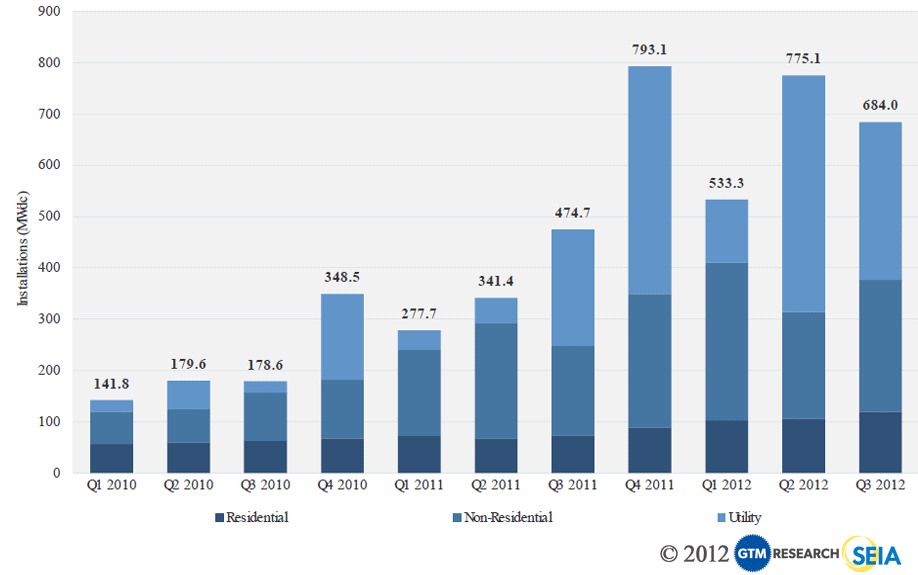
I'd say a 70% drop in prices over 5 years is quite a "trickle" of progress. The number of new solar installations is growing at an almost parabolic rate. Take a look,
http://www.seia.org/sites/default/files/2012q3-PV-Installations-by-Market-Segment2.gif
The US has installed in a single quarter, in both 2011 and 2012, what took an entire year to install back in 2010. I think you aren't giving solar proper credit. -
Re:Or...
Wait, you're suggesting by "I dont know of any company that could afford to beat out the fossil fuel companies to do so." that there aren't companies in the US trying to make money off alternative energy? Further, lots of state governments are actively trying to promote alternative energy, which undermines the theory that the government is afraid of a tax revenue collapse. State governments are subsidizing alternative energy using those very tax revenues, in the hopes that home-grown alternative energy producers will create even more tax revenue in the future.
I hate to sound like a slashvertisement, but I think the following US companies and groups would all disagree with you:
Evergreen Solar (producer based in Mass.)
Heliodyne (producer based in California)
Google (installing panels on its roof)
Solar Energy Industry Association (US trade group)
Tesla Motors) (selling 100% electric cars in the US)
List of solar manufacturers in the US
US solar power installations increase 33% year-to-year
The New York Times has a story about this issue: "Venture Capital Rushes into Alternate Energy" suggesting that $1.5 billion in VC money was invested in 2006 alone in new companies who hope to profit from overthrowing the energy status quo. If you add private equity money then there was $18.1 billion in dealflow in 2006 in the alternate energy sector. Or listen to a 2004 story about the same issue.
It's nice to think that there's some great conspiracy against alternate energy, but the simple truth is that there is a lot of market action in the field and nothing stopping people from making money in it. There is a HUGE amount of money to be made from alternate energy and plenty of people are trying to make it. -
PV links :
National Renewable Energy Lab http://www.nrel.gov/
Sandia National Labs http://www.sandia.gov/pv
Solar energies association http://www.seia.org/
Solar Trade Association - Solar Energy, Energy for a Cleaner Environment http://www.greenenergy.org.uk/sta/solarenergy/cont ent.htm
PV-UK http://www.greenenergy.org.uk/pvuk2/
Solar design associates http://www.solardesign.com/experience.html
PV power resource site http://www.pvpower.com/
PV Materials Efficency http://www.iea-pvps.org/pv/materials.htm
Solar Cell Technologies http://www.solarbuzz.com/Technologies.htm -
Re:Economic, not environmental.If you measure it as ERoEI, it's generally acknowledged by everyone except die-hard solar power advocates that the ratio of Energy Returned over Energy Input for solar is less than 1, unless you use very very recent strained Silicon-based technology, which barely hit break-even earlier this year.
its easy to debunk this myth.
Let's just say, for the sake of argument, that it takes 100 units of energy to make a PV panel. Then according to this myth, the panel only ever produces, say, 90 units of energy. The manufacturer pays for the 100 units of energy + materials to make the PV, and then sells it to the consumer for a profit. The consumer who buys this product (at a price which already accounts for 100 units of energy) is able to save more money than was spent on the purchase with only 90 units of energy? This is clearly not possible.
Either, there is no monetary payback from PV panels, or the ER/EI is greater than 1. But both cannot be true simultaneously. And the data shows that ER/EI is, in fact, greater than 1.
Estimated times for energy payback, from various sources:
(pdf) "1 to 5 years
various sources for estimates, all 1 to 5 years
"in the worst case, 4 years"
"usually under 5"
"range from 1 to 4 years" -
Re:Economic, not environmental.If you measure it as ERoEI, it's generally acknowledged by everyone except die-hard solar power advocates that the ratio of Energy Returned over Energy Input for solar is less than 1, unless you use very very recent strained Silicon-based technology, which barely hit break-even earlier this year.
how does this jibe with the FAQ linked previously in a comment? SEIA probably is a die-hard solar advocate, but how can I evaluate either statement? (eg. are there references that document either position?)
-
Re:I love google but I call "Yippe Skip"
Did we cross the threshold of solar panel arrays giving off more power before the MTBF than it takes to create them?
Yes. Quite a while ago IIRC.Solar power is simply a small way from being price competitive with established power generation. It is a viable energy source. It is not a net energy loss.
-
Re:A look at solar.
I'm not going to bother to check your math, I'll just quote from a January 2005 report of the Solar Energy Industries Association:
"Solar collectors on a 100-by-100-mile area in the Southwest could generate as much electricity as the United States consumes in a year. Alternatively, solar systems on roofs, parking lots, and other developed land across the nation could generate all the electricity we need--now, in 2030, and 2050--without building on the nation's open spaces."
I've seen similar figures from Sandia labs.
I'm really puzzled why people always try to figure out how much space would be taken up by a centralized solar power plant. The appealing thing about solar power (and fuel cells, and wind power) is that it's distributed--generating units are scattered wherever power is necessary. If you think about it that way, the space taken up by solar panels (or whatever) is negligible.
Go into an urban or suburban area and see how much space is taken up by buildings with flat roofs, parking lots, etc. Imagine that space covered by solar panels. Now realize that you can clad tall office buildings in solar panels that look like glass (and that let light through to the interior). There's an idea--make the buildings generate some of the power that they consume.