Slashdot Mirror
Domain: shrinkthatfootprint.com
Stories and comments across the archive that link to shrinkthatfootprint.com.
Comments · 63
-
Re:Really?
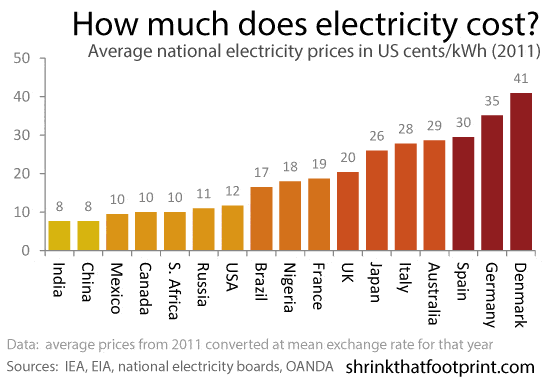
Germany's cost of energy is FAR higher than its peers. http://shrinkthatfootprint.com...
-
Re:Not just Reno
Electricity costs consumers three times what it costs in the US:
http://shrinkthatfootprint.com...
German consumers pay a lot of money to subsidize big corporations and manufacturers of solar and energy-intensive manufacturing is being outsourced from Germany. Is that what you want for the US?
-
Re:in a perfect scenerio, no doubt
Can we factor in the cost of even 1 minor nuclear plant accident and see what the numbers look like then?
Nuclear currently generates about 2700 TWh/yr of elecricity. Electricity prices variy around the world but $0.15/kWh is probably a good average figure. Levelized cost of nuclear production ranges from $0.04/kWh to $012/kWh with a median of $0.06/kWh. So the net benefit of nuclear is $0.15 - $0.06 = $0.09/kWh
2700 TWh * $0.15/kWh = $400 billion worth of electricity each year generated by nuclear. 2700 TWh * $0.09/kWh = $243 billion net benefit each year from nuclear. Even if you factor in the once-a-decade multi-billion dollar accident, the benefit from nuclear exceeds the harm by 2-3 orders of magnitude. The cost of the accidents are literally a drop in the bucket. -
Re:France is 75% nuclear
Very inexpensive? Cost of electricity in France is 19 cents/kWh. Russia is 11 cents and the US is 12 cents. China and India are both 8 cents.
I'll grant you it could be a lot worse. Denmark, the top wind power country in the world (wind is 28% of their consumption), is 41 cents.
(the above are all 2011 figures)
It's not that nuclear power is remarkably cheap; it's that wind power is crazy expensive. Offshore wind plants in particular are just about the most absurdly expensive of all sources of electricity - excluding complete pie in the sky stuff like hydrogen fuel cells and so on.
Inexpensive for Europe. Germany, which invested heavily in solar is one of the more expensive in Europe.
-
Re:France is 75% nuclear
Very inexpensive? Cost of electricity in France is 19 cents/kWh. Russia is 11 cents and the US is 12 cents. China and India are both 8 cents.
I'll grant you it could be a lot worse. Denmark, the top wind power country in the world (wind is 28% of their consumption), is 41 cents.
(the above are all 2011 figures)
It's not that nuclear power is remarkably cheap; it's that wind power is crazy expensive. Offshore wind plants in particular are just about the most absurdly expensive of all sources of electricity - excluding complete pie in the sky stuff like hydrogen fuel cells and so on.
-
Re:Simple problem, simple solution
High densities and affordability in Europe are also achieved by keeping apartments and condos much smaller than in the US.
-
Re:No, because they are not compatible
they have seen much lower energy cost rises than some of their neighbours (particularly the UK).
Baloney.
Average price of electricity in Germany: 0.35 USD/kwHr
Average price of electricity in UK: 0.20 USD/kwHrHoly moly. I'm paying around 0.10 USD/kwHr andcould get it down under 0.09 if I signed up for a contract and instead of going month to month (and down around 0.05 if I were willing to change plans entirely). I'm in Texas, so they probably run enough of a profit to make up for that when I run the Air Conditioning.
-
Re:No, because they are not compatible
they have seen much lower energy cost rises than some of their neighbours (particularly the UK).
Baloney.
Average price of electricity in Germany: 0.35 USD/kwHr
Average price of electricity in UK: 0.20 USD/kwHrBaloney.
Average number of household carpets eaten by badgers in Gemany: 0.2 per annum
Average number of household carpets eaten by badgers in UK: 945 per annumProviding a reference to a statistic that the OP wasn't talking about doesn't win the argument. Energy cost *rises* are not the same as energy costs.
-
Re:No, because they are not compatible
they have seen much lower energy cost rises than some of their neighbours (particularly the UK).
Baloney.
Average price of electricity in Germany: 0.35 USD/kwHr
Average price of electricity in UK: 0.20 USD/kwHr -
Re:Musk's Hubris...
I personally believe that new electric cars are safer than petrol cars generally... they've got less to go wrong badly, and they've been proven.
However, a Nissan leaf gets 40mpg equivalent or so in the US (in terms of carbon emissions), according to here (see Emissions equivalent petrol car). A Tesla will get a lot worse.
That's shit. My parent's car will get almost 50mpg. It's a diesel. My car will get more than 30mpg, and it'll do 0-60 in 6.
-
Re:Nuclear: only interim solution, permanent waste
Really? They're not importing a significant part from it's neighbors?
-
Re:In every Tesla thread I mean to ask...
Here's a good article that looks at emissions based on the type of fuel.
http://shrinkthatfootprint.com/electric-cars-green
If you look at the map "Emissions equivalent MPG", you'll see that Australia CO2 emissions are about equivalent to a 26MPG petrol car whereas the in the US (nationwide average fuel mix) it's about equivalent to a 40MPG car.
India (all coal) is about a 20 MPG car whereas Brazil is equivalent to a 134 MPG car. -
Re:Power vs. energy
Yes, terawatt-hours per year is a valid way to state average power. It's obfuscatory, though, because most people can't do a quick mental conversion based on the number of hours in a year.
No, that doesn't matter at all as the argument goes both ways, i.e.: if average power consumption is 1W, how many Wh is that in a year?
It just depends on what you are comparing with, and as it happens, for energy consumption/production on societal scales, Wh is apparently the convention:
http://en.wikipedia.org/wiki/World_energy_consumptionIf the article had stated that one TWh is enough to supply 85,000 homes for a year, it would have been a coherent and perhaps useful statement -- but why not just carry out the rest of the calculation (1400 * 85000), and say that this has the potential to power almost 12 million homes?
For that matter, why not 1.4 petawatthour and 85 million homes? The conversion would have been even more natural and less error-prone
Some quick Googling turns up US average household energy consumption of 6000 kWh, or 8900 kWh, or 14000 kWh, corresponding to average power consumption of 685 W, 1 kW, and 1.6 kW.
For the record: those are staggering amounts: http://shrinkthatfootprint.com/average-household-electricity-consumption
Then again, it is electricity only. I'm pretty sure that natural gas consumption changes the numbers quite a bit.If the semantics I'm trying to salvage from the summary are correct, it's claiming a figure of 1340 W.
Actually,
1.4 Wh * 10^15 / 1 year =
1.4 Wh * 10^15 / (1*365*24h) =
1.4 W * 10^15 / 8760 =
1.4 / 8.76 * 10^12 W =~
160 * 10^9 W =~ 160 GWThat is pretty ridiculously high, of course. But then again, they're probably talking about the entire energy potential of all the coastal waters of the US, as opposed to what the pilot projects could deliver.
(I don't claim to be a unit-analysis wizard, but I was stating fuel efficiency in inverse acres years before XKCD covered it...)
Hehehe