Slashdot Mirror
Domain: silmaril.ie
Stories and comments across the archive that link to silmaril.ie.
Comments · 17
-
Re:Why not a Mac?
Also, I think TexShop is the best LaTex editor.
"Some people think Buckingham Palace a fine building." (Nicholas Freeling)
I tries some for Windows, and they universally suck, IMHO.
AquaMacs (Emacs for Macs) works perfectly for LaTeX, as it does everywhere.
I can't believe how much time I wasted trying to use word for technical stuff when I was in school.
I run LaTeX courses and I hear this every time, especially from science students.
Learn Latex. I will save you life.
It will certainly save you time and effort. You might even get a life
--
"Learn LaTeX?" Sure -
Re:Why a laptop?The LaTeX Editor app runs perfectly on my Note 4 phone so I assume it will work equally well on any Android tablet.
--
"Learn LaTeX?" Sure -
Re:BFF
And please feel free to add any useful ones to our Acronym Database.
-
Re:Damn, saw that coming.
Canonical is doing what Nokia did, and will pay the same penalty.
I wrote some years ago about how Nokia was missing the point, having developed a pocket computer before knowing what they had done. Their blinkers said "phone" on them, so they never saw the giant road sign that said "computer". As one veteran of a firm then free-falling out of the Fortune 500 put it in The Cluetrain Manifesto, "The clue train stopped there four times a day for ten years and they never took delivery."
Now Canonical have developed another Maemo/Meego: a life-size OS that runs on a pocket device. And Mark Shuttleworth seems to have inherited Nokia's set of blinkers that say "phone", and Lo! and behold! he too cannot see the sign that says "computer". As I said in that article, 'the current pox of "partnerships" is a particularly Good Clue, because it means management is spending more time schmoozing on the golf course than down on the shop floor making or selling.'
I truly hope this doesn't apply (mutatis mutandis) to Mark Shuttleworth, but if you have invested your money, time, or life in Canonical, you need to consider if your forecast of the future concides with theirs.
-
Re:Pain
MS did have some legitimate reasons for changing to the ribbon. The myriad toolbar buttons on classic Office toolbars is confusing to naive users.
Like this example which I often use: http://silmaril.ie/downloads/wordscreen.gif
LaTeX users find this amusing when people say how much easier Word is...
-
Re:maybe
I would imagine Nokia feels ditching their own OS would just make them hardware manufacturers, not so different from a large portion of their competition.
That's certainly possible, but this goes beyond Symbian and MeeGo. There is the whole fiasco which was Maemo.
With the N700 and N800, Nokia had the foundation for a viable, sustainable, open platform for the development of pocket computing, to which they could have added phone capability. Very little needed fixing (mainly the webcam, for which there was never any software except Nokia's own webchat, which no-one used). Instead, they failed to recognise the market, ignored the users completely, and came out with the N900, which was a phone with a hobbled PDA platform.
To be fair, Google made similar mistakes with Android, releasing 1.* with no support for two key elements, principally Bluetooth and Wifi Proxies. But these appear to be partially fixed in 2.*, whereas the N900 was just an expensive not-very-smart-phone.
Every time the deficiencies of Nokia's vision come up, their developers (who are excellent people) come up with the same scripted blather about how important the company's marketing strategy is, and how they know best, and how the market for "tablets" is so important. Of course it is, as the iPad showed, but the N800 was there long before, and had more facilities than the iPad, and could easily have been developed into a larger, competitive device.
But Nokia is at heart still just a phone manufacturer, and they lack the vision to see where the handheld market is going, despite having it explained to them numerous times in words that even marketing 'droids can understand. The future isn't in "tablets" but in portable computing. Call them "tablets" if it makes you feel warm and fuzzy, but don't think for a moment that they are phones with a PDA bolted on. They're computers, and the way to sell them is to make sure they run stuff — simply, easily, quickly, and openly.
-
How do you know if a book was typeset using LaTeX?
> It had been years since I had seen a book typeset using LaTeX.
The publishing industry (including my company) typesets books using LaTeX all the time. The reason you don't notice it (apart from the superior quality) is that it does its job of typesetting very well.
If this book has been typeset using LaTeX then I'm a Dutchman, or something has gone very wrong (and I'd like the author to contact me to let me know what).
Perhaps he was given faulty fonts, perhaps he was using a badly-written publisher's style, or perhaps he -- or his editor -- spent a long time making it look as bad as possible. Maybe OUP had it completely re-typeset in some other system without telling him. There are at least a dozen typographic faults in one paragraph alone, from unnecessary hyphenation to excessive word-spacing to bad math spacing, and LaTeX simply doesn't make those types of mistake unless you work very hard to introduce them manually.
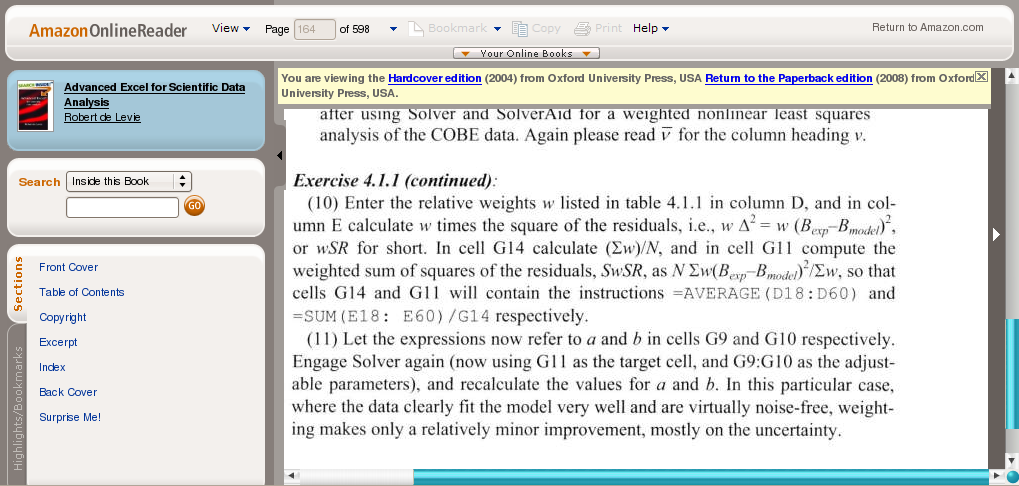
As a test I screenshot a random paragraph that I viewed in Amazon's "Look Inside" feature, and then retyped it in LaTeX and typeset it (PDF).
As I don't have the book (and wouldn't understand it anyway
-
How do you know if a book was typeset using LaTeX?
> It had been years since I had seen a book typeset using LaTeX.
The publishing industry (including my company) typesets books using LaTeX all the time. The reason you don't notice it (apart from the superior quality) is that it does its job of typesetting very well.
If this book has been typeset using LaTeX then I'm a Dutchman, or something has gone very wrong (and I'd like the author to contact me to let me know what).
Perhaps he was given faulty fonts, perhaps he was using a badly-written publisher's style, or perhaps he -- or his editor -- spent a long time making it look as bad as possible. Maybe OUP had it completely re-typeset in some other system without telling him. There are at least a dozen typographic faults in one paragraph alone, from unnecessary hyphenation to excessive word-spacing to bad math spacing, and LaTeX simply doesn't make those types of mistake unless you work very hard to introduce them manually.
As a test I screenshot a random paragraph that I viewed in Amazon's "Look Inside" feature, and then retyped it in LaTeX and typeset it (PDF).
As I don't have the book (and wouldn't understand it anyway
-
How do you know if a book was typeset using LaTeX?
> It had been years since I had seen a book typeset using LaTeX.
The publishing industry (including my company) typesets books using LaTeX all the time. The reason you don't notice it (apart from the superior quality) is that it does its job of typesetting very well.
If this book has been typeset using LaTeX then I'm a Dutchman, or something has gone very wrong (and I'd like the author to contact me to let me know what).
Perhaps he was given faulty fonts, perhaps he was using a badly-written publisher's style, or perhaps he -- or his editor -- spent a long time making it look as bad as possible. Maybe OUP had it completely re-typeset in some other system without telling him. There are at least a dozen typographic faults in one paragraph alone, from unnecessary hyphenation to excessive word-spacing to bad math spacing, and LaTeX simply doesn't make those types of mistake unless you work very hard to introduce them manually.
As a test I screenshot a random paragraph that I viewed in Amazon's "Look Inside" feature, and then retyped it in LaTeX and typeset it (PDF).
As I don't have the book (and wouldn't understand it anyway
-
Re:And i-bullshit too!
A business plan is only any good if you have a saleable product, unless you're just aiming to milk some VCs. I've seen (and done DD on) startups with good business plans, people who understood cash flow and customers and marketing -- but the product was crap, or already obsolete, or simply a non-starter (didn't stop some of them getting the cash, of course, but it sure as hell stopped the business dead in its tracks when the funding ran out).
-
Ubuntu for Enterprise?2006 was the year that a large number of people started to talk Ubuntu as a possible contender for the Enterprise Linux desktop.
Not an icicle's hope in hell. I run Edgy at home and in the office, but I work in IT and I can afford to experiment. We have enough problems as things stand with XP users who don't know their asterisk from their tilde.
Maintenance: this is my first Ubuntu (6.10) so I can't comment on earlier releases. So far it's been fine for me, but a 4-5 day delay to repackage a key browser is too long. Oddly, one of the reasons I moved from FC to Ubuntu was that RH were taking way too long to come out with updates.
The only downsides of Ubuntu (blogged here) were a)having to switch from KDE to Gnome (I didn't have time to try out KUbuntu first), but that's a personal thing: Gnome works, but it needs some serious usability attention; b)CUPS really sucks: it fails to find the shared printers on other local (XP) systems, it fails to honor the supported 11x17 paper size on my HPDJ1220C, it hangs after each job, and when using the parallel port it's as slow as a pig -- why it was written baffles me; c)the failure of the UI fonts to support even ISO 8859-1 (no accents) let alone full Unicode: it's embarrassing that a system could be shipped without this; d)the shipped TeX sucks (and I owe c.t.t details) so I ripped it out and installed from the TUG DVD instead, which puts things in sensible places instead; e)laptop lid suspend doesn't work: it brings up a screenfull of fizz and then reboots (but then no laptop suspend works under any Linux, IMHE).
Subsequent to installation, I find it won't play video except for some formats I've never heard of: certainly not the WMV, MPG, and MOV which are commonplace on the net, until you install MPlayer, and for some of them not even then (should be the default); none of the audio players plays Ogg unless you install the vorbis libraries (why isn't this the default?); the latest Flash update doesn't do anything, certainly not play Flash movies.
However, the real core of what I want to do "just worked", and worked perfectly. It's stable, wifi and wired connections worked straight off, it found all the stupid proprietary hardware on my Inspiron and on my antique Compaq rebuild, and so far it hasn't dropped a bit.
So the answer is clear: Ubuntu isn't ready for any kind of desktop except that of someone in IT who can find and fix the unevennesses. Ubuntu have done an excellent job, but they still need to tidy up some neglected corners. One of the most important would be to recognise and distinguish laptops from deskbounds, and install things appropriately.
The real problem (with all distributions) is that many of the people who do the key work are the same people who don't believe in Usability, and who don't envisage anyone except like-minded gurus using what they write. This makes it almost impossible to move a distro to a serious desktop position, where everything just works, and does so seamlessly and transparently, with appropriate defaults, because the people needed to make it so are those who don't believe that such refinement is necessary ("if it was hard to write, it should be hard to use").
-
Re:XML -- The answer to a problem that didn't exis
Nope not trolling in the least!
From the WC3...
"Extensible Markup Language (XML) is a simple, very flexible text format derived from SGML (ISO 8879). Originally designed to meet the challenges of large-scale electronic publishing, XML is also playing an increasingly important role in the exchange of a wide variety of data on the Web and elsewhere."Hmmm moving data...., I guess I am not far off the mark.
Lets see and there is this which goes on at length about whay its a cool way to, wait for it..... Move Data!
But wait, there's more! You guessed it ladies and gentlement, the WC3 goes to great pains to tell you that only XML is X-Platform and is an excellent way to store, manipulate and transmit data! I would site this as a major push for XML to do exactly what I said it was trying to do.
As to you, fucktard, I was moving data between systems, more then likely, while the best part of you was running down your momma's leg. So shut your fucking cakehole and READ up.
-
Re:Geez, man...Some of us have been doing this for YEARS. At least now we have a buzzword for it.
There is already a buzzword: tag abuse. It's the last resort of the untalented.
This particular version is known as semantic imputation (giving things meanings they don't inherently have). It's neither new, special, exciting, nor useful, but at least we now know how little the people at IBM and Leverage Software know about markup and XML.
I guess I'd better add a warning to the XML FAQ about it...
-
Re:Google Conquers allMy online book/tutorial on LaTeX acquires some interesting ads from time to time but after a few days the pr0n0 ones just go away for a little while. Either there is a learning engine somewhere, or there is a cursory human glance.
The best cure for sea-sickness is to go and sit under a tree [Spike Milligan]
-
Re:Who cares if its XML?This can't be said enough: file formats are what determine whether and how easily data is portable, or whether the user is just stuck.
...
The fact that the data format is documented (and the commitment to keep it so) is what's important.Amen. I blogged more open file formats for my wishlist just last week and I've just received abuse from the anti-XML faction ("too hard", "too fiddly", "just a fad"). OK, so I haven't exactly been polite about programmers who don't grok XML in the past, but believe me there is still a hard core of non-Microsofties out there who still want XML to die
The fact that the format is XML is rather meaningless [...] For many things XML is unsuitable/non-optimal...
Yes, it could have been a number of formats (ODIF, anyone?
You should care that it's XML...
-
Re:Say WHAT?>I can't recall a case in which Microsoft had viable products and decent sales and exited instead of spending more money to compete more effectively. Or even when they had non-viable products (Pocket PC's original OS) and spent years and billions before they had something that worked.
SGML Author for Word. I mentioned this recently. Worked brilliantly, never publicized, never even acknowledged they made it (too embarrassed perhaps).
Then just as the world started to go for XML in a big way and screamingly needed converters...they dropped it on the floor.
-
Re:Free as in beer!?I am starting a beer database...as discussed at the Extreme Markup conference in Montreal a couple of weeks ago. I committed a while back to starting a Beer "published subject" (using Topic Maps) as a use-case, and quite a lot of people have expressed an interest.
An announcement (here and elsewhere) will be up soon. Meantime mail me if you want to contribute. You will need to grok XTM if you want to get involved in the detail, but simpler submissions will be taken via a Web form.