Slashdot Mirror
Domain: solarcellcentral.com
Stories and comments across the archive that link to solarcellcentral.com.
Comments · 7
-
Re:Contrast this with the incoming administration
Ok. Good to know. Either way, you are paying that much because your province is choosing to do so with complete disregard for the market. It's a good way to encourage a new industry and FIT programs like these may be partly or largely responsible for the dramatic drop in cost over the last decade. Now that the technology is competitive without the FIT it no longer makes sense to keep the program.
The best way to end fossil fuel use is with a market driven program such as a revenue neutral carbon tax. This allows the market to decide the optimal solution and lets you drop taxes on activities that you ought to be encouraging such as earning and spending. It looks like instead the province has opted to keep the FIT, add cap and trade, and keep the revenue. Not the best. Hopefully Michael Chong will run for Premier and kick the libs to the curb.
-
Re:Uses blackbody emission
True, however the steepness of the peak is relevant.
Compare the spectral footprint of sunlight at sea level:
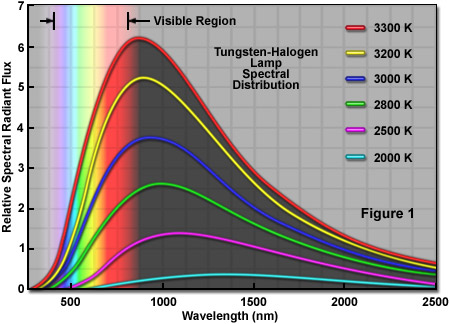
With the typical power curve of pure blackbody emissions:
ClickyThe latter one has a single peak. The former has a much "flatter", but also noisier distribution. One can optimize at the near infra-red band, where the blackbody emission peaks consistently, and harvest the vast majority of the emitted photons. Especially since this band is also very close to the innate emission/capture band of pure silicon.
This means that PV cells tailored for near-IR and IR capture will be WILDLY efficient with this setup.
-
Re:Why not grid level storage?
There is the problem of capacity and storage,
According to the same web site you quote, a reasonably optimistic target is 20% PV, 20% wind by 2030. The rest (60%) must be provided by something else. I don't think coal or nuclear is quite dead yet (unfortunately).
-
Why not grid level storage?
Tesla's replacement 85kwh car battery comes to $140 per kWh based on the wiki numbers, other companies are joining the market, one said they can produce at $160 per kWh of storage. There is no reason why these batteries can't be married with renewables to take 90%+ of the market in the coming years. There is no reason to believe these prices won't continue to drop.
So why not grid level storage, this video shows it can be very useful:
Fully Charged - Electrical energy storage and its place in a low carbon future.It looks like renewables + storage will be very feasible in most of the world within the next decade or two. The video I linked shows it is being trialled in the UK right now.
Nuclear is dead, coal and gas are next, the writing is on the wall. http://solarcellcentral.com/im...
-
Re:Wait until those lamers find out...
Actually solar and coal with CO2 capture are getting pretty close.
Germany, In Euros
hard coal 63â"80
PV power plants 78-142and
UK, in pounds
Solar farms 125â"180
Coal with CO2 capture 100â"155--
Coal causes 4,000 direct deaths per year and pollution from plants without pollution control measures cause tens of thousands of premature deaths annually.
Besides the radioactivity from coal- coal fires render and will continue to render more land uninhabitable than Chernobyl and Fukishima combined. Just one coal fire (burning for decades) has rendered as an area (700sqkm) as large as Fukishima uninhabitable. As a bonus- it pollutes a huge area with mercury and other pollutants.
I don't mean to give solar a pass (lots of rooftop deaths) (and we really don't know the down stream pollution effects or how much land will be rendered uninhabitable yet if we use a LOT of solar). My point is that solar is getting cheaper every day- batteries are getting better every day- and the cost of the two is getting fairly close (unless you want to burn raw brown coal with few to no pollution controls- then coal is half the price).
Personally- I've gotten a MUCH better bang for my buck from going to some CFL and mostly LED Bulbs (I esp. like the 900 lumen G7 3000K A19 factor bulbs. At $12.50ish they pay for themselves very quickly and as a bonus I've never had to replace one yet).
http://solarcellcentral.com/co...
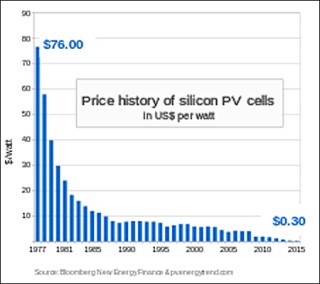
"As can be seen from the chart at the left, solar cell prices have come down by a factor of 100 over the last 35 years. (The reason for the small increase between 2005 and 2008 was because of a polysilicon shortage.) The 2013 average price is expected to be $.74.""First Solar's stated goals are to be under $.55 in 2014 and to be about $.40 by 2017. "
When continuing maintenance costs are considered, solar is already less expensive than cheap coal after 19 years. Coal plants have a higher annual maintenance cost than solar. This is more relevant to municipal plants. A homeowner might be dead or move before the payoff is realized.
I own one solar panel as an experiment.
It generates a maximum of 178 watts (but an average of about 100 watts) between 10am and 6pm right now. I have to wipe it off about twice a month. It saves me about $2 per month averaged over the year but the largest savings are in the summer. I bought it 3 years ago and it will take 19.44 years to pay off (if it makes it- I think the micro inverter will break first). But it's made me aware of solar.
-
Re:$6.36 per Watt
You need to take into account the number of years of operation. Building a given power capacity as nuclear is more expensive than as solar, but the lifetime is at least twice longer. According to your own reference the lifetime cost per kWh is one and a half time better for nuclear than solar. That is the proper metric to use for comparison.
Of course, nuclear has many advantages over solar, like a constant power output, a much smaller footprint and a lower number of deaths per kWh. These advantages are not apparent in the per kWh cost.
-
$6.36 per Watt
(14G$ / 2.2GW) doesn't sound like a good price point to me, with the price of solar being at $3/watt and falling (assuming "AC Watts" have the same energy as "DC Watts"). Why so pricey?