Slashdot Mirror
Domain: solux.net
Stories and comments across the archive that link to solux.net.
Comments · 20
-
Re:Great, but LEDs improve dramatically every quar
Yet LED technology is nowhere near addressing the shitty color reproduction you get from objects lit by LEDs because these light sources continue to have a very uneven spectrum: http://i.stack.imgur.com/lkyXG.... Incandescents, on the other hand, have a blackbody spectrum which is smooth and thus easy to filter. There are incandescents targeted to photographers, galleries, and museums that match the sun's spectrum almost exactly (at your chosen whitepoint color temperature -- human perception of color is not absolute but depends on overall intensity of the light, so typical indoors lighting scenarios you want a lower color temperature because the light intensity is nowhere near solar and matching solar will make things seem too blue): https://www.solux.net/images/s...
-
Re:While you're at it - light tubes!
The phrase you're looking for is CRI (color rendering index). There are a ton of low-CRI crap lighting, but if you're willing to spend it, you can do better:
http://www.handhelditems.com/5500k-color-corrected-light-fluorescent-lamp-photo-bulb-p-5711.html
[Good quality light. No manufacturer anywhere on it so...]http://www.solux.net/cgi-bin/tlistore/infopages/index.html
[Claims. But I haven't dealt with this company]There's others out there, but if you get a CRI in the 90+ range, it will be better than most (Walmart are ~60 last time I researched; bad enough it's hard to find out what they really were). I'll agree with the light tubes as being a good idea, but I haven't used them yet. A poster further down said something about metal halide-- the largest problem with MH bulbs is their output goes down *drastically* as they age; we're retrofitting 8xT-8 bulbs in a few factories with good results.
-
Re:COLOR temperature, not thermal temp
Funny you should quote a site engaging in seriously deceptive marketing.
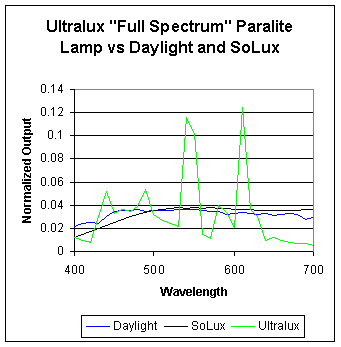
Rebuttal: http://solux.net/ultraluxfalsedata.htm -
Re:Carbon trading and CFLs
The problem is simple: color rendering of CFLs is crap, because they use narrowband phosphors resulting in a very spiky spectrum, which, even if white balanced to daylight, will still result in colored objects appearing completely different from what they would when illuminated by sunlight. Compare the ease, on the other hand, with which a filtering reflector can make the continuous spectrum of an incandescent bulb match that of daylight: http://solux.net/images/ultral1.gif I turn off the disgusting fluorescents off in the office and use my desk lamp with one of those incandescent bulbs. 50 W seem like a waste compared to the dozen of a comparable-brightness CFL? Not when you have proper color rendering.
-
Re:Let's call it what it is -- prohibition.
Complex color matching? There's not the remotest similarity between the spiky spectrum of even a good CFL to the continuous spectrum of an incandescent which can be easily filtered to match that of actual daylight: http://solux.net/images/ultral1.gif Looking at the color rendering difference, there is nothing subtle about it.
-
Re:Incandescent tax would be better
Niche? So you think making colors look the same as in actual daylight is a niche market? Only a continuous spectrum such as of an incandescent bulb can be (with filtering) matched to that of actual daylight. See how even a good CFL compares with its narrowband phosphors in this diagram: http://solux.net/images/ultral1.gif
-
Re:Tax high wattage bulbs instead
That is only reasonable if you can force the CFLs to have a color rendering ability matching that of incandescents. That is, of course, impossible, since CFLs generate light with narrowband phosphors, whereas incandescents have a continuous spectrum, which can be easily filtered to match almost exactly the spectrum of sunlight: http://solux.net/images/ultral1.gif Higher taxation on incandescents would mean that those of us that actually like colors to look the same as they do in daylight will suffer because we'd be forced to switch to the CFLs with their crappy color rendering.
-
Re:More than Australia
How is this the "right" decision? That's very presumptuous of you to say. Why should I trade a continuous spectrum that with proper filtering, can match daylight, to a CFL which uses narrowband phosphors and, even if white balanced to daylight, can never approach the color rendering ability of the former? Compare the spectrum of a high-end CFL to a filtered incandescent and daylight: http://solux.net/images/ultral1.gif
-
Re:More than Australia
Enough about incentives. How about deterrents to using CFLs? All of them use narrowband phospors and so even when matched to the same white balance as daylight, you cannot get comparable color rendition; for that you need a source with a continuous spectrum, which you then tweak with a filter -- an incandescent bulb with a filtering reflector: http://solux.net/images/ultral1.gif I'm using such at work in my desklamp so I can turn off the fluorescents in the office whose color rendering makes me wanna puke.
-
Re:More than Australia
Color temperature is just an average and doesn't tell you how well it will render colors. The narrowband phosphors of a CFL don't have nearly the color rendering capability of the continuous spectrum of even a crappy incandescent. With proper filtering, an incandescent can actually match the spectrum of daylight, as in this example: http://solux.net/images/ultral1.gif So only an incandescent in a proper configuration can give you color reproduction that actually mimics that of sunlight.
-
Re:Incandescent is closer to fire.
There's more to this than coldness and warmth, as that is just looking at a spectrum as one dimensional; it is not. The averaging is inappropriate as you're just matching white balance. But two light sources with different spectra can still have the same white balance and average color temperature. Though white and grey objects will look the same, colored objects will still look different. You have to match the sunlight spectrum very well to get great color rendering. That means no narrowband phosphors as in CFLs, but the continuous spectrum of an incandescent bulb, with appropriate filtering (which is most efficiently done with a filtering reflector rather than a blocking translucent one). Compare a good CFL spectrum with a filtered incandescent and actual daylight: http://solux.net/images/ultral1.gif
-
Re:More than Australia
Color balance is not sufficient. Just because two lights with different actual spectra have the same white balance does not mean colored objects will appear the same with each. If you want something to appear as if lit by sunlight, unless you're only looking at whites or greys, you need a source with a spectrum that fully matches the solar one in the visible light range. That means no narrowband phosphors in CFLs, but a blackbody radiator = incandescent bulb, with an appropriate filter to approximate the effects of temperature differences between the sun and bulb, and atmospheric filtering. To avoid heating the filter, usually manufacturers use reflecting filters. Here are some spectrum comparisons between filtered incandescent, solar, and 'quality' CFL spectra: http://solux.net/images/ultral1.gif
-
Re:More than Australia
Another is the horrible color rendering of the narrowband phosphors that even the best CFLs rely on. Even if one source appears as white as others when illuminating neutral colors (white, greys) -- same white balance, if it's spectrum is different (possible since the human eye is only trichromatic), when colored objects are illuminated they will look different under each of those sources, because the product of the source spectrum with the object color reflectance will vary. So you can only get colors rendition that matches daylight if you actually use a daylight spectrum. No CFL can approach that. An incandescent bulb can because it is a blackbody radiator with a continuous spectrum, so one only needs a good filtering reflector. Here's an example: http://solux.net/images/ultral1.gif
-
Re:Buy a higher quality CFL for better phosphors.
Cut the crap. A good incandescent with filtered reflector is the only thing that can approach a solar spectrum. Compare to the junk you get even from a 'quality' CFL: http://solux.net/images/ultral1.gif
-
Re:Kneejerk Bans Don't Work
Why should I settle for a substrandard lighting spectrum? The narrowband phosphors on a fluorescent bulb result in a light that is still white, but non-neutral colors do not look correctly as the product of the light spectrum with the reflectance of the colored objects will not be the same as a different light source which happens to also have the same white balance. Compare the spectra of a good incandescent bulb with a filtering reflector to that of a typical CFL: http://solux.net/images/ultral1.gif
-
Re:More than Australia
Indeed. Compare the spectrum of a good incandescent bulb with filtering reflector to that of a typical CFL light: http://solux.net/images/ultral1.gif
It just looks soooo much better that I turn off the overhead fluorescent tubes at work and use my desklamp with one of these incandecents. -
Sunlight is about 5500KThe wording varies between manufacturers, but sunlight is around 5500K. So if you want to stimulate a warm sunny day get ~5000K bulbs and a LOT of them. If you don't have enough it won't look like sunlight.
If you could focus the light from a typical 32W T8 3000-lumen bulb on a square foot of space, that would be 3000 foot-candles and a bright sunny day is about 10000 foot-candles. So there's no hope of matching the intensity of sunlight but after a certain point you can trick your psychovisual system into thinking it's close. I use 6 3000-lumen bulbs in a small room and it seems nice and bright. And the quality of the light is much better than incandescent, which looks yellow and sickly to me now.
I also toyed with the idea of getting Solux bulbs which have a reflector that transmits some of the light to make the reflected light close to 5500K (the visible spectrum is also very similar to true sunlight, unlike fluorescent, obviously). But it would take approximately 5x more wattage to equal the light level I have now with fluorescent, which equals a lot of heat.
-
LEDs are NOT efficient
They are only efficient compared to incandecent bulbs. Even most common flourescent lights are more efficient. Halogen lights are more efficient. High pressure sodium lights are several times more efficient.
White LEDs have a horrid spectrum. Here's an example of what spectrum a light source should have, and similar spectrum correcting technology can be applied to more efficient sources such as HPS. LEDs are good for displays as status lights, but it's stupid to use them for general lighting when there are far better options. -
Re:if nobody is going to answer the guy
Heh, well said - it's quite surprising how many crap comments there are on this story, you'd think more pro photographers/designers (or their IT techs) would chip in with some decent advise on colour workflow and calibrating to a specific target. Though, as is usual on Ask Slashdot, the submitter didn't provide many details, so it's harder to give him specific information to help him find a solution.
With regards to colorimeters -- these'll all allow you to calibrate to a "baseline" rather than the best that each device can display -- I've got a Spyder (mk.1) and it's not too bad, though the new ones look much better (increased sensitivity) - though no-one's mentioned so far that the software that comes with these (PhotoCal or OptiCal) requires a seperate licence for each machine they're installed on, so at 30-40 monitors it's not going to be as cheap as it first appears. The GretagMacBeth stuff seems like another good choice (e.g. the Eye-One), as do the Monaco/X-Rite calibration tools, but they're more expensive. Ideally you go for a solution that's not just limited to calibrating screens, but can do printers as well, but again it'll cost more (it's usually worth it though - you might as well do the entire loop while you're at it). Or, if he's really serious about it, standardise on the same model of monitor, such as the Sony Artisan (with built-in calibration that actually adjusts the CRT guns, rather than just generate a profile).
Like another poster said, lighting's also an issue, too; hooding the monitors to minimise reflections is usually a good idea, and standardising on specific lighting such as Just Normlicht fluorescent tubes or Solux halogen bulbs (fed with a specific regulated voltage) helps immensely.
-
Re:For those of you who don't yet know...
Apparently one of the best price-performance ones at the moment is the Sony Artisan (unless you've got serious money to spend, that is). There's a review over at Luminous Landscape. Wish I had a spare $1800, my (Spyder-calibrated) Trinitron is starting to annoy me: the blacks are a bit undefined, even with good desk lighting (Solux bulbs) and a hood
And that's a damn good point about viewing X-rays. I went to the new hospital the government just built here - at a cost of some GBP£111.7 million! - and they have standard Dell machines and TFTs displaying their X-rays! I was NOT impressed; when I spoke with the radiologist about it he just gave the blank "what the hell are you talking about" look