Slashdot Mirror
Domain: spacefellowship.com
Stories and comments across the archive that link to spacefellowship.com.
Stories · 149
-
Orbit Your Own Satellite For $8,000
RobGoldsmith sends word of Interorbital's TubeSat Personal Satellite Kit, which allows anyone to send a half-pound payload to low-earth orbit for $8,000. Your satellite will fly to orbit from Tonga atop an Interorbital Systems NEPTUNE 30 rocket along with 31 other TubeSats. It will function for several weeks, then its orbit will decay and it will burn up in the atmosphere. Interorbital plans to send up a load of 32 TubeSats every month. If you pay in full in advance, you get slotted onto a particular scheduled launch. Here are Interorbital's product page and brochure (PDF). -
Orbit Your Own Satellite For $8,000
RobGoldsmith sends word of Interorbital's TubeSat Personal Satellite Kit, which allows anyone to send a half-pound payload to low-earth orbit for $8,000. Your satellite will fly to orbit from Tonga atop an Interorbital Systems NEPTUNE 30 rocket along with 31 other TubeSats. It will function for several weeks, then its orbit will decay and it will burn up in the atmosphere. Interorbital plans to send up a load of 32 TubeSats every month. If you pay in full in advance, you get slotted onto a particular scheduled launch. Here are Interorbital's product page and brochure (PDF). -
Armadillo Aerospace Flight Paves Way For Science Payloads
Matt_dk writes "Armadillo Aerospace conducted two groundbreaking atmospheric test flights this weekend with their 'Mod' vertical-takeoff-vertical-landing rocket, a vehicle familiar to anyone who has followed NASA's Lunar Lander Challenge competitions. Flying from their test facility in Caddo Mills, Texas, Armadillo Aerospace first completed a milestone flight under a NASA contract, using methane fuel and liquid oxygen as propellant. Later that same afternoon, a second successful low-altitude flight was performed using a 'boosted hop' trajectory of the same type that will be used for suborbital flights to space." -
Armadillo Aerospace Flight Paves Way For Science Payloads
Matt_dk writes "Armadillo Aerospace conducted two groundbreaking atmospheric test flights this weekend with their 'Mod' vertical-takeoff-vertical-landing rocket, a vehicle familiar to anyone who has followed NASA's Lunar Lander Challenge competitions. Flying from their test facility in Caddo Mills, Texas, Armadillo Aerospace first completed a milestone flight under a NASA contract, using methane fuel and liquid oxygen as propellant. Later that same afternoon, a second successful low-altitude flight was performed using a 'boosted hop' trajectory of the same type that will be used for suborbital flights to space." -
Space Shuttle Endeavour Heads To Space Station
RobGoldsmith writes "The STS-127 crew began its journey to the International Space Station at 6:03 p.m. EDT Wednesday when space shuttle Endeavour lifted off from Kennedy Space Center, Fla. The shuttle crew will complete construction of the Japan Aerospace Exploration Agency's Kibo laboratory and deliver a new crew member, astronaut Tim Kopra, to the orbital outpost." -
Space Shuttle Endeavour Heads To Space Station
RobGoldsmith writes "The STS-127 crew began its journey to the International Space Station at 6:03 p.m. EDT Wednesday when space shuttle Endeavour lifted off from Kennedy Space Center, Fla. The shuttle crew will complete construction of the Japan Aerospace Exploration Agency's Kibo laboratory and deliver a new crew member, astronaut Tim Kopra, to the orbital outpost." -
New Map Hints At Venus' Wet, Volcanic Past
Matt_dk writes with this excerpt from Space Fellowship: "Venus Express has charted the first map of Venus' southern hemisphere at infrared wavelengths. The new map hints that our neighbouring world may once have been more Earth-like, with a plate tectonics system and an ocean of water. The map comprises over a thousand individual images, recorded between May 2006 and December 2007. Because Venus is covered in clouds, normal cameras cannot see the surface, but Venus Express used a particular infrared wavelength that can see through them." -
New Map Hints At Venus' Wet, Volcanic Past
Matt_dk writes with this excerpt from Space Fellowship: "Venus Express has charted the first map of Venus' southern hemisphere at infrared wavelengths. The new map hints that our neighbouring world may once have been more Earth-like, with a plate tectonics system and an ocean of water. The map comprises over a thousand individual images, recorded between May 2006 and December 2007. Because Venus is covered in clouds, normal cameras cannot see the surface, but Venus Express used a particular infrared wavelength that can see through them." -
SpaceX Boosts Malaysian Satellite Into Orbit
Soychemist writes "On the same day that yet another shuttle launch was postponed, SpaceX successfully carried a Malaysian satellite, RazakSAT, into orbit. This is the second successful launch in a row for Elon Musk's space exploration startup. Later this year the company will launch its larger Falcon 9 rocket, which could be used to carry cargo to the International Space Station. RazakSAT was designed by ATSB and carries a high resolution camera. If it is intact, the satellite will take photographs of Earth that could be used to better manage natural resources." Adds xp65: "The satellite was separated from the Falcon 1 about 48 minutes after liftoff at 3:35 GMT (11:35 pm EDT). The orbit is 685 km and 9 degrees inclination. Launch was delayed several times due to a faulty helium valve on the ground and bad weather at the launch site at Kwajalein. This was the fifth flight of the Falcon 1 rocket, with the last two flights being succesful. Later this year the inaugural flight of the larger Falcon 9 rocket is planned from Cape Canaveral." -
SpaceX Boosts Malaysian Satellite Into Orbit
Soychemist writes "On the same day that yet another shuttle launch was postponed, SpaceX successfully carried a Malaysian satellite, RazakSAT, into orbit. This is the second successful launch in a row for Elon Musk's space exploration startup. Later this year the company will launch its larger Falcon 9 rocket, which could be used to carry cargo to the International Space Station. RazakSAT was designed by ATSB and carries a high resolution camera. If it is intact, the satellite will take photographs of Earth that could be used to better manage natural resources." Adds xp65: "The satellite was separated from the Falcon 1 about 48 minutes after liftoff at 3:35 GMT (11:35 pm EDT). The orbit is 685 km and 9 degrees inclination. Launch was delayed several times due to a faulty helium valve on the ground and bad weather at the launch site at Kwajalein. This was the fifth flight of the Falcon 1 rocket, with the last two flights being succesful. Later this year the inaugural flight of the larger Falcon 9 rocket is planned from Cape Canaveral." -
Stacking of New Space Vehicle Begins At KSC
Matt_dk writes "For the first time in more than a quarter-century, a new space vehicle will begin stacking on a mobile launch platform (MLP) at Kennedy Space Center. The Ares I-X aft skirt, which was mated to a solid fuel segment in the Rotation, Processing and Surge Facility at KSC, rolled over to the 528-foot-tall Vehicle Assembly Building today, where it will be lifted and placed on the MLP in High Bay 3. On that platform, workers will secure the aft booster and continue adding segments of the first stage rocket, the upper stage simulators, the crew module mockup and the launch abort system simulator, taking the vehicle to a height of 327 feet." -
Stacking of New Space Vehicle Begins At KSC
Matt_dk writes "For the first time in more than a quarter-century, a new space vehicle will begin stacking on a mobile launch platform (MLP) at Kennedy Space Center. The Ares I-X aft skirt, which was mated to a solid fuel segment in the Rotation, Processing and Surge Facility at KSC, rolled over to the 528-foot-tall Vehicle Assembly Building today, where it will be lifted and placed on the MLP in High Bay 3. On that platform, workers will secure the aft booster and continue adding segments of the first stage rocket, the upper stage simulators, the crew module mockup and the launch abort system simulator, taking the vehicle to a height of 327 feet." -
ESA and NASA Establish a Joint Mars Exploration Initiative
Matt_dk sends in a Spacefellowship article: "The ESA Director of Science and Robotic Exploration, David Southwood, met NASA's Associate Administrator for Science, Ed Weiler, in Plymouth, UK, to establish a way for a progressive programme for exploration of the Red Planet. The outcome of the bilateral meeting was an agreement to create a Mars Exploration Joint Initiative (MEJI) that will provide a framework for the two agencies to define and implement their scientific, programmatic and technological goals at Mars." -
ESA and NASA Establish a Joint Mars Exploration Initiative
Matt_dk sends in a Spacefellowship article: "The ESA Director of Science and Robotic Exploration, David Southwood, met NASA's Associate Administrator for Science, Ed Weiler, in Plymouth, UK, to establish a way for a progressive programme for exploration of the Red Planet. The outcome of the bilateral meeting was an agreement to create a Mars Exploration Joint Initiative (MEJI) that will provide a framework for the two agencies to define and implement their scientific, programmatic and technological goals at Mars." -
Successful Test of Superconducting Plasma Rocket Engine
xp65 writes to mention that Ad Astra has successfully tested their VX-200 plasma engine at full power in superconducting conditions, the first time such an engine has been tested at those power levels. "The VX-200 engine is the first flight-like prototype of the VASIMR® propulsion system, a new high-power plasma-based rocket, initially studied by NASA and now being developed privately by Ad Astra. VASIMR® engines could enable space operations far more efficiently than today's chemical rockets and ultimately they could also greatly speed up robotic and human transit times for missions to Mars and beyond." -
Successful Test of Superconducting Plasma Rocket Engine
xp65 writes to mention that Ad Astra has successfully tested their VX-200 plasma engine at full power in superconducting conditions, the first time such an engine has been tested at those power levels. "The VX-200 engine is the first flight-like prototype of the VASIMR® propulsion system, a new high-power plasma-based rocket, initially studied by NASA and now being developed privately by Ad Astra. VASIMR® engines could enable space operations far more efficiently than today's chemical rockets and ultimately they could also greatly speed up robotic and human transit times for missions to Mars and beyond." -
Space Station Marathon Starting This Weekend
RobGoldsmith writes with this snippet from Space Fellowship: "If you've never seen a spaceship with your own eyes, now's your chance. The International Space Station (ISS) is about to make a remarkable series of flybys over the United States. Beginning this 4th of July weekend, the station will appear once, twice, and sometimes three times a day for many days in a row. No matter where you live, you should have at least a few opportunities to see the biggest spaceship ever built." -
Space Station Marathon Starting This Weekend
RobGoldsmith writes with this snippet from Space Fellowship: "If you've never seen a spaceship with your own eyes, now's your chance. The International Space Station (ISS) is about to make a remarkable series of flybys over the United States. Beginning this 4th of July weekend, the station will appear once, twice, and sometimes three times a day for many days in a row. No matter where you live, you should have at least a few opportunities to see the biggest spaceship ever built." -
Can Commercial Space Tech Get Off the Ground?
coondoggie writes "While NASA's commercial partners such as SpaceX and Orbital have made steady progress in developing space cargo transportation technology, they have recently fallen behind their development schedules. Combine that with the fact that the most critical steps lie ahead, including successfully launching new vehicles and completing integration with the space station, and you have a hole that will be tough to climb out of. Those were the two main conclusions of a Government Accountability Office report (PDF) on the status of the commercial space world this week. The GAO went on to say that after the planned retirement of the space shuttle in 2010, NASA will face a cargo resupply shortfall for the International Space Station of approximately 40 metric tons between 2010 and 2015." Speaking of SpaceX, reader Matt_dk sends along an update on the company's Falcon 9 flight efforts. "Six of the nine first stage flight engines have completed acceptance testing and all nine flight engines are on schedule to complete acceptance testing by mid-July." -
Junior-Sized Supernova Discovered By New York Teen
Matt_dk writes "In November 2008, Caroline Moore, a 14-year-old student from upstate New York, discovered a supernova in a nearby galaxy, making her the youngest person ever to do so. Additional observations determined that the object, called SN 2008ha, is a new type of stellar explosion, 1000 times more powerful than a nova but 1000 times less powerful than a supernova. Astronomers say that it may be the weakest supernova ever seen." -
Junior-Sized Supernova Discovered By New York Teen
Matt_dk writes "In November 2008, Caroline Moore, a 14-year-old student from upstate New York, discovered a supernova in a nearby galaxy, making her the youngest person ever to do so. Additional observations determined that the object, called SN 2008ha, is a new type of stellar explosion, 1000 times more powerful than a nova but 1000 times less powerful than a supernova. Astronomers say that it may be the weakest supernova ever seen." -
Evidence For Liquid Water On a Frozen Early Mars
Matt_dk writes "NASA scientists modeled freezing conditions on Mars to test whether liquid water could have been present to form the surface features of the Martian landscape. Evidence suggests flowing water formed the rivers and gullies on the Mars surface, even though surface temperatures were below freezing. Dissolved minerals in liquid water may be the reason." -
Evidence For Liquid Water On a Frozen Early Mars
Matt_dk writes "NASA scientists modeled freezing conditions on Mars to test whether liquid water could have been present to form the surface features of the Martian landscape. Evidence suggests flowing water formed the rivers and gullies on the Mars surface, even though surface temperatures were below freezing. Dissolved minerals in liquid water may be the reason." -
EPOXI Team Develops New Method To Find Alien Ocean
Matt_dk writes "Astronomers have found more than 300 alien (extrasolar) worlds so far. Most of these are gas giants like Jupiter, and are either too hot (too close to their star) or too cold (too far away) to support life as we know it. Sometime in the near future, however, astronomers will probably find one that's just right — a planet with a solid surface that's the right distance for a temperature that allows liquid water — an essential ingredient in the recipe for life. Now scientists looking back at Earth with the Deep Impact/EPOXI mission have developed a method to indicate whether Earth-like extrasolar worlds have oceans." -
EPOXI Team Develops New Method To Find Alien Ocean
Matt_dk writes "Astronomers have found more than 300 alien (extrasolar) worlds so far. Most of these are gas giants like Jupiter, and are either too hot (too close to their star) or too cold (too far away) to support life as we know it. Sometime in the near future, however, astronomers will probably find one that's just right — a planet with a solid surface that's the right distance for a temperature that allows liquid water — an essential ingredient in the recipe for life. Now scientists looking back at Earth with the Deep Impact/EPOXI mission have developed a method to indicate whether Earth-like extrasolar worlds have oceans." -
Simonyi Arrives At the ISS After Shuttle Lands
RobGoldsmith writes in with news of the further adventures of Charles Simonyi, whose first trip to the ISS we discussed a couple of years ago. The Russian Soyuz vehicle carrying Simonyi and two others docked a day after the US space shuttle Discovery landed in Florida. "Space Adventures, Ltd. ... announced today that its orbital client Charles Simonyi and his crew successfully arrived at the International Space Station after launching on-board the Soyuz TMA-14 spacecraft from the Baikonur Cosmodrome in Kazakhstan on March 26. The spacecraft docked to the ISS at 9:05 am (EDT) with Dr. Simonyi and Expedition 19 crew members Russian cosmonaut Gennady Padalka and NASA astronaut Michael Barratt. They were greeted at approximately 12:30 p.m. (EDT) by the Expedition 18 crew..." -
Simonyi Arrives At the ISS After Shuttle Lands
RobGoldsmith writes in with news of the further adventures of Charles Simonyi, whose first trip to the ISS we discussed a couple of years ago. The Russian Soyuz vehicle carrying Simonyi and two others docked a day after the US space shuttle Discovery landed in Florida. "Space Adventures, Ltd. ... announced today that its orbital client Charles Simonyi and his crew successfully arrived at the International Space Station after launching on-board the Soyuz TMA-14 spacecraft from the Baikonur Cosmodrome in Kazakhstan on March 26. The spacecraft docked to the ISS at 9:05 am (EDT) with Dr. Simonyi and Expedition 19 crew members Russian cosmonaut Gennady Padalka and NASA astronaut Michael Barratt. They were greeted at approximately 12:30 p.m. (EDT) by the Expedition 18 crew..." -
Simonyi Arrives At the ISS After Shuttle Lands
RobGoldsmith writes in with news of the further adventures of Charles Simonyi, whose first trip to the ISS we discussed a couple of years ago. The Russian Soyuz vehicle carrying Simonyi and two others docked a day after the US space shuttle Discovery landed in Florida. "Space Adventures, Ltd. ... announced today that its orbital client Charles Simonyi and his crew successfully arrived at the International Space Station after launching on-board the Soyuz TMA-14 spacecraft from the Baikonur Cosmodrome in Kazakhstan on March 26. The spacecraft docked to the ISS at 9:05 am (EDT) with Dr. Simonyi and Expedition 19 crew members Russian cosmonaut Gennady Padalka and NASA astronaut Michael Barratt. They were greeted at approximately 12:30 p.m. (EDT) by the Expedition 18 crew..." -
Finding Twin Earths Is Harder Than We Thought
Matt_dk writes "Does a twin Earth exist somewhere in our galaxy? Astronomers are getting closer and closer to finding an Earth-sized planet in an Earth-like orbit. NASA's Kepler spacecraft just launched to find such worlds. Once the search succeeds, the next questions driving research will be: Is that planet habitable? Does it have an Earth-like atmosphere? Answering those questions will not be easy. 'We'll have to be really lucky to decipher an Earth-like planet's atmosphere during a transit event so that we can tell it is Earth-like,' said Kaltenegger. 'We will need to add up many transits to do so — hundreds of them, even for stars as close as 20 light-years away.'" The abstract of their paper offers a link to the complete paper as a 17-page PDF; here is a short description from 2007 of the same researchers' work, outlining the type of spectral signature that an Earth-like atmosphere would be expected to show. -
Finding Twin Earths Is Harder Than We Thought
Matt_dk writes "Does a twin Earth exist somewhere in our galaxy? Astronomers are getting closer and closer to finding an Earth-sized planet in an Earth-like orbit. NASA's Kepler spacecraft just launched to find such worlds. Once the search succeeds, the next questions driving research will be: Is that planet habitable? Does it have an Earth-like atmosphere? Answering those questions will not be easy. 'We'll have to be really lucky to decipher an Earth-like planet's atmosphere during a transit event so that we can tell it is Earth-like,' said Kaltenegger. 'We will need to add up many transits to do so — hundreds of them, even for stars as close as 20 light-years away.'" The abstract of their paper offers a link to the complete paper as a 17-page PDF; here is a short description from 2007 of the same researchers' work, outlining the type of spectral signature that an Earth-like atmosphere would be expected to show. -
ESA Launches GOCE To Map Earth's Gravity
DSG2 sends in an ESA press release which reads in part: "This afternoon, the Gravity field and steady-state Ocean Circulation Explorer (GOCE) satellite developed by the European Space Agency was lofted into a near-Sun-synchronous, low Earth orbit by a Rockot launcher lifting off from the Plesetsk cosmodrome in northern Russia. GOCE is the first of a new family of ESA satellites designed to study our planet and its environment in order to enhance our knowledge and understanding of Earth-system processes and their evolution, to enable us to address the challenges of global climate change. In particular, GOCE will measure the minute differences in the Earth's gravity field around the globe." One consequence of mapping the planet's geoid in finer detail is that ocean currents can be limned more accurately. This BBC article from 2007 goes into some detail about this application. -
ESA Launches GOCE To Map Earth's Gravity
DSG2 sends in an ESA press release which reads in part: "This afternoon, the Gravity field and steady-state Ocean Circulation Explorer (GOCE) satellite developed by the European Space Agency was lofted into a near-Sun-synchronous, low Earth orbit by a Rockot launcher lifting off from the Plesetsk cosmodrome in northern Russia. GOCE is the first of a new family of ESA satellites designed to study our planet and its environment in order to enhance our knowledge and understanding of Earth-system processes and their evolution, to enable us to address the challenges of global climate change. In particular, GOCE will measure the minute differences in the Earth's gravity field around the globe." One consequence of mapping the planet's geoid in finer detail is that ocean currents can be limned more accurately. This BBC article from 2007 goes into some detail about this application. -
ISS To Become Second Brightest-Object In the Sky
Matt_dk writes "Move over, Morning Star. Once Canadarm2 helps install the fourth and final set of solar array wings to the International Space Station later this month, the Station will surpass Venus as the brightest object in the night sky, second only to the Moon. The Space Shuttle Discovery is set to deliver the power-generating solar panels and Starboard 6 (S6) truss segment to the ISS on the 125th mission in the Shuttle program, known as STS-119/15A (slated for launch on March 11)." -
ISS To Become Second Brightest-Object In the Sky
Matt_dk writes "Move over, Morning Star. Once Canadarm2 helps install the fourth and final set of solar array wings to the International Space Station later this month, the Station will surpass Venus as the brightest object in the night sky, second only to the Moon. The Space Shuttle Discovery is set to deliver the power-generating solar panels and Starboard 6 (S6) truss segment to the ISS on the 125th mission in the Shuttle program, known as STS-119/15A (slated for launch on March 11)." -
The Lower Atmosphere of Pluto Revealed
Matt_dk writes "Using ESO's Very Large Telescope, astronomers have gained valuable new insights about the atmosphere of the dwarf planet Pluto. The scientists found unexpectedly large amounts of methane in the atmosphere, and also discovered that the atmosphere is hotter than the surface by about 40 degrees, although it still only reaches a frigid minus 180 degrees Celsius. These properties of Pluto's atmosphere may be due to the presence of pure methane patches or of a methane-rich layer covering the dwarf planet's surface." -
The Lower Atmosphere of Pluto Revealed
Matt_dk writes "Using ESO's Very Large Telescope, astronomers have gained valuable new insights about the atmosphere of the dwarf planet Pluto. The scientists found unexpectedly large amounts of methane in the atmosphere, and also discovered that the atmosphere is hotter than the surface by about 40 degrees, although it still only reaches a frigid minus 180 degrees Celsius. These properties of Pluto's atmosphere may be due to the presence of pure methane patches or of a methane-rich layer covering the dwarf planet's surface." -
Satellite Collision Debris May Hamper Space Launch
Matt_dk writes "The debris from a recent collision involving two communications satellites could pose a serious threat for future launches of spacecraft into a geostationary orbit, a Russian scientist said on Friday. Future launches will have to be adjusted with regard to the fact that the debris [from the collision] has spread over an 800-km area and will gather at a common orbit in 5-6 years." -
Satellite Collision Debris May Hamper Space Launch
Matt_dk writes "The debris from a recent collision involving two communications satellites could pose a serious threat for future launches of spacecraft into a geostationary orbit, a Russian scientist said on Friday. Future launches will have to be adjusted with regard to the fact that the debris [from the collision] has spread over an 800-km area and will gather at a common orbit in 5-6 years." -
Most Extreme Gamma-Ray Blast Yet Detected
Matt_dk sends in a quote from a story at NASA: "The first gamma-ray burst to be seen in high-resolution from NASA's Fermi Gamma-ray Space Telescope is one for the record books. The blast had the greatest total energy, the fastest motions and the highest-energy initial emissions ever seen. ... Gamma-ray bursts are the universe's most luminous explosions. Astronomers believe most occur when exotic massive stars run out of nuclear fuel. As a star's core collapses into a black hole, jets of material — powered by processes not yet fully understood — blast outward at nearly the speed of light. The jets bore all the way through the collapsing star and continue into space, where they interact with gas previously shed by the star and generate bright afterglows that fade with time. ...Fermi team members calculated that the blast exceeded the power of approximately 9,000 ordinary supernovae, if the energy was emitted equally in all directions." -
Reaction Engines To Fly Reusable Spaceplane
RobGoldsmith writes "Reaction Engines have designed a 'reusable spaceplane' to provide inexpensive and reliable access to space. The Star Wars-looking 'Skylon' reusable spaceplane has already been designed and the team are well into engine testing. They have taken some time out from building spaceships to talk about their background, their goals, and their recent engine tests. This article shows new images of their STERN Engine, an experimental rocket motor which explores the flow in Expansion Deflection (ED) nozzles. They also discuss their Sabre air-breathing engine technology. View the Skylon Spaceplane concept, the STERN Engine and much more in this in-depth interview with the team." -
Reaction Engines To Fly Reusable Spaceplane
RobGoldsmith writes "Reaction Engines have designed a 'reusable spaceplane' to provide inexpensive and reliable access to space. The Star Wars-looking 'Skylon' reusable spaceplane has already been designed and the team are well into engine testing. They have taken some time out from building spaceships to talk about their background, their goals, and their recent engine tests. This article shows new images of their STERN Engine, an experimental rocket motor which explores the flow in Expansion Deflection (ED) nozzles. They also discuss their Sabre air-breathing engine technology. View the Skylon Spaceplane concept, the STERN Engine and much more in this in-depth interview with the team." -
Falcon 9 Is Now Fully Integrated At Cape Canaveral
RobGoldsmith writes "SpaceX's Falcon 9 is now fully integrated: an update from Elon Musk states 'Falcon 9 is now fully integrated at the Cape! Today we mated the 5.2 m payload fairing to the Falcon 9 first stage. This was the final step in the integration process — one day ahead of schedule.' New images are now available showing the first fully integrated Falcon 9 Rocket. Once the launch mount and erector are complete, SpaceX will transfer Falcon 9 on to the erector and raise it to vertical early in 2009." -
Virgin Galactic Signs Historic Lease Agreement
RobGoldsmith writes "Governor Bill Richardson today announced that Virgin Galactic has signed a 20-year lease agreement with the State of New Mexico. Virgin Galactic's world headquarters will be established in New Mexico and its operations will be located at New Mexico's Spaceport America, the nation's first purpose-built commercial spaceport. The signing of the lease agreement coincides with the beginning of the test flying program for Virgin Galactic's WhiteKnightTwo launch vehicle which got underway this month in Mojave, CA. The WhiteKnightTwo will serve as the mother ship for SpaceShipTwo, the vehicle that will carry commercial astronauts into sub-orbital space from Spaceport America." -
Virgin Galactic Signs Historic Lease Agreement
RobGoldsmith writes "Governor Bill Richardson today announced that Virgin Galactic has signed a 20-year lease agreement with the State of New Mexico. Virgin Galactic's world headquarters will be established in New Mexico and its operations will be located at New Mexico's Spaceport America, the nation's first purpose-built commercial spaceport. The signing of the lease agreement coincides with the beginning of the test flying program for Virgin Galactic's WhiteKnightTwo launch vehicle which got underway this month in Mojave, CA. The WhiteKnightTwo will serve as the mother ship for SpaceShipTwo, the vehicle that will carry commercial astronauts into sub-orbital space from Spaceport America." -
New Photos of SpaceX's Falcon 9 Assembly
RobGoldsmith writes "New images are now available of SpaceX's Falcon 9 being assembled. The images are accompanied with a small update from SpaceX. If there are no unexpected delays, it's possible Falcon 9 will be completely integrated by the end of the year. This update shows real flight hardware and really brings the rocket alive. View images of the Falcon 9 nearing completion now!" -
SpaceShipTwo Mothership Makes Maiden Flight
RobGoldsmith writes "Earlier this week images were appearing on the Net showing the WhiteKnightTwo craft doing some tests in Mojave. The earliest tests showed perhaps two of the engines being used, while a later test showed all the engines working and some further testing. Today the four Pratt & Whitney Canada PW308A engines finally carried the craft into the air. The maiden flight of the WhiteKnightTwo lasted just shy of one hour and happened today at around 08:15 local time, at Mojave air and spaceport. Rumors suggest that a Beechcraft King Air was used for a chase plane. The craft will be used to position Virgin Galactic's SpaceShipTwo craft to fly into space; this is estimated to happen around 2010." -
SpaceShipTwo Mothership Makes Maiden Flight
RobGoldsmith writes "Earlier this week images were appearing on the Net showing the WhiteKnightTwo craft doing some tests in Mojave. The earliest tests showed perhaps two of the engines being used, while a later test showed all the engines working and some further testing. Today the four Pratt & Whitney Canada PW308A engines finally carried the craft into the air. The maiden flight of the WhiteKnightTwo lasted just shy of one hour and happened today at around 08:15 local time, at Mojave air and spaceport. Rumors suggest that a Beechcraft King Air was used for a chase plane. The craft will be used to position Virgin Galactic's SpaceShipTwo craft to fly into space; this is estimated to happen around 2010." -
Water Detected At Record Distance From Earth
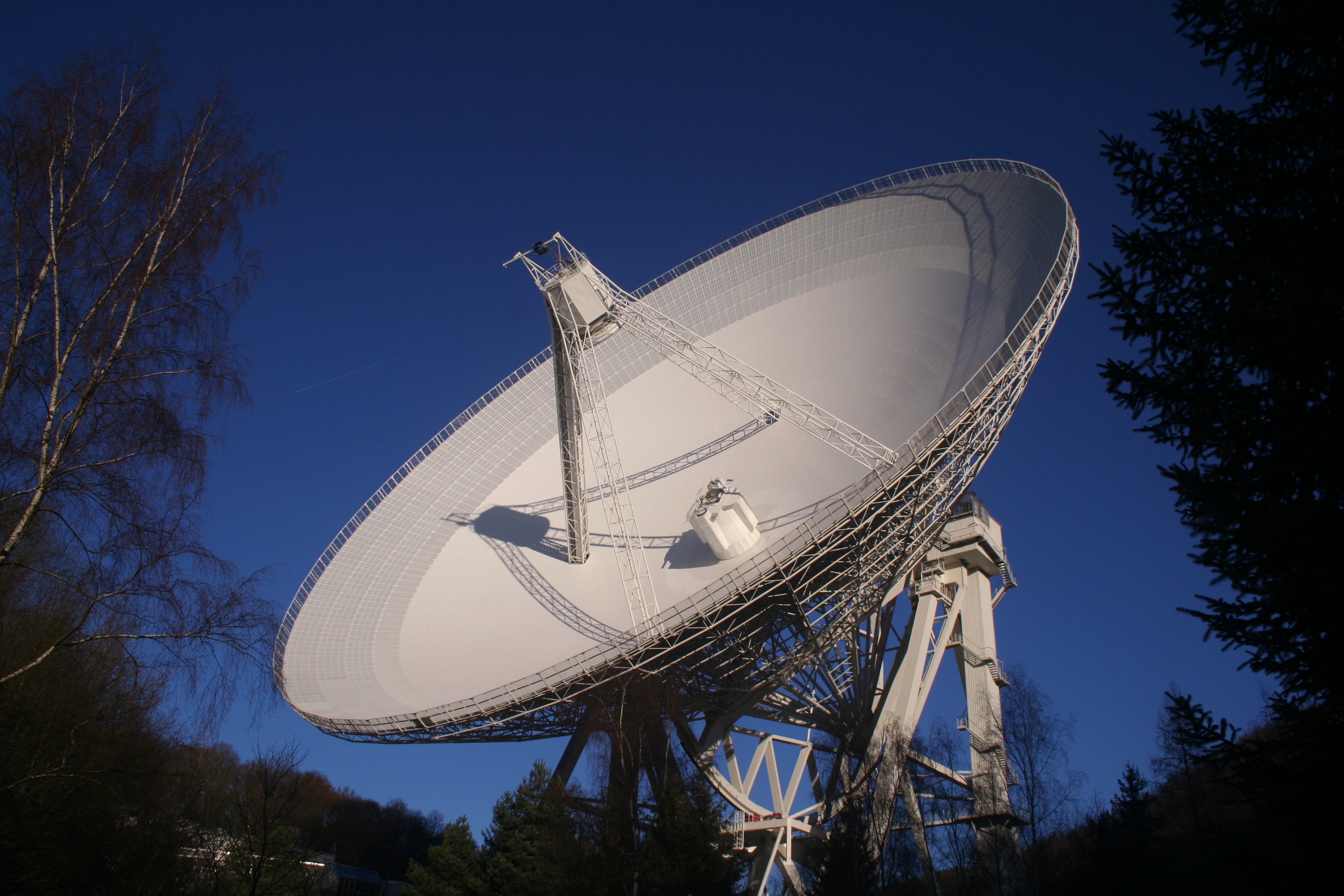
Matt_dk writes with news that scientists have detected water in a galaxy 11.5 billion light-years from Earth. Evidence came in the form of emissions from water masers around a quasar at the center of the galaxy. Detection at such a large distance was made possible by a closer, intervening galaxy which acted as a gravitational lens. "'We were only able to discover this distant water with the help of the gravitational lens,' said Violette Impellizzeri, an astronomer with the Max-Planck Institute for Radioastronomy (MPIfR) in Bonn, Germany. 'This cosmic telescope reduced the amount of time needed to detect the water by a factor of about 1,000,' she added. The astronomers first detected the water signal with the Effelsberg telescope. They then turned to the VLA's sharper imaging capability to confirm that it was indeed coming from the distant galaxy. The gravitational lens produces not one, but four images of MG J0414+0534 as seen from Earth. Using the VLA, the scientists found the specific frequency attributable to the water masers in the two brightest of the four lensed images. The other two lensed images, they said, are too faint for detecting the water signal. The radio frequency emitted by the water molecules was Doppler shifted by the expansion of the Universe from 22.2 GHz to 6.1 GHz." -
VASIMR Plasma Thruster To Be Tested Aboard ISS
Toren Altair brings news that NASA and the Ad Astra Rocket Company finalized a Space Act Agreement earlier this week to test the Variable Specific Impulse Magnetoplasma Rocket (VASIMR) on the International Space Station. The agreement hinges on a series of requirements for the thruster's performance and efficiency in ground-based tests. "The primary technical objective of the project is to operate the VASIMR VF-200 engine at power levels up to 200 kW. Engine operation will be restricted to pulses of up to 10 minutes at this power level. Energy for these high-power operations will be provided by a battery system trickle-charged by the ISS power system. These tests will mark the first time that a high-power, steady-state electric thruster will be used as part of a manned spacecraft." Reader clarkes1 points out related news of a runway trial for Virgin Galactic's WhiteKnightTwo, the mothership that is designed to carry SpaceShipTwo from the ground to 50,000 feet. A very brief video shows the oddly-shaped plane moving down a runway under its own power. -
VASIMR Plasma Thruster To Be Tested Aboard ISS
Toren Altair brings news that NASA and the Ad Astra Rocket Company finalized a Space Act Agreement earlier this week to test the Variable Specific Impulse Magnetoplasma Rocket (VASIMR) on the International Space Station. The agreement hinges on a series of requirements for the thruster's performance and efficiency in ground-based tests. "The primary technical objective of the project is to operate the VASIMR VF-200 engine at power levels up to 200 kW. Engine operation will be restricted to pulses of up to 10 minutes at this power level. Energy for these high-power operations will be provided by a battery system trickle-charged by the ISS power system. These tests will mark the first time that a high-power, steady-state electric thruster will be used as part of a manned spacecraft." Reader clarkes1 points out related news of a runway trial for Virgin Galactic's WhiteKnightTwo, the mothership that is designed to carry SpaceShipTwo from the ground to 50,000 feet. A very brief video shows the oddly-shaped plane moving down a runway under its own power.