Slashdot Mirror
Domain: spacetelescope.org
Stories and comments across the archive that link to spacetelescope.org.
Stories · 19
-
Supermassive Black Hole Rocketing Out of Distant Galaxy At 5 Million MPH (blastr.com)
The Bad Astronomer writes: Astronomers have found a supermassive black hole barreling out of its home galaxy at 5 million miles per hour. The 3 billion solar mass behemoth formed from the merger of two slightly smaller black holes after two galaxies collided and themselves merged. The resulting blast of gravitational waves is thought to have been asymmetric, causing a rocket effect which launched the resulting black hole away. It's currently 40,000 light years from the galaxy's core. Source: ESA/Hubble -
Astronomers Successfully Predict Appearance of Supernova
schwit1 writes: For the first time ever astronomers have been able to predict and photograph the appearance of a supernova, its light focused by the gravitational lensing caused by a galaxy and the dark matter that surrounds it: "The NASA/ESA Hubble Space Telescope has captured the image of the first-ever predicted supernova explosion. The reappearance of the Refsdal supernova was calculated from different models of the galaxy cluster whose immense gravity is warping the supernova's light." What makes this significant is that the prediction models were based on the theory of gravitational lensing and required the presence of dark matter to work. That they worked and were successful in predicting the appearance of this gravitationally bent light (bent by the dark matter it passed through) is a very strong confirmation of both concepts. -
New Hubble Release Puts Another Nail In the Coffin of Dark Matter's Competitors (spacetelescope.org)
StartsWithABang writes: When it comes to the structure of the Universe — forming the galaxies, clusters, and Universe as we see it — the normal matter we know of simply isn't enough. Given our best-understood laws of physics, including Einstein's general relativity, what we see of galaxies and the Universe in general simply doesn't match up to our predictions. The simplest solution, arguably, is to just add a new ingredient: a new form of matter, a dark matter if you will. But a counterargument is that we've got the laws of gravity wrong, and that no new matter is necessary. There's only one way to settle an argument like this: with data, evidence and the full suite of observations at our disposal. The newest Hubble release, along with four other independent lines of evidence, rule out modifications of gravity and leave dark matter as the only option standing. -
Hubble Turns 25
Taco Cowboy points out that the Hubble Space Telescope turns 25 today. Hubble was launched on April 24, 1990, aboard the Space Shuttle Discovery from Kennedy Space Center, Florida. Currently, it is flying about 340 miles over the Earth and circling us every 97 minutes. While the telescope itself is not really much to look at, that silver bucket is pure gold for astronomers. Scientists have used that vantage point to make ground-breaking observations about planets, stars, galaxies and to reveal parts of our universe we didn't know existed. The telescope has made more than a million observations and astronomers have used Hubble data in more than 12,700 scientific papers, "making it one of the most productive scientific instruments ever built," according to NASA. ... NASA aims to keep Hubble operating through at least 2020 so that it can overlap with its successor. The James Webb Space Telescope is due to launch in October 2018 and begin observations in mid-2019. NASA celebrated by releasing a new, epic image from Hubble titled "Celestial Fireworks." It is accompanied by an impressive flythrough video. Some nice galleries of Hubble images have been put together at the NY Times and Slate, but a bigger collection is available directly from the official Hubble website. -
Dark Matter Is Even More of a Mystery Than Expected
schwit1 writes: Using the Hubble and Chandra space telescopes astronomers have discovered that dark matter is not only invisible to direct observation, it is invisible to itself! Quoting: "As two galactic clusters collide, the stars, gas and dark matter interact in different ways. The clouds of gas suffer drag, slow down and often stop, whereas the stars zip past one another, unless they collide — which is rare. On studying what happens to dark matter during these collisions, the researchers realized that, like stars, the colliding clouds of dark matter have little effect on one another. Thought to be spread evenly throughout each cluster, it seems logical to assume that the clouds of dark matter would have a strong interaction — much like the colliding clouds of gas as the colliding dark matter particles should come into very close proximity. But rather than creating drag, the dark matter clouds slide through one another seamlessly." The data here is on the very edge of reality, built on too many assumptions. We know that something undetected as yet is influencing the motions of galaxies, but what exactly it is remains completely unknown. These results only make the mystery more mysterious. -
Hubble Takes Amazing New Images of Andromeda, Pillars of Creation
The Hubble Space Telescope was launched in April, 1990. In 1995, it presented us with one of its most iconic images: a close-up of gas pillars in the Eagle Nebula, dubbed the "Pillars of Creation." Now, as HST approaches its 25th anniversary, astronomers have re-shot the pillars at a much higher resolution. Here are direct images links: visible light, comparison with old image, near-infrared light. "The infrared view transforms the pillars into eerie, wispy silhouettes seen against a background of myriad stars. That's because the infrared light penetrates much of the gas and dust, except for the densest regions of the pillars. Newborn stars can be seen hidden away inside the pillars."
That's not the only new image from Hubble today: NASA has also released the most high definition view of the Andromeda Galaxy that we've ever seen. Here's a web-friendly image, but that doesn't really do it justice. The full image is 69,536 px by 22,230 px. To see Andromeda in all its glory, visit the ESA's dedicated, zoomable site that contains all the image data. At the highest zoom levels, you can make out a mind-blowing number of individual stars. Andromeda is over 2 million light-years distant. -
Hubble Takes Amazing New Images of Andromeda, Pillars of Creation
The Hubble Space Telescope was launched in April, 1990. In 1995, it presented us with one of its most iconic images: a close-up of gas pillars in the Eagle Nebula, dubbed the "Pillars of Creation." Now, as HST approaches its 25th anniversary, astronomers have re-shot the pillars at a much higher resolution. Here are direct images links: visible light, comparison with old image, near-infrared light. "The infrared view transforms the pillars into eerie, wispy silhouettes seen against a background of myriad stars. That's because the infrared light penetrates much of the gas and dust, except for the densest regions of the pillars. Newborn stars can be seen hidden away inside the pillars."
That's not the only new image from Hubble today: NASA has also released the most high definition view of the Andromeda Galaxy that we've ever seen. Here's a web-friendly image, but that doesn't really do it justice. The full image is 69,536 px by 22,230 px. To see Andromeda in all its glory, visit the ESA's dedicated, zoomable site that contains all the image data. At the highest zoom levels, you can make out a mind-blowing number of individual stars. Andromeda is over 2 million light-years distant. -
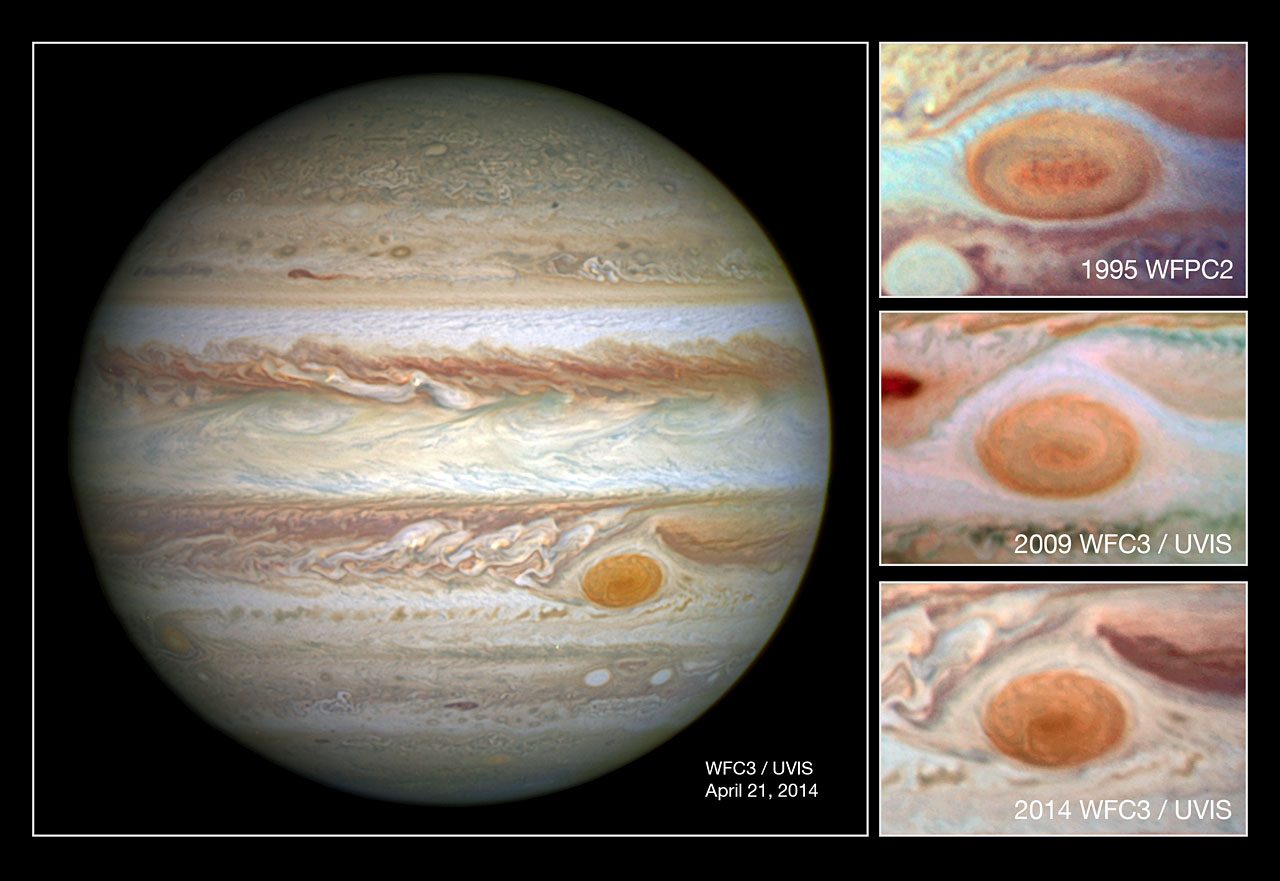
The Shrinking Giant Red Spot of Jupiter
schwit1 (797399) writes "Jupiter's trademark Great Red Spot — a swirling storm feature larger than Earth — is shrinking. This downsizing, which is changing the shape of the spot from an oval into a circle, has been known about since the 1930s, but now these striking new NASA/ESA Hubble Space Telescope images capture the spot at a smaller size than ever before." -
The Shrinking Giant Red Spot of Jupiter
schwit1 (797399) writes "Jupiter's trademark Great Red Spot — a swirling storm feature larger than Earth — is shrinking. This downsizing, which is changing the shape of the spot from an oval into a circle, has been known about since the 1930s, but now these striking new NASA/ESA Hubble Space Telescope images capture the spot at a smaller size than ever before." -
Hubble Images Become Tactile 3D Experience For the Blind
An anonymous reader writes "3D printers are transforming the business, medical, and consumer landscapes by creating objects like airplane parts, lamps, jewellery, and even artificial human bones. Now astronomers are experimenting with the technology to transform astronomy education, turning images from the NASA/ESA Hubble Space Telescope into tactile 3D pictures for people who cannot explore celestial wonders visually." -
Mystery Alignment of Planetary Nebulae Discovered
astroengine writes "Astronomers have discovered something weird in the Milky Way's galactic bulge — a population of planetary nebula are all mysteriously pointing in the same direction. They noticed the mysterious alignment in the long axes of bipolar planetary nebulae. 'This really is a surprising find and, if it holds true, a very important one,' said Bryan Rees of the University of Manchester, co-author of the paper (PDF) to appear in the journal Monthly Notices of the Royal Astronomical Society. 'Many of these ghostly butterflies appear to have their long axes aligned along the plane of our galaxy.' The team of astronomers, who used data from Hubble and the European Southern Observatory's New Technology Telescope (NTT) to survey 130 nebulae, posit that powerful magnetic fields may be behind the phenomenon." -
Mystery Alignment of Planetary Nebulae Discovered
astroengine writes "Astronomers have discovered something weird in the Milky Way's galactic bulge — a population of planetary nebula are all mysteriously pointing in the same direction. They noticed the mysterious alignment in the long axes of bipolar planetary nebulae. 'This really is a surprising find and, if it holds true, a very important one,' said Bryan Rees of the University of Manchester, co-author of the paper (PDF) to appear in the journal Monthly Notices of the Royal Astronomical Society. 'Many of these ghostly butterflies appear to have their long axes aligned along the plane of our galaxy.' The team of astronomers, who used data from Hubble and the European Southern Observatory's New Technology Telescope (NTT) to survey 130 nebulae, posit that powerful magnetic fields may be behind the phenomenon." -
Hubble Discovers 'Planetary Graveyard' Around White Dwarf
astroengine send this interesting excerpt from Discovery: "The Hubble Space Telescope has discovered rocky remains of planetary material 'polluting' the atmospheres of two white dwarfs — a sign that these stars likely have (or had) planetary systems and that asteroids are currently being shredded by extreme tidal forces. Although white dwarfs with polluted atmospheres have been observed before, this is the first time evidence of planetary systems have been discovered in stars belonging to a relatively young cluster of stars. 'We have identified chemical evidence for the building blocks of rocky planets,' said Jay Farihi of the University of Cambridge in a Hubble news release. 'When these stars were born, they built planets, and there's a good chance that they currently retain some of them. The signs of rocky debris we are seeing are evidence of this — it is at least as rocky as the most primitive terrestrial bodies in our Solar System.'" -
Hubble Sees Tribe of Baby Galaxies 13+ Billion Light Years Away
The Bad Astronomer writes "Using Hubble Space Telescope, astronomers have spotted seven galaxies that are all over 13 billion light years away... including one that appears to be a record breaker at a staggering 13.3+ billion light years distant. That one is seen as it was only 380 million years after the Big Bang. This observation reaches into the era of the young cosmos when stars were first forming, and allows astronomers to better understand what the Universe was like back then — a time we know very little about." -
Hubble Directly Images Disc Around a Black Hole
An anonymous reader sends this excerpt from the HST site: "A team of scientists has used the NASA/ESA Hubble Space Telescope to observe a quasar accretion disc — a brightly glowing disc of matter that is slowly being sucked into its galaxy's central black hole. Their study makes use of a novel technique that uses gravitational lensing to give an immense boost to the power of the telescope. The incredible precision of the method has allowed astronomers to directly measure the disc's size and plot the temperature across different parts of the disc." -
Hubble Shoots Movies of Stellar Jets
With his first accepted submission, aglider writes "A number of different science publications are reporting on a recent announcement made by NASA and Hubblesite.org. Quoting: 'A team of scientists [headed by Rice astronomer Patrick Hartigan] has collected enough high-resolution Hubble Space Telescope images over a 14-year period to stitch together time-lapse movies of powerful jets ejected from three young stars. The jets, a byproduct of gas accretion around newly forming stars, shoot off at supersonic speeds in opposite directions through space.' The report is also accompanied by a number of photos and, of course, astounding small movies. The complete scientific study, which dates back to 2011.07.20, has been published in the Astrophysical Journal (subscription needed) but is also available on the ESA's Space Telescope site (PDF)." -
Aging Star System Leaves Strange Death Spiral
jamie tips a post at Phil Plait's Bad Astronomy blog about an extremely unusual astronomical phenomenon originating from a binary system about 3000 light years away. Quoting: "The name of this thing is AFGL 3068. It's been known as a bright infrared source for some time, but images just showed it as a dot. This Hubble image using the Advanced Camera for Surveys reveals an intricate, delicate and exceedingly faint spiral pattern. ... Red giants tend to blow a lot of their outer layers into space in an expanding spherical wind; think of it as a super-solar wind. The star surrounds itself with a cloud of this material, essentially enclosing it in a cocoon. In general the material isn't all that thick, but in some of these stars there is an overabundance of carbon in the outer layers which gets carried along in these winds. ... AFGL 3068 is a carbon star and most likely evolved just like this, but with a difference: it's a binary. As the two stars swing around each other, the wind from the carbon star doesn't expand in a sphere. Instead, we see a spiral pattern as the material expands." -
Black Holes and Cosmic Snapshots
deeptrace writes "The New York Times reports that Andrew J. S. Hamilton, a professor of astrophysics at the University of Colorado used video game technology and Einstein's equations for general relativity to calculate what it might look like to fly through a black hole." On a somewhat more tangible note bahstid writes "The Hubble Team has assembled the largest ever image of the Pinwheel Galaxy beyond Ursula Major from 51 Hubble shots and some terrestrial images. The final composition weighs in at 12392x15852 pixels - just over 10 light years per pixel. In an effort to burn out their server properly their European page is making the 450Mb file available for download, along with some slightly more manageable sizes." -
First Science From A Virtual Observatory
mindpixel writes "I first mentioned Virtual Observatories in my July 2000 Slashdot interview. Now, nearly four years later, Spacetelescope.org is reporting a European team has used the Astrophysical Virtual Observatory (AVO) to find 30 supermassive black holes that had previously escaped detection behind masking dust clouds. The identification of this large population of long-sought 'hidden' black holes is the first scientific discovery to emerge from a Virtual Observatory. The result suggests that astronomers may have underestimated the number of powerful supermassive black holes by as much as a factor of five."