Slashdot Mirror
Domain: stateofworkingamerica.org
Stories and comments across the archive that link to stateofworkingamerica.org.
Comments · 7
-
partially correct
if you took the minimum wage of the '60s and '70s and adjusted it for inflation
Partially correct, the minimum wage adjusted for inflation would be $6.65 from 1960, and it is $7 today. http://www.stateofworkingameri... the problem is not the minimum wage, but that some stuff did increase vastly above the inflation. A 2 bedroom in 1980 in San Francisco was $500 / $600, but now it vastly increase to $4000 in some extreme cases. Inflation adjusted rent should be around $1400. https://medium.com/@mccannatro... For all practical intent and purpose, due to housing speculation (which is still frankly going on) and some ancillaries effect which do not help but increase the problem (e.g. airbnb , rent apartment converted to quasi hotel rooms), rent has become nearly 50% or 60% of the monthly cost of people if they stay in city center, so they are relegated far away from their work, which decrease their likelihood of entertainment or self education (it is hard to go to a side course when you spend 4 hours on travel during the day) and increase stress. Basically I agree with you it is jsut that your data is not 100% correct.
-
Tragedy of the Commons Writ Large
... You can't have a business without customers, you can't have customers if people don't have money, and they can't get money without wages or social security...
What we have here is the situation when corporate power, and the power of the financial elite, takes over all aspects of government policy. It transforms the entire consumer market based economy into the Tragedy of the Commons.
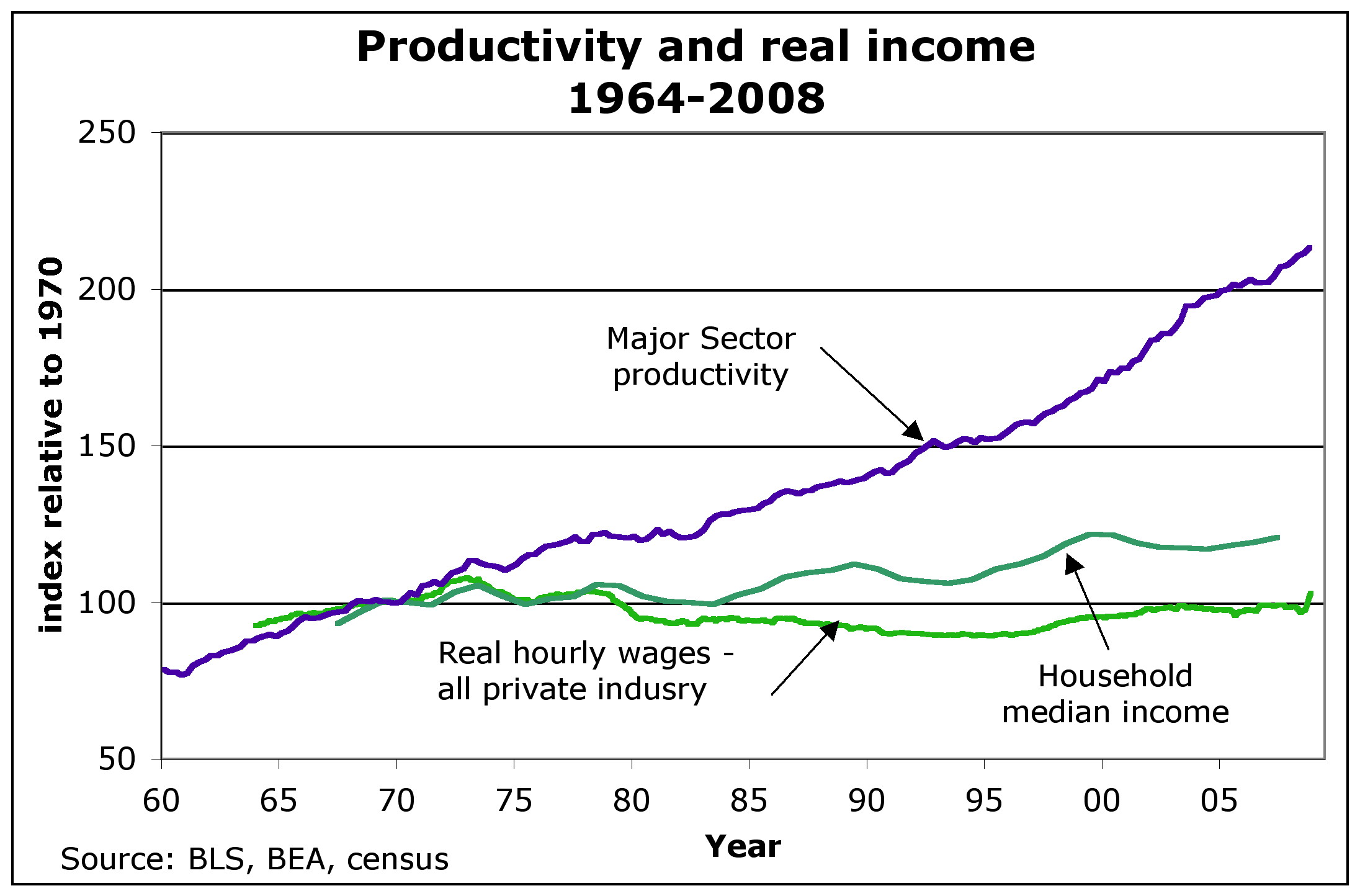
Every corporation aims to to fatten its bottom line, stock price, and C-Suite compensation package by reducing the wages of its labor force. It is a rational micro-decision, just as grazing as many sheep as possible on the commons is rational for the individual farmer, but it destroys in the long run the basis of the whole economy - a nation full of consumers with lots of money to spend on products. The majority of the increases in corporate profitability, and the source of the exploding CEO paychecks, over the last quarter century have come from holding wage payouts flat (or reducing them. Increased productivity stopped being linked to worker compensation a full 45 years ago, an entire working lifetime. As the proportion of wages that make up the economy fall to the lowest level since the Great Depression the engine that drives the growth of the U.S. economy is running out of fuel, now an anemic 2.38%, compared to the long term mean of 4.41%.
But hey, the CEOs are happy!
-
Re:19-0?
I thought the government was for the people by the people.
It is a fucking joke, but only the rich are laughing. It is government for the people by the super-rich. The top 1 percent of Americans owns 34 percent of America's private net worth[...] The bottom 90 percent owns just 29 percent. Yep, that's right : in the U.S. out of a random 100 people on average there will be one person who owns more than ninety of the other people combined.
-
Re:Parallels to the Union movement last century
In particular, figured 3C, 3D, 3E. Of course this isn't exactly what GP was saying. It's more like "Real wages for American male workers below the 50th percentile declined rapidly through the early 80s and have not fully recovered."
-
Re:they're angry
You still have not defined "middle class". How can one measure the performance of the middle class when there is no definition provided?
Your first article described Median Household Income. That is an interesting statistic, but it is not a definition of the middle class. For example, you could define the middle class could be the 2nd, 3rd, and 4rth quintile of personal income. Or the 3rd quintile of household income. Or whatever. Just put a definition on it, and then we can talk.
Household income is a tricky issue because the number of members of a household have changed over the years because of an expansion of single people marrying later, and different tax incentives for a additional household members to have a job or not.
You may want to look at this graph. Real hourly wages rose from 1995-2002, but stagnated since then. Real hourly compensation (wages plus non-wage compensation such as 401K, health insurance, etc.) on the other hand went up every year from 1995 to 2005.
I'm sure if employer-provided health insurance was not tax deductible due to WWII-era tax policy, it would push much of the added non-wage compensation spent by companies on health insurance today back into wages.
-
Re:NO Pension, Rising Healthcare, Falling Dollar..
If you are suggesting that we have less to worry about financially than we did in 1958, then you are the one who is in la-la land. Productivity is more than two times what it was just going back to the 1960's. Yet, the $1.40 minimum wage of 1967 was worth $6.93 versus $5.15 in 2005. Real Wages for the median income have remained completely flat, while the top 20% of income earners are making 115% in real wages compared to 1970. Add to this the rapidly deteriorating value of the dollar, the absolute lack of any job security and disappearance of pensions (hell, even Ford and GM are getting rid of pensions these days... New York Life is the sole remaining major insurer who still offers a pension) coupled with the threat of offshoring and soaring energy costs with almost mandatory college education in most industries and the costs in time and capital associated with post-high school education -- then add to that healthcare costs that are rising twice as fast as inflation while the healthcare benefits provided by companies have decreased by 30% since 1970... and what you have is someone in denial who suggests we are more financially secure than we were at the end of the 1950s. Please visit http://www.stateofworkingamerica.org/tabfig_03.html for some helpful statistics and numbers in
-
ClosingComparing drug use
3% of Swedish 10th graders report using illicit drugs other than cannabis in their lifetime vs 24% in the US. Just 8% of the Swedes reported using cannabis vs 41% in the US.
Besides the well established causal relationship between drug use and criminal activity, this also suggests either significantly different cultural values (e.g., greater propensity to obey authority figures) or better enforcement methods.The other factor you're not addressing, is the simple correlation between progressive taxes on the high end and quality of living, especially violent crime. You seem fond of bringing up small, anecdotal cases. Do explain to me Sweden, with high gun ownership rates and low wealth disparity managed not by an estate tax now, but by a direct, flat tax on total wealth every year. Why is it that they have one of the lowest rates of violent crime and one of the best standards of living? Note, their unemployment rate is about the same as the US.
Ahhh, does little baby want to pack up his toys and go home? Regardless of whether or not you'll respond to me (and risk getting destroyed, again), here is some more information for your edification.
Who knows, maybe you'll think twice before blindly spouting off the miracle that is Sweden...
An absolute comparison of income
Sweden's poorest 10% actually does slightly worse than their counterpart in the US in real dollar terms (PPP adjusted) even after taxes and most subsidies are taken into account. What's more, virtually every economic group above it, especially at the median and above, does significantly better.
If you're unconvinced that absolute measures of poverty "matter"..
Read Page 22
See page 17
Evidence of Sweden's declining economic status. The average Swede has lost purchasing power over the past 20 years and this effect is particularly evident when compared against the rest of Europe. They've slipped from #4 to #18 from 1970 to 1998 (an absolute loss of 17 points vs the OED average of 100).
Swedish Egalitarianism between 1903 and 2004
Evidence that Sweden had much less economic disparity before their welfare state was created due to collapse of capital markets (as opposed to the "because" that you want to believe) and that they've, in fact, followed similar economic trends.
Economist overview of Swedish economy and growing discontent amongst Swedes
A balanced article in the Economist about some not so well known facts about the Swedish economy. For instance, although they report 6% unemployment officially, they have a ton of people that actually long-term unemployed and living off the system (e.g., long term sick leave). Reliable estimates put their true unemployment closer to 15-17%. What's more, 30% of the country works for the government.
They also point out that Sweden has created virtually no new net jobs in private industry since 1950.
Only 1 of Sweden's 50 largest companies was founded after 1970. Entrepreneurship (and even self-employment) are much lower in Sweden than most of the US and even Europe.
Sweden's problem with entrepreneurship
An article discussing some of the problems and statisics relating to Swedish entrepreneu