Slashdot Mirror
Domain: svisions.com
Stories and comments across the archive that link to svisions.com.
Comments · 7
-
Re:Dual core laptops?
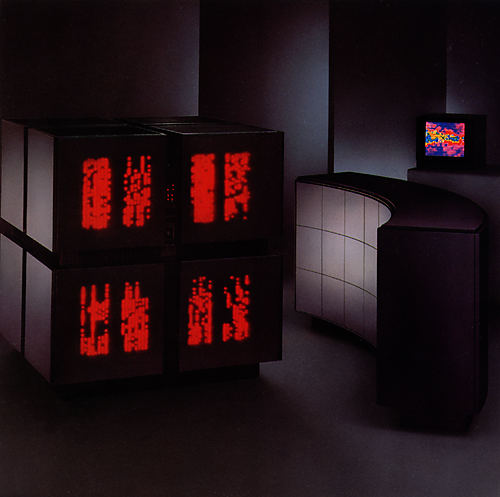
Yeah, black cube-shaped laptops with a lot of red leds rule !
-
Re:PCs to Crays
According to this page a 64k processor CM-2 could do 2500 megaflops. Looking at the #4 machine on the Top 500 list, NCSA's P4 Xeon based system, a 3GHz Xeon gets about 3.9 gigaflops. But then it doesn't have cool blink lights of a CM-2. Pretty amazing how far things have progressed. The first supercomputer, the Cray 1, introduced in 1976, did 160 megaflops and had 8 megabytes of memory. Kinda like a Palm Pilot.
-
The Connetion Machine
In an age where clusters are becoming more prevalent for parallel computing I've often wondered where the parallel processor was. How about you?"
Danny Hillis, the guy who founded ThinkingMachines designed a mchine called The Connection Machine, (this story has a cooler, more sci-fi lookin' pic of the old beastie) the central design philosophy was to achieve MASSIVE computing power through parallelism. It had 65,535 procs, each of lived on a wafer with dram thereon and a high bandwidth connection to up to (if I remember correctly) up to 4 other of the procs. Young sir Danny wrote a book on his exploits, well worth checking out (seemingly, it's been calling to me from my bookshelf for about a year now).
And as someone pointed out, it seems we've seen this topic before. I'd have modded him up, (hint, hint) but I really like mentioning the connection machine where appropriate. -
The Connetion Machine
In an age where clusters are becoming more prevalent for parallel computing I've often wondered where the parallel processor was. How about you?"
Danny Hillis, the guy who founded ThinkingMachines designed a mchine called The Connection Machine, (this story has a cooler, more sci-fi lookin' pic of the old beastie) the central design philosophy was to achieve MASSIVE computing power through parallelism. It had 65,535 procs, each of lived on a wafer with dram thereon and a high bandwidth connection to up to (if I remember correctly) up to 4 other of the procs. Young sir Danny wrote a book on his exploits, well worth checking out (seemingly, it's been calling to me from my bookshelf for about a year now).
And as someone pointed out, it seems we've seen this topic before. I'd have modded him up, (hint, hint) but I really like mentioning the connection machine where appropriate. -
Re:This hearkens back
To me, the Connection Machine range of supercomputers were the ultimate in blinkenlighten computing.
The Connection Machine CM-2 cube. Another picture.
Presently, there's the Connection Machine CM-5. Another image.
-
Re:What about latency?
> Who builds 2-8K processors in a box?
It's been done. The Connection Machine, built in 1988 by Thinking Machines Corporation. System designer and company founder Daniel Hillis employed a hypercube architecture to tie it all together. They achieved 2.5 Teraflops processing power and memory bandwidth of 300Gbits/Sec, all with late-80's technology.
In fact, the CM-2 model incorporated 64,000 processors. And yes, they were all in the same box. So it is eminently do-able.
For verisimilitude, see the very short summary at
David A. Sheppard's site..
And the folks at TMC weren't the only ones to do something like this. Inmos (of England) was producing a hypercube node building block chipset for an architecture they called the Transputer, right around the same timeframe.
> Have you thought for a second what it might take to power or cool this? Or if it could be wired?
You are right to be concerned about thermodynamic considerations, as well as the mechanics and relative performance of interconnection architectures. But you should be advised that there have existed for some time now some rather sophisticated solutions to these problems.
The parent poster's point is anything but moronic, since integration of numerous processors into a single entity reduces time delays and the overhead associated with protocols. For certain kinds of computational problems, this can be significantly important.
> You win the moron of the article award.
So, knowing what you know now, don't you think an apology to the parent poster is in order?
papaTango -
Re:Jurassic Park
Do any of you recall those fantastic red LED covered supercomputers in "Jurassic Park"? I saw a photo of them once in an ad, so I know they're real. Anybody know their name?