Slashdot Mirror
Domain: telecompetitor.com
Stories and comments across the archive that link to telecompetitor.com.
Comments · 11
-
Re:Of course not
This was the point of my last sentence. We, technophiles, would suffer so it won't happen. You and your roommate are heavy internet users as the average household uses 190GB/month. In fact you are on average each above the average household usage. There is nothing wrong with that.
http://www.telecompetitor.com/...This data is from 2016, but it was the easiest to find. Many Americans would see much lower monthly internet costs than the average $60-$80 (surprisingly difficult to nail down) .
I chose the number because it is a little below revenue neutral for the ISP market. At half to double the price, the principle of having the internet paid for by the people who use it seems more fair. And should encourage the ISPs to get everyone the fattest pipe they can.
-
Re:this will not be a popular opinion
Totally agree. But:
(1) If a big chunk of the US doesn't even have 10Mbps broadband yet, do you think it'd be a good idea for the US to make that a priority in cases where a decision has to be made on what things to focus on? (versus making sure that, say, everybody with 25Mbps gets bumped to 50Mbps) Obviously the ideal is to make it good everywhere, but if push comes to shove, where should the focus be?
(2) In the US, part of the broadband reach problem is precisely due to government involvement (of the bad kind). That the government is setting speed goals of X vs Y is barely meaningful when the much larger problem is that broadband reach has been hampered by the government via garbage like this http://www.telecompetitor.com/... .
And there's a good chance that if the bad type of government involvement went away, a lot of the broadband reach problem would be taken care of automatically. See, for example, Singapore, when the government involvement was modest, fostered growth, but largely stayed out of the way. Singapore doesn't have all of the same challenges that a country like the US has, but it's telling that you can get a 2Gpbs for under 40 USD (https://www.singtelshop.com/shop/fibre-broadband/index.jsf).
-
Re:It's not competition..
Wake me up when another company like google is allowed to even try.
Try? Google is already providing 1GB down/up fixed wireless service in seven major metro areas.
Wake up.
-
Re:Hey, cable companies:
I'm gonna quit Frontier ASAP for backing this kind of nonsense...
http://www.telecompetitor.com/...
https://muninetworks.org/conte...
https://www.benton.org/headlin...
https://psmag.com/the-fight-ov...
" AT&T, Comcast, Time Warner, CenturyLink, Verizon, Frontier. To stay in power, they’ve fought against cities and municipalities in state legislatures across the country.
“It’s been kind of a war,” says Christopher Mitchell, the director of the Community Broadband Networks Initiative. “It’s rare for states to do much [Internet] building. Cities want to invest in more competition. But states, acting on behalf of cable and telephone companies, prevent that from happening.” " -
I'm Sick of This Fanboy Bullshit
Contrary to all the stories on various millennial and tech sites, cable continues to retain a SIGNIFICANTLY larger subscriber base that NetFlix et al.
What's more surveys find that 66 Percent of Netflix subscribers are still paying for cable. Ammusingly, the same surveys are used by the fanboy sites to illustrate thier agenda that cable is dead and cord cutting is the present and future.
As a cable subscriber that also uses Amazon Instant Video, Hulu, and just recently the free trial of NetFlix, I can tell you that this is due to the positively abysmal libraries offered by these services. My local RedBox offers far better choices than NetFlix or Amazon streaming services of fairly recent movies. It's also 1/5th the cost to rent a BluRay from Redbox versus renting the same video from Amazon. NetFlix DVD services is still a reasonably good choice, but it is slow and cumbersome and even NetFlix is clearly moving away from this service. Then there is the whole issue of bandwidth requirements, throttling, and data caps. This is especially poignant when considering 4K UHD content, limited as that is. There's also the virtual inability to simply have the TV on(streaming) all day long. I won't even get into live TV and sports.
In short, contrary to the fanboyism in today's media, NetFlix et al suck compared to cable. The ability to binge watch Lost or some other 10 year old TV series does not over come this. What's more, cable offers on demand services that would allow you to binge that shit anyway. It may well be true that the YouTube on a cellphone crowd think that NetFlix is the greatest thing since sliced bread. But people that watch a lot of TV and people that watch TV and movies on ever larger screens aint got time for that streaming shit.
You will know that I am right and that you have failed when NetFlix et al start monetizing their users with ads. Cable did it, the internet did it, streaming TV WILL do it.
-
Re:Still waiting
A mere toy? On my last business trip to an unfamiliar city, my smartphone was absolutely indispensable. It's already closing in on three years old, and I have no intention of replacing it anytime soon unless it breaks. It recently got its first bit of damage (and no clue how it happened), where the lip above the charging port got bent. A little worse, and I would have either had try to pry it open with handtools or replace the phone, as I wouldn't have been able to recharge it.
While some people replace their phone each year, it's certainly not universally true. Those who cycle through phones yearly are undoubtedly *perceived* to be a higher percentage, because all the people who constantly *talk* about phones (bloggers, tech columnists, enthusiasts, status seekers) always buy the latest gadgets, of course.
My prediction is that smartphones will become more like PCs, in that they will tend to remain viable far longer than they used to. I believe we're going to reach a performance and feature threshold of sorts. There's very little a modern high-end smartphone *can't do* simply because it doesn't have enough CPU or GPU power anymore (perhaps outside of pure entertainment). The operating systems are becoming more mature, and the app goldrush has petered off into a more sane and sustainable pace. In short, they're becoming more of an everyday tool rather than some sort of tech status symbol, and few people can actually tell whether you have a brand new or a three year old phone outside of a very small niche.
In terms of the market, again, the exact same thing that happened to PCs (and more recently, tablets) will happen to smartphones. The initial tech rush will die down into a more stable and sustained growth with only slow, incremental improvements and "as needed" replacements. Pundits will lament the "death" of the smartphone market, when all it really means is that most people now have a perfectly usable device and don't feel the need to upgrade each year. Rest assured, the status symbol crowd will find some new sort of gizmo to replace it though.
-
T-Mobile
You could definitely get cheaper UNLIMITED DATA elsewhere. But would you be happy with the COVERAGE? At some point you may want new EQUIPMENT, to which Verizon will tell you that your new phone isn't compatible with the "grandfathered" rate plans. The real questions to ask are "am I happy with the coverage" and "Will I be happy with this phone forever?" If the unlimited data works for you now, keep it for now. But at some point, you'll be forced to make a decision. All the other arguments about "unlimited" data are irrelevant. There are much better UNLIMITED deals elsewhere for the money.
I have gotten comments and run into situations where my T-mobile data and voice coverage in major metropolitan areas are better than Verizon. If you're in a big city or dense areas, it's not clear to me that Verizon is better. T-mobile has also been looking to improve their non-metro coverage [1]. And they've purchased 700Mhz spectrum from Verizon also good for non-dense coverage [2]. Finally, T-mobile "uncarrier" push is constantly striving to improve customer features and services. They are setting the pace with which other carriers follow.
I currently very rarely go outside of big metros so T-Mobile is a great choice for me - and I've had HD Voice for the past year and absolutely love it. Welcome to the club, ATT/VZ - glad you are finally rolling that out.
There is at least one carrier making it their focus to improve their coverage both voice and data significantly over the past 2 years, and T-mobile is definitely on that list.
[1] http://www.fiercewireless.com/...
[2] http://www.telecompetitor.com/... -
Also FiOS
Cox also competes with Verizon FiOS in several markets. This article says only 9%, last year: http://www.telecompetitor.com/...
-
Re:won't matter for 90%
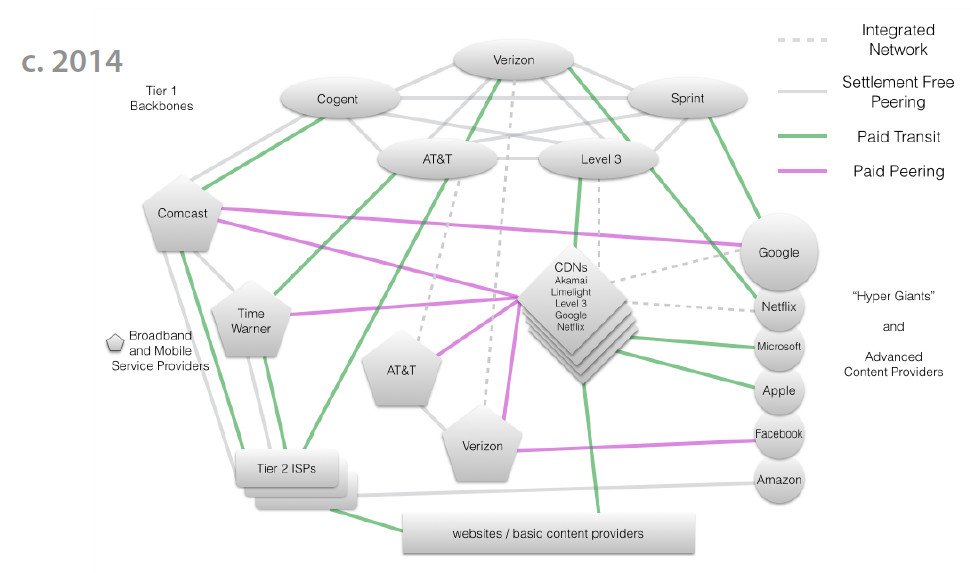
The term "fast lanes" here is referring to direct connection between content provider and ISP, i.e. without going through transit links. Many CDNs (including Netflix) do that. Here is a diagram showing these connections. The pink lines labelled "paid transit" are the "fast lanes".
-
Sounds doable
Comcast recently announced HD bundles that will go for $115 to $180 per month. When you add in what they charge for high speed Internet, you hit $230/month already.
The flaw in parent's math, btw, is that the $44B is mainly one-time investments. The visually stunning, if you like graphs, promote-our-site page is nearly content-free but at least the PDF link (first footnote) reveals that only about $2.2B (over ~3 years) would go to subsidize the on-going costs of end-users (scroll down the PDF to the "Lifeline/linkup..." and "Every child online..." sections. Oh, watch out it is a PDF by the way.
So, Comcast is already hiking their rates, by $60 to $120/month, and in 3 years that works out to $31.75 to $63.5B of variable, not one-time, income. True, the increase is on the TV side of things, but considering their new Internet bandwidth cap it is easy to see them offering an HD/all-you-can-eat Internet upgrade that would be in the same ballpark as their HDTV upgrade.
Comcast rate increases alone (without the need for infrastructure improvements, mind you) make the $44B government plan-so-it will-never-happen look like chump change. -
Re:Why Subscribe?
I'm not too worried about Comcast. The things they do (especially this and the whole guy-sleeping-on-the-job thing) would only serve to either get people moving to other (non-cable?) ISPs (if any) or revolting for fair cable-company laws; it's all shooting themselves in the foot to me.
I am far, far more sickened by my favorite evil Northeast US company, Cablevision; they do seem to provide good service (my parents get cable and my siblings get their Triple Play; I've seen no problems with service, but the "Caller ID on iO TV" spooks me a bit), at the expense of basketball teams worth rooting for (FYI, Garden owners: free food does not make up for team negligence...not that you'd care with the money you make with that Triple Play and its associated annoying ads), competing stadiums (granted, Verizon is no innocent company by any means), competing ISPs, new subway/train stations, and maybe even commuter security (Cablevision suggests otherwise, but their words are hard for me to take as told).
To answer parent comment's question, I suppose people subscribe because...well, when you get email, Colbert, VoIP and such powerful, important abilities like the ability to RickRoll others and Digg the result (ugh *vomits*), who cares about silly things like fair and lawful treatment of consumers, sports fans, and competing ISPs?
Me, I'll use DSL (Verizon, which hasn't given me much, if any, throttling problems) until there's a good free wireless network or whatever, and I've already subscribed to a different TV provider that offers HD free (I don't care that much for Olbermann). To those far from good antenna coverage: good luck, and ditch cable anyway.