Slashdot Mirror
Domain: tudelft.nl
Stories and comments across the archive that link to tudelft.nl.
Stories · 26
-
Researchers Develop Atomic-Scale Hard Drive That Writes Information Atom By Atom (techcrunch.com)
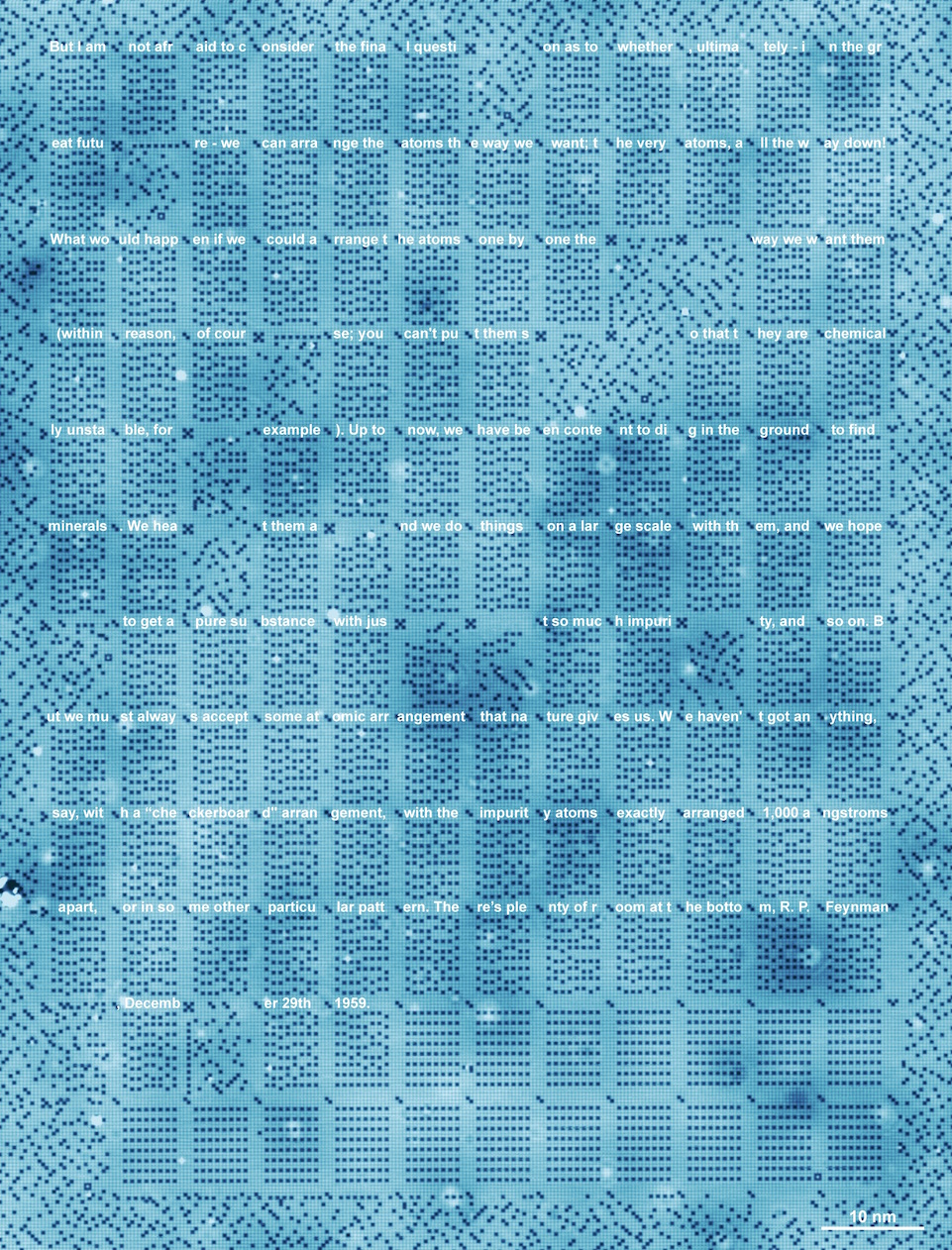
An anonymous reader quotes a report from TechCrunch: Researchers in the Netherlands have created a microscopic storage system that encodes every bit with a single atom -- allowing them to fit a kilobyte in a space under 100 nanometers across. That translates to a storage density of about 500 terabits per square inch. For comparison, those 4-terabyte hard drives you can buy today are about 1 terabit per square inch. That's because, unlike this new system, they use hundreds or thousands of atoms to store a single bit. "Every bit consists of two positions on a surface of copper atoms, and one chlorine atom that we can slide back and forth between these two positions," explained Sander Otte, lead scientist at Delft University of Technology, in a news release. Because chlorine on copper forms into a perfectly square grid, it's easy (relatively, anyway) to position and read them. If the chlorine atom is up top, that's a 1; if it's at the bottom, that's a 0. Put 8 chlorine atoms in a row and they form a byte. The data the researchers chose to demonstrate this was a fragment of a Feynman lecture, "There's plenty of room at the bottom" (PDF) -- fittingly, about storing data at extremely small scales. (You can see a high-resolution image of the array here.) The chlorine-copper array is only stable in a clean vacuum and at 77 kelvin -- about the temperature of liquid nitrogen. Anything past that and heat will disrupt the organization of the atoms. The research was published today in the journal Nature Nanotechnology. -
Biologists Create Self-Healing Concrete
Mr.Intel writes: A team of microbiologists from the Delft University of Technology claims to have invented "bioconcrete" — concrete that heals cracks and breaks using bacteria. The goal was to find a type of bacteria that could live inside concrete and also produce small amount of limestone that could re-seal cracks. This is a difficult prospect because concrete is quite dry and strongly alkaline. The bacteria needed to be able to stay alive for years in those conditions before being activated by water. The bacteria also need a food source — simply adding sugar to concrete will make it weak. The scientists used calcium lactate instead, adding biodegradable capsules of it to the concrete mix. "When cracks eventually begin to form in the concrete, water enters and open the capsules. The bacteria then germinate, multiply and feed on the lactate, and in doing so they combine the calcium with carbonate ions to form calcite, or limestone, which closes up the cracks." -
Scientists Find Long-Sought Majorana Particle
New submitter boner writes "In a follow-up to an earlier Slashdot story, scientists at the Technical University of Delft in the Netherlands yesterday published their findings that they have indeed found the Majorana particle. The announcement on the university website provides both a summary of the academic paper (PDF) and background of this groundbreaking discovery. Quoting: 'Majorana fermions are very interesting – not only because their discovery opens up a new and uncharted chapter of fundamental physics; they may also play a role in cosmology. A proposed theory assumes that the mysterious ‘dark matter, which forms the greatest part of the universe, is composed of Majorana fermions. Furthermore, scientists view the particles as fundamental building blocks for the quantum computer.'" -
Scientists Find Long-Sought Majorana Particle
New submitter boner writes "In a follow-up to an earlier Slashdot story, scientists at the Technical University of Delft in the Netherlands yesterday published their findings that they have indeed found the Majorana particle. The announcement on the university website provides both a summary of the academic paper (PDF) and background of this groundbreaking discovery. Quoting: 'Majorana fermions are very interesting – not only because their discovery opens up a new and uncharted chapter of fundamental physics; they may also play a role in cosmology. A proposed theory assumes that the mysterious ‘dark matter, which forms the greatest part of the universe, is composed of Majorana fermions. Furthermore, scientists view the particles as fundamental building blocks for the quantum computer.'" -
Majorana Fermion May Have Been Spotted At TU Delft
vikingpower writes "A research group at Technical University Delft around prof. Kouwenhoven has probably not only spotted pairs of so-called Majorana Fermions for the first time (these had been predicted to exist by the Italian physicist Ettore Majorana), but also demonstrated that, by generating them at the end of an Indium-Arsenide microwire, quantum computing with them may have come one more step closer to reality. The excitement around Prof. Kouwenhoven at the American Physical Society annual congress in Boston, after he completed his presentation, was considerable.A nice illustration is provided by this newspaper article (in Dutch)." -
Physicists Control the Spin of a Single Electron
jeeb writes "Researchers of the Delft University of Technology and the Foundation for Fundamental Research on Matter have succeeded for the first time in controlling the spin of a single electron in a nanostructure. They are able to rotate the axis to every possible direction and to record it accordingly. This achievement makes it possible to use the electron's spin as a 'quantum bit,' the basis of a (still theoretical) future quantum computer. The researchers have published this scientific breakthrough in the August 17, 2006 edition of Nature." -
Improve Your Hearing With Vision
Ant writes "CNET News.com reports that there is a new pair of "hearing glasses," hearing-impaired people might both see and hear better--and have better social lives. A novel pair of glasses recently released on the market not only improve bad eyesight, but also work as a hearing aid. Developed by the Delft University of Technology and Dutch company Varibel, the glasses promise to keep hearing-impaired people active and social. While in-ear hearing aids usually work well for conversation in quiet surroundings, many people who wear them face problems in more lively environments. Since all incoming sounds are amplified, background noises easily take over, cause discomfort and make conversations difficult. Varibel says its glasses can detect which direction sounds come from, amplifying words spoken directly to the wearer while dampening background noise." -
World Solar Challenge Started in Australian Desert
photonic writes "The World Solar Challenge has just finished the first racing day. It is a 3000 kilometer race from Darwin to Adelaide for cars that are powered by solar energy only. The results from this day have not yet been published, but intermediate results suggest that the Dutch Nuon Solar Team is again on the lead. This team from Delft University of Technology has a reputation to uphold since they also won the previous two races in 2001 and 2003, the last one in a record breaking 97 km/h average. The Tesseract team from MIT was less fortunate: during the qualification they got off track and rolled over. After some fixing up they still managed to qualify into 7th place on battery power, but with substantial damage to the solar panel their challenge will be finishing rather than winning." -
Examining Bittorrent
ToyKeeper and other wrote in with this: "The Register published a detailed analysis of BitTorrent traffic and user habits today, focusing on four aspects: availability, integrity, download speeds, and ability to withstand flash crowds. BitTorrent carries 53% of all P2P traffic (or ~35% of all 'net traffic), and this paper helps explain why. Also included are data about torrent lifetime, network poisoning, response during downtime or attacks, and lots of pretty charts. A few performance problems are revealed, which will hopefully be addressed in future p2p systems." The original paper (pdf) is available. -
Music Related Free and Open Source Software?
An anonymous reader asks: "I'm going to a demonstration of some music software products tomorrow night. The music store hosting the event may be attempting to start a users group of music software. This seems like a job for open source advocacy! Anyone know of any good F/OSS for working with music and audio? I am already aware of Audacity and (Free as in Beer) Jeskola Buzz, but what else is there in the realm of sequencers and audio manipulation?" We did another helpful article back in 2001, and another from last August. What musical creations have you put together with any of this software, and others we may have missed? -
Exploit Found in Seti@Home
Jamie noted that an Exploit was found in Seti@Home and there is code exploiting the hole actually running about in the wild. Patches are available for those of you not interested in running a public warez server or DoS client ;) -
Miniature Humanoid Robot based on 19th Century Toy
dbowden writes: "Recently, Slashdot ran an article about a humanoid robot which runs Linux. It weighs 121 lbs, uses two 750 MHz Pentium III processors, and runs RT-Linux. It also requires a technician to push around a huge power supply that's attached to the robot by an umbilical cord. I found another robot, Baps, which only weighs 6.6 lbs (3 Kg), runs on a single 133 MHz Pentium processor with 32 MB of RAM and 48 MB of flash memory, and is based on a child's toy that was designed in 1888. It also runs on Linux, but requires very little power to move (it can be run on CO2 cartridges), so it doesn't require an umbilical cord, or bulky power supply." (He's also got some tips on building your own below.)"I remember playing with these toys as a child, and thinking how cool they were. For the ./ers who like to build robots, both of these walkers use McKibben Artificial Muscles instead of normal pneumatic cylinders.
I built one of these last week -- they're surprisingly easy to build, and I think they'll be fun to play with. For those with larger budgets, who don't want to build their own, The Shadow Robot Co. in the UK, and Images Co. in the US, both sell pre-made air muscles."
-
Linux Running On Intel XScale CPU
Erik Mouw writes: "Just want to let you know that Nicolas Pitre (nico@cam.org) and I got Linux running on the Intel 80200 XScale CPU. Nico did the largest part of the work during the past couple of weeks, and we did the final bug fixes in a hotel room in New York. The official announce of the patch is available at the linux-arm-announce mailing list archive." The board was on display at the MontaVista booth at Linux World Expo, one of the several tiny Linux set-ups on tantalizing display around the show floor for everything from vending machines to cheap PDAs. (No Yopy in sight, though, despite the fact that development models are available for sale.) Congratulations to Erik and Nicolas. -
Small Form LCD Projectors?
HRieke asks: "Does anyone know as to where to buy low power LCD projectors or parts? I have two needs on this matter: I am computerizing my car in conjunction with my Master's thesis (if approved), the second as a wall video display. Ideally, I would use the device with a PC in the trunk, or LART . My idea is to have the a display projected on the windshield, from over the left shoulder, displaying realtime IR images, possible hazards, and GPS location, at a low lumens level, and for the unit to have small power requirements / low heat waste. Resolution is not that important, 800x600x16bbp is ideal, but I'd settle for even for 640x480x8bbp. After searching a bit, I found the DLP units from Texas Instruments. Be sure to look at the DLP image library too. Are there any other projectors like these?" -
Build Your Own StrongARM Linux Computer
krp writes: "From the LART FAQ page: 'The LART is a small yet powerful embedded computer capable of running Linux. Its performance is around 250 MIPS while consuming less than 1 Watt of power. In a standard configuration it holds 32MB DRAM and 4MB Flash ROM, which is sufficient for a Linux kernel and a sizeable ramdisk image.' Full schematics and CAD files for the main board, kitchen sink board, the boot loader (BLOB) and patches for the Linux kernel are available for download as well as various software tools. This tiny machine could be ideal for embedded / portable / wearable applications -- there are some pictures (including a LART running off a small battery!) in l'ART gallery. " -
Build Your Own StrongARM Linux Computer
krp writes: "From the LART FAQ page: 'The LART is a small yet powerful embedded computer capable of running Linux. Its performance is around 250 MIPS while consuming less than 1 Watt of power. In a standard configuration it holds 32MB DRAM and 4MB Flash ROM, which is sufficient for a Linux kernel and a sizeable ramdisk image.' Full schematics and CAD files for the main board, kitchen sink board, the boot loader (BLOB) and patches for the Linux kernel are available for download as well as various software tools. This tiny machine could be ideal for embedded / portable / wearable applications -- there are some pictures (including a LART running off a small battery!) in l'ART gallery. " -
Build Your Own StrongARM Linux Computer
krp writes: "From the LART FAQ page: 'The LART is a small yet powerful embedded computer capable of running Linux. Its performance is around 250 MIPS while consuming less than 1 Watt of power. In a standard configuration it holds 32MB DRAM and 4MB Flash ROM, which is sufficient for a Linux kernel and a sizeable ramdisk image.' Full schematics and CAD files for the main board, kitchen sink board, the boot loader (BLOB) and patches for the Linux kernel are available for download as well as various software tools. This tiny machine could be ideal for embedded / portable / wearable applications -- there are some pictures (including a LART running off a small battery!) in l'ART gallery. " -
Build Your Own StrongARM Linux Computer
krp writes: "From the LART FAQ page: 'The LART is a small yet powerful embedded computer capable of running Linux. Its performance is around 250 MIPS while consuming less than 1 Watt of power. In a standard configuration it holds 32MB DRAM and 4MB Flash ROM, which is sufficient for a Linux kernel and a sizeable ramdisk image.' Full schematics and CAD files for the main board, kitchen sink board, the boot loader (BLOB) and patches for the Linux kernel are available for download as well as various software tools. This tiny machine could be ideal for embedded / portable / wearable applications -- there are some pictures (including a LART running off a small battery!) in l'ART gallery. " -
Build Your Own StrongARM Linux Computer
krp writes: "From the LART FAQ page: 'The LART is a small yet powerful embedded computer capable of running Linux. Its performance is around 250 MIPS while consuming less than 1 Watt of power. In a standard configuration it holds 32MB DRAM and 4MB Flash ROM, which is sufficient for a Linux kernel and a sizeable ramdisk image.' Full schematics and CAD files for the main board, kitchen sink board, the boot loader (BLOB) and patches for the Linux kernel are available for download as well as various software tools. This tiny machine could be ideal for embedded / portable / wearable applications -- there are some pictures (including a LART running off a small battery!) in l'ART gallery. " -
Build Your Own StrongARM Linux Computer
krp writes: "From the LART FAQ page: 'The LART is a small yet powerful embedded computer capable of running Linux. Its performance is around 250 MIPS while consuming less than 1 Watt of power. In a standard configuration it holds 32MB DRAM and 4MB Flash ROM, which is sufficient for a Linux kernel and a sizeable ramdisk image.' Full schematics and CAD files for the main board, kitchen sink board, the boot loader (BLOB) and patches for the Linux kernel are available for download as well as various software tools. This tiny machine could be ideal for embedded / portable / wearable applications -- there are some pictures (including a LART running off a small battery!) in l'ART gallery. " -
More Companies Jump on the Linux Train
"X Company now supports Linux" announcements are coming in thick and fast these days. Examples: yesterday J Ellerbroek sent this link for Aureal's Linux drivers and Drakar wrote, "I e-mailed Sigma Designs asking them about Linux support for the RealMagic Hollywood Plus DVD Decoder, and they say they're working on supporting Linux for a future product." And Nicholas Tang turned us on to this announcement about an upcoming open sourced RPG with a Linux client. Very nice! But we're getting so many of these announcements that we can't possibly run them all. If you've spotted any others recently, please post them below. (Click for more.)I had a thought while I was typing the words above: should Slashdot do periodic "roundups" of new Linux ports and support announcements? With so many hardware and software vendors now moving into the "Linux marketplace" (which is how many of them see Linux -- as a marketplace), these announcements are no longer "news" in the sense of being unique or unusual events, but they're still good to know about.
Should we make a weekly post out of all these announcements? Or, because they don't come in at an even rate, should we save them up until we have 10 or so and post them all then whether that takes two days or three weeks?
So, besides posting any new Linux product/support announcements you've seen lately, how about a little advice on how Slashdot might best handle these announcements in the future? I promise to read every comment with a moderation level of zero or higher.
- Robin "roblimo" Miller
-
Alpha Centauri Port for Linux?
Freud writes sent us an excerpt from a chat with Brian Reynolds, of firaxis where he was questioned about a Linux port. Brian says "Certainly a Mac version; I'm assuming a Linux version too though that hasn't been finalized. Which is kind of our fault because we expressed some interest (to EA) in doing it ourselves. Worked on it for a while, then got swamped with other stuff. So we handed it back to EA, meaning some time was lost while we were fooling around with it... Anyway, my guess is they will probably do one now. Seems like it would be an easy port. Mostly it was the network code that was going to require some work... " Well, an addict can dream, can't he? -
Linux 2.2 Preview
Freud writes "There's a nice article on linuxtoday about the upcoming 2.2 kernel. It talks about all the new things featured in the kernel (and also about some old stuff ;-))." -
Talking Linus
-
Open Circuit Design
Reinoud Lamberts wrote in to tell us about a mailing list and web site dedicated to open design of circuits. You can read more about it at the web site. Applying the ideals of open software to hardware is a very hot topic right now with serious long term benefits. It's definately something worth paying attention to- especially if you happen to have the skills necessary to help. -
Another Emulator
Hetz Ben Hamo wrote in to say "Well, many of the emulators fans seems to know the System 16 emulator. This emulator (which is different from M.A.M.E concentrates on emulating Arcade machines from 8 bit (it was called system 8), and now mostly on 16 bits arcade. It emulates 68000 arcades and some double processor arcades (like OutRun, etc).Why am I telling you this? Cause now someone has ported system 16 to Linux and it's runs pretty well on it :) So for heaven sakes, check his page and grab the emulator, and grab the ROM's (although it's Illegal cause it's copyrighted by various manufacturers like Sega etc) from davesclassics.com. The emulator itself is here"
Something I personally find interesting about Linux is despite the lack of games, through the emulators ranging from Mame, SNES9x, Dosemu and S16, we can still play a lot of cool stuff.