Slashdot Mirror


Researchers Develop Atomic-Scale Hard Drive That Writes Information Atom By Atom (techcrunch.com)

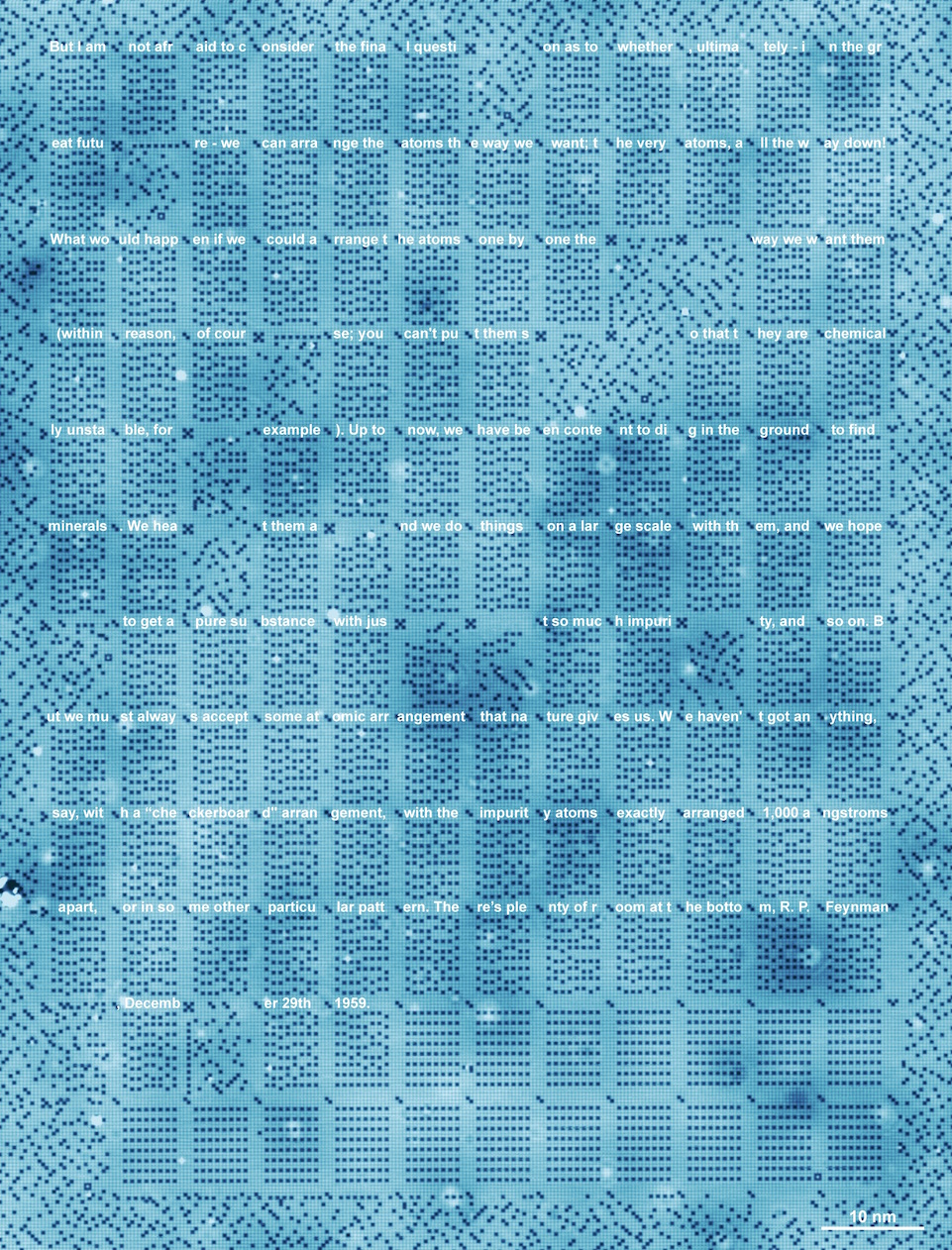
An anonymous reader quotes a report from TechCrunch: Researchers in the Netherlands have created a microscopic storage system that encodes every bit with a single atom -- allowing them to fit a kilobyte in a space under 100 nanometers across. That translates to a storage density of about 500 terabits per square inch. For comparison, those 4-terabyte hard drives you can buy today are about 1 terabit per square inch. That's because, unlike this new system, they use hundreds or thousands of atoms to store a single bit. "Every bit consists of two positions on a surface of copper atoms, and one chlorine atom that we can slide back and forth between these two positions," explained Sander Otte, lead scientist at Delft University of Technology, in a news release. Because chlorine on copper forms into a perfectly square grid, it's easy (relatively, anyway) to position and read them. If the chlorine atom is up top, that's a 1; if it's at the bottom, that's a 0. Put 8 chlorine atoms in a row and they form a byte. The data the researchers chose to demonstrate this was a fragment of a Feynman lecture, "There's plenty of room at the bottom" (PDF) -- fittingly, about storing data at extremely small scales. (You can see a high-resolution image of the array here.) The chlorine-copper array is only stable in a clean vacuum and at 77 kelvin -- about the temperature of liquid nitrogen. Anything past that and heat will disrupt the organization of the atoms. The research was published today in the journal Nature Nanotechnology.
68 comments

  1. Precisely placing atoms is not new. by wierd_w · · Score: 2, Interesting

    I have seen AFM images of xenon atoms spelling out IBM on a graphite sheet as old as the 90s.

    This smacks of "gimme fundingz plz!".

    This work is not terribly novel. If they could dynamically change the state of the arrangement withat applied electric or magnetic fields, that would be worth reporting. This however is not, imho.

    1. Re:Precisely placing atoms is not new. by fluffernutter · · Score: 0, Flamebait

      What did YOU invent this week?

      --
      Laws are rules for the court, but merely a bottom bar to hit for life. Think beyond laws in your actions always.
    2. Re: Precisely placing atoms is not new. by Anonymous Coward · · Score: 0

      Does it matter? Given his point that these guys didn't either they're equal?

    3. Re:Precisely placing atoms is not new. by Anonymous Coward · · Score: 4, Insightful

      What did YOU invent this week?

      I'm still waiting for someone to invent something that somehow does NOT end up being a decade-long litigation between themselves and the fucking patent hoarders.

      Good fucking luck with that shit.

    4. Re: Precisely placing atoms is not new. by Anonymous Coward · · Score: 2, Informative

      Given that his (GP) point was NOT what they were claiming, here: A kilobyte rewritable atomic memoryM

      FT(real)A
      A clear challenge now is the controlled integration of these individual functional atoms into extended, scalable atomic circuits. Here, we present a robust digital atomic-scale memory of up to 1kilobyte (8,000bits) using an array of individual surface vacancies in a chlorine-terminated Cu(100) surface. The memory can be read and rewritten automatically by means of atomic-scale markers and offers an areal density of 502terabits per square inch, outperforming state-of-the-art hard disk drives by three orders of magnitude

      They are talking about manipulating them in a manner to store and retrieve data with error checking, etc. The real article is pretty interesting, the write-up here and the article that they link to is utter crap

    5. Re: Precisely placing atoms is not new. by Anonymous Coward · · Score: 1

      Whoops on the link... this is the real article:
      http://www.nature.com/nnano/journal/vaop/ncurrent/full/nnano.2016.131.html

    6. Re: Precisely placing atoms is not new. by ArmoredDragon · · Score: 1

      Either way, because this requires an extremely cold temperature, it will likely never even end up in even the most state-of-the-art datacenter, nevermind your PC. This is one of those neat yet 100% impractical things that come around every so often. Could a derivative of this technology some day become practical? Maybe, but not with the copper/chlorine combination seen here. I think DNA based storage would probably come sooner.

    7. Re: Precisely placing atoms is not new. by the_Bionic_lemming · · Score: 0

      Gosh, you are absolutely right.

      they should tank the research and move on to making apps for stores.

      --
      _ _ _ Go for the eyes Boo! GO FOR THE EYES!
    8. Re:Precisely placing atoms is not new. by Anonymous Coward · · Score: 0

      If someone already holds a patent wouldn't that mean someone has already invented the technology?

    9. Re:Precisely placing atoms is not new. by Anonymous Coward · · Score: 0

      look, this would be worthwhile if it had any sort of implication of it being feasible for some useful purpose some day. it does not.

      it needs "clean vacuum" and a low temperature. it's less feasible,

      the _only_ reason they arranged them in 8 bits and put that out in the pr was to get press time for something that otherwise would not have gotten any. they could have gone with "you can write the bible on so and so small thing" approach too.

      bubble memory or whatever is more feasible for use than this, that's saying a lot.

    10. Re:Precisely placing atoms is not new. by ElectricHellKnight · · Score: 2, Insightful

      This however is not, imho.

      Yeah who wants tech and science related news on Slashdot, anyway? I want more black lives matter and election coverage! (Before you fools get on my ass, yes I'm aware of the irony of my comment in relation to my current sig.)

    11. Re: Precisely placing atoms is not new. by Anonymous Coward · · Score: 1

      Oddly, enough that is not how the researcher's look at it, in fact the last line of the article on the link says, "Furthermore, the chlorine vacancies are found to be stable at temperatures up to 77K, offering the potential for expanding large-scale atomic assembly towards ambient conditions.

    12. Re:Precisely placing atoms is not new. by ihtoit · · Score: 1

      I think there is more potential in the petabyte-potential crystal storage reported earlier this year, notwithstanding the fact that at current write speeds it would take 1200 years to fill just one 360TB crystal...

      http://www.pcworld.com/article...

      --
      Political debates have me rolling my eyes so much I think I got optical whiplash. I should sue. - Foamy The Squirrel
    13. Re: Precisely placing atoms is not new. by hawguy · · Score: 3, Insightful

      Either way, because this requires an extremely cold temperature, it will likely never even end up in even the most state-of-the-art datacenter, nevermind your PC. This is one of those neat yet 100% impractical things that come around every so often. Could a derivative of this technology some day become practical? Maybe, but not with the copper/chlorine combination seen here. I think DNA based storage would probably come sooner.

      If they could figure out how to read and write to this quickly, don't lose too much space to ECC and get good durability, the temperature requirement won't keep it out of datacenters - liquid nitrogen is (relatively) cheap (10 - 20 cents/liter), and a 500X increase in density would make it very attractive - replacing 500 racks of disks with one rack of these would pay for a lot of liquid nitrogen.

    14. Re:Precisely placing atoms is not new. by hawguy · · Score: 3, Insightful

      look, this would be worthwhile if it had any sort of implication of it being feasible for some useful purpose some day. it does not.

      it needs "clean vacuum" and a low temperature. it's less feasible,

      the _only_ reason they arranged them in 8 bits and put that out in the pr was to get press time for something that otherwise would not have gotten any. they could have gone with "you can write the bible on so and so small thing" approach too.

      bubble memory or whatever is more feasible for use than this, that's saying a lot.

      Wouldn't a hard drive technician from 40 years ago say the same thing if you told him of your plan to build a helium filled hard drive the size of your fist that would have a million times more capacity than the washing machine sized drives that were state of the art?

    15. Re:Precisely placing atoms is not new. by mwvdlee · · Score: 2

      No. It should mean that, but it doesn't.

      --
      Slashdot social media options: AIM, ICQ, Yahoo, Jabber and Mobile Text. Why no MySpace?
    16. Re: Precisely placing atoms is not new. by Salgak1 · · Score: 4, Insightful

      Ahem. It's a proof-of-concept, technology demonstrator. Some of us have been in IT long enough to remember 10 Megabyte disk units for mainframes, that were the size of washing machines (1970s tech). My first PC had a 20MB full-height hard drive: that was 1987. My current box has 2x256 GB SSDs: their combined size is roughly that of a pack of cigarettes (Mind you, I also have several TB of magnetic disk storage. . .).

      Technology evolves. This will as well. . .

    17. Re: Precisely placing atoms is not new. by Anonymous Coward · · Score: 1

      Assuming that the cooling doesn't take any space.
      If accessing the data in anyway produces heat then the data density will suffer from the cooling so the 500X increase in density is unlikely.
      You can't just run the nitrogen past in close proximity if internally generated heat causes data loss. You might need to couple each layer with coolant.
      Perhaps a 50X increase is viable, perhaps a 5X is or perhaps it will be bulkier than current storage.
      Until a larger disk with this technology is made we don't know what is needed to make it work at a scale sufficient for real world applications.

    18. Re:Precisely placing atoms is not new. by cdrudge · · Score: 1

      I have seen AFM images of xenon atoms spelling out IBM on a graphite sheet as old as the 90s.

      It was 1989 on nickle, but close enough. There's a difference though between what IBM did and what these researchers did. The IBM wasn't a precisely positioned repeating layout that could be repeatedly manipulated in a predictable manner.

      No it's not a monumental leap in storage technology from what's previously been demonstrated or discussed. But I haven't seen too many other functioning atomic "hard drives" in the past 27 years either so maybe a small step towards that direction isn't a horrible thing.

    19. Re:Precisely placing atoms is not new. by thoromyr · · Score: 1

      ...and what would be notable is if 30 years from now someone actually comes up with a way of reading & writing in a durable fashion.

      It isn't that their work is useless, it just isn't notable. When IBM arrogantly wrote their name in atoms it was notable because no one had done anything like that before. What these guys have done is kinda neat, but it isn't even remotely near the usable stage.

      Maybe you're too young to remember the excitement about "room temperature superconductors" that never transpired. There's no reason to expect this to ever get anywhere near room temperature, either. Using helium is more of a necessity in advancement and a relatively simple engineering problem. No one has even a plan for maintaining the required stability at room temperature, or alternatively how you would achieve supercooling in a consumer product.

      "Oooo, look we've got 500 terabytes of storage per square inch on the medium, but when factoring in the support equipment we can achieve 500 kilobytes per square foot"

    20. Re:Precisely placing atoms is not new. by Anonymous Coward · · Score: 0

      Placing atoms isn't new. Flipping them around is. IBM essentially made read-only storage, this is rewritable. Given that we expect harddisks to be rewriteable, I wouldn't call the IBM demo an atom-scale harddisk.

    21. Re: Precisely placing atoms is not new. by Anonymous Coward · · Score: 0

      Maybe you should stick to Gizmodo or Amazon reviews or something. Clearly you're only interested when it hits the shrink wrap and you can have it delivered to your house. That's not a bad thing, its just that some people are more intellectually curious than others and articles about early stage tech are interesting to us.

    22. Re:Precisely placing atoms is not new. by Anonymous Coward · · Score: 0

      I patented a method of trolling logged in users in an online forum by posting anonymously.

      --sf

    23. Re: Precisely placing atoms is not new. by Anonymous Coward · · Score: 0

      put them in space

    24. Re: Precisely placing atoms is not new. by Anonymous Coward · · Score: 0

      Yes, they should. I am glad we are all in agreement on that.

  2. So? by meglon · · Score: 4, Funny

    The chlorine-copper array is only stable in a clean vacuum and at 77 kelvin -- about the temperature of liquid nitrogen. Anything past that and heat will disrupt the organization of the atoms.

    As someone who's been using dos/windows for the past 30 years or so.... THIS is the only problem you've got? Meh.

    --
    Fascism: An authoritarian and nationalistic right-wing system of government and social organization. See also: NAZI's
    1. Re:So? by Anonymous Coward · · Score: 0

      The shared problem in this case is that the both are not spherical but rectangular. Dos/Windows is also know to be much safer in vacuum. They are also both not cows. Moo.

    2. Re:So? by Tablizer · · Score: 1

      Trust me, Windows is a big fat cow.

    3. Re:So? by meglon · · Score: 1

      While i'm not positive about it being safer in a vacuum or not, i do know that it most definitely sucks a lot at times.

      --
      Fascism: An authoritarian and nationalistic right-wing system of government and social organization. See also: NAZI's
    4. Re:So? by Anonymous Coward · · Score: 0

      > As someone who's been using dos/windows for the past 30 years or so

      DOS has it's strong points but it's getting pretty dated... you really should get with the times and move on to a modern operating system

    5. Re:So? by Pikoro · · Score: 1

      like Geoworks! or Desqview!

      --
      "Freedom in the USA is not the ability to do what you want. It is the ability to stop others from doing what THEY want"
    6. Re:So? by Anonymous Coward · · Score: 0

      What are these Discs you speak of?

  3. Perfect by fred911 · · Score: 1

    Now we have a stable product to install on the dark side of the Moon, just need to figure the network end and we'll be in the money!

    --
    09 F9 11 02 9D 74 E3 5B - D8 41 56 C5 63 56 88 C0 45 5F E1 04 22 CA 29 C4 93 3F 95 05 2B 79 2A B2
    1. Re:Perfect by Mal-2 · · Score: 1

      There is no dark side of the moon, really.

      Matter of fact, it's all dark.

      --
      How is the Riemann zeta function like Trump rallies? Both have an endless number of trivial zeros.
    2. Re:Perfect by fahrbot-bot · · Score: 3, Funny

      Now we have a stable product to install on the dark side of the Moon, just need to figure the network end and we'll be in the money!

      The a good network is key here, 'cause in space, no one can hear you stream.

      --
      It must have been something you assimilated. . . .
    3. Re:Perfect by Applehu+Akbar · · Score: 2

      Now we have a stable product to install on the dark side of the Moon, just need to figure the network end and we'll be in the money!

      Except that the Moon doesn't have a dark side. It has a hidden side.

      What you're getting at is being able to keep an atomic drive (how cool is that just to say!) array in a naturally cold place where minimal refrigeration will be needed to maintain function. There happens to be a crater at the lunar south pole deep enough that the sun never shines into it, keeping it cold as Hillary's heart.

    4. Re:Perfect by Anonymous Coward · · Score: 0

      Network black holes in space suck the living daylights out of any stream imaginable.

    5. Re:Perfect by Anonymous Coward · · Score: 0

      >as cold as Hillary's heart

      and Trump's non-functional frontal lobes.

    6. Re:Perfect by Anonymous Coward · · Score: 0

      I imagine that Trump's a more of a room temperature kind of guy.

    7. Re:Perfect by Anonymous Coward · · Score: 0

      Yeah, Black Holes Matter!

  4. Not Hard by Anonymous Coward · · Score: 1

    The "hard" in "hard drive" refers to the disk.

    If there is no disk, then it isn't a hard drive.

    1. Re:Not Hard by penguinoid · · Score: 2

      In this case I imagine "hard" refers to "storing data atom by atom at 77 Kelvin (-321 F) in a vacuum". Be sure to keep backups in case it heats up to arctic temperatures.

      --
      Don't waste your vote! Vote for whoever you want, unless you live in a swing state it won't matter anyways
    2. Re: Not Hard by Anonymous Coward · · Score: 1

      I'm getting hard just thinking about it.

    3. Re: Not Hard by Anonymous Coward · · Score: 0

      Think about firewire instead. It's much hotter which will help with your brain freezing.

  5. 500 is ~ 2^9 by nyet · · Score: 4, Interesting

    So according to moore's law, we have about 18 years of storage density progress left.

    1. Re:500 is ~ 2^9 by Anonymous Coward · · Score: 0

      moore's law requires minimum component costs.. if they can find something cheaper than chlorine, then there will still be room for your porn

    2. Re:500 is ~ 2^9 by ihtoit · · Score: 1

      chlorine is piss easy to extract: electrolysis of seawater.

      Thank you, come again.

      --
      Political debates have me rolling my eyes so much I think I got optical whiplash. I should sue. - Foamy The Squirrel
    3. Re:500 is ~ 2^9 by CSMoran · · Score: 2

      So according to moore's law, we have about 18 years of storage density progress left.

      Moore's law refers to the number of transistors (or other electrical components) in ICs, not Cu and Cl atoms in storage devices. Kryder's law would be more appropriate, but still not on the spot. I agree that 500 is ~2^9 though :).

      --
      Every end has half a stick.
    4. Re:500 is ~ 2^9 by KiloByte · · Score: 1

      I thought piss gives you mostly nitrogen.

      --
      The creatures outside looked from Alt-Right to Antifa; but already it was impossible to say which was which.
    5. Re:500 is ~ 2^9 by Anonymous Coward · · Score: 0

      chlorine is piss easy to extract: electrolysis of seawater.

      The method was well developed by submarine crews.

  6. How lavish and extravagant by JustAnotherOldGuy · · Score: 2

    "...they use hundreds or thousands of atoms to store a single bit."

    Those wasteful bastards!

    --
    Just cruising through this digital world at 33 1/3 rpm...
    1. Re:How lavish and extravagant by Anonymous Coward · · Score: 0

      Just you wait. Next they'll be storing bits using a single Higgs boson!

    2. Re:How lavish and extravagant by willworkforbeer · · Score: 1

      64k atoms should be enough for anyone.

      --
      Pretending this is my office full of bitter coworkers..
  7. Backups are for later by bestweasel · · Score: 1

    Stop! Nobody move! I've just dropped the sum total of human knowledge on the floor, so if you can all get down on your hand and knees and help me look for it, this might not mean the end of civilization as we know it.

    1. Re:Backups are for later by Anonymous Coward · · Score: 0

      Sadly while I appreciate your humor, with stories like the following I don't think it's the size of your storage media that matters for a good backup strategy... :/

      https://yro.slashdot.org/story/16/07/14/208255/google-deletes-artists-blog-and-a-decade-of-his-work-along-with-it
      https://developers.slashdot.org/story/16/04/14/1542246/man-deletes-his-entire-company-with-one-line-of-bad-code
      https://tech.slashdot.org/story/16/06/11/1910230/air-force-has-lost-100000-inspector-general-records

      Etc, etc.

  8. Cryogenic equipment sold separately by ihtoit · · Score: 1

    I mean, it's cool (pardon the pun) but not all of us have a GAN plant in our back garden...

    (there's a GAN plant four miles up the road from me, but I'm not about to run up there with a thermos)

    --
    Political debates have me rolling my eyes so much I think I got optical whiplash. I should sue. - Foamy The Squirrel
  9. Arrange the commands juuust right.... by Mats+Svensson · · Score: 1

    Hackers can turn your home computer into a (nukelar) BOMB ...& blow your planet into smithereens!

    1. Re:Arrange the commands juuust right.... by Anonymous Coward · · Score: 0

      Not with copper and chlorine. You need to wait until we start storing our data inside nuclei.

  10. are their figures right? by Anonymous Coward · · Score: 0

    500terrabit/inch on the new one using 1 atom.
    1terrabit/inch on old way taking 100's of 000's of atoms.

    Are they 3 orders of magnitude out? Or what's using all that space now? Advertising?

    1. Re:are their figures right? by ihtoit · · Score: 1

      windows 11.

      --
      Political debates have me rolling my eyes so much I think I got optical whiplash. I should sue. - Foamy The Squirrel
  11. 'Decemb' seems corrupted by Anonymous Coward · · Score: 0

    Well, it does. I can't see the pattern for 'e' repeating in there.

  12. Damn! by Anonymous Coward · · Score: 0

    There are more UIDs between you and me than between CmdrTaco and me.

    You probably don't even know who CmdrTaco is...

    Gettin' old!

  13. Datacenter applications by Anonymous Coward · · Score: 0

    Liquid nitrogen cooling seems to be required. Might be doable with reasonable cost in datacenters.

  14. I see what you did there by computational+super · · Score: 1

    it's easy (relatively, anyway)

    I see what you did there.

    --
    Proud neuron in the Slashdot hivemind since 2002.
  15. defrag drive - nuclear explosion detected by Idisagree · · Score: 1

    If I defrag the hard drive, will it create an irreversible cataclysmic nuclear chain reaction?

  16. Bitrot by Anonymous Coward · · Score: 0

    When your data depends on the position of individual atoms, isn't that extremely untrustable? In my view, data integrity > data density. Otherwise what's the point?

  17. Can Entropy Be Reversed? by tmjva · · Score: 1

    If I recall correctly, that was the storage methodology for one of the iterations of Asimov's MultiVAX in "The Last Question".

    Which we can now ask: "Can Entropy Be Reversed?"

    INSUFICIENT DATA FOR A MEANINGFUL ANSWER

    --
    Tracy Johnson
    Old fashioned text games hosted below:
    http://empire.openmpe.com/
    BT