Slashdot Mirror
Domain: unep.net
Stories and comments across the archive that link to unep.net.
Comments · 12
-
Time to panic? Maybe...
TFS doesn't really make it clear, but the big sand-mining operations are driven to a large extent by the need for concrete. You need "sharp" sand (i.e., not desert sand) to make concrete stronger, and practically every building project in the world uses lots of concrete. So there are huge sand-dredging operations taking it off of the shallow ocean floors. Major storms which might refresh natural beaches can't, because the sand that might have washed ashore is gone.
A minor quibble: I do wish people would stop it with the sea level stuff. A higher sea level does not destroy beaches in a global sense. Sea level has been changing since forever, and it has risen more than 100 meters since the end of the last ice age. If rising sea level destroyed beaches, surely we would have none left. It may change the beaches; new ones will appear, old ones will migrate, but no one promised us an unchanging earth.
-
Re:National Geographic
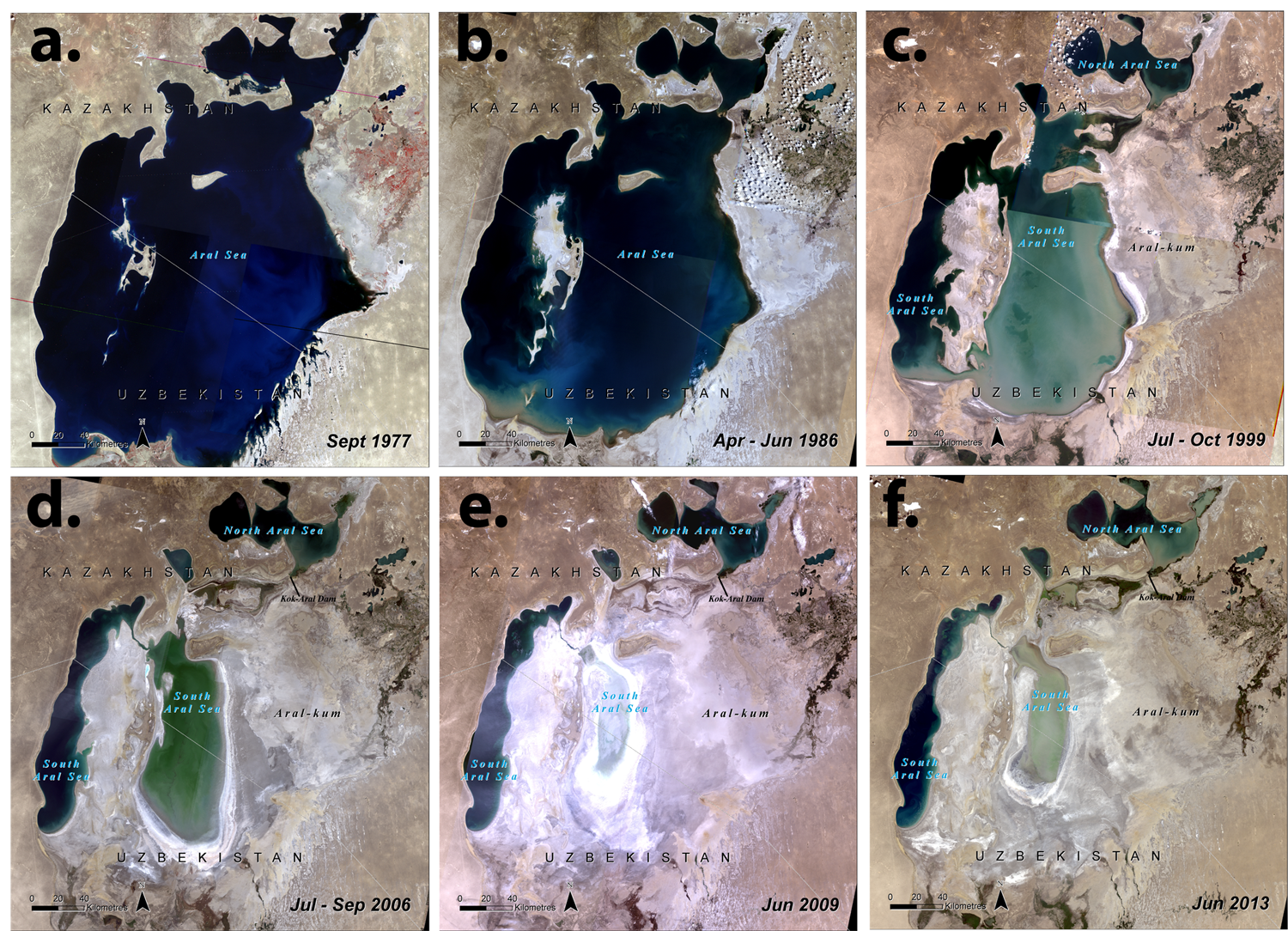
And NASA have been taking satellite images of it since a bit before 2000 too. E.g. 1977
-
Re:Localized Global Warming?
Indeed, that's why all of the top 10 hottest years on record have happened since 1997. Because it's getting colder.
-
Re:You're wrong about one thing
How much funding is it receiving compared to funding allocated to the PR campaigns (IPCC, anyone?) of the AGW crowd?
What is the budget of the IPCC?
Between 1988 and 2007 the IPCC received 94,910,768 CHF http://earthwatch.unep.net/about/docs/scpIPCC.htm
You're going to buy a lot of propaganda with less than 5 million dollars a year.
-
Re:Prior Art
That is just right. Usually figures are given for tracking concentrators or latitude tilt panels. You can find US maps here: http://www.nrel.gov/gis/solar.html. The units are in kWh/m^2/day which I divide by a kW/m^2 to get hours per day. You'll notice that in New York, panels do better than tracking concentrators. This is owing to clouds being a bigger problem for concentrators. Tracking panels should do better than latitude tip panels though by something close to but not quite the fraction that tracking concentrators beat latitude tilt panels in the southwest. For worldwide resources you can look here: http://swera.unep.net/.
-
Re:Verify this for yourself with a NASA GCM
See also this interactive Java climate model. Far simpler than a GCM, but you can play around with it in realtime.
-
Re:Repent! Global warming is nigh
Exactly wrong.
Yes, of course. The system has been going on for billions of years. And what we know of it gives us a timescale for natural changes that also happen to be millions of years. This makes an unprecedented change in a timescale of a hundred years hugely significant. Obviously, in a few millions years time, GW effects might calm down. But our models aren't dealing with geological spans of time, but the sort of timescales that human civilisations operate on. In which case, our data is certainly sufficient to give at least some conclusions.
Sure, everyone has heard that one major volcanic eruption vents more carbon dioxide than all the cars ever constructed by man combined, but that can't really be right, because we are more important than some stupid volcano.
The IPCC models incorporate the effects of volcanic eruptions. Scientists aren't stupid. You can see some of the code they used at http://climatechange.unep.net/jcm/doc/jcm/mod/radf or.html
In any case, your 'everyone' is wrong, dead wrong.
http://www.geology.sdsu.edu/how_volcanoes_work/cli mate_effects.html
Volcanic eruptions can enhance global warming by adding CO2 to the atmosphere. However, a far greater amount of CO2 is contributed to the atmosphere by human activities each year than by volcanic eruptions. Volcanoes contribute about 110 million tons/year, whereas other sources contribute about 10 billion tons/year. -
UN Study download
Here's an interesting atlas by the U.N. One Planet, Many People. Check out the urban areas chapter. Is it me or does it look like Moscow is shrinking?
-
The real link
The link in the article just goes to the press release.
The actual book (full content for both screen and printer resolutions) is here
-
Viewing more images
To see more photos than the BBC offers, you can either order the book here (and murder another tree), or view some of the images in these PDF reports.
-
'Let Them Eat Precaution'According to UN Earthwatch:
In the longer term perspective, a recent expert study estimated that the world is approaching the limits of global food production capacity based on present technologies. Its most optimistic projection suggests that a doubling of food production by 2050 might be technically feasible, and this could feed 7.8 billion people if grain is largely used as human food and not for animals. A likely higher level of population growth, or a failure of sufficient commitment to increase food supplies around the world, will create severe problems for a major part of the world population (Kendall and Pimentel, 1994). The pessimistic assumptions seem more likely, as present per capita food production is stagnating if not declining, and some crops may be close to biological and environmental limits. Already 700 million people experience endemic hunger, not counting those added by natural disasters (Serageldin, 1995).
Further,
The U.N. Food and Agriculture Organization (FAO) expects the world's population to grow to more than 8 billion by 2030. The FAO projects that global food production must increase by 60 percent to accommodate the estimated population growth, close nutrition gaps, and allow for dietary changes over the next three decades. Food charity alone simply cannot eradicate hunger. Increased supply--with the help of tools like bioengineering --is crucial.
Last year Ethiopia's population grew by 2.7%; according to this article: 'Most years, Ethiopia has to depend on some level of food aid as it rarely grows enough to feed the whole population.' The reliefweb article also states: 'many impoverished rural families say they have no choice but to have large families to help raise their incomes.' This strongly suggests that poverty is a vicious circle: because people are poor and famine-stricken they have more children; which leads to even greater pressure on food production; which, at its non-GM present state, is unable to answer with requisite increases in the amount it yields; which leads to even greater poverty; and so on and on and on. A way to break that vicious circle would be to provide people with the means to farm their own food locally and with better chances of success. In their article Technology That Will Save Billions From Starvation Prakash and Conko write:
The productivity gains from G.M. crops, as well as improved use of synthetic fertilizers and pesticides, allowed the world's farmers to double global food output during the last 50 years, on roughly the same amount of land, at a time when global population rose more than 80 percent. Without these improvements in plant and animal genetics and other scientific developments, known as the Green Revolution, we would today be farming on every square inch of arable land to produce the same amount of food, destroying hundreds of millions of acres of pristine wilderness in the process.
It is estimated that Vitamin A deficiency leads to some 1,000,000 children dying and some additional 300,000 being struck by blindless every year. According to the WHO between 100 and 140 million children are vitamin A deficient and between 250,000 to 500,000 children per year become blind due to Vitamin A deficiency. If, as Patrick Moore says, 'adding a daffodil gene to rice in order to produce a genetically modified strain of rice can prevent half a million children from going
-
Re:It's possible, after all
Well, the real problems would be:
- accelerated desertification
- rising seas (lots of islands and low-lying countries are about to disappear, at least partially)
- plant life that dies off because it can't adapt fast enough (plants are sensitive to temperature changes, and if the weather moves faster than the plants, they die)
- the end of the gulf stream, resulting in a radical cooling down of western europe (again, leading to plant extinction, and it's cold enough in Belgium already thank you very much)
- the stored methane in oceans being released (which would result in accelerated climate heating)
- death of the rain forests (with matching disastrous consequences for biodiversity, since rain forests are the life stores of the planet)
- death of the reefs (in fact they're dying already, just look at the sorry state of the great barrier reef). Reefs are the oceanic equivalent of rain forests. Losing them would be disastrous, and not just because they look good.
and so on, and so on...
Now, did you actually try to find out about the consequences of global warming? Because I think that you didn't.
Anyway, for more information, read the IPCC or UNEP climate change documents. (Link to UNEP GEO3, which deals specifically with global climate change in the near future) They contain the current scientific view on what's happening and what the consequences will be.