Slashdot Mirror
Domain: urbandictionary.com
Stories and comments across the archive that link to urbandictionary.com.
Stories · 8
-
Google Developer Says Chrome Team is Working on a Scrollable Tabstrip For the Browser (techdows.com)
If you're a tab-hoarder, and you use Chrome browser, Google may have some news for you soon. The company is working on a scrollable tabstrip to make it easier for users to navigate through tabs, a developer was quoted as saying. Peter Casting, who works on Chrome UI, said, "scrollable tabstrip is in the works. In the meantime, try shift-clicking and ctrl-clicking to select multiple tabs at once, then drag out to separate Windows to group tabs by Window." TechDows, which first reported the development: We're expecting this as the related bug, the 'UI: tab overflow' bug created 10 years back, reports opening too many tabs causes add tab button (+) to disappear and tabs do not scroll then, the expected result has been mentioned as 'scrollable tabs.' Further reading: Google is raiding Firefox for Chrome's next UI features. -
Some Sites That Blue Coat Blocks Under "Pornography"
Bennett Haselton writes this week with a dissection of the effects of one well-known, long-known problem with so-called Internet filters. "The New Braunfels Republican Women, the Weston Community Children's Association, and the Rotary Club of Midland, Ontario are among the sites categorized as 'pornography' by Blue Coat, a California-based Internet blocking software company. While the product may not be much worse than other Internet filtering programs in that regard, it reinforces the point that miscategorization of sites as 'pornographic' is a routine occurrence in the industry, and not just limited to a handful of broken products." Read on below for the rest.On Monday I released a blog post through the Citizen Lab at the University of Toronto, listing some of the sites that we had found to be blocked by Blue Coat's Internet filtering program. Previously we had released a similar report on sites that were miscategorized as "pornography" by Smartfilter. We ran some of the same URL lists through both programs, and found that some unfortunate sites were even blocked as "pornography" by both products, including Barenboim-Said (a youth orchestra featuring musicians from Israel, Palestine, and different Arab nations), and the aforementioned New Braunfels Republican Women.
The full list of sites we said were "miscategorized" is at the end of the Citizen Lab blog post. As far as I know we didn't miss any porn hidden on any of the sites that were in the list. The closest we came was a photo on performancespace.org/ showing what appears to be a model taking one for the team by lying on the floor of a grungy art exhibit. There was also the other borderline case of http://safe-sex.org/, which does include articles on topics like "Safe Sex with Expensive London Escorts." But Blue Coat's own working definition of 'pornography' defines it as "Sites that contain sexually explicit material for the purpose of arousing a sexual or prurient interest," and the articles on Safe-Sex.org do not appear intended to arouse ("The heartwarming fact about having safe sex with expensive London escorts is that they usually present a clean bill of health to clients."), so it gets counted as a miscategorization. The overwhelming majority of miscategorized sites were completely G-rated fare like the Kiddie Kollege Nursery School (which, by the way, would probably have grounds for a lawsuit against Blue Coat, if parents trying to access their website were greeted with a message that it had been blocked for containing "pornography").
Anyone can play the parlor game of examining blocked websites looking for signs of what caused them to be blocked. Is the website of the New Braunfels Republican Women blocked by both Blue Coat and Smartfilter because it has the word "women" in the title? (Tempting to thing so, but unlikely, since there are so many other sites with "women" in the name which were not blocked by either product.) One of the blocked websites, http://www.foundations4betterliving.org/, until recently contained statistics such as "A growing variety of sexual behaviour is being practiced by teens 15- to 19-year-old... 53% admit to masturbating; 49% have participated in oral sex; 11% have had anal sex," all of which you could read on their front page while Bette Midler's 'From A Distance' auto-played in the background. (I was hoping to introduce you to that sublime experience, but unfortunately the domain apparently expired right after the report was published. When you list 150 domain names in a report, that's bound to happen with some of them.) And there's neobit.org/, the homepage of a manufacturer of emulators for dongles. While many Americans probably heard the term for the first time when Amy Poehler asked the Best Buy salesman "Can I use a dongle with this? Does it make you uncomfortable when I use the word 'dongle'?", the eggheads at Blue Coat should know what a dongle actually is. 'Dongle' has never been generally accepted anatomical slang, one rogue entry at the Urban Dictionary notwithstanding.
On the other hand, most websites in the report are not only not pornographic, they don't even seem to contain any content that could have triggered an accidental block. So it's quite possible that Blue Coat simply blocks a certain number of sites as a result of some pseudo-random process, and just by chance, some of those sites happen to contain content which looks like it might have caused the block, but the content actually had nothing to do with it.
Still, that leaves open the question of why so many sites turned up blocked by both Blue Coat and Smartfilter. Out of about 150 sites miscategorized by Smartfilter and about 150 sites miscategorized by Blue Coat, 8 sites showed up on both lists, or about 6%. (That group of 8 is listed in the middle of the blog post, beginning with balticsail.org.) Now if either Smartfilter or Blue Coat were blocking non-pornographic sites completely at random, then the percentage of overlap should be about the same as the percentage of non-pornographic sites that the product blocks generally. (For example: Suppose Blue Coat blocked 1% of non-pornographic sites completely at random. Out of 150 non-pornographic sites blocked by Smartfilter, we would therefore expect 1% of them -- about 1 or 2 sites -- to also be blocked by Blue Coat.) But despite the huge number of errors made by both products, neither of them comes close to blocking 6% of all non-pornographic websites as "pornography"; the percentage of overlap is much higher than we would expect if the blocking were random.
So this suggests that some factor is at work that caused the 8 sites in that list to be more likely than average to be blocked, such that they ended up blocked by both products. Did any of the domain names used to be registered to a porn site? It seems hard to imagine that balticsail.org or barenboimsaidusa.org/ could have ever been in demand as domain names used to advertise porn. moriah.org/ sounds like it possibly could have been (many domain names consisting solely of female first names are registered to porn sites), but according to the Wayback Machine, the a previous owner was a Christian band, before the domain expired and was bought by its present-day owner, a Jewish boarding school. Perhaps the IP addresses of these sites used to be held by porn companies, but then why would the products block the sites by their domain name as well? So I really don't know.
The good news is that, unlike Smartfilter, at least Blue Coat's blacklist doesn't appear to be used by any countries for nationwide Internet censorship. Citizen Lab had previously discovered installations of Blue Coat Internet blocking software in 19 "countries of interest" with poor human rights records, but none of them appeared to be set up to filter Internet traffic in and out of the country. In the one country where the product was being used for statewide Internet filtering, the United Arab Emirates, the Blue Coat software was being used in conjunction with Smartfilter's blacklist, so the sites that are mis-blocked by Blue Coat are not blocked in that country (unless of course they also happen to be mis-blocked by Smartfilter).
For the time being, it is not against U.S. law for a company to sell Internet censoring software to foreign governments, even with the knowledge that the tools are being used to restrict freedom of speech in a manner that would be considered a human rights violation by international standards, so both companies have made it a core part of their business.
What a bunch of dongles.
-
Sites Blocked By Smartfilter, Censored in Saudi Arabia
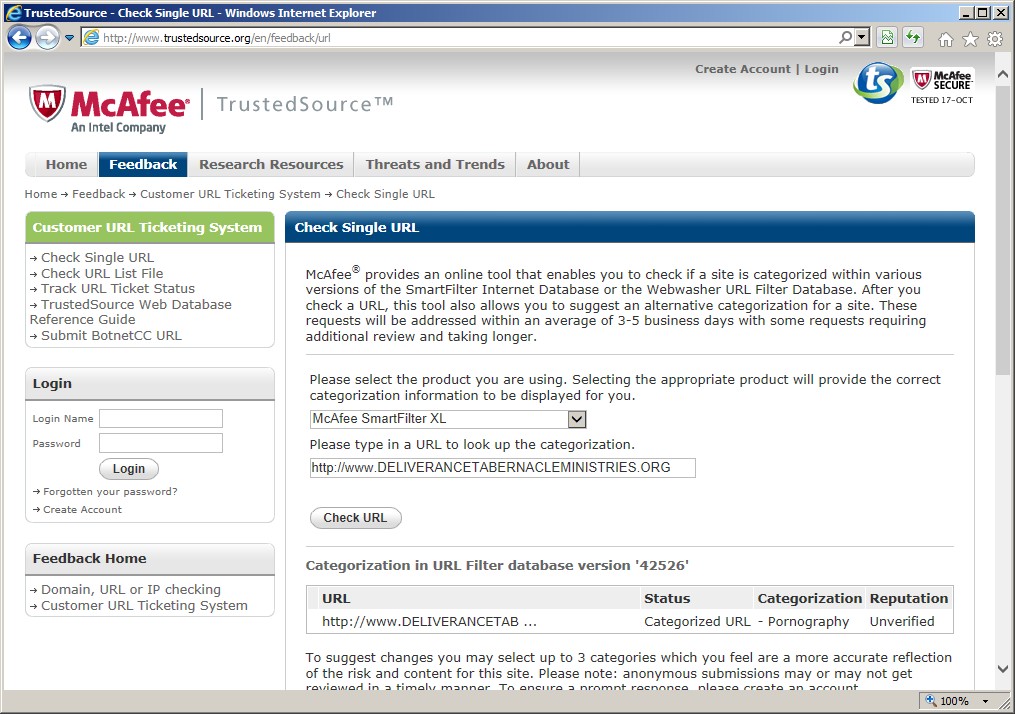
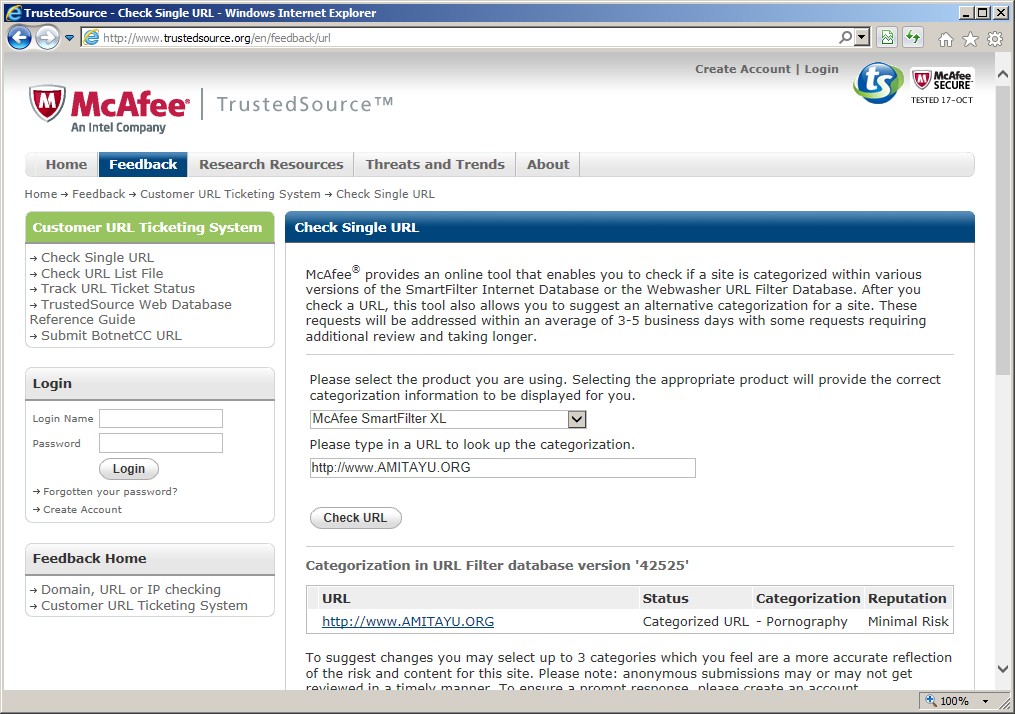
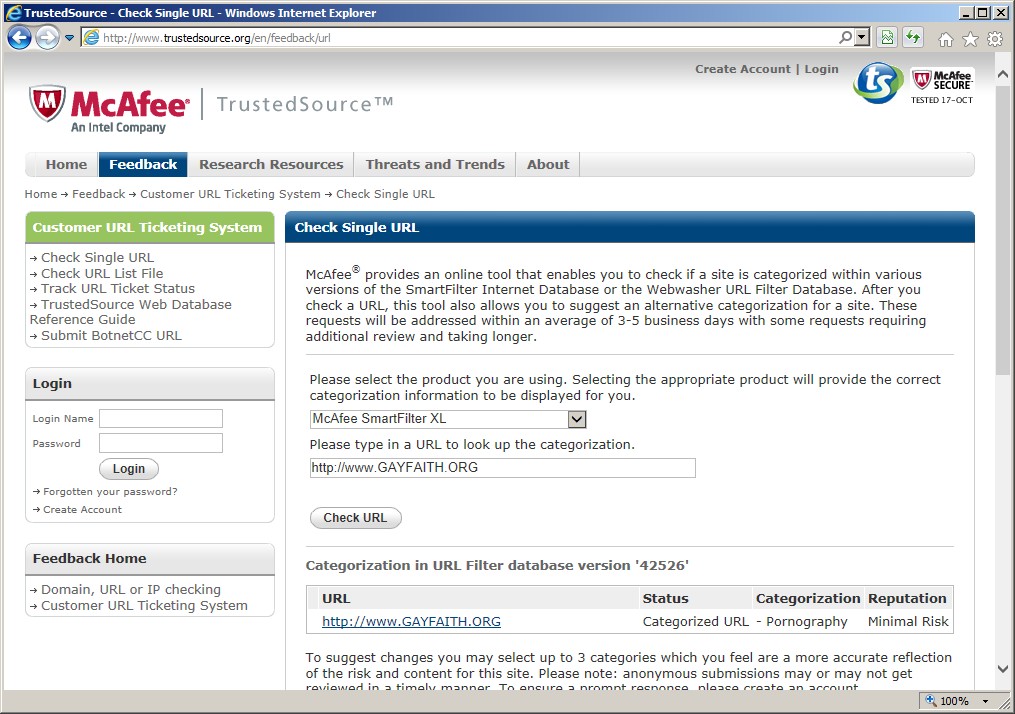
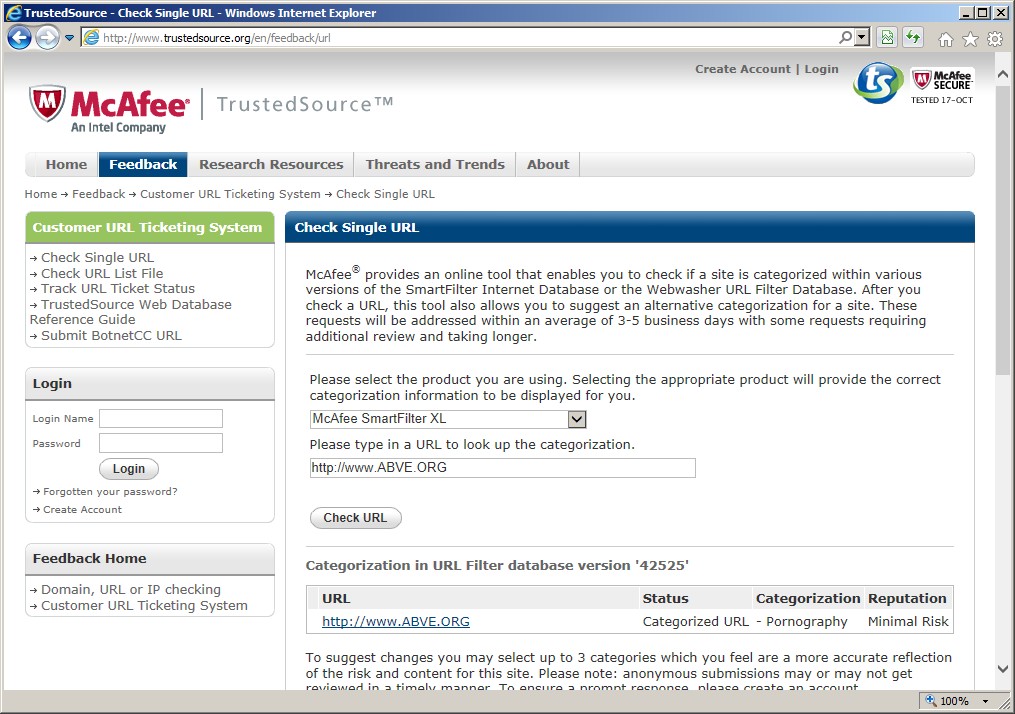
Slashdot contributor Bennett Haselton writes: "Internet users in Saudi Arabia, along with most users in the United Arab Emirates, are blocked by their respective government censors from accessing the websites of the Trinity Davison Lutheran Church, Deliverance Tabernacle Ministries in Pittsburgh, the Amitayu Buddhist Society of Taiwan, and GayFaith.org. An attempt to access any of those websites yields an error page like this one. However, the sites are not blocked because they conflict with the religions beliefs of those countries' governments. Rather, they are blocked because Smartfilter -- the American-made blocking program sold by McAfee, and used for state-mandated Internet censorship in those countries -- classifies those sites as "pornography". You can see the screen shots here, here, here and here." Read on for the rest of Bennett's thoughts.I found these blocked sites by starting with a combination of URL lists and ad hoc spidering, and running as many sites as possible through the Saudi filters to catch the ones that were blocked. Some of the sites were blocked for reasons that were easy to guess -- for example, http://www.bighornbasinsfw.org/, the home page of the Big Horn Basin, Wyoming chapter of Sportsmen for Fish & Wildlife, was almost certainly blocked because of the slang term "nsfw" in their URL. http://www.AgainstPornography.org and http://www.SearchingForMySpermDonorFather.org were presumably blocked because of the presence of the words "porn" and "sperm".
On the other hand, there appears to be no rational reason why the Filipino American Women's Network, the Tuscon Jazz Institute, or the Sacramento Police Activities League would have been blocked by Smartfilter, even by accident. A partial list of the blocked sites that I found is in the blog post I wrote for Citizen Lab, an Internet censorship research center at the University of Toronto.
Articles about sites that are erroneously blocked by Internet censorship software, have a storied history. The first widely read piece was the article "Keys to the Kingdom" written by Brock Meeks and Declan McCullagh in 1996, calling out Cyber Patrol for blocking EnviroLink.org and the University of Newcastle Computer Science Department, and CYBERsitter for blocking the National Organization for Women. I made a minor name for myself and the Peacefire.org site in the late 1990's by writing more pages about sites blocked by other products, including some (like X-Stop and SurfWatch) which no longer exist, and others that are still around, including Smartfilter. I was also one of six people comprising the Censorware Project, a loosely organized group of volunteers that published a few more reports.
By the early 2000's, however, it became clear that anyone whose mind was likely to be changed by information about what kinds of sites were blocked by blocking software, would have changed their mind already (or would, if they came across the research that had already been done up to that point). So the further reports on Internet blocking software errors, by me and other people, slowed to a trickle. I wrote a report in January 2002 on the latest list of sites blocked by Cyber Patrol, a product that most people today have forgotten. In 2006 I worked with the ACLU of Washington to publish a report on sites erroneously blocked by FortiGuard, a program used on computers in some libraries in central Washington, as part of the ACLU's suit to challenge the constitutionality of the program's use on public library terminals. (The Washington State Supreme Court rejected the lawsuit on the grounds that, regardless of what sites were blocked on the computers, it didn't matter because an adult library patron could request for the filter to be turned off.) In 2007 I wrote an article for Slashdot titled "From Bess to Worse" listing some sites that were blocked by an Internet filtering program called Bess (which was later bought out by Smartfilter and discontinued).
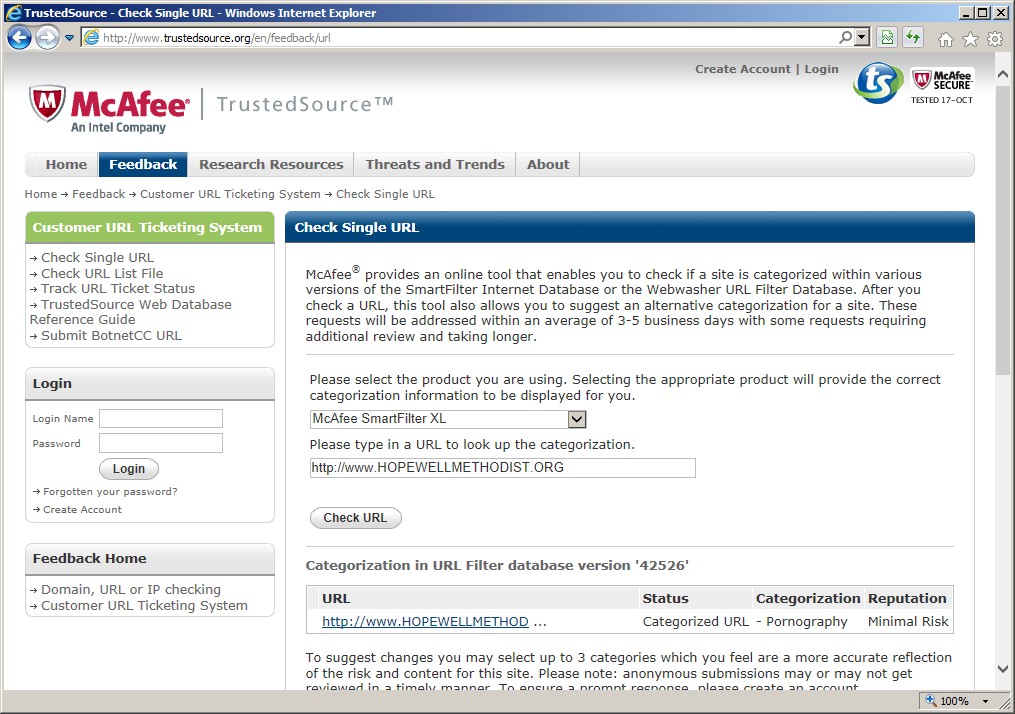
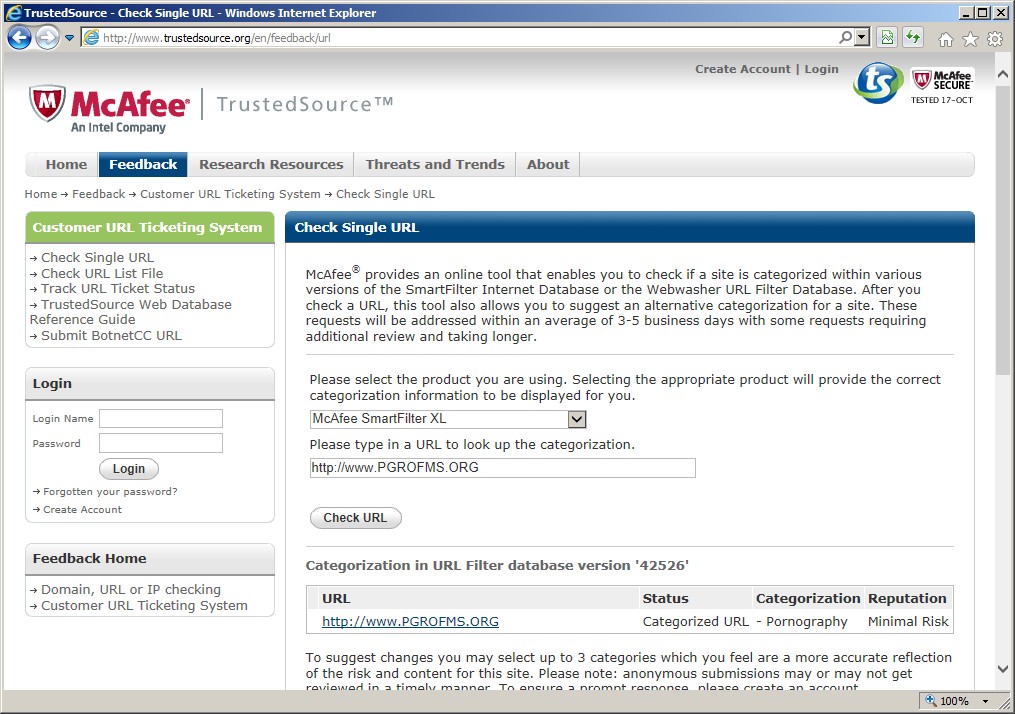
Most people's awareness of this debate, if they had heard about it at all, was limited to the perception that "breast cancer sites" and sites about "chicken breast recipes" were sometimes filtered by Internet blocking programs. Or they heard that "Beaver College" actually had to change its name to avoid being censored by web filters. As I tried to explain in a FAQ (written, according to the Wayback Machine, in 1999, but which still broadly holds true today), these examples are true, but they miss the point. These examples make it sound as if blocking software companies are doing the best job they can under the circumstances, and that the errors are unavoidable due to limitations on machine intelligence. In reality, any software algorithm that blocks the American Board of Vocational Experts, the Hopewell United Methodist Church, and the Patriot Guard Riders of Mississippi, as "pornography" (as Smartfilter currently does), is probably not the best algorithm the company could have come up with -- but there's no incentive for them to try harder, because few people will ever look that deep.
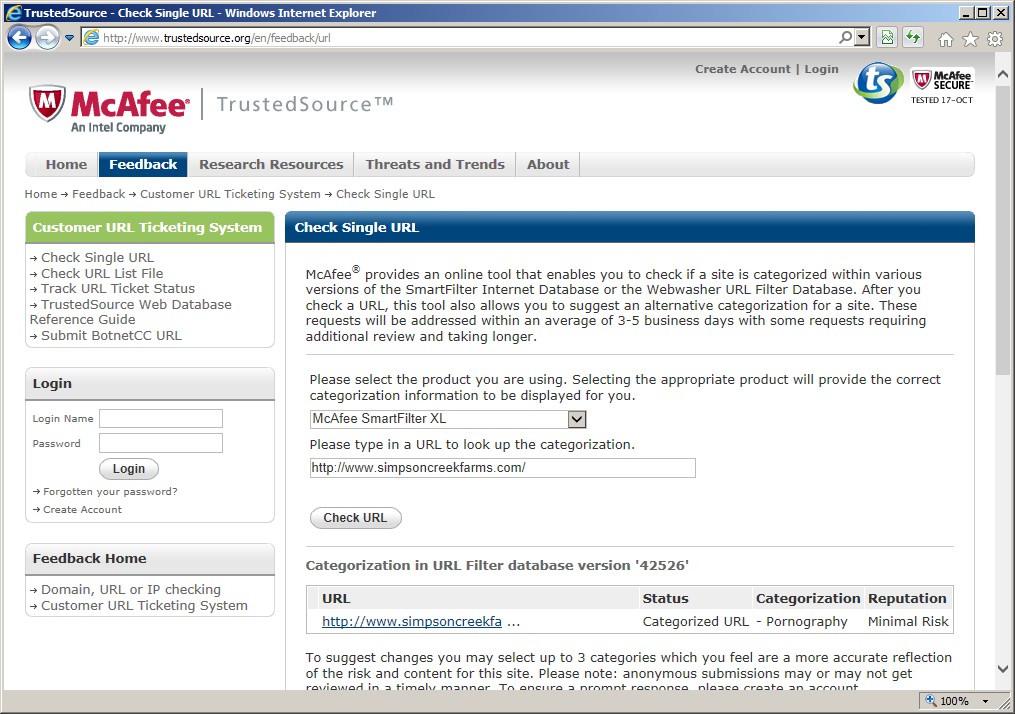
And yet, people continue to remember the "breast cancer site" examples. This sounds to me like an example of the narrative fallacy -- people remember that breast cancer sites were blocked, because there's a tidy explanation. There is no tidy explanation for most other examples of blocked sites, so the meme never spreads very far. Conveniently for the blocking companies, the blocked-site errors which make the company look most sloppy (the Kennels at Simpson Creek Farms, the St. Francis Institute of Milwaukee, etc.) are precisely the ones that, due to the narrative fallacy, most people won't remember or hear about.
One company, CYBERsitter, did manage to make a few blocking decisions in the 1990s that were egregious enough that their antics did make the news, and did finally raise some people's awareness that the controversy over private Internet filtering extended beyond "breast cancer sites". After TIME Magazine's website published an article (no longer online) that criticized CYBERsitter's blocking policies, CYBERsitter responded by blocking TIME Magazine's pathfinder.com domain. A few months earlier, CYBERsitter had blacklisted the monthly e-Zine "The Ethical Spectacle, after the Spectacle's founder, Jonathan Wallace, published an article criticizing CYBERsitter for blocking my own Peacefire.org website. And Peacefire.org had been blocked, in turn, because of a page I wrote (now very much out of date) listing some of the sites that CYBERsitter blocked, including the International Gay and Lesbian Human Rights Commission and Mother Jones. (Nowadays, of course, nobody would be surprised that filtering companies block Peacefire.org, since the site publishes ample instructions on how to get around Internet blockers. But at the time, the site's first and only article was the list of sites blocked by CYBERsitter, which is why CYBERsitter received so much criticism for blocking the domain in retaliation.) CYBERsitter also threatened to have Meeks and McCullagh criminally prosecuted for writing "Keys to the Kingdom" and threatened to sue me over the page that I had made.)
The moral, it seems, is that if you want an example of a censored web site to stick in people's minds, it either has to be a forgivable error, or an insane vindictive dick move -- because in either of those cases, people will understand why it happened. The vast swaths of censored websites on the spectrum in between, the ones for which there is no rational explanation for the blocking, go ignored.
These days, though, American and Canadian "censorware" makers have also come under fire for selling censoring software to foreign governments which use them for country-wide censorship. Most of the criticism focuses, naturally, not on the kinds of sites that are accidentally blocked by the blocking software, but on the immorality of these companies enabling statewide foreign censorship in the first place. Netsweeper, Blue Coat, and McAfee have all made the claim that "Once we sell their product to them, we have no control over what they do with it" -- which, as I wrote previously in Slashdot, is nonsense, because for the product to be effective, it has to rely on updates to the blocked-site list, which are provided at regular intervals by the manufacturer. Cut off the updates, and the product will not work, at least not as well.
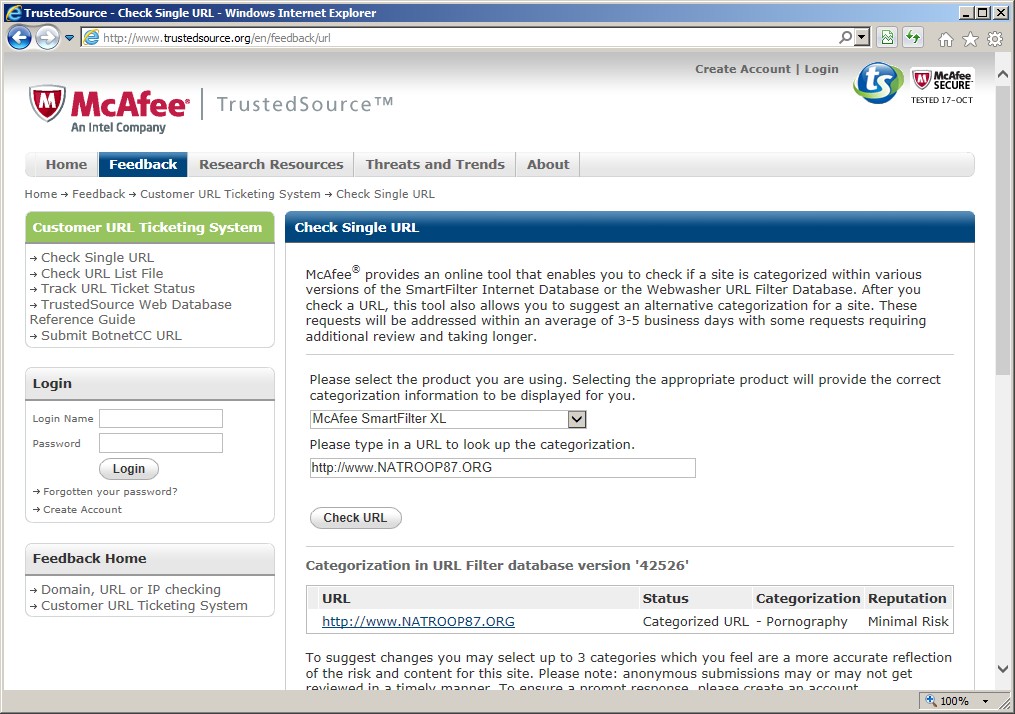
So the fact that McAfee has classified the Boy Scout Troop 87 of North Andover, the Pan-Iranist Party of Iran, and Reptile Conservation International as "Pornography" is (rightly) overshadowed by the fact that McAfee is selling to government censors in Saudi Arabia and the UAE in the first place. However, as long as the filters are installed, these blocked sites are at least part of the problem for users in those countries, just as much as they are for students or cubicle workers in the U.S. whose network administrators happen to use Smartfilter. And, of course, I sampled only a miniscule fraction of the Web to find these examples of blocked sites, so the true number of stupid blocks affecting Saudi and UAE users is likely to be much larger. For each individual example, you might reasonably ask, "Is it really a big deal if Saudis are blocked from accessing Boy Scout Troop 87 of North Andover?" But it adds up.
-
Kevin Bacon Meets Wikipedia With New Pathfinding Program
New submitter BLT2112 writes "Inspired by the Oracle of Bacon, the Oracle of Wikipedia finds the shortest path between two Wikipedia articles, as in Wikipedia Golf. As explained in the site, 'One selects one article as the tee and another article as the hole and then completes the course between them clicking as few links as possible. No typing is allowed. . . . The Oracle also allows you to search for the most challenging potential Wikipedia Golf courses. Can you find a longer course and merit a place in the "records" section?'" -
Can an Open Source Map Project Make Money?
Roblimo writes "Bing and Mapquest both use output from OpenStreetMap.org. Mapquest supports the project with money for equipment and access to the code they've written to integrate OSM's work with their display. Bing? They just take from the project and do nothing for it in return. This may be okay in a legal sense, but it is a seriously nekulturny way to behave. Even so, having Microsoft's Bing as a reference might help the project's founder make money. They've put a lot of work into this project, and it's doing a lot of people a lot of good, so they certainly deserve some sort of payback, either direct or indirect. They have a few ideas about how they might legitimately earn a few bucks from their project while remaining free software purists. Do you have any ideas, yourself, about how they might turn a few bucks from OSM?" -
Ridiculous Software Bug Workarounds?
theodp writes "Ever get a workaround for a bug from a vendor that's so rigoddamndiculous that there has to be a clueless MBA or an ornery developer behind it? For example, Microsoft once instructed users to wiggle their mouse continuously for several minutes if they wanted to see their Oracle data make it into Excel (yes, it worked!). And more recently, frustrated HP customers were instructed to use non-HP printers as their default printer if they don't want Microsoft Office 2007 to crash (was this demoed in The Mojave Experiment?). Any other candidates for the Lame Workaround Hall of Fame?" -
Space Invaders & Qix Twinned For Silver Anniversary Cabinet
Thanks to ClassicGaming for pointing out that Namco is producing a Space Invaders/Qix Silver Anniversary arcade cabinet, combining these two Taito-licensed classics into one arcade machine. The PDF brochure for the machine boasts: "The game that caused a national shortage of coins in Japan is back!", as Namco continues its classic arcade cabinet series that's also spawned Ms. PacMan/Galaga, explaining: "Why bring back these hits from the past? For the past few years, our distributors and we have received comments from operators all over the USA about how well their [classic arcade] games continue to perform, but how beat up the hardware had become." As for Ms. PacMan/Galaga, the info page reveals "the original PacMan is in the game", unlocked by a mutant version of the Konami Code. -
Konami Veterans Talk NES Classics
Thanks to Video-Fenky for posting an interview with Konami NES veterans, Kazuhisa Hashimoto and Shigeharu Umezaki, as they "...discuss what was involved in creating your typical 8-bit console game in the mid-1980s." Highlights include discussion of the infamous Konami cheat code - Hashimoto says "There's [no special story behind it], really. I mean, I was the one using it (laughs), so I just put in something I could remember easily", and the much-reduced development teams of the '80s - "With Hyper Olympic, my first game, there was a programmer and a designer - two people - and it took half a year. Gradius was four people and I don't think it even took that long."