Slashdot Mirror
Domain: usap.gov
Stories and comments across the archive that link to usap.gov.
Comments · 13
-
Re:The answer?
Is obviously nuclear power.
Actually, it has already been done. There was a nuclear power plant at McMurdo Station Antarctica from 1962-1972. It was shut down as it proved to be not cost effective, at least with the then current technology. Perhaps today, the economics have changed.
It also leaked, so there's that too. Antarctica is nuclear free now anyway so there won't be any power plants for a while.
-
Re:The answer?
Is obviously nuclear power.
Actually, it has already been done. There was a nuclear power plant at McMurdo Station Antarctica from 1962-1972. It was shut down as it proved to be not cost effective, at least with the then current technology. Perhaps today, the economics have changed.
-
Re:Seems there's more ice than usual in the antarc
Did you even read the article you cited?
First of all you need to get your terminology right. The article is talking about sea ice (ice that forms on the surface of the sea) not the Antarctic ice sheet (ice on land that's the result of over a million years of snowfall). The other term you should know is ice shelf (ice that's floated on to the ocean at the tongue of a glacier/ice sheet).
Second, the article explains that about 80% of the increase can be explained by the strengthening and converging winds around the South Pole. It doesn't appear to have much to do with colder temperatures. In fact in spite of the record sea ice this year Amundsen-Scott Station at the South Pole set record highs for each month from June to September (winter in Antarctica).
-
Re:Fingers in ears
Couple of things they fail to mention:
1) A lot of that ice grew in the 1940s.
http://news.ku.dk/all_news/2012/2012.5/glaciers_greenland_photos/
"At the time many glaciers underwent a melt similar or even higher than what we have seen in the last ten years. When it became colder again in the 1950s and 1960s, glaciers actually started growing," says Dr. Kurt H. Kjær""Kurt H. Kjær has previously worked with his colleague Svend Funder from Center for GeoGenetics on investigating sea ice extent in the Arctic Ocean. Results showed that the sea ice extent has been far from stable throughout the last 10,000 years."
2) This is what NASA has to say about the "unprecedented melt":
http://www.nasa.gov/topics/earth/features/greenland-melt.html"Ice cores from Summit show that melting events of this type occur about once every 150 years on average. With the last one happening in 1889, this event is right on time," says Lora Koenig, a Goddard glaciologist and a member of the research team analyzing the satellite data."
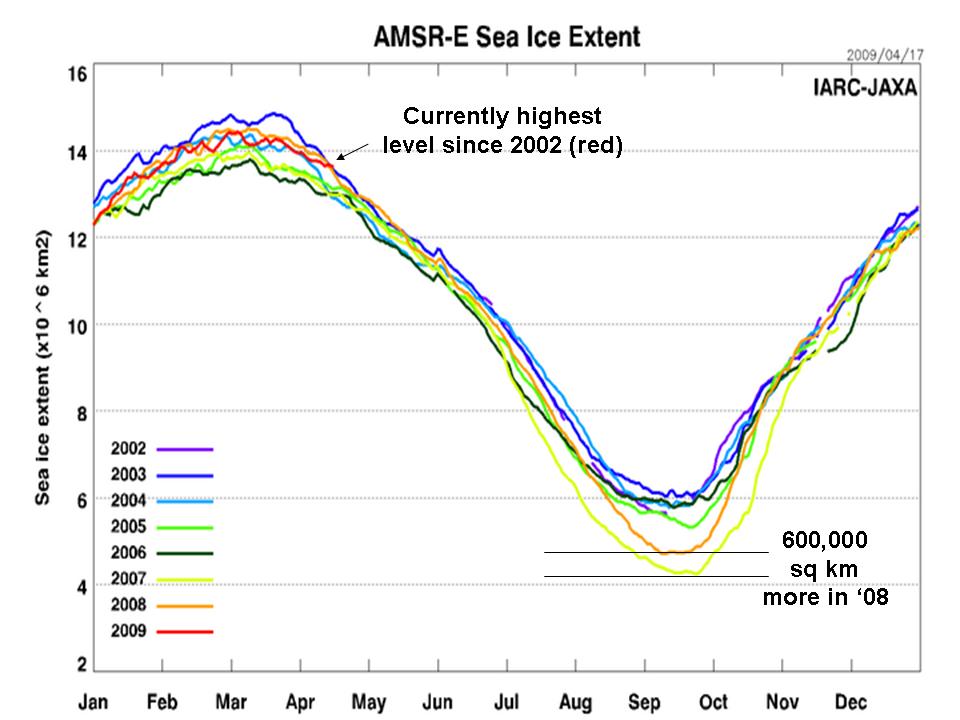
3) "Arctic Ice Threatens Northern Hemisphere
Posted on April 19, 2009 (note the date)
While the eastern Antarctic ice pack continues inexorable year over year growth, Arctic ice is greater than it’s been in the last 8 years, and showing massive expansion again this year."
http://icecap.us/images/uploads/AMSR-E.jpg4) "Antarctic sea ice grows to record extent while Arctic continues to shrink"
http://antarcticsun.usap.gov/science/contenthandler.cfm?id=27505) http://rs79.vrx.net/opinions/ideas/climate/.images/HolocenePeriods.png
The world is warming, or cooling, depending on the time scale you look at. See for yourself.6) The real problems are pollution in a general sense and deforestation. Given mans contribution to carbon is at best 3% and that we've removed so fucking many trees (look for yourself, fly over the Island of Borneo in google maps would be a good start, its gone, it's all gone)... what did you expect was gong to happen. "By Marlowe Hood (AFP) – Jul 14, 2011
PARIS — Forests play a larger role in Earth's climate system than previously suspected for both the risks from deforestation and the potential gains from regrowth, a benchmark study released Thursday has shown." http://www.google.com/hostednews/afp/article/ALeqM5j2BAdNIG5Q2FJlEdac1l-KXiTSCA?docId=CNG.dfe97e07f144a2d29eb615412e0c12be.a81That's right, in 2011 the geniuses that know all about CO2 got the revelation that trees eat the stuff. Next time somebody calls them "experts" rememnber that.
Possibly this was in response to NASA and the NOAA bitch-slapping the IPCC by pointing out in 2012 they'd sort of ignored this fact in their "models":
"8th December 2010 13:24 GMT - A group of top NASA and NOAA scientists say that current climate models predicting global warming are far too gloomy, and have failed to properly account for an important cooling factor which will come into play as CO2 levels rise."
http://www.theregister.co.uk/2010/12/08/new_model_doubled_co2_sub_2_degrees_warming/Which doubt caused Gaia-dude to recant, showing he has at least a modicum of intellectual integrity:
""James Lovelock, the scientist that came up with the 'Gaia Theory' and a prominent herald of climate change, once predicted utter disaster for the planet from climate change, writing 'before this century is over billions of us will die
-
Antarctic Sun article
The U.S. Antarctic Program’s Antarctic Sun has a writeup about this.
-
Some meaty answers for you
"Extremely easy" is hardly informative as said in the top comment... I think what you're asking for is how to find an opportunity, and work.
Antarctica public opportunities are handled through here: http://www.usap.gov/
They need IT people, but it is mostly infrastructure, WAN and LAN related work, and it's usually for 6 month or 1 year contracts. I applied many years back (when Raytheon handled all the contracting through polar.org) but got no response... I met someone later that had done a couple of tours there and he described it as that with something with as tight a community as Antarctica you need an "in", or network your ass off to get to one. It's an environment of trust in an extreme place, and most of the positions are filled by people that already have a relationship with a decision maker.
Positions in dangerous places, if that's the adventure you're looking for, are nearly always managed by an NGO or government contractor responsible for all hiring, etc. So for Afghanistan, as a contractor, you'd probably look to something like SAIC, or even Blackwater/Xe, and once again, you need to network your way to a relationship with someone that could vouch that you're a sane person. These positions are in demand, and they don't lack for peeps through those channels. Again, nearly all infrastructure work. A clearance, if you have one, is a plus, and you'll be required to pass a secret clearance regardless. (which means, some people from the government will ask everything about your life, anything illegal or of bad character you've ever done, drug use, where you lived. The key here is be truthful - it's not necessarily an attempt to eliminate you from getting a clearance, but just to not let anybody blackmail you for skeletons in your closet. They'll ask some questions of your neighbors too, just to verify anything they suspect might be a lie.)
For the rest, in a functioning, growing economy in Asia or South America or Russia vicinity, etc, there are headhunters/staffing firms much like in the US. Best bet is to go local as possible to the hungry, commission only recruiters, vs going through a big multi national. And like the US, don't just work through one, but half a dozen, as they all have knowledge of different opportunities. They do look for real world talent of all kinds, and you can probably bring a lot to the table with the experience you have in more mature environments.
-
C17 landing photo at night, proof here
A C-17 Globemaster III aircrew from McChord Air Force Base, Washington, performed the first known after-dark landing in Antarctica using night vision goggles on September 11, 2008.
-
heres some landing photos at night
Nice landing shots at night.
Id like to see a SR71 land there.
-
other scientists who popularize science.
In that vein, I think a good role model is someone who popularizes science. If I were to quote you some scientists who Hirsch-indices were really high, the problem is that most of their stuff is unintelligible to most adults, much less a kid. So I'd pick ones that have written books that popularize science. Along with Tyson, I'd think about guys like:
Steve Jay Gould (paleontologist, unfortunately dead)
Robert Hazen (mineralogist, works on origin of life, not really young though)
David Goodstein (chemist, writes on oil resource depletion.)
Perhaps someone who reports on science, like the scientists at work blog at the NYT or one of the blogs on national geographic. That way the kid could keep up with current events (maybe you could find a blog of someone working someplace inhospitable, like McMurdo station in the Antarctic. -
Calling Antarctica
There isn't really a 'code' for dialing Antarctica... I worked IT at the Amundsen-Scott South Pole Station for the United States Antarctic Program. The US stations employ a satellite link to the Denver headquarters, and from there it's just connected to the network. Dialing "The South Pole" is actually just a Denver number.
-
Re:Sounds awesome
McMurdo Station is always hiring.
Ask yourself what kind of stuff you want to tell your grandkids when you're old. Then sign up
I'm dying to winter down there--just to say I've done it--heck, I'd apply for the janitor job if that's all that was available. They don't seem to have much need for security consultants -
Denver
The reason the guy keeps referring to his people back in Denver is because logistics and support for the South Pole station (and McMurdo, too, I think) are run by Raytheon Polar Services, which is based in Colorado. The Antarctic program is run out of Washington by the National Science Foundation, but they contract out the actual infrastructure, operations, and other support.
-
Re:Hello, Spiegel
You're assuming that it was a freely floating ice cube with a tether, as opposed to the possibility that it was
(in part) a structural extension protruding from the continent i.e; part of its load was not borne by the sea.
This article seems to support the latter: http://antarcticsun.usap.gov/oldissues2002-2003/Su n102702/icebergs.html