Slashdot Mirror
Domain: wikipedia.org
Stories and comments across the archive that link to wikipedia.org.
Stories · 7,048
-
UCLA, CIsco & More Launch Consortium To Replace TCP/IP
alphadogg writes Big name academic and vendor organizations have unveiled a consortium this week that's pushing Named Data Networking (NDN), an emerging Internet architecture designed to better accommodate data and application access in an increasingly mobile world. The Named Data Networking Consortium members, which include universities such as UCLA and China's Tsinghua University as well as vendors such as Cisco and VeriSign, are meeting this week at a two-day workshop at UCLA to discuss NDN's promise for scientific research. Big data, eHealth and climate research are among the application areas on the table. The NDN effort has been backed in large part by the National Science Foundation, which has put more than $13.5 million into it since 2010. -
Slashdot Talks with David Nalley About Apache CloudStack (Video)
This Citrix Web page at buildacloud.org says, "David is a PMC (Project Management Commitee) member of the Apache CloudStack project, jClouds committer, Fedora contributor and an Open Source Evangelist for the Open Source Business Office at Citrix." CloudStack has been an Apache Top Level Project since March 2013, with David on board all the way. He's obviously the right person to turn to for an Apache CloudStack update, including some commentary on the differences between Apache CloudStack and OpenStack, two projects often viewed as competitors. (Alternate Video Link) -
Slashdot Talks with David Nalley About Apache CloudStack (Video)
This Citrix Web page at buildacloud.org says, "David is a PMC (Project Management Commitee) member of the Apache CloudStack project, jClouds committer, Fedora contributor and an Open Source Evangelist for the Open Source Business Office at Citrix." CloudStack has been an Apache Top Level Project since March 2013, with David on board all the way. He's obviously the right person to turn to for an Apache CloudStack update, including some commentary on the differences between Apache CloudStack and OpenStack, two projects often viewed as competitors. (Alternate Video Link) -
Could Tech Have Stopped ISIS From Using Our Own Heavy Weapons Against Us?
JonZittrain writes: This summer, ISIS insurgents captured Mosul — with with it, three divisions' worth of advanced American military hardware. After ISIS used it to capture the Mosul Dam, the U.S. started bombing its own pirated equipment. Could sophisticated military tanks and anti-aircraft missiles given or sold to countries like Iraq be equipped with a way to disable them if they're compromised, without opening them up to hacking by an enemy?
We already require extra authentication at a distance to arm nuclear weapons, and last season's 24 notwithstanding, we routinely operate military drones at a distance. Reportedly in the Falkland Islands war, Margaret Thatcher was able to extract codes to disable Argentina's Exocet missiles from the French. The simplest implementation might be like the proposal for land mines that expire after a certain time. Perhaps tanks — currently usable without even an ignition key — could require a renewal code digitally signed by the owning country to be entered manually or received by satellite every six months or so.
I'm a skeptic of kill switches, especially in consumer devices, but still found myself writing up the case for a way to disable military hardware in the field. There are lots of reasons it might not work — or work too well — but is there a way to improve on what we face now? -
Bringing New Security Features To Docker
Czech37 writes SELinux lead Dan Walsh wrote last month that Docker "containers do not contain" and that the host system isn't completely protected. Today, Walsh details the steps that Docker, Red Hat, and the open source community are taking to make Docker more secure: "Basically, we want to put in as many security barriers to break out as possible. If a privileged process can break out of one containment tool, we want to block them with the next. With Docker, we are want to take advantage of as many security components of Linux as possible. If "Docker" isn't a familiar word, the project's website is informative; the very short version is that it's a Linux-based "open platform for developers and sysadmins to build, ship, and run distributed applications"; Wikipedia has a good explanation, too. -
Why Phone Stores Should Stockpile Replacements
Bennett Haselton writes: I would be in favor of a regulation requiring cell phone stores to have replacement phones on hand, for any phone model covered by a customer's insurance policy. Then customers who have insurance protection on their phones could get the damaged phones replaced instantly, and the replacement phones that are normally mailed out by overnight mail to customers under their protection plan, could instead be mailed to the stores to replace the one they just gave out to the customer. Read on for the rest of Bennett's thoughtsMy phone got wet. It wasn't a warranty issue, since it was my fault. (Well, it would be more accurate to say that it wasn't the manufacturer's fault. I was going through the Ballard Locks with some friends in a river raft that we were paddling. But taking my phone on the raft wasn't the stupid part; I had it sealed in a zippable plastic bag. But on the way back through the locks, some jerks in a rental yacht pulled up to the raft, started chatting, and then suddenly urged us to get on board and get our raft into the yacht very urgently, making me think it was an emergency and causing me to lose track of my phone. As I dug the soaked phone out of my pocket once we were all on board the yacht, we later determined that the "emergency" was that the jerks were trying to get the three women in bikinis on board their boat.)
So I gave the T-Mobile store rep an abbreviated version of this story the next day, and he said that after I paid the $90 deductible under the phone insurance policy, I could get a new phone mailed out to me by overnight mail. As much as the phone itself sucked, I really wanted a working one again, so since I could see the same model in boxes on the wall, I asked why I couldn't just take one of those, since the insurance policy entitled me to a replacement. He said it was because to save costs, their insurance provider sometimes sent out refurbished phones as replacements under the insurance policy, which are worth less because they can't be sold new.
Well, that's fair. Presumably it really does keep costs down to use refurbished phones as replacements, and while not every cost savings gets passed on to the consumer, it doesn't hurt. Then I asked if I could "borrow" one of the in-store models by buying it and using it until the replacement phone arrived the next day, then returning the borrowed phone to the store under their 14-day return policy? No, he said, at least not without paying the $50 re-stocking fee. (In hindsight I probably should have paid that for the ability to start using my phone again, but it's one of those fees that grates on you not because you can't afford it, but because you're disgusted at having to pay it.)
But, that's still fair. Restocking a phone costs money too. But -- but -- why don't they just keep a stockpile of phones in a cardboard box in the back -- the crummy "refurbished" ones that can't be sold new -- and use those to satisfy customers' insurance claims? Then customers who file a claim could walk out of the store with a replacement phone, the same model they'd always been used to, and the insurance company could mail the replacement phone to the store, to replace the one that was handed out to the customer.
They would only have to have one replacement model of each phone that had been sold recently enough to consumers to still be covered under a replacement insurance plan. That still probably wouldn't take up more space than what you could fit into a medium cardboard box. Perhaps more popular models of phones could have multiple stand-by replacement models in the store, since it would be more likely for two people to walk in on the same day looking for replacements for that phone model -- and once the replacement phones get mailed out by the insurance company, the store's supply of replacements gets replenished anyway. If the store is really unlucky, and four people walk in on the same day making warranty claims on a phone model, when the store's policy was to only carry three of that model in stock, there would be no reason to penalize the store, as long as they made a reasonable effort to have enough replacement phones in stock to handle the normal rate of insurance claims.
For that matter, you wouldn't even have to have the replacement phones all in stock at the same store. One store could serve as the "replacement supplier" for all of that carrier's retail stores in, say, a 20-minute driving radius. So when I make my warranty claim at the initial store, they can tell me to drive 20 minutes and pick up a new phone. That would have been much preferable to waiting another day.
Also, if the customer's replacement phone gets given to me instantly and then the replacement from the insurance provider gets mailed to the store to replenish the one they just gave out, there's no particular reason it would have to be sent out by overnight mail. That would bring down the cost of handling the claim, which might be passed on to the consumer in the form of a lower insurance deductible or lower overall fees (again with the optimism, but lowering costs means the savings will be passed on to somebody, even if only to the shareholders of the cell phone carrier). The more of that phone model they have in stock at the store, the more slowly and cheaply the replacement phone can be mailed out, since you only need to make sure that the store's supply of that model never hits zero. So the optimal solution would involve weighing the cost of storing two or three of a particular phone (versus just one) versus the cost savings of the slower mailing method.
This is a simple (and very first-world) problem and a modest fix, but the larger point is that there's no reason to think that the free market necessarily arrives at the most cost-effective solution in situations like this. Companies compete on cost-effectiveness in arenas that are highly visible to the consumer and likely to factor into their purchasing decisions -- the highest-megapixel camera for the lowest price, for example -- but few customers at purchase time are likely to ask about the insurance claim process (and probably very few people ask how quickly a phone gets replaced when a user files a claim). As such, we're lucky that the insurance provider sends out the replacement phone by overnight mail at all, when they could presumably mail it out by 3- or 4-day mail instead, and no free market forces or government truth-in-labeling enforcers would probably penalize them for that. But an in-store-replacement rule (or a replacement-from-some-store-within-a-20-minute-drive rule) would benefit customers more and, with the savings on the mailing speed for the replacements, possibly cost the carrier less. (Even if it did cost the carrier more to carry a small box of in-store replacements in the back room, and even if that cost did get passed on to customers, I'd consider myself ahead on the deal if it meant I'd never be without a replacement phone for more than a day.)
-
Robot Dramas: Autonomous Machines In the Limelight On Stage and In Society
aarondubrow writes: We're entering an era where we'll increasingly coexist with robots and other intelligent machines — some of which may look like us. Not only is there a growing number of industrial robots (about 1.5 million today), there are 10 million Roombas in our homes, porter-bots in our hospitals and hotels, social robots in our nursing homes and even robot spectators at baseball games in Japan, tele-operated by remote fans.
Theater is not an arena that we typically associate with robots, however, artists, musicians and producers are often early adopters and innovative users of emerging technologies. In fact, robots got their name from the 1920 play, R.U.R., by the Czech playwright, Karel Capek. An article in the Huffington Post describes a panel discussion at the National Academy of Science in June that featured the producers of three recent plays that starred robots. The plays highlight our robot anxieties, while offering new visions for human-robot interactions in the future. -
Ask Slashdot: the State of Free Video Editing Tools?
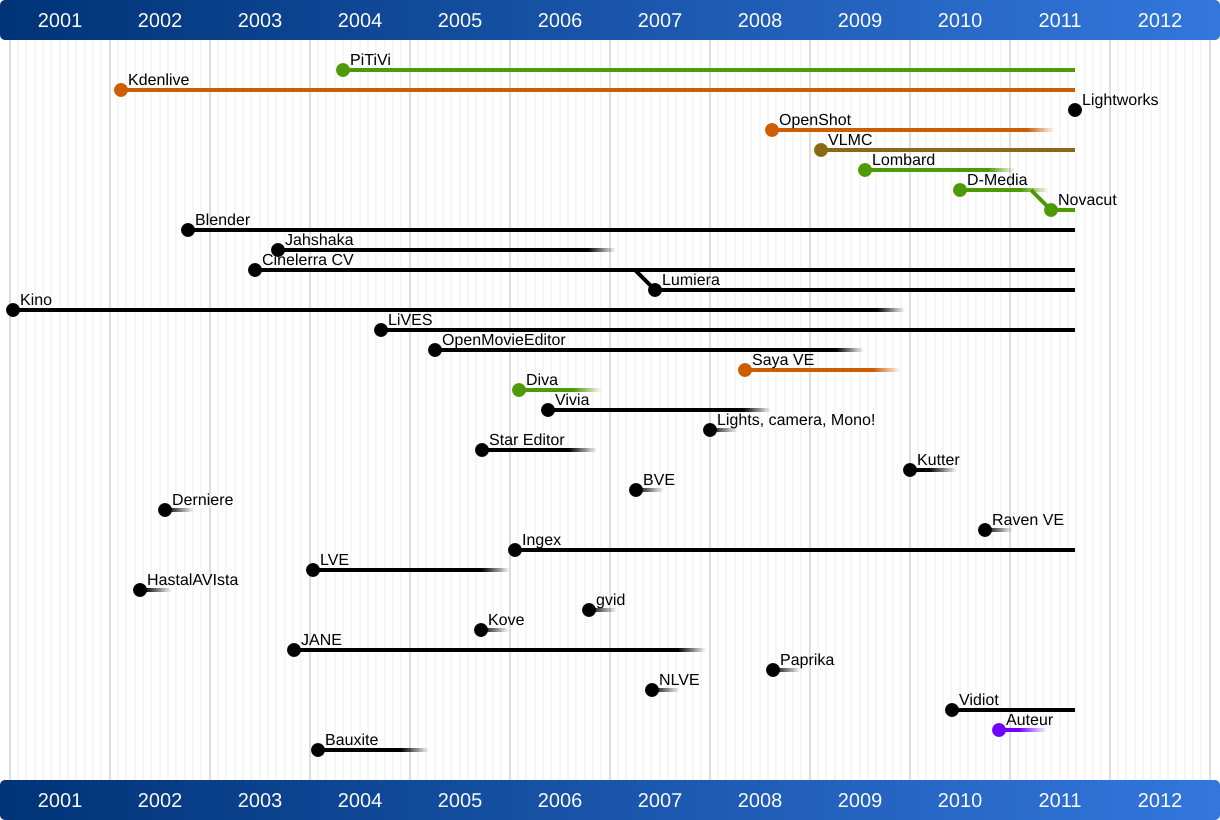
New submitter Shadow99_1 writes I used to do a lot of video editing (a few years ago, at an earlier job) and at that time I used Adobe Premiere. Now a few years later I'm looking to start doing some video editing for my own personal use, but I have a limited budget that pretty well excludes even thinking about buying a copy of Adobe Premiere. So I ask slashdot: What is the state of free (as in beer or as in open source) video editing tools? In my case... I support a windows environment at work and so it's primarily what I use at home. I am also using a camcorder that uses flash cards to record onto, so for me I need a platform that supports reading flash cards. So that is my focus but feel free to discuss video editing on all platforms. I've been looking forward to the Kickstarted upgrade to OpenShot; based on the project's latest update, early versions of an installer should start appearing soon. Video editing is a big endeavor, though, and ambitious announcements and slipped schedules both seem to be the norm: an open-source version of Lightworks was announced back in 2010. Some lighter open-source options include Pitivi (raising funds to get to version 1.0) and Kdenlive, also in active development (most recent release was in mid-May). Pitiviti's site links to a sobering illustration about many of the shorter- and longer-lived projects in this area. -
Ask Slashdot: Linux-Friendly Desktop x86 Motherboard Manufacturers?
storkus writes: The release of Haswell-E and a price drop on Devil's Canyon has made me itch for a PC upgrade. However, looking around I discovered a pair of horror stories on Phoronix about the difficulties of using Linux on a multitude of motherboards. My question: if MSI, Gigabyte, Asus (and by extension Asrock) are out, who's left and are they any good? I'd like to build a (probably dual-boot, but don't know for sure) gaming and 'other' high-end machine with one of the above chips, so we're talking Z97 or X99; however, these stories seem to point to the problems being Windows-isms in the BIOS/UEFI structures rather than actual hardware incompatibility, combined with a lousy attitude (despite the Steam Linux distro being under development). -
Google's Megan Smith Would Be First US CTO Worthy of the Title
theodp writes: Bloomberg is reporting that Google X's Megan Smith is the top candidate for U.S. Chief Technology Officer. With a BS/MS in Mechanical Engineering from MIT, and experience ranging from General Magic to Google, Smith would arguably be the first U.S. CTO worthy of the title (the outgoing U.S. CTO has a bachelor's in Econ; his predecessor has a master's in Public Policy). "Smith joined Google in 2003. As vice president of business development, she oversaw many of its most important acquisitions, like Keyhole, the service that underlies Google Earth. She has led the company’s philanthropic division, Google.org, and served as a co-host for Google’s Solve for X forum, where distinguished thinkers and scientists brainstorm radical technology ideas with Google executives." -
Google's Megan Smith Would Be First US CTO Worthy of the Title
theodp writes: Bloomberg is reporting that Google X's Megan Smith is the top candidate for U.S. Chief Technology Officer. With a BS/MS in Mechanical Engineering from MIT, and experience ranging from General Magic to Google, Smith would arguably be the first U.S. CTO worthy of the title (the outgoing U.S. CTO has a bachelor's in Econ; his predecessor has a master's in Public Policy). "Smith joined Google in 2003. As vice president of business development, she oversaw many of its most important acquisitions, like Keyhole, the service that underlies Google Earth. She has led the company’s philanthropic division, Google.org, and served as a co-host for Google’s Solve for X forum, where distinguished thinkers and scientists brainstorm radical technology ideas with Google executives." -
Google's Megan Smith Would Be First US CTO Worthy of the Title
theodp writes: Bloomberg is reporting that Google X's Megan Smith is the top candidate for U.S. Chief Technology Officer. With a BS/MS in Mechanical Engineering from MIT, and experience ranging from General Magic to Google, Smith would arguably be the first U.S. CTO worthy of the title (the outgoing U.S. CTO has a bachelor's in Econ; his predecessor has a master's in Public Policy). "Smith joined Google in 2003. As vice president of business development, she oversaw many of its most important acquisitions, like Keyhole, the service that underlies Google Earth. She has led the company’s philanthropic division, Google.org, and served as a co-host for Google’s Solve for X forum, where distinguished thinkers and scientists brainstorm radical technology ideas with Google executives." -
MIPS Tempts Hackers With Raspbery Pi-like Dev Board
DeviceGuru (1136715) writes "In a bid to harness the energy and enthusiasm swirling around today's open, hackable single board computers, Imagination Technologies, licensor of the MIPS ISA, has unveiled the Creator C120 development board, the ISA's counter to ARM's popular Raspberry Pi and BeagleBone Black SBCs. The MIPS dev board is based on a 1.2GHz dual-core MIPS32 system-on-chip and has 1GB RAM and 8GB flash, and there's also an SD card slot for expansion. Ports include video, audio, Ethernet, both WiFi and Bluetooth 4.0, and a bunch more. OS images are already available for Debian 7, Gentoo, Yocto, and Arch Linux, and Android v4.4 is expected to be available soon. Perhaps the most interesting feature of the board is that there's no pricing listed yet, because the company is starting out by giving the boards away free to developers who submit the most interesting projects." -
Coffee Naps Better For Alertness Than Coffee Or Naps Alone
An anonymous reader writes: Caffeine is a staple of most workplaces — it's rare to find an office without a coffee pot or a fridge full of soda. It's necessary (or at least feels like it's necessary) because many workers have a hard time staying awake while sitting at a desk for hours at a time, and the alternative — naps — aren't usually allowed. But new research shows it might be more efficient for employers to encourage brief "coffee naps," which are more effective at returning people to an alert state than either caffeine or naps alone. A "coffee nap" is when you drink a cup of coffee, and then take a sub-20-minute nap immediately afterward. This works because caffeine takes about 20 minutes to get into your bloodstream, and a 20-minute nap clears adenosine from your brain without putting you into deeper stages of sleep. In multiple studies, tired participants who took coffee naps made fewer mistakes in a driving simulator after they awoke than the people who drank coffee without a nap or slept without ingesting caffeine. -
Scientists Craft Seamless 2D Semiconductor Junctions
vinces99 (2792707) writes Scientists have developed what they believe is the thinnest-possible semiconductor, a new class of nanoscale materials made in sheets only three atoms thick. The University of Washington researchers have demonstrated that two of these single-layer semiconductor materials can be connected in an atomically seamless fashion known as a heterojunction. This result could be the basis for next-generation flexible and transparent computing, better light-emitting diodes, or LEDs, and solar technologies.
"Heterojunctions are fundamental elements of electronic and photonic devices," said senior author Xiaodong Xu, a UW assistant professor of materials science and engineering and of physics. "Our experimental demonstration of such junctions between two-dimensional materials should enable new kinds of transistors, LEDs, nanolasers, and solar cells to be developed for highly integrated electronic and optical circuits within a single atomic plane." -
If Java Wasn't Cool 10 Years Ago, What About Now?
10 years ago today on this site, readers answered the question "Why is Java considered un-cool?" 10 years later, Java might not be hip, but it's certainly stuck around. (For slightly more than 10 years, it's been the basis of the Advanced Placement test for computer science, too, which means that lots of American students are exposed to Java as their first formally taught language.) And for most of that time, it's been (almost entirely) Free, open source software, despite some grumbling from Oracle. How do you see Java in 2014? Are the pessimists right? -
Mangalyaan Gets Ready To Enter Mars Orbit
William Robinson (875390) writes India's Mars Orbiter Mission, known as Mangalyaan is now at a distance of just nine million kilometres from the red planet, and is scheduled to enter the orbit of Mars at 7.30 am on September 24. Mangalyaan was launched on 5th November 2013 by ISRO, presently busy planning to reduce the speed of the spacecraft through the process of firing the LAM engine and bring it to 1.6 km/sec, before it is captured by the planet's gravity. Eventually, the mission's official updates page should catch up. -
Eruption Of Iceland's Bardarbunga Raises Travel Alert to Red
The eruption of the Bardarbunga volcano in central Iceland, which appeared a strong possibility after a series of earthquakes, is currently underway, beneath the ice of the Dyngjujokull glacier. The BBC reports that Iceland has raised its air travel alert to red, its higest level, but that for now all of Iceland's airports remain open. CNN notes that "the underground activity did not immediately result in changes to volcanic activity on the surface ... Because of a pressure from the glacier cap it is uncertain whether the eruption will stay sub-glacial or not, Iceland 2 TV said." -
A Better Way To Make Mind-Controlled Prosthetic Limbs
the_newsbeagle writes: To make a brain-machine interface, you need a way to capture neurons' electric signals. The most precise and most invasive way uses implants that are stuck in the gray matter. The least precise and least invasive way uses EEG sensors stuck to the scalp. But researchers at Johns Hopkins University say there's a third way that gets the best of both worlds, which is not too invasive and fairly precise. They use ECoG systems, in which a mesh of electrodes is placed under the skull, draped over the surface of the cortex.
They're testing their systems on epilepsy patients, who have these ECoG systems inserted anyway while they're waiting for surgery (the electrodes record the source of their seizures). The researchers are capturing these patients' movement commands from their brains, and using them to control robotic limbs. Someday such a system could be used by amputees to control their prosthetic limbs. -
Couchsurfing Hacked, Sends Airbnb Prank Spam
Slashdot regular (and Couchsurfing.org volunteer) Bennett Haselton writes with a report that an anonymous prankster hacked the Couchsurfing.org website and sent spam to about 1 million members, snarkily advertising their commercial arch-rival Airbnb as "the new Couchsurfing." (Read on below for more on the breach.) As of now, the spam's been caught, but not the spammer.I've been a volunteer host on Couchsurfing.org for 16 months. Despite the ongoing controversies surrounding the site's changes in recent years, I've always found it to be a great way to meet travelers with fascinating stories and to make new friends, not to mention a way to force a deadline upon yourself to clean up your house before the next guest arrives.
On August 15, I received an email sent from "Couchsurfing <noreply@couchsurfing.org>" with the subject "Site Improvements", which read:
Hi!
We have some exciting news. Find out more about the new CouchSurfing here.
The CouchSurfing teambut the hyperlink on the word "here" did nothing when I clicked on it. So I looked at the HTML source code of the message and saw that the source code of the link was: We have some exciting news. Find out more about the new CouchSu= rfing <a href=3D=E2=80=9Chttps://www.airbnb.com/signup_login=E2=80=9D> her= e </a>.
So... the email from Couchsurfing was promoting a link to their commercial arch-rival, Airbnb.
At that point I assume the message was spam that had been sent from some third-party server and simply forged a return address from couchsurfing.org, but the message headers clearly showed that the message really had been sent from Couchsurfing: Received: from messaging3.couchsurfing.com (messaging3.couchsurfing.com. [54.236.187.135]) by mx.google.com with ESMTP id v7si15118226qay.99.2014.08.15.21.30.16 for <bennetthaselton@gmail.com>; The complete message headers and message source are here.
I sent a message to Couchsurfing tech support asking if they knew what had happened, and I started a thread on the Seattle Couchsurfing page, where several other users chimed in that they had received the same email. Couchsurfing support replied to me on August 18th:
Hello Bennett,
Thanks for your patience while we have been looking into this. As you saw yourself, some Couchsurfing members received an email in error on Friday night -- we apologize.
The part of Couchsurfing’s system that sends email to members was breached Friday night and an email was sent to approximately 1 million members. We take this very seriously, and we will continue to investigate and take all appropriate action until this situation is resolved.
There is no action you need to take to secure your account. Once we have further information, we will be sure to send out updates.
Warm Regards,Then on August 19th, I received an email from Couchsurfing (presumably along with all or most other Couchsurfing users) with the subject "Incorrect email -- our apologies":
Dear Bennett Haselton:
We're writing because you may have received an odd email from Couchsurfing in the last few days titled "Site Improvements."
We apologize for any confusion this may have caused -- it should not have been sent.
-- The Couchsurfing Team
Want more details? Find them herewhere the "here" link further explains: "The message was sent by an unauthorized user of our email system. No other systems were compromised, and we've addressed the circumstances that led to this unauthorized use."
So, kudos to Couchsurfing for at least alerting users that something had gone wrong. (Judging from the reactions in the thread that I started, most users who received the email simply deleted it without a second thought after seeing that the link didn't work, so Couchsurfing probably could have said nothing to their users at all, and gotten away with it. As of this writing, a Google News search for "couchsurfing hacked" turns up no other articles about the incident, so it's not as if there was a mob clamoring for answers that they had to respond to.)
On the other hand, I hope Couchsurfing is more forthcoming in the next few days about how much they know about what actually happened. When they say "We've addressed the circumstances that led to this unauthorized use," that probably means that they at least know whether the email was sent by (a) a disgruntled employee (or recently fired employee whose credentials still enabled them to access the server); or (b) someone who used an unpatched security hole to break in from the outside; or (c) something else. (I replied to the tech support ticket asking as much, but as of this writing I have not received a reply. I wasn't naive enough to think that they were probably going to tell me everything they knew, but it's one of those rituals that quasi-journalists engage in so that we can say "as of this writing I have not received a reply".)
Obviously I think it's unlikely that anyone at the real Airbnb would actually risk jail time by hacking Couchsurfing's servers to send out spam advertising the Airbnb website; it seems more like the actions of someone being snarky, possibly a former employee or an outsider with an axe to grind. Couchsurfing's apology email said "Once we have further information, we will be sure to send out updates." Hope so.
-
The 2014 Hugo Awards
Dave Knott writes: WorldCon 2014 wrapped up in London this last weekend and this year's Hugo Award winners were announced. Notable award winners include:
Best Novel: Ancillary Justice by Ann Leckie
Best Novelette: "The Lady Astronaut of Mars" by Mary Robinette Kowal
Best Novella: "Equoid" by Charles Stross
Best Short Story: "The Water That Falls on You from Nowhere" by John Chu
Best Graphic Story: "Time" by Randall Munroe
Best Dramatic Presentation (Long Form): Gravity written by Alfonso Cuarón & Jonás Cuarón, directed by Alfonso Cuarón
Best Dramatic Presentation (Short Form): Game of Thrones: "The Rains of Castamere" written by David Benioff & D.B. Weiss, directed by David Nutter
The results of this year's awards were awaited with some some trepidation in the SF community, due to well-documented attempts by some controversial authors to game the voting system. These tactics appear to have been largely unsuccessful, as this is the fourth major award for the Leckie novel, which had already won the 2013 BSFA, 2013 Nebula and 2014 Clarke awards. -
The 2014 Hugo Awards
Dave Knott writes: WorldCon 2014 wrapped up in London this last weekend and this year's Hugo Award winners were announced. Notable award winners include:
Best Novel: Ancillary Justice by Ann Leckie
Best Novelette: "The Lady Astronaut of Mars" by Mary Robinette Kowal
Best Novella: "Equoid" by Charles Stross
Best Short Story: "The Water That Falls on You from Nowhere" by John Chu
Best Graphic Story: "Time" by Randall Munroe
Best Dramatic Presentation (Long Form): Gravity written by Alfonso Cuarón & Jonás Cuarón, directed by Alfonso Cuarón
Best Dramatic Presentation (Short Form): Game of Thrones: "The Rains of Castamere" written by David Benioff & D.B. Weiss, directed by David Nutter
The results of this year's awards were awaited with some some trepidation in the SF community, due to well-documented attempts by some controversial authors to game the voting system. These tactics appear to have been largely unsuccessful, as this is the fourth major award for the Leckie novel, which had already won the 2013 BSFA, 2013 Nebula and 2014 Clarke awards. -
Scientists Baffled By Unknown Source of Ozone-Depleting Chemical
schwit1 writes: Scientists have found that, despite a complete ban since 2007, ozone-depleting chemicals are still being pumped into the atmosphere from some unknown source. "Carbon tetrachloride (CCl4), which was once used in applications such as dry cleaning and as a fire-extinguishing agent, was regulated in 1987 under the Montreal Protocol along with other chlorofluorocarbons that destroy ozone and contribute to the ozone hole over Antarctica. Parties to the Montreal Protocol reported zero new CCl4 emissions between 2007-2012. However, the new research shows worldwide emissions of CCl4 average 39 kilotons (about 43,000 U.S. tons) per year, approximately 30 percent of peak emissions prior to the international treaty going into effect. "We are not supposed to be seeing this at all," said Qing Liang, an atmospheric scientist at NASA's Goddard Space Flight Center in Greenbelt, Maryland, and lead author of the study published online in the Aug. 18 issue of Geophysical Research Letters, a journal of the American Geophysical Union. "It is now apparent there are either unidentified industrial leakages, large emissions from contaminated sites, or unknown CCl4 sources." -
Qt Upgrades From LGPLv2.1 to LGPLv3
Digia has announced that existing Qt modules will now be covered under the LGPLv3 in addition to the LGPLv2.1, GPLv3, and the enterprise (proprietary) license. New modules will be dropping LGPLv2.1 and GPLv3+ and be released under the LGPLv3 and GPLv2+ instead. This should be a good move: new Qt modules will be Apache license compatible, LGPLv3 code can trivially be converted to GPLv3, and Digia is even releasing a few modules it intended to make proprietary as Free Software. The KDE Free Qt Foundation is on board. The move was made because of device vendors exploiting a loophole in the GPLv2/LGPLv2.1 that denied users the right to modify Qt or write their own applications. Digia has some self-interest as well, since those vendors were exploiting the tivoization loophole to avoid buying enterprise licenses. From the announcement: We also consider locked-down consumer devices using the LGPL’ed version of Qt to be harmful for the Qt ecosystem. ... Because of this, we are now adding LGPL v3 as a licensing option to Qt 5.4 in addition to LGPL v2.1. All modules that are part of Qt 5.3 are currently released under LGPL v2.1, GPL v3 and the commercial license. Starting with Qt 5.4, they will be released under LGPL v2.1, LGPL v3 and the commercial license. ... In Qt 5.4, the new Qt WebEngine module will be released under LGPL v3 in the open source version and under a LGPLv2.1/commercial combination for Qt Enterprise customers. ...
Adding LGPLv3 will also allow us to release a few other add-ons that Digia before intended to make available solely under the enterprise license. ... The first module, called Qt Canvas3D, will give us full WebGL support inside Qt Quick. ... The second module is a lightweight WebView module ... There is a final add-on that will get released under LGPL v3. This module will give native look and feel to the Qt Quick Controls on Android. This module can’t be released under LGPL v2.1, as it has to use code that is licensed under Apache 2.0, a license that is incompatible with LGPL v2.1, but compatible with LGPL v3. -
Your Phone Can Be Snooped On Using Its Gyroscope
stephendavion (2872091) writes Researchers will demonstrate the process used to spy on smartphones using gyroscopes at Usenix Security event on August 22, 2014. Researchers from Stanford and a defense research group at Rafael will demonstrate a way to spy on smartphones using gyroscopes at Usenix Security event on August 22, 2014. According to the "Gyrophone: Recognizing Speech From Gyroscope Signals" study, the gyroscopes integrated into smartphones were sensitive enough to enable some sound waves to be picked up, transforming them into crude microphones. -
At Home with Tim O'Reilly (Videos 1 and 2 of 6)
Wikipedia says Tim O'Reilly "is the founder of O'Reilly Media (formerly O'Reilly & Associates) and a supporter of the free software and open source movements." And so he is. O'Reilly Media is also the company from which Make magazine and the assorted Maker Faires sprang, before spinning off into an ongoing presence of their own. (This year's Solid conference, as well as the confluence of hardware and software at OSCON demonstrate O'Reilly's ongoing interest in the world of makers, though.) O'Reilly has been a powerful force in technical book publishing, popularized the term Web 2.0, and has been at least a godfather to the open source movement. He's also an interesting person in general, even more so when he's hanging out at home than when he's on stage at a conference or doing a formal interview. That's why we were glad Timothy Lord was able to get hold of Tim O'Reilly via Hangout while he was in a relaxed mood in a no-pressure environment, happy to give detailed responses based on your questions, from small (everyday technology) to big (the Internet as "global brain").
We've run a few two-part videos, but this is the first time we've split one video into six parts -- with two running today, two tomorrow, and two Thursday. But then, how many people do we interview who have had as much of an effect on the nature of information transmission -- as opposed to just publishing -- as Tim O'Reilly? We don't know for sure, but there's a good chance that O'Reilly books are owned by more Slashdot readers than books from any other publisher. That alone makes Tim O'Reilly worth listening to for nearly an hour, total. (Alternate Video Links: Video 1 ~ Video 2; transcript below covers both videos.) -
At Home with Tim O'Reilly (Videos 1 and 2 of 6)
Wikipedia says Tim O'Reilly "is the founder of O'Reilly Media (formerly O'Reilly & Associates) and a supporter of the free software and open source movements." And so he is. O'Reilly Media is also the company from which Make magazine and the assorted Maker Faires sprang, before spinning off into an ongoing presence of their own. (This year's Solid conference, as well as the confluence of hardware and software at OSCON demonstrate O'Reilly's ongoing interest in the world of makers, though.) O'Reilly has been a powerful force in technical book publishing, popularized the term Web 2.0, and has been at least a godfather to the open source movement. He's also an interesting person in general, even more so when he's hanging out at home than when he's on stage at a conference or doing a formal interview. That's why we were glad Timothy Lord was able to get hold of Tim O'Reilly via Hangout while he was in a relaxed mood in a no-pressure environment, happy to give detailed responses based on your questions, from small (everyday technology) to big (the Internet as "global brain").
We've run a few two-part videos, but this is the first time we've split one video into six parts -- with two running today, two tomorrow, and two Thursday. But then, how many people do we interview who have had as much of an effect on the nature of information transmission -- as opposed to just publishing -- as Tim O'Reilly? We don't know for sure, but there's a good chance that O'Reilly books are owned by more Slashdot readers than books from any other publisher. That alone makes Tim O'Reilly worth listening to for nearly an hour, total. (Alternate Video Links: Video 1 ~ Video 2; transcript below covers both videos.) -
At Home with Tim O'Reilly (Videos 1 and 2 of 6)
Wikipedia says Tim O'Reilly "is the founder of O'Reilly Media (formerly O'Reilly & Associates) and a supporter of the free software and open source movements." And so he is. O'Reilly Media is also the company from which Make magazine and the assorted Maker Faires sprang, before spinning off into an ongoing presence of their own. (This year's Solid conference, as well as the confluence of hardware and software at OSCON demonstrate O'Reilly's ongoing interest in the world of makers, though.) O'Reilly has been a powerful force in technical book publishing, popularized the term Web 2.0, and has been at least a godfather to the open source movement. He's also an interesting person in general, even more so when he's hanging out at home than when he's on stage at a conference or doing a formal interview. That's why we were glad Timothy Lord was able to get hold of Tim O'Reilly via Hangout while he was in a relaxed mood in a no-pressure environment, happy to give detailed responses based on your questions, from small (everyday technology) to big (the Internet as "global brain").
We've run a few two-part videos, but this is the first time we've split one video into six parts -- with two running today, two tomorrow, and two Thursday. But then, how many people do we interview who have had as much of an effect on the nature of information transmission -- as opposed to just publishing -- as Tim O'Reilly? We don't know for sure, but there's a good chance that O'Reilly books are owned by more Slashdot readers than books from any other publisher. That alone makes Tim O'Reilly worth listening to for nearly an hour, total. (Alternate Video Links: Video 1 ~ Video 2; transcript below covers both videos.) -
C++14 Is Set In Stone
jones_supa (887896) writes "Apart from minor editorial tweaks, the ISO C++14 standard can be considered completed. Implementations are already shipping by major suppliers. C++14 is mostly an incremental update over C++11 with some new features like function return type deduction, variable templates, binary literals, generic lambdas, and so on. The official C++14 specification release will arrive later in the year, but for now Wikipedia serves as a good overview of the feature set." -
Iceland's Seismic Activity: A Repeat Show for Atmospheric Ash?
In 2010, ash spewed into the atmosphere by the volcano beneath Iceland's Eyjafjallajökull glacier grounded European air traffic for days (and, partially, for weeks). As reported by The Guardian, a series of similarly situated earthquakes may herald a similar ash-ejecting erruption, and the country has raised its volcano risk to its second-most-severe rating (orange). From the article: Iceland met office seismologist Martin Hensch said the risk of any disruptive ash cloud similar to the one in 2010 would depend on how high any ash would be thrown, how much there would be and how fine-grained it would be. Bardarbunga is Iceland's largest volcanic system, located under the ice cap of the Vatnajokull glacier in the southeast of Iceland. It is in a different range to Eyjafjallajokull. The met office said in a statement it measured the strongest earthquake in the region since 1996 early on Monday and it now had strong indications of ongoing magma movement. "As evidence of magma movement shallower than 10km implies increased potential of a volcanic eruption, the Bardarbunga aviation colour code has been changed to orange," it said. "Presently there are no signs of eruption, but it cannot be excluded that the current activity will result in an explosive subglacial eruption, leading to an outburst flood and ash emission." ... Hensch said the biggest risk in Iceland itself was from flood waves from any eruption under the glacier. He said the area of Iceland mainly at risk of flooding was mostly uninhabited but that roads in the area had been closed. -
Transparent Fish Lead to Stem Cell Research Breakthrough
brindafella (702231) writes Australian scientists have accidentally made one of the most significant discoveries in stem cell research, by studying the transparent embryos of Zebrafish (Danio rerio). The fish can be photographed and their development studied over time, and the movies can be played backwards, to track back from key developmental stages to find the stem cell basis for various traits of the fish. This fundamental research started by studying muscles, but the blood stem cell breakthrough was a bonus. They've found out how hematopoietic stem cells (HSC), among the most important stem cells found in blood and bone marrow, is formed. The scientists are based at the Australian Regenerative Medicine Institute at Monash University. The research has been published in the Nature medical journal. This discovery could lead to the production of self-renewing stem cells in the lab to treat multiple blood disorders and diseases. -
Why Hasn't This Asteroid Disintegrated?
sciencehabit writes: Planetary scientists have found an asteroid spinning too fast for its own good. The object, known as 1950 DA, whips around every 2.1 hours, which means that rocks on its surface should fly off into space. What's keeping the remaining small rocks and dust on the surface? The researchers suggest van der Waals forces, weak forces caused by the attraction of polar molecules, which have slightly different charges on different sides of the molecule. For example, water molecules exhibit surface tension because of van der Waals forces, because the negative charge of one water molecule's oxygen atom is attracted to nearby water molecules' hydrogen atoms, which have a positive charge at their surfaces. Similar attractions could be occurring between molecules on the surfaces of different pieces of dust and rock. Such forces would be comparable to those that caused lunar dust to stick to astronauts' space suits. -
NASA's Greenhouse Gas Observatory Captures 'First Light'
mdsolar (1045926) writes with news that NASA's second attempt to launch a satellite to map carbon dioxide levels across the globe succeeded, and its instruments are operating properly. From the article: NASA's first spacecraft dedicated to studying Earth's atmospheric climate changing carbon dioxide levels and its carbon cycle has reached its final observing orbit and taken its first science measurements as the leader of the world's first constellation of Earth science satellites known as the International 'A-Train. The Orbiting Carbon Observatory-2 (OCO-2) is a research satellite tasked with collecting the first global measurements of atmospheric carbon dioxide (CO2) — the leading human-produced greenhouse gas and the principal human-produced driver of climate change. The 'first light' measurements were conducted on Aug. 6 as the observatory flew over central Papua New Guinea and confirmed the health of the science instrument. -
NASA's Greenhouse Gas Observatory Captures 'First Light'
mdsolar (1045926) writes with news that NASA's second attempt to launch a satellite to map carbon dioxide levels across the globe succeeded, and its instruments are operating properly. From the article: NASA's first spacecraft dedicated to studying Earth's atmospheric climate changing carbon dioxide levels and its carbon cycle has reached its final observing orbit and taken its first science measurements as the leader of the world's first constellation of Earth science satellites known as the International 'A-Train. The Orbiting Carbon Observatory-2 (OCO-2) is a research satellite tasked with collecting the first global measurements of atmospheric carbon dioxide (CO2) — the leading human-produced greenhouse gas and the principal human-produced driver of climate change. The 'first light' measurements were conducted on Aug. 6 as the observatory flew over central Papua New Guinea and confirmed the health of the science instrument. -
NASA's Greenhouse Gas Observatory Captures 'First Light'
mdsolar (1045926) writes with news that NASA's second attempt to launch a satellite to map carbon dioxide levels across the globe succeeded, and its instruments are operating properly. From the article: NASA's first spacecraft dedicated to studying Earth's atmospheric climate changing carbon dioxide levels and its carbon cycle has reached its final observing orbit and taken its first science measurements as the leader of the world's first constellation of Earth science satellites known as the International 'A-Train. The Orbiting Carbon Observatory-2 (OCO-2) is a research satellite tasked with collecting the first global measurements of atmospheric carbon dioxide (CO2) — the leading human-produced greenhouse gas and the principal human-produced driver of climate change. The 'first light' measurements were conducted on Aug. 6 as the observatory flew over central Papua New Guinea and confirmed the health of the science instrument. -
The IPv4 Internet Hiccups
New submitter pla writes: Due to a new set of routes published yesterday, the internet has effectively undergone a schism. All routers with a TCAM allocation of 512k (or less), in particular Cisco Catalyst 6500 and 7600's, have started randomly forgetting portions of the internet. 'Cisco also warned its customers in May that this BGP problem was coming and that, in particular, a number of routers and networking products would be affected. There are workarounds, and, of course the equipment could have been replaced. But, in all too many cases this was not done. ... Unfortunately, we can expect more hiccups on the Internet as ISPs continue to deal with the BGP problem." Is it time to switch to all IPv6 yet? -
Type 225 Words per Minute with a Stenographic Keyboard (Video)
Joshua Lifton says you can learn to type at 225 words per minute with his Stenosaurus, an open source stenography keyboard that has a not-there-yet website with nothing but the words, "Stenography is about to evolve," on it as of this writing. If you've heard of Joshua it's probably because he's part of the team behind Crowd Supply, which claims, "Our projects raise an average of $43,600, over twice as much as Kickstarter." A brave boast, but there's plenty of brainpower behind the company. Joshua, himself. has a PhD from MIT, which according to his company bio means, "he's devoted a significant amount of his time learning how to make things that blink." But the steno machine is his own project, independent of Crowd Supply.
Stenotype machines are usually most visible when court reporters are using them. They've been around since the 1800s, when their output was holes in paper tape. Today's versions are essentially chorded keyboards that act as computer input devices. (Douglas Engelbart famously showed off a chorded keyboard during his 1968 Mother of All Demos.) Today you have The Open Steno Project, and Stenosaurus is a member. And while Joshua's project may not have an actual website quite yet, it has an active blog. And the 225 WPM claim? Totally possible. The world record for English language stenography is 360 WPM. And you thought the Dvorak Keyboard was fast. Hah! (Alternate Video Link) -
Type 225 Words per Minute with a Stenographic Keyboard (Video)
Joshua Lifton says you can learn to type at 225 words per minute with his Stenosaurus, an open source stenography keyboard that has a not-there-yet website with nothing but the words, "Stenography is about to evolve," on it as of this writing. If you've heard of Joshua it's probably because he's part of the team behind Crowd Supply, which claims, "Our projects raise an average of $43,600, over twice as much as Kickstarter." A brave boast, but there's plenty of brainpower behind the company. Joshua, himself. has a PhD from MIT, which according to his company bio means, "he's devoted a significant amount of his time learning how to make things that blink." But the steno machine is his own project, independent of Crowd Supply.
Stenotype machines are usually most visible when court reporters are using them. They've been around since the 1800s, when their output was holes in paper tape. Today's versions are essentially chorded keyboards that act as computer input devices. (Douglas Engelbart famously showed off a chorded keyboard during his 1968 Mother of All Demos.) Today you have The Open Steno Project, and Stenosaurus is a member. And while Joshua's project may not have an actual website quite yet, it has an active blog. And the 225 WPM claim? Totally possible. The world record for English language stenography is 360 WPM. And you thought the Dvorak Keyboard was fast. Hah! (Alternate Video Link) -
Type 225 Words per Minute with a Stenographic Keyboard (Video)
Joshua Lifton says you can learn to type at 225 words per minute with his Stenosaurus, an open source stenography keyboard that has a not-there-yet website with nothing but the words, "Stenography is about to evolve," on it as of this writing. If you've heard of Joshua it's probably because he's part of the team behind Crowd Supply, which claims, "Our projects raise an average of $43,600, over twice as much as Kickstarter." A brave boast, but there's plenty of brainpower behind the company. Joshua, himself. has a PhD from MIT, which according to his company bio means, "he's devoted a significant amount of his time learning how to make things that blink." But the steno machine is his own project, independent of Crowd Supply.
Stenotype machines are usually most visible when court reporters are using them. They've been around since the 1800s, when their output was holes in paper tape. Today's versions are essentially chorded keyboards that act as computer input devices. (Douglas Engelbart famously showed off a chorded keyboard during his 1968 Mother of All Demos.) Today you have The Open Steno Project, and Stenosaurus is a member. And while Joshua's project may not have an actual website quite yet, it has an active blog. And the 225 WPM claim? Totally possible. The world record for English language stenography is 360 WPM. And you thought the Dvorak Keyboard was fast. Hah! (Alternate Video Link) -
Type 225 Words per Minute with a Stenographic Keyboard (Video)
Joshua Lifton says you can learn to type at 225 words per minute with his Stenosaurus, an open source stenography keyboard that has a not-there-yet website with nothing but the words, "Stenography is about to evolve," on it as of this writing. If you've heard of Joshua it's probably because he's part of the team behind Crowd Supply, which claims, "Our projects raise an average of $43,600, over twice as much as Kickstarter." A brave boast, but there's plenty of brainpower behind the company. Joshua, himself. has a PhD from MIT, which according to his company bio means, "he's devoted a significant amount of his time learning how to make things that blink." But the steno machine is his own project, independent of Crowd Supply.
Stenotype machines are usually most visible when court reporters are using them. They've been around since the 1800s, when their output was holes in paper tape. Today's versions are essentially chorded keyboards that act as computer input devices. (Douglas Engelbart famously showed off a chorded keyboard during his 1968 Mother of All Demos.) Today you have The Open Steno Project, and Stenosaurus is a member. And while Joshua's project may not have an actual website quite yet, it has an active blog. And the 225 WPM claim? Totally possible. The world record for English language stenography is 360 WPM. And you thought the Dvorak Keyboard was fast. Hah! (Alternate Video Link) -
Type 225 Words per Minute with a Stenographic Keyboard (Video)
Joshua Lifton says you can learn to type at 225 words per minute with his Stenosaurus, an open source stenography keyboard that has a not-there-yet website with nothing but the words, "Stenography is about to evolve," on it as of this writing. If you've heard of Joshua it's probably because he's part of the team behind Crowd Supply, which claims, "Our projects raise an average of $43,600, over twice as much as Kickstarter." A brave boast, but there's plenty of brainpower behind the company. Joshua, himself. has a PhD from MIT, which according to his company bio means, "he's devoted a significant amount of his time learning how to make things that blink." But the steno machine is his own project, independent of Crowd Supply.
Stenotype machines are usually most visible when court reporters are using them. They've been around since the 1800s, when their output was holes in paper tape. Today's versions are essentially chorded keyboards that act as computer input devices. (Douglas Engelbart famously showed off a chorded keyboard during his 1968 Mother of All Demos.) Today you have The Open Steno Project, and Stenosaurus is a member. And while Joshua's project may not have an actual website quite yet, it has an active blog. And the 225 WPM claim? Totally possible. The world record for English language stenography is 360 WPM. And you thought the Dvorak Keyboard was fast. Hah! (Alternate Video Link) -
Type 225 Words per Minute with a Stenographic Keyboard (Video)
Joshua Lifton says you can learn to type at 225 words per minute with his Stenosaurus, an open source stenography keyboard that has a not-there-yet website with nothing but the words, "Stenography is about to evolve," on it as of this writing. If you've heard of Joshua it's probably because he's part of the team behind Crowd Supply, which claims, "Our projects raise an average of $43,600, over twice as much as Kickstarter." A brave boast, but there's plenty of brainpower behind the company. Joshua, himself. has a PhD from MIT, which according to his company bio means, "he's devoted a significant amount of his time learning how to make things that blink." But the steno machine is his own project, independent of Crowd Supply.
Stenotype machines are usually most visible when court reporters are using them. They've been around since the 1800s, when their output was holes in paper tape. Today's versions are essentially chorded keyboards that act as computer input devices. (Douglas Engelbart famously showed off a chorded keyboard during his 1968 Mother of All Demos.) Today you have The Open Steno Project, and Stenosaurus is a member. And while Joshua's project may not have an actual website quite yet, it has an active blog. And the 225 WPM claim? Totally possible. The world record for English language stenography is 360 WPM. And you thought the Dvorak Keyboard was fast. Hah! (Alternate Video Link) -
Errata Prompts Intel To Disable TSX In Haswell, Early Broadwell CPUs
Dr. Damage writes: The TSX instructions built into Intel's Haswell CPU cores haven't become widely used by everyday software just yet, but they promise to make certain types of multithreaded applications run much faster than they can today. Some of the savviest software developers are likely building TSX-enabled software right about now. Unfortunately, that work may have to come to a halt, thanks to a bug—or "errata," as Intel prefers to call them—in Haswell's TSX implementation that can cause critical software failures. To work around the problem, Intel will disable TSX via microcode in its current CPUs — and in early Broadwell processors, as well. -
Larry Rosen: A Case Study In Understanding (and Enforcing) the GPL
lrosen (attorney Lawrence Rosen) writes with a response to an article that appeared on Opensource.com late last month, detailing a court case that arose between Versata Software and Ameriprise Financial Services; part of the resulting dispute hinges on Versata's use of GPL'd software (parsing utility VTD-X, from Ximpleware), though without acknowledging the license. According to the article's author, attorney Aaron Williamson (former staff attorney for the Software Freedom Law Center), "Lawyers for commercial software vendors have feared a claim like this for essentially the entire 20-odd-year lifetime of the GPL: a vendor incorporates some GPL-licensed code into a product—maybe naively, maybe willfully—and could be compelled to freely license the entire product as a result. The documents filed by Amerprise in the case reflect this fearful atmosphere, adopting the classically fear-mongering characterization of the GPL as a 'viral' license that 'infects' its host and 'requires it to become open source, too.'" Rosen writes: I want to acknowledge Aaron's main points: This lawsuit challenges certain assumptions about GPLv2 licensing, and it also emphasizes the effects of patents on the FOSS (and commercial) software ecosystem. I also want to acknowledge that I have been consulted as an expert by the plaintiff in this litigation (Ximpleware vs. Versata, et al.) and so some of what I say below they may also say in court. Read on for the rest (and Williamson's article, too, for a better understanding of this reaction to it). An important take-away: it's not just the license that matters.
Let's be open about the facts here. Ximpleware worked diligently over many years to create certain valuable software. The author posted his source code on SourceForge. He offered the software under GPLv2. He also offered that software under commercial licenses. And he sought and received and provided notice of United States patent claims related to that software.
Unbeknownst to Ximpleware, Versata took that GPLv2 software and incorporated it into Versata products – without disclosing that GPLv2 software or in any other way honoring the terms of the GPLv2 license. The reason Ximpleware became aware of that GPLv2 breach is because some months ago Versata and one of its customers, Ameriprise, became embroiled in their own litigation. The breach of GPLv2 came out during discovery.
Ximpleware has terminated that license as to Versata. This is exactly what the Software Freedom Conservancy and others do when confronted by GPL breaches.
That earlier litigation is between two (or more) commercial companies; it is not a FOSS problem. These are mature, sophisticated, profitable companies that have the wherewithal to protect themselves. I know in my own law practice, whether I represent software vendors or their commercial customers, we typically provide for some level of indemnification. Perhaps Ameriprise and the other customer-defendants can count on Versata defending them against Ximpleware. Such a commercial dispute between big companies – even if it involves the GPLv2 software of a small company and separate indemnification for copyright or patent infringement – is between them alone.
But as to Ximpleware and its GPLv2 copyrighted and patented software, there are a few misunderstandings reflected in Aaron Williamson's article:
1. The notion of "implied patent licensing" has no clear legal precedent in any software licensing. While it is true that goods one purchases include a patent license under what is known as the "exhaustion doctrine," there is no exhaustion of patented software when copies are made (even though copying of the software itself is authorized by GPLv2). For example, a typical commercial patent license nowadays might include a royalty for each Android phone manufactured and sold. Companies that distribute Android phones and its FOSS software acquire patent licenses so recipients of their phones are indeed free to use those phones. But that isn't because of some implied patent licenses that come with Android software, but because commercial companies who distribute phones pay for those patent rights, directly or indirectly. I think it is entirely reasonable to require commercial companies to get their patent licenses in writing.
2. Versata's customers who received the (in breach!) GPLv2 software all moved to dismiss Ximpleware's infringement claims against them, pointing to Section 0 of GPLv2, which says, "[t]he act of running the Program is not restricted." What that sentence actually means is just what it says: The GPLv2 copyright grant itself (which is all there is in GPLv2) does not restrict the act of running the program. Nor could it; that is a true statement because running a program is not one of the enumerated copyright rights subject to a copyright license (17 USC 106). The authors of the GPL licenses have themselves made that argument repeatedly: The use of software is simply not a copyright issue.
3. Because there are U.S. patent claims on this Ximpleware software, Section 7 of GPLv2 prohibits its distribution under that license in the United States (or any jurisdictions where patent claims restrict its use). If Ameriprise and the other defendants were outside the U.S. where the Ximpleware patents don't apply, then GPLv2 would indeed be sufficient for that use. But inside the U.S. those customers are not authorized and they cannot rely on an assumed patent grant in GPLv2. Otherwise GPLv2 Section 7 would be an irrelevant provision. Reread it carefully if you doubt this.
The Versata customers certainly cannot depend on an implied patent license received indirectly through a vendor who was in breach of GPLv2 since the beginning – and still is! Versata ignored and failed to disclose to its own customers Ximpleware's patent notices concerning that GPLv2 software, but those patents are nevertheless infringed.
Should we forgive commercial companies who fail to undertake honest compliance with the GPL? Should we forgive their customers who aren't diligent in acquiring their software from diligent vendors?
As Aaron Williamson suggests, we shouldn't ignore the implications of this case. After all, the creator of Ximpleware software made his source code freely available under GPLv2 and posted clear notices to potential commercial customers of his U.S. patents and of his commercial licensing options. Lots of small (and large!) open source commercial companies do that. Although it is ultimately up to the courts to decide this case, from a FOSS point of view Ximpleware is the good guy here!
There is rich detail about this matter that will come out during litigation. Please don't criticize until you understand all the facts.
------------------------------------------
Lawrence Rosen
Rosenlaw & Einschlag (lrosen@rosenlaw.com)" -
Clever Workaround: Visual Cryptography On Austrian Postage Stamps
An anonymous reader writes Have you heard of personalized postage stamps? You pay the value of the stamps plus a fee and the post office prints official stamps usable for postage which show (almost) anything you can put into a jpeg file. An Austrian Tibet supporter found out what 'almost' means. He submitted a picture of the Dalai Lama with the text 'His Holiness the Dalai Lama,' but the Austrian post office refused to produce these stamps. Stampnews and the Neue Zuercher Zeitung (autotranslation) reported that this had been due to pressure from the Chinese embassy in Vienna. Now there is a video showing how visual cryptography has been used to get around this attempt at censorship [caution: organ music] . -
Ask Slashdot: Can Tech Help Monitor or Mitigate a Mine-Flooded Ecosystem?
An anonymous reader writes "The dam break which flooded toxic mining sediments into Quesnel Lake, British Columbia will affect the food web of a very important fisheries ecosystem for many years to come. Here is the challenge; I am asking the people here to come up with suggestions for new and inventive ways to monitor and or help mitigate this horrendous ecological disaster. A large portion of a huge world famous food and sport fishery is at stake. The challenges ahead will take thinking outside the box and might not just be effectively done by conventional means." What would you do, and what kind of budget would it take? -
Do Dark Matter and Dark Energy Cast Doubt On the Big Bang?
StartsWithABang (3485481) writes "Back in the 1960s, after the discovery of the Cosmic Microwave Background, the Big Bang reigned supreme as the only game in town. But back then, we also assumed that what we consider as "normal matter" — i.e., protons, neutrons and electrons — was, along with photons and neutrinos, the only stuff that made up the Universe. But the last 50 years have shown us that dark matter and dark energy actually make up 95% of the energy composition of our cosmos. Given that, is there any wiggle room to possibly invalidate the Big Bang?" -
Do Dark Matter and Dark Energy Cast Doubt On the Big Bang?
StartsWithABang (3485481) writes "Back in the 1960s, after the discovery of the Cosmic Microwave Background, the Big Bang reigned supreme as the only game in town. But back then, we also assumed that what we consider as "normal matter" — i.e., protons, neutrons and electrons — was, along with photons and neutrinos, the only stuff that made up the Universe. But the last 50 years have shown us that dark matter and dark energy actually make up 95% of the energy composition of our cosmos. Given that, is there any wiggle room to possibly invalidate the Big Bang?" -
Slashdot Asks: Should Schooling Be Year-Round?
Around the world, American schools' long summer break is viewed as an anomaly, and the long summer seems to be getting shorter. While most American primary and secondary schools used to start after Labor Day, more and more of them now open sometime in August (and that's not counting the ones that have gone to a year-round schedule). Some of my younger relatives started a new school year last week (in Indiana), while Baltimore schools start later this month. Both Seattle and Portland's kids have until after Labor Day (with start dates of the 3rd and 4th of September, respectively). The 4th is also the start date for students in New York City's public schools, the country's largest district. Colleges more often start in September, but some get a jump start in August, especially with required seminars or orientation programs for new students. Whether you're in school, out of school, or back in school by proxy (packing lunches or paying tuition), what time does (or did) your school-year start? Would you prefer that your local public schools run all year round, if they're of the long-summer variety? (And conversely, if your local schools give short shrift to summer, whether that's in the U.S. or anywhere else, do you think that's a good idea?) -
Wyoming's Natural Trap Cave Yields Huge Trove of Animal Remains
A cave in Wyoming that's easy to fall into, and hard to escape, has become a treasure trove for scientists. Scientists excavating an ancient Wyoming sinkhole containing a rare trove of fossils of Ice Age mammals have unearthed hundreds of bones of such prehistoric animals as American cheetahs, a paleontologist said on Friday. The two-week dig by an international team of researchers led by Des Moines University paleontologist Julie Meachen marked the first exploration of Natural Trap Cave at the base of the Bighorn Mountains in north-central Wyoming since its initial discovery in the 1970s. ... Meachen said the extensive excavation that began late last month uncovered roughly 200 large bones of animals like horses that roamed North America from 12,000 to 23,000 years ago and an uncounted number of microfossils of creatures such as birds, lizards and snakes. ... A number of animals that fell 85 feet to their deaths after stumbling into the 15-foot-wide mouth of the cavern were unusually well preserved by cold and damp conditions, Meachen said.