Slashdot Mirror
Domain: wmbriggs.com
Stories and comments across the archive that link to wmbriggs.com.
Comments · 14
-
Re:Not the real problem
that is why thinks like universal background checks have 97% approval rating
There are some things we need to clean up in the law.
We also ignore the fragmentation of background check data and the sheer amount of stuff that never gets forwarded to NICS. The NRA brings this up now and then to try and divert the conversation from legislative changes, so it's not a favored Democratic talking point; yet these new laws won't actually work if we don't fix the damned background check system.
We also need to deal with the criminal justice system and focus more-strongly on behavioral health services. This, of course, isn't a favored Democratic talking point either, because the Republicans keep trying to attribute every shooting to mental health (and no, these people aren't all crazy; the ones who are mostly would be tame if they had encountered proper BHS, too).
There's a lot of talk about assault weapons bans now, and I worry Democrats will pass a new ban and do nothing else. Maybe people don't need AR-15s. They certainly don't need 30-round magazines (how about a rifle revolver with 6 shots, no modification?); and bullet design has a huge impact on how deadly a shot from any given firearm really is, but where's our conversation on that? Here's the thing: the data doesn't suggest the 1994 AW ban helped.
Conservatives love that argument; they don't like the argument that we should regulate bullets or patch up a few minor problems in our existing laws, but what do you expect from the GOP and the NRA? Democrats don't like that argument because it sounds too much like agreeing with the GOP.
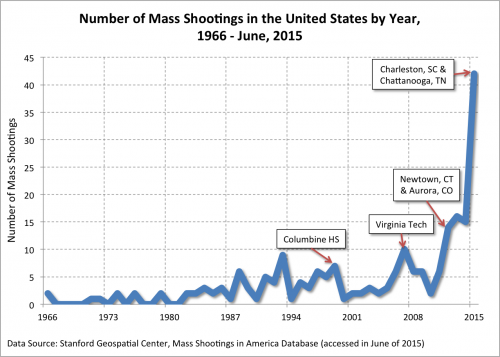
The problem is I can't ignore well-constructed arguments with FBI data that shows the trend in overall homicides following the same shape as the trend in firearms homicides. That's actually better data than that which raised my original concern: what in the hell is happening post-2004 that wasn't going on pre-1994, and why did approximately nothing change in the number of mass-shooting deaths during the ban in relation to the prior decade?
Of course there's a visible impact, if you look hard enough at the graph. It's there. If you cut it back to just the number of mass shootings, it's less-obvious, while this new trend is just as obvious.
There's other data that suggests the number of homicides is going up, but the homicide rate is going down, while the suicide rate and the number of homicides from mass shootings is going up (i.e. more Virginia Techs, fewer back-alley murders).
So we need:
- Legislative tweaks to eliminate e.g. straw man purchases and whatnot
- Accountability so that NICS background checks actually catch people disqualified from gun ownership instead of showing up clean for domestic violence convicts and drug traffickers
- Criminal justice reform as an ongoing effort so as to strongly focus on behavioral health and the reduction of crime in general, reducing the likelihood anyone will be in a position in which they'll likely commit a homicide
- An examination of the ballistics involved in bullets, and a discussion on what we want to do there with regard to public safety (police ammunition), hunting rifles, whatever self-defense firearms people are allowed to carry, and the intersection between these (a hunting rifle might need ammunition in excess of what we want to regulate so as to reduce the potential injury and fatality in a mass shooting)
- Limitations on loadable ammunition size (magazines, belt feeds, revolvers) and rapid-fire mechanisms (full-auto and burst-fire weapons in civilian hands, which we already regulate, although we need to ban bump stocks)
Democrats are talking about:
-
Re:Isolated societies tend to stagnate
Not that I'm comparing the degree, but you are aware that the Nazis didn't like 'Jewish' science, right? More recently, there have been lots of Muslim fundie groups in the Middle East that have decided Western knowledge is bad.
A closer analogy, I think, are the groups that dismiss traditional science as "patriarchal", and develop their own "feminist" alternative. For example, a feminist glaciology framework.
-
Re:Scary stuff
Did you not notice that the hockey stick nearly disappeared a some years ago? One day, it was everywhere you looked. Now you rarely see it except in deep disguise, like that comic strip turned sideways.
That's because a couple of statisticians disproved it, back in like 2003 or so. And by "disproved it", I mean into tiny pieces that were then burned and the ashes dropped into a volcano. Several members of the Hockey Team (their term for themselves) then destroyed what was left of their credibility by attempting to un-disprove it
Climate "science" is, apparently, done by guys that sorta half remember the one stats course they took in high school. Every time you look around these days, you find that someone else with a post-secondary knowledge of statistics has peeled back another sheet of faux-brick wallpaper they've been using to make their styrofoam outhouse look like a stone castle. See, Patrick Frank for an excellent example. Or click around a bit on this site to see what the Statistician to the Stars has to say.
-
Re:The basic question is answered...but still...
Sadly he's probably correct, divide the globe into 5 degree cells, run a hundred calculations on each cell for a half hour time slice, keep going for a 30 year simulation and the round-off error alone would make the results less reliable than a one line simple model. Monckton et. al. said pretty much the same thing.
-
Re: Model errors
http://wmbriggs.com/public/Mon...
IPCC FAR Models averaged is double observed warming rate.
-
I'm aghast...
Very interesting view from one of the authors.
~Loyal
-
William Briggs
From http://wmbriggs.com/post/15337...
"It was at this point real dread set in. It looked like the four of us were telling the truth. We were. And to the deluded who cherish the genetic fallacy this appeared that our result might be true, too. So the mentally feeble David Appell (sometime scourge of the comment box) put a FOIA request to the employer of Legates, but the poor soul was rebuffed because no state monies were involved in the writing of the paper. As we claimed. Then Greenpeace contacted the employer of Soon with the same intent, and Greenpeace discovered that Soon was in the same state as those who receive Greenpeace money. Which is to say, Soon in his career received money from sources other than our beneficent government. But he didn’t get anything for the paper the four of us wrote. How disappointed Greenpeace must have been to have discovered that." -
Re:The last sentence in the summary...
Excuse me? Seriously? The SLR since roughly 1870 is clearly published in a number of places and amounts to roughly 9 inches. Quite aside from the infinity of statistical fallacies one can generate by fitting linear trends to timeseries data: http://wmbriggs.com/blog/?p=51..., or if you prefer a longer and much more detailed statistical (Bayesian) explication of the problems: http://wmbriggs.com/blog/?p=51..., and the fact that those problems are multiplied enormously when you seek to fit a nonlinear trend to the data, to argue that this timeseries reveals "acceleration", presumably correlated with increased CO_2 near the end, in spite of the fact that its greatest visible period of "acceleration" is in the early 20th century when CO_2 levels were nearly irrelevant to any observed climate change in everybody's models is not terribly sensible.
Then we could analyze the other fallacies in this sort of graph used as an argument for 5 meter SLR by 2100. For example, the current rate of SLR is around maybe 3 cm/decade -- a bit over an inch a decade. In the 8.5 decades left in the century, we might be looking at anywhere from 8 inches to a foot of SLR based on the data as we have it now, foolishly extrapolating a linear trend indefinitely into the future for a highly nonlinear chaotic system that is perfectly capable of things like glacial transitions (either way) or century-scale droughts without any help at all from humans. However, this still doesn't do the problem justice, because of the differential probable error bars visible even in the figure you present, and the fact that the measurement methodology changes near the end, and the fact that to properly account for SLR either way one really has to take gravity and surface deformation into account in multiple ways. In particular, the crust is continuing the process of isostatic rebound resulting from the melting of an ice layer several kilometers thick on the polar regions "only" 12,000 or so years ago. The continents continue to drift. The sea bottom continues to remodel as this occurs. Much of this produces changes that we are only barely able to measure, in some places some of the time, now (mostly with satellites and e.g. GRACE, but there is a bit of chicken and egg problem there as well). There is the fact that an isostatic ocean produces LOCALIZED SLR where warm water floats on cooler water and can produce this sort of SLR in mid-ocean far from any tidal gauges. Tidal gauges in coastal areas are largely locked to local surface temperatures of the water. The satellite record includes this -- the tide gauge record does not, and since 70% of the Earth's surface is ocean, and nearly all of this ocean is "far" from continental boundaries and the comparatively tiny number of measurement stations that go back into the distant past with isostatic changes that are impossible to measure retroactively or correct for in the present, the probable error in global SLR visible in these curves is IMO at least almost certainly significantly underestimated, and that is before one gets to the factor of roughly 10 that Briggs asserts one is likely to underestimate true error by when fitting a linear trend to a timeseries.
So what the data might justify is this. The "rate" (linear trend) of SLR over the last 145 years is something like 2 plus or minus 2 mm/year -- it could be anywhere from basically 0 to as much as 4 mm/year, and this might well still underestimate the probable error. The "current rate" (measured with much better precision, but beware picking endpoints!) is perhaps order of 3 mm/year, plus or minus what, a mm/year? At least? Well within the long term average, and clearly visible as being (probably) equaled or exceeded in the past in periods with little possible correlation/causality linkage with CO_2, even in so short a record.
There isn't any conceivable argument that can be made on the basis of either s
-
Re:The last sentence in the summary...
Excuse me? Seriously? The SLR since roughly 1870 is clearly published in a number of places and amounts to roughly 9 inches. Quite aside from the infinity of statistical fallacies one can generate by fitting linear trends to timeseries data: http://wmbriggs.com/blog/?p=51..., or if you prefer a longer and much more detailed statistical (Bayesian) explication of the problems: http://wmbriggs.com/blog/?p=51..., and the fact that those problems are multiplied enormously when you seek to fit a nonlinear trend to the data, to argue that this timeseries reveals "acceleration", presumably correlated with increased CO_2 near the end, in spite of the fact that its greatest visible period of "acceleration" is in the early 20th century when CO_2 levels were nearly irrelevant to any observed climate change in everybody's models is not terribly sensible.
Then we could analyze the other fallacies in this sort of graph used as an argument for 5 meter SLR by 2100. For example, the current rate of SLR is around maybe 3 cm/decade -- a bit over an inch a decade. In the 8.5 decades left in the century, we might be looking at anywhere from 8 inches to a foot of SLR based on the data as we have it now, foolishly extrapolating a linear trend indefinitely into the future for a highly nonlinear chaotic system that is perfectly capable of things like glacial transitions (either way) or century-scale droughts without any help at all from humans. However, this still doesn't do the problem justice, because of the differential probable error bars visible even in the figure you present, and the fact that the measurement methodology changes near the end, and the fact that to properly account for SLR either way one really has to take gravity and surface deformation into account in multiple ways. In particular, the crust is continuing the process of isostatic rebound resulting from the melting of an ice layer several kilometers thick on the polar regions "only" 12,000 or so years ago. The continents continue to drift. The sea bottom continues to remodel as this occurs. Much of this produces changes that we are only barely able to measure, in some places some of the time, now (mostly with satellites and e.g. GRACE, but there is a bit of chicken and egg problem there as well). There is the fact that an isostatic ocean produces LOCALIZED SLR where warm water floats on cooler water and can produce this sort of SLR in mid-ocean far from any tidal gauges. Tidal gauges in coastal areas are largely locked to local surface temperatures of the water. The satellite record includes this -- the tide gauge record does not, and since 70% of the Earth's surface is ocean, and nearly all of this ocean is "far" from continental boundaries and the comparatively tiny number of measurement stations that go back into the distant past with isostatic changes that are impossible to measure retroactively or correct for in the present, the probable error in global SLR visible in these curves is IMO at least almost certainly significantly underestimated, and that is before one gets to the factor of roughly 10 that Briggs asserts one is likely to underestimate true error by when fitting a linear trend to a timeseries.
So what the data might justify is this. The "rate" (linear trend) of SLR over the last 145 years is something like 2 plus or minus 2 mm/year -- it could be anywhere from basically 0 to as much as 4 mm/year, and this might well still underestimate the probable error. The "current rate" (measured with much better precision, but beware picking endpoints!) is perhaps order of 3 mm/year, plus or minus what, a mm/year? At least? Well within the long term average, and clearly visible as being (probably) equaled or exceeded in the past in periods with little possible correlation/causality linkage with CO_2, even in so short a record.
There isn't any conceivable argument that can be made on the basis of either s
-
Re:so?
Okay, and what are the total number of convictions for each of those specific types of crimes over the same time period? Those numbers need to be normalized to be comparable. That same page lists a much higher number of white victims than black ones, so it isn't clear whether the data supports your claim.
This site indicates that the rate of Black Defendant / White Victim homicides is ~3-4x of the reverse while the executions are >10x. That does seem to point to a racial bias in executions. Although, that covers all the way back to 1976 (and even earlier convictions). I wonder if those rates would tend to converge if we exclude older data?
-
Re:Or maybe...
I don't like repeating myself... so see this http://wmbriggs.com/blog/?p=5949 He says it better and more thoroughly than I usually have the patience to.
-
It's not just in medicine
It seems to be affecting all branches of science - http://wmbriggs.com/blog/?p=4832
-
Not the whole story.
William Briggs has a slightly different take on this. He does statistics, so his post is about the error bars.
-
Re:Colleges are such masters of cost control
Additionally, easily available loans - all but guaranteed now - ensure that schools do not need to be as price competitive. I have heard of some schools, and some businesses, that experience increases in unit sales after increasing the price of the unit. E.g., the market may have little interest in your discount luxury $100 watch. However, if you drop the "discount" marketing and raise the price to $500, suddenly that same watch appeals to a new class of buyer. Some small schools found that dramatic tuition hikes made them appear more elite, ivy-like. Of course, luxury or label-driven goods or spending other people's borrowed money with reckless abandon is not the basis for a sound economy. People already discuss the education bubble.
.svg)