Slashdot Mirror
Domain: worldviewofglobalwarming.org
Stories and comments across the archive that link to worldviewofglobalwarming.org.
Comments · 14
-
Re:The ostrich brigade is out in full force today.
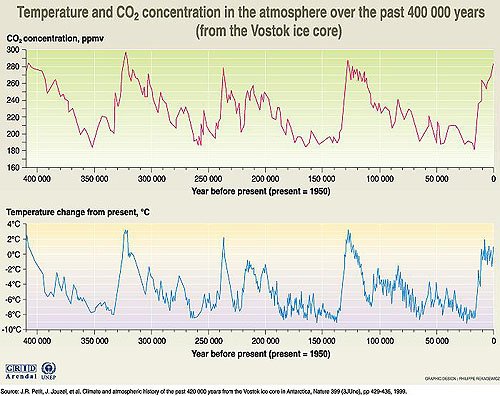
Evil time travelling humans must also be behind all cyclical warming events stretching back hundreds of thousands of years.
http://www.worldviewofglobalwarming.org/images/vostok.jpg
The horror. The horror.
-
There is more than one way to destroy Tuvalu
First of all, without documentation, I'm not going to accept your claim at face value (no offense intended, but that's an easy statement to make without evidence). Secondly, there's more than one way to destroy Tuvalu.
-
Re:Stand and deliver!If there is causation then why do paleo climate records show increases in temperature proceeding increases in CO2 levels?
http://www.ncdc.noaa.gov/paleo/vostokco2.html
From the abstract:
"High-resolution records from Antarctic ice cores show that carbon dioxide concentrations increased by 80 to 100 parts per million by volume 600 +/- 400 years after the warming of the last three deglaciations."
You get that? CO2 increased 400-600 years AFTER the glaciers receded.
This is why when certain scientists graph the CO2 data from the Vostok ice cores, they never overlay temperature on the same graph: http://www.worldviewofglobalwarming.org/pages/pale oclimate.htm. It would be too obvious that the temperature changes proceeded changes in CO2 concentration. For one, nobody but but the strawmen you GW deniers burn claim that CO2 is is the only thing that influences climate.But anyway, thanks for pointing out that as soon as CO2 levels rise after coming out of an ice age, so does the temperature increase.
-
Re:Stand and deliver!
If there is causation then why do paleo climate records show increases in temperature proceeding increases in CO2 levels?
http://www.ncdc.noaa.gov/paleo/vostokco2.html
From the abstract:
"High-resolution records from Antarctic ice cores show that carbon dioxide concentrations increased by 80 to 100 parts per million by volume 600 +/- 400 years after the warming of the last three deglaciations."
You get that? CO2 increased 400-600 years AFTER the glaciers receded.
This is why when certain scientists graph the CO2 data from the Vostok ice cores, they never overlay temperature on the same graph: http://www.worldviewofglobalwarming.org/pages/pale oclimate.htm. It would be too obvious that the temperature changes proceeded changes in CO2 concentration. -
Re:Is this a surprise to you, or are you just joki
That's what I disagree with. CO2 levels and global temps have never tracked over 600 million years.
As I said, you cannot predict global temperature from CO2 level alone. Your statement would only be meaningful if all aspects of the climate other than CO2 were the same historically as they are now, but that is far from the case.
It is only in modern times that we have determined enough about the other natural forcings to be able to isolate the warming contribution of CO2 from other effects.I agree that a 20X increase in CO2 isn't as big as it sound (I'm arguing that it has a minimal effect even at that level), but if a 30% increase is enough to raise temps up to 4.5 degrees C in a short time, according to the IPCC, why wouldn't a 20X increase increase temps by an equivalent amount?
First, the IPCC doesn't predict that a 30% increase in CO2 produces a 4.5 degree warming; that's the upper bound figure for more like a doubling in CO2.
A 20x increase in CO2 certainly would produce significantly more warming than a doubling, but as I said, CO2 is far from the only contributor to the climate.The fact seems to support my argument more than yours, because, if it's logarithmic, maybe a 30% increase in CO2 is completely negligible and you have to get increases of 2000X (guessing again) or more to see a difference.
Making numbers up out of thin air does not support your point.
Logarithmic curves are a great magnitude equalizer; any kind of doubling produces the same amount of warming. So an increase from 1 to 2 ppm theoretically produces the same warming as an increase from 1000 to 2000 ppm.
(This sounds absurd, and to some extent it is, because the actual curve is not perfectly logarithmic, although it is logarithmic for concentrations around 100-1000 ppm. It flattens out at even higher concentrations because of all the extra feedbacks that start kicking in.)
What exactly do you doubt, here? Do you doubt that the amount of sunlight trapped by a given concentration of CO2 can be calculated accurately? That is actually one of the easiest things to calculate, and the amount of heat retained by the atmosphere is more than enough to explain the current warming. If you want to propose an alternative, you not only have to come up with a different mechanism for warming (solar variations doesn't work for reasons already explained), but you also have to come up with extra large cooling mechanisms too, to explain what is countering all the CO2. Claiming that CO2 just doesn't cause that much warming is not an escape; it follows very simple and laboratory-testable physics of radiation adsorption.I think much of the increase in CO2 over the millennia is caused by the huge increase in lifeforms.
What increase? Over what period of time? You mean, the last 20,000 years (here)? What increase of lifeforms are you talking about here?
Incidentally, it is certain that the major increase of CO2 over the last 150 years is due to fossil fuel burning, since that leaves a unique isotopic signature that can be detected.My understanding from discussing GW with others is that CO2 from volcanoes has little impact on the climate because it can't get high enough into the atmosphere to make changes.
Over the short term, that's true, but in the "snowball Earth" scenarios, it's the primary mechanism by which the Earth can melt: with so much ice, the oceans can't take up much CO2, and over millions of years enough accumulates to thaw the planet.
As for other aerosols, over a half billion years, don't you think we'd have several cases of CO2-driven warming?
We surely do; this is most visible over the last million years in the Vostok cores.
As I've mentioned before, that Appalachian Mountains theory flies in the fact of other theories that have pretty g
-
Re:H2O is #1, CO2 is #2, CH4 is #3. Mod parent up
CO2 is blamed for global warming yet the paleoclimate records show there is no correlation.
Really? -
Re:Open and ShutThe guy's area is climatology. And as I see it, he was just talking about his research and making it relevant as scientists are wont to do. NASA people have been talking about climate change in meetings and in departmental lectures at LEAST since the early 1990's when I went to American Geophysical Union meetings and studied space physics. What has changed is this:
- There is an administration in power that is heavily invested in oil.
- Said administration has a history of suppressing scientific data - in fact they have taken it to a new level. Ask the Union of Concerned Scientists what they think.
- Said administration has defined this man's science as policy. It never used to be policy to state such things.
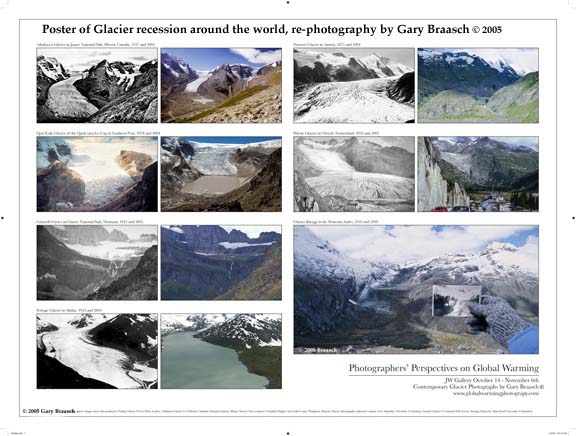
The evidence is getting more and more clear that what I was hearing about climate change in the early 1990's was, in fact, true see here for example. You can also read National Geographic, which does a story about how climate change affects real people every month. Last month, an author went to the Alps and found that the glaciers were melting and that businessmen were concerned that in 30 years many low lying resorts would have to close. This month there is an article on how traditional peoples of the Arctic are worried about drowning. The Arctic ice is melting more than ever before. Every country but the US seems to "believe" in climate change. The evidence is also getting more and more clear that we are the cause of this warming.It seems to me that the Bush administration is upset with this scientist because he is interfering with their policy of keeping the truth about climate change from the American public.
-
Re:Look at the balance points
That requires accurate measurement of precipitation across (sometimes) many square miles of glacier - something we are not doing. So your 'control' is loose at best.
The precision of the data constrains the precision of the conclusion, yes that is true in all science. It does not necessarily invalidate all conclusions. Estimating your potential error is part of doing research.
No, this means that less snow is falling than is required to replenish the glacier. The historical average is meaningless in this instance.
Actually it does not necessarily mean that--did you read what I wrote? A glacier can shrink regardless of how much snow falls on it, if the rate of melting exceeds the rate of replenishment.
Further, the rate of down-valley movement, location of the terminus, location of firn line, and the shape of the glacier can tell you a lot about what is causing the retreat. A glacier with a low firn line, thin firn, and low rate of advance is probably retreating because of decreased precipitation. A glacier with a high firn line and high rate of advance, but retreating terminus and losing mass, is more likely to be retreating due to increased melting.
Certainly it's a clue that something is changing. The question confronting scientists is this; what is changing in the local enviroment and is it representative of a change in the global enviroment? Is is part of a trend? Is it part of a cycle? Once cannot simply say; "the glaciers are retreating! the sky is falling!"
All good questions if you are considering one glacier. But the data shows that alpine glaciers all over the world are retreating. The Global Glacier Mass Balance shows negative mass change for all but 3 of the years since 1960! There is simply no way you can ask if there is a global trend if you're aware of the data. It's blatantly obvious--across the world, alpine glaciers are in retreat.
And I'll point that I did not say anything like "the sky is falling." I said alpine glaciers are retreating, and they're doing it in a way that points the finger at melting due to higher temps.
And in the Year Without A Summer there were hundred of reports of crops freezing, rivers frozen in unexpected places and times, etc... Layman's testimony is essentially meaningless as human memory is extremely plastic
Memory may be plastic but photographs and printed climbing route descriptions are not. I have a copy of Climbing Magazine from the early 90's with an article about climbing in Peru's Cordilla Blanco. Many of those routes are now unclimbable because what was clean ice and snow fields is now crumbly exposed rock. This is also occurring in the Alps, in North America, in New Zealand, in Africa (where the "snows of Kilimanjaro" are almost gone), and even in Asia, where the Khumbu glacier on Mt. Everest is in retreat.
If scientists were really as responsible as they claim - there would be calls from them for $MEGA dollars for increased research. There would be concrete plans being laid for a global monitoring network in order to provide the fine grained data we need.
Instead we get articles about Kyoto and simulations. No wonder even intelligent people don't trust them anymore.
Uh, there ARE those calls and plans. The problem isn't that the scientists aren't ringing the warning bell, the problem is so-called "intelligent people" like yourself who refuse to educate yourself and who ignore the problem. Try digging a little deeper and caring a little more. -
How about some links showing the other side of
-
Re: Consenus Only in the Mind of the Beholder
-
Re:State of FearThe world's climate has been much hotter, and much colder, than it is now, and that is fact.
That is beside the point. It has been warmer at times in the past (usually when CO2 levels were higher - see this link). That doesn't disprove the claim that adding CO2 will cause warming. It also doesn't disprove the claim that rapid CO2 increases will cause disruptively rapid increases in temperature. Then of course there is also the point that both temperature and CO2 levels are higher now than any time in the past 480,000 years (370 ppm last time I checked).
-
Re:It rained yesterdayYou're missing the point. You can predict with a degree of probability *assuming* the parameters that you have considered are the only parameters involved.
Look at this link. You see a correlation between temperature and CO2 levels that has endured for 470,000 years. On that basis I argue that doubling the atmospheric CO2 levels is likely to lead to a warming, especially given that there is a perfecly physically valid explaination for such a link.
All that being said, I cannot say with absolute certainty that there will be warming; there could be an asteroid thta wipes out humanity and destroys all life on the planet tomorrow. There could be a primordial black hole that passes through the Solar System and sends Earth out into the interstellar void. Who knows? Who cares? I will acknowledge the usual scientifically reasonable uncertainty, if you acknowledge that the link between CO2 and warming meets sufficient scientific standards to warrant concern and even action.
And the idea behind giving weather & climate a chaotic description is not that they are absolutely indeterministic, merely that we do not know the initial conditions nor all the related parameters to make a judgement of what is affecting them.
Actually, "chaotic" in this context usually means that the future development of the system is exponetially sensitive to initial conditions; it does not mean that you are completely unable to predict its behavior. Example - a double pendulum is a chaotic oscillator. Even given an arbitrarily accurate set of initial conditions and models I can only predict its behavior some small amount of time into the future. However, I can with complete certainty predict that it will not oscillate forever - the laws of energy conservation still apply. There is always the caveat that there might be an asteroid that hits the oscillator and vaporizes it. So I'm not, strictly speaking, absolutely certain... But I think you understand what I do mean by certainty.
The case of the climate lies somewhere in the middle - we do not have anywhere close to perfect, complete knowledge of the system or initial conditions. But we DO have a good understanding of the physics of radiative transport and heat absorption, as well as records of past behavior, and hence we can make some pretty reasonable inferences based on that. Those inferences have been made by many, many independent researchers and point predominantly in one direction: trouble.
OP: The only way that adding CO2 wouldn't warm the surface was if there was some other negative feedback. Not only that - you then STILL have to account for the observed warming. It's getting to be quite the Oliver Stone scenario.
Re: Yeah, except that you're ignoring a dozen other factors such as the fact that we are at the end of an ice-age, we still have unexplained long term effects of solar activity and dozens of other factors. Does the term Maunder minimum ring a bell to you?
You missed my point. CO2 increases are - based on everything we know about CO2, radiative transfer and greenhouses - expected to cause warming. We see CO2 increases and we see warming. If you want to place the blame for that warming on something else (and there are lots of suggested culprits: the Sun, volcanoes, urban heat islands, chaos theory, the Chinese, and a global conspiracy of pinko green commies), then you have to invoke two new phenomena 1) something that counteracts the unavoidable CO2-related warming and 2) a different soure of warming that appears suspiciously coincident with the rise of CO2 levels. Like I said, that's getting to be quite the conspiracy theory. You can invoke a zillion other factors, but none of them free you from those two requirements. How does the Maunder minimum explain away the fact that CO2 increases would increase surface temps? Where is the negative feedback?
Most climatologists and weather folks worth
-
Re:nota bad thingBoiling a pot of watter has been repeated. I have not seen anyone show me that in that past CO2 levels have gone up and temperature went up with it.
Check out: this link. Scroll down to the plot of CO2 vs temperature and then tell me there isn't a correlation. Now recall that CO2 levels are at 370 ppm and rising... Before you run off an put the cart before the horse (that warming causes CO2), know that we have good, sound physical reasons to expect CO2 rises to cause warming, but few reasons to expect the converse.
Besides, wouldn't the sun be a better analogy for the burner as opposed to CO2? Especially seeing as how solar output has gone up?
If you care to take an analogy too far, then adding CO2 to the atmosphere is like putting a lid on the pot. As for your comment about solar output - that is very unclear, and even the ones who published that said it can't explain all of the observed warming. Not to mention that its a result that doesn't have a lot of back-up, whereas CO2 increases, the observed warming, and the effect of CO2 increases on radiative transport are all things that have been studied by hundreds of researchers.
-
Re:nota bad thingThe argument that it's all Man and the fixation of greenhouse gases and the refusal to look at anything else but Man and greenhouse gases.
That's simply not true; there is a lot of research going on on the impact of other potential sources of global climate change. Some by people intent on proving it isn't caused by CO2, even... It's not that no-one has looked, its that most of the evidence points to anthropogenic CO2.
O2 does not mean warming. [...] urban heat-island effect
That claim has been accounted for for at least 15 years; the effect also doesn't appear in things like ice-core and coral records. The heat-island effect doesn't explain the apparent warming. Period. Check out this link for an interesting discussion on ice-cores and temperature records. Also, if you scroll down you'll notice that there is a pretty obvious correlation between CO2 and temperature.
Now for all this CO2 in the air, why is the ice mass of Antarctica growing?
The claim is not that temperatures have to increase everywhere; just on the average. In fact, the increased precipitation is expected from the modeling (warmer temps=>more evaporatio=>more snow=>more ice); but it won't be enough to reduce the net warming.
The World is getting warmer, but just because CO2 is increasing at the same time doesn't mean CO2 is causing it.
Really officer, there is dead body at my feet, and I have a smoking gun in my hands, but it wasn't me. I fired my gun at the other guy. That guy over there on the grassy knoll. Sure you did...
Look - we know that CO2 released into the atmosphere would cause warming in the absence of any negative feedbacks. We know CO2 is being released by us into the atmosphere. We see warming. We've managed to quantify most of the possible negative feedbacks and se that they are small. What is a reasonable conclusion?