Slashdot Mirror
Search
Search the archive with full-text matching across story titles, bodies,
and comments. Phrases are quoted; or, -word,
and parentheses behave as in a web search. Queries must be at least
3 characters.
Stories · 3,636
-
Quake Live Public Beta Launches To High Demand
x1n933k writes "For anybody who was sitting on top of Quake Live's website today, clicking refresh and waiting for it to open, you can now browse over and join the fun. Unfortunately you'll have to hold in a queue: 'Here we are all dressed up and nowhere to go. Don't worry, to make sure everyone can enjoy the game we have activated our super secret Queue system, which keeps the server from being overloaded and affecting the website.' I've been waiting 40 minutes and now up to 591, after starting from 9982 but have been playing Quake 3 to kill time." The queue bounced up over 15,000, and as of this posting, is down to about 7,000. It moves pretty quickly, and there's an explanatory tour to watch while you wait. Reader Rogerpq3 contributes an interview with id's John Carmack and Marty Stratton, in which they discuss the game's technology and server infrastructure, as well as their thoughts on mod support.
-
Review: F.E.A.R. 2: Project Origin
First-person shooters comprise one of the most well-developed video game genres in existence. The number of high-quality games and franchises practically demands that any new entry must have an interesting concept and a rock-solid engine. Otherwise, it will quickly get buried under an avalanche of award-winning titles. When the original F.E.A.R. came out in 2005, a well-crafted horror theme, the AI, and a few gameplay innovations allowed it to succeed despite direct competition from established franchises, such as Quake 4 and Call of Duty 2, among others. F.E.A.R. 2: Project Origin draws on the strengths of its predecessor and adds a few improvements. The question that now remains is whether or not the additions make up for the fact that the game's concept is no longer new and unique. Read on for the rest of my thoughts.
- Title: F.E.A.R. 2: Project Origin
- Developer: Monolith Productions
- Publisher: Warner Bros. Interactive Entertainment
- System: Windows, PS3, Xbox 360
- Reviewer: Soulskill
- Score: 7/10
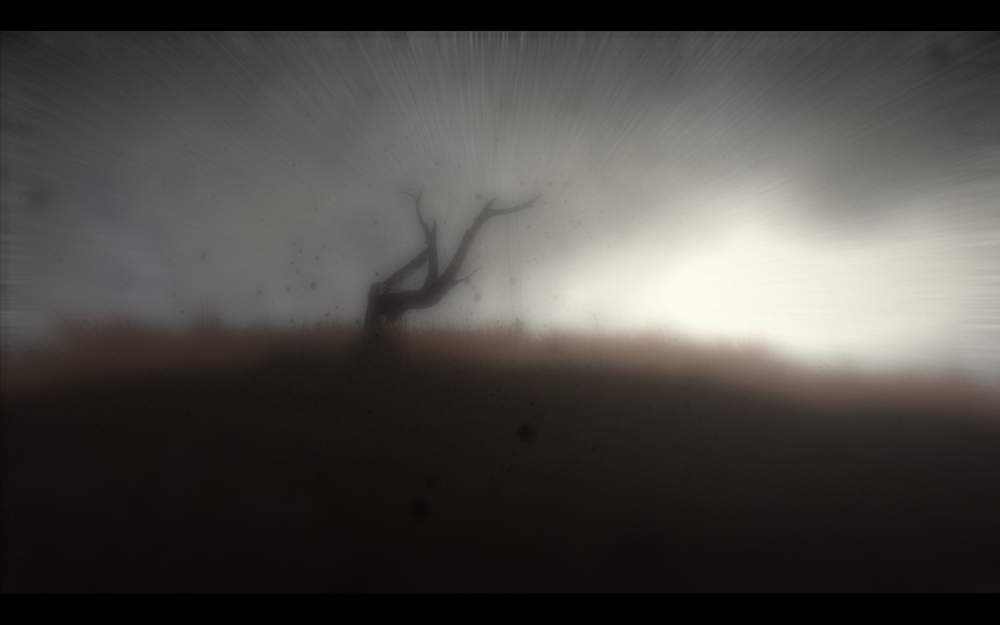
The game starts out with a bang; the first act is extremely well designed. You begin in much the same manner as the first game, given little information and left to wonder what, exactly, is going on. You start in a military transport headed to pick up the president of Armachan Technology Corporation — the typical big, evil corporation developing things they really shouldn't. You're introduced to your squad-mates and then quickly separated from them while being taught some of the gameplay basics. The first serious firefight in the game is located within a room filled with antiques, ceramics, and vases stored in huge glass display cases. It's a brilliant choice in setting — priceless decorations shatter and glass flies everywhere. It's almost theatrical; like being a part of a high-budget action flick. As you shoot your way through the increasingly porous living quarters, hallucinations are induced by Alma, the deranged, telepathic, and telekinetic girl from the first game. The act ends when you witness a nuclear explosion far closer than is healthy, and shortly thereafter struggle to remain conscious as the corporation's doctors do something to you.
It's worth saying again — the first level is incredibly cool. Unfortunately, subsequent levels aren't able to match it. I suppose that's to be expected; after all, it's a horror-themed shooter rather than an epic adventure shooter, but the first level does tend to set expectations. For the next few acts, F.E.A.R. 2 treads mostly on familiar ground. You spend a great deal of time escaping an underground hospital/science facility, and wander your way through broken streets with crumbling buildings. That's not to say it's bad, or even unenjoyable ; the settings are still polished and full of detail, and the plot is continually prodded along in an interesting manner. It's just been done before, and often. If you've played a wide variety of first-person shooters, these levels will probably bring a sense of deja vu . Things pick back up after a while, though. You'll navigate your way through a school that was the site of much violence and destruction, go down into the subway, and even further into a high-tech underground tram. The less you know about any given setting, the more easily it lends itself to creepiness, so the more unique environments in F.E.A.R. 2 keep you focused on the horror aspect much better than the stereotypical science labs.
The visual effects that contribute to the horror theme are integrated quite well into the gameplay. The transition from your normal perception to hallucination is often gradual and seamless. Other times, it's sharp and distinct, using the shock of the immediate change to add an ominous vibe. Sometimes your flashlight will start to flicker in a dark area, and you'll begin to hear your character's panicked breathing and rapid heart rate. I'm on the fence about that; it's used to great effect in a few situations, but since fear in the character isn't mirrored by fear in the player, it also tends to serve as an indicator that something surprising is going to happen — thus negating the surprise. Other horror standards come in to play too. Every so often, Alma will flash into existence somewhere near you, and then disappear. Almost too often... but they find ways of keeping it interesting. The music and sound effects are very well done, laying the foundation for tense scenes, the foreshadowing of a terrible discovery, or giving your fight-or-flight reflexes a little boost.
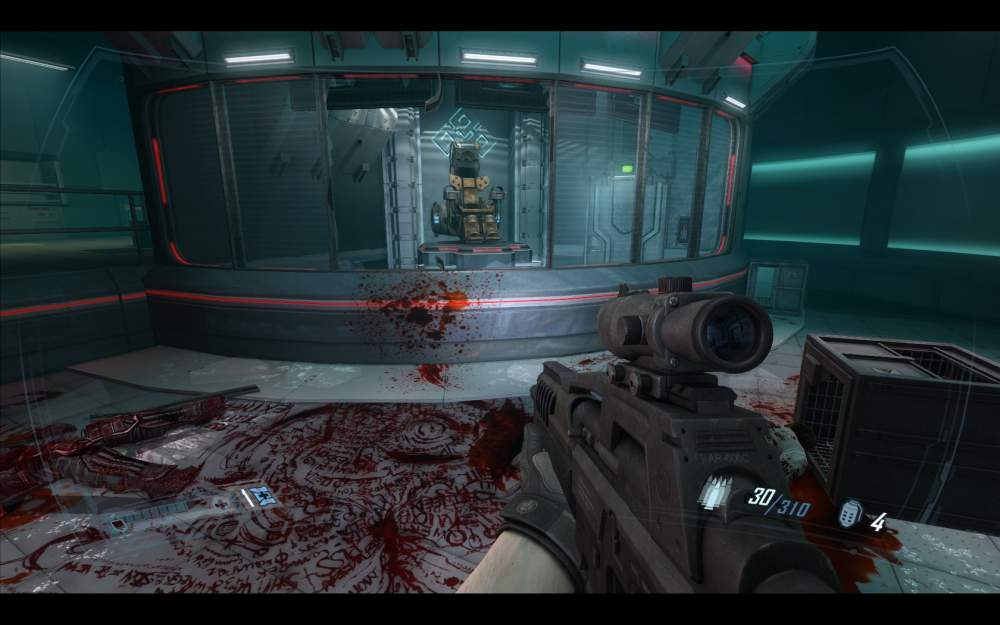
The art team doesn't hesitate to try and scare you with gore, either. The scene I mentioned earlier where you see portions of a medical procedure being performed on yourself is interspersed with hallucinations of zombie doctors tearing out your insides, with gouts of blood flying in every direction. At one point, you sneak up behind a couple of enemy soldiers trying to decipher a huge section of wall that is covered with random words, symbols, and obscenities — all painted with blood. It really does look like something drawn by a psychotic killer, such that I wondered if they contracted the design from a local loony bin. (And presumably, your character feels no cognitive dissonance from gunning down those soldiers, which itself is kind of surreal.) Bloodstains are used liberally, as are all manner of brutal killings. This is definitely not a game for kids or people who faint at the sight of blood. Even aside from the violence and gore, the other artwork is also well done. The attention to detail is refreshing; rooms and objects are correctly proportioned to a greater extent than most shooters. A malfunctioning X-ray machine with throw a series of disjointed X-ray photographs onto a nearby computer monitor. You'll even see T.P.S. reports scattered about an office desk. Everything looks like a real environment, not just an approximation pasted onto an abstract level design.
One of the signature gameplay elements of F.E.A.R. 2 is "reflex time," an ability carried over from the first game. Press a button and, for a short duration, time slows down, giving you a massive advantage over your opponents in a fight. The intention is to make the player feel like an action hero, able to dodge and aim with supernatural speed, and it works. It also makes most fights very easy; I'd recommend going through the game on Normal if it's your first FPS, and on Hard if you have any significant experience. The weapons are another area where F.E.A.R. 2 sets itself apart. There really aren't any bad weapons. They all have their strengths and weaknesses, but you won't spend much time wishing you had a different gun. Even the basic pistol and your melee attack are powerful enough to be interesting. There are definitely some weapons that are more fun, like the missile launcher, the napalm gun, and the laser, but in the end you just wind up switching weapons fairly often as ammo runs out, which does a lot to keep the fights from getting boring.
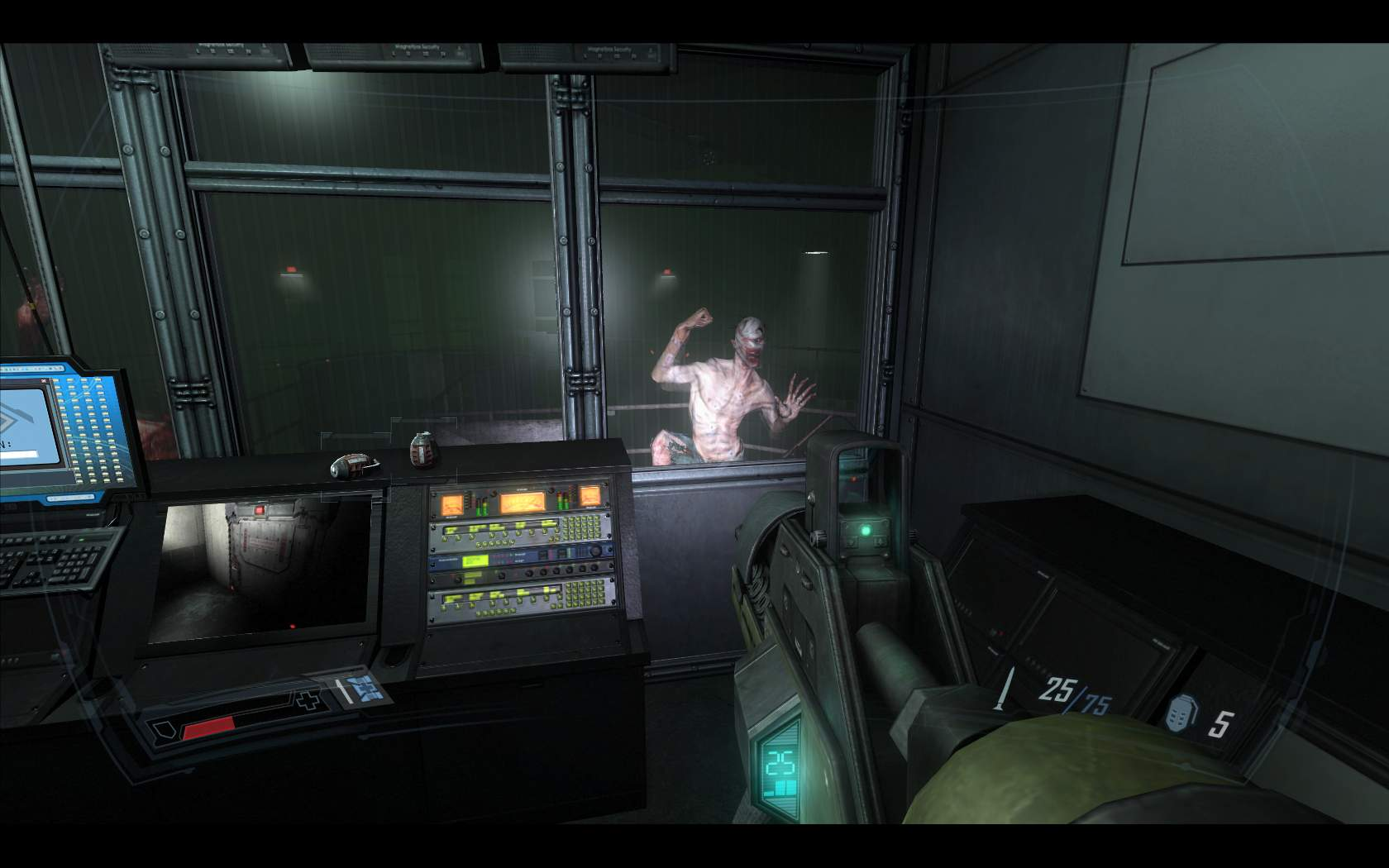
Another instrument they use to keep the fights interesting is the AI, which, as with the first game, is better than average. Enemies are constantly shifting position, finding new cover, and ducking out from behind an obstacle to shoot at you. It forces you to remain active; camping out behind a barrel will get you killed as enemies advance on you. That's not to say it's without flaws; sometimes a soldier will decide to crawl underneath some hanging metal — a very slow maneuver — while you stand five feet away holding a machine gun. The effectiveness of the AI also varies depending on the type of enemy you fight. There are quite a few different kinds, but you wind up fighting the standard soldiers a disproportionate amount of the time, and they handle the AI better than any others. Other enemies tend to be used for dramatic effect. You'll encounter zombie-like creatures that scuttle quickly on all fours, though they are much less scary when you can slow down time. Another type is almost invisible until they attack hand-to-hand. One of the tougher creatures reanimates dead soldiers, and then finds something to hide behind. They take quite a bit of firepower to kill, so you can expect to deal with the revived grunts repeatedly.
Scattered throughout the game are a few situations where you interact with the environment, and a few QTEs. Both are underutilized to the point where they don't really add anything to the gameplay. The QTEs just involve hammering on a button until you win; it's very simple and doesn't really require any effort or brainpower. Granted, most QTEs are added as a way to keep the player connected to a few mini-cutscenes, but the end result isn't very satisfying. The times when you interact with objects are also very shallow; hold down a single button to move an obstacle out of the way, or to close a valve, or to open a set of elevator doors. The added seconds don't really have any affect on what happens to you, so why take the extra time when you can open a regular door with a single click? I'm going to lump the new part of the cover system in with this as well. You can now flip over tables and crouch behind them to shield yourself from enemy fire. It's neat, but there's really no advantage to doing that instead of hiding behind a crate or the corner of a wall. Existing cover is plentiful.
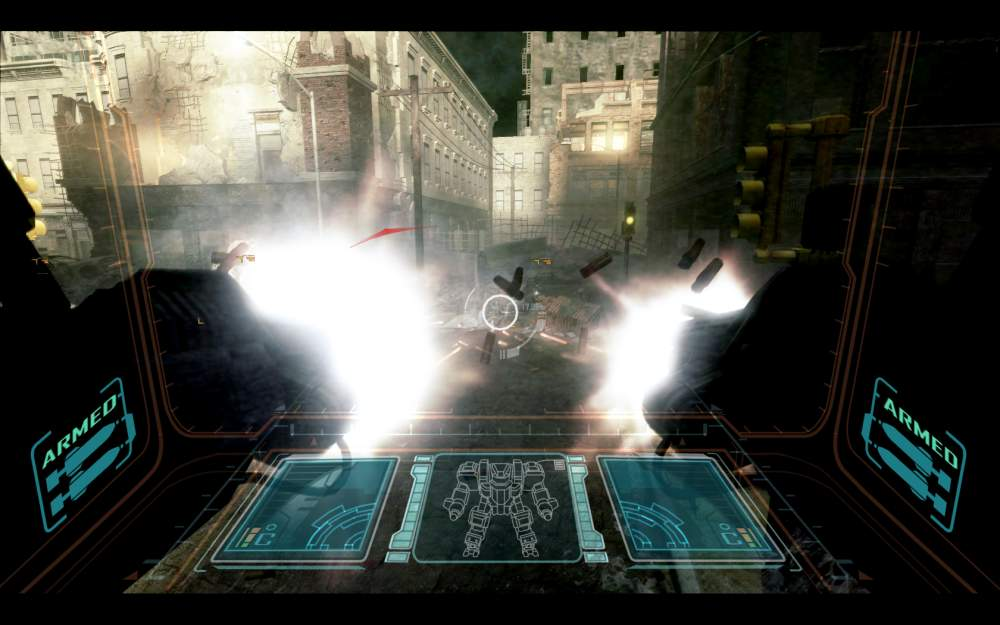
F.E.A.R. 2 infrequently offers a few different ways of fighting. The vast majority of the time, you're on foot holding a weapon of some sort, but you occasionally get to control a turret or a mech. Turrets are very much an upgrade in firepower. Far more enemies swarm than you could normally handle, but the turret cuts them down with ease. Controlling the turret is very easy; some games put silly restrictions like very slow rotation or poor accuracy, but F.E.A.R. 2 gets it right. It's quite fun, and my only complaint is that there aren't more opportunities to use them. The mechs, or "Powered Armor" units are even more powerful, but still very fun and easy to control. You get a couple of mini-guns and a set of rocket launchers, as well as a thermal imaging mode (think Predator). Aside from those two scenarios, there aren't a lot of variations in gameplay. At one point, you're riding on a speeding tram, but you're just walking around on top of it while enemies come to you. There isn't much scenery, and you wouldn't have much time to watch it anyway. The sequence is still fun, but it doesn't hold a candle to similar situations in, say, Gears of War 2.
The game's multiplayer falls into the same trap as the early single-player campaign. It's good, it's fun, and it's interesting, but there's nothing to set it apart from the multiplayer mode of half a dozen other good, fun, interesting shooters. The horror aspect is, of course, completely gone, and the signature time-slowing ability doesn't work because it'd be impossible to code. It has all the standard FPS modes of play (deathmatch, team deathmatch, CTF), and a few other team games that focus on controlling particular points of the map. Armored Front has five such points aligned in a linear manner such that only one is in conflict at a time. You either push the enemy back through successive points or get pushed back yourself. You can use turrets andmechs as well. As I mentioned earlier, all the weapons are relatively powerful in F.E.A.R. 2, and this becomes quite evident in multiplayer games. Players die very quickly without studious use of cover. It may be the case that all the weapons are tuned to be more powerful than they should be. The fights aren't always decided by the first shot, but it happens often enough to be a problem. The maps themselves are, for the most part, very good. There are perhaps a few too many intersections, and a few to many directions you need to watch for enemies, but otherwise they flow quite nicely.
F.E.A.R. 2 is an entertaining game. It's almost exactly what you'd expect out of a triple-A first-person shooter — no more, no less. If you're looking for a quality game and have no problem putting yourself in a state of mind to be creeped out, it will do the job nicely. If you're looking for a title that will push the boundaries of the genre, you're probably better off waiting for another game. There are some great parts to F.E.A.R. 2, and Monolith deserves a lot of credit for making them work as well as they did. This game had the misfortune of coming out after a wave of other, equally compelling titles. It doesn't fall behind, but it doesn't really stand out, either. The bottom line is that if you enjoy horror and first-person shooters, you'll enjoy this game. If your tastes run elsewhere.. well, there's plenty more to pick from.
-
Canon Tries To Shut Down "Fake" Canon Blog
Thomas Hawk writes "An interesting twist over at the Fake Chuck Westfall Blog. Fake Chuck (like Fake Steve before him) has a blog out parodying Canon's real Technical Information Advisor Chuck Westfall. It seems that Canon and their lawyers over at Loeb & Loeb are none too fond of all the fun that Fake Chuck and DSLR geeks everywhere have been having at their expense and have sent Fake Chuck's blog hosting company, WordPress, a notice to take the blog down. Canon's lawyers cite that Fake Chuck's blog is 'calculated to mislead recipients,' even though the blog has 'fake' in the title, 'fake' in the URL and 'fake' just about everywhere else in the blog. What in the heck is wrong with Canon? Do they really think that trying to shut down a parody blog is going to make their new 5D Mark II ship any faster?" After Fake Chuck removed the Canon logo from his site, WordPress is standing behind him and has rebuffed Canon's demand.
-
Warhammer Team Hit By Layoffs
Zonk notes that Mythic Entertainment, developer of Warhammer Online, is being hit by another round of layoffs. The report estimates that between 60 and 130 staff were let go as part of Electronic Arts' reduction of its workforce. This comes alongside news that the number of Warhammer subscribers has settled to around 300,000. Mythic's Mark Jacobs was quick to affirm that while they were "resizing the team," their plans and schedule are unchanged, citing lower demands on QA now that the launch period has passed. Hopefully this means that their upcoming "live expansion," A Call to Arms, will not be affected by the layoffs.
-
Energy Star Program Needs an Overhaul
Martin Hellman writes "DeviceGuru.com ran my piece raising questions about the EPA's Energy Star program. For example, an Energy Star compliant TV that claims to draw 0.1 watts in sleep mode appears to do that — but only seems to sleep about 25% of the time that it is 'off.' The other 75% of the time it draws about 20 watts, for an effective sleep power draw from the user's perspective that is 150 times what the manufacturer claims. Based on the observations described, it is also questionable how many PC's really are sleeping when their screens are blank, even if the user has turned sleep mode on. Given the billions of dollars and tons of CO2 that are at stake, this situation demands more attention."
-
In-Depth With the Windows 7 Public Beta
Dozer writes "With the Windows 7 public beta out, Ars Technica has an in-depth look at the release. There's praise for Windows 7's UI changes and polish as well much-needed changes to UAC, but also a warning that those who have problems with Vista won't like Windows 7 much better. 'If you couldn't stand Vista's UI (whether it's because you didn't like Explorer, Aero, Control Panel, UAC, or anything else), Windows 7 is unlikely to do much to help, as it builds on the same UI. If Vista's hardware demands were too steep, Windows 7 will likely cause you the same grief, as its hardware demands match. And if Vista didn't work with a program or device you need to use, Windows 7 will offer no salvation, as its compatibility is virtually identical.'"
-
Apple Intros 17" Unibody MBP, DRM-Free iTunes
Phil Schiller delivered the keynote at MacWorld, the first after the Steve Jobs era of keynotes. Here is Engadget's live blog. The big news, predicted by many rumor sites, was the introduction of the unibody 17" MacBook Pro. As rumored, the battery is not removable, but it's claimed to provide 8 hours of battery life (7 hours with the discrete graphics): "3x the charges and lifespan of the industry standard." $2,799, 2.66 GHz and 4 GB of RAM, 320GB hard drive, shipping at the end of January. There is a battery exchange program, and there is an option for a matte display. The other big news is that iTunes is going DRM-free: 8M songs today, all 10+M by the end of March. Song pricing will be flexible, as the studios have been demanding; the lowest song price is $0.69. Apple also introduced the beta of a Google Docs-like service, iWork.com.
-
Tooth Regeneration Coming Soon
Ponca City, We love you writes "For thousands of years, losing teeth has been a routine part of human aging. Now the Washington Post reports that researchers are close to growing important parts of teeth from stem cells, including creating a living root from scratch, perhaps within one year. According to Pamela Robey of the NIH. 'Dentists say, "Give me a root and I can put a crown on it."' In a few years dentists will treat periodontal disease with regeneration by using stem cells to create hard and soft tissue; they will take out a tooth that is about to fall, and reconnect it firmly to the regenerated tissue. Although nobody is predicting when it will be possible to grow teeth on demand, in adults, to replace missing ones, a common guess is five to ten years. Baby and wisdom teeth are sources of stem cells that could be 'banked' for future health needs, says Robey. 'When you think about it, the teeth children put under their pillows may end up being worth much more than the tooth fairy's going rate. Plus, if you still have your wisdom teeth, it's nice to know you're walking around with your own source of stem cells.'"
-
Time Warner Recommends Internet For Some Shows
EdIII writes "The dispute between Time Warner and Viacom over fees seems to be without any resolution this year. Time Warner faces the possibility of being without content for almost 20 channels. Alexander Dudley, a spokesperson for Time Warner, is fighting back: 'We will be telling our customers exactly where they can go to see these programs online,' Mr. Dudley said. 'We'll also be telling them how they can hook up their PCs to a television set.' Why pay for digital cable when many content providers are now providing it on demand via the Internet? Not to mention the widespread availability of TV shows in both standard and high definition on public and private torrent tracker sites. It is entirely possible to watch television with no commercials or advertising with only an Internet connection. So getting your content via the Internet is not exactly free, but it certainly isn't contributing to Time Warner or any other cable providers' revenue stream. The real question is why Time Warner would fight back by so clearly showing how increasingly obsolete they are becoming and that cable providers are losing their monopolistic grip on media delivery." If no agreement is reached, those channels are supposed to be dropped just after midnight tonight.
-
RIM Accuses Motorola of Blocking Job Offers
theodp writes "Taking a page from the insanely-jealous-husband-playbook, Motorola management has adopted an if-I-can't-have-you-nobody-can stance on its fired employees, reportedly blocking RIM from offering jobs to laid-off workers. In a complaint filed in state court, Motorola is charged with improperly trying to expand a previous agreement 'to prevent the RIM entities from hiring any Motorola employees, including the thousands of employees Motorola has already fired or will fire.' Through its Compete America membership, Motorola has repeatedly warned Congress that failing to accommodate the lobbying group members' 'principled' demand for timely access to talent would not be in the United States' economic interest and would make the US second-rate in education and basic research."
-
RIAA May Be Violating a Court Order In California
NewYorkCountryLawyer writes "In one of its 'ex parte' cases seeking the names and addresses of 'John Does,' this one targeting students at the University of Southern California, the RIAA obtained an order granting discovery — but with a wrinkle. The judge's order (PDF) specified that the information obtained could not be used for any purpose other than obtaining injunctions against the students. Apparently the RIAA lawyers have ignored, or failed to understand, that limitation, as an LA lawyer has reported that the RIAA is busy calling up the USC students and their families and demanding monetary settlements."
-
Vista To XP Upgrade Triples In Price, Now $150
ozmanjusri writes "Dell has tripled the charge to upgrade Vista PCs to XP. Under current licensing 'downgrade' agreements, system builders can install XP Pro instead of Vista Business or Vista Ultimate; however, Dell has opted for a surcharge of $150 over the price of Vista for the older but more popular XP Professional operating system. Rob Enderle says the downgrade fees could potentially be disastrous for Microsoft: 'The fix for this should be to focus like lasers on demand generation for Vista but instead Microsoft is focusing aggressively on financial penalties," says Enderle. 'Forcing customers to go someplace they don't want to go by raising prices is a Christmas present for Apple and those that are positioning Linux on the desktop.'"
-
Survival-Horror Genre Going Extinct?
Destructoid is running an opinion piece looking at the state of the survival-horror genre in games, suggesting that the way it has developed over the past several years has been detrimental to its own future. "During the nineties, horror games were all the rage, with Resident Evil and Silent Hill using the negative aspects of other games to an advantage. While fixed camera angles, dodgy controls and clunky combat were seen as problematic in most games, the traditional survival horror took them as a positive boon. A seemingly less demanding public ate up these games with a big spoon, overlooking glaring faults in favor of videogames that could be genuinely terrifying." The Guardian's Games Blog has posted a response downplaying the decline of the genre, looking forward to Ubisoft's upcoming I Am Alive and wondering if independent game developers will pick up where major publishers have left off.
-
Apple Disables Egyptian iPhones' GPS
floydman writes "Apparently the Egyptian government is paranoid about its community using GPS devices, to the degree that it demanded Apple remove any GPS functionality from its iPhone 3G. They claim that 'GPS functionality should be limited to military purposes.' Egyptian blogger Ahmed Gabr brought this issue up in another article, and talks about how this does not make sense, since Google maps and the like can be used. I also happen to know for a fact that most of the modern cars in Egypt have built-in GPS systems."
-
Why Auto-Scaling In the Cloud Is a Bad Idea
George Reese writes "It seems a lot of people are mistaking the very valuable benefit that cloud computing enables — dynamically scaling your infrastructure — with the potentially dangerous ability to scale your infrastructure automatically in real-time based on actual demand. An O'Reilly blog entry discusses why auto-scaling is not as cool a feature as you might think."
-
Bush Demands Amnesty for Spying Telecoms
The Bush administration and the Electronic Frontier Foundation are poised to square off in front of a San Francisco federal judge Tuesday to litigate the constitutionality of legislation immunizing the nation's telecoms from lawsuits accusing them of helping the government spy on Americans without warrants. "'The legislation is an attempt to give the president the authority to terminate claims that the president has violated the people's Fourth Amendment rights,' the EFF's [Cindy] Cohn says. 'You can't do that.'"
-
Police In 90 Minute Standoff With Cardboard Cutout
Authorities say a cardboard figure of a person inside a Somerset County bank kept police at bay for 90 minutes. Police sealed off the area to traffic and evacuated residents in three nearby apartment buildings in an attempt to save them from the cardboard menace. The SWAT team was deployed after the cutout refused to answer repeated inquiries as to its demands.
-
Greenpeace Slams Apple For Environmental Record
nandemoari writes "According to a recent advertisement airing on American TV, Apple's new Macbooks (well-received by most technology critics) are 'the world's greenest family of notebooks.' It seems an indication that the Cupertino-based company is increasingly aware of a consumer base that demands green electronics. However, Greenpeace is less than enthused with Apple's overall green performance. In their report (PDF), the environmentalists argue that Apple 'needs to commit to phasing out additional substances with timelines, improve its policy on chemicals and its reporting on chemicals management.'" Ars Technica points out that Greenpeace's research isn't quite up-to-snuff, and it's also worth noting that Greenpeace admitted to targeting Apple for the publicity in the past.
-
Estonian ISP Shuts Srizbi Back Down, For Now
wiedzmin writes "In response to the recent resurrection of the Srizbi botnet, an Estonian ISP has shut down the hosting company that was housing its new control servers. Starline Web Services, based in Estonia's capital Tallinn, had become the new home for the Srizbi botnet control center after the McColo hosting company (which was taken down earlier this month) has briefly come back to life last week, allowing the botnet to hand-off control to the Estonian network. After Estonia's biggest ISP Linxtelecom demanded that Starline Web Service be taken offline, the newly acquired Srizbi control servers went down with it. However, as the rootkit is armed with an algorithm that periodically generates new domain names where the malware then looks for new instructions, it is only a matter of time before a new set of control servers is created and used to manipulate one of the biggest spam botnets in the world."
-
FAA Greenlights Satellite-Based Air Traffic Control System
coondoggie writes "As one of the massive flying seasons gets underway the government today took a step further in radically changing the way aircraft are tracked and moved around the country. Specifically the FAA gave the green light to deploy satellite tracking systems nationwide, replacing the current radar-based approach. The new, sometimes controversial system would let air traffic controllers track aircraft using a satellite network using a system known as Automatic Dependent Surveillance Broadcast (ADS-B), which is ten times more accurate than today's radar technology. ADS-B is part of the FAA's wide-reaching plan known as NextGen to revamp every component of the flight control system to meet future demands and avoid gridlock in the sky."