Slashdot Mirror
Search
Search the archive with full-text matching across story titles, bodies,
and comments. Phrases are quoted; or, -word,
and parentheses behave as in a web search. Queries must be at least
3 characters.
Stories · 13,059
-
School Board Considers Copyright Ownership of Student and Teacher Works
schwit1 writes "A proposal by the Prince George's County Board of Education to copyright work created by staff and students for school could mean that a picture drawn by a first-grader, a lesson plan developed by a teacher or an app created by a teen would belong to the school system, not the individual. It's not unusual for a company to hold the rights to an employee's work, copyright policy experts said. But the Prince George's policy goes a step further by saying that work created for the school by employees during their own time and using their own materials is the school system's property."
-
AT&T: Don't Want a Data Plan for That Smartphone? Too Bad.
An anonymous reader writes "Joel Runyon recounts a tale that will be familiar to many people who have bought secondhand smartphones. After his old dumbphone died a few months ago, Runyon picked up a used iPhone. He just needed it for basic phone capabilities, and used it as such, turning data off. However, AT&T eventually figured out he was making calls from a smartphone, and they decided he needed a data plan, even if he wasn't going to use it. They went ahead and opted him into a plan that cost an extra $30 a month. Quoting: 'According to AT&T: They can opt me into a contract that I didn't agree to because I was using a phone that I didn't buy from them because it had the ability to use data that I wasn't using (and was turned off). To top it all off, they got the privilege of charging me for it because I bought a differently categorized device – even though the actual usage of their network did not change at all and I never reconstituted a new agreement with them.'"
-
Internet-Deprived Kids Turning To 'McLibraries'
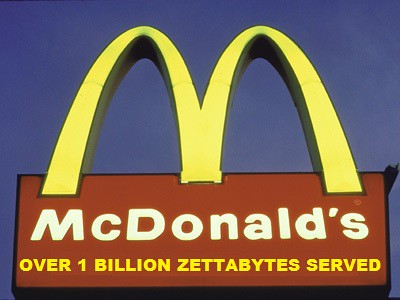
theodp writes "After the school computer lab and public library close for the night in many communities, the local McDonald's is often the only place to turn for students without internet access at home. 'Cheap smartphones and tablets have put Web-ready technology into more hands than ever,' reports the WSJ's Anton Troianovski. 'But the price of Internet connectivity hasn't come down nearly as quickly. And in many rural areas, high-speed Internet through traditional phone lines simply isn't available at any price. The result is a divide between families that have broadband constantly available on their home computers and phones, and those that have to plan their days around visits to free sources of Internet access.' The FCC says it can make broadband available to all Americans by spending $45 billion over 10 years, but until then the U.S. will have to rely on Mickey D's, Starbucks, and others to help address its digital divide. Time to update that iconic McDonald's sign?"
-
Group Kickstarting a High-Bandwidth Software Defined Radio (SDR) Peripheral
TwineLogic writes "Many Slashdot readers have been enjoying the availability of $20 USB radios which can tune in the range of 50MHz-2GHz. These devices, while cheap, have limited bandwidth (about 2MHz) and minimal resolution (8-bit). Nuand, a new start-up from Santa Clara, wants to improve on that. Their Kickstarter proposal for bladeRF, a Software Defined Radio transceiver, will support 20MHz bandwidth and 12-bit samples. The frequency range to be covered is planned as 300MHz-3.6Ghz. In addition to the extended spectrum coverage, higher bandwidth, and increased resolution, the bladeRF will have an on-board FPGA capable of performing signal processing and an Altera processor as well. SDR hobbyists have been using the inexpensive receivers to decode airplane data transmission giving locations and mechanical condition, GPS signals, and many other digital signals traveling through the air around us. This new device would extend the range of inexpensive SDRs beyond the spectrum of 2.4GHz Wi-Fi. In addition, the peripheral includes a low-power transmitter which the experimenter can use without needing a 'Ham' license."
-
Apple To Discontinue Mac Pro In EU Over Safety Regulations
jones_supa writes "Apple has been forced to remove the Mac Pro from sale in the European Union after an amendment to a safety regulation left the machines non-compliant. The updated electronics safety standard IEC 60950-1 increases requirements around electrical port protection (PDF) and the fan guards in the system. Apple does not plan to modify their machines and will simply pull them from market in the EU. Apple wishes to warn customers and partners about the change so that they would have sufficient time to order Mac Pro units and meet any needs prior to 1 March, when the amendment comes into effect."
-
Details of Chinese Spacecraft's Asteroid Encounter
the_newsbeagle writes "Chinese aerospace engineers have revealed, for the first time, details about their Chang'e-2 spacecraft's encounter with the asteroid Toutatis last month. They have plenty to boast: The asteroid flyby wasn't part of the original flight plan, but engineers adapted the mission and navigated the satellite through deep space (PDF). Exactly how close Chang'e-2 came to Toutatis is still unclear. The article states that the first reports 'placed the flyby range at 3.2 km, which was astonishingly—even recklessly—tight. Passing within a few kilometers of an asteroid only 2 to 3 km in diameter at a speed of 10,730 meters per second could be described as either superb shooting or a near disaster.' If the Chinese spacecraft did pass that near, it could provide a "scientific bonanza" with data about the asteroid's mass and composition."
-
Rackspace Flips, Won't Support Third-Party OpenStack Distros
itwbennett writes "Last year, Rackspace planned to support third-party OpenStack distributions as part of its private cloud offering. That was then. 'Things have evolved quickly as enterprises start evaluating their options in the cloud generally and the OpenStack market specifically,' said Jim Curry, general manager of Rackspace Private Cloud. Customers, it seems, want to run a cloud model internally that 'looks and feels like what Rackspace delivers in the public cloud. To deliver that experience, we needed to develop software that deploys an OpenStack cloud that Rackspace can operate and support.'"
-
Missile Defense's Real Enemy: Math
An anonymous reader writes "Since the 1960s until the present day, missile defense has been a hot topic. Ronald Reagan popularized the concept with his 'Star Wars' multi-billion dollar plan to use lasers and various technologies to destroy incoming Soviet warheads. Today, America has a sizable sea-based system, dubbed AEGIS, that has been deployed to defend against rogue states missiles, both conventional and nuclear. However, there is one thing missile defense can't beat: simple math. 'Think about it — could we someday see a scenario where American forces at sea with a fixed amount of defensive countermeasures face an enemy with large numbers of cruise and ballistic weapons that have the potential to simply overwhelm them? Could a potential adversary fire off older weapons that are not as accurate (PDF), causing a defensive response that exhausts all available missile interceptors so more advanced weapons with better accuracy can deliver the crushing blow? Simply put: does math win?'"
-
Federal Gun Control Requires IT Overhaul
New submitter Matt Slaybaugh writes "John Foley at InformationWeek has an editorial saying that the missing piece in the new gun control legislation is adequate data management. 'President Obama introduced 23 executive orders on Jan. 16 aimed at reducing gun violence through a combination of tougher regulation and enforcement, research, training, education and attention to mental healthcare. Several of the proposed actions involve better information sharing, including requiring federal agencies to make relevant data available to the FBI's background check system and easing legal barriers that prevent states from contributing data to that system.' But concrete plans are needed now to improve the current poor system of data collection and sharing. Federal CIO Steven VanRoekel's Digital Government Strategy, introduced in May, 'defines an IT architecture and processes for sharing digitized content securely, using Web APIs and with attention to protecting privacy. ... Unfortunately, on top of the data quality issues identified by the White House, and the FBI's and ATF's outdated IT systems, there's a lack of transparency about the systems used to enforce federal gun-control laws.'"
-
Architecture Firm and ESA To 3D Print Building On the Moon
An anonymous reader writes "Internationally acclaimed architecture firm Foster + Partners built the Hearst Tower, the Millennium Bridge, and the Gherkin here on earth — and now they're setting their sights on outer space with plans to produce a 3D printed building on the moon. Today the firm announced that it has partnered with the European Space Agency to develop a lunar base for four people that can withstand the threat of meteorites, gamma radiation and temperature fluctuations. Since transporting building materials to space is a challenge, the team is considering using on-site 3D printing as a solution."
-
Will Renewable Energy Ever Meet All Our Energy Needs?
Lasrick writes "Dawn Stover has another great piece detailing why renewable energy will never provide us with all our energy needs. She deconstructs the unrealistic World Wildlife Fund report (co-written by several solar companies) that claims renewables will be able to provide 100% of the energy needs of several countries by 2050. From the article: 'When renewable energy experts get together, they tend to rhapsodize about the possibilities, believing that this will somehow inspire others to make their visions come true. But ambitious plans to power entire countries on solar energy (or wind or nuclear power, for that matter) don't have a snowball's chance in Australia. Such schemes are doomed to fail, and not because of the economic "reality" or the political "reality" -- however daunting those may be. They are doomed because of the physical reality: It's simply not physically possible for the world's human population to continue growing in numbers, affluence, and energy consumption without trashing the planet.'"
-
Mozilla To Enable Click-To-Play For All Firefox Plugins By Default
An anonymous reader writes "Mozilla on Tuesday announced a massive change to the way it loads third-party plugins in Firefox. The company plans to enable Click to Play for all versions of all plugins, except the latest release of Flash. This essentially means Firefox will soon only load third-party plugins when users click to interact with the plugin. Currently, Firefox automatically loads any plugin requested by a website, unless Mozilla has blocked it for security reasons (such as for old versions of Java, Silverlight, and Flash)."
-
WTO Approves Suspension of US Copyright in Antigua
hydrofix writes "On Thursday TorrentFreak broke the story (verified by BBC) that the government of Antigua and Barbuda, a tiny island nation on the Caribbean, was planning to launch a legal 'pirate' website selling movies, music and software without paying a penny to U.S. copyright holders. Now, the World Trade Organization has given its final approval for the Antigua government to launch the website. The decision follows from long-running trade dispute between the countries, related to online gambling, which was ruled in Antigua's favor in 2005. After the United States refused to compensate, the WTO granted Antigua the right to 'suspend' U.S. copyrights for up to $21 million annually." From the article: "The Antiguan government further reiterated today that the term 'piracy' doesn’t apply in this situation, as they are fully authorized to suspend U.S. copyrights. It is a legal remedy that was approved by all WTO members, including the United States."
-
Prosecution of Swartz Typical for the "Sick Culture" Pervading the DOJ
tukang writes "According to a report in the Massachusetts Lawyers Weekly, State prosecutors had planned to let Swartz off with a warning and Swartz would not have faced any criminal proceedings or prison time had it not been for the decision of Carmen Ortiz's office to intervene and take over the case." Although the CNET article focuses on Aaron Swartz's particular case, the original article calls attention to general abuse of power within the DOJ: "It seems never to have occurred to Ortiz, nor to the career prosecutors in her office in charge of the prosecution, Stephen Heymann and Scott Garland, that there is something wrong with overcharging, and then raising the ante, merely to wring a guilty plea to a dubious statute. Nor does it occur generally to federal prosecutors that there’s something wrong with bringing prosecutions so complex that they are guaranteed to bankrupt all but the wealthiest. These tactics have become so normal within the Department of Justice that few who operate within the bowels of this increasingly corrupt system can even see why it is corrupt. Even most journalists, who are supposedly there to tell truth to power, no longer see what’s wrong and even play cheerleader."
-
How Proxied Torrents Could End ISP Subpoenas
Frequent contributor Bennett Haselton writes "With the announcement of Verizon's "six strikes plan" for movie pirates (which includes reporting users to the RIAA and MPAA), and content companies continuing to sue users en masse for peer-to-peer downloads, I think it's inevitable that we'll see the rise of p2p software that proxifies your downloads through other users. In this model, you would not only download content from other users, but you also use other users' machines as anonymizing proxies for the downloads, which would make it impossible for third parties to identify the source or destination of the file transfer. This would hopefully put an end to the era of movie studios subpoenaing ISPs for the identities of end users and taking those users to court." Read below for the rest of Bennett's thoughts.
Now, I'm not advocating the creation of software that enables piracy. And I don't mean that in a nudge-wink kind of a way, I'm serious: I think people should reward movie studios for making content that they like, if only because that means studios will make more of that type of content. For my last cross-country flight I paid an honest-to-God four dollars to download a movie from Amazon Unbox to watch on the plane, even though I fondly like to think of myself as smart enough that I could have figured out how to find and download the movie for free. (Well, not all that smart; the movie was Lockout.)
However, the idea of users anonymizing each others' downloads is so elementary, that I literally mean it's inevitable that we will see the rise of such software. Whether I'm in favor of it or not, it's going to happen. In fact, under certain assumptions, there's really only one logical direction that it can evolve in.
First, some background. Under the current BitTorrent protocol -- with no built-in support for anonymization -- some server S makes a large file available for download. When the first downloader, say user D1, requests a copy of the file, they have to begin the process of downloading it from S. But when the next downloader, say user D2, requests a copy of the same file while user D1 is still downloading, the BitTorrent server S tells D2 to start downloading the file from D1 instead of from S directly. (D1 is required at this point to share out the file for download, in order to earn enough "credits" to continue downloading from S.) Subsequent downloaders are similarly told to download from other downloaders instead of from the original server S. In this way, the server S avoids incurring massive bandwidth charges (since S only actually served the file one time), and each user on average only has to share out the file once in return for downloading it themselves.
Note that this still means that in order to initiate the download, the server S has to serve out the whole file at least once, to the first downloader -- and if the file is being distributed without the copyright owner's permission, then the operators of server S can be taken to court. This legal pressure was the reason that the Pirate Bay switched from serving BitTorrent files to serving magnet links, which enable users to download content purely from each other, without the Pirate Bay ever actually serving the content themselves. But with both BitTorrent and magnet links, users who are downloading content from other users, can see those other users' IP addresses -- and they know that those other users are serving the content from files stored on their own hard drives. This means that if you're the copyright owner of that content, you can subpoena the identities of the users behind those IP addresses, and taken them to court for unauthorized possession and distribution of copyrighted material.
So what would a protocol look like with built-in support for anonymization? In my first draft of an idea, I thought that each download could take place using one intermediate user as a proxy, so that instead of server S telling D2 to download from D1, the server would tell D2 to use download D3 as a proxy, and tell D3 to proxy the connection from D1. (As with BitTorrent, the downloader D3 would be required to allow their machine to be used as a proxy, in order to earn credits to continue with their own download.) So D1 would not be able to see the IP address of user D2 downloading from them, and D2 would not be able to see the IP address of user D1 that they were downloading from. Both of them would be able to see the IP address of user D3 which is acting as the proxy between them, but as long as it's not against the law to simply proxy a connection for someone else, that would not be grounds to subpoena the user D3's identity. And D3 would be able to see the IP address of D1 and D2, but if the D1 and D2 are communicating using a shared encryption key, then D3 would have no idea what content is flowing between D1 and D2, even as it proxies the connection between them. So even if one of D1, D2 or D3 were an "adversary" (i.e. a copyright holder intent on suing illegal file sharers), none of the three would be able to see the IP address of another user that they knew was either downloading particular content, or serving it out.
Of course you could also argue that if D3 is among the users that server S is making available to others as an anonymizing proxy, then that constitutes proof that D3 must be downloading something else from S (otherwise, D3 wouldn't need to earn credits by acting as an anonymizing proxy), and if either D1 or D2 is an adversary, they can see D3's IP address and reason that D3 must be guilty of some copyright violation. Similarly, if D3 is the adversary, they can see D1 and D2's IP addresses and reason that both of them are probably guilty of some copyright infraction, even if D3 can't actually see what they're trading. Basically, anybody could be considered "guilty by association" simply by virtue of being in the community of users being coordinated by server S. But (1) that accusation could be deflected if some of the files being served by S were in fact legal and being distributed with the copyright holder's permission; and (2) in any case, the Digital Millennium Copyright Act requires you to claim that your specific copyrighted content is being distributed by a user, before you can unmask that user's identity; it's not enough to claim that the user is part of a network that distributes "some" copyrighted content illegally. D3 may be proxying a connection between D1 and D2 in order to earn credits so that D3 can download some content for themselves, but even though D1 and D2 can both see D3's IP address, there's no way for them to know what D3 could be downloading.
Unfortunately, this three-user-chain idea is not secure, because an adversary could still create a large number of users co-ordinated through server S, and sooner or later, a chain would arise where both the proxy and the downloader controlled by the adversary, and at that point, they would know the IP address of the user serving out the copyrighted content. In other words, eventually you'll get a situation where D2 is downloading content from D1 by going through proxy D3 -- but where D2 and D3 are both controlled by the adversary. So D2 knows the content that's being downloaded via D3, and D3 knows the IP address of D1 that's actually serving out the content -- at which point they can subpoena the identity of user D1, and sue them.
So consider this idea instead: When user D1 sends a request to server S to download a file, server S gives them the IP address of another user, D2, from which they can download the file. Now, 40% of the time, user D2 actually does have the file on their hard drive and is serving it to user D1, with no proxying. The other 60% of the time, user D2 is told by S to proxy the connection from D1 and connect to a third user, D3. Now in 40% of these cases, D3 actually does have the file and is serving it out directly; the other 60% of the time, D3 is proxying the connection for yet another user, D4...
So you end up with chains of varying length, with longer chains having a progressively smaller probability of forming:
40% of chains will be of length 1 (one user downloads directly from another)
60% x 40% of chains (24%) will be of length 2
60% x 60% x 40% of chains (14.4%) will be of length 3
60% x 60% x 60% x 40% of chains (8.64%) will be of length 4 etc.These proportions of course sum to 1, and a little math shows that the length of the average chain is 3.5 nodes. The number of downloads in a chain -- the connections between users -- is one less than the number of nodes in the chain, so this means that to complete one download, the content will have to be transferred an average of 2.5 times -- compared to being transferred only once, when one user downloads from another directly. In order to ensure that users contribute enough to the system as they take from it, that means that in order to download a file, users would be required to provide enough "proxying" to support the equivalent of 2.5 full downloads of that same file.
These chains have a useful property: any time you're downloading content "from" another user, there's only a 40% chance that user is serving content off of their own hard drive, and a 60% chance that they're proxying the connection from somewhere else (another node that may in turn be proxying the connection from yet another node, etc.). So even if the adversary controls three nodes D1, D2, and D3, and D1 is downloading from D2 who is downloading from D3 who is downloading from D4 (and D4 is not controlled by the adversary), from the adversary's point of view there's only a 40% chance that D4 is actually originating the content. This is always true no matter how many nodes in the chain the adversary controls -- in the end, if they want to nail someone for serving out copyrighted content, they have to download the content from some node that they don't control, and there will only be a 40% that user is actually serving the content from their hard drive.
And the 40% number was deliberately chosen in order to weaken the adversary's legal grounds for subpoenaing the identity of the user they're downloading from -- even if they can show that they downloaded content from another user's IP address, it's more likely than not that the other user was not actually hosting the content. (Of course, there might be other details in context that render that probability calculation useless. For example, if the server S only links to one downloadable file, then all users coordinated by that server S are presumably downloading that same file, and anybody that server S connects you to, can be presumed guilty of downloading and sharing that file, 40% figure be damned.)
At this point you might also wonder: Why not just connect over a protocol like Tor, which provides secure anonymity for all transactions, and then use BitTorrent or some other file-sharing system on top of that? The answer is that Tor's connection is likely to be much slower, for at least two reasons. First, Tor servers are a limited resource, and the more people use them (especially for large file trading), the slower they are likely to become. (By contrast, in the peer-to-peer proxying model outlined above, every new downloader can also be made to act as a proxy for other users, so additional users don't slow down the system because they contribute as much as they take out of it.) Second, Tor always routes your connection through multiple servers to guarantee secure anonymity, which means it would be slower on average than the variable-length chains described above, where only about 20% of chains are of length 4 or more.
The key difference is that Tor provides true anonymity whereas the protocol above only provides plausible deniability. In high-risk settings where Tor is often used, it would not be acceptable if there were a 40% chance of your IP address being revealed to your adversary. But for file sharing, the 40% figure might be acceptable if it's just low enough to stave off a subpoena. This trade-off makes it possible to use shorter chains, resulting in faster downloads and less total bandwidth consumption.
You also already have the option today of using a VPN service to download files through an anonymous third-party connection, which renders the rest of these issues moot. But users have to jump through several hoops (and pay some money) to set this up as an option, which means that most users will not be using VPNs any time soon, leaving plenty of naive users for the RIAA and MPAA to go after. The use of peer-proxying links would mean that all users downloading through the system would be protected.
At the moment, the major impediment to a peer-proxying system like this would be that the chained downloads would still consume an average of 2.5 as much bandwidth as direct peer-to-peer downloads. Even with today's high-speed connections, this increase in inconvenience is great enough that some users might just prefer to use plain old BitTorrent to download files directly from peers, and run the (admittedly small) risk of getting in trouble. But as bandwidth speeds continue to grow literally exponentially, eventually the difference in inconvenience will be so small, that users would be foolish not to use proxified downloads if it provided free legal protection.
Note that the viability of this system does depend on the ISP's attitude towards it. In particular, if your ISP only goes after pirates because of legal pressure from content holders, then if the ISP's users are using this peer-proxying protocol instead of a direct download protocol like BitTorrent, then the ISP can quite truthfully claim that they don't have any hard evidence to disconnect any particular users or turn over their identities (because the ISP doesn't know which users are actually storing pirated files and which users are just acting as proxies). On the other hand, if your ISP sincerely wants to stop piracy because your ISP is also a content company (Comcast, for example), then they might also try to squelch the use of any protocol that enables piracy, even if they can't prove that any particular users are using it for anything illegal. Thus Comcast might try to slow the use of the peer-proxy protocol. But in that case they could be forced by Net Neutrality regulations to stop throttling it, in the same way that the FCC ordered Comcast to stop throttling BitTorrent.
As long as those conditions hold true -- content owners continue cracking down on file sharers, but proxying remains legal and bandwidth keeps getting cheaper, and ISPs are restrained from blocking the protocols themselves -- I think that p2p will have to evolve into something like the chained-download system described above, to provide plausible deniability to users, without resorting to the long chains (and subsequently slower downloads) provided by full-anonymity systems like Tor.
But again, I'm just saying it's inevitable, not that it's right. I actually do wish that people would pay the studios' prices for the movies that they watch; part of it is that I think most blockbusters are actually pretty good and deserve to make money. When you refuse to pay for movies, you're casting a vote against fun, big-budget movies that are made for the purpose of getting lots of people to come see them and enjoy them, and instead voting in favor of excruciatingly boring low-budget films that are made primarily so that the director could whine that the cheese-puff-snarfing American public wouldn't know great art if it bit them on their big bloated behind and subsequently didn't even buy enough tickets for the director to pay off the lien he took out on his Honda Civic to get the movie produced. Forget prosecution and civil suits; just make movie pirates sit through The Brown Bunny.
-
Iran Says It Sent Monkey Into Space and Back
Iranian state TV is claiming that the country has successfully sent a monkey into space and back, bringing Iran one step closer to its goal of a manned space flight. According to the report, the rocket named Pishgam, or Pioneer in Farsi, reached a height of 120km. From the article: "Iran has long said it seeks to send an astronaut into space as part of its ambitious aerospace program, including plans for a new space center announced last year. In 2010, Iran said it launched an Explorer rocket into space carrying a mouse, a turtle and worms."
-
Japan Launches Two New Spy Satellites
According to the Daily Yomiuri, "Japan launched two satellites on Jan. 27 to strengthen its surveillance capabilities, including keeping a closer eye on North Korea which has vowed to stage another nuclear test. One of them was a radar-equipped unit to complete a system of surveillance satellites that will allow Tokyo to monitor any place in the world at least once a day. The other was a demonstration satellite to collect data for research and development." The Defense News version of the story says "Japan developed a plan to use several satellites as one group to gather intelligence in the late 1990s as a response to a long-range missile launch by Pyongyang in 1998. The space agency has said the radar satellite would be used for information-gathering, including data following Japan’s 2011 quake and tsunami, but did not mention North Korea by name."
-
Chinese Supplier Gets Dumped By Apple For Fraudulently Using Underage Labor
jones_supa writes "Another report from Apple regarding Chinese labor practices surfaces. After conducting its 2011 audits to 339 sites, the company found that cases of underage labor had jumped from 6 to 74 in one year. It was concentrated in a single circuit board manufacturer, which Apple says was willfully conspiring with families to forge age-verification documents. According to a new report, Apple didn't find any cases of underage workers at its final assembly suppliers in 2012, but it plans to continue going deeper into the supply chain to ferret out violators. We are talking about Guangdong Real Faith Pingzhou Electronics Co., with which Apple has now terminated its relationship."
-
Ask Slashdot: Best Pay-as-You-Go Plan For Text and Voice Only?
sconeu writes "My wife uses an assistive communication device. She wants to use it for SMS texting... We currently have Verizon, so we don't have a SIM. The computer will take a SIM. I'm looking for a pay-as-you-go plan where I can take the SIM from a cheap phone and put it in her computer. Any suggestions?" It would be interesting to hear how this question would be best answered both in the U.S. and around the world.
-
Microsoft Blames PC Makers For Windows Failure
rtfa-troll writes "The Register tells us that Microsoft has begun squabbling with PC manufacturers over the reasons behind the failure of Windows 8. Microsoft is 'frustrated with major OEMs who didn't build nearly enough touch systems.' PC manufacturers have hit back, saying that they 'would have been saddled with the costs of a huge pile of unsold units,' claiming that customers actually avoided higher-end touch products which were available and instead bought lower-end, cheaper laptops while 'Microsoft is not blaming itself for' the failure of its own touch device, the Surface RT. The PC manufacturers' claims that touch is the problem seem to be backed by reviews, and some educational rants from users and opinions from user interface design experts. However, Microsoft sees this differently. Microsoft is planning to strike back at the PC vendors in February with Surface Pro; with a shorter battery life and much heavier than a normal tablet, this is being seen as a direct competitor to traditional laptops. By using its desktop operating system franchise as a lever, Microsoft will be able to enter the lower-specification end of the laptop market with a cost advantage which make make life difficult for former partners such as HP and Dell. We've discussed previously how some PC manufactures such as Dell have failed in generational change whilst others have diversified to survive market changes; Samsung with Android and the (still) bestselling Chromebook. ASUS with their successful Nexus tablets. We also discussed the ergonomic problems which are claimed to make touch screens unsuitable for PC use."