 Slashdot Mirror
Darwin Booting On x86
bjtuna writes "According to this article at the Daily Daemon News, Apple's Darwin is booting on both Intel chips AND Connectix VirtualPC under MacOS." The screenshots are available as is the original link.
← Back to Stories (view on slashdot.org)
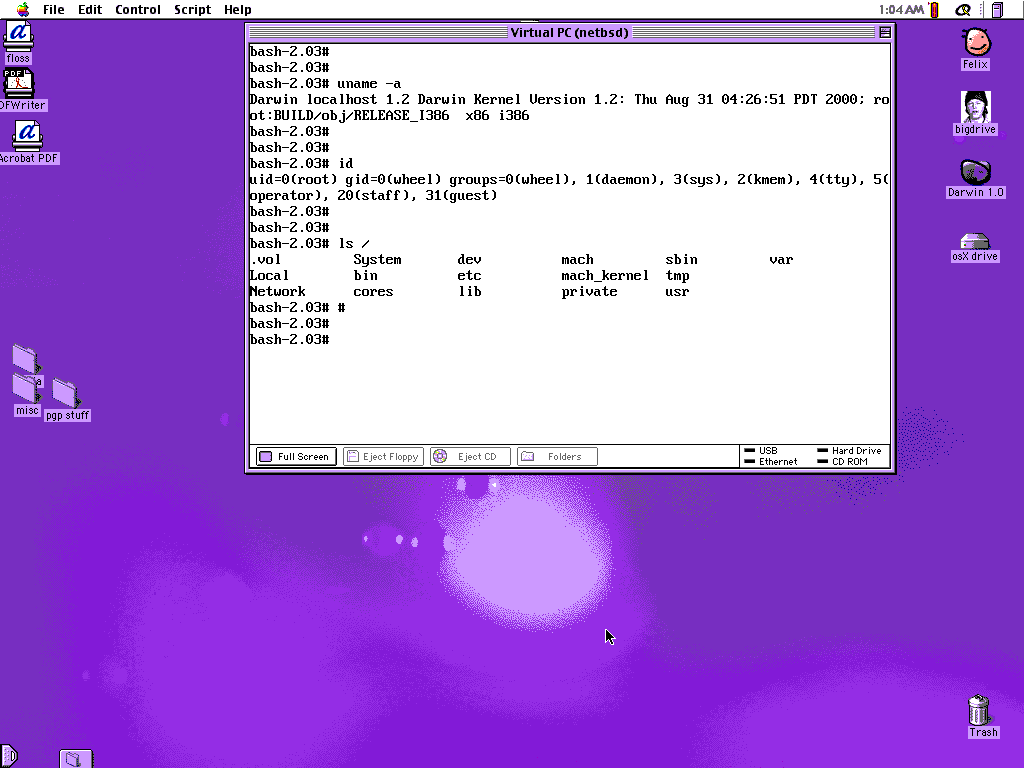
Darwin is the core of MacOS X.
This is why this is such a big deal. The fact that it runs on VirtualPC without modifying that software application (unlike, say, Windows Me) means that a vast majority of x86 processors out there today can run Darwin. And if they can run Darwin, the core of MacOS X, they're much much closer to being able to run MacOS X itself.
So be happy. The open source community has just scored another coup. :-)
Right now Apple's cash cow is their hardware. And until the majority of apps are re-written to be native OS X code (a.k.a. Cocoa), as opposed to "optimized MacOS Classic code" (a.k.a. Carbon), you won't see any public push from Apple to get OS X running on Intel. I'll bet they're working on it, but way, way, way behind the scenes, in case Motorola can't deliver the faster G4s like they said they could. (IBM can do it, but the G4 is Mot's baby, and they're the ones saying "no".)
If Apple would release OS X for X86 before the apps are fully ramped up and Apple has licensing in place with PC vendors, it would be a disaster. The bottom would fall out of Apple's hardware sales, the apps wouldn't be there to make the masses switch platforms (especially corporate clients), and Apple would last about 6 months.
I say they'll keep churning along like they're doing now with PPC hardware, wait a couple years until all the major apps are OS X native, then strike up an OS X for x86 licensing deal with clone manufacturers. Assuming the current clock speed hurdles for the PPC chip are overcome, Apple will retain the "high end" with the PPC, and let clone manufacturers churn out the low-end. Why? Apple will always want to "make the whole widget". And I for one think they should.
---
MacTacToe - for every problem, an elegant solution
The OS X you saw, or probably read about, was PRE-BETA. Are you kidding me? You are judging Alpha software for speed? I read that the beta is nuch faster than DP4 and I ran DP4 and the speed was fine. The reason why Apple is push dual-processor Macs to get a 1GHz machine out there. But regardless a 500MHz G4 runs as fast as a 700-800MHz PIII.
It's an x86 emulator. Darwin for x86 is an x86 program. Of course it works! If it _didn't_, THEN this would be interesting news.
This is like saying, "Super Mario World worked when CmdrTaco tried it on SNES9x for Linux!"
Of course it worked!
Now, it would be interesting if there were followups as to the chances of OSX for x86, etc, etc. But, why would there be? And even if there was, why would any of you Linux junkies want to go out and pay for it? Apple has always made the cash by selling the hardware too.
That's enough outta me.
Does the information concerning Darwin for x86 remind anyone else of BeOS? Too bad Sun Office has not been ported to BeOS and Be has concentrated all their resources on BeIA, it seemed for awhile there (about 1 1/2 years ago?) BeOS had a chance and could have been up to speed with Linux.
I'm curious about the Be communities "feelings" about Darwin.
"Most of the Darwin code is platform independent, and some of the platform-specific code includes some support for Intel processor-based systems. Darwin 1.0 has been compiled (on a PowerPC-based Macintosh system) for both Intel and PowerPC platforms, but the Intel support is very rudimentary. (For example, there's no installer, and it works only on one specific configuration.) We are working with the Darwin community to make Darwin a viable operating system for the Intel platform."
Darwin is still in its earliest stages on x86. If you miss the early days of Linux and *BSD, you might enjoy helping get Darwin going.
If you want to try Darwin for yourself, you'll need
Once you have that hardware, you need to download two images: one for a partition of type AB (20 KB compressed) and one for a partition of type A8 (about 100 MB compressed). Create appropriately sized partitions on your disk (945 blocks and 920304 blocks respectively), and uncompress the images onto those partitions (I used primary partitions; extended partitions might work, too) and try to boot. You can either use lilo, or download a Darwin boot sector.
If you can boot Darwin, then you can begin to explore. If you like to hack on a new OS, or would like to see how Apple's idea of Mach (monolithic kernel) differs from that of the Hurd (microkernel), or even if you'd just like to see things done a different way (e.g., dyld vs. ld.so, netinfo vs. NIS, IOKit vs. ????, etc.), Darwin can be pretty interesting.
For more information on on Darwin, check out Darwinfo or Apple's darwin-devel mailing list.