 Slashdot Mirror
More Mapping of the Net
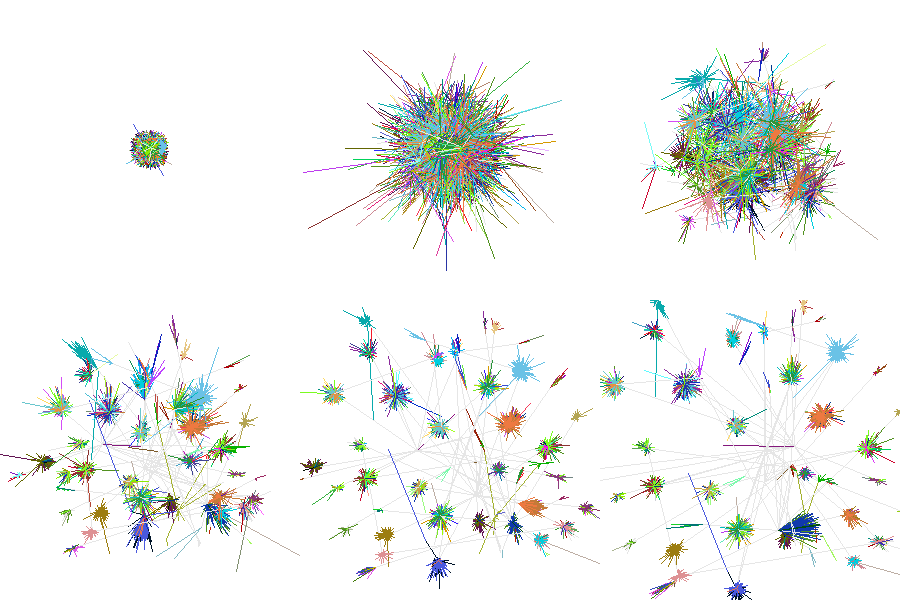
An anonymous reader wrote in to say"It turns out that famous map was not the end of it, a cybergeography alert linked to this site with lots of cool pictures and animations. Turns out they didn't measure time between hosts on the poster map, and it can be used to make cool pix!"


I have two of the files mirrored on my server right now. /. for too long :)
Someone mind helping? I dont think it will handle a heavy
con.jpg
VRML1.jpg
I remember when Bill Cheswick started making them. At the time, both he and my dad were at Bell Labs. He even printed two different views out for me to hang on my dorm room hall. But these have interesting research aspects in small parts. The first is mapping the internet. Damn. He has daily logs going way back, and on his website has videos of the IP's of Bosnia blinking on and off during the days of bombing them. (Google search for him). It's incredible.
But the visualization has interesting problems. My dad did some interesting work on the computational geometry structure that allowed for these things to be visualized. They have various springiness between all the connections that eventually reach the state that's displayed. The colors can be assigned in various ways (the one I remember is that each different part of the IP address is a component of RGB). It's an amazing effort that's a lot less hype and a lot more science than we might think.
For more info, the book Programming Pearls by Jon Bentley has mention of it (my copy is packed away, otherwise I would cite it), if obscure. But if you want to do cool stuff like this, it's important to remember that it's not just scripts, cs theory can help everywhere! A useful lesson to take to heart.
-Dan
...is a big arrow labelled
"YOU ARE HERE"
As the writer of the layout code, I can tell you it was certainly not a design goal. The original goal was just to be able to look at the results of the traceroutes that were being collected.
Via a variety of bugs in the layout code over the years, I've produced interesting images, such as rings, clovers, and (my favorite) hearts. However, they almost always have a fractal feel at the micro-level. This is true for almost any Eades-like layout that I've seen, so it's probably a function of the layout algorithm.
Interestingly enough, corporate networks layout much differently that the Internet. Corporate networks tend to be very clean, while the Internet is very stringy (almost looks like the strands within some fiberglass).