 Slashdot Mirror
12-volt Plexiglass Computer
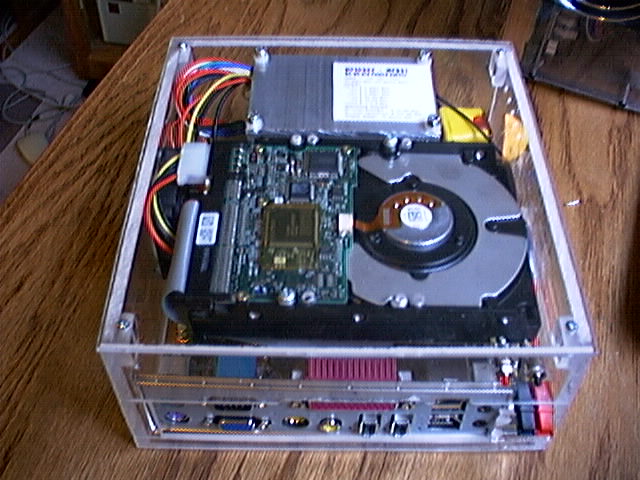
zootjeff writes: "I am in the process of designing and redesigning a computer for my car. This machine is based on the Shuttle FV24 motherboard. I built a box that is 8 inches by 7.5 inches by 3 inches. I also designed and built my own custom power supply. This could be useful to people who want to take linux into their car. It is also useful for solar powered battery operations." He sent some pictures, too, of what the 2nd case looks like, an
overview, including (!) police report number (the 2nd revision was stolen), more on
the power supply,
and the third iteration.
Most of us have seen nifty hardware setups with nice looking cases. However, I am much more interested in custom software to make a car computer more customized.
/., of a Macintosh based system like that - pretty darned cool. Combined with a wireless access card (too bad Ricochet went under) of some sort, it could be somewhat useful for an internet connection. GPS would be simple. Add a wireless ethernet card so when you park in your garage you can access your wireless hub/network (if you have the money to put a computer in your car you can afford a wireless hub). This would make transferring mp3s and other files nice. Perhaps download some web pages for offline reading, a bunch of cool games (and emulated games), and a few joysticks and you'd have a pretty cool entertainment center for the car.
Anyone who has owned or used a power inverter or more demanding electronics in a car knows that you really can't run it (for long) when the engine is off. An inverter will automatically shut itself off and turn itself on when the input voltage fluctuates (a sign that the engine has been turned off).
Since the input voltage is only 12 volts, a easy battery backup could be implemented to allow the computer to run while the car is off. When the battery gets low, the computer automatically suspends or hibernates.
Obviously, these things are already present in every laptop. If I were to construct such a device for my car, I would probably use the laptop as the CPU and connect an LCD screen and monitor/mouse combo (wireless, probably) to it externally. Since laptops have one input voltage, you only need to build a single car adapter (or buy one).
In addition, plexiglass isn't shielded like the average metal case - you'll get more interference, especially noticable in a sound system.
I'd like to see setups of a small LCD touch screen that allows the user (preferably the passenger - drivers shouldn't be messing with computers while driving) to easily navigate through things. I think I have seen one such example, perhaps from
So, in conclusion, a laptop is an easier (if less creative) choice that is superior to most home-built CPUs, and the peripherals and software is the real place to be creative and innovative.
"The universe seems neither benign nor hostile, merely indifferent." --Carl Sagan